




Abstract
In the present investigation, zinc oxide nanorods (ZnO-NR) were synthesized via the hydrothermal method using ZnCl2 as a zinc ion precursor in the presence of cetyltrimethylammonium bromide. Synthesized ZnO-NR was featured using advanced techniques including XRD, PL, SEM, and UV-visible spectroscopy. The role of these assynthesized ZnO-NR was evaluated for the sequestration of lead ions in batch mode. The elimination of lead ions was achieved at pH 6-7 using a 0.06 g adsorbent dose, 25 min contact time, 25 mg/L initial lead ion concentration, 323 K temperature, and 200 rpm agitation speed. A thermodynamic study revealed the endothermic nature of lead ion sequestration onto ZnO-NR. The lead ion sequestration followed kinetic (pseudo-second-order) and isotherm (Langmuir) models. The lead ions were eliminated up to 142 mg/g at the optimum level of affecting variables. The ZnO-NR might be a potential adsorbent for lead ion removal from industrial effluents.
1. Introduction
Nanomaterials have tremendous applications in environmental challenges, including medicines, catalysis, water treatments, and solar energy conversion [1–3]. Numerous researchers in the field of nanoparticle synthesis believe that metal oxides are much better agents for cleaning or purifying the environment. This can be attributed to their ability to act as an efficient adsorbent for pollutants. The aforementioned ability is associated with their greater surface area-to-volume ratio. For example, different metal oxide nanomaterials (Fe2O3, CeO2, Al2O3, TiO2, MnO2, NiO, ZnO, and MgO) have shown their character for the sequestration of metallic ions from wastewater.
The environmental pollution caused by lead ions has tremendously increased due to industrialization and is considered a severe health hazard. Exposure to Pb(II) leads to nervous system damage, anemia, mental retardation, renal kidney disease, and cancer. Mining, plumbing, painting and printing processes, petroleum industries, and automobile batteries are the major sources of contamination. Different world agencies, e.g., USEPA and WHO have set the maximum allowed Pb levels (0.015 mg/L and 0.01 mg/L), respectively, in potable water [4]. So, the matter is of great concern, and there is a need to remove lead from water. There are many methods used to remove Pb from water, e.g., solvent extraction, ion-exchange membranes, chemical precipitation, adsorption, and membrane separation [5–8]. Among these terminologies, adsorption is considered viable because of the availability of different adsorbents, easy handling, high efficiency, and recycling of the adsorbed metal ions [9].
Zinc oxide (ZnO) is an
The hydrothermal method has gained much attention due to its simple apparatus, catalyst-free reaction, controlled particle size, environmental friendliness, and cost-effectiveness. The conditions for hydrothermal reaction at high temperature (100–300°C) and pressure in an aqueous medium are employed, and in response to heating followed by cooling at room temperature, crystal nuclei are produced and grown. The morphology of these crystal nuclei is greatly influenced by the composition of the reaction mixture, concentration of reactants, and temperature and pressure of the reaction media which results in a product having a high degree of crystallinity as well as high purity [12].
A hydrothermal approach was used for the fabrication of ZnO-NR. Then, the efficiency of this synthesized ZnO-NR was appraised for the removal of lead ions. Various operational variables, i.e., adsorbent amount, pH, reaction time, temperature, shaking speed, and initial concentration, were optimized and performed systematically in a batch process. Isotherm modeling, kinetics, and thermodynamics were analyzed to comprehend the process of lead removal using synthesized ZnO-NR.
2. Material and Methods
The chemicals were procured from Merck (Germany). The Pb(NO3)2 1000 mg/L solution was prepared, and dilutions were made for further use. To prevent hydrolysis, 1% of HNO3 was added. Different working solutions of varying concentrations were arranged using distilled water.
2.1. Synthesis Protocol
The hydrothermal method in the presence of cetyltrimethylammonium bromide (CTAB) was employed for the preparation of ZnO-NR. The ZnCl2, NaOH, and CTAB solutions in water were mixed in a molar ratio of 1 : 2 : 1. The mixture was agitated vigorously for 10 min and transferred to an autoclave cell having a Teflon chamber. Then, the content was heated at 180°C for 3 h, cooled down to 25°C, and centrifuged at 3000 rpm (20 min) to discrete the precipitates from the mixture. Then, these obtained white ppt. and were washed with methanol and distilled water several times. This washing continues until pH 7 was achieved. Then, ppt. was kept in an oven at 80°C for 4 h [13].
2.2. Characterization of Nanorods
UV-visible spectrum was taken on PG-T 90+ Double Beam UV-VIS Spectrophotometer. The data was achieved in 340-400 nm. Bruker D 8 diffractometer was employed for XRD analysis. The other conditions are Cu Kα, have
2.3. Batch Run Protocol
A batch mode of analysis was used for the lead ion removal using ZnO-NR. The ZnO-NR and 50 mL of lead ion solution (50 mg/L) were mixed and subjected to shaking for an appropriate time. The influences of adsorbent dose, initial concentration of lead ions, pH, reaction time, temperature, and agitation speed were studied. The metal ion solution and adsorbent were mixed for a programmed time interval. The resultant solution was a suspension, which was centrifuged for 20 min at the rate of 3000 rpm. The influence of the dose of adsorbent was evaluated by mixing different quantities of adsorbent (0.02-0.20 g) with lead ion solution (50 mg/L, 50 mL). The mixture was stirred for 30 min at 200 rpm at 25°C. The pH effect was studied by the variations in the pH of the solution from pH 3 to pH 8, which was adjusted using 0.1 MHNO3/NaOH. 50 mL of the solution was mixed with 0.06 g of adsorbent and subjected to shaking at 200 rpm for half an hour at 25°C. For the contact time study, a 0.06 g of adsorbent was assorted with 50 mL of the solution and stirred at 200 rpm, and contact time was studied in 0-30 min range at pH 6 and 25°C. The effect of initial metal ion concentrations was studied by shaking 0.06 g of adsorbent with 50 mL of lead ions solution. This was performed by varying initial concentrations of 50-500 mg/L at an agitation rate of 200 rpm at pH 6, 25°C for 30 min. To find out the impact of temperature, 0.06 g of ZnO-NR was assorted with a lead solution and temperature was varied between 293 and 323 K. The AAS was used for the residual concentration of lead ions determined. All the trials were conducted in thrice and data was averaged. The removal efficiency (percentage removal and
3. Results and Discussion
3.1. Properties of ZnO Nanorods
Ultraviolet-visible analysis is useful to evaluate the light absorption nature of the materials [14], which results in the excitation of the electrons from lower to higher energy levels. The UV-visible spectrum of ZnO-NR dispersed in distilled water is presented in Figure 1. There appears to be a strong peak in the UV-visible spectrum at 375 nm. This could be the start of the visible region or the end of the UV region depending on the type of instrumental conditions. This peak is linked with the band gap of ZnO-NR, and the reason for this peak can also be linked with the electronic transition between the valence and conduction bands [15]. The peak shifts towards the shorter wavelength with reference to the bulk ZnO band edge [16]. This kind of blue shift could be linked with a change in the particles’ size [17, 18]. It has been observed that the absorption edge moves towards a short wavelength when particle size reduces as compared to its bulk counterpart, and hence, its band gap energy values increase [19]. The Tauc relationship (Equation (2)) is employed for band gap estimation.

UV-visible analysis ZnO-NR prepared via hydrothermal route.

ZnO-NR (prepared via hydrothermal route) band gap energy.
The structural and phase analyses were performed by XRD analysis [20], and the response is portrayed in Figure 3. The XRD diffraction peaks confirmed the presence of hexagonal wurtzite-structured ZnO (JCPDS Card. 36-1451). In addition, the peaks are quite intense and sharp, suggesting that the particles are highly crystalline. No peak corresponding to other impure phases is observed, indicating the purity of the sample. The Debye–Scherrer equation is employed for the monitoring of crystallite size.

XRD analysis of ZnO-NR prepared via hydrothermal route.
The morphology was studied by SEM analysis [21], and Figure 4 exhibits the SEM image of prepared ZnO-NR. The images clearly revealed a spongy mass of rod-like structures with a 60-70 nm particle size. The structure has pores that facilitate the adsorption of lead. Figure 5 depicts the photoluminescence (PL) spectrum of ZnO-NR. The spectrum revealed two emission bands, one corresponding to UV emission at 397 nm and the second is a broad visible emission at 590 nm. The UV emission is usually correlated with the transfer of photon generated from the CB to the VB. The response thus observed illustrated the trapping of electrons and holes by defects present in the sample. This trapping of electrons and holes further hindered their recombination and thus improved the photocatalytic properties of semiconductor materials. The defects in the visible region are generally arisen due to the doping or impurities present in the sample. In ZnO, these defects are related to interstitial defects of oxygen and zinc, vacancies in oxygen and zinc, oxygen substitution at zinc, and complex of oxygen vacancy with zinc interstitial. Moreover, the peak intensity of UV emission is related to the crystalline nature of the sample. While the visible emission peak intensity depicted the defects are present in the sample. Thus, the analysis of the spectrum shows that the fabricated ZnO-NR is crystalline in nature with defects.

SEM analysis of ZnO-NR prepared via hydrothermal route at different resolutions, (a) 50 μm (b) 1 μm.

Photoluminescence spectrum of ZnO-NR prepared via hydrothermal route.
3.2. Pb Ion Removal Performance
3.2.1. Adsorbent Dose Impact
The sequestration process of metal ions on NPs is dependent on adsorbent dosage (Figure 6). By increasing the adsorbent dosage, lead ion removal was significantly increased. It is revealed that sequestration depends on the active moieties on the adsorbent surface, and a certain quantity of adsorbent enhanced the sequestration capacity of the adsorbent. After a certain point, the adsorbent dose effect became insignificant at an extremely higher adsorbent dose, and removal efficiency did not change. This is further ascribed to the saturation of the active moieties on the adsorbent surface. This point is called the equilibrium point, where the number of ions in aqueous media and the amount of ions on the solid surface become constant [22]. In our experiment, the maximum percentage sequestration of lead ions was obtained with an adsorbent dosage of 0.06 g.
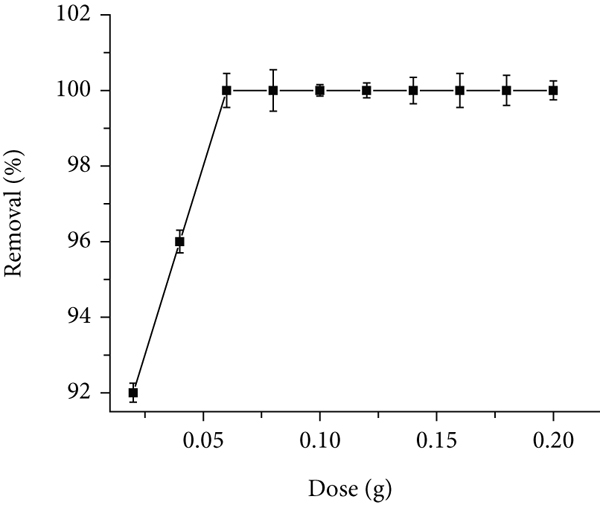
Lead ions removal (%) versus ZnO-NR dose.
3.2.2. pH Influence
The pH of the metal ion solution exerts a profound effect on the process of sequestration as it influences metal ion solubility and adsorbent ionizing ability. As shown in Figure 7, when the pH value was low (<7), the hydrogen ion concentration increases; thus, there is a struggle between H+ and Pb2+ for the same active site, which results in lower sequestration efficiency. While at higher pH (>7), hydrolysis and precipitation of metal ions are started. Therefore, the percent removal remained constant above pH 7. In a pH range of 7-11, different species of Pb(II), i.e., Pb(OH)2 and Pb(OH)+ are prominent, which in turn furnished higher percentage sequestration of lead ions by sequestration of (Pb(OH)+) and precipitation of (Pb(OH)2). The influence of the pH of the solution on the removal process can also be elucidated on the basis of two factors. These could be charges on the adsorbent surface and adsorbate speciation. The adsorbent surface at lower pH acts as a hydrous oxide and is covered by hydrogen ions (MOH+2). On the other hand, deprotonated oxide (MO−) is produced by hydroxyl ions by reacting with the hydrous oxide under basic condition. This will interact with metal cation and lead to more sequestration [23]. The sequestration capacity was low at a lower pH (in an acidic region). On the other hand, when pH increased from 4 to 5, the percentage sequestration of lead ions increased significantly. The maximum adsorbent was in pH 6-7 range. These results revealed that the pH of the solution has a remarkable impression on the sequestration mechanism of lead ions. Thus, the optimum pH value is determined to be 6.0 for maximum lead ion sequestration.

Lead ions removal (%) versus pH using ZnO-NR.
3.2.3. Contact Time Influence
Adsorption is a time-dependent phenomenon, and the effect of contact time on lead ion sequestration on ZnO-NR was also investigated, and the response is presented in Figure 8. Initially, the sequestration rate was fast at the initial stage, which braked in the second phase, and then was equilibrium reached in half an hour (30 min). The number of active sites was higher initially, which binds the metal ions favorably. Later, the rate of sequestration slowed down, due to the coverage of binding sites present on the surface, and the sequestration did not change considerably beyond this time [24].
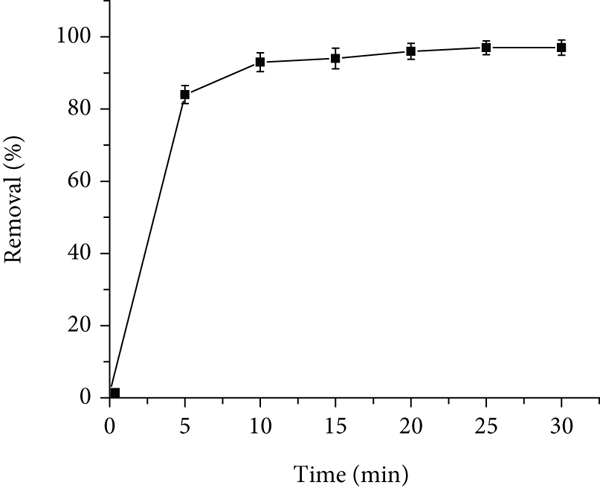
Lead ions removal (%) versus contact time using ZnO-NR.
3.2.4. Initial Concentration Influence
The lead ion sequestration efficiency of ZnO-NR for different concentrations is depicted in Figure 9. The increased metal ion concentration also enhanced the sequestration process of ZnO-NR. At higher metal ion concentrations, the active sites are surrounded by a large number of metal ions, which facilitates the sequestration of lead ions. On the contrary, the percentage sequestration of lead ions was declined as the initial metal ion concentration was increased. At lesser concentration, the surface of ZnO was unsaturated, but as the concentration increased, the surface becomes drenched with lead ions and thus, limits the removal capacity of the adsorbent. Therefore, higher concentration results in lower percentage elimination of the lead ions, which reveals that the sequestration of lead ions was dependent on initial concentration [25].
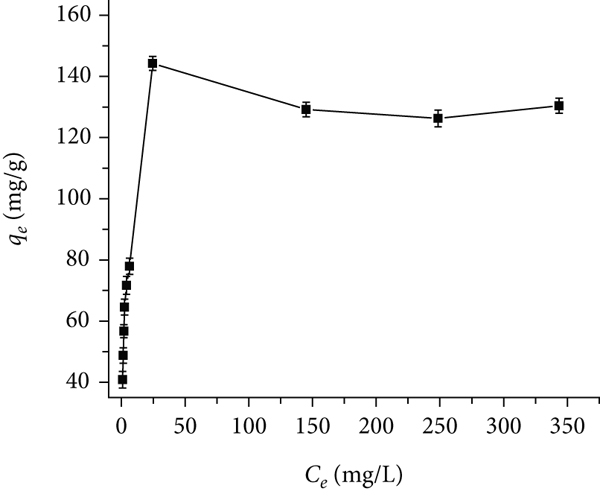
Lead ions removal (%) versus lead ions initial concentration using ZnO-NR.
3.2.5. Temperature Influence
The impact of temperature on the sequestration capacity of lead ions on ZnO-NR was studied in the 293-323 K range, and the responses thus observed are depicted in Figure 10. It can be seen that as the temperature increased, the sequestration efficacy of the lead ions was also increased, which is an indication of an endothermic sequestration nature process [22]. When temperature is increased, the mobility of metal ions increased, resulting in effective interaction between binding sites and lead ions, leading to improve the sequestration of lead ions with temperature.

Lead ions removal (%) versus temperature using ZnO-NR.
3.2.6. Agitation Influence
The agitation of the adsorbent and adsorbate may also influence the sequestration efficiency, which was also studied for the sequestration of lead ions. The agitation effect was studied in the 100-260 rpm range, and the response is presented in Figure 11. It was observed that as the agitation speed increased, the sequestration efficacy of the lead ions was also increased and was maximum at 200 rpm. After 200 rpm agitation speed, there was no change in sequestration. It has been reported that agitation provides forces that collapse the adsorbent agglomerates and generate a well-dispersive system, which resultantly affects the sequestration of the adsorbate on the adsorbent. The agitation also properly distributes the adsorbent throughout the bulk solution.
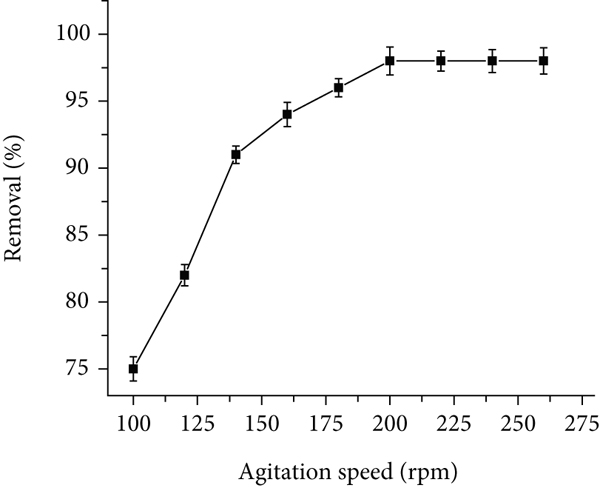
Lead ions removal (%) versus agitation speed using ZnO-NR.
3.3. Adsorption Isotherm Modeling
Adsorption isotherms give an insight into how adsorbate interacts with the adsorbent as a function of concentration. The results obtained by these isotherms help in finding the maximum sequestration capacity [26, 27]. The most commonly used isotherms for understanding the adsorption process include Freundlich and Langmuir.
Langmuir’s model presumes the adsorption as a monolayer formation, and binding sites are homogeneous and equivalent energetically, also, one ion is an adsorbent/binding site [28]. The Langmuir model is expressed as follows:
The Freundlich model undertakes multilayer formation on nonuniform active sites on the adsorbent surface and linear relation is depicted in the following [30]:
Adsorption isotherm parameters for the adsorption of Pb(II) ions onto ZnO nanorods.

Langmuir’s isotherm plot for the removal of lead ions using ZnO-NR.

Freundlich’s isotherm plot for the removal of lead ions using ZnO-NR.
3.4. Kinetics Studies
Adsorption is a time-dependent phenomenon. The impact of contact time on lead ion sequestration to ZnO-NR is studied to evaluate the sequestration kinetics. Results revealed that the rate of sequestration was much fast initially until the equilibrium is established. There are large numbers of active sites present at the start. This richness of exchangeable sites favors the binding of lead ions to the adsorbent surface. After the attainment of the stability, the rate of sequestration did not change for later contact time. This is due to the coverage of all the active moieties on the surface [32]. Therefore, no significant increase in sequestration is observed. The present experiment revealed that the equilibrium was attained within 30 min, which revealed excellent efficiency of ZnO-NR for the elimination of lead ions.
For the kinetic study, three (intraparticle diffusion, pseudo-second, and pseudo-first) models were computed. The expression for the pseudo-first-order is expressed in the following [33, 34]
Thus,
Kinetic parameters for the adsorption of Pb(II) ions onto ZnO.

Kinetics plot (pseudo-first-order) for the removal of lead ions using ZnO-NR.

Kinetics plot (pseudo-second-order) for the removal of lead ions using ZnO-NR.
Based on the results and the correlation coefficients, it is inferred that the pseudo-second-order described the lead ion sequestration. The
3.4.1. Intraparticle Diffusion
The intraparticle diffusion model relation is presented as follows [37]

Intraparticle diffusion plot for the removal of lead ions using ZnO-NR.
3.5. Thermodynamic Analysis
The influence of temperature on the sequestration of lead ions on ZnO-NR was scrutinized in the 293-323 K range. It can be seen that the rise in temperature leads to enhanced percent elimination efficiency of the lead ions. The lead ions adsorbed onto ZnO-NR while adsorbing heat, which revealed the endothermic sequestration process. This trend can be explained as; when the temperature is increased, the mobility of metal ions increased, this increased mobility results in effective interaction between lead ions and ZnO-NR, which helps in the elimination of metal ions. The thermodynamic variables, i.e.,

lnkD versus 1/T plot for the removal of lead ions using ZnO-NR.
Thermodynamic parameters for the adsorption of Pb(II) ions onto ZnO.
Lead ions removal using various nanoadsorbents and nanocomposites.
4. Conclusions
ZnO-NR was prepared through the hydrothermal method by employing CTAB as a surface-directing agent. The prepared ZnO-NR showed promising efficiency for the elimination of lead ions. The maximum removal was obtained at pH 6-7, ZnO-NR dosage of 0.06 g, initial concentration of lead ions of 25 mg/L, and agitation speed of 200 rpm and 323 K. The lead ion adsorption data fitted well to the Langmuir and pseudo-second-order kinetic models. The highest uptake capacity calculated from Langmuir’s isotherm is 142 mg/g. The endothermic, spontaneous, and feasible lead ion sequestration using ZnO-NR was observed. Hence, the ZnO-NR can be utilized as an adsorbent to remediate metal ions in the effluents.
Footnotes
Data Availability
Data will be made available on request.
Conflicts of Interest
The authors declare that they have no conflicts of interest.
Acknowledgments
The authors express their gratitude to Princess Nourah bint Abdulrahman University Researchers Supporting Project number (PNURSP2023R439), Princess Nourah bint Abdulrahman University, Riyadh, Saudi Arabia.