




Abstract
In this study, polypyrrole (PPy) was introduced into durian rind (DR) by in situ polymerization method to prepare durian rind/polypyrrole (DR/PPy) composite. The resulting material was characterized using scanning electron microscope (SEM), transmission electron microscope (TEM), infrared spectroscopy (IRS), and X-ray diffraction (XRD). Then, the removing performance of the DR/PPy material for anionic dyes was explored. The impact of key variables such as the amount of adsorbent, initial dye concentration, pH, adsorption temperature, and contacting time on the adsorption efficiency was examined. The result disclosed that the adsorption efficiency of DR/PPy for methyl orange, sunset yellow, and amaranth was satisfactory. In pH of 7, initial concentration of 100 μg mL-1, and DR/PPy dosage of 1.5 g L-1, the removal efficiency reached 97.31%, 98.48%, and 98.20%, respectively. The adsorptive kinetics and thermodynamic process were analyzed subsequently. The adsorption of anionic dyes on DR/PPy conforms to the pseudo-second-order kinetic and Langmuir isotherm models with maximum adsorption capacity (
1. Introduction
Currently, the emission of pollutants has increased dramatically due to the rapid urbanization and expanding scale of industrial production. Among these pollutants, colored dye wastewater produced by the textile industry has been deemed as the main contaminant related to its mutagenic and noxious properties. Meanwhile, the extremely high chroma of dyes can inhibit the photosynthesis of aquatic plants, which causes the disrupting of the ecological balance in water bodies [1, 2]. Therefore, it is particularly important to take appropriate methods to reduce or remove dyes before discharging into environment. At present, the techniques for the disposal of dye wastewater mainly include adsorption, chemical precipitation, photocatalytic degradation, and electrochemical degradation [3–6]. Generally speaking, each method owns its inherent advantages and disadvantages. Among these aforementioned methods, adsorption has always been mentioned as one of the most versatile, low-cost, environment-friendly, and efficient techniques for pollutant treatment. Normally, the performance of pollutant elimination is predominantly depended on the peculiarities of the adsorbent, including the specific surface area and degree of exposure of the functional groups. Therefore, numerous scholars will have to commit substantial effort to develop applicable and cost-effective adsorbents. Durian rind, as a kind of agricultural waste, is discarded in large quantities every year. In the interest of environment, the exploitation and utilization of durian rind is very important. Some authors have utilized durian rind, as a low-cost adsorbing material, to eliminate dyes and heavy metals from aqueous solution [7–10]. Asbollah et al. monitored the synergistic adsorption effect on the elimination of acid red-1 and methylene blue by durian rind [11]. These reports manifested that it is necessary to exploit the potential application of durian rind in the adsorption field.
Recently, the emerging of polymer-based adsorbents especially conductive polymer, which has obtained increasing attention owing to their satisfactory features such as good biocompatibility, excellent stability, simple synthesis process, nontoxicity, and low cost, has attracted extensive attention of scholars. Polypyrrole, as a heterocyclic conjugated conductive polymer, has been commonly used. PPy has a positive charge center in its structure, which can selectively remove anionic pollutants from aqueous solutions through electrostatic and
In view of the excellent prospects of polypyrrole in the field of adsorption and the urgent status of durian rind, this study is aimed at preparing durian rind/polypyrrole composite material as an adsorbent for wastewater pollutant treatment. In this work, polypyrrole was introduced into durian rind by in situ polymerization method to produce DR/PPy composite. The prepared DR/PPy material was analyzed via SEM, TEM, IRS, and XRD. Typical anionic dyes were selected to evaluate the adsorption performance. Experiments in batch were performed to explore the effect of DR/PPy dosage, initial concentration of dye, pH, adsorption temperature, and contacting time on the removal performance. The adsorptive kinetics, isotherm, and thermodynamics were specifically conducted and evaluated. Finally, a possible mechanism involved in the adsorption system was proposed. This research provides a reasonable idea and reference for the effective utilization of waste and the control of dye pollution.
2. Materials and Methods
2.1. Reagents and Materials
Pyrrole (99%), octylphenol ethoxylate 10 (OP-10, 98%), FeCl3 (99%), methyl orange (98%), sunset yellow (85%), amaranth (85%), and other required reagents (AR) procured from Macklin, China, were used. Durian rind supplied by a local market, China, was used.
2.2. Preparation of DR/PPy Composite
The prepared method details were referred to our previous research [1]. Firstly, the durian rind with the outer shell removed was dried in a vacuum drying oven at 60°C for 48 h. The dried samples were crushed and sieved to get 20-40 mesh samples. Then, 1.0 g of DR powder was mixed with 25 mL of pyrrole aqueous solution (0.2 M) stirring at 250 rpm for 20 h. On the other hand, an appropriate amount of OP-10 (used as surfactant) was dispersed in 50 mL of distilled water and then added together with 2.0 g of FeCl3 at 25°C in a magnetic stirring for 1 h. The mixture in the first container was again stirred for 5 h under ice bath condition by the dropwise addition of FeCl3 solution. Then, the obtained product was separated and washed alternately with ethanol and distilled water to clear the impurities. The resulting DR/PPy composite was dried and used in the following experiments.
2.3. Characterization of DR/PPy Composite
Herein, SEM, TEM, IRS, and XRD were requisitioned to characterize the structure and properties of the sample of DR/PPy composite. The image of surface of DR/PPy composite (coated with gold) was captured using EVO18 SEM (ZEISS, Germany). The TEM was performed on JEM-2100F instrument (JEOL, Japan) to determine the shape of DR/PPy material. IRS spectra were recorded with KBr pellets by FTIR-850 infrared spectroscopy (Gangdong, China) with a range of 4000-400 cm-1. The XRD pattern was operated on a XD-3 diffractometer (Persee, China) in the region of
2.4. Dye Adsorption Procedure
The adsorption behavior of DR/PPy composite was evaluated for methyl orange, sunset yellow, and amaranth removal at various conditions. Batch experiments were conducted, and parameters including the amount of DR/PPy, initial dye concentration, pH, adsorption temperature, and contacting time were investigated in the research studies. All of the data were carried out three times, and the corresponding mean value was recorded in this work. Generally, 0.03 g of DR/PPy particle was mixed with 20 mL of dye solution (
Pseudo-first-order, pseudo-second-order, and intraparticle diffusion kinetic equations as well as the Freundlich and Langmuir isotherm models (equations (3), (4), (5), (6), and (7), respectively) were employed to assess the adsorption system.
3. Results and Discussion
3.1. Characterization of Materials
The surface morphological structure of DR, DR/PPy, and dye-loaded DR/PPy (taking the removal of amaranth as an example, i.e., amaranth-loaded DR/PPy) is intuitively presented in Figure 1. The surface of DR was relatively smooth with a lamellar shape at the edge of the fold (Figure 1(a)). However, after modification with PPy, rough surface could be found in the DR/PPy as compared to the durian rind. It is clear that some aggregations of spherical particles were appeared on its surface (Figure 1(b)). It could be attributed to the coating cover of PPy particles on the surface of durian rind during the preparation of DR/PPy. This structure was also observed by Khadir et al. after modification of sisal with polypyrrole and polyaniline [14]. The relative morphology of DR/PPy was slightly changed after adsorption, which might be due to the cover of surface of DR/PPy via dye molecules (Figure 1(c)). Figure 2 exhibits the TEM images of DR and DR/PPy material. The result showed that there was changing in the morphology of DR after modification with PPy. Moreover, the dark spots of PPy nanoparticles with diffused form were dispersedly embedded in the matrix of DR. The comparison result indicated the successful introduction of PPy into DR material. Mashkoor and Nasar also discovered approximately similar structure for the chitosan/PPy/Fe3O4 in TEM image [12].

SEM image of (a) DR, (b) DR/PPy, and (c) amaranth-loaded DR/PPy.


TEM image of (a) DR and (b) DR/PPy.

The IRS spectra of DR and DR/PPy illustrated in Figure 3 showed the appearance of new peaks in DR/PPy. The broad peak at 3440 cm-1 of DR/PPy was concerned in the O-H stretching vibration. The characteristic peaks at 1545 and 1461 cm-1 in DR/PPy are assigned to the C=C stretching vibration at pyrrole ring [1, 12]. This result indirectly indicates the successful introduce of PPy into DR. In addition, the stretching vibration peaks of C-C and C-N appear at 1460 and 1303 cm-1, respectively. The peaks at 1308, 1175, 1040, 967, and 787 cm-1 correspond to the stretching vibration of C-N, C-H in-plane vibration, N-H in-plane vibration, C-H out-of-plane deformation, and C-H wagging vibration of pyrrole ring, respectively [12, 15]. The result clearly confirmed the successful introduction of PPy into DR. IRS spectra of DR/PPy after adsorption of methyl orange, sunset yellow, and amaranth are also illustrated in Figure 3. The peaks related to DR/PPy shifted to 3410, 1547, 1454, and 1033 cm-1 after adsorption. In addition, the intensity of peaks was also changed. A similar shifting was also observed in previous report [12]. The outcome reminded that the functional groups of DR/PPy material were involved in the formation of interaction force with dye during adsorption process. In the end, Figure 4 displays the XRD patterns of DR, PPy, and DR/PPy. For the XRD pattern of DR, 16.6° and 22.0° correspond to the diffraction peaks of cellulose. The XRD pattern of PPy has a broaden diffraction peak at 15-30° due to the amorphous feature of PPy. The result was in conformity with the literature [16, 17]. In the XRD pattern of DR/PPy, characteristic diffraction peak of 22.1° related to PPy is integrated with the cellulose peak of DR, which is consistent with the related phenomenon reported in our previous report [1]. This similar phenomenon has been found in other literature [18].

IRS spectra of (a) DR, (b) DR/PPy, (c) methyl orange-loaded DR/PPy, (d) sunset yellow-loaded DR/PPy, and (e) amaranth-loaded DR/PPy.

XRD patterns of (a) DR, (b) PPy, and (c) DR/PPy.
3.2. Analysis of Adsorption Performance of DR/PPy
To illustrate the effectiveness of modification of DR, the comparison in the adsorption efficiency of DR and DR/PPy was conducted, and the result is shown in Figure 5. (The initial pH is the inherent pH of the original dye solution itself, which is very close to 7. So, it was set as 7 for convenience.) It is indicated that the prepared DR/PPy composite was a potential material for the elimination of anionic dyes.

Comparison in the removal efficiency of DR and DR/PPy (conditions: DR/PPy dosage of 1.0 g L-1, temperature of 20°C, contacting time of 23 h, pH of 7, and
The quantitative effect of DR/PPy for dye elimination was evaluated via varying adsorbent dosage within the range of 0.5-4.0 g L-1 with an initial dye concentration of 100 μg mL-1. The result is shown intuitively in Figure 6. It was displayed that DR/PPy exhibited increasing removal efficiency of methyl orange from 61.41% to 99.35%, sunset yellow from 49.27% to 99.49%, and amaranth from 20.75% to 99.73%, respectively. The continuous increasing removal efficiency could be ascribed to the larger surface area and greater available active sites at higher adsorbent dosage. Actually, the increasing trend of removal efficiency was not obvious at the amount of adsorbent from 1.5 g L-1 to 4.0 g L-1. It is because most of the dyes have been adsorbed onto the DR/PPy at the dosage of 1.5 g L-1. According to the experimental data, the removal efficiencies of DR/PPy for methyl orange, sunset yellow, and amaranth at adsorbent dosage of 1.5 g L-1 reached 97.31%, 98.48%, and 98.20%, respectively. Considering the principle of removal efficiency and cost-saving, an appropriate adsorbent dosage of 1.5 g L-1 was selected for the subsequent adsorption tests.

Effect of DR/PPy dosage on the removal performance (conditions: temperature of 40°C, pH of 7,
The pH of solution could change the surface properties of DR/PPy material and the existing state of studied dye. This will affect the adsorption efficiency [19]. Figure 7 shows the impact of pH value on the adsorptivity of DR/PPy material for each dye under a wide pH range of 3-11. It was observed that higher removal efficiencies were achieved under acidic conditions. At acidic pH, positive surface charge of DR/PPy was produced via its protonated amine group. This could provide enhancing electron affinity with anionic adsorbate via electrostatic attraction (polarization phenomenon). Just right, sulfonate groups of methyl orange, sunset yellow, and amaranth provided the anionic center. The electrostatic force between dye molecules and the surface of DR/PPy became weaker at basic pH, which was not conductive to the removal for the anionic target. These results were in conformity with the current assumption of greater removal efficiency under acidic medium. This outcome was consistent with previous reports [12, 20]. Unexpectedly in methyl orange, the removal efficiency increased from 94.73% to 97.49% within the pH from 3 to 5. It was owing to the fact that methyl orange acquired partial positive charge on the N-atom at lower pH. In this case, the electrostatic attraction between methyl orange and DR/PPy becomes weak. A similar tendency was also discovered for the removal of methyl orange by MChs/PPy [12].

Effect of pH on the removal performance (conditions: DR/PPy dosage of 1.5 g L-1, temperature of 40°C,
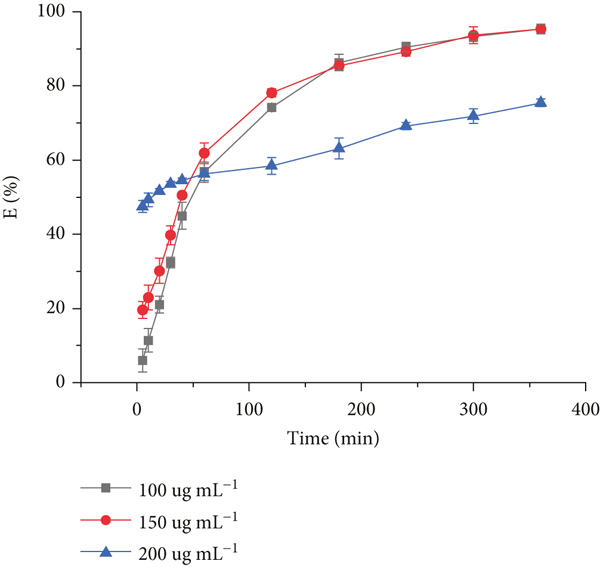
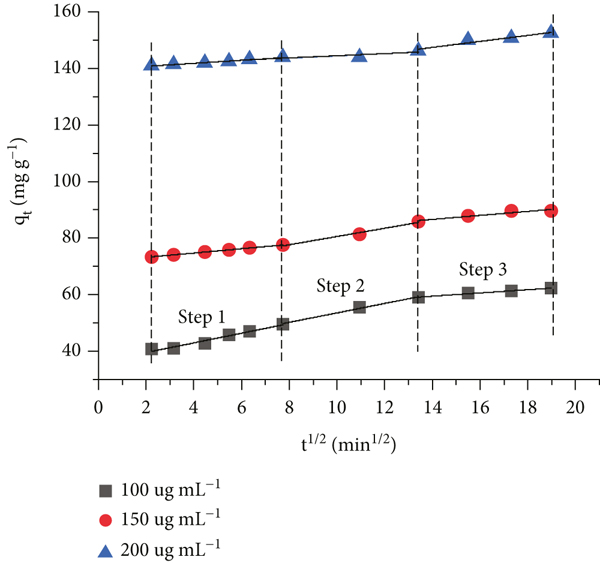
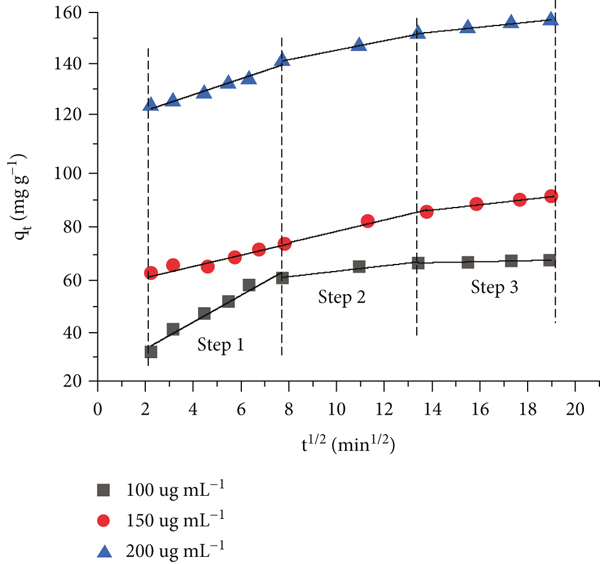
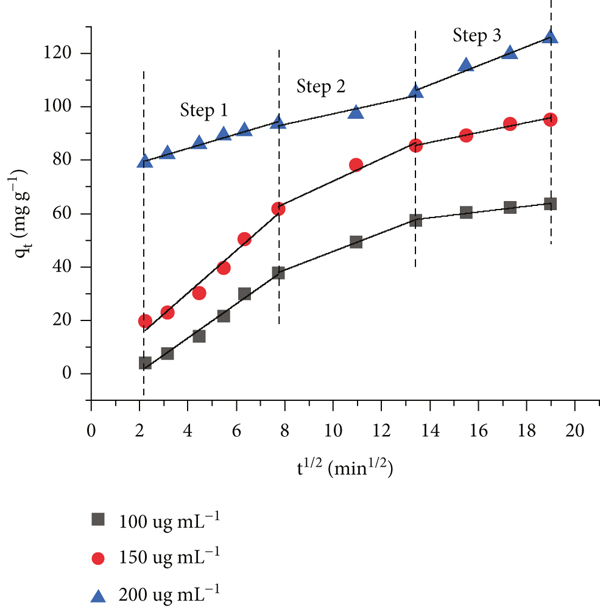
The effects of initial dye concentrations (100, 150, and 200 μg mL-1) and adsorbate/adsorbent interaction time (5-360 min) on the adsorption performance of DR/PPy for removing of methyl orange, sunset yellow, and amaranth are presented in Figure 8. The result clearly revealed that removal efficiency and adsorption capacity increased initially with a fast rate and gradually tended to equilibrium (see Figures 8(a)–8(c)). At the early stage, an abundance of available surface-active adsorption sites was easy approachable for the adsorbate target. But the adsorption rate was gradually reduced with the extension of time, which was due to the occupation of surface-active sites of DR/PPy via adsorbate molecules. Mashkoor and Nasar also believed that the active sites on the surface of MChs/PPy adsorbent play key role in the adsorption behavior [12]. As shown in Figure 8(d), it was visibly found that the adsorption capacity rose with the growing trend of initial dye concentration. Actually, at the early stage in adsorption process, it is clearly seen that the removal degree of methyl orange onto DR/PPy was greater than that of sunset yellow and amaranth, respectively, while with some exceptions. It may be due to the size of dye molecule, which will influence the instantaneous diffusion of dye molecules to the surface of DR/PPy [12]. Subsequently, the kinetics behind the adsorption of the three explored dyes was researched in detail via pseudo-first-order, pseudo-second-order, and intraparticle diffusion kinetic equations. These obtained kinetic parameters for different models are summarized in detail in Table 1, and the most appropriate fitting models are shown in Figures 9(a), 9(c), and 9(e). According to the results, the adsorption towards methyl orange, sunset yellow, and amaranth on DR/PPy conformed to the pseudo-second-order model with higher

Effects of time and initial dye concentration on the removal performance for (a) methyl orange, (b) sunset yellow, and (c) amaranth, respectively, as well as (d) their corresponding adsorption capacity (conditions: DR/PPy dosage of 1.5 g L-1, pH of 5, and temperature of 40°C).


Kinetic parameters for different models (conditions: DR/PPy dosage of 1.5 g L-1, pH of 5, and temperature of 40°C).

Pseudo-second-order model fitted results ((a) methyl orange, (c) sunset yellow, and (e) amaranth) and intraparticle diffusion model fitted results ((b) methyl orange, (d) sunset yellow, and (f) amaranth).


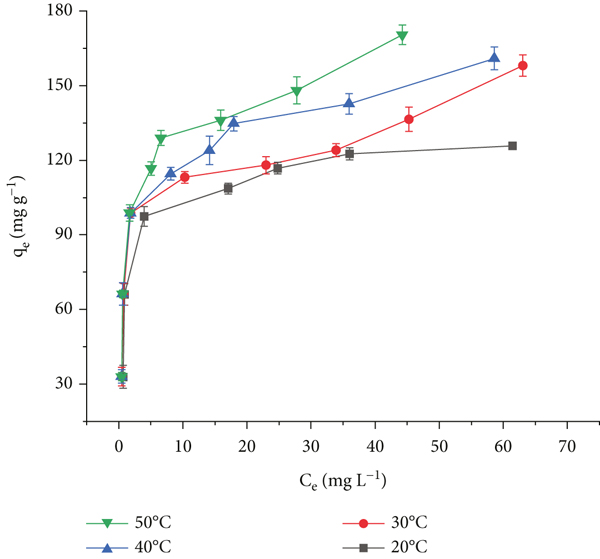
The adsorption equilibrium data for methyl orange, sunset yellow, and amaranth on the DR/PPy were inspected. Subsequently, the Freundlich and Langmuir isotherm models were adopted to fit the obtained data. The results are given Figure 10 and Table 2. It could be seen that the
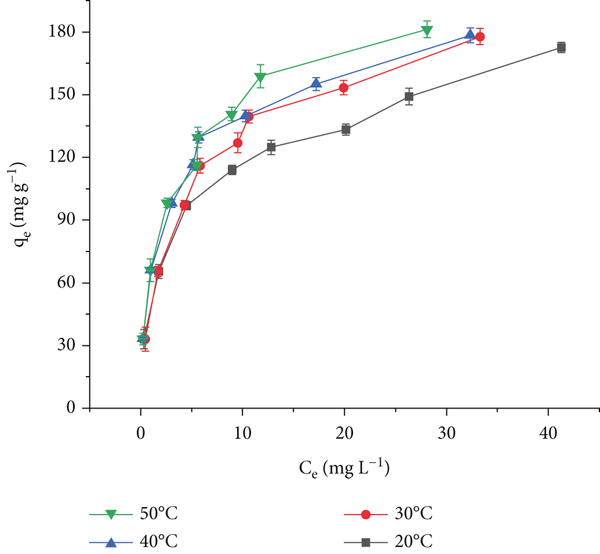
Equilibrium isotherms at different temperatures ((a) methyl orange, (c) sunset yellow, and (e) amaranth) and corresponding Langmuir isotherm plot ((b) methyl orange, (d) sunset yellow, and (f) amaranth).



Parameters of applied isotherm models for dye on DR/PPy material (condition: DR/PPy dosage of 1.5 g L-1, contacting time of 23 h, and pH of 5).
Thermodynamic parameters are critical to reveal the feasibility and characteristic of the adsorption system. Table 3 illustrates the obtained thermodynamic parameters at various temperatures ranging from 288 K to 318 K. All negative values of
Thermodynamic values for methyl orange, sunset yellow, and amaranth adsorption (condition: DR/PPy dosage of 1.5 g L-1,
3.3. Mixed Adsorption Effect
The mixed adsorption behavior of DR/PPy material was assessed for the ternary mixture of methyl orange, sunset yellow, and amaranth with different concentrations. The experimental results obtained are illustrated in Table 4. It was observed that the DR/PPy material had a competitive adsorption performance for mixture dyes with respect to removal efficiency. Though the removal efficiencies for mixture dyes were relatively inferior to the initial results with each of the dyes separately, the DR/PPy still exhibited satisfactory adsorption performance for the removal of methyl orange, sunset yellow, and amaranth in ternary mixture. The result showed that DR/PPy material has great potential to eliminate methyl orange, sunset yellow, and amaranth ternary mixture.
Mixed adsorption efficiency (condition: DR/PPy dosage of 1.5 g L-1, temperature of 50°C, contacting time of 23 h, and pH of 5).
3.4. Mechanism
Positive surface charge of adsorbent was produced via the protonated amine group of DR/PPy under acidic medium. Fortunately, methyl orange, sunset yellow, and amaranth are anionic dyes, which have –SO3Na groups. The dissociation of dye could bring about the formation of –SO3
-. Therefore, two opposite charge groups were existing in the system. Then, the electrostatic attraction between sulfonate groups of methyl orange, sunset yellow, and amaranth and protonated amine groups of DR/PPy becomes functioning [12, 20]. Additionally, other interactions such as
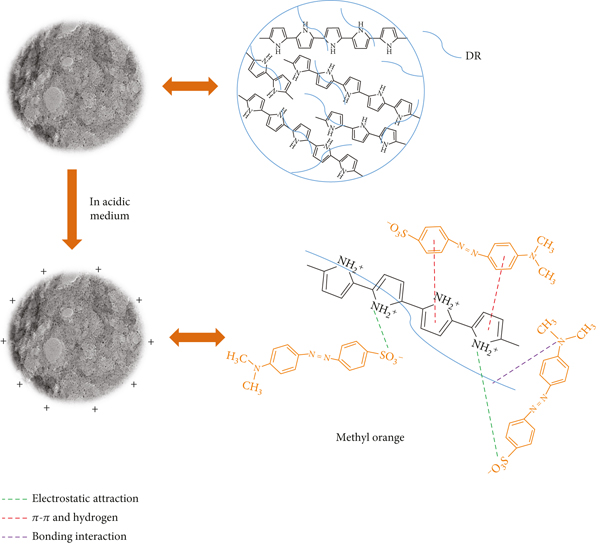
Schematic illustration of plausible mechanism for adsorption of anionic dye onto DR/PPy.
3.5. Comparison with Other Materials
The adsorptivity of DR/PPy for methyl orange, sunset yellow, and amaranth was compared with other adsorbents to evaluate its applicability. The compared outcome is illustrated in Table 5. It was observed that DR/PPy was superior to most of adsorbents, such as MChs/PPy [12], zirconium-immobilized bentonite [22], imprinted polymer NPs [23], MWCNTs-PATMSPEDA-Pd-NPs [24], sisal/polypyrrole/polyaniline [14], PPy/starch [25], and activated carbon [26]. Compared with the above adsorbents, DR/PPy occupies place in the field of adsorption for dyes.
Comparison of DR/PPy towards the removal of dye with other adsorbents.
4. Conclusion
The present study indicated that the DR/PPy composite was a desirable adsorbent for the efficient elimination of anionic dyes from aqueous medium. It is the first time that DR/PPy composite was prepared and applied for elimination of dyes. Herein, polypyrrole was introduced into durian rind by in situ polymerization technology to prepare DR/PPy composite, which was confirmed via TEM, SEM, IRS, and XRD in detail. Process variables involving the dosage of DR/PPy, initial dye concentration, pH, adsorption temperature, and contacting time had obvious influences on the performance for the removal of dyes. Under initial concentration of 100 μg mL-1, pH of 7, and DR/PPy dosage of 1.5 g L-1, the removal efficiency reached 97.31%, 98.48%, and 98.20% for methyl orange, sunset yellow, and amaranth, respectively. The time-dependent adsorption kinetic data of anionic dyes on DR/PPy conformed to the pseudo-second-order kinetic model. Meanwhile, the result fitted by intraparticle diffusion model indicated that the process of methyl orange, sunset yellow, and amaranth molecules onto DR/PPy materials exhibited multiple diffusion steps. The Langmuir model was the most appropriate model for fitting the experimental data. The
Footnotes
Data Availability
All relevant data are within the paper.
Conflicts of Interest
The authors declare that they have no conflicts of interest.
Acknowledgments
We really appreciated the support from the University Natural Science Research Project of Anhui Province (no. KJ2021A0884) to undertake this study. This work was supported by the National College Student Innovation Training Program (no. S202210879287).