




Abstract
In this work, orange peel (OP) was used as raw material to produce biochar. The effect of oxygen-limited carbonization temperature (200, 400, and 600°C) on the physicochemical properties and adsorption behavior of orange peel biochar (OPB) toward La(III) and Y(III) in aqueous media was studied. The prepared OPB samples were characterized by SEM, FTIR, and XRD. The experimental results exhibited effective removal of La(III) and Y(III) from aqueous solution by OPB. The carbonization promoted the pore development, and the adsorption process occurred rapidly. The main chemisorption of La(III) and Y(III) on OPB was analyzed by the Langmuir and pseudo-second-order kinetic model, and the participations of electrostatic attraction, exchange, and hydroxyl and carboxyl complexation in OPB were confirmed. The Langmuir maximum capacity of 55.57 mg/g and 31.49 mg/g was obtained at the optimum pH range of 4~6 and the OPB dosage of 1 g/L and 2 g/L for La(III) and Y(III). The efficient orange peel biochar with high adsorption performance can be obtained by considering suitable carbonization temperature.
1. Introduction
Rare earth (RE) is a generic term for the seventeen metal elements in the periodic table, mainly divided into lanthanides, scandium, and yttrium, known as industrial “gold.” Because of their excellent physical and chemical properties such as photoelectricity and magnetism, the RE group plays a significant role in military, metallurgy, petrochemical, glass, and ceramics, as well as agriculture and other applications. In recent years, a huge amount of effluent with rare earth elements (REEs) has been generated due to the year-round continuous exploitation and smelting, resulting in serious loss of rare earth resources and pollution of the surrounding environment [1]. Therefore, separation and recovery of REEs in solution have attracted considerable attention. Traditional methods for treating rare earth wastewater mainly include chemical precipitation, ion exchange, solvent extraction, and membrane separation. Most of these methods have their respective advantages in treatment, but there are still shortcomings such as low recovery rate, long separation time, high price, complicated process, secondary pollution, and poor effect of low concentration wastewater treatment [2].
The biochar adsorption technology that has emerged in recent years has shown great potential in the field of heavy metal removal due to its simplicity, low operating cost, high selectivity, fast adsorption and desorption rates, environmentally friendly nature, etc. [3, 4]. Based on the innovative concept of “treating waste with waste,” researchers have worked to utilize biological waste to prepare biochar adsorbents and achieved expected recovery results in various metal adsorption applications. Orange peel (OP) has been widely applied due to its low cost and accessibility, mainly focusing on metal-containing [4], organic drugs [5], toxic-oxygenated anions [6], and textile dyes [7]. However, OP as an adsorbent has more restrictions on environmental conditions, and its disadvantages such as weak reactivity, low porosity, and surface area restrict their application in selective and low concentration adsorption [8]. For the reason, several techniques have emerged for the modification of OP, including chemical modification [9], carbonization [10], and activated carbon preparation [11]. Researchers have found that carbonization and thermal activation contribute to improve the stability and adsorption effect of this biomaterial, which is related to its growing specific surface area, abundant mineral content, and pore structure [12–14]. Interestingly, the carbonization temperature at which biochar is prepared plays a crucial role in its quality [15]. Song et al. [15] focused on the effects of biochar composite adsorption performance using different hydrothermal methods (200°C) and pyrolysis temperatures (350°C, 500°C, and 700°C); the optimal temperatures (350°C) and the maximum adsorption (8.163 mg/g) were confirmed. Wu et al. [16] selected spent mushrooms as substrates to carbonize at 300°C, 500°C, and 700°C.
In the literature, the minimum temperature of 200°C was selected for the initial pyrolysis of volatile substance in OP, while the endpoint temperature was 700°C; in general, biochar prepared at charring temperatures above the endpoint temperature contains predominant carbon as the volatile organic compounds have been completely thermally decomposed [17], and these biochars of higher alkalinity and ion exchange capacity within less than 700°C were demonstrated [17, 18]. In order to prevent excessive carbonization of orange peel, a conservative temperature of 600°C was selected in the present work. Therefore, orange peels were exploited to prepare beneficial sorbents by the carbonization at 200, 400, and 600°C; their performance and mechanisms in La(III) and Y(III) adsorption were investigated; and, combined with analysis of SEM, FTIR, and XRD, the physicochemical properties of prepared biochar at three pyrolysis temperatures were compared.
2. Materials and Method
2.1. OPB Preparation
The orange peel (OP) was supplied by local orchards in Ganzhou, China. The supplied OPs were cut into small pieces, washed, and oven-dried to constant weight at 60°C. The dried material was subsequently heated from room temperature to 200, 400, and 600°C (a heating rate of 10°C/min) for 2 h, respectively. This process was conducted under an oxygen-limited condition by using covered corundum crucibles. The resulting biochar was ground and sieved into desirable sizes (less than 0.15 mm) and labeled as OPB. As shown in Figure 1, 35.02%, 30.79%, and 24.05% of OPB200, OPB400, and OPB600 were acquired according to yield formula.

Preparation information of the OPB.
2.2. Characterization Studies
The surface morphology of OPB was observed using an MLA650F-type field emission scanning electron microscope (SEM) (FEI, USA). Infrared spectra before and after adsorption in the wave range of 400-4000 cm-1 were recorded by a Nicolet FTIR spectrometer (Vertex 80+Hyperion 2000, China) to obtain the peak changes of the material functional groups. An X-ray diffractometer (XRD) (Empyrean, The Netherlands) was adopted for the analysis to identify the crystalline phases in the material.
2.3. Adsorption Experiments
The experimental La(III) and Y(III) solutions were prepared by diluting the stock solutions that were produced from La2(SO4)3 and Y2(SO4)3·8H2O. Batch adsorption experiments were specifically conducted: 50 mL of La(III) and Y(III) solutions with a concentration of 36 mg/L was added to 60 mL test tube bottles, and OPB adsorbent was added at dosage of 1 and 2 g/L, respectively. The mixture was shaken for 2 h at 200 r/min and room temperature. The factor experiments, while remaining other conditions, included the following: (i) the effect of dosage ranged from 0.25 g/L to 5 g/L; (ii) the effect of initial pH ranged from 2 to 7; (iii) adsorption isotherms and thermodynamics at initial La(III) and Y(III) concentration ranged from 5 mg/L to 100 mg/L under temperature of 30, 40, and 50°C; and (iii) adsorption kinetics with contact time ranged from 5 min to 150 min. Three parallel experimental groups were used to calculate the average value. After adsorption, the ion concentration of the supernatant filtered through 0.45 μm filter paper was measured by ultraviolet spectrophotometer (UV-5100).
The adsorption amount (
3. Results and Discussion
3.1. Physicochemical Properties
As shown in the SEM image of Figure 2, the surface of OPB was rough and loose and attached with a mass of ash particles. This is because high temperature caused the decomposition of volatile compounds [10, 16]. Due to the adequate carbonation, OPB600 had higher ash content and more surface-attached particles, which increased surface area and available sites for adsorption.

SEM images of OPB at different carbonization temperatures.
The FTIR analysis of OPB is exhibited in Figure 3. The broad peaks near 3400 cm-1 and 2900 cm-1 were identified by -OH stretching and -NH bending vibration [9, 19]. The 2731, 2392, 2062, 1759, 824, and 714 cm-1 were attributed to vibrations of C=O and C-OH from the alcohol, phenol, ether, and lactone groups in OP, and these oxygen-containing groups (like -OCH3) are mainly derived from cellulose [20]. The π-electrons provided by these structures could contribute to the adsorption [13, 17]. Similar peaks were displayed in the OPB spectra, but some characteristic peaks near 3400, 2900, 1600, 1300, 1000, and 700cm-1 of intensity were weakened or disappeared with higher carbonization temperature. It is noteworthy that for the vibration peak from water molecules, as the preparation temperature increased, the peak of OP shifted from 1759 cm-1 to 1587 cm-1 of OPB600 and the peak intensity became weaker to inconspicuous. This is due to the decomposition of organic substance and breakdown of chemical bonds by high temperatures, like peaks C=C, C=O, and C-OH; there were fewer acidic functional group on the OPB600 [21, 22]. Therefore, the aromatization was increased in OPB, which is in accordance with most literature that high-temperature biochar has lower O/C, H/C, and (O+N)/C ratios [8].
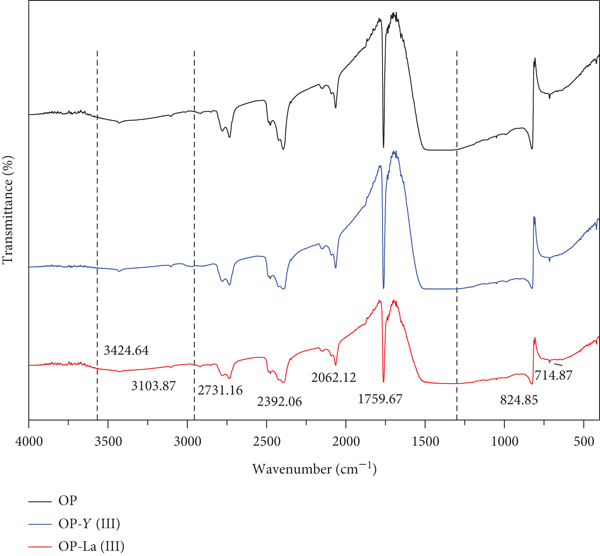
The FTIR spectrum of OPB and OP before and after La(III) and Y(III) adsorption.
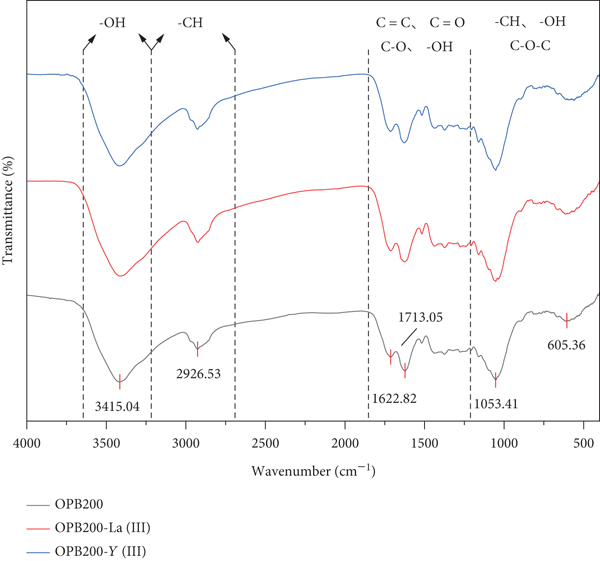
OPB200

OPB400
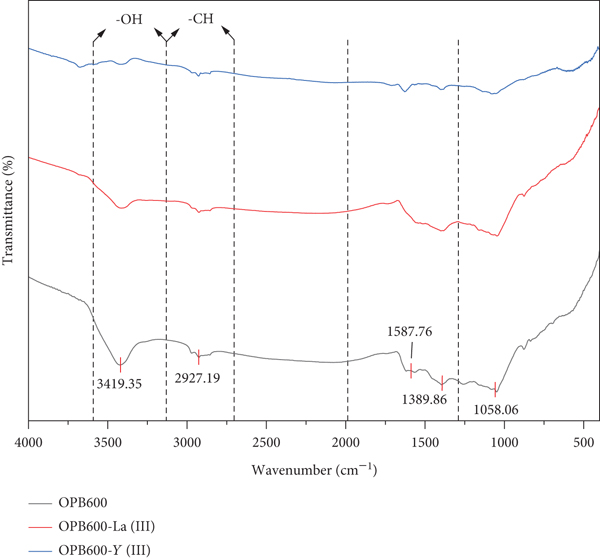
OPB600
From the analysis of the XRD pattern of OPB in Figure 4, the small peaks of OP and OPB200 at about 2θ =15.50° suggest that the samples persisted in some imperfect decomposed cellulose structures [16]. The carbon peaks in most region appeared low reflection sharpness, especially OPB400 and OPB600, indicating the noncrystallinity of the structure. Two broad peaks appeared at 20°~25° and 40°~45° were considered to amorphous carbon [14, 24]. This could confirm the presence of some graphite. However, the characteristic peaks of OPB600 at 29.30°~42.84° exhibited greater sharpness and intensity, which were reflections from the mineral components, combined with the FTIR results; this can suggest that higher carbonization temperatures promote organic matter decomposition and mineralization.

The XRD patterns of OPB and OP.
3.2. Effect of OPB Dosage
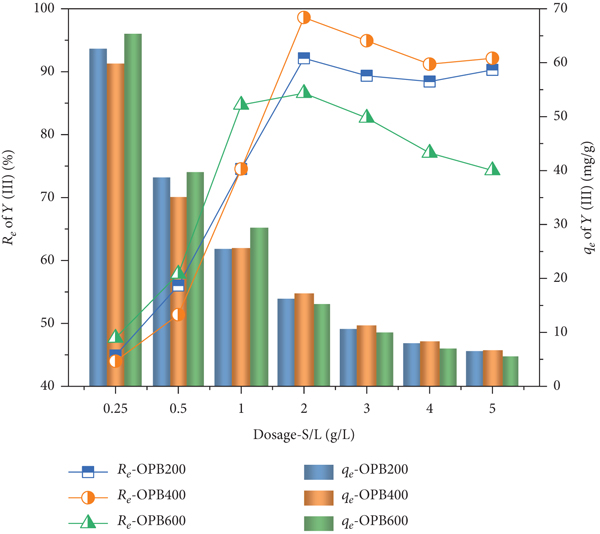
The capacity of adsorbent can be visually expressed through its dosage (S/L). As illustrated in Figure 5, the adsorption efficiency of La(III) and Y(III) increased with increasing OPB dosage, and a maximum was observed at 0.25 g/L to 1 g/L and 2 g/L, respectively. The ions and active sites were sufficiently matched at this optimal dosage; on this premise, the greatest adsorption efficiency of up to 100% could be reached with the appropriate dose of OPB. The adsorption amount decreased as the OPB dosage was incremented. At high biochar dosages, small OPB particles were prone to agglomeration, leading to a decrease in the number of effective adsorption sites, and the tortuous adsorption paths resulting from overlapping particle surface areas can hinder the mass transfer process [25, 26]. In addition, the elevation of solution equilibrium pH value (

Adsorption of La(III) and Y(III) with different OPB dosages (

Equilibrium pH of solution after adsorption.

3.3. Effect of pH
The adsorption trend by OPB at different initial pH is shown in Figure 7. The solution pH often significantly affects the adsorption performance. This is because pH exerts its effect by changing the adsorption system, exactly adsorbate (i.e., RE ions) of species and adsorbent (i.e., biochar) of surface charge in solution [3].

Adsorption for La(III) and Y(III) by OPB with different initial pH (

Under the strong acidity conditions, the oxygen-containing functional groups of OPB underwent protonation, resulting in the OPB surface with positive charge. Also, electrostatic repulsion between OPB adsorbents and La(III) and Y(III) occurred due to the undissociated of most of the -COOH or -OH groups, leading to low sorption activity and capacity [3, 17]. In addition, especially low solution pH less than 3.5, the adsorption efficiency of OPB400 and OPB600 was significantly lower than that of OPB200. This means that the herein studied higher temperature biochar was more influenced than lower temperature biochar through electrostatic attraction from pH. The elevation of solution pH allowed RE ions to be present in the form of hydroxyl RE ions (e.g., RE(OH)2+ and RE(OH)2 +) [27], and the conversion of carboxylic acids into free -COO- forms increased. Therefore, a greater number of RE ions were transferred to the OPB phase via a growing attraction force, which facilitated the interaction of La(III) and Y(III) with the active sites and thus adsorption. Since the smaller effective hydration radius of hydronium ions (H3O+ with 0.280 nm) compared to La(III) and Y(III) (~0.452 nm), it is more competitive in occupying the adsorption site on OPB, and the adsorption dominates only when the solution acidity weakens [3, 28].
When the pH values increased from 2.0 to 5.5, the adsorption capacity of OPB adsorbent for La(III) and Y(III) has increased and reached its maximum. Clearly, this result suggests that electrostatic attraction was an existence of dominating contribution in the adsorption process (namely, pore filling and physical adsorption as secondary contributions). With rising pH above 6, the
3.4. Effect of Contact Time
As shown in Figure 8, the overall adsorption was a process of first fast and then slow and finally reaches equilibrium, which indicates the effective role of surface sites and porous structure of the carbonaceous adsorbent. Initially, the fast adsorption stage completed within about 25 min, and the La(III) and Y(III) adsorption by OPB600 reached more than 98%. It is noteworthy that this stage with relatively faster adsorption process was attributed to the abundance of vacant binding sites and the higher gradient concentration between solute and adsorbent phases, which prompted a greater accessibility of La(III) and Y(III) to active sites in the OPB surface [25].

La(III) and Y(III) adsorption by OPB with contact time (

Then, the slow adsorption phase proceeded because of the almost saturation in OPB surface sites. At this point, prolongation of equilibrium time resulted from diffusion of residual ions and obstruction of mass transfer processes [4], OPB200 adsorption duration within 60 min, while a much shorter time, about 30 min, was required for OPB600 and achieved a higher adsorption efficiency. This is mainly because the increased pore structure of OPB600 after carbonization at high temperature was conducive to the adsorption process. In the final stage, the adsorption efficiency did not vary with time, implying the equilibrium relationship between the desorption and adsorption.
3.5. Effect of Initial La(III) and Y(III) Concentration
As can be seen in Figure 9, the adsorption efficiency for La(III) and Y(III) decreased almost linearly upon the increase of the initial concentration from 5 to 100 mg/L. At lower initial concentrations, the optimum adsorption amount was 66.03 mg/g for La(III) and 35.14 mg/g for Y(III). This is because of the driving force provided by the gradient difference between the low concentration ions and the high mass adsorbent, which promotes the approach of ions to adsorbents [25], which can also be considered as a strong adsorption force generated from the unsaturated sites of OPB and targeted to the low concentration of RE ions. However, a fixed amount of OPB has a limited maximal adsorption capacity. As a result, as the initial concentration increases, the adsorption efficiency of the RE ions was negatively affected, mainly because the saturation of available adsorption sites would limit the interaction between RE ions and OPB. Consequently, the optimum adsorption depends on the ratio of adsorbent dosage to ion concentration.

La(III) and Y(III) adsorption by OPB with different initial concentrations (S/L of La(III) and

On the other hand, OPB600 kept the highest equilibrium adsorption capacity, followed by OPB400. Similar results were obtained on wood ear mushroom stick-derived biochar [26] and microalgal residue-derived biochar [29], for adsorption of Cd(II) and Pb(II). These observations disclosed that biochar prepared at higher temperatures has an available surface structure for adsorption and greater adsorption affinity for ions, resulting in better adsorption capacity.
4. Adsorption Model
4.1. Kinetic Studies
This study adopted the pseudo-first-order kinetic (PFO) (Equation (2)), pseudo-second-order kinetic (PSO) (Equation (3)), and Weber-Morris model (intraparticle diffusion model) (Equation (5)) to analyze the experimental results.
As illustrated in Table 1, the OPB adsorption for La(III) and Y(III) with higher fit coefficient
Kinetic model parameters of OPB adsorption.
The graph plotted from

Linear fitting of the Weber model for La(III) (a) and Y(III) (b).

4.2. Adsorption Isotherm Studies
The interaction between adsorbent and adsorbate can be elucidated by isothermal adsorption. Three classical isothermal adsorption models, Langmuir (Equations (6) and (7)), Freundlich (Equation (8)), and Dubinin-Radushkevich (D-R) (Equations (9)–(11)), were employed to calculate the model fitting parameters, and the results are presented in Tables 2 and 3.
Isotherm parameters of La(III) adsorption on OPB.
Isotherm parameters of Y(III) adsorption on OPB.
If
From the table results, the adsorption for La(III) and Y(III) on OPB in this solution concentration range conformed better to the Langmuir model. It can be concluded that the adsorption has proceeded via a monolayer covering homogenous process [35, 36]. The
The
The D-R model can be applied to estimate the apparent free energy and determine the role of microporous adsorption [37]. The formulas are as follows:
From the results, the less
4.3. Thermodynamic Studies
The adsorption properties and thermodynamic behavior of OPB on La(III) and Y(III) can be predicted by the Gibbs parameter analysis. The relevant equations are as follows:
Table 4 shows the calculation results of thermodynamic parameters. The adsorption behavior of La(III) and Y(III) on OPB can be inferred as a spontaneous reaction from negative
Thermodynamic model parameters of La(III) and Y(III) adsorption by OPB.
4.4. Adsorption Mechanism
Table 5 compares the adsorption capacity of La(III) and Y(III) between the prepared biochar and other biochar reported in the literature. The orange peel-derived biochar displays higher adsorption capacities than some other biochar. The result affirms that OPB could be recruited as valuable adsorbents with high adsorption capacities for recycle of rare earth ions from water medium.
Comparison of the adsorption capacity of orange peel carbon and other biochar-modified materials for La(III) and Y(III) (adsorption temperature: 22°C~25°C).
Note: AC: activated carbon. Lanthanides are the measured value of La(III) in lanthanide solution.
Due to the plentiful nature of biomass and biochar, their adsorption mechanism for RE ions is relatively complex. The FTIR spectra in Figure 3 show various oxygen-containing functional groups on OPB. These active groups adsorbed RE ions in solution though hydrogen bonding and also π-π interaction as a primary adsorption mechanism owing to the high aromaticity structure of OPB, which can be found from the shift of peak positions and the decrease of the peak intensity [9, 13, 46]. Physisorption is critical for the adsorption of carbon-based adsorbent materials. OPB is a carbonaceous material with well-developed porous, and this porosity property can utilize a pore filling mechanism to improve the adsorption capacity for La(III) and Y(III), especially at high-temperature adsorption [17]. The adsorbent dosage affected the equilibrium
Taken together, as illustrated in Figure 11, OPB with higher preparation temperatures, the main contributions in adsorption process were electrostatic attraction and pore filling, as well as functional group action, hydrogen bond formation, and ion exchange [17, 48]. The isothermal, kinetic, and thermodynamic analyses concluded that the driving force of La(III) and Y(III) in solution enhanced at higher ion concentrations and higher temperatures, which accelerated their diffusion and purposeful approach to the OPB adsorbents, thereby promoting the feasibility and spontaneity of adsorption.

Adsorption mechanism of La(III) and Y(III) on OPB.
5. Conclusions
This study demonstrates the properties of orange peel-derived biochar prepared at three carbonization temperatures, and the prepared samples were used as adsorbents to study the adsorptive behavior of La(III) and Y(III). The prepared OPB exhibited well-developed porosity characters and were influenced by the carbonization temperature. OPB are carbonaceous mesoporous adsorbents with abundant surface sites and functional groups, which facilitated the coordination with ions. The OPB600 exhibited better adsorption capacity, and the Langmuir adsorption amounts of La(III) and Y(III) reached 55.57 mg/g and 31.49 mg/g. This study confirms that orange peel biochar, as a cost-effective adsorbent, can be applied to the treatment of La(III)- and Y(III)-contaminated water.
Footnotes
Data Availability
All relevant data during this study are included within the article.
Conflicts of Interest
The authors declare no competing interest.
Authors’ Contributions
Li Liu conceptualized the study and prepared the first draft of the manuscript. Bo Feng, Tao Huang, and Qi Xiong Gu supervised the study and wrote, reviewed, and edited the manuscript. Chang Shun Tian and Yun Zhang Rao were responsible for funding acquisition.
Acknowledgments
The authors acknowledge the financial support from the National Natural Science Foundation of China (51964014) and Program of Science and Technology Research, Education Department of Jiangxi Province (GJJ200814).