




Abstract
The coal matrix can expand after gas adsorption, thus reducing the permeability of coal reservoirs and further affecting the coalbed methane production. Whether the heat released by coal adsorbing gas is a cause of the coal expansion has not yet been determined. Therefore, the anthracite coal with high gas adsorption capacity was used; under the conditions of 35°C and 1-6 MPa, the adsorption capacity and the adsorption heat of coal adsorbing CO2 and CH4 were tested. The specific heat capacity and thermal expansion coefficient of coal at 35°C were tested. The temperature change of the coal after being heated was calculated by combining the absorption heat and specific heat capacity; also, the thermal expansion rate was calculated by combining the temperature change and expansion coefficient. In addition, the cube law was used to calculate the permeability change of coal before and after the adsorption expansion. The results show that the changes in the gas adsorption capacity and adsorption heat of the coal obey the Langmuir equation, and those to CO2 are both higher than to CH4. The temperature of coal increases after the heat is released in the process of CO2 and CH4 adsorption, and the temperature change of coal adsorbing CO2 and CH4 reaches 102°C and 72°C, respectively, at 6 MPa. The thermal expansion rate of coal adsorbing CO2 and CH4 reaches 5.40% and 3.81%, at 6 MPa, respectively. It is found that a higher gas pressure could lead to a higher temperature change, a higher thermal expansion rate, as well as a higher thermal expansion and coal deformation. After the adsorption of CO2 and CH4, the coal permeability is reduced by 20.43% and 14.66%, respectively, at 6 MPa. Both the thermal expansion rate and the permeability change with the gas adsorption pressure obey the Langmuir equation. Therefore, the adsorption expansion of coal may be thermal expansion caused by the heat released by coal adsorbing gas.
1. Introduction
Coal is a typical dual-porosity rock with matrix pores and fractures, in which matrix pores are the main space for the storage of coalbed methane (CBM), and fractures are the main channels for CBM to migrate [1, 2]. The gas adsorption and desorption of coal can cause the expansion and shrinkage of the coal [3, 4], leading to the change in fracture width and so does the permeability, affecting the production efficiency of CBM [5–7].
Previous studies have found that the coal expansion caused by gas adsorption refers to different mechanisms [8–10]. Specifically, during the gas adsorption process, the pressure drives the gas molecules into the pores and fractures of the coal, prompting the sorption layer to wedge microfissures with similar diameters of gas molecules, thereby causing the coal to expand [11]. Also, the interaction between the gas molecules adsorbed on the coal surface and the coal molecules may lead to expansion [12]. In addition, the van der Waals force on the coal fracture surface is weakened during the gas adsorption process, causing a decrease in the internal attraction energy of the coal and an increase in the expansion energy, which could also result in the expansion [13, 14]. Note that the heat change caused by gas adsorption/desorption would lead to the change in coal temperature [15–18], while coal has the property of thermal expansion, which means thermal expansion during the gas adsorption/desorption process could also be a cause of coal deformation. However, there is no sufficient evidence to prove this.
Some publications have studied the temperature change of coal during the adsorption/desorption process through contact thermometers or sensors [19–23]. They found that the coal is accompanied by energy conversion, which indicates that there will be a temperature change in the coal. The gas adsorption in coal will release heat, which will increase the coal temperature. While gas desorption is reversible, it will absorb heat and reduce the coal temperature [24, 25]. Also, the change range of coal temperature is related to multiple factors, such as the pressure, gas adsorption characteristics, and coal metamorphism degree. Generally, the higher gas pressure, gas adsorption ability, and the coal metamorphism degree could lead to greater temperature change in the coal during the gas adsorption/desorption process [26, 27].
In this paper, experiments were conducted to determine the isothermal adsorption capacity and adsorption heat of coal samples to CO2 and CH4, the specific heat capacity, and the expansion coefficient of coal. On this basis, the temperature change and thermal expansion rate of the coal after being heated were calculated, and the relationship between the temperature change and the deformation of the coal was analyzed. The cubic law was used to determine the coal permeability change, and the influence of thermal expansion on permeability was investigated, which could provide a theoretical basis for further research on the CBM production law and the geological storage of carbon dioxide in coal reservoirs.
2. Experiments and Methods
2.1. Coal Sample Collection and Preparation
In this study, coal samples from Zhongma Mine in Jiaozuo, Henan Province, were collected as experimental samples, and the coal characteristics are shown in Table 1. Some coal samples were pulverized and sieved to 60-80 mesh for the tests of isothermal adsorption, adsorption heat, and specific heat capacity. In addition, some coal was made into cubic coal blocks with the size of
Vitrinite reflectance and proximate analysis of the coal sample.
2.2. Isothermal Adsorption Test and Adsorption Heat Test
The ISO-300 isothermal adsorption instrument was used to measure the isothermal adsorption capacity of coal samples to CO2 and CH4 at 35°C. Under the conditions of 35°C and 1-6 MPa, the heat released by the adsorption of CO2 and CH4 in the coal samples was measured by the French Setaram C80 calorimeter.
2.3. Test of Coal-Specific Heat Capacity and Thermal Expansion Coefficient
The specific heat capacity of coal samples at different temperatures was measured by Naichi DSC 200F3 specific heat capacity instrument. The linear expansion coefficient of the coal samples at different temperatures was determined by DIL402C NETZSCH thermal expansion coefficient device.
3. Results and Discussion
3.1. Variation of Gas Adsorption Capacity and Adsorption Heat
The results of the isothermal adsorption test and the heat of adsorption test are shown in Table 2 and Table 3, respectively.
Isothermal adsorption of CO2 and CH4 to coal samples under different pressures.
Adsorption heat of coal samples to CO2 and CH4 under the pressure of 1-6 MPa.
Through Equation (1), the isotherm data of coal to CO2 and CH4 were fitted, and the curve of the isotherm adsorption of the coal to the two gases was obtained (Figure 1). With the increase of pressure, the adsorption capacity of coal samples for both gases showed a trend of rapid increase at first and then gradually stabilized. The adsorption capacity of CO2 is always greater than that of CH4. The Langmuir volume

Adsorption isotherms of CO2 and CH4 on the coal samples.
Parameters related to the adsorption capacity and adsorption heat and temperature change of coal to CO2 and CH4.
Through Equation (2), the adsorption heat data of coal to CO2 and CH4 were fitted, and the curve of the adsorption heat of the coal to the two gases was obtained (Figure 2). The results show that the adsorption heat of the two gases increases with the increase of the pressure, which conforms to the Langmuir equation and is consistent with the variation law of adsorption capacity. Also, it can be seen that the heat released by adsorption is positively correlated with the adsorption capacity. The adsorption heat parameter

Variation of adsorption heat of CO2 and CH4 by coal with pressure.
The gas molecules adsorbed on the coal surface interact with the coal surface molecules and generate intermolecular forces with previously adsorbed gas molecules to release heat. With the continuous gas adsorption process, the intermolecular forces become dominant, and the greater the adsorption pressure, the greater the gas intermolecular force and the heat released. In addition, consistent with the results of the adsorption capacity, the adsorption heat of the coal samples to CO2 is greater than that of CH4, which is because the physical adsorption force is the van der Waals force including the dispersion force and the inductive force. The greater the polarizability and ionization potential of the molecule, the greater the dispersion force and inductive force, and therefore, the larger the adsorption heat. The polarizability and ionization potential of CO2 are 7.344 C·m2·V-1 and 15.6 eV, respectively, which are greater than those of CH4 of 6.541 C·m2·V-1 and 13.79 eV [26]. Therefore, the adsorption heat of CO2 is greater than CH4.
3.2. Coal Sample Temperature Change
The results of the specific heat capacity and the thermal expansion coefficient test of coal at different temperatures are shown in Table 5. In this paper, the specific heat capacity and thermal expansion coefficient of coal at 35°C is selected.
Specific heat capacity and linear expansion coefficient of coal samples at different temperatures.
The temperature change of a unit mass coal after gas adsorption and heat release can be calculated by
The gas adsorption/desorption process is accompanied by the temperature change of the coal. If the adsorption system is adiabatic and does not exchange heat with the outside environment, the temperature change of the coal can be calculated by the adsorption heat and the specific heat capacity (Table 6). Equation (4) was used to fit the temperature change of coal samples to CO2 and CH4 under different pressures, and the fitting result is shown in Figure 3. The temperature change parameter
The temperature change of the coal samples under the pressure of 1-6 MPa due to the adsorption of CO2 and CH4.
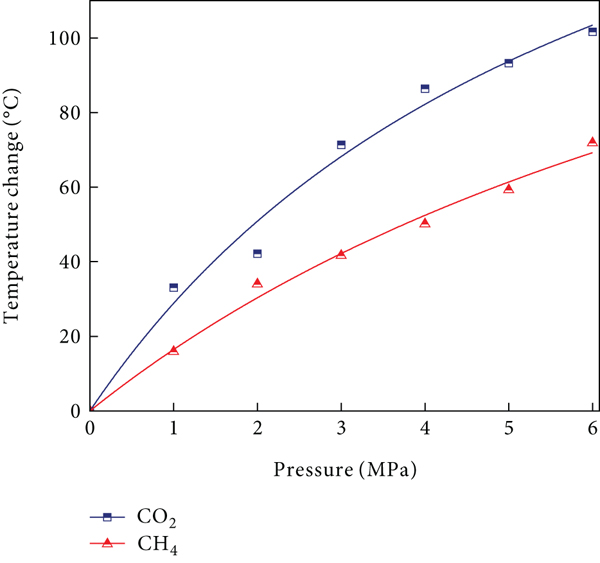
Variation of temperature change with pressure on coal adsorption of CO2 and CH4.
It can be seen from Figure 3 that the temperature change of the coal samples increases with the gas pressure and obeys the Langmuir equation (Equation (4)). Since the adsorption heat of coal to CO2 is larger than that of CH4, the temperature change of CO2 adsorption by coal is always larger than that of CH4, and the change law of its curve is similar to that of adsorption heat. At 6 MPa, the temperature changes of the coal samples adsorbing CO2 and CH4 reach 102°C and 72°C, respectively, which has not been found in previous studies. In the gas adsorption/desorption process under the in-situ conditions of the reservoir, since the environment cannot be adiabatic, the temperature change of coal will not be so severe. According to the statistics of changes in reservoir temperature during CBM development in Qinshui Basin [28], it is found that with the progress of drainage, the reservoir temperature generally decreases.
3.3. Thermal Expansion Rate and Permeability Change
3.3.1. Thermal Expansion Rate
Objects have expansion and contraction due to temperature changes [9]. Through the positive and negative values of the coal thermal expansion rate, we can intuitively observe whether the increase in coal temperature will cause the expansion of the coal matrix. That is, the value of the coal thermal expansion rate is positive, which proves that the increase in coal temperature will lead to the expansion of the coal matrix. So, the thermal expansion rate in this section is calculated.
By measuring the linear expansion coefficient of the coal samples, the volume expansion coefficient can be obtained as
From Equation (5), the thermal expansion rate of the coal can be obtained:
The volume expansion coefficient of the coal was obtained according to Equation (5), and the thermal expansion rate was obtained by substituting the volume expansion coefficient and the temperature change of the coal samples into Equation (6), as shown in Table 7. The thermal expansion rate of coal adsorption of CO2 and CH4 under different pressures was fitted by Equation (7), which shows the similar trends of the Langmuir equation (Figure 4), and the thermal expansion rate of CO2 is always greater than that of CH4, and the thermal expansion coefficient
The thermal expansion rate and permeability change of coal matrix adsorbing CO2 and CH4 under the pressure of 1~6 MPa.

Variation of thermal expansion rate and permeability change of coal adsorbing CO2 and CH4 with pressure.
Parameters related to the thermal expansion rate and permeability change of coal to CO2 and CH4.
3.3.2. Permeability Change
The coal will absorb the gas to release heat and cause thermal expansion, while desorb the gas to absorb heat and cause shrinkage, resulting in the change of the reservoir fracture width (Figure 5). Cubic law can be used to characterize the relationship between fracture width and reservoir permeability, which treats the fracture as a parallel plate with a certain degree of opening. Under the action of a stable equilibrium pressure gradient, the cubic law expression can be derived from the Navier-Stokes equation and expressed as follows [29–31]:

Variation of crack width before and after coal matrix expansion.
Assuming the equivalent permeability of the fractured coal samples is
Comparing Equation (9) and Equation (10), the relationship between equivalent permeability and fracture width can be obtained as
According to Equation (11), the permeability of the coal before and after the thermal expansion can be obtained, and then, the permeability change
4. Conclusions
In this paper, the relationship among adsorption capacity, adsorption heat, coal temperature change, thermal expansion rate, and permeability change was obtained by analysis. The cubic law is used to characterize the relationship between the permeability and the coal fracture width.
It was found that the adsorption capacity and adsorption heat of coal to CO2 and CH4 showed a trend of rapid increase at first and then gradually stabilized with the increase of pressure, and the adsorption capacity and adsorption heat of coal to CO2 were both larger than of CH4. The coal temperature change, thermal expansion rate, and permeability change have the same variation law as the adsorption heat and all obey the Langmuir equation.
The heat released by the coal-adsorbed gas increases the temperature of the coal. The greater the adsorption heat, the greater the temperature change and the greater the thermal expansion rate, that is, the greater the degree of expansion deformation of the coal. It shows that the expansion caused by coal-adsorbed gas may be caused by the thermal expansion caused by the increase in coal temperature. The expansion deformation of the coal will compress the fracture channels of the coal, which leads to a decrease in permeability. This study can provide an experimental basis for realizing the dual benefits of CBM production increase and carbon dioxide sequestration in the process of engineering application.
Footnotes
Data Availability
The data used to support the findings of this study are available from the corresponding author upon request.

Conflicts of Interest
The authors declare that they have no known competing financial interests or personal relationships that could have appeared to influence the work reported in this paper.
Acknowledgments
This work was supported by the National Natural Science Foundation of China (42072193), Natural Science Foundation of Henan Province for Young Scientists of Henan Province, China (222300420173), and the Science and Technology Major Project of Shanxi Province (20191102001).