




Abstract
The Ziehl-Neelsen stain is a mixture of Basic Fuchsin (BF), phenol (Ph), and methylene blue. It is used to stain the cell walls of Mycobacterium species. In this study, Basic Fuchsin was efficiently removed from synthetic wastewater using natural clay of Gankawa (GC) from Sulaimanyah city, and the effect of the presence of high concentrations of phenol in the adsorption mixture is demonstrated. In addition, X-ray diffraction (XRD), X-ray fluorescence (XRF), N2 gas adsorption analyzer, and field-emission scanning electron microscopy (FESEM) were used to characterize the natural clay. The clay was found to be mostly calcite, with a minor percentage of smectite, and contaminated with low percentages of illite. The adsorption kinetics show a relatively fast equilibration time (60-70 minutes). A second-order pseudokinetic model better fits the experimental kinetic data. The effect of the initial pH of the solution mixture was negligible at the experimental concentration range of the study. Freundlich and Langmuir’s adsorption isotherm models were applied to the equilibrium experimental data using nonlinear regression curve fitting. Both kinetics and isotherm studies point to a chemical adsorption mechanism for the process. For adsorption in the mixture, phenol molecules were found to compete with BF molecules for the active adsorption sites, while a synergetic effect of BF exists on phenol adsorption. As a naturally abundant cheap material, GC shows a superior adsorption capacity toward BF (287.0 mg g-1) over all natural materials and most of the synthetic or modified materials found in the literature.
1. Introduction
Dyes are one of the largest water pollutants worldwide [1]. On a large scale, dyes enter water and wastewater either directly from the dye manufacturing industry or from the finishing steps in coloring other industrial products such as textiles, cosmetics, leather, food, and paper [2]. In addition to their effect on increasing the biochemical oxygen demand by preventing light penetration in aquatic systems which is essential for photosynthesis, most synthetic dyes are toxic [3], mutagenic, and carcinogenic [4] and cause detrimental effects on the water environment if not removed from effluents before entering the ecosystem. Several dyes are used by clinical laboratories to colorize bacteria to give better resolution under the microscope. Because it is straightforward and inexpensive, the Ziehl-Neelsen method is frequently employed for coloring sputum smears in underdeveloped nations [5]. To accelerate the rate of the formation of the mycolate-fuchsin complex in the cell wall, BF solution is applied to the specimen and heated. A counterstain, such as 0.3% methylene blue, is then applied and the acid-fast bacteria are colored red-violet on a blue background to be visualized under microscopes [6, 7]. The excess of the stain in all blood film preparation methods goes to sewage via the washing steps of the slide preparation procedures [8] unless it is collected separately. Medical laboratory effluents have other disadvantages and lead to several water problems, such as taste, odor, color, turbidity, and pH. The biotransformation products of organic molecules, such as dyes, adversely affect human health because of their toxicity and carcinogenic and mutagenic effects even if they are present in trace amounts [9, 10]. A variety of technologies are available for removing synthetic dyes from water and wastewater to reduce their environmental impacts, such as sedimentation, filtration technology, oxidation, membrane isolation, electrocoagulation, advanced activated process, biodegradation, adsorption, and ion exchange [11, 12]. To remove these toxic materials from effluent streams, adsorption technology remains the best choice because of its simplicity and cost-effectiveness [13]. Among the huge sources of absorbents, recent investigations focused on the effectiveness of low-cost adsorbents for dye removal such as rice husk carbon [14], walnut shell powder [15], sawdust [16], sewage sludge [17], activated clay [18], chitosan [19], and agricultural waste [20]. Novel materials are growing attention for diverse uses based on their specific functionality and surface area as reported by the Awual group where they used a ligand-based composite material for the detection and removal of metal ions at trace levels with 100% regeneration and reuse [21–23]. Such materials may be useful for removing trace amounts of metal ions only and for limited water effluents, because of their higher cost than naturally abundant adsorbent sources like clay. Even though activated carbon has the highest adsorption capacity for the adsorption of organic and inorganic species, due to its disadvantages (like cost and difficulties in separation and reactivation), researchers are continuously seeking cheap and more abundant adsorbents [24]. Agricultural waste [25, 26] and natural clay [27, 28] are mostly attracted materials after activated carbon. Clays are promising adsorbents because they are affordable and readily available, and they have a high capacity for the adsorption of a variety of organic and inorganic contaminants [29]. The current study was aimed at evaluating a local clay to be used as an efficient adsorbent for removing Basic Fuchsin from wastewater.
Using local source adsorbents for the treatment of dye-contaminated wastewater may be the best choice.
2. Materials and Methods
The clay from Gankawa (GC) in Sulaimanyah, Iraq, was extracted from the surface to avoid contamination of organic and agricultural plants. The fine fraction practice was separated from the clay using successive dilution and sedimentation in a 1 L cylinder. The sample was dried at 105 degrees Celsius and passed through a 200-micron sieve. Basic Fuchsin (BF) dye was purchased from JOURILABS.
The BF solutions were prepared using ethanol as a solvent. A concentration of 400 mg L-1 BF was prepared and used as a stock solution from which a series of standard concentrations were prepared by dilution with ethanol to obtain the calibration curve. A Cary 60 UV-Vis spectrophotometer from Agilent Technologies, USA, was used to measure absorbance at
2.1. Adsorbent Characterization
The chemical composition of Gankawa clay (GC) was analyzed using energy-dispersive X-Ray Fluorescence (XRF) spectroscopy at the State Company of Geological Survey and Mining of Iraq. 1000 mg of GC clay was heated to 1000°C for 1 hour to determine the loss on ignition (LOI). A PANalytical X’Pert PRO X-ray diffractometer (XRD) was used to record the XRD patterns (Cu-K α1 radiation generated at 40 kV and 30 mA). Specific surface area, pore volumes, and pore diameters were analyzed by an N2 gas adsorption analyzer using a Micrometrics Gemini VII 2390t apparatus. The analysis was performed at 77 K. A field-emission scanning electron microscope model ZEISS SIGMA FE-SEM was used to record the surface morphology of the clay.
2.2. Adsorption Studies
The adsorption experiments were conducted using 0.2 g of GC with 25 mL of the BF solution (various concentrations) in 100 mL dark polyethylene bottles. A 120 rpm agitation rate in a thermostat water bath shaker model GFL was used for all the experiments. At specified time intervals of the adsorption process, 5 mL of the dispersions was centrifuged for 10 minutes at 5000 rpm. The remaining concentrations of the stain in the supernatants were determined by a UV-visible spectrophotometer. Equation (1) was used to calculate the amount of the adsorbed BF,
where
The equilibrium time was studied first (0 to 120 min) at room temperature; then, the effect of the initial pH of the solution mixture was studied in the range of 2 to 10 using diluted HCl and NaOH to control the initial pH. The kinetics and isotherm studies for the adsorption process were investigated at different temperatures.
2.3. Error Analysis
To resolve the theoretical kinetic and isotherm models that best fit the experimental kinetic and equilibrium data, the error analysis for the nonlinear curve fittings was performed. The correlation index (coefficient of determination) (
The smaller the values of SSE, the better the fit of the model under investigation.
3. Results and Discussion
3.1. Adsorbent Characterization
The percentages of the components represented as their oxides were estimated to be SiO2 (34.3%), Al2O3 (4.2%), Fe2O3 (2.4%), Na2O (0.1%), K2O (0.7%), CaO (38.7%), MgO (1.7%), and LOI (17.0%).
The XRD pattern of GK shows several peaks (Figure 1). The most intense peaks found at

XRD pattern of the GC clay sample.
The surface properties of the GC clay were determined from the N2 gas adsorption-desorption isotherms at 77 K (Figure 2). The BET surface area (

N2 gas adsorption-desorption isotherms for GC at 77 K.

FESEM micrograph for GC.
3.2. Adsorption Studies
The equilibrium time study and the effect of the initial pH of the solution for the adsorption of BF on GC are shown in Figures S2 and S3, respectively. The equilibrium time was estimated to be 60 minutes, and the initial pH shows no significant effect on the adsorption process.
3.2.1. Kinetics of the Adsorption
The mechanism of the adsorption of a solute on an adsorbate can be clarified via the study of the adsorption kinetics. For this purpose, different kinetic models have been proposed to deduce the rate-determining step and the controlling mechanism like mass transfer mechanism or chemical reaction. In this study, pseudo-first-order (suggested by Lagergren, Eq. (4)) [32] and pseudo-second-order (suggested by Hoo, Eq. (5)) [33] kinetic equations were applied to the experimental data, and their error analysis such as the correlation coefficient (
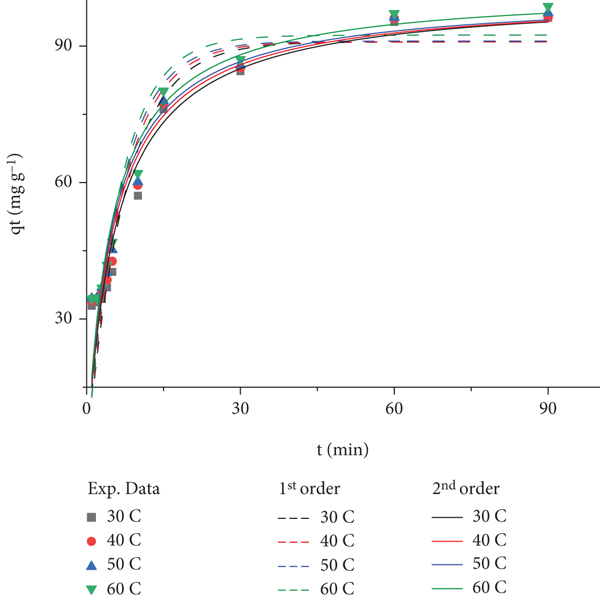
Pseudo-first-order and pseudo-second-order adsorption kinetics for BF on GC (0.2 g GC, 150 mL of 400 mg L-1 BF, initial
Kinetic parameters for the adsorption of BF on GC at different temperatures.
The error analysis (
The activation parameters (

Arrhenius and Eyring plots for the adsorption of BF onto GC.
Activation parameters for the adsorption of BF on GC.
Activation energies around 40-800 kJ mol-1 point to a chemically controlled mechanism, while below 40 kJ mol-1 is assigned to a physically controlled mechanism. The
3.2.2. Isotherms of the Adsorption
The adsorption isotherm provides information about the affinity of the adsorbent to the surface of the adsorbate at equilibrium which governs the distribution of the adsorbate between solution and adsorbent.
The monolayer adsorption of the absorbate on the adsorbent is best described by the Langmuir isotherm (Eq. (8)). The premise of an energetically identical adsorption site on a homogeneous surface and the absence of any interspecies interaction form the basis of the Langmuir isotherm [36]. This isotherm is also appropriate to determine the maximum adsorption capacity from the experimental data [37].
where
The Freundlich isotherm (Eq. (9)) was formulated for multilayer adsorption on heterogeneous surfaces [38].
Figure 6 shows Langmuir and Freundlich adsorption isotherms for the adsorption of BF on the clay sample (GC) at 30, 40, 50, and 60°C. The estimated isotherm parameters from the graphs are listed in Table 3.

Langmuir and Freundlich adsorption isotherms for the adsorption of BF on GC (0.2 g GC, 150 mL BF, initial
The adsorption isotherm parameters for the adsorption of BF onto GC.
The error analysis for the adsorption isotherms shows that both Langmuir and Freundlich models are fitted well with the experimental data. The adsorption capacity (
3.2.3. Thermodynamic Study
The thermodynamic parameters (Gibbs free energy change
where
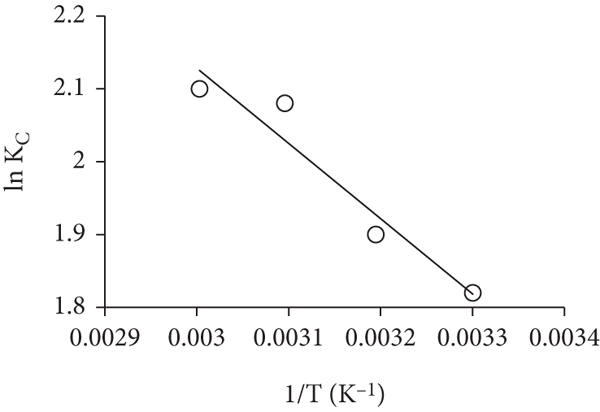
Van’t Hoff plot for the adsorption of BF on GC.
Thermodynamic parameters for the adsorption of BF on GC.
The thermodynamic parameters point to endothermic adsorption (positive value of
3.2.4. Comparison of Adsorption of BF in Mixture with Phenol
The Ziehl-Neelsen stain uses BF and phenol (Ph) chemicals to stain the cell wall of Mycobacterium species, and the washing waste would be a mixture of BF and phenol. Therefore, the adsorption of BF in a mixture with phenol was studied. First, the adsorption isotherm for phenol on GC was studied separately; then, the adsorption isotherms for BF and Ph were studied in a mixture together (Figure 8).
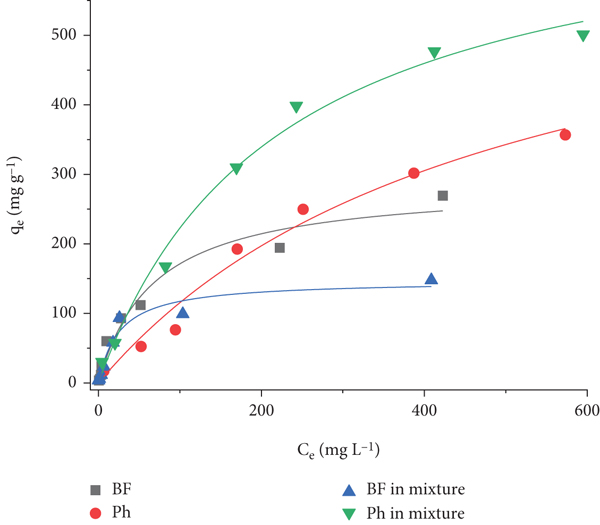
Adsorption isotherms of BF and Ph separately and in the mixture.
From the isotherms in Figure 8, competitive adsorption, on the active adsorption sites on GC, was detected for the adsorption of BF in a mixture with Ph (the adsorption capacity for BF adsorption has declined from 287.0 to 147.3 mg g-1), while a synergetic effect of BF molecules was found on the adsorption of phenol on GC (the adsorption capacity of GC towards phenol molecules has increased from 675.4 to 711.6 mg g-1) [42].
3.2.5. Adsorption Mechanism
The high adsorption capacity of the clay for cationic BF dye onto the natural clay can be explained by the formation of links with anionic acid groups on the adsorbent to adhere to the clay surface, which was described in terms of a chemisorption mechanism. For the adsorption of phenol in the presence of BF, the synergetic effect may be due to the formation of hydrogen bonds between the nitrogen of the amine group of the adsorbed BF and the oxygen atoms of the phenol molecules in addition to the directly adsorbed phenol molecules by the active sites (Figure 9) [43].

Synergetic effect on the adsorption of phenol on GC in the presence of BF.
3.2.6. Comparison of GC Clay with Other Natural, Modified, and Synthetic Adsorbents
The maximum monolayer adsorption capacity (
Comparison of the adsorption capacity of GC with other reported natural, modified, and synthetic adsorbents.
4. Conclusion
In the present study, we demonstrated the high efficiency of local natural clay to adsorb the cationic dye (Basic Fuchsin) from aqueous media which was reflected by the monolayer adsorption capacity (
In the comparison of the adsorption capacity of the present natural clay to other materials, GC may be considered a promising material for application in the elimination of cationic dyes from industrial effluents.
Footnotes
Data Availability
The authors confirm that the data supporting the finding of this study are available within the article.
Conflicts of Interest
The authors have no conflict of interest.
Authors’ Contributions
All authors contributed to the study’s conception and design. Material preparation, data collection, and analysis were performed by Harez Rashid Ahmed, Musa Mohammed Hama Radha, Lava Kamal Karim Abdulla, and Hevi Ahmed Nooralddin. Clay characterization, data interpretation, and analysis were performed by Stephan Kaufhold, Bakhtyar Kamal Aziz, and Kareem Jummah Al Salihi. The first draft of the manuscript was written with the aid of Harez Rashid Ahmed, and all authors commented on previous versions of the manuscript. All authors examined and approved the very last manuscript.