




Abstract
We report a kinetic and equilibrium study in which we examined the removal of perchlorate anions from water by adsorption onto modified reed (MR), an adsorption material constituted by giant reed (GR) particles whose anion adsorption properties have been enhanced by quaternary amine (QA) crosslinking. In particular, we examined how MR adsorption of perchlorate interacts competitively with concomitant adsorption of agriculture-derived phosphate and nitrate contaminants. Equilibrium and pH experiments were first conducted in single-component systems, the results of which were best described by the Langmuir-Freundlich (L-F) isotherm. Subsequent analyses of competitive effects on adsorption showed that although MR had a higher adsorption capacity for perchlorate alone than for nitrate or phosphate alone, the addition of either phosphate or nitrate to a perchlorate solution had a diminishing effect on MR adsorption of perchlorate within a natural-water pH range, with phosphate having the stronger competitive effect. Perchlorate adsorption on MR varied inversely with competing ion concentrations, providing direct evidence of the perchlorate diminution effect being attributable to anion competition. Finally, we developed a multicomponent isotherm model that describes the binary adsorption of perchlorate in the presence of each of these competing anions. The results of this work provide perchlorate removal efficiency information that is directly applicable to the design of water treatment systems.
1. Introduction
Modified reed (MR) particles are chemically stable, highly reactive agricultural byproducts formed by the addition of quaternary amine (QA) functional groups to giant reed (GR) plant materials [1]. The added QA functional groups enhance the adsorptive properties of GR greatly, thus enabling MR to bind a wide range of anionic contaminants, including perchlorate [2], phosphate [3, 4], and nitrate [5] ions (molecular formulas: ClO4 −, PO4 3−, and NO3 −, respectively). Perchlorate removal by MR adsorption has been shown to depend on pH and the initial perchlorate concentration [2]. In real-world water treatment systems, perchlorate removal efficiency is affected by additional factors, including the presence of competing anions [6].
Phosphate and nitrate molecules are common in perchlorate-polluted waters and their ions, PO4 3− and NO3 −, have been identified as major competing anions for adsorption in water treatment processes [7, 8]. Phosphate and nitrate are major constituents of natural water [9] in which they serve as nutrients for photosynthetic macro- and microorganisms [10, 11]. However, fertilizer overuse can elevate concentrations of phosphorus and nitrogen in domestic wastewater and agricultural effluents, giving rise to high phosphate and nitrate levels [1]. Excess phosphate and nitrate accumulation causes eutrophication, especially in closed water bodies [12–14]. Such eutrophication depletes water of dissolved oxygen, which has negative impacts on ecosystems [15]. Furthermore, nitrate concentrations above 10 mg/L in drinking water have been linked to methemoglobinemia (a.k.a. blue-baby syndrome), a potentially fatal blood disorder in infants characterized by an insufficient erythrocyte oxygen-carrying capacity [16]. There has been relatively limited investigation of anion competition on functionalized adsorbents such as MR. Namasivayam and Höll [5] reported that both perchlorate and phosphate (both 100 mg/L) have been reported to impede the removal of nitrate (10 mg/L) by crosslinked Chinese reed (0.2 g/L) at a pH of 5.8. They found that perchlorate and phosphate competition reduced nitrate adsorption capacity by 30% and 25%, respectively. However, they did not explain the physical nature of the competition or its relation to experimental conditions, such as initial concentration and pH. In a study examining perchlorate removal by pronated crosslinked chitosan at a pH of 4, Xie et al. [8] found that nitrate (10 mg/L) competed with perchlorate (10 mg/L) for adsorption and that functionalized chitosan adsorbent (10 g/L) had a higher selectivity for perchlorate than for nitrate. The authors did not attempt to explain the competition effect or the preferential adsorption of perchlorate.
Because the presence of phosphate and nitrate ions in contaminated water requiring perchlorate removal may affect the efficiency of perchlorate removal, the effects of these ions on perchlorate adsorption should be investigated systemically. The objectives of this work were threefold: (1) to determine the MR adsorption capacity and equilibrium isotherm for phosphate and nitrate in single-component systems, (2) to investigate competition effects of phosphate and nitrate on MR adsorption capacity and equilibrium isotherm values for perchlorate, and (3) to develop a multicomponent isotherm model that describes the binary adsorption of perchlorate in the presence of phosphate and in the presence of nitrate. Experiments were conducted over a range of pH values and anion concentrations. The results of this work provide perchlorate removal efficiency information that is applicable to the design of perchlorate treatment systems.
2. Materials and Methods
2.1. Reagents
All chemicals used were of ACS grade (Fisher Scientific). All experiments were performed with tap water left at room temperature for 24 h. Conductivity measurements indicated that the water had an average ionic strength of 0.01 M. Perchlorate, phosphate, and nitrate stock solutions were prepared from sodium perchlorate monohydrate (NaClO4·H2O), potassium dihydrogen phosphate monohydrate (KH2PO4·H2O), and sodium nitrate (NaNO3), respectively. All stock solutions were prepared in deionized water (18.2 MΩcm, Millipore, Cambridge, MA) at an ionic concentration of 10,000 mg/L.
Raw GR and QA reagent were provided by Dr. Baoyu Gao (School of Environmental Science and Engineering, Shandong University, China). GR (whole stems, no leaves) contains 21.1% lignin, 31.1% cellulose, 30.3% hemicellulose, and 12.1% extractives [2, 17].
2.2. MR Particles
Adsorbent MR particles were prepared as described previously for wheat adsorbent particles [18] with minor modifications. Briefly, raw GR was rinsed with water, dried in an oven at 60°C for 48 h, and then passed through a fine-mesh sieve (100–250 μm). The sieve-passed GR was reacted with epichlorohydrin, ethylenediamine, and triethylamine to form cellulose ether, and QA groups were added to GR by crosslinking with epichlorohydrin and dimethylamine [2, 19, 20]. For crosslinking, 5 g aliquots of GR residue were dispersed in 60 mL volumes of N,N-dimethylformamide, each in a 500 mL three-necked round-bottom flask. We added 50 mL of epichlorohydrin to each flask. After the mixture was stirred for 1 h while being heated to 100°C, we added 20 mL of pyridine catalyst and stirred the mixture for an additional 1 h at 100°C. Finally, 75 mL of 33% (
Sorbent yield was determined gravimetrically as the quotient of raw GR dry weight divided by MR dry weight multiplied by 100. Because MR total exchange capacity is associated with its nitrogen content, we used an element analyzer (Elementar, Germany) to determine the nitrogen content of the MR obtained [20], which was found to be 7.78% in MR (vs. 0.9% in GR). Based on the chemical composition of the QA group [-CH2CHOHCH2NHCH2CH2NHCH2 OHCHCH2N (CH2CH2)3 +], the QA charge content was estimated to be ~1.64 eq(+)/g (≈162 mg ClO4/g exchange capacity) [2].
2.3. Anion Analysis
Perchlorate and nitrate concentrations were determined by ion chromatography as described previously [2]. For NO3 - analysis, the following parameters were applied: 10 mM KOH eluent, 50 mA current suppression, 1.0 mL/min flow rate, 50 μL sample injection volume, and 10 min running time. The detection limit was 0.1 mg/L. The HACH testing method 8114, which was adapted from a standard method for wastewater [21], was employed. Total phosphate concentration was measured with a DR/2800 spectrometer supplied with Test ‘N Tube™ vials (both from HACH, Loveland, CO).
2.4. Adsorption Studies
Following QA enhancement, MR particles were used at a concentration of 2 g/L. For adsorption studies, conditions typical for perchlorate contamination were set: concentration range 0–2,000 mg/L, room temperature (25°C), and pH of
A previously described perchlorate adsorption procedure [2] was followed. Briefly, to determine the MR adsorption capacity for ClO4, equilibrium tests were performed in binary perchlorate-phosphate and perchlorate-nitrate systems. MR (0.1 g) was added to 50 mL tap water containing 0, 3, 10, 30, 50, 100, 150, 300, 500, 700, or 900 mg/L ClO4, with each sample containing either 250 mg/L nitrate or 50 mg/L phosphate, and mixed for 24 hours at 25°C and a pH maintained at
Kinetic studies were carried out with 0.1 g GR samples (50 mL suspension containing 10 mg/L ClO4) and 0.1 g MR samples (50 mL suspension containing 10, 20, and 30 mg/L ClO4). After mixing at 25°C in 125 mL bottles with magnetic bar stirring, samples were drawn at 0, 1, 3, 5, 7, 10, 14, 15, 20, 25, and 30 min and again at 24 h, with last sampling time being selected to ensure a steady state reading. A neutral pH (
Isotherm tests were performed to determine MR adsorption capacity for ClO4. MR (0.1 g) in 50 mL tap water containing 3, 10, 30, 50, 100, 150, 300, 500, 700, or 900 mg/L ClO4 was mixed at 150 rpm in 125 mL bottles on a rotary mixer (Glas–Col, 2128, Terre Haute, IN) for 24 h to reach equilibrium at room temperature (25°C). The pH of each sample was maintained at
2.5. pH and Zeta Potential Effects
To examine pH effects on perchlorate removal, 0.1 g samples of MR suspended in 50 mL tap water with or without 30 mg/L ClO4 were prepared in 125 mL bottles with pH levels ranging from 3.5 to 10.5 and placed on a rotary mixer at 150 rpm for 24 h at 25°C. Samples were analyzed in triplicate for aqueous perchlorate and equilibrium pH determination by drawing aliquots of equilibrated suspensions into disposable zeta cells via a Luer-Lok syringe and injecting them into a Nanoseries® Zetasizer (Malvern Instruments, Worcestershire, UK) with parameters set as follows: 25°C, dielectric
The Smoluchowski approximation [24–26], which supposes that
3. Results and Discussion
3.1. MR Adsorption of Nitrate and Phosphate: Isotherm and pH Effects
To obtain a better understanding of the competitive effect of nitrate and phosphate on perchlorate adsorption by MR, equilibrium and pH experiments were first conducted in single-component systems. The experimental adsorption data were fitted with the Langmuir-Freundlich (L-F) isotherm (Equation (2)), which takes into account the nonideal, heterogenous nature of an adsorbent surface. In our previous work [2], the L-F isotherm was shown to better fit adsorption data obtained by the present methods than either the Langmuir isotherm or the Freundlich isotherm owing to it having the lowest residual sum of the squared estimate of errors (SSE) value (16.34). The L-F isotherm optimized adsorption parameters of perchlorate, nitrate, and phosphate used are listed in Table 1. Notably, optimal perchlorate adsorption was observed within the pH range of 3.5 to 7.0.
L-F model parameters for anion adsorption.
The effects of isotherm and pH on MR adsorption of nitrate and phosphate are shown in Figure 1. Both phosphate and nitrate exhibited good adsorption characteristics on MR (Figure 1(a)). At the pH studied (

Isotherm and pH effects on MR adsorption of nitrate and phosphate. (a) Adsorption of anions by MR (2.0 g/L) and the fitted L-F isotherm model at pH

Hydrated radius of common anions from Moyer and Bonnesen [29].
Similar to the perchlorate adsorption data, the sorbed concentrations of phosphate and nitrate at equilibrium
In the equilibrium experiments, adsorption on MR was higher for phosphate than for nitrate. At the experimental pH (
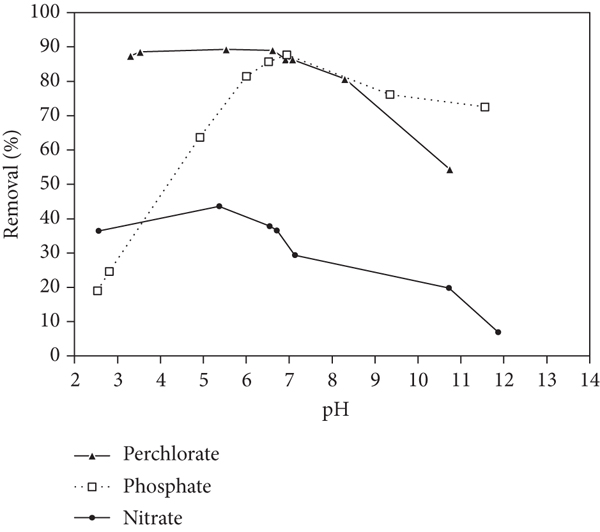
The effects of varying pH from 2.5 to 12 on the removal of perchlorate (30 mg/L), phosphate (50 mg/L), and nitrate (250 mg/L) on MR (0.1 g) at room temperature (25°C) are illustrated in Figure 1(c). Within the acidic equilibrium pH range up to a pH of ~6.5, removal percentages of nitrate and perchlorate tend to remain stable (see essentially flat regions of curves in Figure 1(c)). The MR surface is positively charged at low pH levels, which increases the electrostatic forces between QA functional groups and anions [8]. At neutral and basic equilibrium pHs, that is, levels above ~6.5, removal percentages of nitrate and perchlorate show clear decreasing trends with increasing pH. These lesser removal rates at higher pH levels are likely due to competition with hydroxide ions for adsorption sites. In addition, a decreased surface charge at a high pH would be expected to weaken the electrostatic attraction between anions and the MR surface [2].
In contrast to the nitrate and perchlorate adsorption data, we observe a lopsided inverted-U curve for phosphate adsorption in relation to equilibrium pH (Figure 1(c)). That is, the phosphate removal percentage increases steadily within the pH equilibrium range of 2.5~7.0, with the phosphate removal percentage peaking at a neutral equilibrium pH of 7.0, possibly due to the formation of divalent HPO4 2- (Figure 1(b)). The relatively low phosphate removal percentages obtained at equilibrium pH values below 5.5, compared to rates seen in the neutral-to-acidic equilibrium pH range, could be consequent to the formation of noncharged H3PO4 species. Similar findings have been reported previously [6, 14, 26]. The MR surface is positively charged at low pH, increasing the electrostatic forces between QA functional groups and anions [8].
As shown in Figure 1(c), the maximum removal obtained for phosphate, 88%, occurred in the pH range of 6.5 to 7.5. Removal decreased significantly at lower pH levels (e.g., a 70% decrease in removal at a pH of 2.5). A speciation diagram for 50 mg/L total phosphate is shown in Figure 1(b) (
For nitrate (50 mg/L), a maximum removal rate of 43% was observed at a pH of 5.1 (Figure 1(c)). Removal decreased slightly at lower pH levels. For example, at a pH of 2.5, removal decreased by only 7.2% from its maximum value. Increasing the pH also reduced the removal rate, with a 36.7% rate being observed at a pH of 11.8. Nitrate and perchlorate adsorption followed similar patterns as a function of pH (Figure 1(c)). Nitrate and perchlorate ions have similar ionic charges and radii (Table 2), which could explain their similar adsorption behaviors. These two anions are often found together in nature [35].
3.2. Effect of Phosphate and Nitrate Concentration on Perchlorate Adsorption
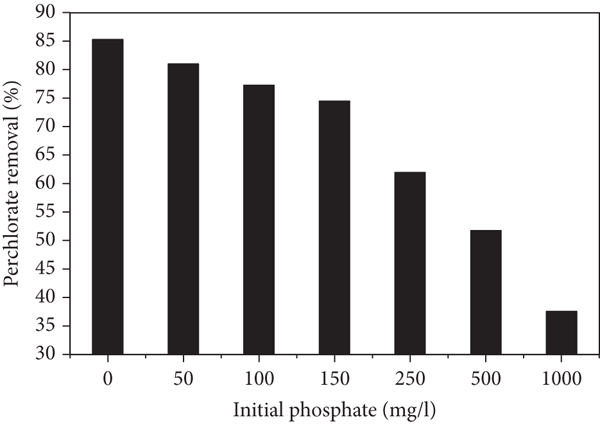
The addition of either phosphate or nitrate (0–2000 mg/L) had a diminishing effect on perchlorate adsorption (30 mg/L) (Figures 2(a) and 2(b)), determined under the conditions described in previous work [2]. Perchlorate adsorption on MR varied inversely with phosphate and nitrate concentrations. The reduced perchlorate adsorption observed in the presence of phosphate or nitrate can thus be attributed to increasing anion competition for MR adsorption on MR as the added anion concentrations increased.

Anion competition effects on perchlorate removal by MR. (a) Nitrate concentration effect; initial
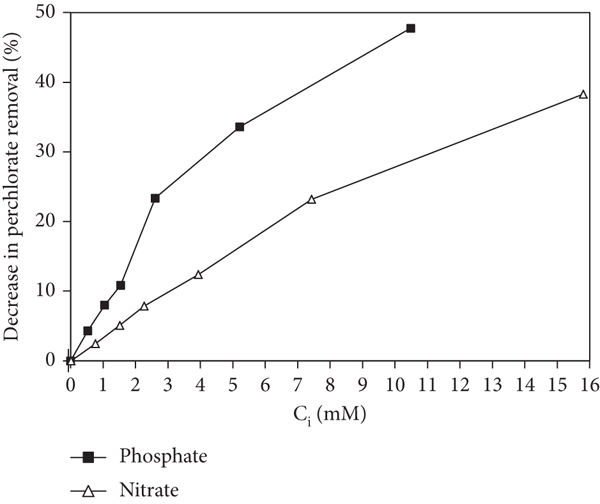
Adsorption of perchlorate (30 mg/L) was reduced slightly, by 2.5%, in the presence of 50 mg/L NO3 −, compared to in the absence of nitrate loading (Figure 2(a)). Even with relatively high nitrate loading (500 mg/L), perchlorate adsorption was decreased by only 23.2% relative to the non-nitrate-loaded condition. Only in the presence of 1000 mg/L NO3 − did perchlorate adsorption show a drop (38.3%). Interestingly, perchlorate adsorption was decreased by only 51% in the presence of 2000 mg/L NO3 −, demonstrating substantive perchlorate adsorption even at a large perchlorate-to-nitrate ratio. These results show that although nitrate would be expected to compete with perchlorate for similar MR adsorption sites, given that the two ions have similar charge and size properties, MR exhibits selectivity for perchlorate over nitrate, consistent with the findings of Xie et al. [8].
The presence of phosphate also decreased perchlorate adsorption, in a concentration-dependent manner, indicating that perchlorate and phosphate anions compete for similar adsorption sites. Perchlorate adsorption was decreased by 4.3%, 33.6%, and 47.8% with 50 mg/L, 500 mg/L, and 1000 mg/L PO4
3−, respectively. Indeed, phosphate had a stronger effect on perchlorate adsorption than nitrate (Figure 2(b)), likely owing to greater electrostatic forces of phosphate consequent to its greater charge at the pH studied (
3.3. Perchlorate Isotherm Studies in the Presence of Competing Anions
Equilibrium tests were performed to determine the MR adsorption capacity for perchlorate in the presence of phosphate and nitrate in binary perchlorate-phosphate and perchlorate-nitrate systems (Figure 3). MR (0.1 g) was added to 50 mL of tap water containing 0, 3, 10, 30, 50, 100, 150, 300, 500, 700, or 900 mg/L ClO4
−, with all samples containing either 250 mg/L NO3
− or 50 mg/L PO4
3−. As shown in Figure 3, the presence of either additional anion decreased perchlorate adsorption for the entire concentration range studied (0–900 mg/L ClO4
−), and the competitive effect was greater at higher initial perchlorate concentrations. That is, the perchlorate adsorption
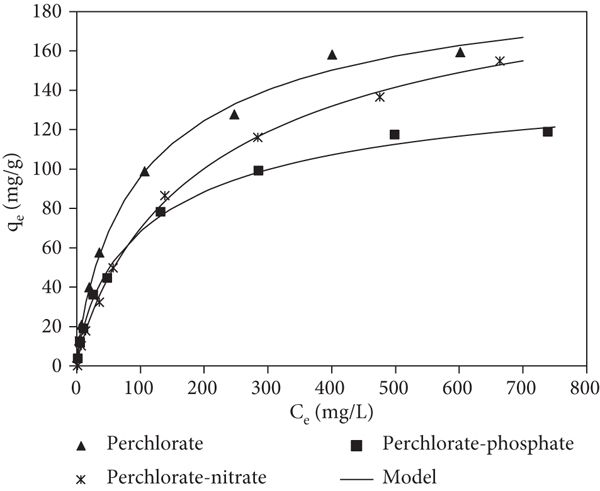
Effect of anions on perchlorate adsorption by MR and the fitted L-F model. Initial
Although equilibrium studies do not enable the identification of the forces affecting adsorption, they can reveal similarities of adsorption behaviors across ion species by demonstrating the relative affinities of each species to the adsorbent, a variable described by
Measured residual anion concentration data verify that nitrate and phosphate were indeed adsorbed by MR. Phosphate had a stronger competitive effect than nitrate on perchlorate adsorption (Figure 3). The fact that phosphate has a greater negative charge than perchlorate at the pH studied (
The L-F model [2] used to fit the equilibrium results of perchlorate adsorption on MR in the presence of competing anions assumes that each adsorption site is available for only one ion and that the number of available adsorption sites is constant. Because the concentration of the competing anion is constant (250 mg/L NO3 − or 50 mg/L PO4 3−), we assume that the number of adsorption sites available to perchlorate is reduced by a magnitude that remains constant throughout the entire perchlorate adsorption period as in a single-ion system containing only perchlorate.
The L-F equation (Equation (8)) was fitted to the experimental data using nonlinear regression (plot in Figure 3; isotherm parameters listed in Table 3). The perchlorate adsorption capacity (
L-F model parameters for anion adsorption.
Favorability of adsorption is represented by the constant separation factor
3.4. Modeling the Competitive Effect
The Langmuir equation describes the dependence of the surface coverage of the adsorbed species on its concentration at equilibrium and at a fixed temperature and pressure [37]. To model competitive effects, we modify the Langmuir isotherm equation and test its accuracy in predicting the binary sorption of perchlorate-nitrate and perchlorate-phosphate systems. For the modification, we assume that adsorption is competitive by including the adsorption of the additional competing anion at equilibrium.
The variables
The rate of desorption
The Langmuir constant
Substituting in the constant
For the binary anion system, we extend the Langmuir equation to include two species (A and B). Because these two species are assumed to occupy the same adsorption sites, the fraction of vacant adsorption sites is equal to (
At equilibrium, mass balance at the interface yields
Similarly, for species B,
Substituting the mass-balance equations into Equation (4), we obtain
Then, we substitute Equation (17) into Equation (16):
Finally, we obtain the following surface coverage values for both anions A and B:
Equations (22) and (23) were used to calculate fractional surface coverage. The parameter assessment for each binary system was obtained by nonlinear regression calculation (performed with the Solver tool in Microsoft Excel® 2003). The competition models for the perchlorate-nitrate and perchlorate-phosphate systems are shown in Figures 4(a) and 4(b), respectively. In both systems, ion coverage fractions increased in the presence of greater mass fractions of each respective ion as would be expected given that the greater presence of an ion produces more opportunities for it to interact with the adsorbent surface. The shapes of the curves differed between the two systems. In the case of the perchlorate-nitrate system, equivalent coverage between the two ions (coverage fraction of ~0.5) was seen at 0.1~0.2 mass fractions of perchlorate with 0.8~0.9 mass fractions of nitrate. Thus, nitrate competed effectively with perchlorate for adsorption sites when it was the overwhelmingly predominant ion (>0.8 nitrate mass fraction) but became dramatically less competitive when it was not the overwhelming majority ion (i.e., with the progressive relative addition of perchlorate). This pattern is evidenced by steep coverage slopes at low perchlorate/high nitrate mass fraction levels that proceed to flatten gradually and then asymptote at high perchlorate mass fraction levels. Meanwhile, the coverage fraction curves obtained for the perchlorate-phosphate system were near linear with slopes near
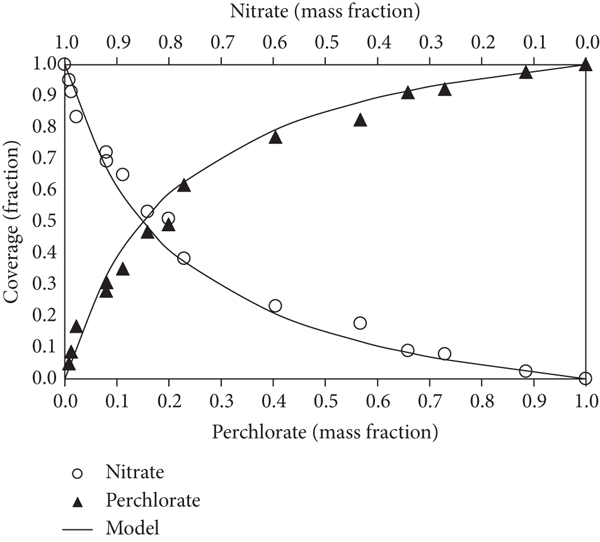
Adsorption fractions and modified Langmuir models in a binary anion system. (a) Ratio of sorbed perchlorate to sorbed nitrate. (b) Ratio of sorbed perchlorate to sorbed phosphate. For both graphs,

Modified Langmuir isotherm parameters for adsorption in the presence of competing anions.
Anion A is perchlorate. Anion B is phosphate or nitrate, respectively.
3.5. pH and Zeta Potential Effects
The effect of pH on perchlorate removal was studied by comparing the perchlorate, perchlorate-nitrate, and perchlorate-phosphate systems at concentrations of

Effects of competing anions on MR properties. (a) Effect of competing anions on perchlorate removal at different pH values. (b) Effect of competing anions on the zeta potential of MR equilibrated with ClO-
4 for 24 hours (adsorbent

The effects of competing anions on MR surface charge were studied by measuring the zeta potential [21] as a function of pH in each of the same three systems. As shown in Figure 5(b), the point of zero charge did not significantly shift when nitrate or phosphate anions were added to the perchlorate system, suggesting that anion interactions with MR are largely electrostatic in nature. The addition of either anion species did result in a decreased zeta potential, as expected given their negative charge, and perchlorate removal percentage correlated directly with the zeta potential value (compare Figures 5(a) and 5(b)). Nitrate had a stronger effect on surface charge than phosphate owing to our having used a higher nitrate concentration (250 mg/L).
4. Conclusions
The present findings show that although MR had a higher adsorption capacity for perchlorate alone than for nitrate or phosphate alone, the addition of either phosphate or nitrate to a perchlorate solution had a diminishing effect on MR adsorption of perchlorate within a natural-water pH range, with phosphate having the stronger competitive effect. Perchlorate adsorption on MR varied inversely with phosphate and nitrate concentrations providing direct evidence of this diminution effect being attributable to anion competition. The L-F isotherm described our perchlorate equilibrium results in two-ion systems accurately though we would not expect its utility to generalize to real water systems with numerous constituents.
Footnotes
Data Availability
Data is available upon request.
Conflicts of Interest
The authors declare that they have no conflicts of interest.
Acknowledgments
The authors thank the Center for Environmental Systems at Stevens Institute of Technology (USA), School of Environmental Science and Engineering at Shandong University (China), and Environmental Safety Division at the Ministry of Oil (Kuwait), for their support of this work.