




Abstract
The novel and intriguing role of Fe(NO3)3 as a chemical activator in carbonization of macadamia nutshell is introduced in this work. Magnetic mesoporous carbon was achieved by chemical activation of macadamia nutshell with Fe(NO3)3 under nitrogen atmosphere at 850°C (MMC-850). Porosity of MMC-850 included S BET 317 m2/g with V micro 0.0796 cm3/g and considerably high V meso 0.4318 cm3/g. Not only did MMC-850 possesses good magnetic properties with saturation magnetization and coercive force of 31.48 emu/g and 506.6 Oe, respectively, but MMC-850 also showed high-removal efficiency of reactive black dye (RB5) with maximum adsorption capacity at 123.51 mg/g. The experimental data fit the Langmuir isotherm and Elovich model. Thermal regeneration was effective in degrading RB5 and removal ability was above 90% after two regeneration cycles. RB5 removal from water by MMC-850 as an adsorbent is considered a facile and inexpensive method since macadamia nutshell is a food by-product which is a green and renewable carbon precursor. MMC-850 is a potential adsorbent because it can be separated from wastewater treatment system using magnetic force. Besides, MMC-850 particle is not brittle compared to other porous biochar/activated carbon with similar size; therefore, it is an excellent candidate for column packing or scaling up for wastewater treatment facilities in the future.
1. Introduction
Water pollution and water shortages are major global crises caused by expansion of the industrial sectors and rise of population [1]. Textile industries consume a large amount of water and chemicals [2, 3]. Reactive black 5 (RB5) is an azo dye which is one of the most widely used dye in textile industries due to its bright color and good colorfastness [4, 5]. Approximately, 10-15 percent of RB5 dye is lost in effluent wastewater during dyeing and finishing process [6, 7]. Since RB5 has intense dark hue, a minute amount of RB5 tremendously disturbs water clarity. In addition, chromophores in azo dyes cause mutagenicity and carcinogenicity in humans and animals [8, 9].
In general, there are several methods to remove dyes from wastewater, including physical or chemical processes such as coagulation-flocculation [10–12], membrane filtration [13, 14], ozonation [15], advanced oxidation process (e.g., photocatalysis, Fenton and photo-Fenton, electrochemical, and sonolysis) [16–20], as well as biological process like anaerobic/aerobic process [21–23], or activated sludge process [24]. Most dye removal processes are complicated, expensive, and environment unfriendly while biological processes are green but time-consuming. However, most reactive dyes especially RB5 are not biodegradable, resulting in poor removal efficiency by biological techniques [25]. Adsorption is one of the most acceptable processes for dye-contaminated water treatment due to its simplicity, high efficiency, and low investment [26, 27]. Activated carbon is commonly used as an adsorbent due to its large surface area, high degree of microporosity, and desired surface functionalization [28]. Adsorption of RB5 in water with commercial-activated carbon and activated carbon prepared from coal, agricultural, and industrial wastes, including granular-activated carbon: FILTRASORB 400 [29], granular-activated carbon: DARCO®, granular-activated carbon: Norit® PK 1-3 [30], powdered-activated carbon [31], and activated carbon from H3PO4-bamboo [29], activated H3PO4-sawdust [32], activated carbon from textile sludge [33], activated carbon from palm shell [34], and activated carbon from walnut wood [35] have been thoroughly studied. Generally, commercial-activated carbon with specific or tailor-made properties is rather expensive.
Renewable and sustainable agricultural by-products such as tree nut shells, coconut shells, peanut shells, and rice husks and straw mainly consist of lignocellulose (cellulose, hemicellulose, and lignin) [36–40]. Porous properties of activated carbon strongly depend on lignocellulosic composition of raw materials. Carbon precursor with high-lignin content tends to have high yield and large number of mesopores [41, 42]. There are several macadamia plantations located at high-altitude area in northern part of Thailand. Macadamia nutshell (MNS) with approximately 50% lignin content [37, 38] is a food by-product from macadamia nut-cracking process in which about 60-70% by weight of MNS is generated [43, 44]. Since MNS exhibits unique properties such as high carbon and lignin contents with excellent hardness [45] which are crucial for preparation of tailor-made mesoporous carbon. Thus, MNS is a promising carbon precursor for adsorbents used in practical application such as column packing for scale up in the future.
In general, physicochemical properties of porous carbon (e.g., porous properties, functional groups, and magnetic properties) can be improved by physical activation (e.g., CO2 and steam) or chemical activation (e.g., acids, alkali, oxidizing agents, and metal ions). Application of nitric acid (HNO3) [46, 47], sodium hydroxide (NaOH) [46], phosphoric acid (H3PO4) [47], and sulfuric acid (H2SO4) [48] as chemical activators for carbonization of MNS were studied. In order to conveniently separate spent adsorbent from the system after wastewater treatment, magnetic adsorbents are considered to be attractive options. In general, magnetic porous carbon is obtained by impregnation of transition metal salts such as FeSO4·nH2O [49], FeCl3·nH2O [50, 51], Fe(NO3)3·nH2O [52], NiCl2·nH2O [53], and MnCl2·nH2O [54] to carbon precursor. Unlike other iron compounds, Fe(NO3)3 creates not only good magnetic property but also high-mesopore volume. Effortless, green, sustainable, and economical ways of RB5 removal by magnetic mesoporous carbon adsorbent is introduced for the first time in this work.
2. Materials and Methods
2.1. Materials and Chemicals
Macadamia nutshell (MNS) was collected from Pong Yang agriculture, Chiang Mai, Thailand. Iron (III) nitrate nonahydrate (Fe(NO3)3·9H2O, (KemAus, ≥ 98%) was used. The commercial adsorbent was a granular-activated carbon (CAC) derived from bituminous coal, purchased from CARBOKARN Company Limited (I2 number 1000). The anionic dyes, reactive black 5 (RB5, Sigma-Aldrich, > 50%), were purchased from Sigma-Aldrich. Molecular structure of RB5 is shown in Figure 1.
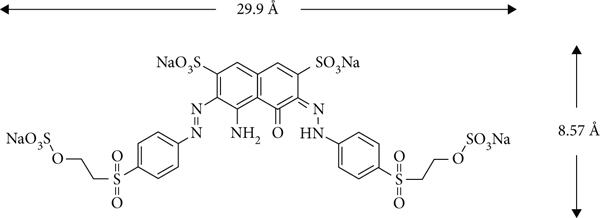
Molecular structure of the reactive black 5.
2.2. Preparation of Magnetic Mesoporous Carbon (MMC) and Macadamia Nutshell Carbon (MNSC)
Macadamia nutshell (MNS) was immersed in 0.1 M of Fe(NO3)3 and continuously stirred at 80°C for 2 hours, followed by oven drying at 80°C for 24 hours. Magnetic mesoporous carbons (MMCs) were fabricated by the carbonization under nitrogen atmosphere. Immersed macadamia nutshells were carbonized at 650°C and 850°C with a heating rate of 10°C/min with 2-hour holding time. Macadamia nutshell carbon (MNSC) was carbonized without chemical activation at 850°C. The samples were denoted as MMC-650, MMC-850, and MNSC-850, as listed in Table 1.
Synthesis conditions of samples.
Remark: NR: no report.
2.3. Characterization
Surface area and pore volume were investigated by N2 adsorption-desorption apparatus at 77 K (Autosorb-1-MP, Quantachrome). Morphology and surface features were demonstrated via scanning electron microscopy/energy dispersive X-ray spectroscopy (SEM, Hitachi S-3700 N). Crystalline structure and phase transformation were analyzed by powder X-ray diffraction with an X-ray diffractometer (D8 Advance, Bruker). Magnetic properties of magnetic porous carbon were studied by vibrating sample magnetometer (VSM; model-73098, Lank Shore). Iron content was determined by atomic absorption spectrophotometer (AAS; Analytik Jena ZEEnit 700P). The point of zero charge (pHpzc) was determined by pH drift method [55].
2.4. Adsorption Experiments
Adsorption was performed in batch experiment. Firstly, for each carbon, 50 mg of sample was added to 100 mL of RB5 solution with different concentrations in the range of 5-300 mg/L. The mixtures were shaken at 200 rpm at 30°C until the appropriate time was reached. The concentration of RB5 was measured by an ultraviolet-visible spectrophotometer at maximum absorbance wavelength of 599 nm. The effect of pH on RB5 removal was performed in the range of pH3 to 11, adjusted by a buffer solution of acetic acid/sodium acetate and ammonium hydroxide/ammonium chloride at an initial concentration of 100 mg/L. Further, the stability of the adsorbent after RB5 adsorption was studied. The amounts of adsorbed RB5 at equilibrium (qe
) were calculated by Equation (1)
2.4.1. Adsorption Isotherm Model
Adsorption isotherm is used to describe the phenomena that occur during transportation of adsorbate in bulk solution to the adsorbent surface at a constant temperature and pH. Moreover, the maximum adsorption capacity as well as adsorption mechanisms that involve the interaction between adsorbate and adsorbent at adsorption equilibrium was described [56, 57]. Langmuir, Freundlich, and Dubinin-Radushkevich (D-R) models were used for data analysis.
Langmuir model is used for monolayer adsorption on an equivalent surface site with an equal sorption activation energy of each molecule, resulting in homogeneous adsorption [58]. Langmuir isotherm model is determined by Equation (3)
Freundlich model is an empirical equation based on assumption that the adsorption occurs on heterogeneous surfaces of adsorbent. Freundlich isotherm model [59] is calculated by Equation (4):
D-R model is a semiempirical equation that is generally applied for an explanation of adsorption mechanism with Gaussian energy distribution onto heterogeneous surfaces [57, 60]. D-R model is expressed as follows in Equations (5)–(7):
2.4.2. Kinetic Adsorption Model
The pseudo-first-order (PFO) model, the pseudo-second-order (PSO), and the Elovich model are the most widely applied to describe kinetic process of adsorption and to calculate kinetic constant.
The PFO rate expression by Lagergren [61] is presented in Equation (8)
The PSO model [62] is determined by Equations (9) and (10)
Elovich model is widely used to evaluate chemisorption [63, 64] indicated by Equation (11)
Meanwhile, intraparticle diffusion (IPD) model is often used to describe the mechanism of diffusion process and to predict the rate-limiting step of the adsorption process [65]. The adsorption dynamics can be explained by the following three steps: (1) film or surface diffusion of solute from the bulk solution through to the external surface of adsorbent, (2) transportation of solute into the interior of adsorption (intraparticle or pore diffusion), and (3) adsorption on the interior surface of the adsorbent [66–68]. The last step is rapid, so it was not considered a rate-limiting step. The IPD model [69] is calculated by Equation (12)
2.4.3. Thermodynamic Adsorption Models
The thermodynamic parameters of RB5 adsorption consisted of standard enthalpy change (
These parameters can be estimated by the thermodynamic laws stated and the van’t Hoff equation [55] in Equations (14)–(16)
3. Results and Discussion
3.1. Preparation of Magnetic Mesoporous Carbon and Macadamia Nutshell Carbon
3.1.1. Effect of Fe(NO3)3 and Carbonization Temperature on Porous Properties
Porous properties of all samples were investigated by nitrogen adsorption-desorption isotherms as shown in Figure 2(a). MMC-650 demonstrated type II isotherm according to the International Union of Pure and Applied Chemistry (IUPAC) classification [70, 71] indicating nonporous adsorption. While macadamia nutshell carbonized at 850°C (MMC-850), exhibits type I and type IV isotherms, which suggests a combination of microporous and mesoporous structure. On the contrary, MMC-650 and MNSC-650 shared type II isotherm. The BET surface area and pore volume of all samples are presented in Table 2. MMC-650 and MNSC-850 exhibited small surface area at approximately 8 m2/g and 49 m2/g, respectively. As for the MMC-850, high-mesopore volumes were obviously generated in carbon structure where specific surface area, micropore volume, and mesopore volume were 317 m2/g, 0.0796 cm3/g, and 0.4318 cm3/g, respectively. The preliminary results suggested that Fe(NO3)3 chemical activator together with carbonization at 850°C were crucial factors in generating pores structure especially mesopores [72, 73].
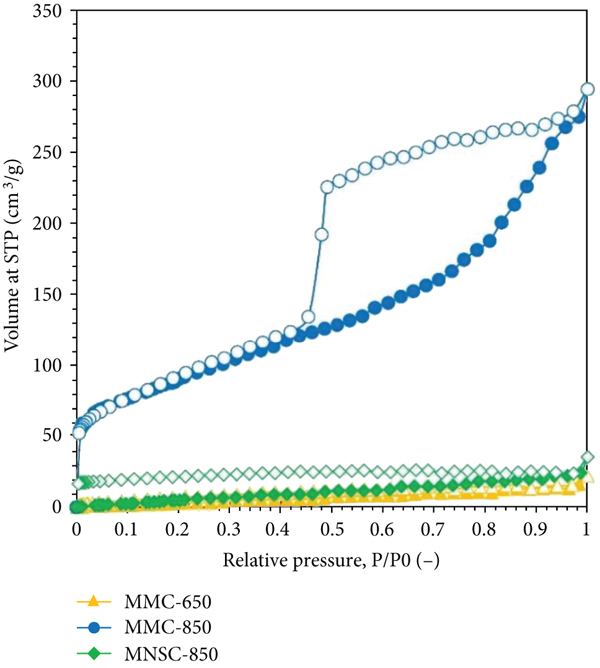
N2 adsorption-desorption isotherms (77 K) of MMC-650, MMC-850, and MNSC-850 (a) and CAC (b).

The specific surface area, total pore volume, micropore volume, and mesopore volume of MMC-650, MMC-850, MNSC-850, and CAC.
Remark: N/D: not determined.
3.1.2. Effect of Fe(NO3)3 on Surface Morphology
Surface morphologies of MNSC-850, MMC-650, and MMC-850 are presented in Figure 3. Surface morphologies of MNSC-850, MMC-650, and MMC-850 were totally different. SEM micrographs clearly emphasized the role of Fe(NO3)3 on the tremendous increase of surface area for MMC-650 and MMC-850 compared to MNSC-850.

Scanning electron microscope (SEM) images of MNSC-850 (a, d), MMC-650 (b, e), and MMC-850 (c, f).
3.1.3. Effect of Fe(NO3)3 on Crystalline Arrangement and Phase Transformation
The crystalline arrangement and phase transformation of MMC-850, MMC-650, and MNSC-850 were determined from X-ray diffraction patterns, as shown in Figure 4. Both MMC-650 and MMC-850 exhibited peak at 2θ around 45°, which corresponded to metallic Fe (JCPDS no. 03-065-4899) [74, 75]. MNSC-850 and MMC-650 revealed broad diffraction peaks at 2θ around 26° and 44°, indicating amorphous carbon (low graphitization degree) [76]. As regards MMC-850 presented a shape peak at 2θ around 26°, suggesting crystalline structure of graphite (JCPDS no. 01-075-1621). The presence of iron compounds in amorphous carbon at high temperatures can cause catalytic graphitization process, transformation of amorphous carbon into the graphitic structure [40]. Besides, only XRD pattern of MMC-850 demonstrated peaks at 2θ around 30.4°, 35.3°, 43.2°, 53.2°, 57.1°, and 62.6°, which corresponded to the characteristic peaks of magnetite (Fe3O4) (JCPDS no. 01-075-0499) [75]. Carbonization temperature of Fe(NO3)3 impregnated macadamia nutshell obviously played an important role for full formation of Fe3O4 phase. Complete magnetite phase was obtained when the suitable temperature (850°C) was reached.

X-ray diffraction (XRD) patterns of MMC-850, MMC-650, and MNSC-850.
3.1.4. Magnetic Properties of Magnetic Mesoporous Carbon
Magnetization curves of MMC-650 and MMC-850 are shown in Figure 5. The saturation magnetization (

Vibrating sample magnetometer (VSM) curves of MMC-850 and MMC-650.
Magnetic properties of MMC-650 and MMC-850 and chemical composition of all samples.
3.2. Adsorption of Reactive Black 5 Dye
The adsorption efficiency of MNSC-850, MMC-850, and CAC was investigated in batch adsorption tests. CAC was intentionally selected as an example of activated carbon adsorbents for general removal of organic contaminants in wastewater treatment process. Large specific surface area and high micropore volume of CAC are shown in Table 2.
3.2.1. Effect of Carbon Dosage on RB5 Removal and Adsorption Efficiency
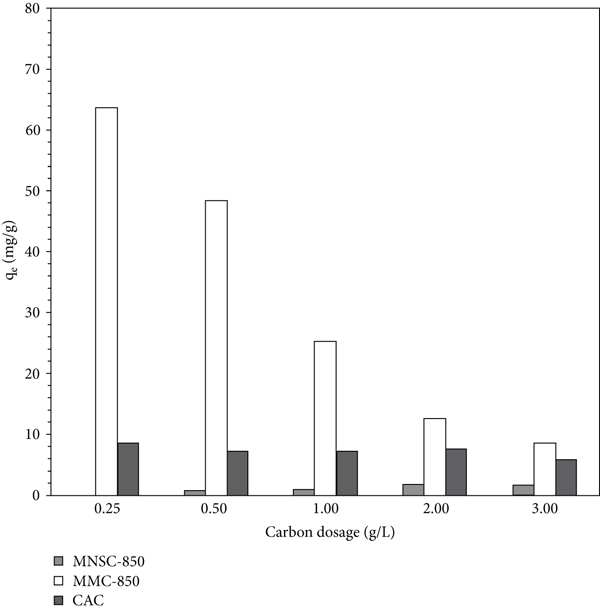
RB5 adsorption efficiency was investigated using different amounts of carbon (0.25, 0.50, 1.0, 2.0, and 3.0 g/L) with an initial concentration of 20 mg/L at 30°C for 48 hours. In Figure 6, the more carbon dosage, the higher RB5 removal percentage (from 0.00 to 18.55 percent for MNSC-850, 63.04 to 99.99 for MMC-850, and 9.00 to 74.14 percent for CAC, respectively) becomes. In contrast, the adsorption capacity (

Effect of carbon dosage on RB5 removal (a) and adsorption efficiency (b) of MNSC-850, MMC-850, and CAC.
3.2.2. Effect of Initial Concentration on the RB5 Removal
Effect of initial concentration on RB5 removal percentage was examined by initial concentration in the range of 5 to 300 mg/L, 0.5 g/L carbon dosage for 72 hours. Figure 7 shows that MNSC-850 had poor removal efficiency (from 4.04 to 0.00 percent), while MMC-850 and CAC showed decreases in the uptake of RB5 as the initial concentration increased (from 99.99 to 19.44 percent for MMC-850 and 43.52 to 2.81 for CAC). When the ratio between RB5 and active site on adsorbent surface is high as a result the removal percentage was decreased. The greater removal percentage at all concentrations and higher removal efficiency of MMC-850 compared to CAC were presumably due to the number of mesopores in MMC-850.

Effect of initial concentration on the adsorption of RB5 onto MNSC-850, MMC-850, and CAC.
3.2.3. Effect of Adsorption pH on the RB5 Removal
The adsorption pH is an important factor in determining the surface charge of the adsorbent. Figure 8 shows the adsorption efficiency at pH range 3-11. MMC-850 under acidic conditions showed relatively high adsorption efficiency of 126.70 mg/g and 131.80 mg/g for pH 3 and pH 5, respectively. As the pH increased, the adsorption efficiency decreased due to the electrostatic interaction force. At adsorption

Effect of pH on the adsorption of RB5 solution onto MNSC-850, MMC-850, and CAC.
3.2.4. Adsorption Equilibrium and Thermodynamics Adsorption
Table 4 displays parameters from Langmuir (
Isotherm parameters of Langmuir, Freundlich, and D-R models for RB5 adsorption.

Adsorption isotherm models for RB5 adsorption onto (a) CAC, (b) MMC-850 at 30°C, (c) MMC-850 at 40°C, and (d) MMC-850 at 50°C.


D-R model can determine whether the adsorption mechanism was physisorption, ion exchange, or chemisorption through free energy of adsorption (
The Langmuir model was used to calculate the maximum monolayer adsorption capacity (
Table 5 presents thermodynamics parameters for RB5 adsorption on MMC-850 at 30°C, 40°C, and 50°C. The negative value of
Thermodynamics parameter for RB5 adsorption onto MMC-850.
3.2.5. Adsorption Kinetic of RB5
The adsorption kinetic and dynamic of RB5 on MMC-850 were investigated by kinetic rate models, pseudo-first-order (PFO), pseudo-second-order (PFO), and Elovich models.
Kinetic parameters of pseudo-first-order (PFO), pseudo-second-order (PSO), and Elovich model for RB5 adsorption.

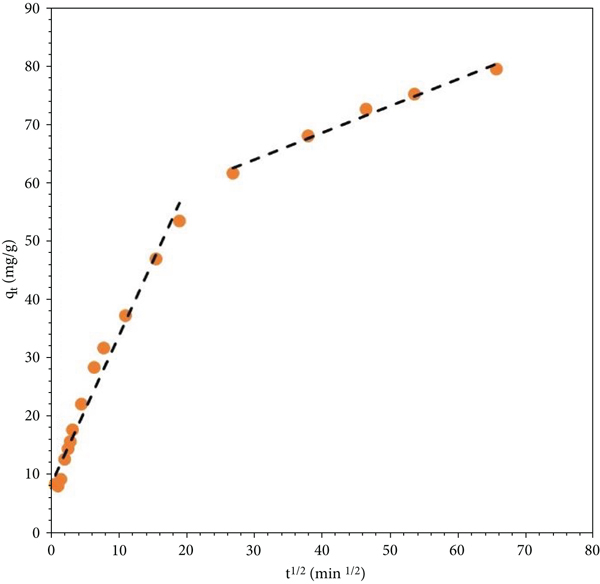
(a) Adsorption kinetic models for RB5 adsorption onto MMC-850; (b) intraparticle diffusion model for RB5 adsorption onto MMC-850.
3.2.6. Intraparticle Diffusion Model
The intraparticle diffusion model is used for describing the adsorption mechanism and rate-limiting step. According to Weber and Morris [69]; when the regression of
Intraparticle diffusion parameter for RB5 adsorption.
3.2.7. Adsorption Mechanisms of RB5 Adsorption
Mechanisms for cationic dye adsorption included electrostatic attraction, hydrogen bonding formation,
From Section 3.2.3, RB5 adsorption efficiency of MMC-850 slightly changed when the solution pH changed. Therefore, it was suggested that the electrostatic interaction mechanism was negligible in RB5 adsorption. In addition,
3.2.8. MMC-850 as RB5 Adsorbent Compared to Others
RB5 adsorbents consisting of commercial-activated carbon, activated carbon from waste materials, and magnetic iron oxide as well as polyethyleneimine and cellulose on magnetic nanoparticles (MNPs) are listed in Table 8. However, carbon precursor of magnetic mesoporous carbon (MMC-850) is made from agricultural waste, providing them both inexpensive and renewable adsorbent. Besides, MMC-850 is considered as high potential as RB5 adsorbent in term of low cost, sustainability, facile, and green preparations by using only one Fe(NO3)3 chemical activator. Furthermore, RB5 adsorption by MMC-850 was conducted at pH 7 which is considered environment friendly process since no added chemical is required for pH adjustment. Moreover, MMC-850 can be easily separated from wastewater treatment afterward. The future scale up of RB5 adsorption by MMC-850 by column packing is highly possible due to the strength of macadamia nutshell.
Adsorbents for RB5 adsorption.
Remark: NR: no report.
Remark: NR: no report.
3.3. Stability of Adsorbent after Adsorption Process
The stability of MMC-850 after RB5 adsorption was quantified by the amount of iron leached into solution during the adsorption process and crystalline structure of iron compounds in the adsorbent structure after the adsorption process. The result showed that the leaching content of iron was less than 0.50 mg/L in solution. Furthermore, the XRD patterns of MMC-850 after RB5 adsorption were identical to MMC-850 before RB5 adsorption, as illustrated in Figure 11. Therefore, magnetite and iron in the MMC-850 structure had negligible loss.

X-ray diffraction (XRD) patterns of MMC-850 before and after RB5 adsorption.
3.4. Thermal Regeneration of Spent Magnetic Mesoporous Carbon
The reversibility of adsorption was examined using a thermal regeneration experiment [84]. The spent magnetic mesoporous carbon was pyrolyzed under a nitrogen atmosphere at 400°C for 2 hours to decompose RB5 within the structure. For each cycle, the regenerated carbon was retested for adsorption efficiency at a RB5 concentration of 10 mg/L and 30°C. According to Figure 12, the removal percentage of RB5 decreased slightly from 99.47% in the first cycle to 98.95% in the second cycle. By the third cycle of the experiment, the RB5 removal percentage rapidly reduced to 77.48%, possibly due to a change in the pore structure within the absorbent material. At the end of the fourth cycle, the percentage of RB5 removed declined continuously from 77.48 to 68.92. It was observed that thermal regeneration was effective in degrading RB5.

Thermal regeneration of RB5 onto MMC-850 at four cycles (condition: initial concentration 10 mg/L, carbon dosage 0.5 g/L, temperature 30°C, and time 72 hours.).
4. Conclusion
Magnetic mesoporous carbon from macadamia nutshell (MMC-850) is a promising adsorbent in terms of facile preparation, low cost, and sustainability. Fe(NO3)3 and high-lignin content macadamia nutshell were carbonized at 850°C to generate magnetic mesoporous carbon that can be easily separated from RB5 adsorption system. It can be preliminarily concluded that mesopores on MMC-850 played a crucial role for RB5 adsorption. The isotherm and kinetics adsorption models of RB5 removal by MMC-850 were Langmuir and Elovich, respectively. The intraparticle diffusion model suggested that RB5 adsorption onto MMC-850 was influenced by multisteps, film diffusion, and intraparticle diffusion. Thermodynamic studies described RB5 adsorption on MMC-850 as a spontaneous process and an exothermic adsorption process. The dominant mechanism of RB5 removal on MMC-850 was pore filling. MMC-850 is not only an effective adsorbent for RB5 removal, but it can also be easily regenerated through thermal regeneration.
Footnotes
Abbreviations
Data Availability
The supporting data used to support the findings of this study are available from the corresponding author upon request.
Conflicts of Interest
The authors declare that they have no conflicts of interest.
Acknowledgments
The authors would like to acknowledge Dr. Chanchana Thanachayanont from National Center for Metal and Materials Technology Center (MTEC) who provided insight and expertise that greatly assisted the research. This research work was partially supported by Chiang Mai University. The authors would also like to thank Assistant Professor Dr. Yothin Chimupala from the Department of Industrial Chemistry, Faculty of Science, Chiang Mai University, for comments that greatly improved the manuscript. This work was supported by the Industry Academia Partnership Programme-18/19, Royal Academy of Engineering and Office of the Higher Education Commission (IAPP18-19\119), and Thai Graduate Institute of Science and Technology (TGIST), National Science and Technology Development Agency (SCA-CO-2562-9657-TH).