




Abstract
The wide application of organic dyes in many industries has brought challenges to the effective treatment of organic wastewater. In this study, a series of ZrMOX (M: Fe, Co, Ni, Cu) particles were prepared by the coprecipitation method to adsorb methyl orange (MO) in aqueous solution. The adsorbents were characterized by X-ray diffraction (XRD), scanning electron microscopy (SEM), Fourier transform infrared spectroscopy (FT-IR), and N2 adsorption-desorption. The selected adsorbent with the best adsorption performance was ZrFeOX with a molar ratio of 1 : 1 and calcination temperature of 573 K; the maximum adsorption capacity was 138.95 mg·g-1. The adsorption behavior of MO onto the adsorbent was studied as a function of contact time, initial concentrations, adsorption temperature, and pH conditions. The analysis results showed that pseudo-second-order, Elovich, and Langmuir models were suitable to describe the adsorption behavior of MO on the adsorbent. In addition, regeneration experiments presented that the MO removal rate reached over 96% after repeated recycling for 5 times. The adsorbent developed in this work is not only simple to prepare and low cost but also green and energy-saving, which can make some contributions to environmental governance.
1. Introduction
Dye is a very important part of human production and life [1]. Up to now, more than 100 000 types have been discovered or invented, and over 7 000 tons of dyes are being manufactured and used yearly world widely [2]. There are about 100 tons of dye wastewater discharged into the water body every year in the process of using dyes [3]. MO belongs to the type of azo dye; it is mainly used as an acid-base indicator and biological dye. Due to the existence of the −N=N− group and the benzene ring, MO and other azo dyes are highly toxic [4, 5]. They not only cause various diseases in humans and animals but also cause harm to the environment. Therefore, it is necessary to remove MO and other dyes before the dye wastewater is discharged.
Many efforts have been made for eliminating dyes from polluted water, such as advanced oxidation technology [6], extraction [7], photocatalysis [8], and adsorption [5]. Among those, compared with the electrochemical oxidation energy consumption, extraction required more additives; photocatalysis is limited by the intensity of light. Adsorption has the advantages of mild conditions and does not need high temperature. More importantly, adsorption is a convenient, low-cost method for its extremely well-sourced adsorbent materials [9, 10].
In recent years, various adsorbent materials were discovered to the removal of dyes from wastewater. Active carbon (AC) [11–13] and modified AC [14–16] were the largest type, because they showed a high specific surface area up to 2 000 m2·g-1. MOF [17] such as UiO-66-NH2 showed excellent adsorption ability to methyl orange and methylene blue, and the maximum adsorption capacities were as high as 148.4 and 549.6 mg·g-1, respectively. Metal composite oxides [9, 18] and some natural products [19–21] also showed excellent adsorption performance for dye absorption. However, there are many problems in adsorbents such as deficient adsorption capacity, poor regeneration performance, and loss of active components. Zirconium has good ability to accept lone pair electrons, and various coordination compounds have stable spatial structure [22, 23]. Composite oxide-based zirconium represented favorable stability against most solution systems with different acid-base properties and temperatures. The adsorbents possessed larger adsorption capacity; good stability and good reusability are optimum.
In this work, an anionic dye MO was selected as the target contaminant molecule. A series of metal composite oxides based on zirconium were prepared by the coprecipitation method as adsorbents. The materials were characterized by N2 adsorption-desorption, XRD, SEM, and FT-IR. Then, the effects of contact time, adsorption temperature, pH, and initial concentration on the adsorption of adsorbents were evaluated through batch experiments. The adsorption kinetics, isotherm, and thermodynamics of the experimental data were analyzed. In addition, the regeneration performance of the adsorbent was evaluated.
2. Experimental
2.1. Materials and Methods
Ni(NO3)2·6H2O (≥98%), Co(NO3)2·6H2O (≥98.5%), Fe(NO3)3·9H2O (≥98.5%), Zr(NO3)4·5H2O (≥99%), and HCl (36%~38%) were obtained from Tianjin Kermel Chemical Reagent Co., Ltd. (Tianjin, China). Cu(NO3)2·3H2O (≥99%) and MO (C14H14N3SO3Na, CAS No.: 547-58-0,
2.2. Preparation of Adsorbents
Adsorbent metal composite oxides were prepared by coprecipitation [24]. 0.02 mol of M(NO3)X·yH2O and 0.02 mol of Zr(NO3)4·5H2O were weighed and added to 100 mL distilled water. The mixed solution was stirred for 30 min at room temperature to obtain a homogeneous solution. Precipitator (NH3·H2O, 10% aqueous solution) was added to adjust pH of 9, then stirred 1 h, and stood for 1 h. After filtration, the residue was dried for 12 h at 353 K. Then, the obtained powders were calcined at given temperature through a 2 K·min-1 heating rate and holding temperature for 4 h. After selecting the ZrMOX with the highest adsorption capacity, the optimum adsorbent was selected according to the order of Zr/M molar ratio (4/2, 4/3, 4/4, 4/5, and 4/6) and calcination temperature (473 K,573 K, 673 K, and 773 K). A series of adsorbents were obtained at various preparation conditions, which were labelled as a-b-ZM, where
2.3. MO Adsorption on ZrMOX
Batch experiments were carried out using a series of a 50 mL conical flask sealed with cling film. MO stock solution of 200 mg·L-1 was prepared through adding a certain amount of MO into distilled water. For each experiment, a certain amount of MO stock solution was diluted to required concentration. 40 mg adsorbent was added to 50 mL methyl orange solution for each adsorption test. Batch adsorption experiments were run in an air bath shaker (THZ-100, Shanghai Yiheng Instrument Co. Ltd., China, 160 rpm), and each batch was controlled no less than 24 h. All concentrations of MO solutions were analyzed by a dual-beam ultraviolet-visible spectrophotometer (PERSEE, TU-1900, Beijing, China). Before determination, the standard curve was plotted by the testing of standard samples, and the correlation coefficient reached 0.99. All experimental data were repeated twice in order to reduce errors. The adsorption capacity
2.4. Regeneration of Adsorbents
Regeneration study was carried out as follows. 0.5 g of used adsorbent was put into 100 mL of 0.1 M NaOH solution stirring for 1 h. The adsorbent was washed to neutrality and centrifuged out. Then, it was put into 0.001 M HCl solution containing 100 mL and stirred for 1 h, after which centrifugalization and lavation were performed. Adsorption experiment was carried out after the adsorbent was dried at 353 K for 8 h. Removal rate of MO was calculated as follows:
2.5. Characterization of Adsorbents
Morphological features of all adsorbents in this work were examined via scanning electron microscopy (SEM) using a JSM-6700F equipment (JEOL, Japan). X-ray diffraction analysis of the adsorbents was performed with a Bruker D 8 Advance (Bruker-AXS, Germany) equipped with a copper anode (
3. Results and Discussion
3.1. Effect of the Type of ZrMOX
A batch of Zr/Cu, Zr/Co, Zr/Ni, and Zr/Fe oxides with the molar ratio of 1 : 1 was prepared for equilibrium adsorption experiment. The results are shown in Figure 1(a); the equilibrium adsorption capacity of the 1-573-ZFe was the largest. Surface area and pore volume are an important indicator that affects the adsorption capacity [26]. From Table 1, it can be seen that 1-573-ZFe has abundant surface area and pore volume in the four ZrMOX, which attributed to obtaining the highest equilibrium adsorption capacity among the four ZrMOX.

Factors affecting the adsorption performance of ZrMOX: (a) different ZrMOX, (b) molar ratio of Zr/Fe, (c) calcination temperature, and (d) pH of the solution (adsorption conditions of (a), (b), (c), and (d): conc.: 50 mg·L-1, dose: 40 mg, T: 303 K).


The surface area and pore volume parameters of four samples.
3.2. Investigation on the Optimal Zr/Fe Molar Ratio
A series of ZrFeOX particles with different molar ratios were prepared as adsorbents to investigate the removal of MO. From Figure 1(b), it was obvious that the largest adsorption capacity was obtained at 1 : 1 of the Zr/Fe molar ratio. This situation may be caused by the synergistic effect between Zr and Fe [27]. When the Zr/Fe molar ratio was greater than 1, the synergistic effect gradually increases with the increase of Fe content, and the adsorption sites gradually increase, resulting in an increase in the equilibrium adsorption capacity. However, when the molar ratio was less than 1, iron oxides may coat the adsorption sites [28], resulting in a decrease in adsorption sites and further a reduction in the equilibrium adsorption capacity.
3.3. Effect of Calcination Temperature
The calcination temperature has a significant effect on the formation [29] and absorption efficiency of adsorbents. The adsorption properties of 1-ZFe prepared after calcination at 473 K, 573 K, 673 K, and 773 K for MO were investigated, respectively; the result is shown in Figure 1(c). It can be seen from Figure 1(c) that when calcination temperature was between 473 K and 573 K,
3.4. Effect of MO Solution pH
As shown in Figure 1(d), the effect of solution pH (2~12) on adsorption performance of 1-573-ZFe was tested. It can be seen that adsorption of MO on the surface of 1-573-ZFe can proceed normally under acidic conditions. However, when pH reached 7,
3.5. Characterization of ZrMOX
Figure 2 shows the XRD spectrum of four 1-ZFe calcined at 473 K, 573 K, 673 K, and 773 K. It was shown that the adsorbents were amorphous. By comparing with the standard PDF card of the oxide of zirconium and iron, the peak appearing at about 32° may be contributed by Fe2O3 and ZrO2 (JCPDS card No. 40-1139 and 49-1746, respectively). When the calcination temperature reached 773 K, it can be seen that there were two peaks near 32°, which may be caused by the increase of crystallinity which reflected in the (1 1 3) and (1 1 6) planes of Fe2O3 and the (1 2 0) and (1 1 1) planes of ZrO2. There was no information about the broad peak near 15° related to the oxides of zirconium and iron, which was consistent with the results reported by Dou et al. [31].

XRD patterns of four 1-ZFe calcined at different temperatures.
N2 adsorption-desorption isotherms are shown in Figure 3(a), and the adsorption of N2 on ZrMOX was type IV isotherm according to IUPAC [32]. There was a hysteresis loop at relative pressure (

(a) N2 adsorption-desorption isotherms and (b) the pore size distributions of four ZrMOX.

Figure 4 shows the FT-IR spectrum of 1-573-ZFe. The absorption peaks at 3408 cm-1 and 1630 cm-1 were bending vibration and O-H tensile vibration of water molecules adsorbed by 1-573-ZFe, respectively [33]. The signals at 1385 cm-1 were attributed to the bending vibration of the Zr-OH groups [34]. The wide peak near 500 cm-1 was caused by the vibration of Zr-O and Fe-O bonds.

FT-IR spectra of 1-573-ZFe.
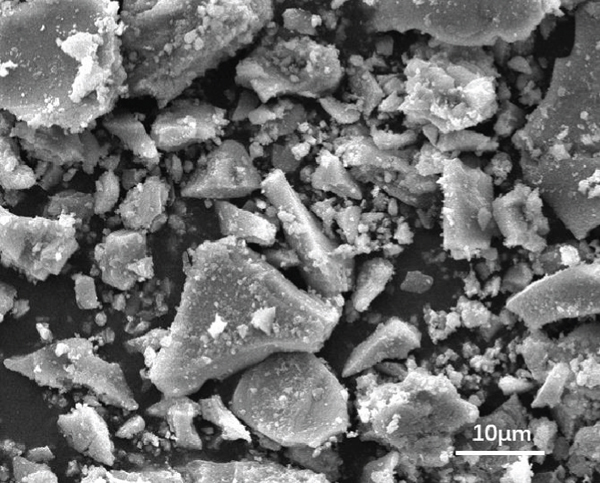
As shown in Figure 5, the morphology for 1-573-ZFe was observed by SEM. It can be seen from the figure that the size distribution of the material was wide and amorphous, and there have many particles smaller than 2 microns on the solid surface of the adsorbent. There was no obvious pore structure observed on the surface of the adsorbent. Combined with the characterization results of N2 adsorption-desorption, it can be well proved that there was no macroporous structure in the adsorbent.

(a, b) The SEM images of 1-573-ZFe.
3.6. Adsorption Kinetics
The kinetic data was obtained under the conditions of 303 K and initial concentrations of 50 mg·L-1 and 200 mg·L-1 MO solutions. Several classical kinetic models were used in this work, such as pseudo-first-order (PFO), pseudo-second-order (PSO), and Elovich (ELO) models presented in the following (Equations (4)–(6)) [35]:
Fitting parameters of PFO, PSO, and ELO kinetic models for MO adsorption are shown in Figure 6 and Table 2. It can be seen from Figure 6 that no matter the initial concentration was 50 mg·L-1 or 200 mg·L-1, there was a fast adsorption rate in the initial stage of adsorption, and the adsorption was almost completed within 300 minutes. Combined with the chart, the kinetic models of PSO and ELO are more consistent with experimental data than PSO. It can be explained that the rate-limiting step was chemical adsorption [36] on the heterogeneous interface of 1-573-ZFe [37].
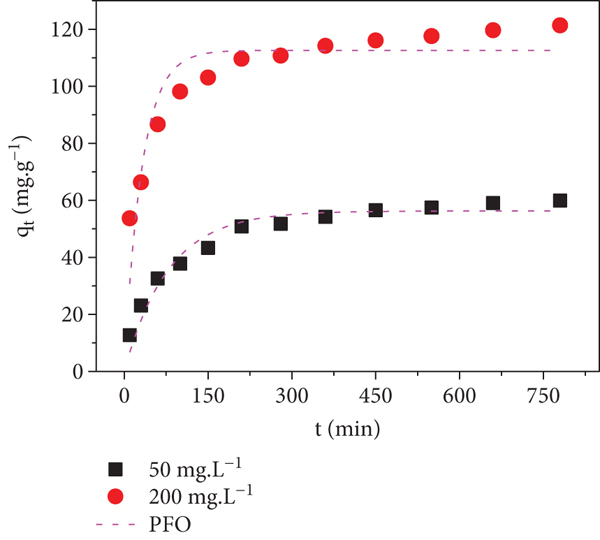
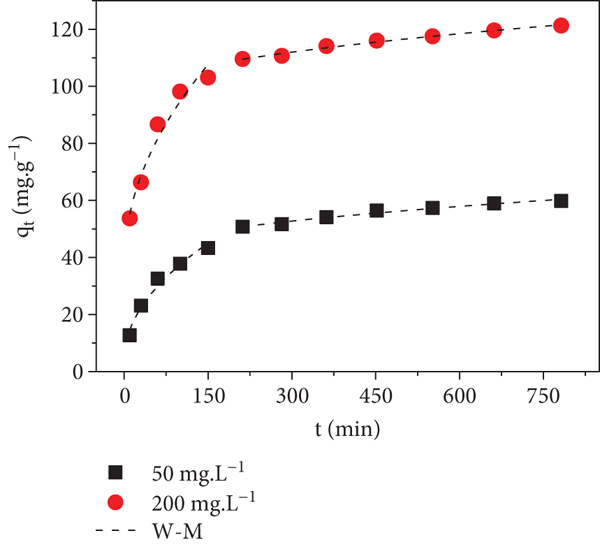
Fitted of experimental data with (a) PFO, (b) PSO, (c) ELO, and (d) W-M kinetic models.


The fitted values of parameters in PFO, PSO, and ELO and W-M kinetic models.
In general, the Weber and Morris model (W-M) was often applied to fit the kinetic data in order to deduce the rate-limiting step [32], expressed as Equation (7) [38]:
It can be seen from the multisegment fitting diagram in Figure 6(d) that the adsorption process of MO on 1-573-ZFe has undergone two stages of film diffusion and pore diffusion; Qian et al. [39] adsorption of haloforms on granular activated carbon and Liu et al. [30] adsorption of MO on FeOCl-MoS2 both observed similar phenomena. Surface adsorption occurs first in the first stage, and the MO in the solution rapidly diffuses and adsorbs to the surface of 1-573-ZFe, resulting in a larger value of
3.7. Adsorption Isotherms
Adsorption isotherm is an important factor of adsorption performance. Adsorption isotherm demonstrates the relationship curve between
As shown in Figure 7(a), it can be seen that

Experimental adsorption isotherms of MO adsorption on 1-573-ZFe at 303-323 K (a) and their correlation with Langmuir and Freundlich adsorption models (b, c, and d).


The fitted values of parameters in Langmuir and Freundlich models for MO adsorption.
3.8. Adsorption Thermodynamics
In order to obtain the change of energy in the adsorption process, thermodynamic experiments were carried out at the temperature of 303 K, 313 K, and 323 K, respectively. The changes of thermodynamic parameters of Gibbs free energy (
Thermodynamic parameters for adsorption of MO on 1-573-ZFe.
It can be seen from Table 4 that
3.9. Regeneration Performance
The regeneration of the adsorbent is an important indicator to judge whether it can be used as an industrial adsorbent. After the regeneration experiment was finished, 1-573-ZFe was directly used for readsorption of MO. The result is shown in Figure 8. It can be seen from the figure that although the removal rate of MO gradually decreases with the increase of the number of cycles, the results of the fifth cycle regeneration test show that the removal rate of MO can reach 96.37%. Even after the sixth time, the MO removal rate can still reach more than 80%. These results demonstrated that 1-573-ZFe not only has good regeneration stability but also has good application potential in environmental remediation.

Regeneration efficiency from batch experiments for 6 consecutive cycles of regeneration of 1-573-ZFe.
In Table 5, the adsorption capacities of MO were compared between this work and other reported adsorbents. The adsorbents were often modified through some processes to increase their adsorption capacity for MO. By comparison, it can be seen that the 1-573-ZFe adsorbent reported in this work has good adsorption capacity. Moreover, the preparation method is simple, the economic cost is low, and the energy consumption is low. It is an adsorbent with good commercial application value.
Comparison of MO adsorption capacity for various adsorbents.
4. Conclusion
In summary, among the four ZrMOX adsorbents prepared by the coprecipitation method, through step-by-step screening, 1-573-ZFe showed best adsorption performance when the pH was between 4 and 6; this may be due to their high BET surface area (255.754 m2·g-1) and pore volume (0.218 cm3·g-1). It can be seen from the XRD and SEM characterization results that 1-ZFe is an amorphous composite metal oxide with irregular structure. The experimental data of kinetics and PSO and ELO can describe the dynamic adsorption process of MO on 1-573-ZFe, indicating that the adsorption of MO on 1-573-ZFe was a chemical adsorption control process that occurs on a heterogeneous surface. When the MO concentration is 0~60 mg·L-1, the temperature change has almost no effect on the equilibrium adsorption capacity, and the removal rate of MO can reach more than 94%. The isotherm model indicated that MO has a monolayer adsorption on the 1-573-ZFe surface. The thermodynamic parameter
Footnotes
Data Availability
The data used to support the findings of this study are included within the article.
Conflicts of Interest
The authors declare that they have no conflicts of interest.
Authors’ Contributions
Ms. Yulong Sun contributed equally to this work and should be considered co-first author.
Acknowledgments
The investigation was supported by Kaifeng Science and Technology Planning Development Project (2001005).