




Abstract
With the exhaustion of coal resources in shallow coal seams, many mining areas have moved to deep mining, and the coal storage environment is obviously affected by the mining depth, mainly manifested as the increase of gas pressure and temperature, which makes the adsorption characteristics of deep coal seam gas much more complicated than shallow coal seam. Based on this, this paper chooses Pingdingshan coking coal as the research object, using Hsorb-2600 high-temperature and high-pressure gas adsorption instrument to carry on isothermal adsorption experiment. According to the adsorption theory and the uniqueness of the adsorption characteristics cure, the adsorption model was analyzed and studied. The results show that the predicted curve of coal seam gas adsorption isotherm is in good agreement with the measured curve, the relative error is less than 10%, and the adsorption characteristic curve is logarithmic. At the same time, the model is used to study the variation of adsorbed gas amount with mining depth. The results show that the adsorbed gas amount increases first and then decreases with coal burial depth.
1. Introduction
The development and utilization of coking coal play a vital role in the development of Chinese coal industry and is an indispensable resource for our economic construction [1–3]. For a long time, the mining depth of coking coal is generally lower than that of anthracite [4], and the focus of gas control is mainly on highly metamorphic coal represented by anthracite, and the research on coking coal mining area is less, but with the depletion of shallow coal resources, many mining areas have been transferred to deep mining [5–7]. Deep mining means that while little research has been done on the influence of coking coal on gas adsorption under high temperature and high pressure, adsorption characteristics of deep coal seam gas are the basis of coalbed methane development, and the date of methane adsorption is also the necessary basic parameter for predicting and analyzing coalbed methane reasoures [8–10]. Therefore, it is necessary to study the gas adsorption characteristics in deep coking coal mining area for the safe mining of deep coal seams and the effective control of gas disaster [11].
A lot of studies have been done on the influence of temperature and pressure on the adsorption performance of coal. Levy et al., Bustin and Clarkson, and Sakurovs et al. [12–14] found that the gas adsorption amount on the coal body surface is directly proportional to the pressure and inversely proportional to the temperature. By studying the adsorption/desorption of anthracite coal at -30°C to 30°C, Wang et al. [15] found that the temperature has great influence on the gas adsorption isotherm of coal, and the lower the temperature is, the greater the gas adsorption amount of coal; Zhao et al. [16] mainly focused on the single factor of temperature and studied the gas adsorption characteristics under high-temperature conditions and found that the gas adsorption amount increases with the temperature. It can be seen from the above that most of the early scholars’ studies on the occurrence law of coal seam methane were carried out under low temperature and low pressure and mainly focused on the influence of a single factor. In the process of coalbed methane reserve prediction, in order to explore the relationship between methane gas volume adsorbed by coal and pressure at different temperatures, it is necessary to consider the influence of temperature and pressure on coal adsorption. Therefore, it is of great significance to study the influence of temperature and pressure on methane gas volume adsorbed by coking coal.
At present, the research on predicting the variation of coalbed methane with burial depth has been paid much attention in the evaluation of coalbed methane reserves. The results of Zhao et al.’s [17] study on the effect of deep coalbed methane reservoir show that the relationship between temperature and coal bed adsorption capacity is negative, which is far greater than the positive correlation of formation pressure, resulting in the existence of a critical depth of gas content in deep coalbed, indicating that temperature and pressure jointly affect the adsorption characteristics of coal bed, so the shallow adsorption model is not applicable to deep coal bed. Nie et al. [18] predicted the gas content of deep coal seam. The results show that the existing adsorption model can be used to predict the gas content of shallow coal seam within 800 m, while the combined effect of temperature and pressure should be considered to predict the gas content of deep coal seam above 800 m. To sum up, with the increase of mining depth, the adsorption capacity of coal has a significant change; whether the original adsorption model is applicable has yet to be verified [19–21]. The adsorption of methane on coking coal belongs to the range of physical adsorption [22–24]. The physical adsorption force is mainly the dispersion force, and the dispersion force is independent of temperature. At the same time, the adsorption potential theory holds that the adsorption potential is unique to the volume of the adsorption space and does not change with temperature [25–28].
Based on the adsorption potential theory, the adsorption characteristics of coking coal are studied, the adsorption characteristics curves of coking coal are calculated, and the relationship between the adsorption characteristics and the temperature, pressure, and methane adsorption capacity is established. On this basis, the calculation model of methane adsorption capacity of coking coal under the combined action of temperature and pressure is deduced, and the characterization constants are solved. At the same time, the calculation equation of methane adsorption by coking coal under geological conditions is established by using this model and the prediction of gas content variation with burial depth is studied based on this equation, in order to improve the safety of deep coking coal mining and provide an important basis for the prevention and control of gas outburst.
2. Isothermal Adsorption Experiment of Coking Coal
2.1. Coal Sampling
The main coking coal production and reserve bases in China are mainly concentrated in North China, East China, and South China, and Pingdingshan mining area is the main area in South China. Based on high-temperature and high-pressure methane adsorption experiments, this paper investigates the gas adsorption response characteristics of coking coal in deep coal seam and selects coking coal (soft and hard) samples from Pingdingshan, Henan Province, for the determination of basic parameters. The determination results of the basic parameters of the coal sample are shown in Table 1.
The basic parameters of coal samples.
2.2. Determination of Experimental Temperature and Pressure Parameters
2.2.1. Description of Sampling Sites
Pingdingshan Coal Mine is located in the middle and west of Pingdingshan Coal Field, Henan Province. The administrative region is under the jurisdiction of Xinhua District, Pingdingshan City. Geographical coordinates are as follows: 113° 11
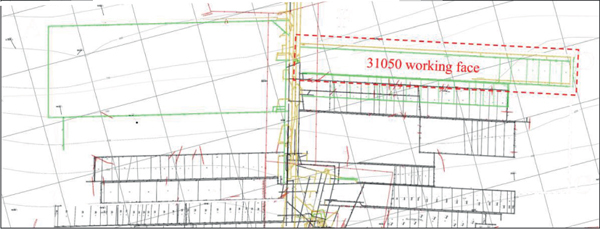
Face sampling map.
2.2.2. Determination of Experimental Temperature and Pressure Parameters
According to the survey data, the maximum value of average geothermal gradient is 4.6°C/100 m, while the minimum value is 3.2°C/100 m, and the average value is 3.9°C/100 m; the maximum value of average reservoir pressure gradient is 1.293 MPa/100 m, while the minimum value is 0.42 MPa/100 m, and the average value is 0.86 MPa/100 m.
Since the maximum gas pressure of 6.3 MPa in Pingdingshan Mine is about 1000-1100 m, and combined with the research purposes and the actual situation of the experimental device, the maximum equilibrium pressure of this experiment is determined to be 11 MPa, and the temperature parameters are 30°C, 50°C, 70°C, and 90°C.
2.3. Experimental Device and Process
With the help of Hsorb-2600 high-temperature and high-pressure gas adsorption instrument, the isothermal adsorption experiment was carried out. The experimental equipment is shown in Figure 2. The highest temperature of the instrument can reach 600°C, and the lowest is -196°C, while the maximum pressure is 20 MPa, and the minimum is 0.04 MPa. It can be used to measure the adsorption/desorption of methane by coal at any temperature and pressure with this range. In terms of temperature pressure and accuracy, the instrument has a wider temperature range and a wider range of analyzable items than other common gas sorption apparatus.

Hsorb-2600 high-temperature and high-pressure gas adsorbent instrument.
The experimental adsorbent is 99.999% high-purity methane, and the experimental procedure is as follows:
The prepared coal sample for high-temperature and high-pressure adsorption experiment shall be put into the sample tube, then click on the pretreatment, and be dried for 4 hours at 105°C After the pretreatment, the sample tube shall be removed after cooling then installed for testing Computer set test parameters: the maximum adsorption equilibrium pressure is set to 11 MPa, 11 equilibrium pressure points, and the experiment temperature is set to 30°C. The instrument can automatically record the adsorption amount after the instrument reaches adsorption equilibrium, and the adsorption data of different adsorption equilibrium pressure points are obtained Change the experimental temperature. High-temperature and high-pressure methane adsorption experiments at different temperatures (50°C, 70°C, and 90°C) were carried out on soft and hard coal of Liulin and Pingdingshan Mine
The isothermal adsorption characteristics of Pingdingshan coking coal (soft and hard) samples at constant pressure 11 MPa and different temperatures (30°C, 50°C, 70°C, and 90°C) were studied in this paper, and 8 experiments were carried out in total.
3. Analysis of Experimental Results
3.1. Isothermal Adsorption Line
Because the maximum temperature of methane is -82.6°C and the maximum pressure is 4.59 MPa, which exceeds the critical temperature and pressure of methane, methane adsorption becomes supercritical adsorption at this experimental temperature and pressure [29]. The adsorption capacity of Gibbs is obtained by isothermal adsorption experiment (Figure 3). The adsorption capacity of Gibbs is the difference between actual adsorption density and gas phase density, and the absolute adsorption quantity indicates the actual adsorption quantity of the solid adsorption system. It can be seen that the excess adsorption quantity is less than the absolute adsorption quantity. Because the absolute adsorption quantity cannot be measured directly, the excess adsorption quantity has a certain influence on the study of adsorption model. Therefore, in the study of isothermal adsorption characteristics and model, the excess adsorption should be converted to the absolute adsorption, and then, the absolute adsorption was used for model study.
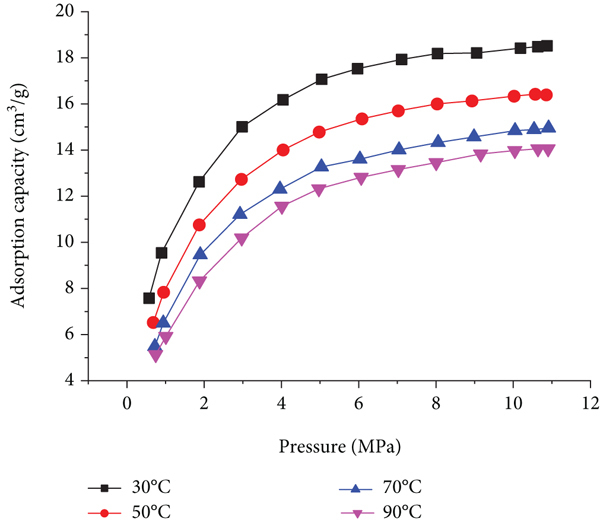
Isothermal adsorption line of methane adsorbed by coking coal.

Isothermal adsorption line of methane by PY
3.2. Correction for Excess Adsorption
According to the definition of absolute adsorption capacity, the relationship between excess adsorption capacity and absolute adsorption capacity is as follows [30]:
From formula (1), the density of free phase (
The density of adsorbed phase in supercritical condition cannot be obtained directly by experiments. Previous scholars mostly used liquid phase method and Langmuir model to calculate the density of adsorbed phase to correct the absolute adsorption capacity. Because there are many parameters in Langmuir fitting method, it will be affected by many factors, while the liquid phase method considers not only the temperature but also the pressure, so the liquid phase method is used to calculate the density of adsorption phase to correct the absolute adsorption. The expression is as follows [31]:
The correction result of absolute adsorption capacity is shown in Figure 4.

Corrected curve of absolute adsorption capacity.

PY corrected absolute adsorption curve
The error bar results of the two are shown in Figure 5.

Absolute adsorption capacity error bar.

PY absolute adsorption error bar
As shown in Figures 3 and 5, the absolute adsorption amount is greater than the excess adsorption amount, and both temperature and pressure affect the difference between the two. In the low-pressure stage (0-4 MPa), the difference between the two is small, and with the increase of pressure, the difference gradually increases; with the increase of temperature, the difference between the two also gradually increases.
4. Adsorption Characteristic Curve
The relationship between adsorption potential and adsorption space is unique. In order to study the adsorption mechanism of deep coking coal on methane, the adsorption potential theory was introduced, the adsorption potential and adsorption space were calculated, and the adsorption characteristic curve is obtained. According to the adsorption potential theory proposed by Polanyi, the relationship between adsorption potential and pressure is as follows [32]:
Under supercritical conditions, the empirical formula established by Dubinin is used to calculate the virtual saturated vapor pressure of methane [33, 34].
The formula for calculating
The absolute adsorption amount of
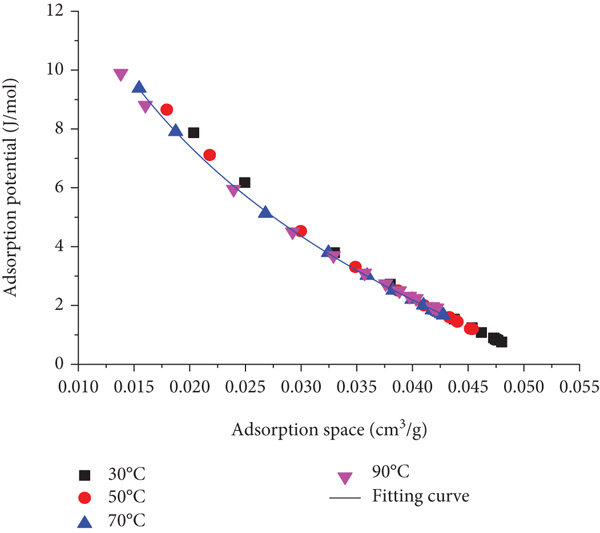
From equations (4) to (8), it can be seen that through the isothermal adsorption curve, the relationship curve between adsorption potential and adsorption space can be obtained, namely, the adsorption characteristic curve of

Characteristic curve of coke coal adsorbing methane.
PY
It can be seen from Figure 6 that the adsorption curves of two groups of coking coal samples at 4 temperatures are almost on the same curve, which shows that the adsorption curve is independent of temperature, and the adsorption curve of coal decreases with the increase of adsorption space. Therefore, the parameters of the adsorption model can be obtained by fitting the adsorption date at a certain temperature which can be used to predict the adsorption amount at different temperatures and pressures.
The expression of the adsorption characteristic curve accords with the logarithmic expression
Pingdingshan soft medium fitting formula.
Pingdingshan hard medium fitting formula.
5. Derivation of Methane Adsorption Model of Deep Coking Coal
Based on the isothermal adsorption experimental data of coking coal, the adsorption model considering the combined effect of temperature and pressure can be derived by fitting the expression of
Take logarithms on both sides of the equation to get
As the depth increases, the gas pressure and the formation temperature are changing. The maximum value of average reservoir pressure gradient is 1.293 MPa/100 m, the minimum value is 0.42 MPa/100 m, and the average value is 0.86 MPa/100 m from 2-2 known mining area.
Due to the direct relationship between formation temperature and depth, the maximum value of average geothermal gradient in the mining area is 4.6°C/100 m, while the minimum value is 3.2°C/100 m, and the average value is 3.9°C/100 m.
Based on the adsorption model of coking coal with the change of temperature and pressure,
6. Validation of Adsorption Model
It is very important to study the variation law of gas content in coal seam with burial depth, because the common adsorption model has better fitting effect on shallow coal seam and poorer fitting effect on deep coal seam. The adsorption model deduced in this paper can be used to know the adsorption characteristics of coking coal at different temperatures and pressures, and the application range is wide. In order to further verify the reliability of the model, 8 groups of coking coal isotherm adsorption data were used to verify the model derived in this paper, and the error analysis method was used to analyze the difference between the adsorption amount calculated by the model in this paper and the measured adsorption amount.
Eight groups of isothermal adsorption data of coking coal are selected to calculate the adsorption amount of coal bed gas: (1) using the data of two groups of coking coal samples at 30°C, calculate the logarithmic value of the adsorption amount, namely,
Fitting results of isothermal adsorption test data of hard coal.

Comparison between predicted isothermal adsorption line of coking coal sample model and measured isothermal adsorption line.
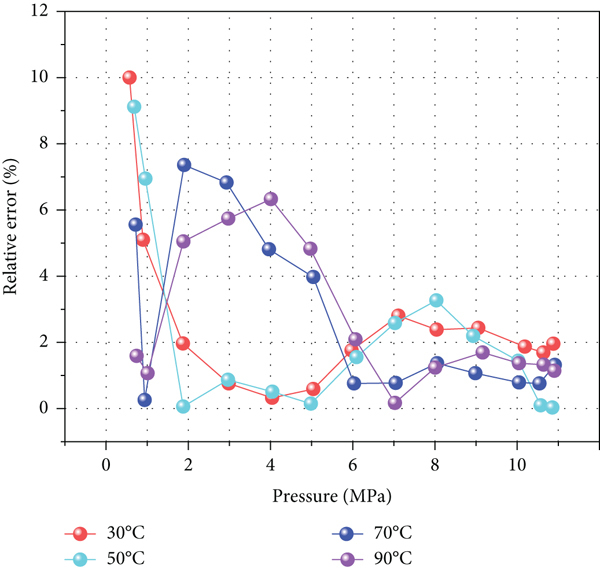
Comparison of predicted value error of coking coal sample model.

Error comparison of PY coal sample model

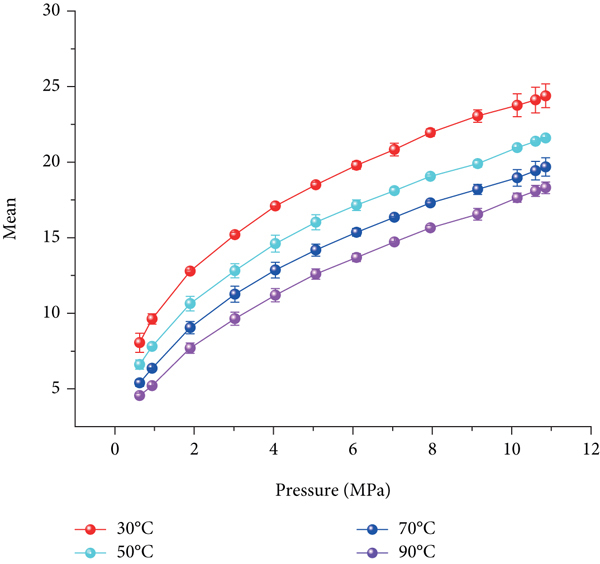
Coking coal sample prediction error bar.
PY
The isothermal adsorption lines predicted by the model and measured isothermal adsorption lines of different coal samples (Pingdingshan hard coal and Pingdingshan soft coal) at different temperatures (30°C, 50°C, 70°C, and 90°C) are shown in Figure 7. It can be seen from Figure 7 that the predicted and measured isotherms of each coal sample under different temperatures are similar, and the predicted and measured isotherms of Pingdingshan soft coal are better fitted than those of Pingdingshan hard coal. The authors think that the reason for this phenomenon is that compared with the total specific surface area of coking coal soft coal and hard coal, the former is always significantly greater than the latter, and the gas adsorption capacity is significantly higher than that of hard coal with the same metamorphic degree. Therefore, the fitting degree of hard coal is relatively low. The fitting between the adsorption model prediction and the measured isotherm of each coal sample is better under high pressure. It can be seen from Figures 8 and 9 that the predicted value of coking coal sample is close to the measured value, and the relative error is less than 10%, among which the predict and the measured value of coking coal under low pressure is larger than that under high pressure, and the error between the predicted and measured is smaller. It is shown that the model derived from the adsorption potential theory can predict the methane adsorption by coking coal with high accuracy, which indicates that the model derived from the adsorption potential theory is feasible. The model expression is as follows:
Soft coal
Hard coal
In order to take into account the amount of gas adsorption at different temperatures and pressures, formulas (11) and (12) show the variation of coal seam pressure and temperature with the change of depth.
Soft coal
Hard coal
The results are shown in Figure 10.
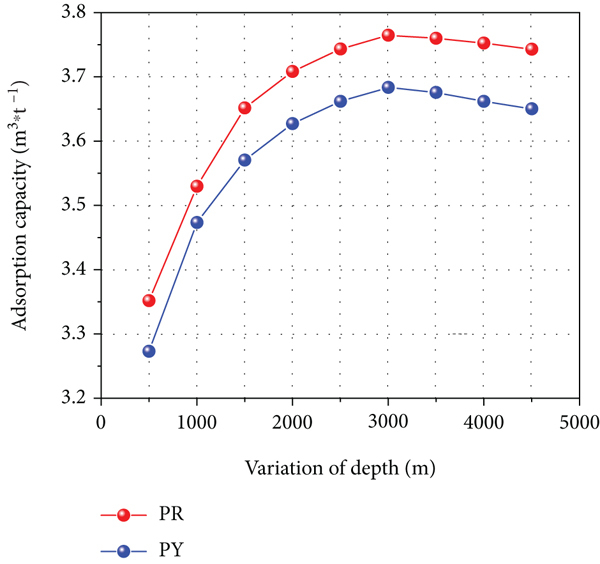
Variation law of coal seam gas content with buried depth.
From Figure 10, it can be seen that the adsorption amount of coking coal in the two groups is consistent with the depth, first increasing with the depth, then decreasing with the depth. Combined with Figure 3, the reason is that the adsorption gas of coking coal increases with the increase of pressure and decreases with the increase of temperature, which shows that the adsorption of temperature and pressure on coking coal is competitive. When the burial depth of coking coal is less than the burial depth corresponding to the maximum adsorption capacity of coking coal, the pressure plays a major role, while when the burial depth equals the burial depth corresponding to the maximum adsorption capacity of coking coal, the major role is temperature.
7. Conclusion
The absolute adsorption capacity is greater than the excess adsorption capacity, and the temperature and pressure have a certain impact on the difference between the two values. When the temperature increases, the difference between the two values decreases, while when the pressure increases, the difference between the two values increases Based on the adsorption potential theory. The adsorption curves of The coking coal adsorption model derived based on the adsorption potential theory has high prediction accuracy and can predict the adsorption amount of coking coal at different temperatures and pressures and obtain isotherm adsorption lines By using the derived adsorption model of coking coal, it is found that the adsorption capacity of coking coal increases first and then decreases with the increase of the coal seam depth
Footnotes
Data Availability
Some or all data, models, or code generated or used during the study are available from the corresponding author. These materials can be requested directly from the corresponding author if needed.
Conflicts of Interest
The authors declare that they have no conflicts of interest.
Acknowledgments
This study was financially supported by the National Natural Science Foundation of China (52074107).