




Abstract
This work aims to evaluate the adsorption capacity of an abundant natural diatomite (ND) to remove the azo dye carmoisine, known as a harmful emerging organic pollutant. Indeed, to the best of our knowledge, no results were reported on this subject. The ND was characterized by FTIR, XRD, and SEM/EDX analyses. The experimental study of adsorption was carried out in batch mode. Results showed that ND adsorbent is mainly composed of silica. A fraction of calcite and ankerite was also identified. It is a porous material with a specific surface of about 41 m2.g-1 and with a hydroxyl surface functional group -OH. Adsorption results showed that adsorption process on ND is found to be effective in removing the carmoisine colorant. The adsorption capacity is strongly affected by the adsorbent and adsorbate contents, the solution pH, the work temperature, and the water hardness and mineralization. At room temperature, optimal experimental conditions for the highest adsorption capacity (12 mg.g-1) were colorant concentration 50mg.L-1, pH 2, contact time 30min, and ND content 1 g.L-1. Modeling study has showed that experimental results are well modeled by the Freundlich isotherm in multilayer adsorption. The reaction kinetics are pseudo-second order, and the thermodynamic parameters indicated that the nature of the adsorption process is endothermic and spontaneous.
1. Introduction
Azoic dyes make up most dyes used in food, textiles, plastics, etc. Their productions and commercialization continue to increase, and they constitute 50-70% of the synthetic dyes used for industrial purposes [1, 2]. However, the release of these recalcitrant dyes, done generally in the water bodies directly, characterizes an important way of environmental contamination [3]. They are harmful to humans, aquatic fauna, and flora [4, 5]. Several methods and techniques were then proposed to treat contaminated water and wastewater. It was reported that the biological treatments under aerobic conditions are not often effective due to the recalcitrance to the degradation of some dyes [6]. Nevertheless, physicochemical processes such as coagulation-flocculation, electrocoagulation, membrane techniques, and chemical and electrochemical oxidation have shown excellent efficacy in treating azo dyes [7–9]. The adsorption, as process of pollutant removal, is chosen for this study; it can be also an alternative method for the treatment of contaminated water with organic molecule as azo dyes. The adsorption process consists in removing the pollutant from the aqueous phase and concentrating it in the adsorbent surface following several mechanisms. It is known to be an efficient, relatively simple, and inexpensive technique. Different adsorbents can be used: classic such as activated carbon and silica gel, as well as recent ones such as natural and industrial waste [10–12]. Natural diatomite (ND) can be also considered among these recent adsorbents, which meet the criteria of sustainable development. ND is an accumulation of hydrated amorphous silica of high stability, nontoxic, low density, and naturally porous [13]. Several researches were performed for possible applications in various domain such as catalysis, hydrogen storage, thermal energy storage, and solar energy production [14–16]. Moreover, ND is recognized to have an adsorbent power for many pollutants [17]. In water treatment and more particularly for the adsorption of dyes, diatomite has also been applied [18–21]; but the literature review has not shown any report on carmoisine dye. In the present work, the study of carmoisine removal was motivated by the fact that it is a very common azo dye, incorporated into several food products: juices, sodas, cookies, ice cream, canned fruits, red meats, etc. [22, 23], making it a potential pollutant which can be released in the environment. In addition, carmoisine, like all other azo dyes, is stable and difficult to degrade; then it can cause more or less serious health risks, such as hyperactivity and attention disorders in children and also neurological and allergenic potentials [24]. For the specific treatment of food dyes, different techniques were applied for wastewater and synthetic solutions: a rotating activated carbon adsorber [25], hybrid system coupling electrocoagulation and solar photocatalysis [26], microbial degradation [27], electro-oxidation-plasma [28], Fenton process [29], and electrocoagulation [30]. Hence, this study will focus on the removal of carmoisine azo dye by adsorption process on natural diatomite. Indeed, there is no work in the literature on this adsorbent/adsorbate couple. For this, the study will start by a physicochemical characterization of the ND adsorbent. In a second stage, main parameters that control adsorption treatment process will be optimized in a batch mode. Finally, modeling of adsorption isotherm and adsorption kinetics will be performed.
2. Materials and Methods
2.1. Preparation and Characterization of Diatomite for Adsorption
The adsorbent used in this study is ND from the Sig region (west Algeria). The raw diatomite without prior pretreatment was washed several times with bidistilled water until the turbidity of the rinse water was less than 5 NTU. After removing the impurities, the diatomite was dried in a study at 80°C for 24 h and then weighed several times until constant weight to evaporate moisture. The dry diatomite was milled (grinder Janke and Kunkel IKA Labortechnik) to obtain a grain size around 1 mm. The resulting sample was kept in an airtight bottle for later use in characterization and the adsorption tests. The characterization of a material is an important factor in explaining the adsorption mechanism. Thus, different structure and texture parameters of an ND were examined. It is possible to cite the specific surface analyzed by nitrogen adsorption at 77°K, using an instrument Thermo Quest Sorptomatic1990, according to the traditional method of Brunauer, Emmett, and Teller or BET [31]. The Fourier transform infrared (FTIR) spectroscopy was recorded at room temperature between 400 and 4000 cm-1 by the standard KBr disk method using a Shimadzu spectrometer. The scanning electron microscopy (SEM) was employed to visualize the morphology of ND using a Philips XL-3 CP microscope. The X-ray diffraction (XRD) was performed on an X-ray diffractometer (Philips X’PERT PANalytical, Almelo, Pays-Bas) with a radiation CuKα at
2.2. Preparation and Analysis
For the preparation and the analyses, we followed the approach of [32, 33].
2.2.1. Preparation
The food colorant tested in this study is a commercial dye prepared in synthetic aqueous solution, and some specific characteristics of this dye are given in (Table 1). All the reagents used for pH regulation in solution (NaOH and HCl) and others are analytical grade supplied by Panreac and Sigma. These reagents are prepared at the desired concentration in double-distilled water.
Some characteristics of carmoisine used.
For the purposes of calibration and adsorption tests, a stock solution of carmoisine at 50 mg L-1 was prepared by dissolving its powder in double-distilled water. Scanning this solution in the visible spectrum between 400 and 800 nm made it possible to determine the maximum wavelength (λmax: 512 nm). The calibration was carried out at this wavelength for the daughter concentrations: 5, 10, 20, 30, and 40mg L-1 prepared by dilution of the stock solution to 50 mg L-1. It should be noted that the correlation coefficient of the calibration curve obtained from the concentration measurements of these solutions is close to unity.
2.2.2. Analysis
The absorbance measurements of all the carmoisine solutions prepared before and after adsorption were carried out using a single-beam type UV/visible spectrophotometer (Spectrophotometer Jenway 7315).
2.3. Batch Adsorption Experiments
The adsorption tests of carmoisine on ND were conducted in batch mode. In order to find the best operating conditions, the influence of important parameters in the adsorption phenomena, was tested. The parameters are as follows: the initial concentration of ND (0.25 to 5 g L-1), the initial pH of the solution (2 to 9), the initial concentration of carmoisine (5 to 60 mg L-1), and the initial temperature of the solution (10 to 50°C). For pH tests, the solutions were adjusted using 0.1 M HCl or NaOH. For all experiments, a considered mass of ND is contacted with 50 mL of the carmoisine solution in a 100-mL beaker. This mixture was stirred in a thermoregulated bath at a constant speed of 200 rpm for a definite contact time. After the adsorption equilibrium, the contents of the beaker are filtered, and the residual concentration of carmoisine is measured in visible spectrometry at 512 nm. The absorption capacity of carmoisine on ND at equilibrium (qe: mg L-1) can be formulated by
For each measurement realized (5 series), the relative error is less than 5%. In order to validate the experimental results, kinetic models pseudo-first order [34] and pseudo-second order [35], as well as the adsorption isotherms [36, 37], were applied. To find the adsorption isotherms and kinetic models best adapted, it is necessary to analyze all the data using chi-square (
For a low value of
2.4. Study of Material Regeneration and Wear
The adsorption/desorption or regeneration experiments were performed by saturating 10 g of ND with carmoisine. This is achieved by inserting into different beakers, 1 g L-1of ND with 50 mL of carmoisine at 50 mg L-1 and pH 2. After stirring the mixture for an equilibrium time of 60 min at 200 rpm, the ND masses are recovered by filtration to be dried in an oven (Memmert) at 105°C for 5 hours. For the desorption tests, masses of ND saturated with carmine are transferred into different eluents: bidistilled water and solutions at a concentration of 0.1 M: HCl, H2SO4, H3PO4, CH3COOH, and NaOH. Organic solvents were also used: ethanol and acetone at 25, 50, and 75% successively. These desorption tests were carried out at a stirring speed of 200 rpm and at a temperature of 20°C, for a contact time of 60 min. Material wear was deduced from repeated adsorption/desorption tests or regeneration cycles using the best eluent.
3. Results and Discussion
3.1. Characterization of ND Material
In order to achieve optimal performance in terms of adsorption capacity, it is essential to have a suitable adsorbent material that meets the criteria of cost and adsorbability [38, 39].
Thus, the characterization of a material is necessary before any study on surface treatments such as adsorption. Knowledge of the structure, texture, and chemical composition parameters would facilitate the understanding of the adsorption phenomena. For this purpose, several parameters were analyzed on the ND studied.
X-ray diffraction analysis indicates that ND contains minerals of calcite, quartz, and ankerite, as shown in Figure 1, These three phases are in the range of 30 to 85°of 2-theta. Their presence in a diatomite gives it to be used as a potential adsorbent [40].

X-ray diffraction patterns of ND.
The ND studied has a specific surface area (BET) of 40.1 m2g-1.This surface value is close to that found by [41] for a diatomite of the same locality, but a sampling place is probably different. It should be noted that according to regions and countries, variable specific surfaces are observed: low 13.04 m2g-1 [42] and high 149 m2g-1 [43].
Given the low specific surface areas found compared to those of activated carbons which can reach 2000 m2g-1 [44], it can be deduced that the adsorption of dyes would be governed by the pores heterogeneity surface of the diatomite and/or the electrostatic effect via the surface sites of the material. These deductions have been observed for natural diatomites of different types and compositions [18, 20].
The microscopic structure of ND samples observed using SEM images shows a set of regular pores, aligned, and of different sizes according to a pattern of honeycomb in Figure 2. This figure reveals overlays layers of ND with clogging of a certain number of pores, in addition to impurities related to the natural origin of ND. According to [45], the presence of porosity in the diatomite gives it a high permeability and a high adsorption capacity. Figure 3 presents the weight composition of ND obtained by EDX. It reveals the presence of oxides of Si (31.28% in Si) and Al (1.78% in Al) and other mineral impurities, such as Na, Ca, Mg, and F.

SEM images of ND displaying surface morphology details.

Composition of ND by EDX.
In order to determine the surface groupings of ND that may be involved in the adsorption of the carmoisine, the IR spectrum was established. Figure 4 describes the main absorption bands found at 3419.79, 1797.66, 1431.18, 1095.57, 873.75, 798.53, 711.73, and 466.77 cm-1. The wide band at 3419.79 cm-1 is due to the OH elongation vibration but could also be attributed to the Si-OH and Al-OH elongation vibrations groups as observed by [46] on a natural diatomite. The carbon bands at 1797.66 and 1431.18 cm-1 would be the groups (C=O) and (CH3) successively. The signal at 1095.57 cm-1 corresponds to the siloxane group (Si-O-Si), while the peak at 873.75 cm-1 would be related to the bending vibration of the Al-O-Si group (octahedral sheet) [47]. The 798.53 cm-1 band is attributed to the free silica and/or quartz found in all diatomites (Si-O-Si intertetrahedral bending). The peak at 711.73 cm-1 corresponds to the C-O bond of calcium carbonate belonging to diatomite. The band at 466.77 cm-1 can be defined as an asymmetric elongation mode of the Si-O-Si bond.

IR spectrum of ND.
3.2. Operating Parameters
3.2.1. Effect of Adsorbent Concentration on Carmoisine Adsorption
Studying the effect of adsorbent concentration is important; this allows the optimum adsorption to be determined. In other words, identify the necessary and sufficient quantity of adsorbent to obtain maximum adsorption capacity. Therefore, the higher the concentration of adsorbent used, the higher the cost of operation and vice versa [48].
In this study, the effect of ND concentration for the removal of carmoisine from an aqueous solution at 50 mgL-1, room temperature
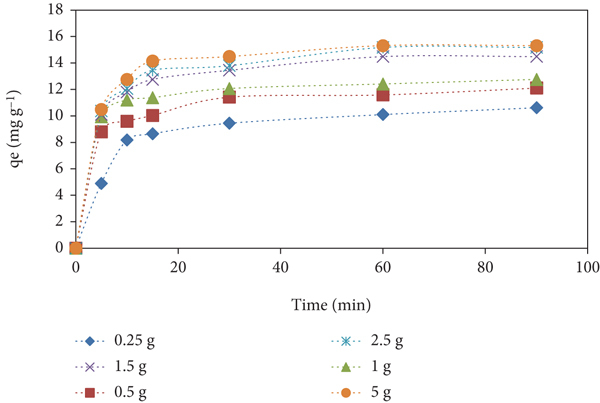
Effect of ND concentration on adsorption of carmoisine.
3.2.2. Effect of Solution pH on Carmoisine Adsorption and Mechanisms
The pH parameter plays an important role on the surface charge of the adsorbent, on the degree of ionization of the dye in solution and consequently on the adsorption rate [50, 51]. The pH effect was studied at values between 2 and 9.
The other experimental parameters are kept constant at 1 g L-1in ND, 50 mg L-1of carmoisine, contact time at 60 min, and a temperature at

Effect of the initial pH of the carmoisine solution on adsorption efficiency.
Thus, the important adsorption in acid medium could be formulated by the interactions of Si+2 and H+ of the surface of the ND with the sulfonates in solution.
On the other hand, at pH above the value of PZC, the surface of the ND becomes negatively charged, due to the predominance of OH- resulting from the addition of NaOH. In addition, the presence of OH- in solution may compete with the sulfonate groups thereby reducing the number of positive charges on the ND surface as the pH increases. In this case, electrostatic repulsion adsorbent/adsorbate is favored; diffusion and adsorption are then delayed. Similar results have been reported on the adsorption of carmoisine with “bottom ash and deoiled soya” [3] and “waste biomass of Saccharomyces cerevisiae” [4].
3.2.3. Effect of Contact Time and Initial Carmoisine Concentration on Adsorption
The effects of the contact time and the initial concentration of a given pollutant are very important for assessing the kinetics of the reaction [10].
This study was carried out at deferent concentrations of carmoisine and contact times between 5 to 60 mg L-1 and 5 to 90 min, respectively. The concentration parameters of the adsorbent, the pH of the carmoisine solution, and the ambient temperature are kept constant at 1 g L-1, pH

Effects of initial carmoisine concentration and contact time on adsorption efficiency.
3.2.4. Effect of the Initial Temperature of the Solution and Thermodynamic Study
The effect of temperature is another important physicochemical parameter in explaining the adsorption phenomenon because it modifies the mobility of the pollutant in solution and its adsorption capacity on the adsorbent as well as the thermodynamic process [55–57].
The adsorption of the carmoisine on ND was studied at different temperatures between 283 and 323°K and at contact times between 0 and 90 min. The parameters of concentration of the adsorbent, the pH, and the initial concentration of the carmoisine solution are kept constant at 1 g L-1, pH

Effect of the initial temperature of the solution on the adsorption efficiency of carmoisine on ND.
In order to confirm whether the adsorption process of carmoisine on ND is endothermic, the thermodynamic parameters, Gibbs free energy
Here,
The

Van’t Hoff plot for carmoisine adsorption on ND.
The values of
Thermodynamic parameter values for carmoisine adsorption equilibrium on ND.
3.2.5. Hardness Effect and Mineralization of Water
To take into account the effects of hardness and mineralization or conductivity of water on the adsorption of carmoisine on ND, the samples of dye prepared in double-distilled water and water of increasing hardness have been tested Table 3. The results given in Figure 10 show that increasing the hardness and mineralization of the water adversely affects the color removal efficiency on ND. More precisely, for a contact time of 60 min, the adsorption capacity of carmoisine goes from ~16 mg g-1 for bidistilled water to ~11 mg g-1 for very hard water. The reduction in efficiency observed could be attributed in particular to the competition between and CO3 2- of water and SO3 - of carmoisine for the same reactive sites on the surface of LND. On the other hand, a passivation effect on the surface of ND would be possible by forming complexes and surface precipitates with aluminum and silica, which are the main constituents of ND. This surface passivation of the material was reported by [60] but for nZVI/Pd bimetallic nanoparticles supported by clay, used to remove methyl orange from an aqueous solution.
Some characteristics of the waters tested.

Effect of hardness and mineralization of water on the adsorption efficiency of carmoisine on ND.
3.2.6. Study of the ND Regeneration and Wear
This study aims to evaluate the rate of adsorption and desorption of the dye or the rate of regeneration of the biomaterial and also to note the number of cycles of adsorption/desorption or wear of this biomaterial. All the experiments were carried out after saturation of the ND at 1 g L-1 with an initial solution of carmoisine at 50 mg L-1, pH

Desorption of carmoisine using (a) different eluents and (b) acetone (50%) after 4 cycles.
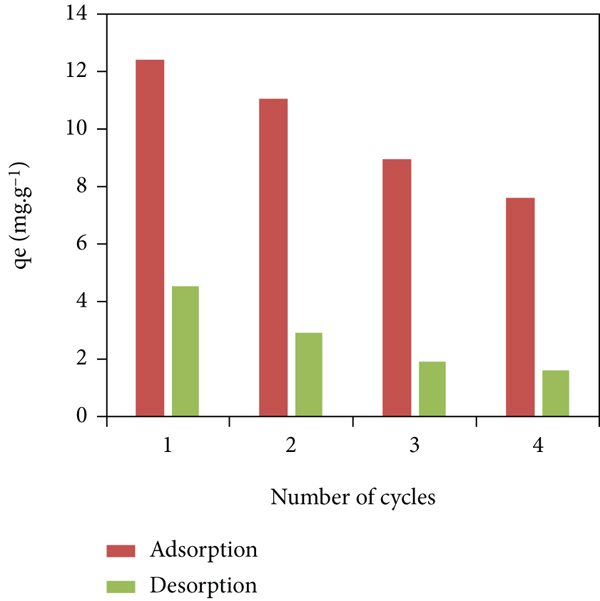
The wear of the material is frequently explained by the loss of active sites on the surface of the adsorbent [61, 63]. This loss of effectiveness of the material over time does not discourage its use given its abundance. The comparison of the adsorption capacity of carmoisine on ND with other natural and composite biomaterials shows Table 4 that is competitive and can therefore be potentially used as a low-cost biosorbent for the elimination of carmoisine from an aqueous solution. However, direct comparison of adsorption capacities is not always easy due to the different experimental conditions used in each study. On the other hand, these treatments generate in all cases a sludge containing the adsorbent and residues of the dye and other chemical additives. This constitutes a major drawback of the use of this adsorption technique. However, coupling with electrochemical techniques is an innovative alternative to solve this problem [61, 64].
Comparison of adsorption capacities of various adsorbents for removal of carmoisine (Cne).
3.3. Modeling of Adsorption
The advantage of adsorption isotherms is that they show the distribution of adsorbent molecules on the surface of the adsorbent under equilibrium conditions and the effect of concentration at equilibrium on the loading capacity at different temperatures [68].
Thus, the modeling of experimental data by the use of linear and nonlinear regression models like those of Langmuir, Freundlich, Brunauer-Emmett-Teller, Redlich-Peterson, Dubinin-Radushkevich, Temkin, Toth, Koble-Corrigan, Sips, Flory-Huggins, and Radke-Prausnitz makes it possible to provide valuable information such as the nature of the adsorption (monolayer and multilayer), the adsorbent/adsorbate interaction mechanisms, the surface properties, and the degree of affinity of the adsorbent [69].
The models tested in this study are those frequently used in adsorption, namely the Langmuir and Freundlich models represented by their respective equations in Table 5.
Parameters of adsorption models applied in adsorption of the carmoisine on ND.
Nomenclature:
The adsorption modeling was carried out on the basis of the experimental results in Figure 8, at variable temperatures (283 to 323°K), with an initial concentration of carmoisine at 50 mgL-1 and at free pH. The results of the modeling and the adsorption parameters are shown in Figures 12(a)–12(c) and Table 5. They clearly show that Freundlich model most closely reflects the experimental results. Indeed, a good linearization of the curves is observed with correlation coefficients close to the unit and very low chi2 tests (3.846 to 0.565). The results given in Figure 12(c), conducted at an ambient temperature at 293°K, a concentration of 50 mg L-1 in carmoisine,

Plots of (a) Langmuir, (b) Freundlich, and (c) experimental data (at 20 °C) for the adsorption of carmoisine onto ND.


3.4. Kinetic Modeling
Adsorption kinetics are important to follow, as they provide valuable information on the effectiveness of the treatment and the design of adsorption systems.
They are of considerable practical interest for the implementation of an industrial adsorbent. It is expressed in terms of the rate of solute retention as a function of the contact time. The speed with which thermodynamic equilibrium is reached is a function of the adsorbate diffusion rate and the adsorbate-adsorbent interaction [71, 72].
To this end, the experimental data in Figure 7 are analyzed using the kinetic models of pseudo-first order and pseudo-second order equations indicated in Table 6.These two models are widely studied and compared; the first explains the adsorption of the adsorbate on the adsorbent according to the first-order mechanism indicated by the corresponding equation, while the second assumes that the rate of adsorption of the adsorbate is proportional to the sites available on the adsorbent [73].
Parameters of kinetic models applied in adsorption of the carmoisine at 20°C.
Nomenclature:
The results of the modeling and kinetic parameters are summarized in Figures 13(a)–13(c) and Table 6.They clearly show that the pseudo-second-order model best represents the experimental results. Indeed, for each of the concentrations of carmoisine tested (5 to 60 mg L-1), the experimental adsorption capacity (

Plots of (a) pseudo-first-order kinetic, (b) pseudo-second-order kinetic, (c) and experimental data.


4. Conclusion
This work focuses, for the first time, on the use of a natural diatomite (ND) in removing the azo dye carmoisine, high-risk food coloring agent for consumer health, by adsorption process. The physicochemical characterization show that ND is mainly composed of silica with a fraction of calcite and ankerite minerals. The ND adsorbent is porous with a specific surface of about 41 m2 g with a hydroxyl surface functional group -OH.
Adsorption process on ND was found to be effective in removing the carmoisine colorant. The adsorption capacity is strongly influenced by the adsorbent and adsorbate contents, the solution pH, the work temperature, and the water hardness and mineralization. The maximum of adsorption capacity, as function of temperature, was between 15 and 12 mg g-1. At room temperature, optimal experimental conditions for the highest adsorption capacity (12 mg.g-1) was colorant concentration 50 mg.L-1, pH 2, contact time 30 min, and ND content 1 g.L-1.
Modeling study has shown that experimental results are well modeled by the Freundlich isotherm in multilayer adsorption. The reaction kinetics are pseudo-second order, and the thermodynamic parameters indicated that the nature of the adsorption process is endothermic and spontaneous. This study suggests that adsorption treatment using abundant and inexpensive ND could be considered as a practical, rapid, and economical alternative for the removal of carmoisine and more widely anionic azo dyes.
Footnotes
Data Availability
There is no data supporting this study.
Conflicts of Interest
The authors declare no conflicts of interest.
Acknowledgments
The authors acknowledge the financial support of the Algerian Ministry of Higher Education and Scientific Research (Research project No. E01120140052). The authors thank Dr. Labiod Hanene for her guidance and supportive advices which contributed to the enrichment of this research. The authors also thank Ms. Fetni Ikram for her generous help with the grammatical review of the article. And we thank Ms Chouikhi Hanene for her good treatment and her help to do some important analyzes.