




Abstract
This study is aimed at comparing the use of zinc oxide (ZnO), titanium dioxide (TiO2), and aluminium oxide (Al2O3) for removing lead ions from water through adsorption. The point of zero charge was obtained for ZnO, TiO2, and Al2O3 and was found to be 7.3, 7.1, and 9.0, respectively. The effect of pH, adsorbent dose, contact time, initial concentrations, and temperature was investigated in batch experiments. The optimal conditions obtained were 7, 2 g/L, 120 mins, 100 ppm, and 41°C, respectively, where the optimal removal efficiencies were 98.43%, 96.45%, and 85.50% for ZnO, TiO2, and Al2O3, respectively. In addition, analyses of adsorption kinetics, mechanisms, isotherms, and thermodynamics were performed. The adsorption kinetics of Pb(II) were compared to popular models, and it was found that the pseudo-second-order (PSO) model best fitted the Pb(II) uptake for all adsorbents at correlation coefficient (
1. Introduction
Contamination of aquatic environments by heavy metals is one of the most major environmental challenges because of their flexibility, aggregation, persistence, and nonbiodegradable nature. Some of the toxic heavy metals, in particular lead, can have severe and poisonous effects on human beings and marine organisms even at trace levels [1, 2]. This problem is exacerbated in developing countries, where polluting industries are rapidly developed for various applications, such as mining operations, tanneries, batteries, fertilizer, pesticides, paper industries, and coke factories [3].
Various adsorbents are used to remove heavy metals, such as arsenic, cadmium, nickel, mercury, chromium, zinc, and lead, from aqueous solutions. These adsorbents include carbon-based adsorbents [4], bioadsorbents [5], low-cost adsorbents [6], and polymeric nanosorbents [7]. This study sheds light on lead, which is one of the most toxic heavy metals that attracts considerable attention from environmentalists. Lead is discharged into aquatic ecosystems from various industrial activities, such as storage batteries, ceramic glass industries, mining, plating, coating, and automotive industries. Another potential source for lead contamination is the wide utilization of agricultural chemicals such as fertilizers and fungicidal sprays [8]. In addition to the pollution of aquatic environments, the adverse effects of lead on human health have been well documented and characterized. Lead poisoning causes serious harm to the kidneys, damages the central nervous system and liver, and can result in cancer and brain damage, in addition to abnormalities in living creatures’ organs [9, 10].
In response to this, several techniques have been developed to remove harmful heavy metals from aqueous solutions and maintain environmental safety, such as chemical precipitation, ion exchange, membrane separation, adsorption, and electrochemical removal [11]. Among these techniques, adsorption has recently gained growing importance for being an efficient, effective, and economical technique. It provides high quality treated outputs, low operating cost, high design and operating flexibility, and high removal efficiency in the absence of interference of any competing additives [12].
A wide range of adsorbents was used to extract lead, such as activated carbon [13], modified alginate aerogel with melamine/chitosan [11], reduced graphene oxide-Fe3O4 [8], and pea peel waste [14]. The use of zinc oxide (ZnO), titanium dioxide (TiO2), and aluminium oxide (Al2O3) as adsorbents for removal of different constituents from wastewater is promising in light of its advantages, such as availability, simplicity, nontoxic nature, resilience to corrosive elements, and a strong affinity for metal ions used in wastewater treatment [15]. Efficient removal of heavy metals was reported in the literature using ZnO nanocomposites and nanoparticles [16, 17], TiO2 composites and nanoparticles [2, 18], and Al2O3 nanocomposites and nanoparticles [19–22]. However, few studies compared the capacities of these three adsorbents in the removal of heavy metals.
Despite the studies mentioned above, limited studies compared the adsorption capacity and removal mechanism for lead adsorption onto zinc oxide (ZnO), titanium dioxide (TiO2), and aluminium oxide (Al2O3) under the same conditions. To our knowledge, no study compared the thermodynamics of these metal oxides for this particular case. Thus, this research is aimed at studying and comparing the use of these metal oxides for lead removal from water by adsorption. The effect of pH, adsorbent doses, contact time, initial concentrations, and temperature on lead removal was investigated. The experimental results were analyzed using pseudo-first order (PFO), pseudo-second order (PSO), Elovich equation, the intraparticle diffusion model, and the Boyd kinetic models to determine the most compatible adsorption kinetic and mechanism model. Subsequently, the equilibrium data were investigated using various isotherm models, such as Langmuir, Freundlich, Temkin, and Dubinin-Radushkevich (D-R) models, to determine the appropriate isotherms for the characterization of the behaviour of lead adsorption on metal oxides.
2. Materials and Methods
Lead nitrate (Pb (NO3)2), manufactured by Loba Chemie Pvt. Ltd., India, 99% extra pure, was used to prepare the contaminated solution. A 1000 ppm stock solution is prepared by dissolving 1.58 g of lead nitrate in 1000 mL of deionized water containing 10% (
Zinc oxide 99% pure (AR zinc white), titanium dioxide, 98% extra pure, and aluminium oxide active (basic), manufactured by Loba Chemie Pvt. Ltd., India, were used as adsorbents. The surface of materials before and after adsorption was studied using scanning electron microscopy (SEM) and energy-dispersive X-ray spectroscopy (EDX). By following procedures described in earlier studies [23, 24], the points of zero charge for each of the three adsorbents using the pH drift method were found to be 7.3, 7.1, and 9.0 for ZnO, TiO2, and Al2O3, respectively, see Figure 1.

pH drift method for all adsorbents.
The adsorption experiments are divided into several batches, where each batch evaluates a specific parameter that affects the adsorption process and determines its optimal value among the tested range. The tested parameters were pH of the solution, adsorbent dose, contact time, initial concentration of Pb(II), and temperature. The effect of pH was investigated by adjusting the solution pH between pH 3 and 9 using 0.1 M of nitric acid (HNO3) and NaOH. The adsorbent dosage tested range varied between 0.01 and 0.05 g. The effect of contact time was investigated by varying the contact time from 5 to 120 min. The impact of the initial concentration of lead was studied between 50 and 150 ppm, and the temperature effect was studied between 18 and 41°C. For each batch, the solution flasks were shaken to ensure that the solution reached equilibrium (maximum adsorption capacity). At the end of each batch, the solution was centrifuged, filtered using a filter paper (Whitman number 45), and analyzed using inductively coupled plasma (ICP) spectrometry (model Ultima 2 JY Plasma) to measure the final concentration of lead in water samples complies to Environmental Protection Agency (EPA-US) measurement technique [25]. The adsorption percentage and the capacity of adsorption can be calculated according to Equation (1) and Equation (2), respectively, [26]:
3. Results and Discussion
3.1. Adsorption Studies
3.1.1. Effect of pH Solution
The effect of the initial pH of the solution on the percentage of Pb(II) removed by adsorption was investigated at four different pH values, namely, 3, 5, 7, and 9, using an initial adsorbent mass of 0.02 g with 25 mL of contaminated solution. The initial Pb(II) concentration was 100 ppm at room temperature

Effect of different parameters on the adsorption of Pb(II) onto all adsorbents: (a) initial pH of the solution, (b) adsorbent dosage, (c) contact time, (d) initial concentration of Pb(II), and (e) temperature.


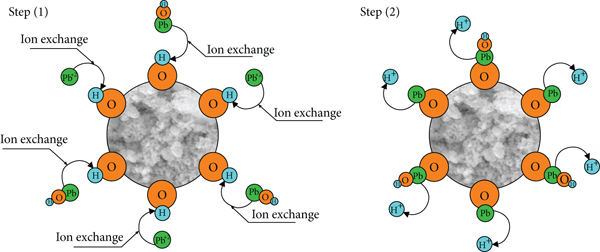
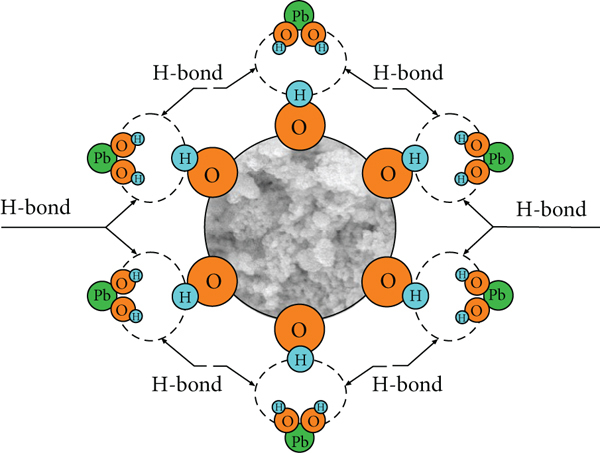
Adsorption mechanisms of Pb(II) on metals adsorbent surfaces: (a) ion exchange mechanism and (b) hydrogen bonding mechanism.
Ion exchange mechanism:
Hydrogen bonding:
At higher pH values (7.0–9.0), a decrease in the adsorption percentage was observed in ZnO and TiO2 due to the formation of soluble hydroxyl complexes. However, for Al2O3, an increase in adsorption percentage was observed since the value of pH at the point of zero charge (pHPZC) for Al2O3 is 9.0, see Figure 1. As the pH of the solution increases, the adsorbent surface becomes less positively charged which allows for more adsorption of Pb(II) cations. For the following batches, an optimal pH value of 7.0 is used. Below this optimal value, competition between Pb(II) ions and H3O+ reduces the adsorption efficiency, while higher pH values result in hydrolysis of lead species which encourages precipitation and prevents quantitative adsorption.
3.1.2. Effect of Adsorbent Dosage
This batch of experiments was conducted with different concentrations of adsorbents, namely, 0.01, 0.02, 0.03, 0.04, and 0.05 g, at the optimal initial pH value, with 25 mL of the contaminated solution. The initial Pb(II) concentration was 100 ppm at room temperature of
3.1.3. Effect of Contact Time
This batch of experiments was conducted at different contact times, namely, 15, 30, 60, 90, and 120 min, with optimal pH value and adsorbent dose of 7.0 and 0.05 g, respectively, at room temperature of
3.1.4. Effect of Initial Concentration of Pb(II)
This batch was conducted at different initial concentrations of Pb(II), namely, 50, 75, 100, 125, and 150 ppm, at the optimal pH value and the optimal adsorbent dose obtained from previous batches with 25 mL of contaminated solution at room temperature of
3.1.5. Effect of Temperature
This batch was conducted at different temperature values, namely, 18, 29, and 41°C, at an optimal pH of 7.0, an optimal dose of adsorbents equal to 0.05 g, and a 25 mL contaminated solution of 100 ppm Pb(II) as an optimal initial concentration. The blend was shaken for 120 min at a constant stirring velocity of 150 rpm. The final Pb(II) concentration values were measured, and the adsorption percentage was calculated using Equation (1). The maximum removal efficiencies were 98.43%, 96.45%, and 85.50% for ZnO, TiO2, and Al2O3, respectively, at a temperature of 41°C for all adsorbents as shown in Figure 2(e).
The results showed that the percentage of Pb(II) removal by adsorption increases as the temperature increases. The adsorption percentage was observed to increase from 88.55 to 98.43% for ZnO, from 87.46 to 96.45% for TiO2, and from 70.34 to 85.48% for Al2O3 as the temperature was increased from 18 to 41°C. This indicates that the adsorption process is an endothermic reaction for all adsorbents.
3.2. Kinetic Studies
The uptake rate of Pb(II) ions from the water can be predicted by adsorption kinetics. Three mathematical models, namely, pseudo-first order (PFO), pseudo-second order (PSO), and Elovich equation, were used to fit the uptake rate using the Pb(II) adsorption data at different contact times. The PFO model, PSO model, and Elovich equation are expressed by Equations (5), (6), and (7), respectively [28–30].
The PSO model’s correlation coefficient (

Models for the kinetics of Pb(II) adsorption onto all adsorbents: (a) PFO, (b) PSO, and (c) Elovich’s equation.


Kinetic parameters for adsorption of Pb(II) onto different adsorbents using PFO, PSO, and Elovich equation.
3.3. Adsorption Mechanisms
The adsorption process consists of three controlling steps: (1) the motion of the adsorbate from the bulk liquid to the surrounding film of the adsorbent, a process known as film diffusion, (2) the transport of the adsorbate from the film to the adsorbent surface, a process known as surface adsorption, and (3) the transmission of the adsorbate to the internal active sites, a process known as intraparticle diffusion [31]. The active sites sequentially attach to these metal ions.
The limiting step of adsorption refers to the slowest step in the process that controls the total adsorption rate. To identify the limiting step of the adsorption mechanism, several kinetic models are commonly used to investigate the rate-limiting step; this included the intraparticle diffusion model as well as the Boyd model. The intraparticle diffusion model was applied to determine the adsorption mechanism. The model is described by Equation (8) [32].
Figure 5(a) shows that the plot of Pb(II) uptake against

Adsorption mechanisms of Pb(II) onto all adsorbents: (a) intraparticle diffusion model and (b) Boyd kinetic model.

Furthermore, the Boyd kinetic model is used to determine the slowest step that limits the adsorption process. The model is described by Equation (9) [36], and the results are presented in Figure 5(b).
For any adsorbent, a linear plot that succeeds to pass through the origin indicates that the limiting step in the adsorption process is the intraparticle diffusion. However, it is clearly shown in Figure 5(b) that the plot of
3.4. Equilibrium Isotherms
Isotherms are the equilibrium relationship between the solid phase and the liquid phase solution concentration. The suitability of a particular adsorbent for extraction of a pollutant can be studied using adsorption isotherms, and the maximum adsorption capacity can also be obtained using various mathematical expressions, such as Langmuir [37], Freundlich [38], Temkin [39], and Dubinin-Radushkevich [40] isotherms. These are the most common isotherms used to describe a solid-liquid adsorption system. These isotherms are described by Equation (10), Equation (11), Equation (12), and Equation (13), respectively.
Figures 6(a)–6(d) represent plots of the experimental data using the linearized form of the isotherms mentioned above models. Each isotherm has specific assumptions regarding the conditions at which adsorption takes place. Freundlich isothermic adsorption assumes that adsorption occurs on a heterogeneous surface through multilayer adsorption processes, while Langmuir isotherm assumes maximum limiting adsorption at a given number of accessible sites on the adsorbent surface, with the same energy available at all adsorption sites [41, 42]. Temkin isotherm assumes that the adsorption heat decreases linearly as the surface of the adsorbent is covered. The Dubinin-Radushkevich isotherm considers the influence of the porous structure of the adsorbent surface.

Equilibrium isotherms of Pb(II) onto all adsorbents: (a) Langmuir, (b) Freundlich, (c) Temkin, and (d) Dubinin-Radushkevich.


The corresponding correlation coefficients (
Isotherm parameters related to the adsorption of Pb(II) onto adsorbents.
Comparison of the adsorption capacities of Pb(II) using various adsorbents.
3.5. Thermodynamics Studies
Since temperature is one of the most important factors in the adsorption processes, the thermodynamics of the adsorption process shall be investigated. To determine the inherent energetic changes that are linked to the adsorption process, thermodynamic constants were investigated by varying the equilibrium constants with temperature to determine: (1) Gibbs free energy (
The values of enthalpy (
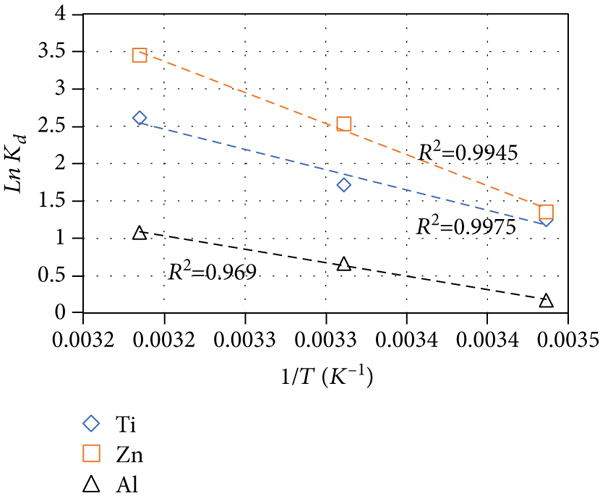
Van’t Hoff plot of the adsorption of Pb(II) onto all adsorbents.
The thermodynamic parameters of Pb(II) adsorption onto ZnO, TiO2, and Al2O3 are summarized in Table 4. The positive enthalpy values indicate that Pb(II) adsorption by ZnO, TiO2, and Al2O3 is an endothermic process. In addition, the high enthalpy values (
Thermodynamic parameters for the adsorption of Pb(II) onto all adsorbents.
3.6. The Morphological and Chemical Composition of the Adsorbents
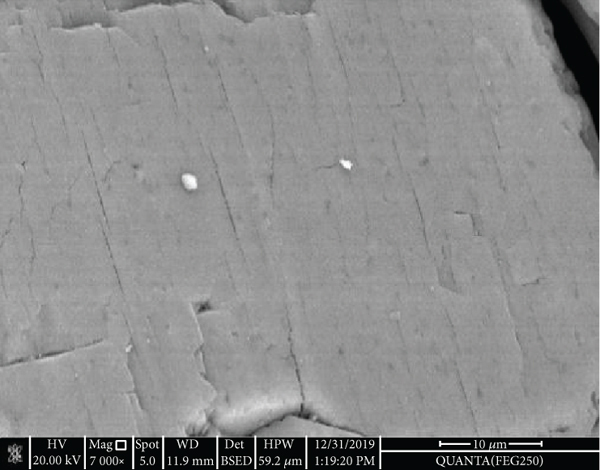
The morphology of the adsorbents’ surface was examined using the SEM test, where SEM images revealed changes in the morphology of the adsorbents before and after the adsorption process, see Figures 8(a)–8(f). The SEM images (Figures 8(a) and 8(c)) showed that both ZnO and TiO2 exhibit tough and irregular surfaces with spongy openings before the adsorption process. In contrast, the SEM images for Al2O3, Figures 8(e), show solid and smooth surfaces with few porous openings. This may explain the low removal efficiency of Pb(II) using Al2O3 compared to ZnO and TiO2. After the adsorption process (Figures 8(b), 8(d), and 8(f)), the porous openings on ZnO, TiO2, and Al2O3 surfaces were filled. The comparison of the SEM images of ZnO, TiO2, and Al2O3 before and after Pb(II) uptake at different magnification scales reveals a clear change in the morphology and emphasizes that adsorption occurred.
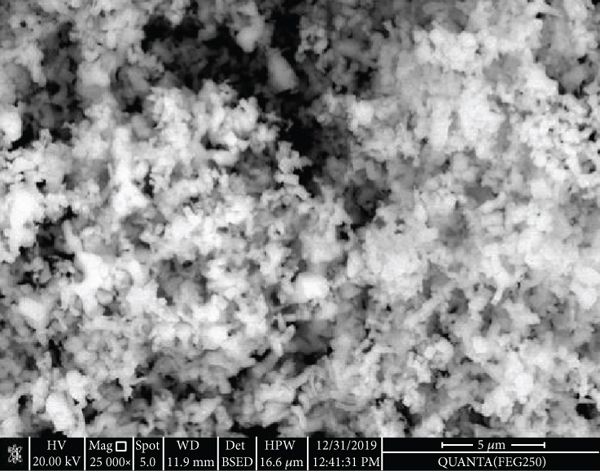
SEM micrograph: (a) unloaded ZnO at 25000x magnification, (b) loaded ZnO at 25000x magnification, (c) unloaded TiO2 at 25000x magnification, (d) loaded TiO2 at 25000x magnification, (e) unloaded Al2O3 at 7000x magnification, and (f) loaded Al2O3 at 7000x magnification.



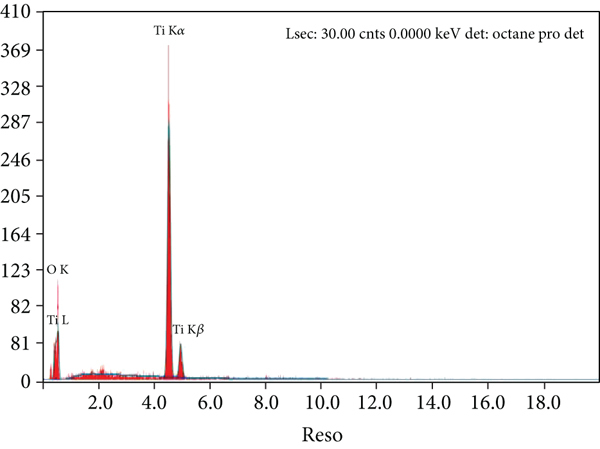
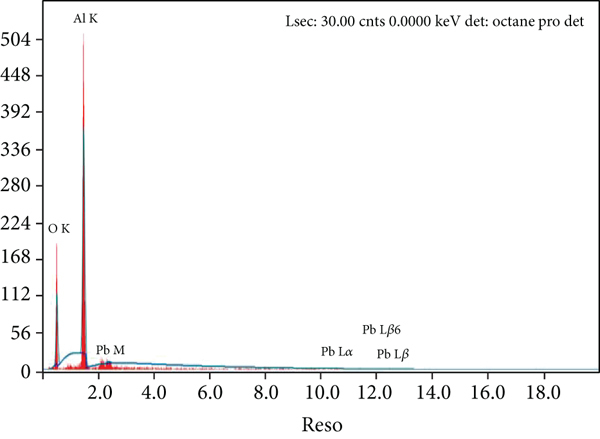
EDX analysis was used to determine the elemental and chemical composition of a sample and measure the amount of trace elements. EDX analysis provided further affirmation of Pb(II) uptake on ZnO, TiO2, and Al2O3. Figures 9(a)–9(f) show the EDX spectra for ZnO, TiO2, and Al2O3 before (unloaded) and after (loaded) the adsorption process. Figures 9(a), 9(c), and 9(e) show no characteristic signals for any metal ions except for Zn2+, Ti2+, and Al3+, respectively. On the other hand, Pb(II) signals were observed in Figures 9(b), 9(d), and 9(f). This shows the accumulation of Pb(II) onto the surface of ZnO, TiO2, and Al2O3 particles.
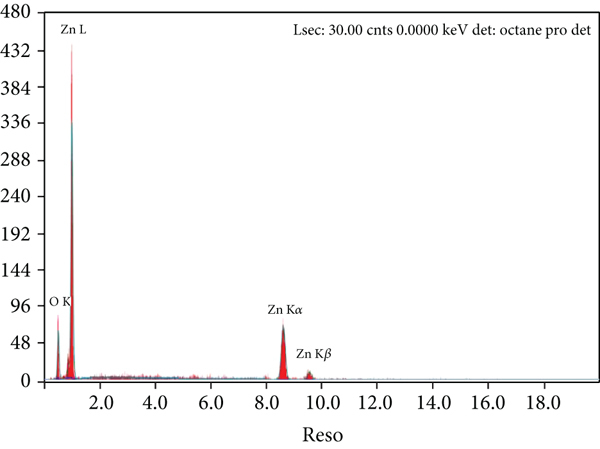
EDX pattern: (a) unloaded ZnO, (b) loaded ZnO, (c) unloaded TiO2, (d) loaded TiO2, (e) unloaded Al2O3, and (f) loaded Al2O3.



4. Conclusions
In this research, a comprehensive study of lead removal by adsorption was conducted using three different metal oxide adsorbents, namely, zinc oxide (ZnO), titanium dioxide (TiO2), and aluminium oxide (Al2O3). The points of zero charge for the considered adsorbents were found to be 7.3, 7.1, and 9.0 for ZnO, TiO2, and Al2O3, respectively. The effect of pH of the solution, adsorbent dose, contact time, initial concentrations, and temperature on the adsorption process and removal efficiency was studied. The optimal values of these parameters were obtained using separate batch experiments. After applying the optimal values of the studied adsorption parameters for the adsorbents, the adsorption kinetics were investigated using different models, such as PFO, PSO, and Elovich equation, where PSO best fit the adsorption of lead for all of the adsorbents.
Furthermore, the adsorption mechanism was investigated using the intraparticle adsorption and Boyd kinetic models. The intraparticle adsorption model showed that the adsorption of lead was a multistep controlled mechanism, while Boyd’s kinetic model showed that the film diffusion mechanism is the limiting step of the adsorption process for all the considered adsorbents. In addition, the adsorption isotherms were studied at equilibrium. The results showed that the Langmuir isotherm model best described the adsorption of lead by ZnO and TiO2, while the adsorption behaviour of Al2O3 was best fitted by the Dubinin-Radushkevich isotherm model. The thermodynamic studies showed that the adsorption of lead onto ZnO, TiO2, and Al2O3 was endothermic and spontaneous. Finally, the morphological and chemical compositions of the adsorbents were tested using SEM and EDX analysis. The SEM images showed that both ZnO and TiO2 surfaces had very porous holes compared to Al2O3. Changes in the adsorbent morphologies confirmed that adsorption occurred. The EDX spectra illustrated the presence of lead signals after the adsorption process, ensuring that lead ions had accumulated onto the surface of the ZnO, TiO2, and Al2O3 particles. At the end, it can be concluded that under the optimal conditions adopted in this study, lead removal from aqueous solutions by adsorption is best obtained using ZnO followed by TiO2 and finally comes Al2O3.
Footnotes
Data Availability
The authors confirm that the data supporting the findings of this study are available within the article.
Conflicts of Interest
The authors declare that they have no conflicts of interest.