




Abstract
This research is aimed at investigating the possible use of cassava agroindustry solid wastes in manufacturing adsorbents and their use in removing heavy metals Cd2+, Pb2+, and Crtotal from water. Thus, a pilot study was conducted in two main steps: (1) obtaining and characterizing the adsorbents and (2) laboratory studies focused on the evaluation of critical physicochemical parameters on adsorption, such as pH of the solution containing heavy metals, the effect of adsorbent dose, besides kinetics and equilibrium adsorption and desorption studies. Three adsorbents were studied, cassava barks, bagasse, and their mixture. SEM, FTIR, pHPZC, acid digestion, and chemical composition analysis were employed for adsorbent characterization. The pH of the contaminated solution was evaluated within 4.0 to 7.0, while the adsorbent doses varied from 5.0 to 24.0 g L-1. The adsorption kinetics was evaluated within 5 to 180 minutes and interpreted using pseudofirst- and second-order models. Finally, equilibrium and desorption studies were performed by evaluating adsorbent performance within 5 to 200 mg L-1 of heavy metals, using several nonlinear models for results interpretation. SEM analysis reveals a heterogeneous structure full of cavities. FTIR before and after adsorption reveals gaps related to missing functional groups, suggesting a significant role of alkenes, carboxylic acid, alcohol, anhydride, and ether. pHPZC is found at pH 6.02, 6.04, and 6.26 for adsorbents derived from barks, bagasse, and their mixture. In low concentrations of metals, the higher adsorption capacities were found at pH 7.0 (94.9%) using 16 g L-1 of adsorbent, with the most cost-benefit dose found using 8.0 g L-1. The removal of metals reaches equilibrium within 5-10 minutes of contact time with pseudosecond-order best adjustments to the observed phenomena. The adsorption of metals by a cassava adsorbent is better adjusted to the Freundlich model, with significant and critical information provided by Sips, Redlich-Peterson, Temkin, Liu, and Khan models. Adsorption/desorption studies indicate that cassava adsorbent performs, on average, -10% of the adsorption of metals compared to activated carbon. Nevertheless, factors such as low cost and availability favor the use of such natural materials.
1. Introduction
In the last decade, the increasing industrialization and urbanization have raised the number of pollutants disposed of in the environment, especially water bodies [1]. In this sense, among the many contaminants that affect aquatic environments and human health, the pollution from organic or inorganic compounds, such as toxic metals and metalloids (Cd, Pb, Cr, As, Hg, among others) and pesticides (organophosphates, carbamates, triazines, organochlorines, among others.) need to be treated as a serious issue by governs and institutions. Moreover, access to fresh water and sanitation still is a global concern. For example, WHO [2] reports that 785 million people lack even a basic drinking water service, including 144 million people who are dependent on surface water; globally, at least 2 billion people use a drinking water source contaminated with feces, that is not to mention water pollution by chemicals, such as toxic heavy metals.
Developing and undeveloped countries already struggle with the standard procedures and cannot afford more advanced technologies to treat emergent pollutants such as pesticides and metals [3]. Among the advanced treatments that are usually employed for the removal of toxic metals, we can highlight chemical and physical precipitation, ionic exchange, Fenton and photo-Fenton processes, oxidation processes, filtration by membranes, osmosis processes, advanced oxidation processes, and adsorption with activated carbons; this last example is considered a gold standard for the removal of many organic and inorganic pollutants from waters and wastewaters [4], especially when those are in low (or trace) concentrations but not low enough to ensure the safety of the disposal of the wastewater or the use of water [5–7]. That is the case with heavy toxic metals [8].
The current legislation for drinking water by Environmental Protection Agency [9], World Health Organization [4], and Ministerio de Salud de Chile [10], respectively, state the maximum contaminant level for the studied metals: Cd2+ (0.005 mg L-1, 0.003 mg L-1, and 0.01 mg L-1), Pb2+ (0.015 mg L-1, 0.01 mg L-1, and 0.05 mg L-1), and Crtotal (0.01 mg L-1, 0.05 mg L-1, and 0.05 mg L-1). Thus, the limits are low because such substances can promote damage to living organisms even at trace levels. Further information regarding toxicity and environmental issues caused by heavy metal exposure (with special attention to Cd, Pb, and Cr) are shown in the Supplementary Materials.
Another problem that causes significant concern in the agroindustry business is the correct biomass solid waste destination, e.g., solid byproducts from the cassava industry. These agroindustries tend to generate significant amounts of organic wastes, which can or cannot be correctly destined [3, 11–13], usually disposed of either by burning, dumping, or unplanned landfilling [14, 15].
In cassava agroindustry, solid wastes are generated in the processing of cassava roots, mainly used to manufacture animal feed and biofertilizers. Schwantes et al. [13] estimate that cassava peel makes up approximately 3 to 5% of the total mass of roots and about 1 million tons of cassava peels are produced annually in Brazil, 11 million tons worldwide. This estimate does not consider the produced bagasse, representing more than 80% of the cassava industry’s solid wastes.
The last reports evidence the possibility of using cassava as adsorbent for the removal of Cd2+, Pb2+, and Crtotal from waters [16], or as biomass modified with H2O2, H2SO4, or NaOH 0.1 M [13], or for the removal of Cu2+ [17], Cu2+, and Zn2+ [18]. Rajeshwarisivaraj et al. [19] report the use of cassava wastes impregnated with H3PO4 in activated carbon development to remove dyes and metal ions. Thompson et al. [20] reported using activated biomass from cassava wastes to remove Pb2+ from water. Although the above reports are interesting, Schwantes et al. [18], Schwantes et al. [13], and Schwantes et al. [16] present only preliminary studies, with many gaps regarding the adsorption process and its evaluation. Also, the above authors do not elucidate the adsorption mechanism that rules metals’ removal. Jorgetto et al. [17] only used the minced cassava root as an adsorbent raw material, not focusing on the cassava bagasse, which corresponds to more than 90% of the wastes of cassava agroindustry. Moreover, the above authors only test the adsorbent for Cu2+ adsorption without the necessary deep required for adsorption studies (kinetics, equilibrium, and thermodynamic studies). Rajeshwarisivaraj et al. [19] tested cassava wastes as adsorbents for the removal of dyes (Rhodamine-B, direct brown, procion orange, acid violet, malachite green, and methylene blue) and metals (Cr6+, Hg2+, and Fe2+) without evaluating the influence of essential parameters, such as pH, adsorbent doses, contact time, equilibrium, and thermodynamic studies. Thompson et al. [20] developed activated carbon from solid cassava wastes, resulting in a material gifted with 119.6 m2 and good adsorption capacity, nevertheless, with inferior results comparing other adsorbents and activated carbons derived from adsorbent materials. Therefore, there is still a lack of studies regarding cassava solid wastes for adsorption purposes. Thus, such raw materials are still undervalued and unexploited.
In this scenario, this research attempts to propose solutions for two problems (environmental and public health) at the same time: first, to develop natural ecofriendly adsorbents from cassava agroindustry solid wastes for the remediation of water containing toxic metals (Cd2+, Pb2+, and Crtotal), providing an economical and novel solution for water and wastewater treatment, especially attractive for undeveloped/developing countries; and the second part of the double solution, to provide a correct and possible destination for the risen tons of agro-industrial cassava wastes, which already are, in some cases, environmental problems in developing countries located in South America, Africa, and equatorial parts of Asia.
Thus, until this date, the potential of solid cassava wastes has not been fully accessed in developing ecofriendly and efficient adsorbents, especially for removing heavy metals such Cd2+, Pb2+, and Crtotal. As a consequence, this research aimed at (i) developing natural adsorbents from cassava agroindustries and studying its morphology and other essential characteristics; (ii) evaluating these natural materials regarding their adsorption capacity and performance; (iii) studying the adsorption mechanism of Cd2+, Pb2+, and Crtotal, evaluating the interactions between the pH of the metal solutions versus dose of adsorbents, as well as studies of kinetics and equilibrium; and (iv) evaluating the possibility of the cassava adsorbents reuse in new cycles (desorption studies).
2. Material and Methods
2.1. Obtaining, Development, and Characterization of the Cassava Natural Adsorbents
In agroindustry, the cassava wastes were obtained from Toledo, Paraná State (Brazil). During the cassava root preparation for further processing, the first solid waste is obtained (cassava barks) by the washing and mechanical peeling of the roots, constituted mainly of lignin and cellulose. After removing starch and other essential components, the second solid waste (bagasse) was obtained at the end of the industrial process. The bagasse is constituted mainly by lignin, cellulose, and residues of nonextracted starch.
It is essential to mention that the agroindustrial cassava sector destines these wastes for animal feeding by mixing a small proportion of barks with bagasse selling them to cattle and cow farmers as a low-cost feed. Therefore, these wastes were sampled and sent to the laboratory, washed with water, dried, milled, and sieved, with particle size standardized between 14 to 60 mesh, as already well reported by previous studies [18]. This procedure generated the three adsorbents of cassava: CASS-BK (adsorbent of cassava barks), CASS-BA (adsorbent of cassava bagasse), and CASS-BB (the mix of barks and bagasse of cassava). These three were characterized by studying their surface by pHPZC analysis, micrographs by SEM, surface functional groups by FTIR, and their chemical composition.
The pH corresponding to the point of zero charge (pHPZC) is defined as the pH at which the surface of the solid has a neutral charge. The methodology used in this work for its determination is called the “11 point experiment” [3]. The procedure consisted of mixing 25 mg of the adsorbent in 50 mL of aqueous solutions of KCl 0.5 and 0.05 M under 11 different conditions of initial pH, varying from 2.0 to 13.0 by adjustment with HCl and NaOH (0.1 mol L-1), and measuring the pH after 24 h of equilibrium. The results are expressed through the graph of final pH versus initial pH, with the pHPZC corresponding to the range in which the final pH remains constant (regardless of the initial pH), i.e., the surface behaves like a buffer. The surface micrographs were obtained using scanning electron microscopy (SEM - JEO JSM 6360-LV, Thermo®, U.S.A), equipped with dispersive energy microscopy. The surface functional groups were characterized using an FTIR-8300 Fourier transform spectrometer operating in transmission mode (4000–400 cm−1), using the standard KBr pellet method (Shimadzu®, Japan). The chemical composition of metals was analyzed by acid digestion of the cassava adsorbents [70], followed by FAAS determination. Thus, 0.5 mg of each adsorbent was weighted in test tubes with 5 mL of HNO3+HClO mixture (2 : 1
2.2. Preparation of the Metallic Solutions
All single-element solutions of Cd, Pb, and Cr were prepared by using salts of cadmium (Cd(NO3)2 4H2O
2.3. Adsorption Studies (Cd2+, Pb2+, and Crtotal)
2.3.1. pH and Adsorbent Dose Studies
The effect of the pH of the single-element solutions of Cd2+, Pb2+, and Crtotal and its interaction with different cassava adsorbent doses was evaluated by testing three (3) pH conditions (4.0, 5.0, and 6.0, adjusted with NaOH and HCl 0.1 M) and six (6) adsorbent doses (4, 8, 12, 16, 20, and 24 g L-1). Thus, in Erlenmeyer’s of 125 mL, 200, 400, 600, 800, 1000, and 1200 mg of CASS-BK, CASS-BA, and CASS-BB were set in contact with 50 mL of the single-element solutions of Cd2+, Pb2+, and Crtotal (10 mg L-1). The experimental condition of this preliminary study was 200 rpm at 25°C. At the end of 1.5 h of stirring, samples were taken, and the remaining metal concentration was determined by FAAS.
Using Statistica® 7.0, a response surface analysis (RSA) was conducted to interpret these preliminary results. Therefore, a weighted linear regression was used to study the possible interactions between the adsorbent doses and the solution pH. In addition, the Fisher test was conducted to determine the statistical significance of the variables above on the removal % of heavy metals. Finally, the Tukey test evaluated the removal percentage means at 5% of probability to create a ranking between the adsorbents and the evaluated metals. The studied pH range is explained by the Theoretical speciation of Cd2+, Pb2+, and Crtotal (Puigdomenech, 2018), presented in Figure S2 [22].
2.3.2. Kinetics Studies
In order to evaluate the effect of the contact time between the cassava adsorbents and the Cd2+, Pb2+ and Crtotal single-element solutions, the adsorbent dose of 8.0 g L-1 (previous best condition) was tested in the following contact time ranges: 5, 10, 20, 40, 60, 80, 100, 120, 140, and 160 min.
Thus, in Erlenmeyer of 125 mL, 400 mg of CASS-BK, CASS-BA, and CASS-BB was set in contact with 50 mL of single-element solutions of Cd2+, Pb2+, and Crtotal solutions (10 mg L-1), and samples were taken at each period (5 to 160 min), centrifuged at 2000 rpm for liquid-solid separation, and the remaining metal concentration was determined by FAAS.
To elucidate the kinetics of adsorption for Cd2+, Pb2+, and Crtotal into the CASS-BK, CASS-BA, and CASS-BB surfaces, the obtained data were studied by the models of pseudofirst-order (PFO) [23] and pseudosecond-order (PSO) [24] models, as exhibited in Table S1 (supplementary material).
2.3.3. Equilibrium Studies and Side-by-Side Comparison (Activated Carbon)
In order to construct isotherms for CASS-BK, CASS-BA, and CASS-BB for the adsorption of metals, in Erlenmeyer of 125 mL, the dose of 8.0 g L-1 (400 mg) of cassava adsorbents was set in contact with 50 mL in increasing concentrations of Cd2+, Pb2+, and Crtotal single-element solutions (5, 20, 40, 60, 80, 100, 120, 140, 160, and 200 mg L-1). The following experimental conditions were set at pH 5.5, 60 min of stirring, 200 rpm, and 25°C. The content (adsorbent solution) was centrifuged at 2000 rpm for liquid-solid separation and sampled to determine the residual metal concentration by FAAS.
It is also essential to highlight that for the isotherm construction and evaluation, a side-by-side comparison was performed with a gold standard (commercial activated carbon Synth) in the same physical-chemical conditions CASS-BK, CASS-BA, and CASS-BB.
For the interpretation of the obtained data, the nonlinear models of Langmuir [25], Freundlich [26], Sips [27], Temkin and Pyzhev [28], Redlich-Peterson [29], Toth [30], Liu et al. [31], Khan et al. [32], and Khan et al. [33] were employed. These and other equations used in this research are exhibited in Table S1 (supplementary material).
2.3.4. Desorption studies
The possibility of reusing CASS-BK, CASS-BA, and CASS-BB was evaluated through an acid elution using HCl 0.1 mol L-1. For that, after the isotherm’s construction (after one adsorption cycle in different metal concentrations), the cassava adsorbents were dried at
2.3.5. The Effect of Temperature on the Adsorption of Cd2+, Pb2+, and Crtotal by Cassava Adsorbents
To evaluate the effect of temperature on the adsorption of heavy metals, 400 mg of each adsorbent was weighed in 125 mL Erlenmeyer flasks and set in contact with 50 mL of Cd2+ (50 mg L-1), Pb2+ (100 mg L-1), or Crtotal (50 mg L-1) solutions at pH 5.5. These flasks were stirred for 60 min at 25, 35, 45, 55, and 65°C. After that period, samples were taken and centrifuged at 2000 rpm to separate the adsorbent from the solution, and FAAS determined the remaining concentration of each metal. Thermodynamic parameters ∆G°, ∆H°, and ∆S°, were estimated according to Table S1.
2.4. Data Analysis
Maple 13®, Statistica 7®, Sisvar 5.6 [34], and Origin 2018® were employed to evaluate the aforementioned nonlinear models, besides the construction of the graphics. All values from adsorption studies were obtained in triplicate. Also, the studied models were subjected to reduced chi2,
3. Results and Discussion
3.1. Characterization of the Cassava Natural Adsorbents
The CASS-BK, CASS-BA, and CASS-BB surfaces revealed by SEM (Figure 1) reveal adsorbents endowed with fibrous and spongy aspects, with irregular and heterogeneous structures. In addition, it is possible to observe some cavities, which could indicate the structure’s porosity, which is suggested as a promising adsorbent characteristic by Conradi Jr. et al. [3].
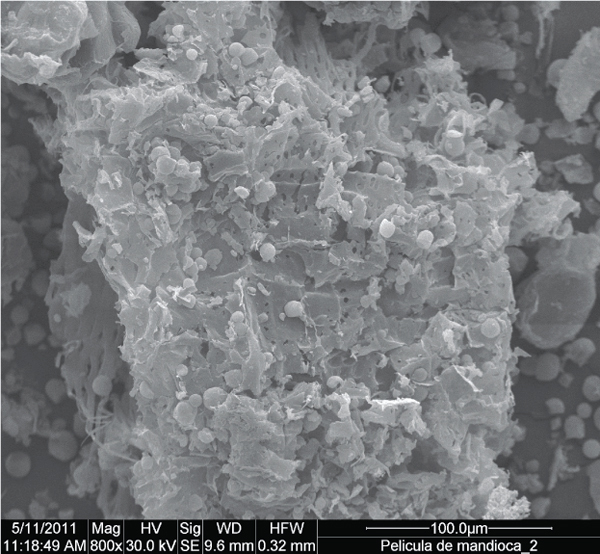
SEM of CASS-BK ((a, b) 800 and 6000x), CASS-BA ((c, d) 200 and 6000x), and CASS-BB ((e, f) 1200 and 5000x).
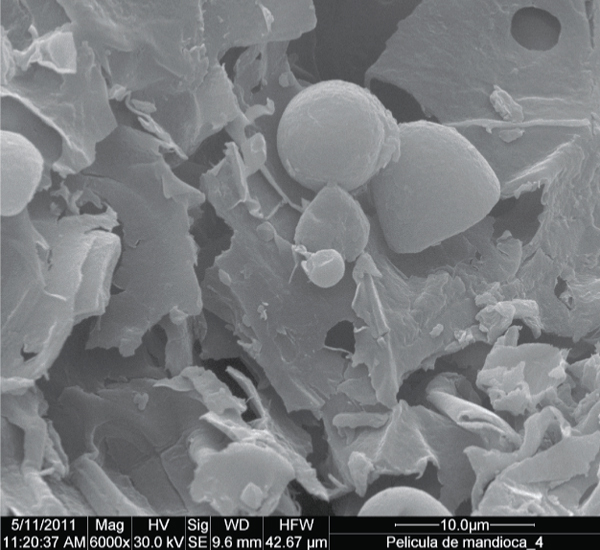

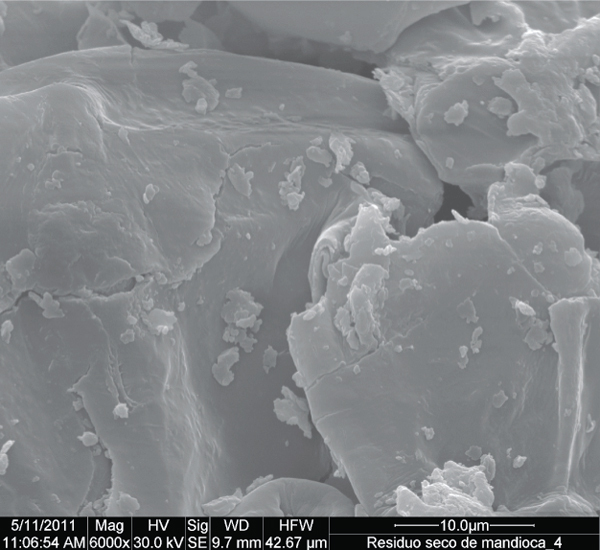
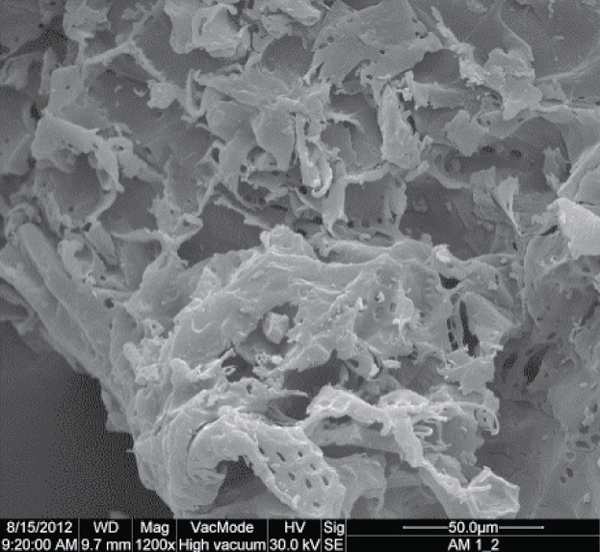

Figure 2 and Table S2 show infrared spectroscopy absorption by frequency regions from before and after the adsorption of Cd2+, Pb2+, and Crtotal. The abovementioned results highlight the missing peaks at 760 cm-1 for CASS-BK adsorption of Cd2+ and Pb2+, suggesting C=C medium to strong bending of alkenes [35].

FTIR obtained for the cassava natural adsorbents CASS-BK (a), CASS-BA (b), and CASS-BB (c) before and after the adsorption of Cd2+, Pb2+, and Crtotal. Additional information is provided in Table S2.

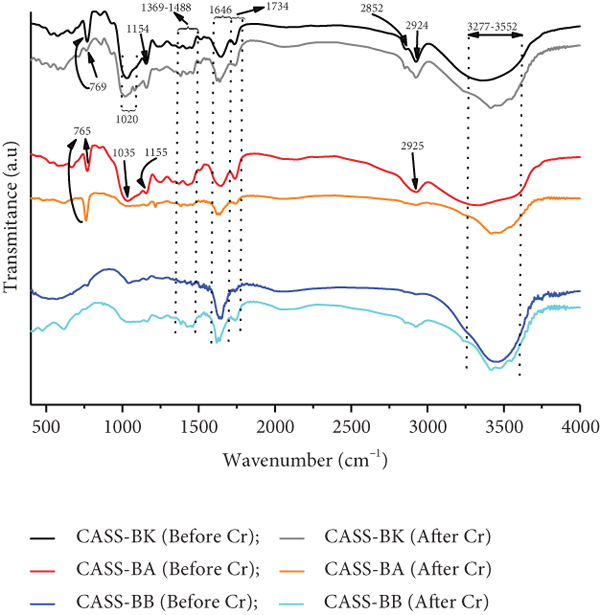
Comparing the results from before and after adsorption, there are many gaps for CASS-BA, such as 769, 1030, 1157, 1240-1662, and 2930 cm-1 for Cd2+ adsorption, suggesting a significant role by C=C from alkenes; CO-O-CO from anhydride; C-O from alcohol and aliphatic ether; C-H and O-H from alkanes, carboxylic acid, and alcohol; and C-H stretching from alkanes [36]. For Pb2+ adsorption by CASS-BA, gaps were found at 770, 1039, and 1155 cm-1, indicating C=C bending from alkenes, CO-O-CO stretching from anhydride, C-O from alcohol and ether, and C-H stretching from alkanes [37]. For Crtotal adsorption by CASS-BA, gaps were found at 1035 and 1155 cm-1, suggesting CO-O-CO stretching from anhydride and C-O stretching from secondary alcohol and aliphatic ether and C-H stretching from alkanes [61]; [37].
CASS-BB gaps are found for Cd2+ adsorption at 1733-1744 cm-1 strong C=O stretching from conjugated anhydride, esters, and aldehyde and Pb2+ adsorption 1039 cm-1, from medium C-H stretching from alkanes [38].
The pHPZC values of the cassava natural adsorbents were
Gonçalves Junior et al. [40], studying canola-based adsorbents, found values ranging from 5.95 to 6.04. Gonçalves Junior et al. [41], studying Euterpe Oleracea-based adsorbent, found 5.09 as pHPZC. Schwantes et al. [42, 43] found 5.67 for a crambe-based adsorbent (Crambe abyssinica Hochst). Schwantes et al. [12] found 4.28 for the grape steam adsorbent. All the above authors conducted adsorption studies with pH values within the range 4.0 to 7.0, mainly due to the surface functional groups from lignin and cellulose structures that all the above adsorbents have in common and because heavy metals such as Cd2+, Pb2+, and Crtotal tend to precipitate in higher pH values.
When the
The chemical composition of the cassava adsorbent (Table 1) is evidence around 22.5 to 35 g kg-1 of Ca, 5.7 to 24 g kg-1 of K, and 4.5 to 6.8 g kg-1 of Mg. CASS-BK presents the higher concentration of Mn (123 mg kg-1), while CASS-BA and CASS-BB present 27.6 and 34.0 mg kg-1, respectively. Fe concentrations were found around 35.6 and 4.5 mg kg-1, while Zn was found around 17.0 and 32.0 mg kg-1.
Composition of K, Ca, and Mg (g kg-1) and Cu, Fe, Mn, Zn, Cd, Pb, and Cr (mg kg-1) of the cassava adsorbents.
Notes: LQ: limits of quantification:
Minor Pb levels were found in the cassava adsorbent composition, about 3.3 to 14.6 mg kg-1. The lead is probably from (1) industrial contamination during the cassava roots processing, or (2) it was absorbed from the soil by the cassava plants and accumulated in the roots. Bassegio et al. [1] report that Pb is not translocated to upper vegetal organs, primarily accumulated in roots. This element was only detected because the adsorbent was submitted to strong acid digestion, which released the Pb bonded to the lignocellulosic structure of the adsorbent. Pb release in water samples was not observed.
3.2. Adsorption Studies (Cd2+, Pb2+, and Crtotal)
3.2.1. pH and Adsorbent Dose Studies
Table S3 shows the regression coefficients from Figure 3, while Table S4 shows the analysis of variance (ANOVA). Figure 4 illustrates the regression analysis for adsorbent doses. Finally, Table S3 shows the ideal pH and adsorbent dose conditions for the higher removal of heavy metals.
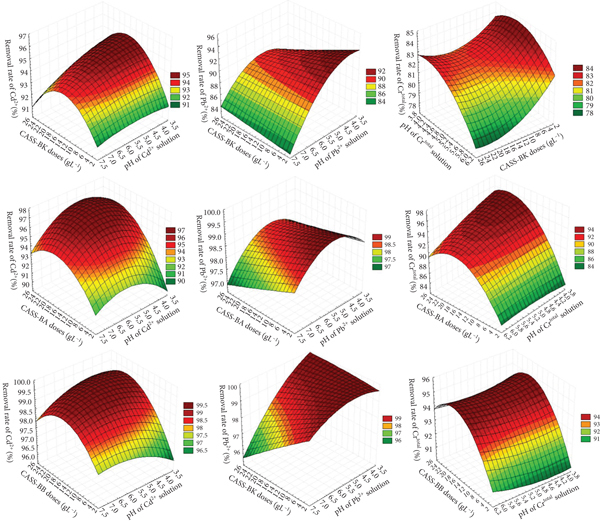
The influence of pH and the adsorbent doses on removing Cd2+, Pb2+, and Crtotal by CASS-BK, CASS-BA, and CASS-BB. Experimental conditions: adsorbent doses tested from 4.0 to 24 g L-1, pH evaluated from 4.0 to 7.0, stirring at 160 rpm, at 298 K for 1.5 h.
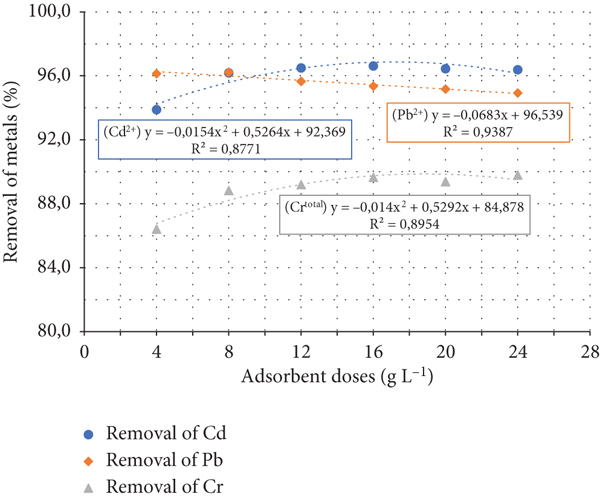
Regression analysis for the adsorbent doses (4.0 to 24.0 g L-1) and its performance in removing Cd2+, Pb2+, and Crtotal. Note: additional information regarding this figure is provided in Table S6.
The variable “Adsorbent” is significant at 1% of probability for Cd2+, Pb2+, and Crtotal removal, which means that there are differences in the removal rate of metal regarding the adsorbent (CASS-BK, CASS-BA, and CASS-BB). Furthermore, the parameter “Doses” is significant at 1% of probability for Cd2+, and 5% for Pb2+ removal, evidencing that the adsorbent doses influence heavy metal removal. Also, for Pb2+ removal, the variable “pH” of solution and the interaction between “Adsorbent” and “pH” presented statistical differences.
Tukey’s range test (Table S5) evidence the higher removal percentages at pH 5.0 for Cd2+ and Pb2+, while tested doses or pH values did not provoke statistical differences for Crtotal. Regarding the tested adsorbents, CASS-BB presented the higher removal of Cd2+ (98.8%). CASS-BA (98.6%) and CASS-BB (98.9%) had the highest Pb2+ removal percentages, while CASS-BB (93.7%) had the highest Crtotal removal percentage. The interaction between the evaluated factors “pH” and “dose” is provided in Table S7.
On the other hand, Tukey’s test range for the interaction between “Adsorbent” and “pH” (Table S7, Figure 3 and Figure S3) evidenced that CASS-BA presented higher means for Cd2+ removal at pH 6.0 (95.88%). CASS-BK presented higher means for Pb2+ removal at pH 4.0 and 5.0 and CASS-BA (99.96%) and CASS-BB (92.53%) at pH 5.0. Furthermore, CASS-BB presented higher removal of Crtotal at pH 4.0.
Figure S3(a) shows a comparison between the removal percentage of the heavy metals (mean of Cd2+, Pb2+, and Crtotal) and the cassava-based adsorbents, where the following order is observed:
Gonçalves Junior et al. [40] evaluated 16 canola-based adsorbents and reported the best adsorption rates using about 4.0 g L-1 to remove Pb+2. The above authors did not find significant variations in the studied pH range (4.0 to 7.0) on Pb2+ removal. However, Gonçalves Junior et al. [41] found a statistical difference for adsorbent doses and pH of Cd+2 solution using Euterpe Oleracea endocarp-based adsorbent. The above authors report that 4.0 g L-1 produced the higher removing percentage of Cd2+, Pb2+, and Crtotal from water, and, in the case of Cd2+ adsorption systems, the pH ranges from 6.0 to 7.0 presented higher removal rates. Similarly, Schwantes et al. [42, 43] found no pH dependency (from 3.0 to 7.0) on adsorption of Zn by crambe-based adsorbents, being the adsorbent dose the primary influencer on Zn removal. In their studies, the higher Zn removal rates were found using 5.0 g L-1. On the other hand, Schwantes et al. [12] found statistical differences only for the adsorbent doses, with higher removal of Cd2+ found using 5.0 g L-1 of grape steam-based adsorbent. These authors also claim that the evaluated pH range (3.0 to 7.0) did not influence Zn adsorption.
It is essential to state that heavy metal ions such as Cd, Pb, and Cr are only available for adsorption when dissolved in water solution, i.e., ions. Therefore, variations on the medium pH can cause the formation of complexes and favor their precipitation. For example, the theoretical diagram provided in Figure S2 illustrates the formation of different Cd, Pb, and Cr complexes in solution in
3.2.2. Kinetics Studies
Figure 5 shows that the adsorption of Cd2+, Pb2+, and Crtotal by the cassava-based adsorbents is a relatively fast process, with 90% of the removal achieved within 5 minutes of contact adsorbent metal in solution, with the physicochemical equilibrium reached between 5 and 10 min. This result is an essential and technological advantage when the industrial use of cassava adsorbents is considered for wastewater treatment.

Kinetics of Cd2+ (a), Pb2+ (b), and Crtotal (c) adsorption by CASS-BK, CASS-BA, and CASS-BB. Experimental conditions: adsorbent dose of 8.0 g L-1, pH of 5.5, stirring at 160 rpm, at 298 K, during 5, 10, 20, 40, 60, 80, 100, 120, 140, 160, and 180 min.

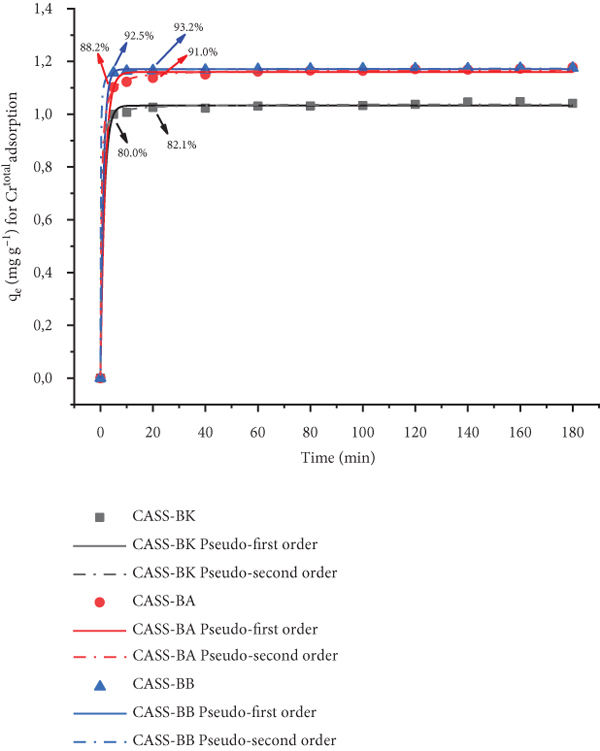
The goodness of the fit obtained for PFO (Adj.
Kinetic parameters for the adsorption of Cd2+, Pb2+, and Crtotal by CASS-BK, CASS-BA, and CASS-BB, using the nonlinear models of pseudofirst order (PFO) and pseudosecond order (PSO).
Notes:
Therefore, PFO does not predict the observed phenomena correctly. On the other hand, the goodness of the fit obtained for PSO (Adj.
Silveira Neta et al. [44] report that PFO and PSO models assume that the difference between the adsorbed concentration at a given time and the equilibrium adsorbed concentration is the driving force of adsorption. Furthermore, the global adsorption rate is either proportional to the driving force in the PFO equation or is the square of the driving force for the PSO model.
The PSO velocity constant (
Wu et al. [45] developed hydrothermal activated carbon from cassava slag biochar. The authors found
3.2.3. Equilibrium Studies and Side-by-Side Comparison (Activated Carbon) and the Reusability of the Materials in Other New Adsorption Cycles
Table S8 and S9 exhibit the ANOVA results, while the isotherms and
Equilibrium parameters by the nonlinear models of Langmuir, Freundlich, Sips, Redlich-Peterson, Toth, Temkin, Liu, and Khan to remove Cd2+, Pb2+, and Crtotal by cassava-based adsorbents.
Notes: it was impossible to construct an isotherm for the comparison study of Pb2+ with activated carbon (AC).
(1) Cd2+ Equilibrium Studies. Langmuir predictions indicate a higher theoretical adsorption capacity (
Similar behavior is seen in Freundlich parameters, with
Sips, also known as the Langmuir-Freundlich model, can predict simultaneously mono and multilayer adsorption. For example, CASS-BK (65.38) and CASS-BB (131.82) presented higher
The Redlich-Peterson model is similar to Sips, as it is a hybrid isotherm model that features Freundlich and Langmuir isotherm models with three parameters [52]. It approaches the Freundlich model at high concentration (as
The bTP
values (dimensionless) obtained by the Temkin model follow the order:
Liu’s model is derived from a combination of Langmuir and Freundlich models; thus, the Langmuir assumption of the monolayer formation and the Freundlich infinite adsorption assumption are eliminated by the Liu model [55]. This model predicts that active adsorbent sites cannot have the same energy, and its often used for better predictions of Liu’s maximum adsorption capacity prediction (
Khan’s predictions on Cd2+ maximum adsorption capacity (
(2) Pb2+ Equilibrium Studies. CASS-BK presented the highest Pb2+ adsorption maximum capacity (
The maximum capacity of Pb2+ adsorption predicted by Sips (expressed in mg g-1) followed the order:
Using activated carbon (AC) from tobacco wastes for the removal of Pb2+, [40] found
KRP (L g-1) values followed the order:
The following order is observed for
(3) Crtotal Equilibrium Studies. Langmuir model predicted the following values for maximum Crtotal adsorption (qLangmuir, expressed in mg g-1): qLangmuir CASS-BK (18.38) > qLangmuir CASS-BA (14.09) > qLangmuir CASS-BB (13.28) > qLangmuir AC (12.80), illustrating a superiority of cassava adsorbents compared to AC. Furthermore,
Nevertheless,
The Redlich-Peterson exponent (
For Crtotal adsorption, bTP
values follow the order:
The maximum adsorption of Crtotal predicted by the Liu model indicates the following order:
3.2.4. The Effect of Temperature on Cd2+, Pb2+, and Crtotal adsorption by the Cassava Adsorbents
The effect of temperature on heavy metal adsorption is shown in Figure 6, with
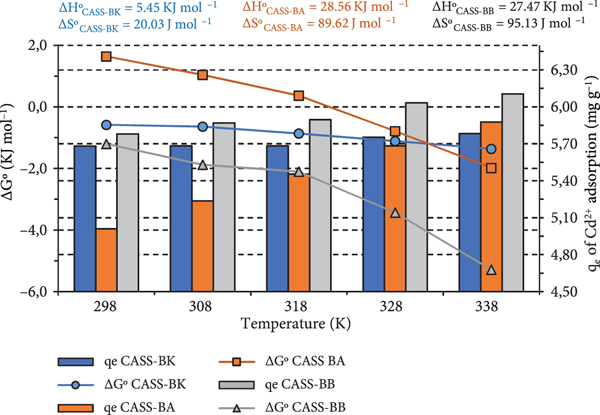
Thermodynamic parameters obtained in the adsorption of Cd2+ (a), Pb2+ (b), and Crtotal (c) by CASS-BK, CASS-BA, and CASS-BB. Experimental conditions: adsorbent dose of 8.0 g L-1, pH of 5.5, stirring at 160 rpm for 60 min,
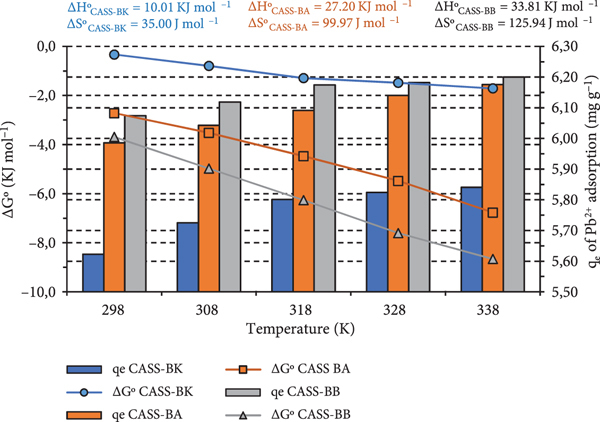

For Cd2+ adsorption,
For Cd2+ adsorption,
3.2.5. Heavy Metal Removal by Cassava-Based Adsorbents and Desorption Studies—General Considerations, the Summary of Our Findings
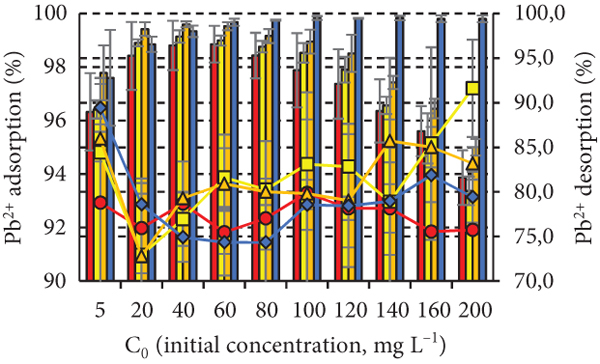
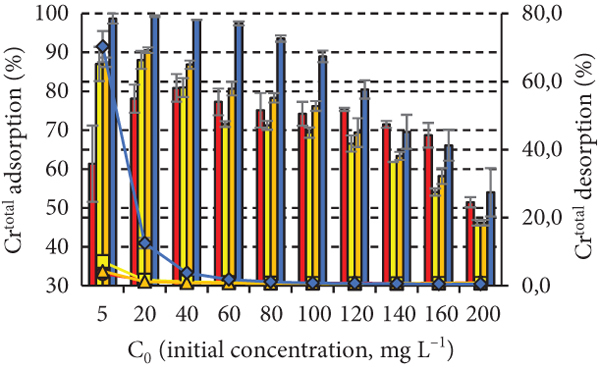
Figure 7(d) shows 83% of adsorption of heavy metals (Cd2+, Pb2+, and Crtotal) by the cassava-based materials, with a 47% rate of desorption. On the other hand, the AC presented 93% adsorption with a 53% desorption rate. In other words, AC presented higher adsorption and desorption of heavy metals. Nevertheless, cassava-based adsorbents presented close results, highlighting their great potential.

Cd2+ (a), Pb2+ (b), and Crtotal (c) adsorption (ADS) and desorption (DES) percentage for CASS-BK, CASS-BA, and CASS-BB, in different initial concentrations (from 5.0 to 200 mg L-1). Mean for the adsorption and desorption of 3 heavy metals (d). Experimental conditions: adsorbent dose of 8.0 g L-1, pH of 5.5, stirring at 160 rpm for 60 min, at 298 K.

Wu et al. [45] removed 96% of Rhodamine B using cassava slag biochar. Guo et al. [57] removed 99% of Cr (IV) using cassava sludge-based AC. Chen et al. [46] reached 79% and 86% of Pb2+ removal using modified corn cobs and chestnut shells. Scheufele et al. [58] removed 60% of direct black dye using cassava root husks. As observed, cassava-based adsorbents and their derivatives still have great potential for removing organic and inorganic contaminants from water mediums.
As mentioned above, the adsorption means obtained during the equilibrium studies highlight the great potential of cassava-adsorbents removing heavy metals, such as Cd2+, Pb2+, and Crtotal from water. CASS-BK removed on average 83.98% of Cd2+, 96.06% of Pb2+, and 65.65% of Crtotal; CASS-BA removed 80.27% of Cd2+, 97.36% of Pb2+, and 67.76% of Crtotal; CASS-BB removed 84.91% of Cd2+, 98.18% of Pb2+, and 73.72% of Crtotal (Figure 7); meanwhile, the AC, a commercial adsorbent removed 95.74% of Cd2+, 99.43% of Pb2+, and 84.65% of Crtotal. Thus, considering the averages obtained for the removal of heavy metal combined, cassava-adsorbents presented
The acid elution with HCl 0.1 M recovered a significant part of Cd2+ and Pb2+, but only a fraction of Crtotal adsorbed by cassava materials. The desorption procedure was able to recover, on average, 63.22% of Cd2+, 77.34% of Pb2+, and only 1.18% of Crtotal. CASS-BA recovered 56.49% of Cd2+, 81.80% of Pb2+, and 0.85% of Crtotal. CASS-BB recovered 63.62% of Cd2+, 81.17% of Pb2+, and 1.14% of Crtotal. In contrast to the adsorbents, AC recovered 71.01% of Cd2+, 78.88% of Pb2+, and 9.26% of Crtotal.
Considering the excellent recovery rates obtained for Cd2+ and Pb2+, it is possible to predict the reuse of cassava adsorbents in more than one adsorption cycle. Nevertheless, the same cannot be stated for Crtotal adsorption.
Compared to the obtained results, Manfrin et al., [59], using tobacco-activated carbon, achieved
Barka et al. [60] reached
4. Conclusion
SEM analysis reveals a heterogeneous structure full of cavities. In addition, FTIR before and after adsorption reveals gaps related to missing functional groups, suggesting a significant role of alkenes, carboxylic acid, alcohol, anhydride, and ether. pHPZC is found at pH 6.02, 6.04, and 6.26, indicating a negatively charged surface above such points, which could potentiate cation adsorption.
In low concentrations of metals, the adsorbents derived from barks, bagasse, and their mixture better perform at pH 7.0 (94.9%) using 16 g L-1 of adsorbents. Nevertheless, the most cost-benefit dose is found using 8.0 g L-1, with less than 1% of the maximum efficiency.
The removal of metals reaches equilibrium within 5-10 minutes of contact time with best adjustments for pseudosecond order. The adsorption of metals by cassava adsorbents is better adjusted to the Freundlich model, with significant and critical information provided by Sips, Redlich-Peterson, Temkin, Liu, and Khan models.
Adsorption/desorption studies indicate that cassava adsorbents perform, on average, -10% of the adsorption of metals compared to activated carbon. Nevertheless, factors such as low cost and availability favor the use of such natural materials.
Footnotes
Data Availability
All figures, tables, photos, excel files, etc. will be provided to readers upon request.
Conflicts of Interest
The authors declare that they have no conflicts of interest.
Acknowledgments
This study was financed in part by the Coordenação de Aperfeiçoamento de Pessoal de Nível Superior–Brasil (CAPES)–Finance Code 001 and to the CNPq, for the research productivity scholarship (authors 2, 4, and 5). We are also grateful to the Department of Chemistry of the State University of Londrina (UEL, Brazil) for the assistance in carrying out the characterization evaluations (SEM and FTIR).