




Abstract
In this paper, the modified attapulgite-reduced graphene oxide composite aerogel (ATP-RGO CA) was prepared by sol-gel method using modified attapulgite as silica source. The removal of the cationic dye malachite green (MG) and azo dye methyl orange (MO) onto ATP-RGO CA from unitary and binary systems was investigated. Morphology and microstructure studies of ATP-RGO CA were investigated by Fourier transform infrared (FTIR), scanning electron microscopy (SEM), X-ray diffraction (XRD), and specific surface area and porosity analysis. Experiments were carried out as a function of pH, contact time, initial dye concentration, and temperature in unitary and binary systems. The adsorption kinetics, isotherms, thermodynamics, and dye desorption were studied in unitary and binary dye systems. The adsorption kinetics was modeled using the pseudo-first-order, pseudo-second-order, and intraparticle diffusion kinetics equations. The equilibrium adsorption data of MG and MO dyes on ATP-RGO CA were analyzed. Thermodynamic parameters of dye adsorption were obtained. In addition, the regeneration of ATP-RGO CA was studied using dye desorption in unitary and binary dye systems. The adsorption kinetics of the dyes followed pseudo-second-order kinetics. The results indicate that the Langmuir model provides the best correlation of the experimental data. The thermodynamic studies showed that the dye adsorption onto ATP-RGO CA was a spontaneous and endothermic reaction. High desorption of MG and MO showed the regeneration of ATP-RGO CA. It can be concluded that ATP-RGO CA is suitable as an adsorbent material to remove MG and MO dyes from unitary and binary systems.
1. Introduction
Dyes are widely used in various industries including textile, cosmetics, paper, plastics, rubber, and coating. Their discharge into water causes serious environmental and health problems [1]. Most of these dyes contain aromatic rings, which make them carcinogenic and mutagenic. Dyes can cause allergy, dermatitis, and skin irritation and also provoke cancer and mutation in humans [2]. At the same time, their complex molecular structure makes them very stable and difficult for biodegradation [3]. Therefore, the removal of color from waste effluents has become environmentally important. Many researchers have made considerable attempts to find suitable treatment systems to treat wastewater containing dyes from different industries, especially the textile industry.
Cationic dye malachite green (MG) and azo dye methyl orange (MO) are the representatives of dyes. MG and MO dyes have a negative impact on human health and increase the risk of cancer. Those used in the food industry are related to the appearance of allergy, asthma, dermatitis, and vascular edema [4], while the use in the pharmaceutical industry is alleged to cause skin irritation. MG rapidly metabolizes into fat-soluble colorless malachite green when it enters aquatic animals. MG has potential carcinogenic, teratogenic, and mutagenic effects. The wastewater formed by MO contains −N=N− components that are difficult to degrade, and carcinogens will be produced under certain conditions. MG and MO dyes are toxic due to the presence of aromatic rings in their structures. Dye degradation is not easy and can induce the following diseases: dizziness, jaundice, burns, allergic problems, vomiting, diarrhea, nausea, and even affect development and mental health [4]. Due to the stable chemical properties and obvious toxicity of MG and MO, it is considered as a refractory organic wastewater by researchers [5]. The commonly used methods for dye removal from waste effluents are adsorption [6], coagulation [7, 8], biodegradation [9], membrane process, etc. [10, 11]. At present, the most common technique is adsorption technology, which is popular for its effectiveness, efficiency, economy, and absence of secondary pollution [12].
Recent studies have also confirmed that adsorption is a reliable and effective method for removing dyes from dye wastewater. Li et al. [13] prepared polyvinyl alcohol/graphene oxide adsorption sponge by crosslinking graphene oxide and polyvinyl alcohol. The adsorption sponge has ultralow density, good mechanical properties, and excellent continuous flow adsorption capacity. Sobhanardakani et al. [14] studied the adsorption of malachite green (MG), Nile blue A (NB), and Janus green B (JG) dyes on NiFe2O4 nanoparticles. Wu et al. [15] used ethyl silicate as the precursor, anhydrous ethanol as solvent, and γ-methacryloxypropyltrimethoxysilane as a modifier to prepare hydrophobic SiO2 aerogel by sol-gel two-step catalytic method. The results show that the temperature resistance can reach 407°C, the specific surface area is 877.17 m2·g-1, the pore size distribution is 1.9~5 nm, and the particle size range is 10~50 nm. It is a typical nano-mesoporous material. These studies have shown that adsorption has a good effect on the removal of dyes from aqueous solutions, but few researchers pay attention to the cost and mechanical strength of the prepared adsorbents. Due to the use of expensive raw materials, the prepared adsorbents are unacceptable under large-scale production conditions. Moreover, if the mechanical strength of the adsorbent is not ideal, the potential cost generated in production activities is also immeasurable. Therefore, it is very important for researchers to find economical raw materials and prepare adsorbents with high mechanical strength and excellent adsorption performance to remove dyes from dye-polluted wastewater [16, 17].
In this manuscript, we used cheap natural attapulgite modified as silicon source to extract amorphous silicon oxides. The modified attapulgite-reduced graphene oxide composite aerogel (ATP-RGO CA) was synthesized by the sol-gel method. We report a detailed application of ATP-RGO CA as an adsorbent for the removal of dyes: methyl orange (MO) and malachite green (MG). The morphology features of ATP-RGO CA were characterized by Fourier transform infrared (FTIR), scanning electron microscopy (SEM), X-ray diffraction (XRD), and specific surface area and porosity analysis. The impact of external adsorption conditions such as pH value, contact time, and adsorption temperature on the adsorption process of unitary and binary dye systems was successfully achieved. To achieve the adsorption capacity and mechanisms of MG and MO adsorption onto ATP-RGO CA, the equilibrium kinetic, isotherm, and thermodynamic parameters were studied. The reusability test of ATP-RGO CA was performed by carrying out five cycles of adsorption-desorption studies. This study provides a useful reference for the preparation and application evaluation of dye adsorbents in the future.
2. Materials and Methods
2.1. Chemicals and Materials
Graphite powder, concentrated sulfuric acid, potassium permanganate, hydrochloric acid, and sodium nitrate are analytical pure, purchased from Tianjin Tianli Chemical Reagent Co., Ltd.; hydrogen peroxide, purchased from Tianjin Damao chemical reagent factory; ascorbic acid, concentration for analysis pure, purchased from Tianjin Tianxin Fine Chemical Development Center; malachite green, methyl orange, sodium hydroxide, sodium chloride, trimethylchlorosilane, and n-hexane are analytical pure, purchased from Tianjin Comiou Chemical reagent Co., Ltd. All the used chemicals are of analytical grade and without further purification. Attapulgite was collected from a real estate company in Gansu Province.
2.2. Preparation of Graphene Aerogel and Composite Aerogel
2.2.1. Preparation of Graphene Oxide
Add graphite powder and sodium nitrate at a ratio of 1 ∶ 2 in 50 mL concentrated sulfuric acid and react for 40 min in the ice bath. Then, potassium permanganate was added in batches and fully reacted; heating, stirring at the same time, and then slowly dropping water, full reaction15 minutes, according to the water and ultrapure water volume ratio of 1 : 8 in the solution, after filtration. The filter cake was washed with dilute hydrochloric acid, dispersed with pure water, and centrifuged. The obtained graphene oxide sample was dried at 40°C [18].
2.2.2. Preparation of Graphene Aerogel
Graphene oxide solution of 4 mg·mL-1 was mixed uniformly by ultrasonic stirring. The graphene oxide and ascorbic acid were mixed according to the mass ratio of 1 : 2.5. The mixed solution after ultrasonic vibration treatment was put into a reaction kettle and heated in an oven at 90°C for 2 h to prepare the thermally reduced graphene hydrogel in the effluent [19]. Remove static to room temperature after multiple cleaning dialyzes in ethanol aqueous solution [20], after freeze-drying machine processing graphene aerogel.
2.2.3. Preparation of Modified ATP-RGO Composite Aerogel
Attapulgite was immersed in hydrochloric acid with a concentration of 9%. After shaking in a water bath shaker at 25°C and 30 rad/min for 30 min, it was moved to a water bath pot, stirred every 30 min at 70°C, cooled to room temperature after 8 h, and dried after filtration [21]. The 2.00 g acid-modified attapulgite was placed in a 50 mL small beaker, and hydrochloric acid with a concentration of 9% was added. The mixture was stirred evenly with a glass rod and moved to a hydrothermal crystallization reactor with polytetrafluoroethylene as the lining. The mixture was placed in an oven at 180°C and cooled to room temperature after 12 h. The mixture was filtered and dried with a circulating vacuum pump to obtain a white powdered solid, which was the silicon source [22].
Add silicon source into 2 mol·L-1 NaOH solution reacted at 90°C for 3 hours, and the solution was filtered to remove insoluble residues. Sodium chloride solution with a mass fraction of 4% and saturated sodium silicate solution with the same volume were mixed at room temperature, and dilute sulfuric acid solution with a mass fraction of 1 mol·L-1 was added when stirring to form silica sol (
After standing for 2 h at room temperature, the water in the gel was washed and replaced with a 50% ethanol solution. After aging for 12 h at room temperature, the gel was further aged with anhydrous ethanol for 24 h. Trimethylchlorosilane and n-hexane were mixed evenly as modifiers according to the volume ratio of 1 : 9, and the sample was immersed in it for 24 h at 40°C for hydrophobic treatment. After modification, modified ATP-RGO composite aerogel was prepared by fully washing and drying with n-hexane. A brief preparation procedure of ATP-RGO composite aerogel is demonstrated in Figure 1.

Preparation scheme of ATP-RGO composite aerogels.
2.3. Experimental Method
2.3.1. Adsorption Experiment
The concentration of 500 mg·L-1 MG, MO solution 100 mL, adding 20 mg composite aerogel, shaking the water bath at 25°C for 6 hours, sampling every other time, and determination of MG, MO absorbance. The removal rate and adsorption amount of MG and MO dye systems by composite aerogel were calculated. Experimental design adjusted pH to 2, 4, 6, 8, and 10; the initial dye concentration was 200 mg·L-1, 300 mg·L-1, 400 mg·L-1, and 500 mg·L-1. The set temperature is 25°C, 35°C, and 45°C three temperatures; Langmuir and Freundlich’s isothermal adsorption models were used to fit the adsorption experimental results of composite aerogel. The effect of contact time on dye removal rate was investigated by selecting a certain time node as the contact time. The calculation formulas of MG and MO removal rate
where
To better explain the adsorption mechanism in the adsorption process, several adsorption models were fitted in this study. Pseudo-first-order kinetic (Equation (3)), pseudo-second-order kinetic (Equation (4)), and intraparticle diffusion (Equation (5)) are three classical kinetic models that reveal the adsorption process. The equation is as follows:
Langmuir, Freundlich, and Temkin isothermal adsorption models are the three most commonly used adsorption models for wastewater treatment. Therefore, in this study, the Langmuir model (Equation (6)), Freundlich model (Equation (7)), and Temkin model (Equation (8)) were used to fit the adsorption isotherms of MG and MO on composite aerogel. The equation is as follows:
To further evaluate the adsorption process, one of the key parameters of the Langmuir equation
If
To study the dependency of the MG and MO adsorption process on the temperature, the equilibrium data were evaluated in terms of thermodynamics. The effects of different operating temperatures (298.15 K, 308.15 K, and 318.15 K) are investigated in this research. The thermodynamic parameters enthalpy (
2.3.2. Orthogonal Experiment
As a kind of material with a controllable structure, the modified ATP-RGO composite aerogel has many variables in the preparation process, and each variable restricts the other. The change of a variable will directly affect the performance of the composite aerogel. Therefore, it is necessary to comprehensively analyze the influence of various factors on its performance. Therefore, the orthogonal test method can be used to analyze. The orthogonal experiment method is a design method to study multifactor and multilevel, which can improve the efficiency of the experiment and give the optimization analysis scheme. It is an efficient, rapid, and experimental design method [25]. In this experiment, the solid-liquid ratio of silicon source to alkali solution (
L9 (34) orthogonal design and experimental results.
It can be seen from the orthogonal experiment results that the gel of sample 3 (
In summary, in the preparation of ATP-RGO CA, the aging temperature has the greatest influence on gelation time and mechanical strength. Analysis of experimental data, comprehensive factors, selected solid-liquid ratio 1 : 15, aging temperature 55°C, drying temperature 40°C, the best preparation process of modified ATP-RGO composite aerogel.
2.3.3. Desorption Experiment
To evaluate the reusability of the composite aerogel, adsorption and desorption tests were conducted using three eluents, namely, 0.01 M CH3COOH, 0.01 M C5H6O, and 0.01 M HCl. Desorption (%) is estimated by
3. Discussion
3.1. Material Characterization
3.1.1. X-Ray Diffraction Analysis
XRD diffraction patterns of graphene aerogel and modified ATP-RGO composite aerogel are given in Figure 2. It can be found from the graphene aerogel that a broad diffraction peak appears at

X-ray diffraction patterns of graphene aerogels and composite aerogels.
3.1.2. Scanning Electron Microscopy
SEM images were used to examine the morphology and structure of graphene aerogels and composite aerogel. Figures 3(a) and 3(b) show the SEM images of graphene aerogels; Figures 3(c) and 3(d) show SEM images of composite aerogel.

SEM of (a, b) graphene aerogel and (c, d) composite aerogel.


It can be seen from Figures 3(a) and 3(b) that the prepared graphene aerogel has a three-dimensional network structure, the graphene sheets overlap with each other, and its structure has a certain regularity. It can be seen from Figures 3(c) and 3(d) that the composite aerogel is also three-dimensional networks. White flake amorphous silicon oxide particles are uniformly distributed on the surface of graphene, indicating that silicon oxide is well loaded on the surface of graphene. These silicon oxide particles coated on the surface can effectively prevent the natural accumulation of graphene oxide sheets, which is another evidence of the protective effect of silicon oxide particles. The existence of a three-dimensional network structure greatly increased the specific surface area of aerogels [28] and provided a large number of adsorption sites, which showed great adsorption capacity.
3.1.3. Infrared Spectroscopic Analysis
From the infrared spectra of graphene aerogel (GA) and composite aerogel (CA) shown in Figure 4, there is no obvious absorption peak, which indicates that the oxygen-containing groups on the graphene aerogel sheet are reduced by ascorbic acid, and the new absorption peak at 1550 cm-1 also indicates that the graphene aerogel with the new structure is successfully prepared [29]. The composite aerogel showed characteristic peaks of Si-O-Si at 1085 cm-1, 848 cm-1, and 435 cm-1, indicating that silicon oxide was successfully loaded into the graphene aerogels [30]. Due to the modification of trimethylchlorosilane, the alkyl peak appeared at 2960 cm-1. At 757 cm-1 and 2960 cm-1, the antisymmetric stretching vibration peak and symmetric stretching vibration peak of C-H in -CH3 were observed, respectively [31]. The absorption peak near 1259 cm-1 was caused by Si-C vibration, which indicated that after the modification of trimethylchlorosilane, -CH3 was connected to the end branch of the composite aerogel so that the aerogel was hydrophobic [32].

Infrared spectra of graphene aerogel and composite aerogel.
3.1.4. Specific Surface Area and Pore Size Analysis
The N2 adsorption-desorption isotherms and pore size distribution curves of graphene aerogels and composite aerogel are displayed in Figures 5(a) and 5(b), respectively. From Figure 5(a), it is obvious that all isotherms are type IV, indicating typical mesoporous materials. From Figure 5(b), when

(a) N2 adsorption-desorption isotherms and (b) pore size distribution of graphene aerogels and composite aerogels.

3.1.5. Contact Angle Analysis
The contact angle test diagram of graphene aerogel and composite aerogel is shown in Figures 6(a) and 6(b), respectively. When the contact angle is in the range of 90°~150°, the solid surface is difficult to be soaked in water, which is called the hydrophobic surface and reflects the hydrophobicity of the solid. As shown in the figure, the contact angle between graphene aerogel and pure water is 105°, showing a certain hydrophobicity. The contact angle between the composite aerogel and pure water is 135°, indicating that the sample has good hydrophobicity. Hydrophobicity enables aerogels to maintain nonwettability in water and to preferentially adsorb dyes in water, which is beneficial to the treatment of dye wastewater.

Contact angle test diagram of (a) graphene aerogel and (b) composite aerogel.

3.1.6. Mechanical Strength Analysis
Aerogels must have a certain mechanical strength, otherwise under the impact of the fluid will appear scattered, structural collapse, and so on. To this end, we tested the mechanical properties of graphene aerogels and composite aerogel, as shown in Figure 7. It indicates that 20 mg of graphene aerogel can support the 2500-fold weight (50 g) of its mass without deformation and damage. Figure 7(b) indicates that 20 mg composite aerogel can successfully support 100 g weight, which is 5000 times its weight. After removing the weight, the aerogel has no deformation and damage, showing excellent mechanical strength. The reason for the increase in the strength of the composite aerogel is that silicon oxide is added as an agglomeration inhibitor to curb the accumulation of graphene sheets, resulting in a more complete pore wall structure of the composite aerogel, enhancing the stability of its structure and thereby increasing the mechanical strength of the composite aerogel.

Mechanical strength test diagram of graphene aerogel and composite aerogel.

3.2. Adsorption Experiments
3.2.1. Effect of pH on Adsorption of Malachite Green and Methyl Orange
The pH is one of the important factors that affect the adsorption process of pollutants in wastewater. The pH influences the solubility of dyes in water, the activity of surface functional groups of the adsorbents, and ion competition for the adsorption centers [35]. To explore the effect of pH on the adsorption properties of composite aerogel, MG and MO monobasic and binary dye systems were adsorbed by composite aerogel under different pH (Figure 8(a)). Meanwhile, to better understand the effect of solution pH on the adsorbent itself, the point of zero charge (pHpzc) of the composite aerogel was also studied. The results are shown in Figure 8(b). The removal rates of MG and MO reached the highest adsorption capacity at

(a) Effect of pH on adsorption of MG and MO; (b) pHpzc of the adsorbent.


The MO structures in acidic solute (a); the MG structures in acidic solute (b).

Considering the practical application, the pH value was determined to be 6. Different from the monobasic system, the removal rate of MO by composite aerogel in the binary dye system has been greatly improved, indicating that the coexistence of the two dyes has a great role in promoting the adsorption of the two, and the two are synergistic adsorption.
3.2.2. Effect of Adsorption Time on Adsorption of Malachite Green and Methyl Orange
The composite aerogels were used to adsorb MG and MO monobasic and binary dye systems, and the results are shown in Figure 10. The removal rate of MG by composite aerogel in either monobasic or binary dye systems was high, indicating that the silica compounds were successfully composited into graphene aerogels, which increased the specific surface area of composite aerogel and improved their adsorption capacity. It can be seen that in the binary system, MG and MO reach the adsorption equilibrium after 180 and 60 minutes, respectively, while in the unitary system, MG and MO reach the adsorption equilibrium after 250 minutes. At the same time, the removal rates of MG and MO in the binary dye system were higher than those in the monadic system, which was due to the formation of dimers between MG and MO in the binary system to improve their aromaticity, thereby enhancing the
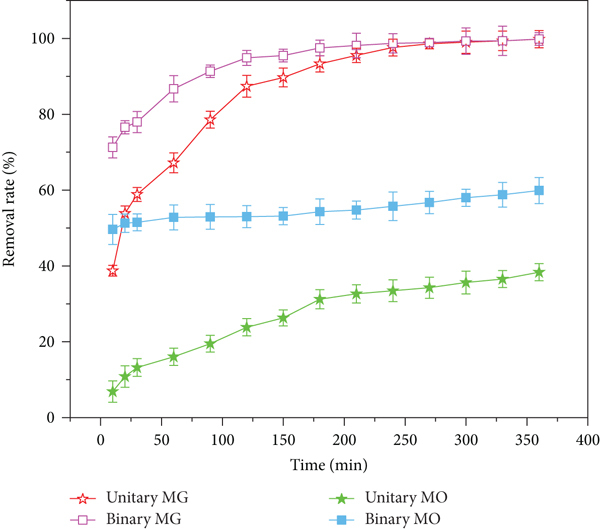
Effect of adsorption time on the adsorption of MG and MO by composite aerogel.
3.2.3. Effect of Adsorption Temperature on Adsorption of Malachite Green and Methyl Orange
At different temperatures, MG and MO monobasic and binary dye systems were adsorbed to explore the effect of temperature on the adsorption properties of composite aerogel. The results are shown in Figure 11. The removal rate of MG and MO increased with the increase in temperature, indicating that the adsorption of dyes by composite aerogel was an endothermic reaction. It is obvious that in the binary system, the removal rate of MO by composite aerogel fluctuates little with time, and the removal rate is much higher than that of the monobasic dye system, which once again shows the synergistic adsorption of the two dyes. In addition, it can be observed that the removal rate of MG by composite aerogel in the binary dye system is higher than that in the unitary system, which also reflects that MG and MO form dimers to improve their aromaticity in the binary system, thereby enhancing the
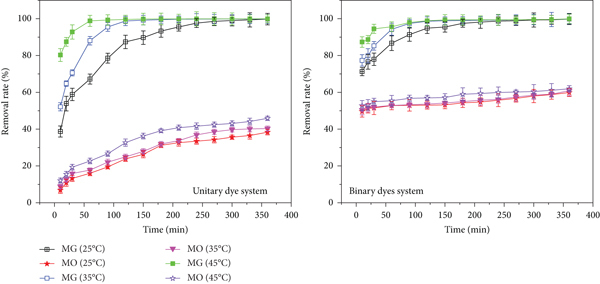
Effect of temperature on the adsorption of MG and MO by composite aerogel.
3.2.4. Adsorption Kinetics of Malachite Green and Methyl Orange on Modified ATP-RGO Composite Aerogel
To explore the adsorption mechanism of MG and MO on composite aerogel, pseudo-first-order kinetic model, pseudo-second-order kinetic model, and intraparticle diffusion model were used to fit and analyze the experimental results of MG and MO adsorption on monobasic and binary dye systems. The obtained adsorption kinetics data are shown in Figure 12 and Table 2.

(a, b) Pseudo-first-order kinetic fitting curve, (c, d) pseudo-second-order kinetic fitting curve, and (e, f) intraparticle diffusion equation fitting curve of MG and MO adsorption on composite aerogel.


Adsorption kinetic parameters of malachite green and methyl orange on composite aerogel.
Table 2 shows the fitting of different kinetic equations to the test results. According to the data in the table, the correlation coefficient
3.2.5. Adsorption Isotherms of Malachite Green and Methyl Orange on Modified ATP-RGO Composite Aerogel
To explore the interaction between composite aerogel and two dyes, unitary and binary dye systems with different initial concentrations were adsorbed at 25°C and an analysis of adsorption isotherm. The adsorption isotherm data fitted by Langmuir, Freundlich, and Temkin isotherm models are tabulated in Figure 13 and Table 3.

Isotherm fittings of (a) MO adsorption and (b) MG adsorption on the composite aerogels (Langmuir isotherm: solid line, Freundlich isotherm: point line, Temkin isotherm: scratch line).

Adsorption isotherm parameters of MG and MO on composite aerogel.
As shown in Table 3, based on the Langmuir isotherm model data, under the optimum experimental conditions (
Comparison of maximum adsorption capacities of different adsorbents for MG and MO.
It can be seen from Table 3 that the
3.2.6. Adsorption Thermodynamics Analysis of Malachite Green and Methyl Orange on Modified ATP-RGO Composite Aerogel
The thermodynamic parameters of MG and MO adsorption by composite aerogel at 298.15 K, 308.15 K, and 318.15 K were obtained through the thermodynamic analysis of the adsorption process of MG and MO in the monobasic and binary dye systems. The results are shown in Table 5. All
Adsorption thermodynamic parameters of MG and MO on composite aerogel.
3.2.7. Desorption Study
Nowadays, the reproduction of adsorbents is one of the most challenging and important factors for industrial applications. At the same time, the reusability is also one of the criteria for evaluating the performance of an adsorbent. In this study, 0.01 M CH3COOH, 0.01 M C5H6O, and 0.01 M HCl were designated as desorbing agents to test the reusability of composite aerogel in multiple dye adsorption-desorption cycles. Five adsorption-desorption cycles in ethanol, acetone, and HCl were applied to check the reusability of both adsorbents. The results of these experiments are presented in Figure 14.
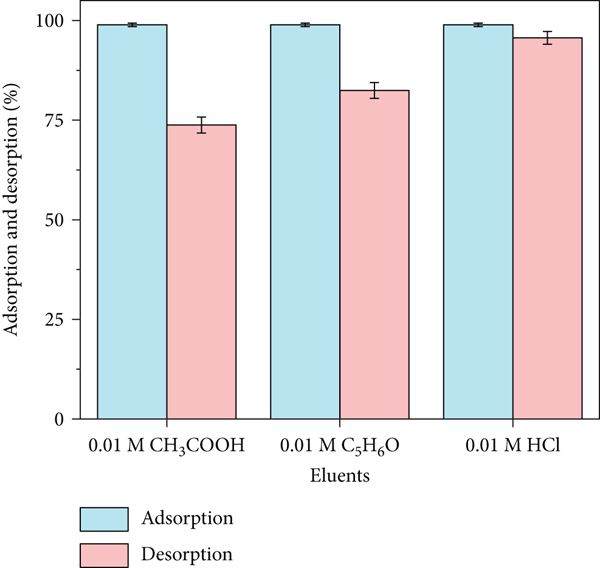
(a) Comparison of eluents for desorption of MG from composite aerogel surface, (b) comparison of eluents for desorption of MO from composite aerogel surface, and reusability of composite aerogel for (c) MG and (d) MO.
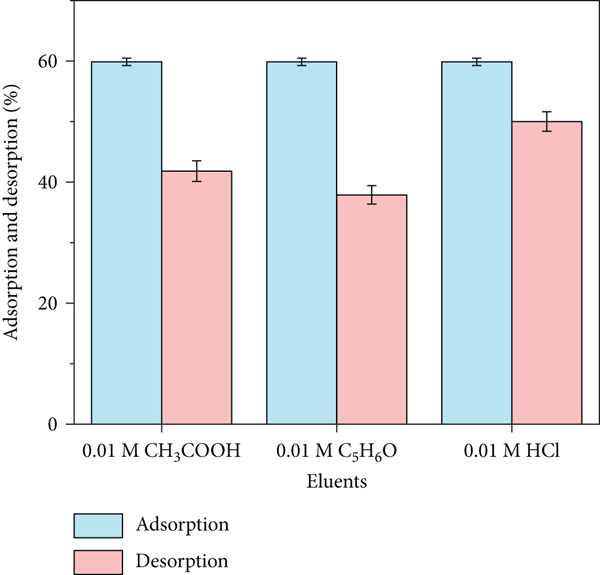

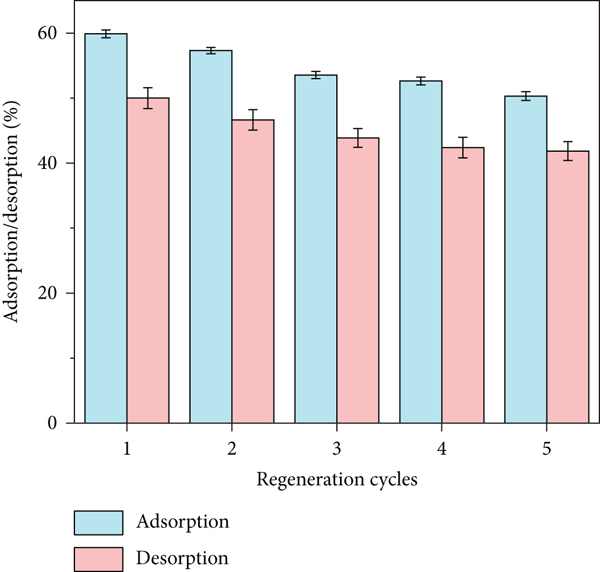
As shown in Figure 14, the desorption process of MG and MO loaded on composite aerogel was performed by 0.01 M ethanol, 0.01 M acetone, and 0.01 M HCl as three eluents by an ultrasonic assistant. Readsorption process was carried out at the same optimum condition of experiments (
After five cycles, the adsorption amount of MG on the composite aerogel decreased by 13.4%, and the final adsorption amount was 82.27%. The adsorption amount of MO decreased by 8.15%, and the final adsorption amount was 41.86% (Figures 12(c) and 12(d)). The results indicated that composite aerogel was a regenerable and reusable adsorbent.
4. Conclusions
The modified attapulgite-reduced graphene oxide composite aerogel (ATP-RGO CA) was synthesized by the sol-gel method to be used as effective adsorbents for the removal of malachite green (MG) and methyl orange (MO) dyes from unitary and binary aqueous solutions. The as-obtained composite materials prepared were characterized by X-ray diffraction, FTIR spectroscopy, SEM, and specific surface area and porosity analysis. The results confirmed the successful synthesis of composite materials. Moreover, the physical properties of the prepared composite aerogel were improved compared with those of the initial graphene aerogels. Kinetic, equilibrium, and thermodynamic studies were conducted for the adsorption of MG and MO from aqueous solutions onto ATP-RGO CA in unitary and binary systems. The results of adsorption showed that ATP-RGO CA can be effectively used as an adsorbent for the removal of dyes. The kinetic studies of dyes on ATP-RGO CA were performed based on pseudo-first-order, pseudo-second-order, and intraparticle diffusion rate mechanisms. The data indicated that the adsorption kinetics of dyes on ATP-RGO CA followed the pseudo-second-order model. The equilibrium data were analyzed using the Langmuir, Freundlich, and Temkin isotherms, and the characteristic parameters for each isotherm were determined. The results showed that the Langmuir isotherm best describes the adsorption on ATP-RGO CA and indicates that MG and MO adsorption occurs on the homogeneous surface of ATP-RGO CA as a monolayer. Thermodynamic studies show that the adsorption process of MG and MO onto ATP-RGO CA was endothermic and spontaneous. The reusability test of ATP-RGO CA exhibited that the adsorption capacity of ATP-RGO CA decreased slightly after five cycles, but the adsorption capacity was still good. The results of the study indicate that ATP-RGO CA is relevant as adsorbent to clean dye-containing wastewater.
Footnotes
Data Availability
All relevant data in this article are available to the corresponding author.
Conflicts of Interest
The authors state that there is no conflict of interest in the publication of this paper.
Acknowledgments
This work was supported by the National Natural Science Foundation of China (No. 21573171), the Shaanxi Province Key Research and Development Plan of China (2021SF-438), the Natural Science Foundation of Shaanxi Province of China (No. 17JK0327), the Ph.D. Research Initiation Fund of Xi’an Polytechnic University (BS201932), and the Research and Innovation Training Project for Graduate in General Universities of China (201910709028).