




Abstract
The development of advanced materials for the removal of heavy metal ions is a never-ending quest of environmental remediation. In this study, a facile and cost-effective approach was employed to synthesize copper ferrite (CF) and copper ferrite/reduced graphene oxide (CG) by microwave assisted combustion method for potential removal of barium ions from aqueous medium. The physiochemical characterizations indicated the formation of magnetic nanocomposite with an average crystallite size of CF and CG is 32.4 and 30.3 nm and with specific surface area of 0.66 and 5.74 m2/g. The magnetic results possess multidomain microstructures with saturation magnetization of 37.11 and 33.84 emu/g for CF and CG. The adsorption studies prove that upon addition of rGO on the spherical spinel ferrite, the adsorption performance was greatly improved for CG nanocomposite when compared with the bare CF nanoparticles. The proposed magnetic adsorbent demonstrated a relatively high Ba2+ adsorption capacity of 161.6 mg·g-1 for CG nanocomposite when compared to 86.6 mg·g-1 for CF nanoparticles under optimum conditions (
1. Introduction
One of the critical challenges faced by the present world is to control the pollution of natural resources, out of which natural water pollution is of primary concern. The direct disposal of heavy metals into the environment by the developed industries is the primary cause of pollution [1]. Heavy metals are nonbiodegradable and therefore accumulate in soil, water, and air which causes serious environmental problems. Hence, the removal of heavy metal from the polluted water is of urgent concern.
Among the heavy metal pollution, barium is the most commonly found radionuclides in industrial wastewater and several other industrial activities such as gas, oil, and petrochemical wastes [2]. In general, barium is soft with white silver metal which easily dissolves in water and thereby readily mobilizes to contaminate the environment [3]. Barium has high fission yield and long half-life which makes them to form two significant nucleotides of fission products which leads to serious pollution in the environment. This exposure has a detrimental impact on human’s health causing various fatal disease [4].
The soluble barium species are considered toxic when compared with insoluble as it stimulates cell processes like paralysis and hypokalemia which results in cardiac attack and respiratory issues. Barium carbonate is strong poison to human because it gets easily dissolved in human stomach. Acute poisoning causes gastrointestinal problems with symptoms like nausea, diarrhea, and gastric pain and neurological problems which causes tremors and mydriasis [5]. Barium also causes musculoskeletal problems with muscle weakness and paralysis effects. Exposure to high doses of barium for a long time leads to chronic poisoning effects which give rise to cardiovascular misfunction and kidney damage in humans. Besides, highly soluble barium chloride is considered more hazardous as it leads to liver and kidney dysfunction, nervous disorders, dyspnea, brain swelling, and paralysis [6, 7].
By considering the toxicity of barium, the World Health Organization (WHO) has regulated the maximum barium concentration of 0.7 mg/L in the clean drinking water [8]. These constraints have prompted special concerns for easy and efficient removal of barium ion pollutant.
The removal of heavy metals by a powerful removal method with easy and new methodology is still a driving concern. Over the recent years, multiple conventional techniques such as electrocoagulation [9], membrane filtration [10], solvent extraction [11], biosorption [12], chemical precipitation [13], ion exchange [14], electrocoagulation [15], cementation [16], and adsorption [17] are being adopted for the removal of heavy metal ions. Many of these techniques have limitations in terms of experimental applicability, operational cost, and removal efficiency. Among these techniques, adsorption is considered one of the most effective and fastest method with significant choice of potential adsorbents used to remove toxic metal ions from waste water [18]. It is also employed to overcome the limitations associated with conventional techniques due to its easy applicability, viability, and effectiveness in the removal of numerous organic and inorganic pollutants [19].
Due to the exceptional features of adsorption technique, several conventional adsorbent materials were developed for the removal of Ba(II) ions from aqueous solution such as biosorbents, conducting polymers, and carbon-based nanocomposites such as carbon nanotube, graphene oxide, and activated carbon [20–23]. Fard et al. [3] prepared MXene by a ball mill process which exhibited adsorption capacity of 9.3 mg/g of Ba(II) within 120 min at pH 6. Majidnia et al. [4] reported that maghemite and titania PVA-alginate beads prepared by a coprecipitation method showed adsorption capacity of 19.37 mg/g of Ba(II) for a contact time of 120 min. Ghaemi et al. [24] suggested that the dolomite powder demonstrated low adsorption capacities of 1.172 mg/g and 3.958 mg/g with a contact time of 120 min at pH 5.5, respectively, for Sr (II) and Ba(II) removal from water. Likewise, Kaveeshwar et al. [25] prepared Pecan shell-based activated carbon by a thermal decomposition method and reported an adsorption capacity of 8.8 mg/g of Sr (II) and 3.3 mg/g of Ba(II) with a longer contact time of 360 min. Torab-Mostaedi et al. [26] reported that commercially perlite exhibited an adsorption capacity of 1.14 mg/g of Sr (II) and 2.49 mg/g Ba(II) for a contact time 90 min at pH 6.
However, it is important to highlight that besides adopting adsorption as an effective method for heavy metal removal, the selection of an appropriate adsorbent to eliminate the pollutant remains crucial. Among the metal oxides, magnetic nanoparticles are reviewed as the most interesting adsorbent materials because of its easy application and removal of heavy metals from waste water [27]. Spinel ferrites are considered excellent adsorbents due to their excellent and controllable magnetic properties, abundance of active sites, and large surface area. This favors adsorption activity by interaction with contaminant ions [28]. Moreover, the magnetic property of spinel ferrites helps in easy recovery of the adsorbent which can be readily washed and reused. The utilization of iron-based nanoparticles as magnetic adsorbents has been widely examined for removal of pollutants from wastewater [29].
Several studies have reported the use of metal ferrite for effective removal of heavy metal ions [30–32]. Among the reported ferrites, copper ferrite (CuFe2O4) is one of the spinel ferrites that has been identified as a potential candidate for adsorption studies owing to their surface area, catalytic reactions, and excellent magnetic properties [33]. This improved property is due to the tendency of the spinels to occupy the trivalent and divalent cations in octahedral and tetrahedral sites. A comprehensive range of contaminants present in water was removed by copper ferrite. Tran et al. [34] reported that the removal of Pb(II) by Cu-Mg binary ferrite cubical nanoparticles of 30 nm in particle size showed an adsorption capacity of 57.7 mg/g at pH 7. Tu et al. [35] indicated that CuFe2O4 nanoparticles of particle size 20 to 120 nm exhibited a maximum adsorption capacity of 45.66 mg/g at pH 3.7 for As(III).
However, the low sensitivity of spinel CuFe2O4 is reformed by graphene-based materials which is enormously applied in the elimination of pollutants. The attention is devoted to graphene oxide-based nanomaterials because of their high surface area, stability, exceptional optical and electrical properties, and high thermal conductivity [36]. Moreover, they are low weight and less toxic and are affordable when compared to other complex organic and inorganic adsorbents [37]. Reduced graphene oxide (rGO) is a two-dimensional structure with a high specific surface area. Hence, in this work, these properties of rGO were exploited on to the surface of spinel copper ferrite to design ferrite-graphene-based nanocomposite for potential adsorbent in barium removal [38].
In the current study, copper ferrite (CF) and copper ferrite-reduced graphene oxide (CG) have been employed for adsorption of Ba(II) ions from aqueous solution. Although many studies on the synthesis of CF and CG nanocomposite using different methods have been reported, their complex methods and the expensive procedures restrict their usage. In this study, CF and CG nanoadsorbents were synthesized by a microwave-assisted combustion method. It is a commonly used noncontact heating technique for the preparation of nanoparticles which uses dissolved solutions of metal nitrates and fuel to undergo combustion reaction [39]. It is noteworthy that the synthesis of CG nanocomposite can be effectively achieved by a microwave-assisted combustion method [40]. Inside the microwave oven, the microwave energy is converted into heat energy due to strong intermolecular friction which raises the temperature of the sample to undergo rapid exothermic reaction. This results in obtaining pure nanosized particles with better texture, surface area, morphology, and crystallite size in short reaction time [41]. Furthermore, fuel plays a significant role in the combustion process as it oxidizes and thereby liberates CO2, N2, and H2O gases. As a result, the large particles are broken down to smaller particles with the controlled pore size [40]. In recent studies, amino acids are nontoxic inorganic compounds which are regarded as powerful green fuel. They contain free carboxylic and amine functional groups which regulates the surface properties of nanoparticles. In view of its advantages, several studies have used amino acids such as glycine and L-alanine as fuels in a combustion process. L-lysine (C6H14N2O2) helps to obtain uniform mixing of reaction mixture, and due to its high flame propagating property, it helps to combust the products [42]. To the best of authors knowledge, preparation of rGO-based copper ferrite nanocomposites using L-lysine as fuel in the microwave-assisted combustion method have not been reported elsewhere.
In the present work, CuFe2O4 and CuFe2O4/rGO magnetic nanocomposite was synthesized by the microwave-assisted combustion method using L-Lysine as fuel. The synthesized adsorbents possess increased adsorption sites and are deployed for the removal of Ba(II) ions from aqueous solution. The different adsorption parameters such as pH, contact time, and temperature which influences the removal of Ba(II) ions were examined. In addition, the adsorption efficiency, kinetics, isotherms, and reusability of CF and CG nanoadsorbents were discussed. The possible mechanisms involved on adsorption of Ba(II) ions are studied.
Based on its properties, CuFe2O4/rGO nanocomposite can be used as an effective adsorbent for the removal of barium ions in the treatment of waste water. Nonetheless, it is important to highlight that there are very limited studies reported in the literature on the removal of barium heavy metal; consequently, there is a necessity of huge demand for new technology development [43]. This study is aimed primarily on the effect of CuFe2O4 and CuFe2O4/rGO nanocomposite which is synthesized by the microwave-assisted combustion method using L-lysine (amino acid) as fuel.
2. Experimental Procedure
2.1. Preparation of CF Nanoparticles
CF nanoparticles were synthesized by using copper nitrate hexaferrite (Cu(NO3)2·6H2O, ≥99%), ferric nitrate nonahydrate (Fe(NO3)3·9H2O, ≥99%), and L-lysine (C6H14N2O2, 99%) which were purchased from Merck and used without any purification. In the current work, a domestic microwave oven was used for the preparation of CF and CG nanocomposite. The nitrate salts of molar ratio of 1 : 2 used as cation precursors were dissolved individually in double distilled water. L-lysine is used as fuel, with the metal nitrate to fuel ratio of 1 : 1. All the solutions were mixed and magnetically stirred to obtain a clear solution. The obtained solution was transferred into a silica crucible and subjected to irradiation in a domestic microwave oven at a frequency of 2.4 GHz with an output power of 850 W for 12 min. The collected black powder was washed thoroughly with distilled water and ethanol.
2.2. Preparation of CuFe2O4/rGO Nanocomposites
Initially, reduced graphene oxide was prepared using modified Hummer’s method [44]. 10 mg of graphene oxide was dispersed in double distilled water to form homogenous solution. To this solution, the prepared 1 : 2 CuFe2O4 and Fe(NO3)3 and lysine were added and stirred continuously for 24 h to achieve a homogenous solution. The final solution was transferred to a silica crucible and kept for irradiation in a domestic microwave oven at a frequency of 2.45 GHz, 800 W output power for 10 min. The obtained black precipitate of CuFe2O4/rGO was thoroughly washed with distilled water and ethanol then dried at 60°C for 8 h.
2.3. Characterization Techniques
The crystal structure of CF and CG samples were checked by X-ray diffraction (XRD) using Bruker D8–Advance diffractometer equipped with Cu-Kα radiation source (
2.4. Adsorption Tests
Batch mode adsorption experiments were carried out to optimize the operational conditions and to estimate the adsorption efficiency of Ba(II) ions from aqueous solutions using CF and CG adsorbents. A known stock solution of Ba(II) concentration was dissolved using double distilled water. The initial concentration of Ba(II) ions was 45 mgL-1; 25 mL of Ba(II) ion solution with 10 mg of adsorbent was optimized. The pH of the solution was maintained to be neutral with the addition of 1 M of NaOH. Throughout the experiments, the flasks were shaken at 300 rpm using a mechanical shaker at room temperature for 24 h. At a certain time interval, the supernatant liquid was separated to determine the residual amount of Ba(II) in the aqueous solution.
The removal efficiency and the adsorption capacity (
2.5. Adsorbent Stability Test
The stability of CF and CG nanoadsorbents is investigated under various parameters such as water exposure, Ba(II) concentrations, solution pH, and adsorbent reusability. The stability study on the effect of water exposure was examined by direct experiments, in which 0.3 g/L of adsorbents was soaked in ultrapure water for a time duration of 1-5 days. The adsorbents were then dried under air for 70° C to determine the crystalline structure and the adsorption performance of Ba(II). The stability of the solution pH was determined by dispersing 0.3 g/L of the adsorbents in 50 mL of water at pH ranging from 2 to 8 for 24 h. The stability of the nanoadsorbents was examined by using the ICP-OES analyzer.
3. Results and Discussion
3.1. X-Ray Diffraction Analysis
The phase purity and the crystallinity of the prepared CF and CG nanocomposite were determined by using X-ray diffraction [45]. The peaks are substantially sharp which is an indication of the crystalline nature of the prepared samples. The diffractions peaks of CF and CG located at
Generally, the strong intense diffraction peak at
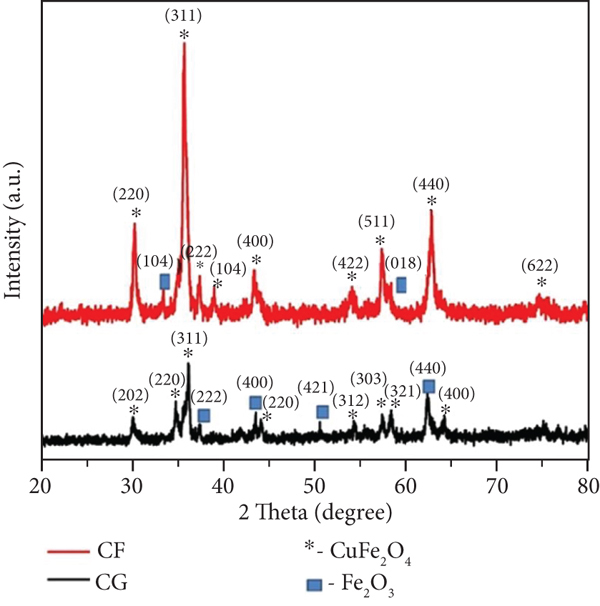
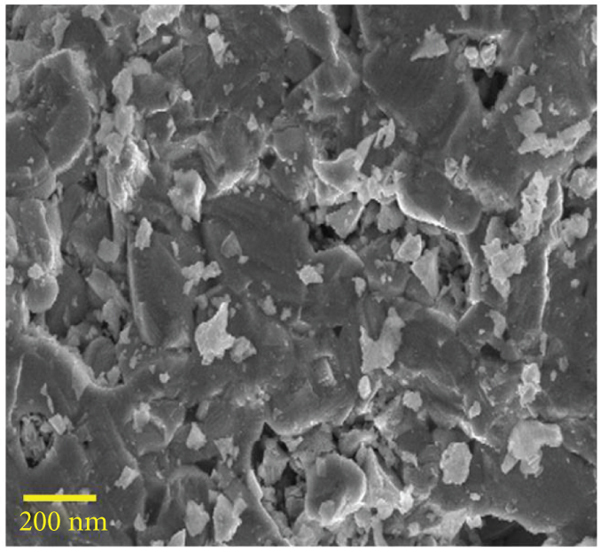
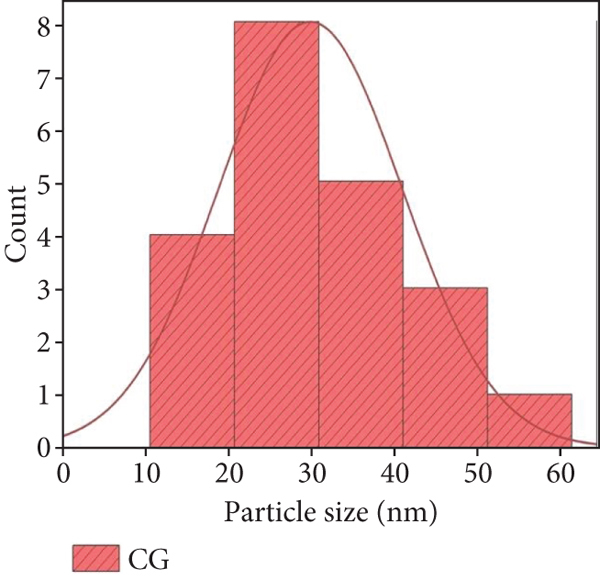
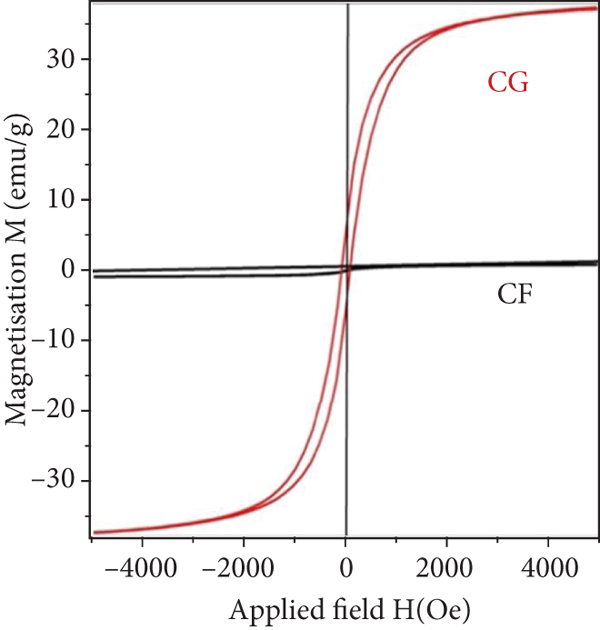
(a) XRD patterns of CF (CuFe2O4) and CuFe2O4/rGO (CG); FE-SEM images of (b) CF and (c) CG; the corresponding representative histograms of particle-size distribution with average size calculation by Lorentz fitting of (d) CF and (e) CG; EDX spectra of (f) CF and (g, h) nitrogen adsorption–desorption isotherms of CF and CG nanocomposite; (i) M-H curves recorded at room temperature for CF and CG.




The relatively broadened diffraction peaks in XRD patterns are due to the defects associated with the size and strain in crystal lattice; as a result, the crystallite size calculated from different methods varies. The Williamson-Hall (W-H) method contemplates on the particle size and strain caused in the physically broadened peaks. The investigation of the average crystallite size and the strain caused as a consequence of the distortion in the crystal lattice are analyzed [50]; the integral width of the peak is defined by the following equation [51]:
Phase composition, structural, and microstructural parameters of CF and CG nanopowders.
Similarly, the Halder-Wagner (H-W) method deals with the investigation of the strain in the lattice and crystallite size. It is favorable to the small and less intensity and low angle peaks. Moreover, it overcomes the difficulty caused in the W-H method that neglects to agree with the XRD peaks. To simplify the understanding of strain and the crystallite size, the below given expression is used [52]:
The crystallite size and the microstrain
It is evident from Table 1 that the crystallite size of CF calculated from H-W and W-H methods shows some variation. This is because the influence of strain on the crystallite size is more significant as well due to the variation of size distribution in CF crystal lattice [53]. In CG, the impact of strain on the crystallite size is negligible; hence, the particle size is similar in both methods. The estimated strain in the W-H method is four times higher than that in the H-W method. This is attributed to the distortions caused in the crystal lattice of CF and CG [54].
Therefore, it is necessary to note that crystallite size depends on the lattice strain which regulates the overall properties of nanoparticles. Due the reduction in the crystallite size of the nanoparticles, the pressure is developed on the surface of crystallite interfaces which results in stress. The stress developed leads to crystal lattice strain to expand the unit cell [55].
Furthermore, the lattice constants
3.2. Morphological and Compositional Observations
SEM images of CF and CG are presented in Figures 1(b) and 1(c). The microstructural framework in CF shows spherical nanoparticles with varied particle size and with moderate agglomeration. This is due to the magnetic character which causes magnetic dipolar interaction between CuFe2O4 nanoparticles [58]. To estimate the particle size distribution of the nanoparticles from the SEM images are obtained using ImageJ software [59]. The particle size distribution curve of CF and CG is shown in Figures 1(d) and 1(e). The average particle size distribution of spherical CF nanoparticles is within a narrow range of 110-130 nm with a calculated mean value of 120 nm. This is significantly higher than the values of the crystallite size estimated by XRD analysis thus suggesting each particle is in fact formed my multiple crystallites. The CG SEM image shows that the CuFe2O4 nanoparticles are homogenously dispersed onto the surface of graphene layers. The presence of CuFe2O4 particles in CG hinders the accumulation of graphene sheets allowing them to create multiple pores which are evident from Figure 1(c). The average particle size distribution of CG surface is reduced to 100-120 nm, with a mean value of 106 nm which corroborates with XRD analysis. This decrease in particle size is due to the presence of rGO sheets which restrict grain growth and also function as nucleating centers to promote the crystal formation [60, 61]. Thus, CG SEM image signifies that CuFe2O4 nanoparticles incorporated within reduced graphene oxide layers manifest high porosity and increased surface area and consequently an expected enhanced adsorption activity.
The elemental composition of CF and CG has been determined by EDX analysis. From the EDX spectra displayed in Figures 1(f) and 1(g), the EDX spectrum of CF and CG is demonstrated at 10 keV. The spectra show the presence of Fe, Cu, and O peaks which confirms the formation of CuFe2O4 in both CF and CG spectra; besides, the Cu : Fe ratio is compatible to the stoichiometry of the synthesis procedure. In addition to the presence of Fe, Cu, and O in the CG EDX spectrum, the presence of C peak reveals the presence of rGO alongside CuFe2O4. The quantitative data such as the weight percentage (wt%) and atomic percentage (at%) of CF and CG nanocomposite are given in the table inset of Figures 1(f) and 1(g). The assessed atomic percentages of CF and CG nanocomposite are in total agreement with the theoretical values. Moreover, the absence of additional elements confirms the purity of the as prepared samples [62].
3.3. Surface Analysis
The textural properties of CF and CG powders have been examined using Brunauer-Emmett-Teller (BET) analysis. This study gives detailed information on the surface area, pore volume, and diameter of the as prepared powders [63]. From Figure 1(h), the nitrogen adsorption/desorption isotherm expresses type IV BET isotherm according to the IUPAC classification, with the presence of a hysteresis loop. The CF samples present a surface area of 0.66 m2·g-1 and a pore volume of 1.7 cm3·g-1; then, both increase significantly with the addition of rGO reaching 5.74 m2·g-1 and 16.9 cm3·g-1, respectively. The enhancement of surface area of CG by almost five times compared to CF implies that CoFe2O4 nanoparticles are well incorporated with regular distribution onto rGO sheets. This favors the production of more reactive sites which will be accompanied by an effective adsorption activity [64, 65].
The (Barrett-Joyner-Halenda) BJH method has been adopted to verify the bimodal mesoporous size distribution in CF and CG powders using the desorption arm in the presented Figure 1(h) [66]. The calculated surface area, pore volume, and diameter of CG are greater in comparison with those of CF (Table 2).
BET characteristics of CF and CG nanopowders.
3.4. Magnetic Studies
The magnetic behavior of the as-prepared pure CF and CG powders has been investigated by recording the magnetization vs. magnetic field (M-H) curves, as shown in Figure 1(i), and the corresponding magnetic properties are presented in Table 3. It is clearly apparent from the figure that both samples possess soft ferromagnetic behavior, because it possesses near-zero magnetostriction. The saturation magnetization (
Magnetic properties of prepared CF and CG nanopowders.
The remnant ratio (or)/squareness ratio (Mr/Ms) of a magnetic material is an essential parameter which corresponds to its anisotropy. These values represent the indiscriminately oriented single axial particles along the cubic magnetocrystalline anisotropy [72]. It has been examined that the squareness ratio which is significantly above 0.5 depicts that the material is single domain and below 0.5 is ascribed to multiple domain structure where domain wall activity of particles changes its orientation very easily with applied field [73]. In the present study, the estimated squareness ratio value of CF and CG at room temperature is demonstrated in Table 3. It is visible that the reported values of CF (0.05) and CG (0.16) correspond to the multiple domain particles. The values indicate the presence of noncollaborative single domain particles with cubic anisotropy being present in the nanoparticles. The excellent magnetic nature of CG nanocomposite can be used as a magnetic adsorbent for easy separation by an external magnet from any aqueous solution. This characteristic also helps to maintain the adsorbent for reutilization in the adsorption process.
3.5. Barium Adsorption Studies
Further, adsorption experiments of barium ions from the aqueous solution using CF and CG powders have been performed in batch mode, in order to determine the impact of bare ferrite and the rGO-based ferrite nanocomposite on the adsorption efficiency and the involved mechanism. The two important properties of adsorption process such as the contact time and the pH of the solution have been examined. Figure 2(a) indicates that the CF removal efficiency reaches 68% and then increases up to 78% for CG in 120 min. The observed enhancement is due to the significant role of rGO, since it increases the surface area, pore volume, and more available active sites because of its layered nanostructure.

(a) Comparison of equilibrium time models for Ba(II) adsorption on CF and CG nanocomposites and nonlinear plot. (b) Effect of pH value on the equilibrium adsorption capacity of Ba(II) by CF and CG.

3.5.1. Effect of pH
It is certain that the pH of the solution regulates the barium adsorption performance in aqueous solution [74]. It also governs the active surface charge and the functional group species present at the surface of the adsorbent [1, 2]. This assists the barium ions to not easily form complexes and hydrolyze [4]. In order to determine the effect of pH change on the removal activity and the optimal pH, this set of experiments has been conducted within a pH range 3–11 by using a fixed mass of adsorbent 10 mg in 25 mL barium solution. Figure 2(b) illustrates the impact of pH value on the barium removal activity of both CF and CG. It can be observed that the increase of pH within the range 3–7 enhances the removal efficiency of barium ions followed by a steady decrease with further pH up to 11. This is because at pH 7, it shows the absence of surface charge on the adsorbent whereas at pH lower to 7. Coulomb electrostatic repulsion occurs between the positively charged adsorbents and the negative species of Ba(II) which hinder the removal of Ba(II) ions. Also, the rapid decrease in the removal efficiency with increase in pH in the range 7–11 is due to the progressive deprotonation of the hydroxyl groups on the surface of adsorbent particles which therefore cause repulsion between the Ba(II) ions and the negatively charged adsorbent that tends to inhibit the removal activity [75, 76]. The figure also depicts that pure CF nanoparticles exhibit ~38% removal of Ba(II) ions at pH 7 whereas CG nanocomposite displays much improved adsorption efficiency reaching ~73%. This clearly testifies the effect of rGO on the adsorption activity and the removal potency of Ba(II) ions. Hence, the adsorption activity of the as-prepared CuFe2O4/rGO nanocomposite depends significantly on the pH. The optimized pH 7 has been used for further experiments.
The point of zero charge (

Zero-point charge curve on CF and CG.
3.5.2. Adsorption Kinetics Study
The kinetics of the adsorption is pivotal as it describes the contact time in the removal of Ba(II) ions, the rate of the solute uptake, and the adsorption capacity of the adsorbent [34]. The adsorption kinetics has been evaluated using pseudo-first-order, pseudo-second-order, and Elovich models, which are expressed below.
The pseudo-first-order reaction is regularly employed for the liquid and solid sorption; the linearized rate determining expression is given by the Equation (6) [43]:
The pseudo-second-order is considered for the chemical reactions that occur on the surface of the adsorbent; the linearized expression is given in Equation (7) [43]:
The linearized Elovich model is used to analyze the liquid sorption on the surface and pores of the adsorbents; the expression is given in Equation (8) [77]:
The obtained experimental data were fitted with the above-mentioned kinetic models. The plots drawn with

(a) Pseudo-first-order, (b) pseudo-second-order, and (c) Elovich kinetic models for adsorption of Ba(II) for CF and CG nanocomposites.

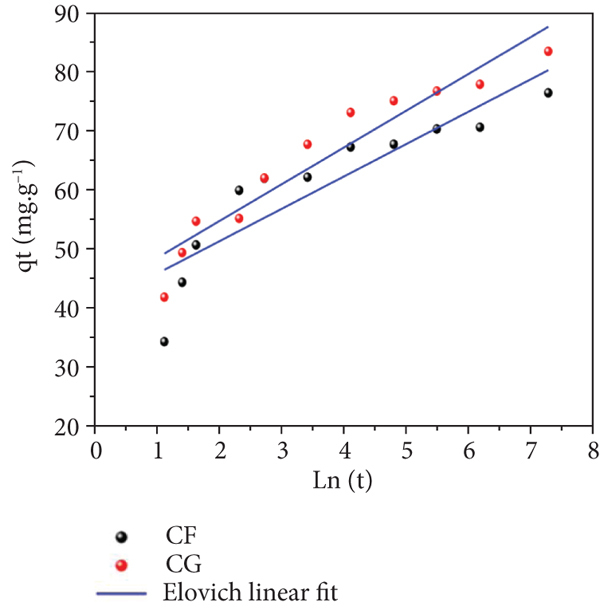
Kinetics model parameters for the adsorption of Ba(II) by CF and CG nanopowders.
Another model has been also tested in order to investigate the possible diffusion mechanism [81], namely, Weber-Morris kinetic model (intraparticle diffusion). The heavy metal adsorption occurs when metal ions present in the bulk solution get diffused into the outer surface of the adsorbent. This mechanism depends on the reactiveness of the surface area and the density of the liquid layer. The feasible intraparticle diffusion rate limiting expression is given by the following equation [34]:
Intraparticle diffusion and mass transfer model parameters for the adsorption of Ba(II) by CF and CG nanopowders.
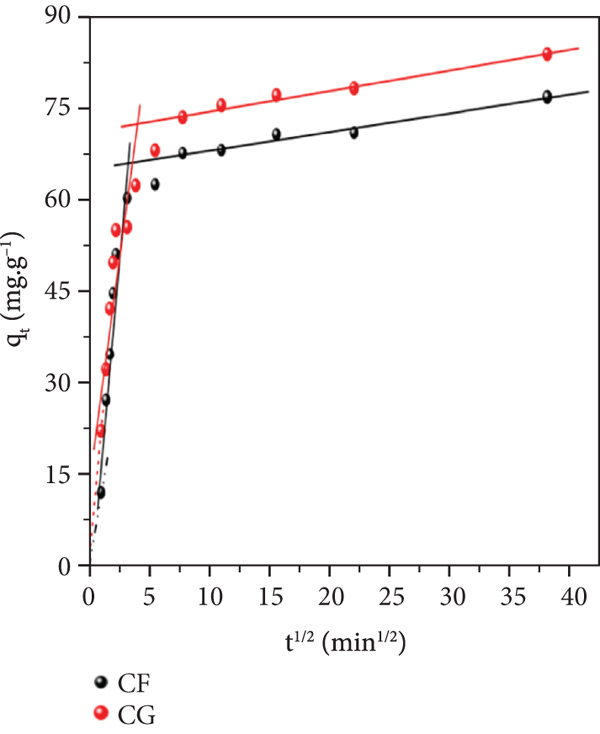
(a) Intra-particle diffusion plots (b) Mass transfer linear fit of CF and CG on the adsorption of Ba(II).

The adsorption kinetics is also controlled by the mass transfer reactions. The kinetic expression of the mass transfer model is expressed by the following equation [38]:
The initial step of the intraparticle diffusion process is the mass transfer reactions, which occurs due to the driving forces that cause the transfer of chemical compounds present in the fluids [85]. The plot from the Figure 5(b) shows that the obtained lines are nonlinear which strongly does not encourage the adsorption of Ba(II) ions using mass transfer reactions. The parameters such as diffusion constant
The nonlinear plots of all the kinetic models such as pseudo-first-order, pseudo-second-order, and Elovich are drawn against the time (
3.5.3. Adsorption Equilibrium Study
The equilibrium isotherms are used to study the adsorption characteristics such as the correlation between the adsorbent-adsorbate and also the adsorption efficiency of the adsorbent [87].
The equilibrium approach in the current study is designed using four main models, namely, Langmuir, Freundlich, Temkin, and Redlich-Peterson, in order to explain the adsorption of Ba2+ ions onto CF and CG magnetic adsorbents. The plots of the isotherms are constructed by the amount of Ba(II) adsorbed at equilibrium (mg/g) to the equilibrium concentration of Ba(II). These isotherms were fitted by means of linear expressions which are expressed below.
The Langmuir isotherm explains the formation of monolayer on the surface of the adsorbents. The adsorbed atoms are situated at definite site with consistent adsorption energy. The linear expression of Langmuir isotherm model is given by Equtaion (11) [45]:
This Freundlich isotherm accounts on the heterogeneous surface of the adsorbent which is related to a multilayer adsorption. The linear expression of Freundlich isotherm model is given by the following Equation (12) [88]:
The Temkin isotherm is characteristics of the relationship between the adsorbent and the adsorbate. The surface of adsorbent is heterogeneous with the ionization energy evenly distributed. The isotherm also infers that the temperature (heat) of the molecules in the layer during the adsorption process decreases linearly in consequence of the increase in adsorption quantity. The linear expression of Temkin isotherm model is given by Equation (13) [84]:
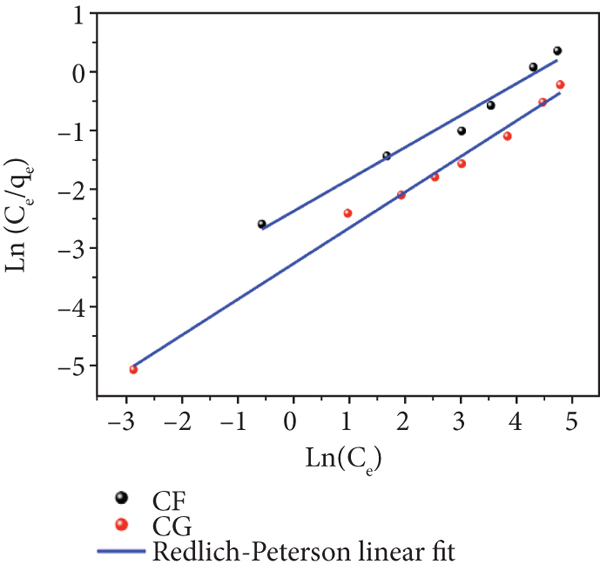
The Redlich-Peterson isotherm involves the combination of Langmuir and Freundlich isotherms. The model holds linearity in the exponential and numerator function which correspond to the adsorption equilibrium for a different concentration of adsorbate. Due to their flexibility, it can be suitable for homogenous and heterogeneous adsorption systems [88]. The linear expression of Redlich-Peterson isotherm model is given by the Equation (14) [89]:
The adsorption isotherm experiments were performed for CF and CG nanopowders. The linear plots of
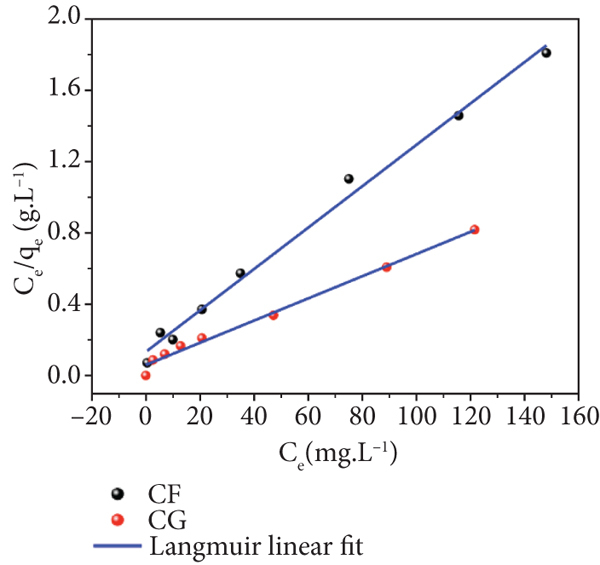
Assessment of isotherm models for Ba(II) adsorption on CF and CG nanocomposite by (a) Langmuir, (b) Freundlich, (c) Temkin, and (d) Redlich-Peterson.


Different model Isotherm constants for the adsorption of Ba(II) by CF and CG nanopowders.
Based on the experimental results from Langmuir isotherm model, the correlation coefficient (
The recorded
From the Temkin isotherm experimental results, the
Based on Redlich-Peterson isotherm results, the
On the basis of the
The nonlinear fit for the aforementioned isotherms is shown in Figure 7. By comparing the calculated nonlinear plot with the experimental data, the Langmuir isotherm matches well with the experimental data.

Comparison of isotherm models for Ba(II) adsorption on CF and CG nanocomposites and nonlinear plot.
3.6. Thermodynamic Studies
The effect of temperature from 25 to

(a) Effect of temperature on the adsorption of Ba(II) onto CF and CG adsorbent; Van’t-Hoff plot for adsorption of Ba(II) onto (b) CF and (c) CG.

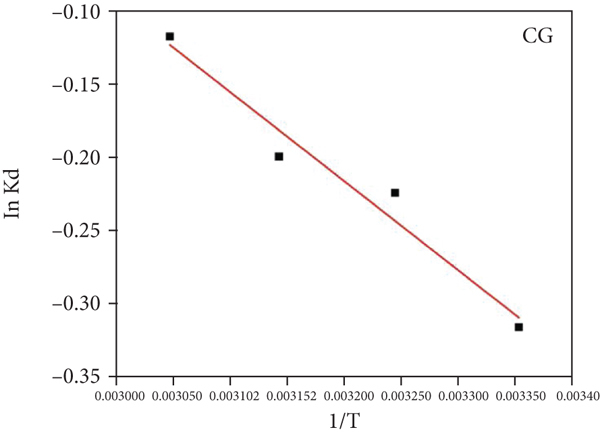
The values of
Thermodynamic parameter values for the adsorption of Ba(II) on CF and CG.
3.7. Stability Evaluation of CF and CG Adsorbents
To study the stability of CF and CG adsorbents, water stability, effect of pH, and effect of concentration stability of CF and CG adsorbents were investigated. In addition, the changes in crystal structure of the adsorbents were also studied.
3.7.1. Water Stability of CF and CG
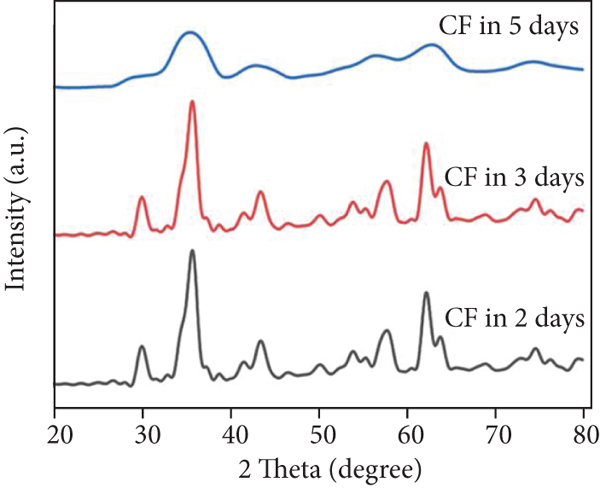
The effect of water stability of CF and CG adsorbents was supervised using XRD analysis. It is visible from the XRD patterns of CF and CG adsorbents are unchanged, which indicate that soaking the adsorbents in water for 5 days does not show any variation in the crystal structure of the adsorbent materials. This confirms the water stability of the prepared nanoadsorbents which is shown in Figures 9(a) and 9(b). However, the intensity of the diffraction peaks is slightly lowered at the fifth day which signifies that the CF and CG adsorbents are in the initial stages to dissolve in water [93]. Further, the adsorbents were collected to estimate the adsorption capacity towards Ba(II). The results show no considerable reduction in the adsorption quantity of Ba(II) by the CF and CG adsorbents after exposure to water for 5 days (Figure S1).
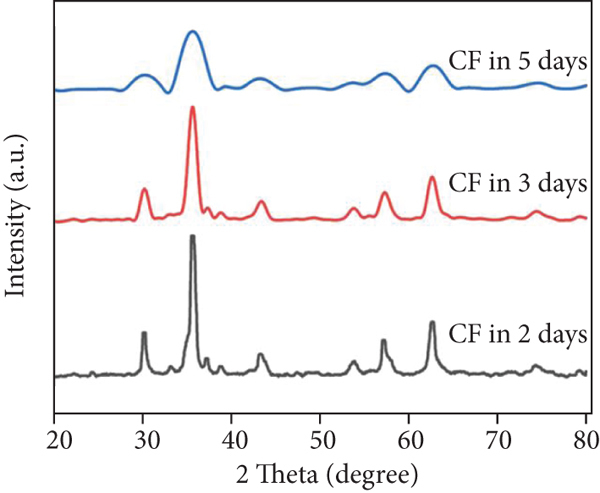
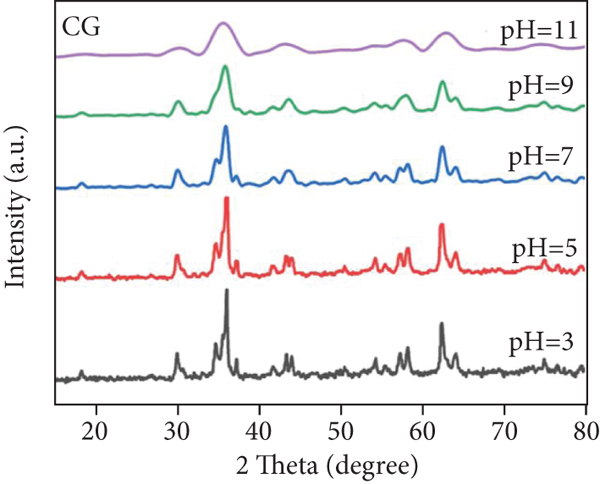
(a) Stability determination using X-ray diffraction patterns of (a) CF and (b) CG exposure in water for five days; (c) CF and (d) CG after soaking in aqueous solution at different pH for 24 h with the adsorbent dosage of 10 mg/L.

3.7.2. Effect of pH on Stability of CF and CG Adsorbents
The effect of pH on the stability of CF and CG adsorbents was investigated in the range 3-11. The XRD results from Figures 9(c) and 9(d) confirm that the adsorbents could be employed for a broad range of pH with no change in crystal structure. The main XRD diffraction peaks of CF and CG are retained; however, some peaks shifted to weak low-intensity peaks. At
Furthermore, leaching of metal ions is an additional factor that relies on the pH value, and at acidic pH, the solubility of the metal ions increases [95]. The leaching of iron and copper metal ions at different pH for CF and CG adsorbent was examined, and the results are displayed in Figures 10(a) and 10(b). The results reveal that the release of copper metal ions was relatively significant under acidic conditions but declined after pH 7, whereas leaching of iron was comparatively low at acidic and basic pH. This signifies that the stability of adsorbents is remarkable under alkaline and neutral medium.
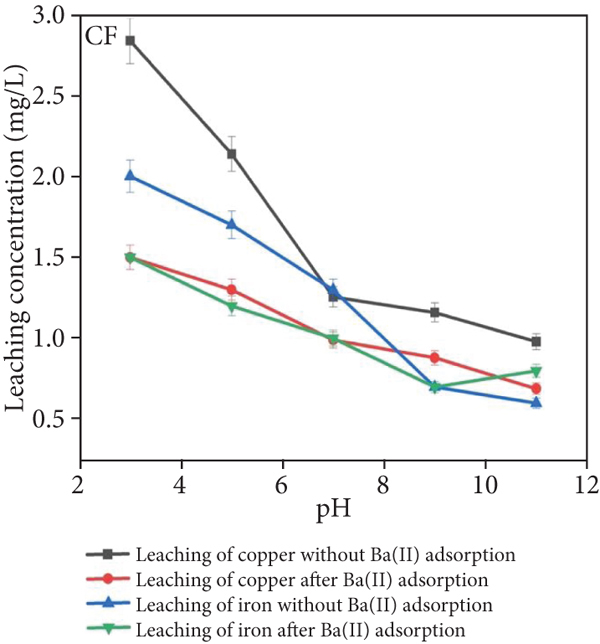
Effect of pH on the leaching of copper and iron on (a) CF and (b) CG.

3.7.3. Effect of Ba(II) Concentration on Stability of CF and CG Adsorbent
As shown in Figure S3 (a and b), the crystal structure reveal minor changes in XRD patterns of CG nanocomposite after 45 mg/L Ba(II) concentrations, revealing the stability of the crystal structure after 5 days of water exposure. The leaching of iron and copper after Ba(II) adsorption was also examined on CG nanocomposite with various concentrations. The leaching of copper ions decreased with increasing Ba(II) concentrations from 45 to 65 mg/L, which is shown in Figure S3 (c and d). From Figure 10, the leaching of copper ions was relatively higher, before adsorption of Ba(II), whereas after adsorption, leaching of copper and iron decreased. This is attributed to the coprecipitation between copper and Ba(II) which partially destroys the structure of CG nanocomposite that results from leaching. Hence, leaching of metal ions from CG nanocomposite affects the stability of CG nanocomposite [95].
3.8. Reusability of CF and CG Magnetic Adsorbents
The reusability study of the adsorbents is crucial for economic reasons and for practical applications. The reusability of the adsorbents was examined for 6 repeated cycles under similar operational conditions. After each cycle, the used adsorbents were separated by an external magnet, washed for several times, and dried for reuse for the next cycle [96]. Figure 11 shows the adsorption efficiency of CF and CG on Ba(II) for 6 repeated uses, although the adsorption efficiency of CF and CG was reduced after each cycle the adsorption capacity. However, after 5 cycles, the Ba(II) adsorption capacity using CF adsorbent is 71.23% and that using CG adsorbent is 79.60%. This is due to the partial erosion of the surface of CF and CG adsorbents. Another possible cause is incomplete removal of Ba(II) ions, which gets deposited on the surface of the adsorbents. Hence, the reusability results show that the CF and CG are promising magnetic adsorbents for the removal of barium ions from aqueous solutions and wastewaters.

Reusability of CF and CG adsorbents for the removal of Ba(II) through six cycles.
3.8.1. Adsorption Mechanism
In this study, the obtained results show higher adsorption capacity of CG nanocomposite than CF nanoparticles which can be described by the adsorption mechanism involved by the adsorbents and Ba(II) ions. The principal factors such as the pH and the adsorbate-adsorbent interactions are involved during Ba(II) ion removal [97]. On this basis, the adsorption of Ba2+ ions follows three main steps [98].
External diffusion: migration of Ba(II) ions from the bulk solution to the adsorbents surface which occurs due to the concentration gradient Internal diffusion: migration of Ba(II) ions from the external surface of the adsorbents to the inner pore of the adsorbents Attachment of Ba(II) ions to the pore through -COOH and -OH sites
Generally, the physiochemical interactions such as ion exchange, electrostatic interactions,
The inner sphere surface complexation adsorption mechanism in CF and CG nanocomposite is analyzed using Fourier Transfer-Infrared Resonance (FT-IR) spectroscopy by comparing the recorded spectra of CF and CG loaded with Ba(II) ions with the bare [99], as shown in Figures 12(a) and 12(b). All the spectra show the presence of two main absorption bands around 600 and 400 cm-1 that are attributed to Cu-O and Fe-O occupancy sites [65]. The peak at 589 cm−1corresponds to the stretching vibration of Fe3+-O2− in the tetrahedral complexes, and the peak at 482 cm−1 is assigned to the stretching vibration of Cu2+-O2− in the octahedral complexes [100]. It is apparent that there exists a shift in peaks’ position after adsorption. This variation in the loaded FT-IR spectrum shows potential involvement of other functional groups on the exterior of the adsorbent [101]. The absorption peaks of -C-O, -C-H, Cu-O, and Fe-O are shifted to a lower frequency in Ba(II) loaded CF adsorbent. Fe-O shows significant shift of 589-570 cm-1, and -C-O shows significant shift of 482-417 cm-1 in CF adsorbent [102]. This shift in the peaks’ position is attributed to the transformation of hydroxyl groups on barium oxide or in the re-formation of C-O stretching vibration in the -COOH during the inner sphere hydroxyl group complexation of Ba(II) ions [96]. The loaded CG nanocomposite also shows the presence of similar band shift which indicates the potential chemical interactions between Ba(II) ions and the functional groups on the surface of CG nanocomposite. However, the bands show slight decrease in the intensity which is due to the electron delocalization on the adsorbent surface when Ba(II) ions are adsorbed. These interactions intensify the effective removal of heavy metal ions [97, 103].

FTIR spectra of (a) CF and (b) CG before and after adsorption of Ba(II).

The possible adsorption mechanism of Ba(II) ions on the CG surface using FT-IR analysis is as follows:
On the basis of the aforementioned reactions, the adsorption mechanism of Ba(II) is achieved by the inner sphere chemical complexations and the electrostatic interactions on the surface of the adsorbent. Banerjee et al. [104] reported the prominent role of pH in the adsorption process, as it determines the surface charge of the adsorbent. Hence, the influence of pH intensified the adsorption capacity as at higher pH, the interaction between the deprotonated hydroxyl groups and Ba(II) ions is high, and ,also the cationic exchanges with the -COOH group also increase [102]. The presence of rGO in CG nanocomposite enabled high selective adsorption sites for an effective removal of Ba(II) ions from the aqueous solution.
3.9. Comparison with Previous Literatures
It is important to achieve maximum adsorption efficiency with the synthesized adsorbents. A comparative study on the previously reported results on the removal of Ba(II) with the obtained results may help to understand the efficiency of the prepared samples (see Table 8). Fard et al. [3] employed the adsorption process with the synthesized MXene. The unique properties of MXene showed an adsorption capacity of 9.3 mg/g with the removal efficiency of 100% at pH 6 after 120 min. Majidnia et al. [4] fabricated PVA-alginate beds embedded with TiO2 and
Comparative study of the present work with literature.
However, in the present study, CF exhibits an adsorption capacity of 86.6 mg·g-1 which is almost doubled to reach 161.6 mg·g-1 for CG in 120 min and at pH 7. This significant enhancement in the adsorption capacity of CG, compared to the removal of Ba(II) by different materials in the literature, is attributed to the incorporation of CuFe2O4 nanoparticles on the graphene sheet layers. The CG nanocomposite containing oxygen functional group increases the number of vacancy sites. Thereby, both factors favor the adsorption capacity on the removal of Ba(II) ions.
3.9.1. Advantages and Disadvantages of CF and CG Adsorbents
In the current study, CF and CG adsorbents were synthesized as adsorbents for the effective removal of Ba(II). These magnetic nanoadsorbents can be retrieved from aqueous solutions and can be reutilized for up to five cycles by following easy washing and centrifugation or filtration methods. Among both the adsorbents, CG attract their attention due to its structure, high surface area, magnetic property, and stability. However, after five cycles, the efficiency of the adsorbents decreases which is due to the changes that occur on the surface of adsorbents. Moreover, the adsorption performance of CG adsorbent was comparable and acceptable when compared to other reported nanocomposite materials (see Table 8). Hence, CG adsorbent can be extremely used for potential application in heavy metal removal from wastewater.
4. Conclusion
Concisely, CuFe2O4 (CF) and CuFe2O4/rGO (CG) magnetic nanopowders were synthesized through a simple and ecofriendly method by using a commercially available microwave. Structure, morphology, and surface studies indicated the formation of spherical spinel ferrite with a surface area of 0.66 m2g-1 and 5.74 m2g-1 for CF and CG. The removal tests of Ba(II) ions from aqueous solution manifested promising and distinctive capability of both CF and CG. Furthermore, the pH-dependent adsorption analysis indicated that the adsorption process obeyed pseudo-second-order rate kinetics. The well-fitted Langmuir model demonstrated an excellent adsorption capacity of 86.6 mg·g-1 for CF and 161.6 mg·g-1 for CG adsorbents, achieved under the optimized parameters of 10 mg of adsorbent dose in 25 mL solution at pH 7. A thermodynamic study reveals that the reaction is endothermic and spontaneous. The CG adsorbent exhibited strong chemical and water stability, which could be utilized for removing Ba(II) under various concentrations and wide pH range. In addition, the effect of rGO on the adsorption mechanism of Ba(II) was also studied in detail, hence underlying the principal role of rGO. The rich adsorption sites onto rGO layer enable enhanced adsorption activity of CG nanocomposite when compared to bare CF nanoparticles. Both CF and CG demonstrated soft ferromagnetic behavior with considerable saturation magnetization and hence can be easily separated and reused for several adsorption cycles. To the extent of our knowledge, this is the first report on the adsorption of Ba(II) using copper ferrite and copper ferrite/rGO nanocomposite. This research work suggests the utilization of magnetic CG nanocomposite as effective adsorbent, with high structural stability and excellent adsorption capacity for heavy metal remediation in wastewater.
Footnotes
Data Availability
No data were used to support this study
Ethical Approval
The authors have agreement with all the copyright rules and ethics in publishing that could have appeared to influence the work reported in this paper.
Conflicts of Interest
The authors have no conflict of interest to declare that are relevant to the content of the article.
Acknowledgments
The authors would like to acknowledge Loyola College Management, affiliated to the University of Madras for presuming the necessary organizational facilities to carry out this research work and IIT Madras, University of Bahrain, and Al Imam Mohammad Ibn Saud Islamic University (IMSIU), Saudi Arabia, for providing the characterization facilities.