




Abstract
The present research work is aimed at developing a nickel alloy (Ni-Cr) matrix hybrid nanocomposite comprising 5 wt%, 10 wt%, and 15 wt% of alumina nanoparticles (Al2O3) size of 50 nm with stable weight percentage (5 wt%) of titanium dioxide (TiO2) nanoparticle via vacuum die casting process for an automobile brake pad application. The deliberation of multireinforcement surface on nickel alloy matrix tribological performance was evaluated by constant sliding distance (200 m) on dry sliding condition via rotating pin on disc apparatus with different loading conditions of 10 N, 30 N, 50 N, and 70 N under the sliding velocity of 0.25 m/sec, 0.5 m/sec, and 0.75 m/sec, respectively. The influences of alumina and titanium dioxide nanoparticles in the nickel alloy matrix resulted in the thermal conductivity increasing by 18% compared to unreinforced nickel alloy. After temperature drop, the coefficient of thermal expansion for nickel alloy hybrid composite decreases progressively with increased reinforcement content as 10 wt% Al2O3/5 wt% TiO2. Further inclusion of both Al2O3 and TiO2 in nickel alloy was increased nominally. The thermal adsorption characteristic on composites mass loss was decreased while temperature increased from 28°C to 1000°C.
1. Introduction
The innovative creation of conventional matrix materials (aluminium, magnesium, and titanium) was blended with organic/inorganic reinforcements to achieve specific characteristics such as high wear resistance [1]; good thermal stability on higher temperatures [2]; high tensile strength; and good corrosion resistance facilitates in a sports car, aviation, electrical contacts, and structural applications [3]. The incorporation of hard ceramic particles into metal matrix speaks with tremendous isotropic performance compared to conventional materials [4, 5]. Similarly, selecting matrix, reinforcement, and process parameters for composite fabrication was the most critical factor for deciding composite characteristics [6, 7]. Recently, most researchers referred to aluminium, magnesium, titanium, and their alloy matrix developed with organic/inorganic reinforcement [8] via conventional fabrication techniques such as solid and liquid state processing [9, 10]. Nickel and its alloy-based matrix materials have met the demand for high-temperature applications like automobile valves, brake pads, and siphon bodies [11]. In the past decades, various researches have been accomplished by tribomechanical performance studies on nickel-based alloy matrices such as nickel (Ni)/chromium (Cr)/zirconia matrix [12], Ni/Cr/M0S2, nickel (Ni)/graphite (Gr)/titanium carbide (TiC), Ni/tungsten carbide (WC), Ni/titanium carbide (TiC), and Ni/cobalt (Co)/zirconia [13]. However, the properties of composite were integrated by ceramic phase (Si3N4, Al2O3, SiC, ZrO2, etc.) [14], high-performance materials (Co, Fe, Ni, etc.) [15–17], and intermetallic compounds alloys (Ti-Al, Fe-Al, Ni-Al, etc.) [18–20]. The tribological behaviour of Ni/Cr alloy was investigated at higher temperatures (20-600°C). It resulted in oxide sulfides during wear surface under reduced friction [21]. The Ni/TiC composite was developed through the Gr coating process. The Gr-coated layer in Ni/TiC composite has low wear loss and better coefficient friction than conventional Ni-Cr alloy [22]. Leech et al. [23] investigated the wear performance of Ni/TiC alloy composite by dry state pin on flat wear tester with a garnet abrasive wheel. They found that the composite has superior wear performance on higher frictional temperature excavation on the constituent matrix. Incorporating TiC particles leads to resisting the depletion against the frictional temperature. The TiC-reinforced Ni-Cr alloy composite was produced by infiltration technique, and its electrical-thermal-wear characteristics were studied for high-temperature applications. TiC particles in the Ni matrix having good tribothermal behaviour resist the high frictional force during the evaluation of wear studies [24]. Srivastava et al. [25] studied the mechanical and chemical properties of zirconia bonded Ni-Co alloy composite. They found that the composite has good chemical and mechanical performance. Among the studies reported above, limited research is available on tribothermal adsorption on multiceramic reinforced nickel alloy hybrid nanocomposite. The present research is focused on developing a nickel alloy matrix bonded with various weight percentages of Al2O3 and stable weight percentages of TiO2 via a vacuum die casting process. Finally, the developed composites’ tribothermal performance was evaluated by ASTM test standards. The test results were compared to cast nickel alloy and recommended for brake pad applications.
2. Materials and Processing of Composites
2.1. Materials and Reinforcement
Ni-Cr alloy metals are pointed out for their superior tribomechanical characteristics and excellent corrosion resistance. So the nickel alloy was chosen as matrix material with 20% chromium [26]. The different weight percentages of 50 nm alumina (Al2O3) and stable weight percentage of TiO2 nanoparticles were considered to reinforce the Ni-Cr alloy matrix. The Al2O3 has good wear resistance, the best electrical insulator, and high thermal stability. TiO2 particles were one of the best complex reinforcements bonded to the Ni-Cr alloy matrix, resulting in good chemical stability and high thermal stability [27]. Table 1 indicates the thermomechanical properties of matrix and reinforcements.
Thermomechanical characteristics of matrix and reinforcements.
2.2. Experimental Details for Processing and Testing of Ni-Cr Alloy Matrix Composites
The schematic diagram for processing of Ni-Cr alloy matrix composite is represented in Figure 1. The different sized Ni-Cr alloy pieces are located in an electrical furnace configured with an induction coil with the capacity of 5 kg operated under a different temperature range of 27°C to 1700°C. The preheated temperature of Ni-Cr alloy is maintained at 400°C in stable condition on 15 min period [28]. Then, the furnace temperature is raised from 1200°C to 1500°C to melt the Ni-Cr alloy as molten (liquids) stage. Similarly, the reinforcements are preheated at 550°C to remove the moisture content and increase the wettability [29]. The externally preheated reinforcements are added into the semisolid stage (1100°C) Ni-Cr alloy, and both matrix and reinforcements are bonded with the help of stir action (400 rpm) for a 10 min period. The prepared Ni-Cr alloy matrix was poured into preheated (450°C) rectangular die sized on

Schematic diagram for processing of Ni-Cr alloy matrix hybrid nanocomposite.
Constitutions of Ni-Cr alloy matrix hybrid nanocomposite.
The dry state wear performance of unreinforced and reinforced Ni-Cr alloy composites (Figure 2(a)) was evaluated by ASTM G99-05 via pin-on-disk wear apparatus configured with EN31 steel counter disc is shown in Figure 2(b). The wear test samples were sized by

Dry state wear test apparatus setup: (a) test pin samples, (b) wear tester, and (c) enlarged view of test pin and rotating disk.
Wear test input process parameters.
Figure 3 illustrates the principle diagram for evaluating thermal conductivity on Ni-Cr alloy matrix composite (

Block diagram for laser-based thermal conductivity evaluation.
The linear thermal expansion of the Ni-Cr alloy matrix hybrid nanocomposite was estimated using NETZSCH make DIL 402C and LFA 427 model thermotester apparatus.
3. Results and Discussion
3.1. Effect Al2O3 and TiO2 on Dry State Wear Performance of Ni-Cr Alloy Matrix Composite
Table 4 shows the wear test results on Ni-Cr alloy matrix hybrid nanocomposite tested by dry state condition with 0.25 m/sec, 0.5 m/sec, and 0.75 m/sec sliding speed under an applied load of 10 N, 30 N, 50 N, and 70 N, respectively.
Wear performance Ni-Cr alloy matrix hybrid nanocomposite.
It was observed from Figures 4(a)–4(c) that the wear rate of Ni-Cr alloy composite decreased gradually with the additions of Al2O3 and 5 wt% TiO2. Figures 4(a)–4(c) illustrate the wear performance of Ni-Cr alloy containing 5 wt%, 10 wt%, and 15 wt% of Al2O3 with constant 5 wt% of TiO2 hybrid nanocomposite evaluated by at 0.25 m/sec with different loading conditions like 10 N, 30 N, 50 N, and 70 N, respectively [30].
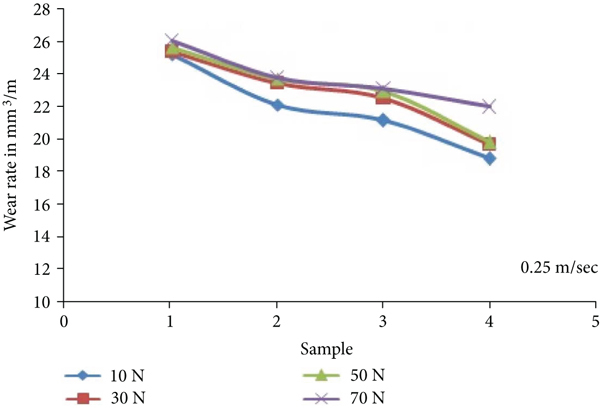
Wear rate of Ni-Cr alloy matrix composites (a) 0.25 m/sec, (b) 0.5 m/sec, and (c) 0.75 m/sec. (d) Optical micrograph of Ni-Cr/15 wt% Al2O3/5 wt% TiO2 hybrid nanocomposite.
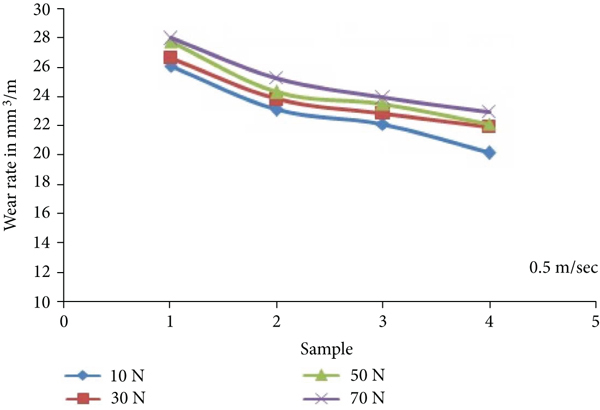


The composite having 15 wt% alumina nanoparticles with 5 wt% titanium dioxide particle shows an optimum wear resistance of 21.98 mm3/m under high load 70 N. It was due to hard alumina’s resistance to the deflection layer on the high frictional force. A similar trend was found during the wear evaluation of AZ61 magnesium alloy hybrid composites [7]. Figure 4(b) represents the wear rate of unreinforced and reinforced Ni-Cr alloy hybrid nanocomposite under 0.5 m/sec sliding velocity with varied load conditions of 10-70 N. It was clearly shown that the wear rate progressively increased with an increase in load condition at a constant sliding distance of 200 m [31]. Similar results were reported by León-Patiño et al. [24] during the evaluation of Ni/TiC composites. Figure 4(c) shows the variations of wear rate for Ni-Cr alloy hybrid nanocomposite estimated by a high sliding speed of 0.75 m/sec. It shows the wear rate of composite is 29.12 mm3/m to 22.98 mm3/m under 70 N applied load. However, the wear rate of the composite decreased with increased reinforcements. Good bonding strength between matrix and reinforcement is evidenced in Figure 4(d). However, interfacial bonding strength may be varied due to the choice of process (stir casting) parameter [5].
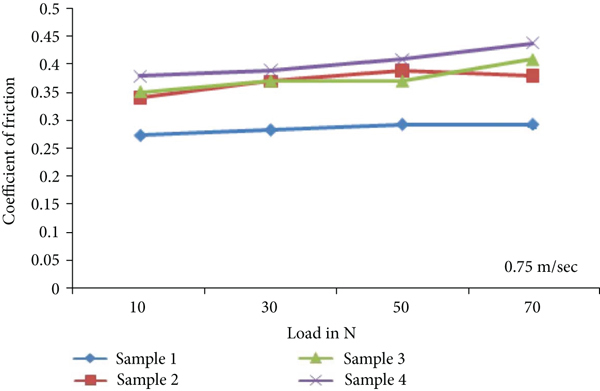
Figure 5 shows the coefficient of friction (COF) of Ni-Cr alloy and its hybrid nanocomposite estimated by 0.25 m/sec to 0.75 m/sec sliding velocity with varied load conditions of 10-70 N, respectively. Figure 5(a) illustrates that the coefficient of friction of unreinforced and reinforced Ni-Cr alloy composite varies from 0.25 to 0.41. The COF of composite has steadily increased with the additions of alumina nanoparticles and titanium dioxide particles. Figure 5(b) shows the COF of Ni-Cr alloy and its hybrid nanocomposite estimated by 0.5 m/sec sliding speed at different load conditions. The curve indicates that an upward slope varied from 0.34, 0.37, 0.39, and 0.41 on an applied load of 10 N, 30 N, 50 N, and 70 N, respectively. The improvement of COF was due to the presence of hard ceramist which leads to enhance the resistance of high frictional on the higher temperature of 57°C. The high sliding performance on COF of Ni-Cr alloy and its hybrid nanocomposite is shown in Figure 5(c). It was revealed from Figure 5(c) that the challenging ceramic plays a significant role in friction with a higher coefficient value of 0.44 under high load and sliding speed of 40 N and 0.75 m/sec with 73.6 N frictional force. However, the COF of the composite was increased progressively by adding reinforcement. The maximum COF is 0.44, found in sample 4. Its COF value increased 34% as compared to cast Ni-Cr alloy.

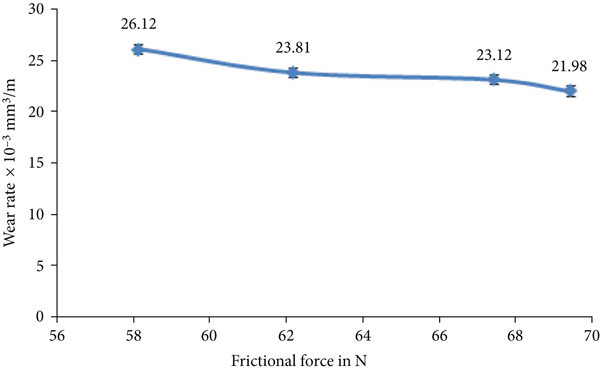
Coefficient of friction for Ni-Cr alloy matrix composites: (a) 0.25 m/sec, (b) 0.5 m/sec, and (c) 0.75 m/sec. (d) Effect of the frictional force on wear relation of Ni-Cr alloy hybrid nanocomposites.

3.2. Effect of the Frictional Force on Wear Performance of Ni-Cr Alloy Matrix Composites
Figure 5(d) represents the relation of frictional force effect on wear behaviour of Ni-Cr alloy hybrid nanocomposite evaluated by 70 N load with the applied sliding speed of 0.25 m/sec.
It was revealed from Figure 5(d) that the composite’s wear rate gradually decreased with an increased friction force of 58.12 N to 69.43 N. Sample 1 indicates that the wear rate of
3.3. Effect Al2O3 and TiO2 on Thermal Adsorption Behaviour of Ni-Cr Alloy Matrix Composite
Table 5 represents the thermal adsorption behaviour of Ni-Cr alloy composite bonded with various weight percentages (5 wt%, 10 wt%, and 15 wt %) of Al2O3 and 5 wt% of TiO2.
Thermal behaviour of Ni-Cr alloy composite.
Figure 6 indicates that the thermal conductivity of Ni-Cr alloy contained 5, 10, and 15 wt% of alumina nanoparticle with stable 5 wt% of TiO2. Both nanoparticles have enhanced the thermal performance of the composite.

Thermal conductivity of Ni-Cr alloy matrix composites.
The thermal conductivity of composite has varied from 33.918 W/m°C to 41.870 W/m°C due to the inclusion of hard ceramist. The cast Ni-Cr bonding has 33.918 W/m°C while adding 5 wt% of hybrid constitutions was 37.829 W/m°C. Generally, alumina and titanium dioxide have good thermal stability and high hardness compared to conventional reinforcements [4]. The maximum thermal conductivity of 41.870 W/m°C was found on a composite containing 15 wt% Al2O3/5 wt% TiO2. It was due to the effect weight percentages and good isotropic properties of Ni-Cr alloy. However, the thermal conductivity of Ni-Cr alloy and its composites may vary due to input temperature conditioning. The influences of alumina and titanium dioxide nanoparticles in the nickel alloy matrix resulted in the thermal conductivity increasing by 18% compared to unreinforced nickel alloy.
The thermal dimension of temperature variations of Ni-Cr alloy and its hybrid nanocomposite coefficient of thermal expansion (CTE) is represented in Figure 7. It was closely observed by the thermal changes of Ni-Cr alloy hybrid nanocomposite which may be related to the bonding of matrix and reinforcement. The CTE of Ni-Cr alloy was

Coefficient of thermal expansion of Ni-Cr alloy matrix composites.
3.4. Thermal Adsorption Characteristics
The thermal adsorption characteristics of mass loss of Ni-Cr alloy and its hybrid nanocomposites were evaluated by thermogravimetric apparatus configured with 0°C to 1500°C temperature span under a constant heat flow rate of 25°C/min as shown in Figures 8(a)–8(d). The wear loss of Ni-Cr alloy was found at 9.78 mg on 1000°C under 25°C/min steady heat supply. At the same time, incorporating Al2O3 and 5 wt% of TiO2 in the Ni-Cr matrix showed higher mass loss than Ni-Cr alloy. It was due to the effect of ceramic particles on different phases, like dislocation between the Ni-Cr layers. Figures 8(c) and 8(d) illustrate the effect of thermal adsorption on mass loss of hybrid nanocomposites containing 10 wt% and 15 wt% of alumina nanoparticles with stable 5 wt% of TiO2 particle, resulting in a limited mass loss on a higher temperature. The curve of Figure 8(d) indicates the regular slope of 926°C. Further temperature increases showed a steady-state condition of mass loss. It happened due to the chain reaction of hard ceramic particles that can withstand the high temperature on 25°C/min heat flow.

Thermal adsorption performance on wear loss of Ni-Cr alloy matrix composites: (a) cast Ni-Cr alloy, (b) Ni-Cr/5 wt% Al2O3/5 wt% TiO2, (c) Ni-Cr/10 wt% Al2O3/5 wt% TiO2, and (d) Ni-Cr/15 wt% Al2O3/5 wt% TiO2.
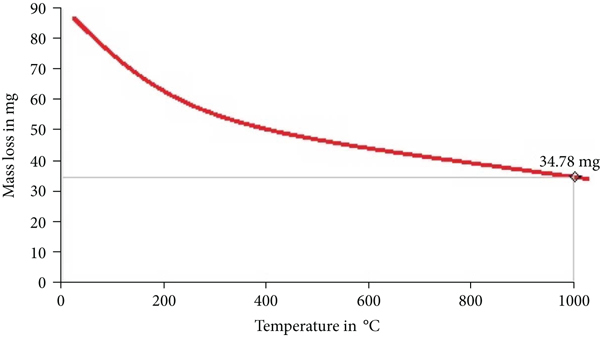


The weight loss of the hybrid nanocomposite (Ni-Cr/15 wt% Al2O3/5 wt% TiO2) was limited to 1.21 times of ambient temperature under the same heat flow of 25°C/min. However, the thermal adsorption on mass loss of composite is related to interfacial bonding strength between matrix and reinforcements of the hybrid nanocomposite.
4. Conclusions
The vacuum die casting process developed the nickel alloy (Ni-Cr) matrix hybrid nanocomposites. The developed composites were subjected to tribothermal characteristics studies. Based on this performance, the composite containing 15 wt% alumina nanoparticles with 5 wt% titanium nanoparticles was found to have optimum tribological-thermal properties compared to conventional cast Ni-Cr alloy. The wear resistance of sample 4 is increased by 16% compared to cast Ni-Cr alloy. The coefficient of friction of 0.44 is observed on Ni-Cr alloy/15 wt% alumina nanoparticle with 5 wt% titanium nanoparticle under high sliding speed and a load of 0.75 m/sec and 70 N. The thermal conductivity of Ni-Cr alloy/15 wt% Al2O3/5wt%TiO2 hybrid nanocomposite found 18% increased conductivity compared to Ni-Cr alloy. However, the composite containing 15 wt% Al2O3/5wt% TiO2 shows
Footnotes
Data Availability
The data used to support the findings of this study are included within the article. Should further data or information be required, these are available from the corresponding author upon request.
Conflicts of Interest
The authors declare that there are no conflicts of interest regarding the publication of this paper.