




Abstract
In this study, dimercaptosuccinic acid-functionalized magnetic chitosan (Fe3O4@CS@DMSA) was synthesized via in situ coprecipitation process and amidation reaction, aiming to eliminate cadmium (Cd(II)) ions from an aqueous environment. The structure, morphology, and particle size of the Fe3O4@CS@DMSA adsorbent were investigated using FTIR, TEM, EDX, TGA, zeta potential, and XRD techniques, and the obtained results approved the successful synthesis of the Fe3O4@CS@DMSA nanocomposite. The influence of external adsorption conditions such as pH solution, adsorbent mass, initial Cd(II) concentration, temperature, and contact time on the adsorption process was successfully achieved. Accordingly, pH: 7.6, contact time: 210 min, and adsorbent mass:10 mg were found to be the optimal conditions for best removal. The adsorption was analyzed using nonlinear isotherm and kinetic models. The outcomes revealed that the adsorption process obeyed the Langmuir and the pseudo-first-order models. The maximum adsorption capacity of Fe3O4@CS@DMSA toward Cd(II) ion was 314.12 mg/g. The adsorption mechanism of Cd(II) on Fe3O4@CS@DMSA nanocomposite is the electrostatic interaction. The reusability test of Fe3O4@CS@DMSA nanocomposite exhibited that the adsorption efficiency was 72% after the 5th cycle. Finally, this research indicates that the Fe3O4@CS@DMSA exhibited excellent characteristics such as high adsorption capacity, effective adsorption-desorption results, and easy magnetic separation and thus could be an effective adsorbent for removing Cd(II) ions from aqueous solutions.
1. Introduction
Water contamination by a toxic cadmium (Cd(II)) metal is a widespread environmental issue owing to its long-term adverse effects on humans and ecosystems. Cd(II) is one of the most dangerous metal ion due to its nondegradable, strong bioaccumulate, and highly toxic even at low concentrations, which leads to a serious threat to human health [1, 2]. Cd(II) pollution can cause kidney, liver, and bone damage to humans with a long time exposure. Cd(II) has excellent solubility which can be easily released into the aqueous systems through industrial production processes such as alkaline batteries, electroplating, textile printing industries, and pigment [3]. Cd(II) is classified as a category one carcinogen by U.S. EPA, and the maximum concentration of Cd(II) in drinking water is 5 μg/L [4, 5]. Thus, the removal of extremely toxic cadmium from an aqueous environment is essential to avoid pollution to the environmental systems. Several techniques, namely, chemical precipitation [6], adsorption [7], membrane separation [8], ion exchange [9], and electrodeposition [10, 11], have been applied to treat the toxic metals from wastewater. Among them, the adsorption technique has been proven economical, simple, easy operation and ecofriendly, cost-effective, versatile in nature, and highly efficient for metal removal [12].
Many adsorbents have been applied to adsorption of Cd(II) from aqueous medium like sulfonated biochar [13], functionalized cellulose derived [14], amino-functionalized lignin [15], metal-organic framework (MOF) ZIF-8 [16], EDTA/mGO [17], and para-aminobenzoic acid-functionalized activated [18]. These adsorbents suffer from the difficulty of recovering metal after adsorption using traditional methods such as centrifugation and filtration, which may result in secondary pollution and loss of the amount of adsorbents [19]. Magnetic nanocomposite has received great attention as an efficient adsorbent owing to its many advantages such as easy magnetic separation, high surface area, low toxicity, biocompatibility, and the existence of a large number of surface hydroxyl groups that use them in surface modification. To improve the stability of Fe3O4 nanoparticles under acidic conditions and reduce the agglomeration of the nanoparticles, the surface of Fe3O4 nanoparticles can be modified with some materials like activated carbon [20], graphite oxide [21], and carboxylated MNP nanoparticles [22].
Naturally abundant polysaccharides such as chitosan are considered as one of the most promising surface stabilizing materials for magnetite nanoparticles due to their multifunctionality, nontoxicity, biocompatibility, and renewability [23]. Chitosan has a strong affinity with metal ions because of the existence of NH2 and OH groups which can serve as the active adsorption sites for the removal of metals [24–26]. To improve the number of active adsorption sites for adsorption on magnetic chitosan, it needs to be surface modified to provide specific functional groups. Meso-2,3-dimercaptosuccinic acid (DMSA) is a suitable candidate for enhancing the adsorption process owing to DMSA having carboxyl and thiol groups, which can be used for the capture of heavy metals [27, 28]. In addition, DMSA acid is a nontoxic chelating agent and FDA approved drug which has been used to treat heavy metal poisoning in the human body [29–31]. To the best of our knowledge, the Fe3O4@CS@DMSA nanocomposite has not been used for the elimination of pollutants.
In this study, Fe3O4@CS@DMSA nanocomposite was synthesized by an in situ coprecipitation method followed by a covalent functionalization of Fe3O4@CS with DMSA acid via amidation reaction. The synthesized Fe3O4@CS@DMSA adsorbent was applied to eliminate Cd(II) ions from water. The synthesized Fe3O4@CS@DMSA was characterized using zeta potential, FTIR, XRD, TGA, TEM, and EDX techniques. The impact of external adsorption conditions such as pH solution, adsorbent mass, initial Cd(II) concentration, temperature, and contact time on the adsorption process was successfully achieved. To achieve the adsorption capacity and mechanisms of Cd(II) adsorption onto Fe3O4@CS@DMSA nanocomposite, the equilibrium kinetic and isotherm were studied. Thermodynamic parameters were also studied. The reusability test of Fe3O4@CS@DMSA nanocomposite was performed by carrying out five cycles of adsorption-desorption studies.
2. Experimental
2.1. Chemicals and Reagents
FeCl2·4H2O, ≥99%, FeCl3·6H2O, ≥99%, chitosan, medium MW, meso-2,3-dimercaptosuccinic acid, ~98%, and 1-ethyl-3-(3-dimethylaminopropyl)carbodiimide (EDC) were purchased from Sigma-Aldrich, USA. Dimethyl sulfoxide (DMSO) was obtained from Panreac, UK. HNO3, 69%, NaOH, ≥98%, and Cd(NO3)2 were obtained from BDH Chemicals Ltd. (Poole, England). NH4OH, 25%, and HCl, 36.5-38%, were procured from Merck, Germany. All chemicals and reagents utilized in these experiments were of AR grade.
2.2. Synthesis of Fe3O4@CS
Magnetic chitosan (Fe3O4@CS) was synthesized by an in situ coprecipitation method according to the literature [32] with some modifications. Typically, 1.8 g of chitosan (CS) was dissolved in acetic acid solution (100 mL, 3%

Schematic for preparation of Fe3O4@CS@DMSA nanocomposite.
2.3. Synthesis of Fe3O4@CS@DMSA
Fe3O4@CS@DMSA nanocomposite was synthesized by amidation reaction between the carboxylic group of DMSA and the amino group of magnetic chitosan (Fe3O4@CS). Typically, DMSA (0.91 g) was added into 50 mL of DMSO to be completely dissolved by ultrasonication; then, 0.776 g of EDC was added into the DMSA solution under ultrasonication and N2 gas for 1.0 h. After that, 1.00 g of Fe3O4@CS was dispersed into the above solution by mechanical stirring under N2 gas for 24 h. Then, the black product was isolated by a magnet and then washed with D.I. water. Finally, the Fe3O4@CS@DMSA was dried at 50°C for 24 h. A brief preparation procedure of Fe3O4@CS@DMSA is demonstrated in Scheme 1.
2.4. Characterization of Fe3O4@CS@DMSA Nanocomposite
The functional groups of Fe3O4 nanoparticles, DMSA, Fe3O4@CS@DMSA, and Cd(II)-loaded Fe3O4@CS@DMSA were recorded by Fourier transform infrared spectroscopy (FTIR) (Nicolet 6700, Thermo Scientific, USA). The morphology and particle size of the Fe3O4@CS@DMSA were performed using TEM (JEOL 2100, Japan). The surface composition of Fe3O4@CS@DMSA and Cd(II)-loaded Fe3O4@CS@DMSA was analyzed by energy-dispersive X-ray (EDX) using EDXS: AMETEK Nova 200. The crystallinity nature of Fe3O4 nanoparticles and Fe3O4@CS@DMSA nanocomposite was performed by XRD analysis using a Shimadzu model 6000. The zeta potential of Fe3O4@CS@DMSA nanocomposite was determined using a Nano Plus Series, USA. TGA curve was recorded Fe3O4@CS@DMSA nanocomposite using a thermogravimetric analyzer (Mettler Toledo GA/SDTA851) under an N2 atmosphere.
2.5. Batch Adsorption Experiments
The removal efficiency of Cd(II) ions by Fe3O4@CS@DMSA from water was studied by batch method to achieve the impact of various process factors such as adsorbent mass, contact time, pH solution, temperature, and initial Cd(II) concentration on adsorption process. In this work, contact time, solution pH, and adsorbent mass were achieved in the range of 5-350 min, 1.8-9.1, and 5-30 mg whereas temperature and initial Cd(II) concentration were varied from 25 to 45°C and 25 to 300 mg/L. A known amount of Fe3O4@CS@DMSA was put into an Erlenmeyer containing 25 mL of known Cd(II) concentration, and the sample was then adjusted to the desired pH at 25°C. After that, the sample solution was shaken for 24 h. Then, the sample was isolated by a magnet, and the residual concentration of Cd(II) ions has been determined using AAS. The adsorbed amount (
3. Results and Discussion
3.1. Characterization of Fe3O4@CS@DMSA Nanocomposite
Figure 1(a) shows the FTIR spectra of Fe3O4 nanoparticles, DMSA, Fe3O4@CS@DMSA, and Cd(II)-loaded Fe3O4@CS@DMSA. For Fe3O4 nanoparticles, the characteristic bands at 572 and 1612 cm−1 are due to the Fe –O and –OH bonds, respectively [33]. In the spectrum of DMSA, the characteristic bands are shown at around 2551 and 1693 cm-1 attributed to

FTIR spectra of (a) Fe3O4, DMSA, Fe3O4@CS@DMSA, and Cd(II)-loaded Fe3O4@CS@DMSA and (b) XRD pattern of Fe3O4, and Fe3O4@CS@DMSA.
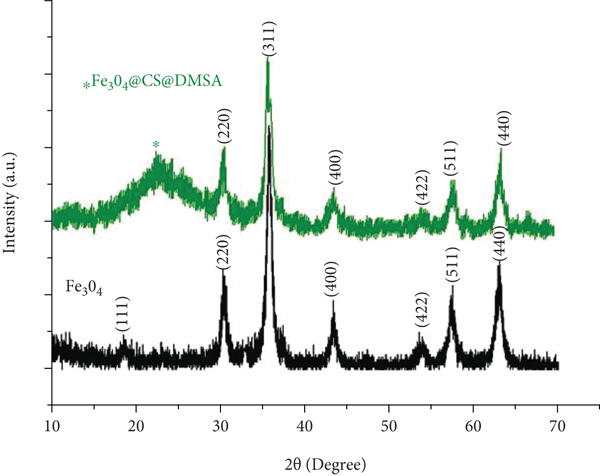
The XRD patterns of magnetite nanoparticles and Fe3O4@CS@DMSA are indicated in Figure 1(b). The major peaks at
Figure 2(a) displays the TGA curves for Fe3O4 nanoparticles and Fe3O4@CS@DMSA nanocomposite. The total weight loss was ~9% and 17% observed for Fe3O4 nanoparticles and Fe3O4@CS@DMSA nanocomposite, respectively. The weight loss of mass for magnetite nanoparticles in a range of temperatures (30-700°C) due to evaporation of adsorbed H2O and decomposition of oxygen-containing functional groups from the Fe3O4 nanoparticles [43, 44]. The thermal stability of Fe3O4@CS@DMSA exhibited a high loss in mass of approximately 17% with two stages. In the first one, the weight loss was ~3% in low temperature up to 200°C owing to elimination of adsorbed water and solvent absorbed onto the surface Fe3O4@CS@DMSA nanocomposite. In the second one, ~15% weight loss at around 200–700°C ascribes to the thermal decomposition of an organic part of CS and DMSA [45], confirming the successful synthesis of Fe3O4@CS@DMSA nanocomposites.

TGA analysis of (a) Fe3O4 and Fe3O4@CS@DMSA and (b) zeta potential plots as a function of Fe3O4@CS@DMSA nanocomposite.

To determine the point of zero charge (PZC) of Fe3O4@CS@DMSA, the surface charge of Fe3O4@CS@DMSA was measured under different pH values. The outcomes are displayed in Figure 2(b). It was seen that the zero of point charge value (pHpzc) of Fe3O4@CS@DMSA nanocomposite was ~5.2. This value is lower than ~7.1 for Fe3O4 nanoparticles [46]. This behavior of the Fe3O4@CS@DMSA nanocomposite is mainly assigned to the existence of –OH, COOH, and –SH groups, which are being protonated at lower than ~5.2.
The size and morphology of the Fe3O4@CS@DMSA were studied by TEM, and the outcomes are displayed in Figure 3(a). It is clear that the nanoparticles were uniform spherical morphology with a bright of amorphous CS and DMSA over the dark spot crystalline core of magnetite nanoparticles [47]. The value particle size of Fe3O4@CS@DMSA was ~11.5 nm confirming the surface modification of magnetite nanoparticles with CS and DMSA (Figure 3(b)). The elemental surface of Fe3O4@CS@DMSA and Cd(II)-saturated Fe3O4@CS@DMSA nanocomposite is shown in Table 1. The EDX analysis of Fe3O4@CS@DMSA showed the presence of Fe, O, C, N, and S on the Fe3O4@CS@DMSA surface, confirming the successfully prepared Fe3O4@CS@DMSA nanocomposite. The Cd(II) ions were observed on the Fe3O4@CS@DMSA surface after adsorption by EDX analysis (Table 1), which indicated the good adsorption capability of the Fe3O4@CS@DMSA nanocomposite when applied to Cd(II) adsorption.

(a) TEM image and (b) particle size distribution plots of Fe3O4@CS@DMSA nanocomposite.

EDX analysis.
3.2. Adsorption Study
3.2.1. Effect of pH Solution
The functional groups on the surface of Fe3O4@CS@DMSA nanocomposite and the state of Cd(II) metal ions are greatly influenced by H+ concentration [48]. The effect of different initial pH values (1.8-9.1) on Cd(II) adsorption by Fe3O4@CS@DMSA nanocomposite was studied as shown in Figure 4(a). The other parameters were kept constant as initial Cd(II) concentration (25 mg/L), temperature (25°C), contact time (210 min), adsorbent mass (10 mg), and agitation speed (100 rpm). As implied in Figure 4(a), the adsorption capacity of Fe3O4@CS@DMSA toward Cd(II) was increased from 0.75 to 58.75 mg/g as the pH increased from 1.8 to 7.6, respectively. After that, it is slightly reduced and may be owing to the formation of Cd(II) hydroxide precipitate such as Cd(OH)+ and Cd(OH)2, inhibiting the Cd(II) ion adsorption on Fe3O4@CS@DMSA nanocomposite [49–51]. The maximum value of Cd(II) elimination occurred at near pH (7.6). The zero-point charge of Fe3O4@CS@DMSA nanocomposite was determined as 5.2 as shown in Figure 2(b). Therefore, when the value of pH solution was lower than the pHzpc (5.2), the surface of Fe3O4@CS@DMSA becomes positively charged and would form electrostatic repulsion between Fe3O4@CS@DMSA adsorbent and Cd(II) ions, which lead to reduced adsorption capacity. As the value of pH solution is greater than pHpzc (5.2), the surface charge of Fe3O4@CS@DMSA nanocomposite becomes negatively charged, indicating the presence of electrostatic attraction between Cd(II) ions and Fe3O4@CS@DMSA nanocomposite which results in increased adsorption capacity. The

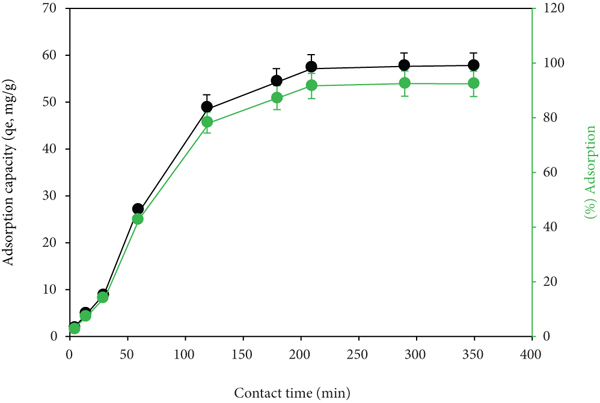
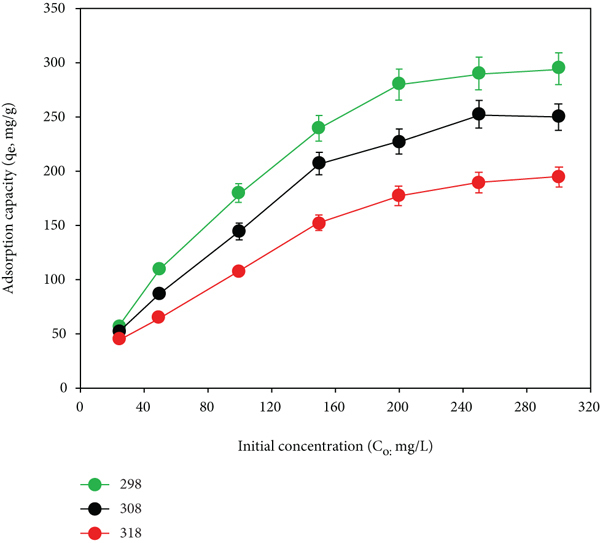
Effect of (a) pH (adsorbent dose: 0.01 g;

3.2.2. Effect of Adsorbent Mass
Figure 4(b) demonstrates the Cd(II) adsorption onto Fe3O4@CS@DMSA nanocomposite under various adsorbent mass in the range between 5 mg and 30 mg at constant temperature (25°C), initial Cd(II) concentration (25 mg/L), speed agitation 100 rpm, and pH (7.6). It was observed that the percentage removal of Cd(II) ions was improved sharply from 52% to 93.6% with an increasing amount of adsorbent from 5 mg to 10 mg, respectively, due to increasing the availability of active adsorption sites on the Fe3O4@CS@DMSA surface. Conversely, the adsorption capacity of Fe3O4@CS@DMSA nanocomposite toward Cd(II) reduced from 65.0 to 58.5 mg/g with rising the amount of Fe3O4@CS@DMSA adsorbent to 10 mg. This is due to the adsorption capacity being inversely proportional to the adsorbent mass as per equation (Equation (1)) [38, 52]. After the adsorbent mass of 10 mg, no significant change in adsorption capacity was observed.
3.2.3. Effect of Contact Time
To find out the optimum contact time, experiments were conducted at various time intervals between 5 and 350 min at constant adsorbent mass (10 mg), initial Cd(II) concentration (25 mg/L), pH (7.6), stirring rate (100 rpm), and temperature (25°C) as presented in Figure 4(c). It was noticed that the amount of Cd(II) adsorbed onto the Fe3O4@CS@DMSA increased rapidly with increasing equilibrium time and the maximum adsorption capacity and removal efficiency reached up to 58.0 mg/g and 92.8%, respectively, at 210 min. In the initial stage of the adsorption process, the Cd(II) ions easily interacted with active sites of Fe3O4@CS@DMSA nanocomposite owing to the abundance of the active adsorption sites on the Fe3O4@CS@DMSA surface. After 210 min, no significant change in the adsorption capacity owing to the active sites of Fe3O4@CS@DMSA tended to saturate and could not easily adsorb the Cd(II) ions.
3.2.4. Effect of Initial Cd(II) Concentration and Temperatures
Figure 4(d) displays the influence of initial Cd(II) adsorption in the range of 25 to 300 mg/L with different temperatures (298-318 K) on the adsorption capacity of Fe3O4@CS@DMSA toward Cd(II) ions at constant of the other parameters (
3.3. Modeling
3.3.1. Isotherm Model
The adsorption of studied Cd(II) onto Fe3O4@CS@DMSA was studied at three various temperatures 298, 308, and 318 K by different nonlinear isotherm models, namely, Dubinin Radushkevich (Equations (4)–(6)) [56], Langmuir (Equation (7)) [57], Freundlich (Equation (8)) [58], and models. The fitting outcomes and parameters are indicated in Figure 5 and Table 2, respectively.

Adsorption isotherm fit for the Cd(II) adsorption onto Fe3O4@CS@DMSA at (a) 298 K, (b) 303 K, and (c) 318 (time: 210 min;

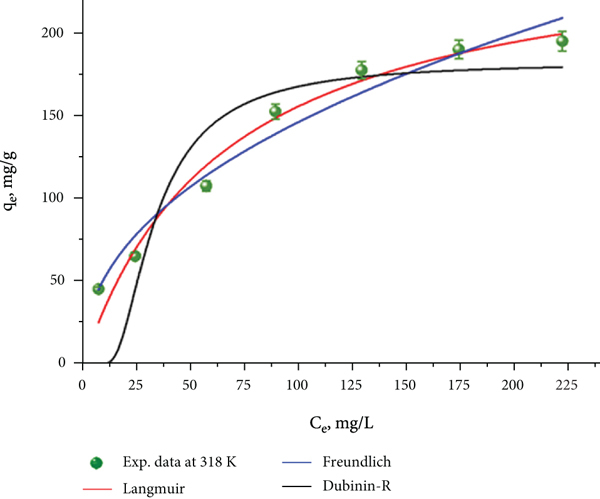

Isotherm data for Cd(II) adsorption by Fe3O4@CS@DMSA nanocomposite (time: 210 min;
where
Figure 5 displays the three nonlinear fitting parameter results of the adsorption isotherm models for the Cd(II) adsorption on Fe3O4@CS@DMSA nanocomposite. By comparison, it was observed that the
Comparison of Cd(II) adsorption performance on Fe3O4@CS@DMSA nanocomposite with different adsorbents.
3.3.2. Kinetic Model
The kinetic studies were estimated at different contact times in the range of 5-350 min with fixed parameter conditions (
Kinetic data for Cd(II) adsorption by Fe3O4@CS@DMSA nanocomposite (
where
Based on
3.3.3. Adsorption Thermodynamics
The thermodynamic parameters, namely, enthalpy change (

(a) Van’t Hoff plot for the adsorption of Cd(II), (b) comparison of eluents for desorption of Cd(II) from Fe3O4@CS@DMSA surface, and (c) reusability of Fe3O4@CS@DMSA.


where
Thermodynamic data for the Cd(II) adsorption on Fe3O4@CS@DMSA.
3.4. Adsorption Mechanism
The proposed adsorption mechanism is shown in Figure 7. Based on the adsorption kinetic results, the adsorption process followed the pseudo-first-order model, suggesting a physical interaction through electrostatic attraction between the Cd(II) ions and the Fe3O4@CS@DMSA nanocomposite. According to the FTIR analysis (Figure 1(a)), the position peaks of functional groups declined in intensity and slightly shifted to a lower wavenumber. In detail, the bands at 3393 and 2550 cm-1 decrease in intensity owing to the interaction between Cd(II) and carboxyl (COOH), hydroxyl (OH), and SH groups, respectively, on the Fe3O4@CS@DMSA surface by electrostatic interaction. In addition, the band at 1274 cm-1 for
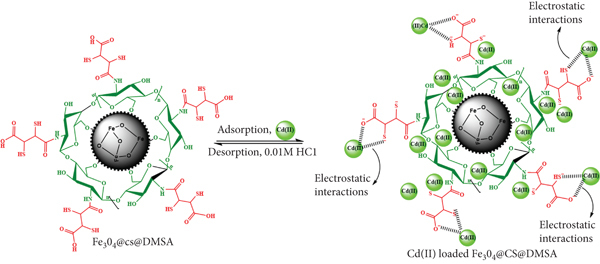
Mechanism adsorption of Cd(II) onto Fe3O4@CS@DMSA nanocomposite.
3.5. Reusability Study
To evaluate the reusability of the Fe3O4@CS@DMSA, adsorption and desorption tests were conducted using three eluents, namely, 0.01 M CH3COOH, 0.01 M HNO3, and 0.01 M HCL. The % desorption (Equation (15)) was estimated by the equation:
4. Conclusion
Fe3O4@CS@DMSA nanocomposite was synthesized via the in situ coprecipitation method followed by a covalent functionalization of Fe3O4@CS with DMSA acid by amidation reaction. The synthesized Fe3O4@CS@DMSA nanocomposite was characterized using zeta potential, FTIR, XRD, TEM, EDX, and TGA techniques. These techniques confirmed the formation of adsorbent successfully. After characterization, the Fe3O4@CS@DMSA was used to eliminate Cd(II) ions from aqueous systems. The Fe3O4@CS@DMSA adsorbent exhibited a high adsorption capacity (314.12 mg/g at the optimum condition pH: 7.6, contact time: 210 min, temperature: 298 K, adsorbent mass:10 mg, and stirring rate: 100 rpm). The FTIR and EDX results confirmed the existence of Cd(II) ions after adsorption on Fe3O4@CS@DMSA nanocomposite. The Freundlich isotherm data and pseudo-first-order kinetic data displayed more compatibility with the equilibrium data than that of other models. The mechanism of Cd(II) adsorption on Fe3O4@CS@DMSA nanocomposite is electrostatic attraction. The thermodynamic results confirmed the spontaneous and exothermic nature of adsorption. The reusability test of Fe3O4@CS@DMSA nanocomposite exhibited that the adsorption efficiency was 72% after five cycles. The results indicate that the Fe3O4@CS@DMSA has a good potential for the elimination of Cd(II) from an aqueous solution.
Footnotes
Data Availability
Anyone who wants to request research article data can contact me directly via the following email:
Conflicts of Interest
There are no conflicts to declare.
Acknowledgments
The authors are thankful to the Deanship of Scientific Research at Najran University for funding this work under the General Research Funding program grant code (NU/-/SERC/10/509).