




Abstract
Some environmental problems caused by the intrusion of active drug ingredients, especially antibiotics, into water resources pose a serious threat. Ciprofloxacin (CIP) is an antibiotic from the group of fluoroquinolones that is used extensively in the treatment of bacterial infections. The presence of drug residues in the environment, especially in water resources, is an essential issue due to their stability and nondegradability. This study is aimed at investigating the efficiency of magnetite (Fe3O4) nanoparticles and the effect of independent variables, including initial concentrations of CIP (35-80 mg/L), adsorbent doses (20–60 mg), and pH values (4–10) at reaction time (80 min) for the removal efficiency of CIP antibiotics based on the Box-Behnken design (BBD) method. The analysis of variance (ANOVA) results indicated that a quadratic model was convenient for modeling CIP removal. The first step, the coprecipitation method, was appropriate for the preparation of Fe3O4 nanoparticles and developed as highly efficient adsorbents. Synthesized nanoparticles were later characterized by X-ray diffraction (XRD), Scanning Electron Microscopy (SEM), and Fourier transform infrared spectra (FT-IR). The results of XRD have shown that angles for the peaks at
1. Introduction
Water is a natural and essential resource for human survival, and that is why human beings have always been looking for clean and healthy water for life. Various methods were carried out to evaluate the quality of surface water and groundwater [1–6]. Today, freshwater resources are endangered due to increased population growth and climate change [7–10]. The slow decomposition and incomplete metabolism of antibiotics have shown that more than 95% of it is not metabolized and goes into wastewater, making it more stable in the environment and polluting surface water and groundwater [11]. Antibiotics, with domestic wastewater, medicinal effluents, hospital wastewater, veterinary clinics, and agricultural products significantly enter the water resource and environment [12]. Antibiotic resistance is one of the main reasons for the purification of antibiotics, which may cause significant threats to global human health [13]. One of the prominent antibiotic families is fluoroquinolones that can be mentioned as ciprofloxacin (CIP), norfloxacin (NOR), and ofloxacin (OFL), which are widely used in therapeutic fields [13–15]. The presence of fluorine atoms in the composition of these antibiotics causes their stability and is considered stable and nonbiodegradable in the environment [15, 16]. CIPs are extensively used to treat bacterial infections (urinary tract infections) [17–19]. They have been detected in wastewater and surface water at concentrations of less than 1 μg/L, in hospital effluents at concentrations of above 150 μg/L, and in pharmaceutical plants at concentrations of about 30 mg/L [12]. Besides, the antibiotics can also be absorbed in the sludge at 2.43 mg/kg [12]. To remove contaminants, various studies through physical, chemical, biological, and combined methods have been used [20–22]. The results of these studies showed that most of these methods have not been cost-effective, due to the inability to completely decompose contaminants and the high cost of investment, as well as low returns, complex management and maintenance, and lengthy time [23–27]. Due to the indiscriminate and arbitrary use of antibiotics and the impossibility of removing these compounds by standard processes in municipal, hospital, and pharmaceutical wastewater treatment plants, the study of practical and feasible methods is inevitable [12].
Among the mentioned methods, adsorption processes are good options for separation due to their simplicity, low operating cost, low energy consumption, high flexibility, and the availability of numerous cheap adsorbents with complex properties. Adsorption is a type of separation operation similar to the liquid adsorption process in terms of the shape of the mass transfer operation. In the adsorption process, some of the soluble components in the fluid phase are transferred to the active surface of the solid adsorbent. The reason for using this process is the appropriate selectivity of the adsorbent to adsorb one or more components of the carrier fluid. The adsorption involves the accumulation of adsorbed molecules on the inner and outer surfaces of the adsorbent. Porous adsorbents with a high surface-area-to-volume ratio are usually common for possible utilization [27–30]. Nowadays, nanotechnologies in water and wastewater treatment have been developed using materials and processes such as zerovalent iron (nZVI) and magnetite (Fe3O4) nanoparticles [31–34].
In a study, researchers examined cephalexin (CEX) to be removed from an aqueous solution by powdered activated carbon coated with ZnO and nZVI nanoparticles derived from pomegranate peel extract. This study showed that the promotion of nanoparticles in the form of composites could be applied, and biophilic adsorbents remove CEX from an aqueous solution [34]. Azari et al. investigated the use of magnetic nanotube carbon adsorbents to remove nitrate from aqueous media. The results revealed that the optimal conditions of the variables were pH equal to 3, contact time 60 min, stirring speed 200 rpm, and 1 g adsorbent per liter [35].
Jalili et al. used the UV/ZnO nanophotocatalytic process for phenol decomposition. The results showed an inverse relationship between phenol removal efficiency and pH increase in the UV/ZnO nanophotocatalytic process. Optimal conditions in the UV/ZnO nanocatalytic process were 10 mg/L, contact time of 30 min, and
Azari et al. evaluated the ultrasonic dispersed solid-phase magnetic adsorption method with a high-performance liquid chromatographic system to remove diethyl phthalate (DEP). The primary interaction of parameters such as pH (3-11), adsorbent dose (0.10–0.50 g L−1), ultrasound time (1–5 min), and DEP concentration (5–10 mg/L) was considered. The results showed that MGO has outstanding potential as an adsorbent to remove phthalates from contaminated water [38]. Ferrous nanoparticles are studied due to their abundance, cost-effectiveness, nontoxicity, fast reaction, high ability, and efficiency in decomposing pollutants such as organic matters [37–39]. Nanoparticles’ specific surface increases with decreasing particle size, which some studies have suggested the successful use of iron nanoparticles in removing some antibiotics such as amoxicillin, ampicillin, and metronidazole [35–41].
The present study optimized the influential variables in removing CIP antibiotics using the Box–Behnken design (BBD) method based on the response surface methodology (RSM). In this study, magnetite nanoparticles such as adsorbents have been investigated, and the characterization of nanoparticles synthesized using techniques such as X-ray diffraction (XRD), scanning electron microscopy (SEM), and Fourier transform spectroscopy (FT-IR) was determined.
2. Materials and Methods
The materials used, such as CIP powders (C17H18FN3O3, 98% in purity) were purchased from Temad Pharmaceutical and Nanosany Companies, Iran. Ferric chloride hexahydrate and Ferrous chloride tetrahydrate (FeCl3.6H2O, FeCl2.4H2O), sulfuric acid (H2SO4), sodium hydroxide (NaOH), ammonia solution (NH3, 25%), and nitric acid (HNO3) were prepared from Merck company.
2.1. Experimental Procedures
Experimental design is a method for conducting a systematic set of experiments to obtain reliable and appropriate results based on a limited number of observations [42–44]. Optimization techniques may be used to identify the optimal values for variables and investigate the effect of optimized parameters on the response. The main tools in this field are divided into two groups of experiment design and analysis tools. In the experimental design, there are methods such as the full factorial method and Latin square-based method. The experimental analysis, including the analysis of variance (ANOVA), its derivatives, and regression analysis are the essential tools. The flowchart proposed for optimization of CIP removal by the synthesis of magnetite nanoparticles is presented in Figure 1.
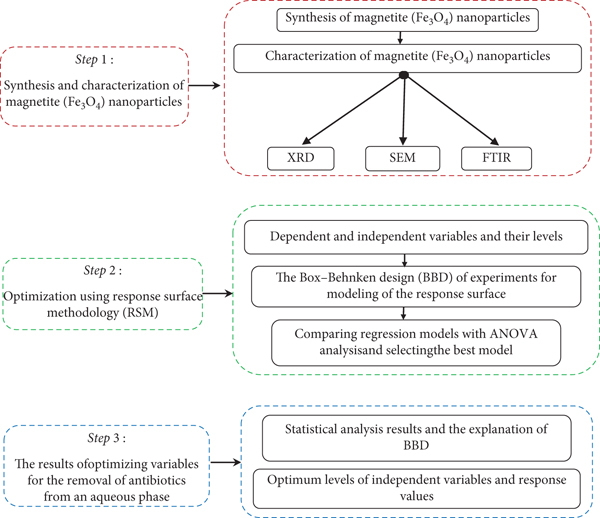
The proposed methodology for optimization of CIP removal by synthesis of magnetite (Fe3O4) nanoparticles using BBD.
RSM is one of the most powerful statistical tools, which is helpful for optimizing influential variables in various processes, and it is widely used for designing experiments [45–47]. Examination of the effect of different variables and their interaction on the response of different experimental design methods should be done systematically based on the number of experiments. The most important designs of optimization experiments include full three-level factorial design (FFD), BBD, and central composite design (CCD). In the FFD method, the number of experiments can be obtained with
In the BBD method, the variables are in three levels of high (+1), medium (0), and low (-1) with five central repetition points (to estimate the percentage error of the sum of squares), with a total of 17 experiments, designed by the Design-Expert software (DX7). The number of experiments required for the model was determined from Equation (1):
Selected levels of independent variables in BBD.
In this method, the experiments are performed in turn and according to the values provided for the design of the BBD in Table 1. To perform each sample, a specific concentration of an antibiotic solution is mixed with a certain amount of adsorbent in a pH and specified contact time. Finally, the nanoparticles are separated with centrifugation and external magnetic, so the concentration of antibiotics remaining in the solution is measured with a UV-Vis spectrophotometer. Fit analysis was carried out, and the accuracy and correctness of the obtained results were investigated. For this purpose,
The CIP removal efficiency was evaluated through (Equation (2)), the
3. Results and Discussion
3.1. Synthesis of Magnetite (Fe3O4) Nanoparticles
The relevant nanoparticles were synthesized by the coprecipitation method. First, 1.625 g of FeCl2.4H2O with 4.43 g of FeCl3.6H2O was mixed with 320 mL of deionized water by a magnetic stirrer for one hour at 80°C. Then, after the end of the reaction time, 12.5 mL of ammonia (NH3, 25%) was added slowly to the solution of the first part at 80°C, so a black precipitate was formed at the bottom of the Erlenmeyer flask, representing nanoparticles. After extraction, the stirrer is removed, and it is slowly washed three times with ethanol and distilled water and filtered with a vacuum pump. The precipitate was finally dried under a vacuum for 24 hours. Figures 2–4 show the results of the analysis of XRD, SEM, and FT-IR nanoparticles, respectively.

X-ray diffraction spectrum of Fe3O4 nanoparticles.
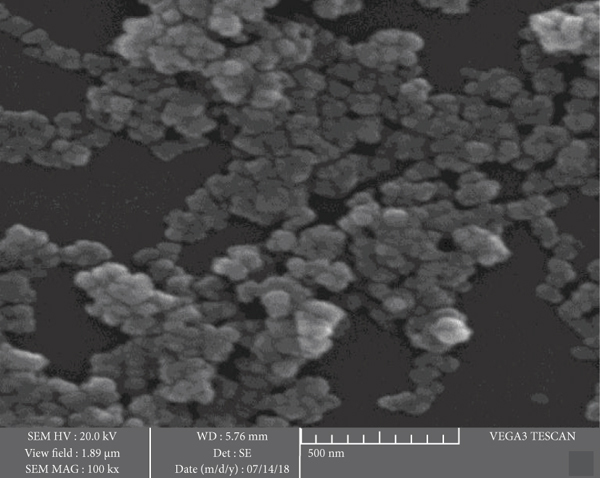
SEM images of Fe3O4 nanoparticles.
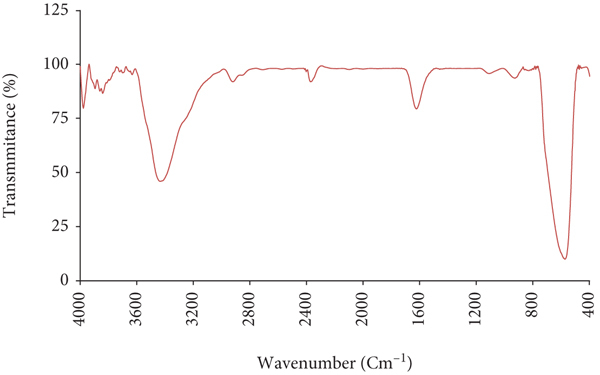
FT-IR spectrum of Fe3O4 nanoparticles.
The obtained nanoparticles were examined using XRD to analyze the structure and composition of the particles. The phase-detection and crystalline properties were determined by X-ray diffraction (XRD) using a Siemens D5000 diffraction gauge. Scattering was obtained using Cu-Kα radiation (
The shown angles for the peaks in the sample at
The properties of Fe3O4 nanoparticles were determined using various devices to study the shape, the average diameter of the particles, and the surface details of the nanoparticles that were taken by SEM Figure 3.
The image of the nanoparticles synthesized by the coprecipitation taken with SEM showed that the nanoparticles produced had the form of clusters of cohesive spherical particles that have irregular shapes and were more or less uniform and had a balanced surface. As can be seen in Figure 3, the diameter of the nanoparticles is in the range of 20-48 nm and 34 nm on average which is in the expected range. Based on the empirical classification given by IUPAC, particles with a diameter of
FT-IR is a crucial method for investigating chemical bond groups and functional groups on the surface of nanosorbent particles [51]. In this study, FT-IR was used to investigate the chemical bonds and levels of nanoparticles and the interactions that occurred at these levels during adsorption on the Fe3O4 surface [40]. The FT-IR spectra of Fe3O4 nanoparticles in the range bands at 400 cm-1 to 4000 cm-1 have been prepared and indicate that in this spectrum the functional groups in the frequency of 572 cm-1 which are related to the formation of the band the Fe-O and generally peak wavelength of bands 572 cm-1, 1622 cm-1, and 3420 cm-1 attributed to the tensile and flexural vibration of bond O-Fe, absorption band C=C, and the O-H bond in water adsorption (or carboxylic groups), respectively [52–56]. In this regard, the size of Fe3O4 particles decreases to the nanoscale, the constant bond strength will increase, as a large number of bonds of surface atoms are broken as a result of the rearrangement of unstable electrons on the particle surface.
3.2. Experimental Design and Optimization Using BBD
Based on the experimental design results and statistical analysis performed on the response, the use of a quadratic statistical model was evaluated. The model results obtained by experimental design software are shown in Equation (3).
A positive (negative) sign indicates that the variables have a direct (inverse) effect on the target. Tables 2 and 3 indicate the results of BBD experiments and ANOVA, respectively.
The results of the Box-Behnken experimental design (BBD).
Results of analysis of variance (ANOVA).
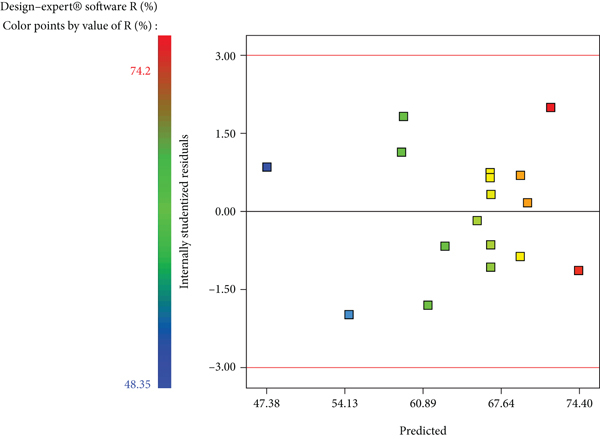
According to Table 3, the

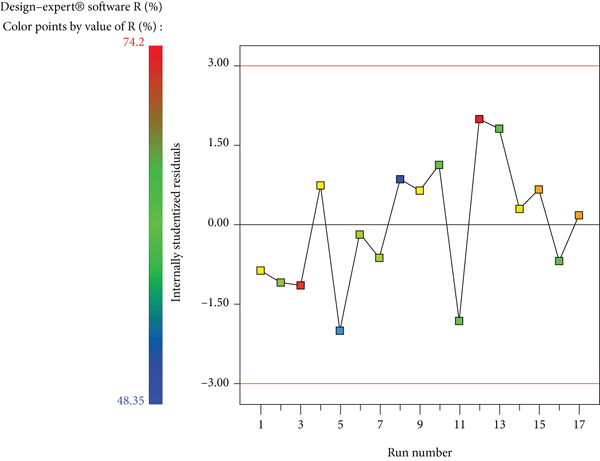
(a) Normal probability of student residuals. (b) Residuals versus predicted. (c) Residuals versus run number. (d) Measured values versus predicted values.

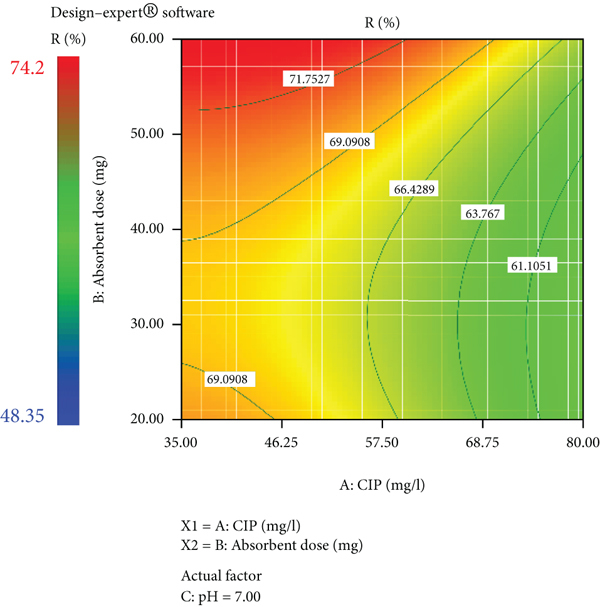
Also, in Figure 6, response surface plots (3D) and contour plots (2D) showed the effects of variables, the interaction between adsorbent dosage and initial concentration of CIP (mg/L) (Figures 6(a) and 6(b)), the interaction between initial concentration of CIP (mg/L) and pH (Figures 6(c) and 6(d)), and the interaction between adsorbent dose and pH (Figures 6(e) and 6(f)) vs. response, respectively. According to Figure 6, from the three-dimensional response surfaces and contours related to the variables, it can be concluded that in Figures 6(a) and 6(b), with the increasing the amount of adsorbent dose up to 50 mg and decreasing the initial concentration of antibiotics less than 50 mg/L, the highest percentage of removal was observed. Also, in Figures 6(c) and 6(d), with a decreased pH of less than 5.5 and the initial concentration of antibiotics less than 46 mg/L, the highest percentage of removal was observed. In Figures 6(e) and 6(f), the highest removal percentage was observed by increasing the amount of adsorbent

Response surface plots (3D) and contour plots (2D): (a, b) interaction between adsorbent dose and initial concentration of CIP (mg/L), (c, d) interaction between initial concentration of CIP (mg/L) and pH, and (e, f) interaction between adsorbent dose and pH.


Summary of studies performed using nanotechnology to the removal of different types of antibiotics.
4. Conclusion
Due to the simultaneous effect of variables such as initial antibiotic concentration, adsorbent dosage, pH, and contact time, nanotechnology can be more effective as adsorbents for the removal of various types of contaminants than other methods. The results of XRD showed that the angles for the peaks at
The results of the experimental data with the predicted model had good accuracy (
Footnotes
Data Availability
The data used to support the findings of this study are included within the article.
Conflicts of Interest
The author declares that they have no conflicts of interest.
Acknowledgments
The author thanks the Temad Pharmaceutical and Nanosany Companies, for providing the drugs.