




Abstract
The efficiency of activated carbon produced from grape waste as a low-cost, nontoxic, and available adsorbent to remove Reactive Red 2 from aqueous solution has been investigated. The prepared activated carbon has been characterized by FTIR, SEM, and BET. The results of characterization indicate the successful conversion of grape waste into mesoporous AC with desirable surface area consist of different functional groups. The results of statistical modeling displayed high
1. Introduction
In recent years, the use of synthetic dyes in industries has increased dramatically due to low-cost in synthesis, efficient synthesis process, high stability and resistance to temperature, light and detergent, and other factors in comparison to natural dyes [1, 2]. Synthetic dyes are widely used in different industries such as paper, textile, food, plastic, leather, and cosmetic [3, 4]. The presence of organic dyes in the environment, even in low concentrations, can threaten human health and cause diseases such as gastritis, heinz body formation, skin allergies, tissue necrosis, and cancer [5]. Dyes can be divided into different types, namely, reactive, acidic, direct, cationic, disperse, and vat according to their characteristics and application [6]. Reactive dyes due to their stability, high solubility, high dye variety, and low-cost are one of the most common used synthetic dyes which are widely used to dye cotton and other cellulosic fibers, nylon, and wool [7, 8].
Reactive Red 2 (RR2) is a reactive azo dye and is difficult to be decomposed in natural environment due to its strong covalent bonds [9]. Direct discharge of colored wastewater from aforementioned industries into the environment leads to serious environmental problems [10]. Therefore, various methods such as biological, chemical, and physical methods or a combination of these methods are used to treat wastewater containing dyes and thus reduce the environmental hazards of dyes [11]. Researchers has used a variety of methods, such as coagulation [12], ozonation [13], Fenton processes [14], biodegradation [15], photodegradation [16], and adsorption [17] to remove dyes from water and wastewater efficiently. The results of previous research works made clear that dyes cannot be degraded effectively by chemical and biological processes [18].
Nowadays, adsorption due to its high efficiency, high selectivity at molecular level, low energy consumption, easy operation, and the ability to separate different chemical compound has been used widely for dye removal [19]. Adsorption is a physicochemical method in which the soluble molecule (such as dye molecules) is attached to an adsorbent surface according to its physical and chemical properties. Depending on the properties of the adsorbent and the type of dyes, different interactions may occur between the adsorbent and the dye such as electrostatic interaction or Van der Waals forces [20]. Thus, adsorption is an effective and economical efficient and method with high potential for removing dyes from aquatic environments. Among the large number of adsorbents, activated carbon (AC) is widely used due to high surface area, microporous structure, and high adsorption capacity [21, 22].
The commercial AC is expensive and therefore, many studies have been carried out to produce AC from low-cost raw materials. Agricultural wastes are a good option for producing AC, which is less expensive and environmentally friendly. In the last several decades, different agricultural wastes have been used as low-cost adsorbent, such as peanuts [23], apricots stones wastes [24], grape stalk [25], olive almonds [26] and cherries [27]. Agricultural waste is made from hemicellulose, cellulose, and other functional groups that are a suitable alternative to commercial activated carbon. Agricultural waste is cheap and abundantly available and sometimes even causes a lot of environmental problems [28]. Therefore, converting agricultural wastes into valuable materials such as AC is valuable in points of economic and environmental protection view [29]. For this purpose, grape waste was used to prepare activated carbon. Grapes are one of the most common fruit products in the world. Approximately 7.5 million of land around the world in 2017 is under grapevine cultivation [30]. Therefore, pruning the branches of vines to produce higher quality grapes produces a significant amount of agricultural wastes. Using grape wood to make adsorbent is an efficient management strategy to control agricultural wastes.
This study is aimed at investigating the Reactive Red 2 (RR2) removal using prepared activated carbon from grape wood wastes as low-cost adsorbent from aqueous solution. The effects of contact time, initial dye concentration, adsorbent dosage, and solution pH on the RR2 adsorption rate have been modeled and optimized using the central composite designs (CCD) through response surface methodology (RSM). The mechanism of adsorption has been described through isotherm and kinetic studies.
2. Materials and Methods
2.1. Chemicals and Reagents
All chemicals such as RR2 (C19H10Cl2N6Na2O7S2), sulfuric acid, and NaOH used in this study were reagent grade. The RR2 with purity of 98% has been provided by Merck Company, Germany. The chemical activation of adsorbent carried out by using 98% sulfuric acid. The pH of solution was adjusted using NaOH (1 mol L-1) and HCl (1 mol L-1), which were purchased from Merck company. The chemical structure of RR2 dye is offered in Figure 1 [31].

The structural formula for RR2.
2.2. Activated Carbon Preparation
Grape wood waste was obtained from the Kermanshah rural area in the western region of Iran. The raw material was crushed mechanically and transferred to the laboratory. In order to eliminate impurities such as debris and dust, grape wood waste cleaned and washed with distilled water and dried at 100°C for 3 h. The activation agent sulfuric acid (with 98% purity) was used for the chemical preparation of activated carbon during 8 h with the weight ratio of 1 : 10 for sulfuric acid to grape wood wastes. Then, it was dried for 24 h at 100°C. In next phase, the thermal activation carried out by oven at 750°C for 1 hour. After cooling, the AC was passed through the sieve mesh size 50. The powder has been neutralized with NaOH and HCl. Finally, grape wood activated carbon (GWAC) was dried at 100°C for 3 h.
2.3. Characterization of Activated Carbon
To study the physical and chemical characteristics of GWAC, Fourier transform infrared (FTIR), scanning electron microscopy (SEM), and Brunauer–Emmett–Teller (BET) have been used. The surface morphology of the adsorbent was observed with SEM (Jeol JSM 840A, Japan). The BET has been used to analysis the specific surface area of GWAC. The FTIR has been used to determine functional groups of adsorbent.
2.4. Experimental Design and Empirical Modeling
In this study, Design-Expert software (version 11) was applied for the design of experiments and data analysis through RSM using CCD technique. Response surface methodology is a statistical method that uses the quantitative data from experiments to examine the interaction of the several parameters affecting the process and study the responses of various factors by varying them simultaneously [32, 33]. The effects of four independent variables, such as contact time (A), initial pH (B), adsorbent dosage (C), and initial dye concentration (D), were investigated by means of (3-level-4-factor) CCD. The effect of input factors on the responses was investigated by analysis of variance (ANOVA) through statistical evaluation of
Ranges and level of studied parameters in order to design the experiments.
Experimental conditions for adsorption process in the presence of prepared GWAC.
The quadratic model based on Eq. (1) was applied to evaluate the coefficients of the statistical model, where
2.5. Batch Equilibrium Studies
This empirical study carried out at a laboratory bench scale by using activated carbon prepared from grape wood waste for removing RR2 from aqueous solution. In the first phase, a series of batch experiments were performed to investigate the removal of RR2 dye from synthetic wastewater. The adsorption process has been conducted at the different values of independent variables; contact time (10 to 90 min), pH (3–11), initial concentration of dye (100-500 mg/L), and adsorption dosage (0.25 to 12.25 g/L) using a series of pyrex glass with total volume of 250 mL and working volume of 100 mL. Ambient temperature and mixing speed were constant during process at
where
3. Results and Discussions
3.1. Characteristics of Adsorbent
The SEM image (Figure 2) indicates the surface porosity of GWAC. According to Figure 2, presence of honeycomb pores on the GWAC surface makes clear that adsorbent has ability to remove dye from aqueous solution by adsorption process. Previous studies reported that high porosity increases the surface area and effectively increases the adsorption efficiency [36]. Based on BET analysis, the adsorbent-specific surface area was 119.084 m2/g.

SEM image of prepared AC.
The FT-IR spectrum is very important for determining the characteristics of the functional groups as well as their changes in the adsorbent. The FT-IR spectra of the adsorbent after RR2 adsorption are shown in Figure 3. Based on various studies, the peaks of the Figure represent between 1000 and 1200 cm-1 are related to the C-O functional group. The band at 3200 to 3600 cm-1 corresponds to the O-H tensile vibration of the hydroxyl functional groups. The peak at 1700 to 1800 cm -1 is related to the C = O stretch of the carboxyl groups. The peak at about 960 cm-1 may be due to the vibration of the C-C or C-H groups [37].

FTIR spectrum after adsorption.
3.2. Statistical Analysis and Modeling
The results of analysis of variance (ANOVA) have been summarized in Table 3. Based on the results adsorbent dosage, initial concentration of dye and contact time has a positive effect on adsorption efficiency. The positive amount of variables indicates the effect of variables, while the negative value indicates an inverse relationship between the factors and their response.
Statistical parameters and ANOVA results using Design-Expert 11.0.0 for the studied variables.
3.3. Effects of Variables and Comparison
The 3D surface response and contour plot of the quadratic model have been developed by the Design Expert software version 8, and they used to study the interactive relationships between independent variables and response.
3.3.1. Effect of Initial pH and Contact Time
The pH has a large effect on the adsorption capacity of the adsorbent. The pH can affected on the electrical charge of adsorbent surface, dissociation of various functional groups on the active sites of the adsorbent, and the ionic forms of adsorbate molecule. Therefore, it can play an important role in the dye adsorption process [40]. Figure 4 shows the interaction effects of contact time and initial pH based on response in the adsorption process. In order to study the effect of pH on dye removal efficiency, different initial values of pH (3, 5, 7, 9, and 11) were examined. As shown in Figure 4, the dye removal efficiency increased by increasing of pH from 3 to 7, but it decreased by increasing of pH from 7 to 11. It is evident that both variables (pH and time) have a strong influence on the RR2 removal [41]. The adsorption of RR2 was high at low pH when

3D response surface and 2D contour plots show the effect of pH and contact time on the RR2 removal.

The comparison of results of this study with previous works.
One of the most important design parameters of adsorption studies is the contact time between the dye and the adsorbent [45]. The results show that with increasing contact time from 10 to 90 minutes, the percentage of dye removal increases. Initially, the adsorption process decreases rapidly and gradually over time due to the presence of voids on the activated carbon surface. It means at first, there are more sites for adsorption, which with the passage of time and the occupation of adsorbent sites, that the carbon adsorption capacity reaches a constant amount and the so-called equilibrium between the amount of adsorbed dye and the amount of desorption. Therefore, the amount of adsorption is also reduced [46]. Bazrafshan et al. (2013) conducted a study on the removal of Reactive Red 120 using carbon made from cumin herb wastes. The results of this study show that increasing the contact time has a positive effect on the dye removal process [47].
3.3.2. Effect of Adsorbent Dosage and Dye Concentration
The adsorbent concentration is an important factor because it determines the capacity of the adsorbent for a given initial RR2 concentration. In order to determine the effect of adsorbent dosage on the adsorption process, 0.25 to 12.25 g/L adsorbent (activated carbon obtained from grape wood wastes) was used for adsorption experiments. Figure 5 shows the interaction effects of dye concentration and adsorbent dosage in the response process. As shown in Figure 5, with increasing of adsorbent dosage up to reach to equilibrium in high dosages, the RR2 removal efficiency increases. The highest adsorption rate was obtained in 12.25 g/L of activated carbon that was 96.83%. This is due to the fact that as the adsorbent dosage is increased, the surface area available for adsorption increases, thus producing more active sites for adsorption [48, 49]. The comparison of the results of current study with previous research works indicated same effects of different variables (Table 4). The results of Al-Sharify et al. (2013) study show, with increasing the amount of activated carbon prepared from Hazelnut Shells (as adsorbent), the amount of RR2 removal which also increases [50]. The results of this study are consistent with a study by Divriklioglu and Akar [51].
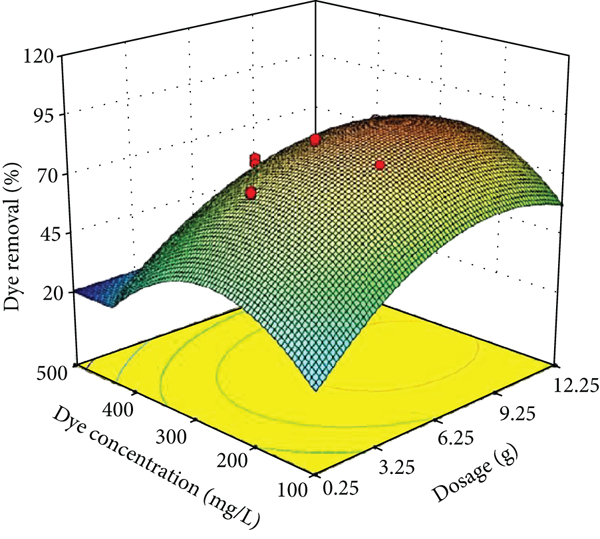
3D response surface and 2D contour plots show the effect of dosage and dye concentration on the RR2 removal.
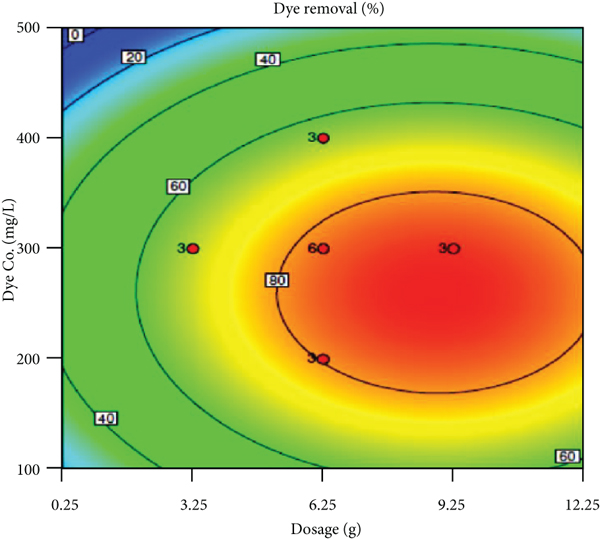
The initial concentration of dye in the solution has a significant effect on the number of effective collisions between the adsorbent surfaces and the adsorbed molecules [52]. The effect of initial dye concentration was evaluated in the range of 100-500 mg/L. The effect of initial dye concentration on the dye removal efficiency showed that overall dye removal efficiency decreased with increasing dye concentration. For example, increase in dye from 100 to 500 mg/L decreases the decolorization from 94% to 61.6% at 90 min. As the dye concentration increases, the adsorbent vacancy sites decrease for dye adsorption [53].
3.4. Adsorption Isotherms
Adsorption isotherm data are of great importance in adsorption studies in order to optimize the design of the adsorption system. Various isotherm equations such as Langmuir and Freundlich isotherms were used to investigate the RR2 dye adsorption equilibrium on GWAC [56].
Based on Langmuir isotherm, adsorption occurs by monolayer coating at homogeneous sites with a limited number [57]. Furthermore, once dyes molecule occupies a site, no further adsorption can take place at that site. Langmuir isotherms can be plotted at four different linear types. Equations (5)-(8) show the linear form of four types of Langmuir isotherm models [58]:
where
One of the parameters of the Langmuir equation, which determines the type of adsorption process, is the coefficient of separation parameter RL. When
The Freundlich isotherm describes heterogeneous adsorption with different surface energy sites. In this model, the amount of dye adsorption changes with the exponential distribution of sites and adsorption energies. The linear form of the Freundlich isotherm is shown in Eq. (10) [61, 62]:
where

Freundlich isotherm for RR2 adsorption on GWAC at (
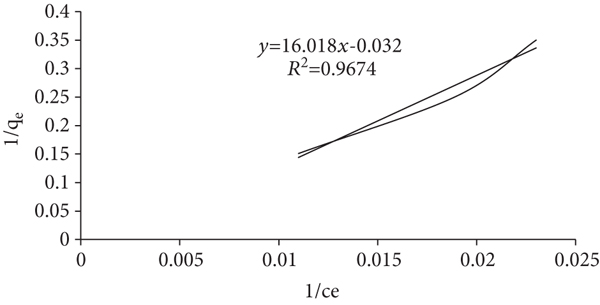
In present work, the equilibrium adsorption data were analyzed using the Langmuir and Freundlich adsorption models. The parameters obtained from Figures 7 and 6 are summarized in Table 5.
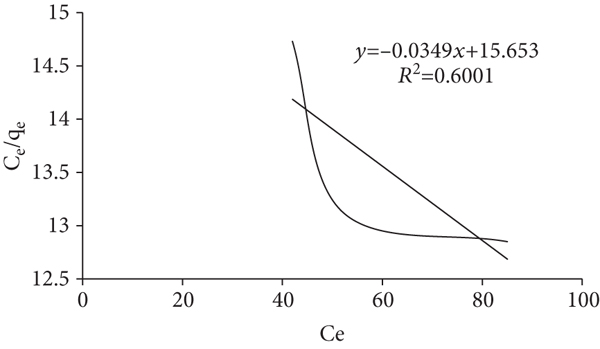
Langmuir isotherm for RR2 adsorption on GWAC (a) type 1 Langmuir, (b) type 2 Langmuir, (c) type 3 Langmuir, and (d) type 4 Langmuir at (


Isotherm model parameters and correlation coefficients for RR2 adsorption on GWAC.
Comparison of
3.5. Kinetic Study
Kinetics is one of the important characteristics in defining the efficiency of adsorbent. Adsorption kinetics describes the rate of adsorption of solutes, which in turn depends on the retention time or adsorption reaction. Kinetic parameters can be calculated by analyzing experimental data obtained at different times. Therefore, in this way, some information needed to design and model the adsorption processes that can be obtained [64].
3.5.1. The Pseudofirst-Order Model
The linear form of the pseudofirst-order equation can be represented using the following equation (Eq. (11)):
where
3.5.2. The Pseudosecond-Order Model
The pseudosecond-order model equation was proposed in 1995 by Ho. This equation shows how the pertained rate of adsorption is related to the equilibrium value [65]. Four types of the pseudosecond-order model were defined as (Eqs. (12)-(15)) [66]:
where
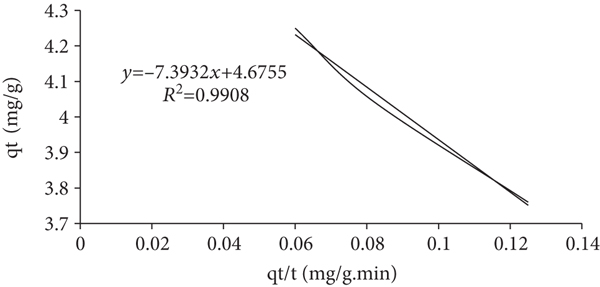
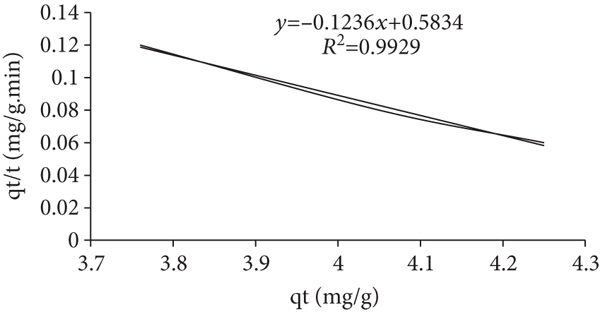
Based on Figures 8 and 9, the experimental results at different times show that the data follows a pseudosecond-order kinetic model. The kinetic parameters for the pseudofirst-order and pseudosecond-order models are summarized in Table 6.

The pseudofirst-order kinetic plots for the adsorption of RR2 onto prepared adsorbent.

The pseudosecond-order kinetic plots for RR2 adsorption on GWAC (a) type 1: the pseudosecond-order, (b) type 2: the pseudosecond-order, (c) type 3: the pseudosecond-order, and (d) type 4: the pseudosecond-order.

Kinetic model parameters and correlation coefficients for RR2 adsorption on GWAC.
3.6. Adsorption Thermodynamics
To understand the properties and mechanisms of adsorption, the thermodynamic parameters such as standard enthalpy change)
where
Thermodynamic parameters for the adsorption of RR2 on GWAC at
4. Conclusion
In this study, the removal of RR2 dye from aqueous solution using grape wood-based activated carbon was investigated. Parametric studies, optimization, thermodynamics, adsorption isotherm and kinetic studies were done and following conclusions were obtained:
Using the Design-Expert software, the optimum parameter conditions of 100 mg/L initial RR2 concentration, 90 min contact time, 12.25 g/L adsorbent dose, and pH of 3 were determined to yield a maximum RR2 removal of 96.83% The percentage removal of RR2 increases with increasing adsorbent dose and contact time The percent (%) of RR2 removal increases with decreasing pH and initial dye concentration The Langmuir isotherm of type (II) best described the equilibrium data with The pseudosecond-order kinetic model of type (I) best describes the kinetics of the GWAC adsorption system due to its high Conclusively, grape wood-based activated carbon is an effective and low-cost adsorbent in the removal of RR2 dye from aqueous solution, where process parameters such as solution pH, initial dye concentration, contact time, and adsorbent dose significantly affect the percentage removal of RR2
Footnotes
Abbreviations
Data Availability
The [data type] data used to support the findings of this study are included within the article.
Conflicts of Interest
The authors declare that they have no conflicts of interest.
Acknowledgments
The authors would like to thank the Research Council of Kermanshah University of Medical Sciences for its financial support of this project (Project No. 94037).