




Abstract
In this study, polypyrrole-modified red mud (PRM) was prepared for the efficient removal of anionic dyes (methyl orange and Congo red) from aqueous solutions. The phytotoxicity (bean sprouts) of the dye solution before and after dye removal was investigated. Adsorption kinetics confirmed that the adsorption of methyl orange (MO) and Congo red (CR) on PRM was controlled by chemical reactions between the functional groups of polypyrrole and dyes. From Langmuir isotherm fitting, we found the theoretical adsorption capacities of MO and CR on PRM were 194.1 and 314.9 mg/g, respectively. The adsorption progress of MO and CR on PRM was found to be spontaneous and endothermic. The column studies demonstrated that, under dynamic flow, the PRM can efficiently remove MO and CR from aqueous solution, with adsorption capacities of 31.08 and 55.04 mg/g, respectively. In the toxicity test, the phytotoxicity of the column effluents (after dye removal) was significantly lowered compared to the initial dye influents. After the removal of MO and CR, the average root length of bean sprouts was increased from 3.30 cm to 5.18 cm and from 3.01 cm to 7.00 cm, respectively. These findings highlighted the efficient removal of dyes by PRM from aqueous solution, demonstrating the possible application of PRM for the removal of dye from dye-contaminated wastewaters.
1. Introduction
Different types of contaminations in water bodies pose great threat to the environment and society [1, 2]. Among these contaminations, organic dyes are highly noteworthy because over 40,000 types of organic dyes are fabricated and widely used in a lot of industrial including textile, paper, and leather [3]. Due to inappropriate treatment process, large amount of dyes together with industrial wastewater are discharged into natural water bodies [4, 5]. The presence of dyes in the aqueous solutions poses a huge threat to the environmental livings because they have been confirmed to be carcinogenicity, genotoxicity, and neurotoxicity [6, 7]. Among these dyes, there are more than 7,000 different synthetic chemical molecules involved which are nonbiodegradable under environmental conditions [7, 8]. Hence, the sufficient removal of organic dyes before discharging into water bodies is of great significance to environmental safety.
Recently, different technologies have been investigated for the treatment of dye-contaminated wastewater including, coagulation, chemical oxidation, photocatalysis, and adsorption [9–12]. Among these technologies, adsorption progress has been confirmed to be a reliable and effective solution for dye removal from aqueous solutions [13, 14]. The removal of Congo red (CR) by using N,N-dimethyl dehydroabietylamine oxide-modified zeolites was investigated by Liu et al., and they found that the adsorption capacity of CR on modified zeolites was 69.9 mg/g [6]. Zhang et al. studied the dye adsorption capacity by g-C3N4/graphene oxide-wrapped sponge monoliths [15]. Most of these studies showed promising dye adsorption performance; however, few have calculated the potential cost of the fabricated adsorbents. With expensive raw materials used (such as precious metals), the cost of these adsorbents is not acceptable under real conditions. Hence, it is crucial for researchers to find affordable alternatives for the removal of dye from dye-contaminated wastewaters.
Red mud (RM), which is a by-product of aluminum industry, has been recognized as a hazardous waste due to its difficulty of disposal and large volumes [16]. The inappropriate placements of RM have caused several severe accidents in China and around the world. However, recent researches proposed that the red mud could be used as raw material of adsorbent due to its high content of iron and aluminum; this could transfer the “wastes” into “resources” and reduce the cost of raw materials. Successful fabrications of red mud-based adsorbents have been developed for the removal of fluoride [17], arsenic [18], antibiotics [19, 20], phosphate [21], and dyes [22].
In this manuscript, we report a detailed application of polypyrrole-modified red mud (PRM) as adsorbent for the removal of anionic dyes: methyl orange (MO) and CR. The morphology features of PRM were characterized by scanning electron microscopy (SEM), Fourier transform infrared spectroscopy (FT-IR), and energy-dispersive X-ray spectroscopy (EDS). The effects of initial pH, dye concentration, adsorbent dosage, adsorption time, and adsorption temperature were investigated through batch studies. A continuous-flow column study was designed and operated to investigate the adsorption performance of both dyes onto PRM under dynamic condition. Furthermore, the phytotoxicity of the column effluents was assessed. The objectives of this study are to (i) investigate the adsorption performance of MO and CR onto PRM in batch and column studies, (ii) elucidate the proper mechanisms by model fittings and adsorbent characteristics, and (iii) characterize the dye detoxication ability of PRM. The research provided a useful reference for future researches in dye adsorbent fabrications and application evaluations.
2. Materials and Methods
2.1. Materials
Methyl orange and Congo red are purchased from Ourchem Co., Ltd (Shanghai, China). The characteristics and structure of these two dyes are listed in Table 1. Other used chemicals are purchased from Sinopharm Chemical Reagent Co., Ltd, China, including ferric sulfate, HCl, NaOH, pyrrole, and methyl alcohol. All the used chemicals are of analytical grade and without further purification. Deionized water is used in all experiments. Red mud is collected from an alumina industry in Shandong province. Orion StarTM A211 (Thermo Fisher) is used in this study for pH adjustment.
Characteristics and structures of methyl orange and Congo red.
2.2. Preparation of PRM Adsorbents
The PRM adsorbents are prepared using optimized procedures based on early studies [23, 24]. First, pyrrole solution is prepared using 0.6 mL pyrrole diluted into 100 mL with deionized water. Then, 2.5 red mud is added into 30 mL pyrrole solution and mixed in a rotator mixer for 1 h. After 1 hour of complete mixing, 1.25 g ferric sulfate is added into the solution. Finally, the red mud is rinsed with methyl alcohol and deionized water for several times until the supernatant reaches neutral and dried in an oven; the obtained PRM is collected in a desiccator for future use.
2.3. Adsorption Experiments
Batch and column studies are conducted to investigate the adsorption performance of both dyes onto PRM under static and dynamic conditions. 1000 mg/L of MO and CR stock solutions are prepared and stored in the refrigerator. The dye solutions of 10-100 mg/L are prepared by dilution of stock solutions. The pH of the dyes is adjusted by adding 0.1 M HCl or 0.1 M NaOH.
For static experiments, certain amount of PRM is added to 100 mL conical flasks with 50 mL of dye solutions. The flasks are sealed with parafilm and placed in a thermostatic orbital shaker with a shaking speed of 120 rpm (temperature is maintained constant). The concentrations of dyes are determined by a UV-Vis spectroscopy at 497 nm for MO and 464 nm for CR (DR2800, HACHI). All experiments are conducted in duplicates, and the data are average. The adsorption capacity
For dynamic experiments, a laboratory-scale column (
2.4. Adsorption Models
To better interpret the adsorption mechanism during the adsorption progress, several adsorption models are fitted in this research. Pseudo-first-order (Equation (3)), pseudo-second-order (Equation (4)), and intraparticle diffusion (Equation (5)) are three classical kinetic models to reveal the adsorption progress, and
Adsorption isotherms for both dyes onto PRM are fitted using Langmuir model (Equation (7)), Freundlich model (Equation (8)), and Temkin mode (Equation (9)). The equations are listed as follows:
For further evaluation of the adsorption progress, dimensionless factor
Temperature is a vital parameter in adsorption progress; the effects of different operating temperatures (288.15 K, 298.15 K, and 308.15 K) are investigated in this research. The adsorption thermodynamic is revealed by the widely used Van’t Hoff equation as follows [26]:
where
In order to predict and evaluate the adsorption performance in column studies, the Thomas model is used in this research. The Thomas model assumes that the adsorption progress by mass transfer processes at the interphase species which can be expressed as follows [27, 28]:
2.5. Adsorbent Characterization
The surface morphology was determined by SEM (SU8010, Hitachi, Japan). The EDS was detected by ZEISS SEM (Gemini 300, Germany). FT-IR spectrophotometer (Thermo Fisher, USA) was used to analyze the functional groups of the adsorbents.
3. Results and Discussion
3.1. Characterization of PRM
SEM images and FT-IR spectrum of raw red mud and PRM are given in Fig. S2&3. The polypyrrole modification improved the roughness of the adsorbent surface, with increased granular-like morphology occurred on the surface of PRM. In FT-IR spectrum, the pyrrole monomer ring at antisymmetric and symmetric stretching vibrations was observed around 1540 and 1460 cm-1 [29]. Moreover, the band at 880 and 680 cm-1 was related to C-H and N-H bending vibrations. These results confirm the successful modification of polypyrrole onto the red mud. The SEM images and EDS of PRM after adsorption of MO and CR are shown in Fig. S4 and Fig. S5. The increase of S element in EDS confirmed the successful adsorption of MO and CR. After adsorption, the surface of PRM turned to a uniform and smooth surface without evident pores. Thus, in compliance with EDS results, it can be confirmed that both dyes are adsorbed onto the surface PRM.
3.2. Effect of Initial pH and Dosage
Before investigating the adsorption performance of MO and CR onto PRM, the effect of initial solution pH and adsorbent dosage should be thoroughly assessed due to their significant influence on adsorption progress [30]. The effect of initial solution pH on MO and CR adsorption is studied in the pH range from 3 to 11. In order to better understand the effect of initial solution pH on adsorbent itself, the point of zero charge (

(a) Effect of initial pH on MO and CR adsorption; (b)


Effect of initial pH on dissolved Fe concentration (experiment condition:
The proper adsorbent dosage is considered to be an important influencing factor in the adsorption progress, since it could change the equilibrium system between adsorbent and adsorbate [33]. The influence of adsorbent dosage is carried out with dosage ranging from 0.25 to 5 g/L, at initial solution pH of 4 and initial dye concentration of 100 mg/L for both MO and CR. As illustrated in Figure 3(a), the removal rates of MO and CR increase with dosage ranging from 0.25 to 3 g/L and reach equilibrium above 3 g/L. With the dosage amount increase from 0.25 g/L, the vacant active sites increased significantly which leads to a higher dye removal rate. Under dosage of 3 g/L, CR is removed 100% in the solutions and further increase in adsorbent dosage is unnecessary. However, after dosage of 3 g/L, the removal rate of MO reaches equilibrium of around 70% with no significant signs of continuously increase. This could be due to the interaction behavior between adsorbents when the dosage increases to a certain level, the active sites might be interfered. The adsorption capacity under different absorbent dosage is given in Figure 3(b). It is obvious that higher dosage leads to lower adsorption capacity; hence, in consideration of the removal rate and adsorption capacity, the dosage of 1 g/L is chosen in following experiments.

(a) Effect of adsorbent dosage on MO and CR removal; (b) dye adsorption capacity at different adsorbent dosages (experiment conditions:

3.3. Adsorption Kinetics
The adsorption kinetics are of great significance to evaluating the adsorption efficiency and progress of MO and CR onto PRM during the adsorption [34]. Time-dependent adsorption experiments were carried out with different initial dye concentrations (20, 50, and 100 mg/L). As shown in Figures 4(a) and 4(d), the remaining concentrations of MO and CR are recorded at different time intervals in 36 h. Obviously, the adsorption reactions show rapid adsorption rates at initial stage and stabilized afterwards [35]. At initial concentration of 20, 50, and 100 mg/L, the equilibrium MO concentration decreased to 11.0, 23.0, and 41.5 mg/L. However, the adsorption of CR is more effective, with equilibrium concentrations plunge to 0.0, 5.5, and 14.0 mg/L. The possible mechanism is that MO and CR have different molecular weights (MW), with the MW of CR reaches 696.7 g/mol which is twice that of MO. Hence, the adsorption capacities for MO and CR are comparable in terms of adsorbed molecules (mM/g).
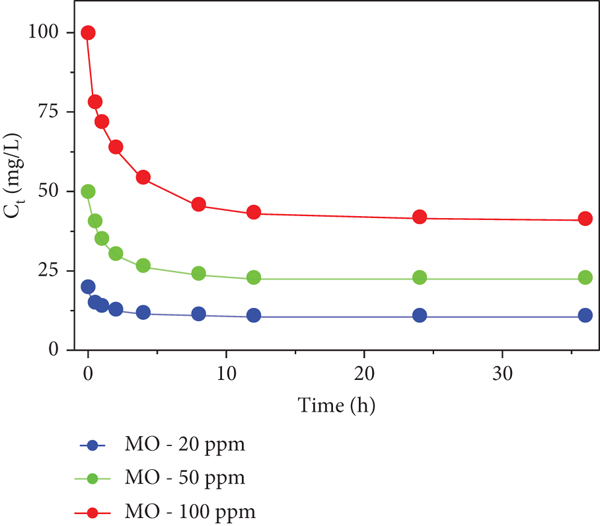
Effect of time on (a, d) MO and CR adsorption, (b, f) pseudo-first-order, (c, g) pseudo-second-order, and (d, h) intraparticle diffusion model fitting of MO and CR (experiment conditions:


The fitting parameters of pseudo-first-order, pseudo-second-order, and intraparticle diffusion model are summarized in Tables 2 and 3. For pseudo-first-order model, the calculated
Kinetic parameters of pseudo-first-order and pseudo-second-order.
Kinetics parameters of intraparticle diffusion model.
The fitting of intraparticle diffusion model is shown in Table 3. The adsorption progress of dyes onto PRM can be divided into three stages; the first stage of fitted MO adsorption lines almost passes the origin while CR adsorption fitted lines could not pass, suggesting that the intraparticle diffusion plays a dominant role in MO adsorption onto PRM (likely the rate-limiting step) [8, 37]. For CR adsorption onto PRM, the adsorption progress could be jointly controlled by external mass transfer and intraparticle diffusion.
3.4. Adsorption Isotherms
The adsorption isotherms of MO and CR onto PRM were conducted using different initial dye concentrations (Figure 5). As well investigated before, the adsorption capacity of CR exceeds the adsorption capacity of MO. With the increase of initial dye concentration, the adsorption capacity of CR rises dramatically while the adsorption capacity of MO reaches plateau related to the saturation of PRM. The adsorption isotherm data fitted by Langmuir, Freundlich, and Temkin isotherm models are tabulated in Figure 6 and Table 4.

Effect of initial MO and CR concentration on PRM adsorption capacity (experiment conditions:


Isotherm fittings of (a) MO adsorption and (b) CR adsorption onto PRM (Langmuir isotherm: dash line, Freundlich isotherm: connecting line, and Temkin isotherm: dotted line) (experiment conditions:

Kinetics parameters of Langmuir, Freundlich, and Temkin models.
Based on the fitted
Detailed adsorption performance of different reported adsorbents.
3.5. Adsorption Thermodynamic
As stated in Section 3.3, the environmental temperature has a pronouncedly favored effect on the adsorption of dyes, and the adsorption progress of dyes onto PRM is accelerated by increased temperature. Thus, the detailed thermodynamic of the adsorption progress is of significance to investigating the adsorption of dyes onto PRM (Figure 7 and Table 7). In all cases, the negative values of
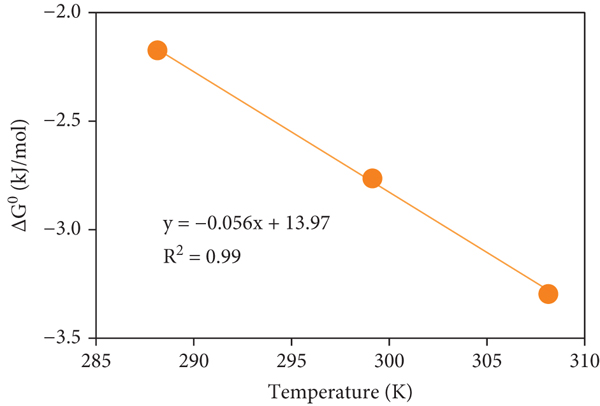
Thermodynamics of (a) MO and (b) CR onto PRM (experiment conditions:

Fitting parameters of thermodynamic model.
3.6. Column Study and Phytotoxicity Assessment
The column study is conducted in this research to further investigate the adsorption performance of both dyes in real applications. Continues treatment of 50 mg/L of MO and CR in a continuous column system is given in Figure 8. The adsorption progress of both dyes follows the same trend although the adsorption saturation time is different. For MO adsorption, the adsorbent column is exhausted at 3500 min, while the adsorption saturation time for CR is more than 6000 min. Specifically, the concentrations of MO effluents increase slowly in the first 2000 min (~180 bed volumes) while a more rapid increase is observed afterwards. In contrast, no evident increase is observed before 4000 min for CR adsorption column (~360 bed volumes), indicating that the CR removal in column study is also better than MO removal which shares the same result from batch studies.

Effectivity of PRM in removing MO and CR in column study.
In order to have quantitative evaluations and thus have solid predictions on the adsorption performance in column studies and future applications, the Thomas model is used and its detailed parameters are summarized [28]. As shown in Table 8, the adsorption rate of the CR is higher than MO in column study which is in accordance with the fitted kinetic parameters in batch studies. In addition, the maximum adsorption capacity for MO and CR is 31.08 and 55.04 mg/g, respectively, and it is not surprising that the adsorption capacity in column studies is considerably lower than in batch studies (~20% of batch studies) [49]. Moreover, the calculated experimental adsorption capacity
Fitting parameters of Thomas model.
The effluents from the column study are used for further toxicity assessment (collected around 2000 min). The germination of bean sprouts is used as the indicator of PRM effectivity for eliminating anionic dyes in terms of aqueous toxicity. In this research, the deionized water is used as control group (no dye) and the influent (50 ppm for MO and CR) and effluent from the column study are used. After germinating the bean sprouts for 3 days under no light condition, the length of the roots is measured and summarized in Figure 9. As shown in Figure 9(a), the mean root length of the control group is 7.06 cm and the length is reduced to 3.30 and 3.01 cm, for MO influents (
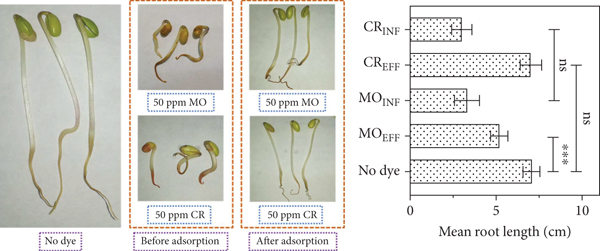
Toxicity assessment of PRM in removing MO and CR using bean sprout seeds (
4. Conclusion
In this study, the adsorption performance of two anionic dyes by a red mud-based adsorbent was investigated. The removal of dyes (CR and MO) from aqueous solution by the red mud-based adsorbent was investigated by batch and column studies. The successful loading of the polypyrrole onto the surface of red mud helps to improve the adsorption capacity of the adsorbent: 194.1 mg/g for MO adsorption and 314.9 mg/g for CR adsorption at 15°C, respectively. The highest adsorption capacity was obtained at pH 4 and decreased with the increase of pH. Thermodynamic results suggested that the adsorption progress of MO and CR onto PRM was endothermic and spontaneous. Phytotoxicity assessment of the column study effluents confirmed the effectivity of PRM in eliminating the dye toxicity in terms of germination of bean sprouts. Therefore, the PRM adsorbent could be applied as a promising adsorbent for decolorization in aqueous solutions.
Footnotes
Data Availability
The data that support the findings of this study are available on request from the corresponding author, Changqing Liu.
Conflicts of Interest
The authors declare that there is no conflict of interest regarding the publication of this paper.
Authors’ Contributions
Conceptualization was done by Ya-nan Luan and Changqing Liu. Data curation was contributed by Feng Zhang, Yue Yin, and Chunlei Qiao. Funding acquisition was contributed by Changqing Liu. Investigation was conducted by Feng Zhang, Yue Yin, Ya-nan Luan, Mengyan Guo, and Yihua Xiao. Methodology was done by Yue Yin. Project administration was done by Changqing Liu. Software was contributed by Chunlei Qiao and Mengyan Guo. Writing—original draft was contributed by Feng Zhang and Yue Yin. Writing—review and editing was contributed by Yihua Xiao and Changqing Liu. Feng Zhang and Yue Yin contributed equally to this work.
Acknowledgments
This study was funded by the Major Science and Technology Innovation Project of Shandong Province (Grant No. 2018YFJH0902) and the Taishan Scholar Foundation of Shandong Province (Grant No. tsqn201909126).