




Abstract
Methane adsorption isotherm experiments on semianthracite (2.00-2.33%
1. Introduction
Different from conventional gas resources, coalbed methane (CBM) belonging to unconventional gas resources is retained in coal reservoirs in three different forms, including adsorbed gas, free gas, and dissolved gas [1–5]. Among that, the adsorbed state is predominant [4–12]. Understanding of adsorption behavior is extremely important in estimating CBM resource and determining CBM productivity [9, 13]. More importantly, during underground coal mining, a deeper understanding of methane adsorption capacity is critical to prevent gas-related problems, such as explosive and outburst hazard [14, 15]. These significances make studies on methane adsorption capacity become one of the most valuable topics [16–18].
Many researches have been performed to investigate factors affecting methane adsorption capacity. In the traditional view, the influencing factors can be divided into two aspects: inherent properties of coal (e.g., coal rank, coal maceral, coal quality, and coal lithotype) and external conditions (e.g., temperature, pressure, burial history, sequence stratigraphy, water occurrence states, and water invasion) [6–8, 13, 19–36]. Additionally, other parameters of coal property, including coal deformation [29], macromolecular structure or crystallite structure characteristics of coal [37, 38], chemical structure of coal organic matters (e.g., aromatic structure, aliphatic structure, and coal surface functional group) [6, 14, 28, 39], and pore structure characteristics (e.g., pore specific surface area, pore volume, pore size distribution, and fractal characteristics) [7, 28, 30, 40–44], also play important roles in methane adsorption capacity. Coal rank is generally considered to be the dominant parameter affecting methane adsorption capacity [12, 45]. Coal samples used in previous studies, however, show wide range of variation in coal rank [25, 39, 46], which may mask the effects of other influencing factors. Therefore, for coals with similar rank, more in-depth analyses are essential to understand influencing factors on methane adsorption capacity and to establish a comprehensive mathematical model of methane adsorption capacity. This paper examines the variation of methane adsorption capacity and its influencing factors of the No. 21 coal in the Xin’an coal mine, Henan Province, China. The two major objectives are to (1) individually analyze the effects of influencing factors in terms of pore structure, coal quality, coal maceral, and coal rank on methane adsorption capacity and (2) comprehensively establish a mathematic model containing the influencing factors of methane adsorption capacity using multivariate statistical analysis. The research result may serve as an important geological basis for the safety production of the unmined area in the coal mine.
2. Experiments and Methods
The study area, the Xin’an coal mine, is located in northwestern Henan Province, China (Figures 1(a) and 1(b)). It spans within a homocline, with NE strike and SE trend. The No. 21 coal within the Lower Permian Shanxi Formation is economically minable. The coal underwent extreme tectonic deformation and is classified as tectonically deformed coal. A total of eleven coal samples were collected from six working faces (Figure 1(c)). One of the samples belongs to the working face 12201, two to the working face 13151, five to the working face 14211, one to the working face 14221, and the remaining two to the working faces 15051 and 15061, respectively. The samples were sieved directly and reduced in size to 2 mm (maximum particle size). Several subsamples of each coal sample were obtained by coning and quartering for proximate analysis, petrographic analysis, low-pressure N2 adsorption analysis, and methane adsorption isotherm experiment.
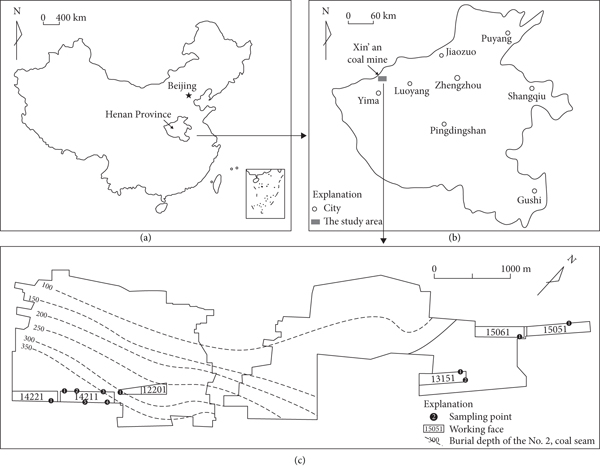
(a) Location of the Henan Province. (b) Location of the Xin’an coal mine. (c) Map showing sampling points, working faces, and burial depth of the No. 21 coal in mining area of the Xin’an coal mine.
Proximate analysis was conducted in accordance with ASTM Standards D3173-11 [47], ASTM Standards D3175-11 [48], and ASTM Standards D3174-11 [49]. The polished samples for petrographic analysis were prepared according to the procedure described in Mardon et al. [50]. Maceral analysis (500 point counts) and mean maximum vitrinite reflectance (
Low-pressure N2 adsorption analysis was performed to obtain pore structure parameters including Brunauer-Emmett-Teller (BET) specific surface area (
Methane adsorption isotherm experiments on coal samples were conducted on an Isotherm Adsorption/Desorption System ISO-200, following Chinese National Standard GB/T 19560-2008 [53]. The coal samples on the air dry basis were sieved into a particle size fraction of 0.18–0.25 mm and moisture equilibrated under the controlled relative humidity (RH) condition using saturated salt solutions of K2SO4 (97% RH) for at least four days. The pretreated moisture-equilibrated samples were put into the sample cell of the ISO-200 for the adsorption isotherm experiment. The experimental temperature and equilibrium pressure were 30°C and up to 8 MPa, respectively. The measured adsorption data were fitted by the Langmuir model [54] to determine the Langmuir constants, i.e., Langmuir volume (
3. Results and Discussion
3.1. Methane Adsorption Capacity
Coal rank of the samples varies in a relatively small range with
Summarized results of petrographic analysis, proximate analysis, pore structure parameters, and Langmuir constants of the No. 21 coal in the Xin’an coal mine.
Notes:
Methane adsorption capacity of different rank coals has been researched in previous publications. For low-rank coal, methane adsorption capacity of coals with 0.34-0.69%
3.2. Influencing Factors of Methane Adsorption Capacity
3.2.1. Pore Structure
The low-pressure N2 adsorption and desorption isotherms of the coal samples are presented in Figures 2(a)–2(c). With the similar trend, these isotherms exhibit the feature of physisorption isotherm type IV with hysteresis loop H3 [60, 61]. The occurrence of hysteresis loop at the relative pressure from 0.45 to 0.995 is considered to be associated with capillary condensation in mesopores [61, 62]. The shape of hysteresis loop is identified with the particular pore structure [63]. The adsorbed nitrogen quantity at the maximum relative pressure varies among coal samples from different working faces, with the maximum value of 7.91 cm3/g at the sample 15051-1 and the minimum value of 2.18 cm3/g at the sample 14211-3. This substantial difference translates into the evident variations in

(a–c) Low-pressure N2 adsorption and desorption isotherms of the No. 21 coal samples from different working faces in the Xin’an coal mine. (d) Pore size distributions obtained from adsorption branches of low-pressure N2 adsorption isotherms.


Pore structure parameters including pore specific surface area and pore volume have significant implications on methane adsorption capacity [7, 12, 20, 34, 44, 55, 64], with distinctly different mechanisms (surface adsorption versus pore volume filling) [65]. Moore [12] and Zhou et al. [44] suggested that pore specific surface area is the most important parameter in determining methane adsorption capacity, whereas Clarkson and Bustin [7] concluded that pore volume is more important. It is of great importance to have a better understanding of their roles in methane adsorption capacity in our study. The scatter plot (Figure 3(a)) displays that there is a significant positive correlation between methane adsorption capacity and

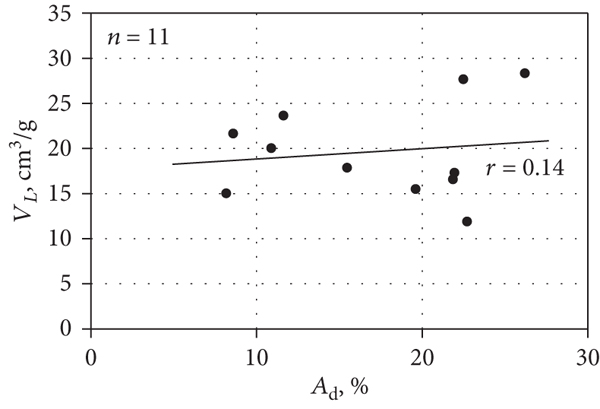
Scatter plots of (a) BET specific surface area, (b) BJH pore volume, (c) moisture content, (d) ash content, (e) inertinite content, and (f) coal rank versus methane adsorption capacity of the No. 21 coal in the Xin’an coal mine.




3.2.2. Coal Quality
Coal quality correlates significantly with methane adsorption capacity [39, 40]. The results of proximate analysis of the samples are listed in Table 1. The No. 21 coal displays low moisture content (0.56-0.98%, 0.72% on average). The scatter plot (Figure 3(c)) shows that methane adsorption capacity has an insignificant negative correlation with moisture content with the
Inorganic matter (as indicated by ash content) plays a critical role in methane adsorption capacity [8, 10, 19, 25, 44, 68, 72–74]. Ash content of studied samples ranges from 8.16% to 26.26% (Table 1), which is classified as special low ash to medium ash coal according to Chinese National Standard GB/T 15224.1-2010 (Ash yield <10% for special low ash coal, 10.01-20% for low ash coal, and 20.01-30% for medium ash coal). There is a positive association between ash content and methane adsorption capacity but the relationship lacks statistical significance (
3.2.3. Coal Maceral
As indicated in Table 1, coal maceral is dominated by vitrinite, followed by inertinite, with no occurrence of liptinite. Vitrinite and inertinite range from 86.65% to 95.10% and from 4.90% to 13.35%, averaging at 92.50% and 7.50%, respectively. Submaceral of vitrinite is mainly telinite and telocollinite, while that of inertinite contains mainly fusinite and some sclerotinite.
The influence of coal maceral on methane adsorption capacity is rank dependent, but with controversies. Laxminarayana and Crosdale [13] indicated that methane adsorption capacity increases with the increasing vitrinite content at high-volatile bituminous coal and decreases at semianthracite and anthracite, whereas methane adsorption capacity is not associated with coal maceral at low-medium-volatile bituminous coal. Liu et al. [26] suggested that methane adsorption capacity of vitrinite is weaker than that of inertinite for low-rank coal, and the opposite is true for high-rank coal. Flores [73] concluded that vitrinite-rich coal is characterized by greater methane adsorption capacity than inertinite-rich coal up to low-volatile bituminous coal. In contrast, Ettinger et al. [76] supported the opposite. But they have the consensus that methane adsorption capacity of coal maceral is similar at higher-rank coal (Ettinger et al. [76]; [73]). Chalmers and Bustin [45] suggested that there is no significant difference in methane adsorption capacity of coal maceral for lower-rank coal, but for higher-rank coal, vitrinite-rich coal has higher methane adsorption capacity. For the high-rank coal in our study, the negative correlation (
3.2.4. Coal Rank
As the most important indicator of metamorphism,
3.3. Mathematic Model of Methane Adsorption Capacity
Methane adsorption capacity is affected by these various factors, and the contributions of the individual variables to methane adsorption capacity may interact and be likely to be incorrect in univariate analysis. It is necessary to develop a computational scheme of methane adsorption capacity affected by the combined individual variables. Quantification theory I belongs to multivariate statistical analysis method, which can associate quantitative and qualitative variables simultaneously. The CBM geological mathematical model software was developed on the basis of quantification theory I and used to relate methane adsorption capacity to the combined effects of the independent variables in our study. The quantitative variables including
The model was checked using ANOVA (i.e., analysis of variance,
The measured values from the experiment and the predicted values from the mathematical model of methane adsorption capacity are listed in Table 2. The deviation of the measured values to the predicted values varies from -1.75 cm3/g to 2.06 cm3/g. The maximum and minimum deviations are belonging to the working face 13151, which is mainly attributed to the relatively high methane adsorption capacity. The relative error varies from 0.08% to 9.31% with the average value of 4.59%. The correlation coefficient between the measured values and the predicted values of methane adsorption capacity is 0.98, as illustrated in Figure 4, indicating there is a good consistency between the mathematical model prediction and the experimental measurement.
Comparison of measured values and calculated values of methane adsorption capacity of the No. 21 coal in the Xin’an coal mine.

Scatter plot of measured versus predicted methane adsorption capacity of the No. 21 coal in the Xin’an coal mine.
3.4. Comparison of Univariate Analysis and Multivariate Analysis
For the univariate analysis expressed by the scatter plots, the correlation coefficients suggest that the contributions of the analytical factors to methane adsorption capacity in a descending order are as follows:
There are similarities and differences between the univariate analysis and the multivariate analysis. The similarities are that
4. Conclusions
Methane adsorption isotherm experiments on semianthracite collected from the Xin’an coal mine, Henan Province, China, were conducted to investigate the effects of pore structure, coal quality, coal maceral, and coal rank on methane adsorption capacity using univariate analysis expressed by the scatter plots and multivariate analysis expressed by the mathematical model. The key conclusions are summarized as follows:
Methane adsorption capacity varies widely from 12.03 cm3/g to 28.40 cm3/g, suggesting a remarkable difference for the coal with similar rank (2.00-2.33% In univariate analysis, methane adsorption capacity has a strong positive correlation with In multivariate analysis, the mathematical model of methane adsorption capacity is established:
SBET has the greatest contribution to methane adsorption capacity, while The mathematic model is more representative in evaluating methane adsorption capacity because it covers the combined effects of the influencing factors
Footnotes
Data Availability
All data generated or analyzed during this study are included in this article.
Conflicts of Interest
The authors declare that there is no conflict of interest.
Acknowledgments
We gratefully acknowledge the financial support from the National Natural Science Foundation of China (grant numbers 41972184 and 41902177) and the research foundation of Jiangxi Provincial Department of Education of China (grant number GJJ190570). We sincerely appreciate the anonymous reviewers and the associate editor for their constructive comments to substantially improve the manuscript.