




Abstract
The separation of ethanol, propanol, and butanol from aqueous solutions was studied using adsorption on bone char. Adsorption kinetics and thermodynamic parameters of this separation method were studied at different conditions of pH and temperature. Results showed that the maximum adsorption capacities of these bioalcohols were obtained at pH 6 and 20°C. An exothermic separation was identified, which can be mainly associated to hydrophobic interactions between bone char surface and bioalcohols. Binary adsorption studies were also performed using mixtures of these bioalcohols. An antagonistic adsorption was observed for all bioalcohols where the ethanol and propanol separation was significantly affected by butanol. A model based on an artificial neural network was proposed to correlate both single and binary adsorption isotherms of these bioalcohols with bone char. It was concluded that the bone char could be an interesting adsorbent for the sustainable separation and recovery of bioalcohols from fermentation broths, which are actually considered emerging liquid biofuels and relevant industrial chemicals.
1. Introduction
The reserves of conventional fuels are depleting due to their excessive exploitation, which is blamed for several environmental problems; furthermore, some concerns have raised in geopolitical security of oil supply [1–3]. Therefore, it is crucial to develop renewable, cost-effective, and alternative sustainable fuels to overcome these challenges.
Biofuels are considered the most environmentally friendly energy source. Liquid biofuels have been studied as a future leading alternative of energy to replace fossil fuels [4]. Production of liquid biofuels includes a variety of approaches (e.g., sugar fermentation, cellulose hydrolysis, biomass pyrolysis and gasification, and oil esterification/transesterification) that differ in terms of their advantages and disadvantages, but all of them undoubtedly have a low environmental impact [4–9]. Therefore, liquid biofuels production can involve several steps where the purification and recovery of final products are relevant factors to compare and select the best process for commercialization and potential applications at industrial level [3].
Bioalcohols C2-C4 can serve as multipurpose chemical feedstocks including their application as alternative liquid biofuels [10]. For example, ethanol is utilized in the manufacture of cosmetics, pharmaceuticals, and alcoholic beverages [11]. Propanol is also an important solvent, an intermediate for the production of several esters and amines and as a precursor for propylene production [12]. On the other hand, butanol is a solvent and extract of drugs and natural substances such as antibiotics, hormones, and vitamins [13]; it is also an important chemical precursor for paints, polymers, and plastics [14].
Fermentation is a cost-effective route to obtain these bioalcohols in the context of biorefineries [15, 16]. However, this process suffers of a limited product yield generating fermentation broths with a final low alcohol concentration (around 1-2%), which constraints the product(s) separation and its operating conditions [13, 17]. Note that the separation costs can be increased if energy-intensive methods are utilized to recover the bioalcohols [18]. Therefore, sustainable, energy-saving, and low-cost technologies are required for the purification of these liquid biofuels. The recovery stage is paramount since separation processes represent the major production costs in biorefineries (about 20–50%) [19]. Distillation is the conventional method employed to separate the components from fermentation broths, but it is energy-intensive with high operating cost and also contributes to CO2 emissions [17]. Furthermore, the separation of ethanol, propanol, and butanol from aqueous solutions is also challenging because the systems
Adsorption is an alternative to recover liquid biofuels obtained from a variety of processing routes. This separation method is an energy-saving and environmentally friendly method in which the adsorbents used as separation medium can be regenerated and reused thus reducing the purification costs and environmental impact [17, 21]. Selective separations, not feasible by other methods, can be performed by adsorption. Moreover, adsorption can also offer additional operational and economic advantages. To develop an effective and reliable adsorption process for biofuels recovery, it is important to identify a suitable adsorbent for the separation of the target compound(s), which will be followed by a comprehensive study of its key properties and the main adsorption parameters from kinetics, equilibrium, and desorption experiments [17]. There are studies reported in the literature covering the application of adsorbents for alcohols separation, and they include resins [22], zeolites [23] and activated carbons [17]. For example, Nielsen et al. [22] analyzed the adsorption of ethanol, iso-propanol, n-propanol, iso-butanol, n-butanol, 2-methyl-1-butanol, 3-methyl-1-butanol, and n-pentanol using six resins as adsorbents. These authors found that the adsorbents with nonpolar structure and high specific surface area achieved the highest alcohol adsorption. It was also demonstrated that the longer chain alcohols were more adsorbed due to their increasingly hydrophobic nature. On the other hand, Xue et al. [21] evaluated the adsorption capacity of nine different adsorbents (i.e., activated carbon Norit ROW 0.8, ion exchange resins Amberlite IRA-900, Amberlite XAD-4, Diaion HP-2MG, Diaion HP-20, Dowex Optipore L-493, Dowex Optipore SD-2, and zeolites CBV901 and CBV28014) for the butanol recovery from aqueous solutions. Activated carbon was the best adsorbent to perform the alcohol adsorption from a fed-batch fermentation thus producing 54.6 g/L of butanol.
Evidently, the bioalcohol recovery could be feasible with a wide variety of adsorbents. However, to the best of the authors’ knowledge, few studies have determined kinetic, equilibrium, and thermodynamic parameters of bioalcohol separation via adsorption at different operating conditions to support a reliable process design. This study reports the adsorption of ethanol, propanol, and butanol from aqueous solutions using bone char as an alternative purification medium. The performance of this bioalcohol separation strategy was evaluated at different pH and temperatures to obtain the main adsorption parameters. Binary separation of these compounds was also studied to determine the impact of coadsorbate on bioalcohol recovery, and an artificial neural network model was proposed to predict both single and binary adsorption isotherms. Therefore, the contribution of the present paper relies on the following: (1) to report new experimental data of bioalcohol adsorption using bone char, (2) to calculate kinetic and thermodynamic parameters for the bioalcohol(s) adsorption, (3) to introduce an alternative adsorption model based on artificial neural network for simulating the binary adsorption isotherms of bioalcohols, and (4) to analyze the corresponding adsorption mechanism involved in the separation and recovery of bioalcohols from aqueous solutions using bone char. Results of this study can be used to develop alternative and non-energy intensive separation processes to recover bioalcohols for their use as biofuels and other industrial applications.
2. Methodology
2.1. Bioalcohol Separation with Bone Char
In this work, the efficiency of a commercial bone char as adsorbent for the recovery of bioalcohol molecules that can be produced during fermentation processes was evaluated. This adsorbent was supplied by the Brazilian company Bonechar Carvao Ativado do Brasil Ltda. Table 1 displays some relevant physicochemical properties of this adsorbent, which were provided by the supplier and verified in previous studies [24]. This adsorbent can be obtained from the pyrolysis or carbonization of bone wastes [25]. Bone char was washed with deionized water, dried at 110°C during 24 h, and sieved to obtain adsorbent particles with a mean size of 0.297-0.42 mm. These adsorbent particles were then utilized in the studies of bioalcohol recovery from the solution.
Physicochemical properties of bone char used for the separation of bioalcohols from aqueous solutions.
Data obtained from Company Bonechar Carvao ativado do Brasil Ltda. and Mendoza-Castillo et al. [24].
The main functional groups of bone char were analyzed, before and after the bioalcohol adsorption, via FTIR spectroscopy with a Thermo Scientific Nicolet iS10 FTIR spectrophotometer. FTIR spectra were recorded in the region 4000 to 400 cm-1 with a resolution of 4 cm-1. Thirty two (32) scans were performed for each sample. Bone char samples were measured as pellets using KBr. Scanning Electron Microscopy (SEM) micrographs of this adsorbent were obtained using a Zeiss DSM 942 SEM equipment where the samples were covered with gold using Denton Vacuum to observe their morphology. Crystalline structure of the adsorbent, prior and after bioalcohol separation, was also studied with an Empyrean X-ray diffractometer (Malvern-PANalytical). Bone char samples obtained from single (one alcohol in the solution) and binary (two alcohols in the solution) adsorption studies were analyzed and the diffraction pattern interpretation was carried out with the HighScore Plus software.
Ethanol, propanol, and butanol (anhydrous reagent grade supplied by J.T. Baker) were employed as model compounds representing the typical bioalcohols obtained from fermentation broths. Bioalcohol solutions were prepared using deionized water, and their pH was adjusted to a desirable value using diluted HNO3 or NaOH solutions. These aqueous solutions were utilized for all adsorption studies.
Adsorption kinetic and equilibrium experiments for the separation of these bioalcohols with bone char were performed in triplicate in batch conditions in continuously agitated 20 mL glass vessels. More precisely, 10 mL of bioalcohol aqueous solution (
Physical properties of the bioalcohols (PubChem) used in adsorption tests.
Bioalcohol(s) concentration in all adsorption studies was determined via gas chromatography using a Thermo Scientific Trace 1300 GC equipped with a flame ionization detector (FID) and a 5% diphenyl-95% dimethylarylenesiloxane TG-5 SILMS column with dimensions of
2.2. Kinetics and Thermodynamic Parameters of Bioalcohol Separation Using Bone Char
Adsorption rates and thermodynamic parameters of the recovery of ethanol, propanol, and butanol via adsorption with bone char were determined. These parameters were obtained from the experimental data analysis and the application of adsorption models. Bioalcohol adsorption rates were estimated with the pseudo-first [28] and pseudo-second order [29] models, Equations (2) and (3), respectively:
Langmuir [30], Freundlich [31], and Sips [32] models, Equations (4)–(6), were employed to calculate the equilibrium parameters of bioalcohol adsorption in single aqueous solutions
Adsorption enthalpy for bioalcohol separation with bone char was estimated via the next equation:
Results of preliminary fittings showed that the Langmuir-, Sips-, Freundlich-, and Redlich-Peterson-based multicomponent isotherm equations failed to correlate the binary bioalcohol adsorption data. Therefore, an artificial neural network (ANN) model was also utilized to correlate the binary adsorption isotherms of ethanol, propanol, and butanol (see Figure 1). This surrogate adsorption model was defined as

Artificial neural network used to model the adsorption of bioalcohols on bone char.
These models were fitted to experimental bioalcohol adsorption data via a nonlinear regression where a least square objective function was minimized with a global stochastic optimization method. Modeling errors and determination coefficients
3. Results and Discussion
3.1. Adsorption Kinetics, Isotherms, and Thermodynamics of Bioalcohol Separation with Bone Char
Figure 2 shows the adsorption kinetics of the three bioalcohols on bone char at different solution pH and initial adsorbate concentrations. Bioalcohol adsorption in these kinetic studies ranged from 0.20 to 7.71 mmol/g for ethanol, 0.27 to 7.85 mmol/g for propanol, and 0.50 to 9.71 mmol/g for butanol, respectively. For all tested operating conditions, the adsorption equilibrium was practically reached at 24 h and the adsorption kinetic profile became asymptotic due to the equilibrium condition between the bioalcohol molecules and adsorbent surface. It was estimated that 82% of the bioalcohol adsorption was achieved during the first 4–6 h of contact time of bone char-bioalcohol solution. This finding indicates that most of the bioalcohol adsorption occurred on the adsorbent external surface. Note that the internal surface area of bone char represents only the 6% of the total adsorbent area (~100 m2/g) and the adsorption kinetic profiles were in concordance with this result [24]. The effect of solution pH on the alcohol adsorption is also reported in Figure 2. It was evident that an increase in solution pH decreased the adsorption capacity for the three bioalcohols. This experimental finding was related to the ionization degree and solubility of tested adsorbates as well as the surface charge of bone char [34].
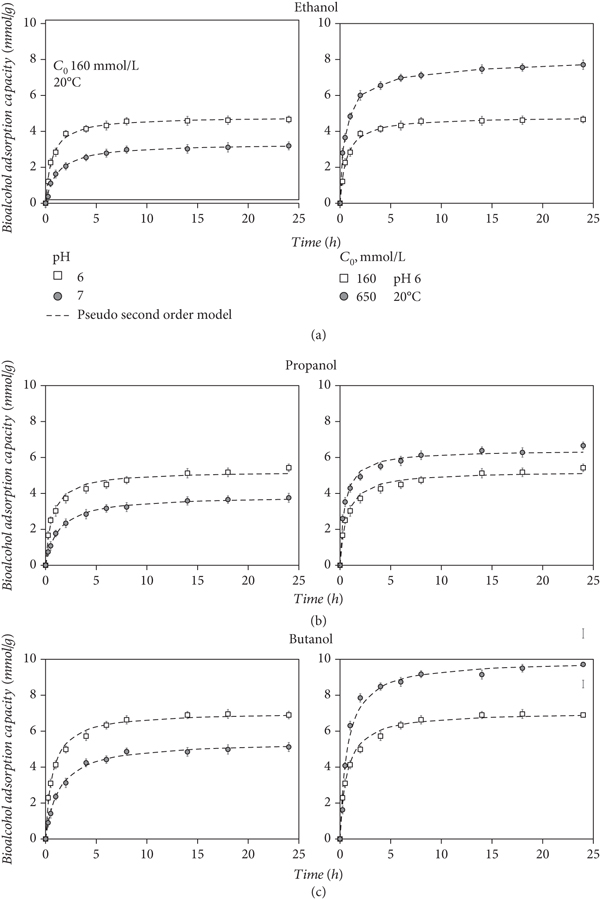
Adsorption kinetics of ethanol, propanol, and butanol from aqueous solutions with bone char as adsorbent at 20°C.
Table 2 shows the pKa values of three bioalcohols, and it was clear that they remained as nonionizable molecules at pH 6-7 tested in the adsorption studies [22]. It is worth mentioning that the adsorbent surface of bone char was positively charged at tested pH conditions due to its pH at the point of zero charge (i.e.,
Therefore, it could be expected that hydrophobic interactions (i.e., van der Waals forces) and hydrogen bond between bone char surface groups and bioalcohols could also take place [22, 26, 35, 36]. Specifically, the strength of the hydrophobic interactions is governed by the hydrophobicity of both the solute and adsorbent. Nielsen et al. [22] stated that hydrophobic interactions can be involved in the separation of organic compounds at pH that is below the pKa of tested solute. Also, hydrogen bonds could be formed by the interaction of protonated functional groups of side chains of the adsorbent with the oxygen of bioalcohol molecules (Lin et al., 2009; [35]; Bouiahya et al., 2019). A similar adsorption mechanism has been observed in the phenol separation with hydroxyapatite nanopowders and composites (Lin et al., 2009; Bouiahya et al., 2019). Note that the increase of pH from 6 to 7 resulted in the surface charge of bone char becoming less positive and, consequently, the impact of electrostatic attraction forces was reduced. Figure 2 also shows that the presence of a high content of adsorbate molecules in the aqueous solution can enhance the mass transfer increasing the bioalcohol recovery by bone char.
Calculated kinetic parameters of bioalcohol adsorption are reported in Table 3. Statistical analysis indicated that the pseudo-second order model was the best to predict the adsorption kinetic profiles for the bioalcohol removal from aqueous solutions via bone char. Determination coefficients
Results of the kinetic modeling of adsorption of ethanol, propanol and butanol on bone char.
Kinetic parameters showed that the adsorption increased at low pH confirming the presence of hydrophobic interactions between bioalcohols and bone char. It was also observed that temperature decreased the adsorption kinetic rates thus indicating an exothermic separation process. Adsorption rate constants

(a) Rate constants and (b) enthalpies for the adsorption of ethanol, propanol, and butanol from aqueous solution with bone char as adsorbent.

Adsorption isotherms of the bioalcohol separation at different pH and temperatures are shown in Figure 4. All isotherms of tested bioalcohols matched to the Langmuir type of Giles’ classification for liquid phase adsorption [37]. Adsorption capacities increased with the initial bioalcohol concentration because of the increased driving force from the concentration gradient at the solid-liquid interphase. This phenomenon reduced the mass transfer resistance in the interphase until reaching the adsorbent saturation at tested operating conditions [38]. Maximum adsorption capacities of bone char were 8.26, 8.94, and 9.92 mmol/g for ethanol, propanol, and butanol, respectively, at pH 6 and 20°C, which were the best adsorption conditions tested for the recovery of these bioalcohols. As stated, the pH of aqueous solution affected the adsorption of three bioalcohols where the adsorption capacities decreased from 8.3 to 15.9%. However, the impact of pH was more pronounced for butanol recovery, which dropped by 15.9% from pH 6 to pH 7 at 20°C, as shown in Figure 4. It is important to remark that standard deviations of all experimental adsorption capacities are reported in Figures 4–6 where ANOVA indicated that the observed differences were statistically significant (i.e.,

Adsorption isotherms of ethanol, propanol, and butanol on bone char in aqueous solutions at different conditions of pH and temperature.
This experimental finding confirmed the results of kinetic experiments and can be attributed to the fact that the global surface charge of bone char was affected by the pH of aqueous solution. It is worth mentioning that low pH favors the alcohol adsorption via hydrophobic forces, especially for long chain molecules [22]. Adsorption isotherms obtained at 20 and 30°C are shown in Figure 4 where an exothermic separation process was identified for all bioalcohols. Adsorption capacities decreased in 8, 10, and 12% for ethanol, propanol, and butanol, respectively, with respect to increments of solution temperature from 20 to 30°C at pH 6. For instance, an exothermic adsorption of butanol has been also reported from 37 to 60°C for different adsorbents like commercial activated carbons, ion exchange resins, and zeolites [21]. Calculated adsorption enthalpies for the separation of the three bioalcohols with bone char ranged from -9.58 to -19.37 kJ/mol, which decreased with partition coefficients where
Results of the equilibrium modeling of adsorption of ethanol, propanol, and butanol on bone char.
A direct relationship was observed between the hydrophobic nature of the bioalcohols and the adsorption capacities of bone char. The partition coefficients (log Kow) in the aqueous solutions were -0.26 for ethanol, 0.25 for propanol, and 0.8 for butanol, as shown in Table 2. It is clear that the more hydrophobic compounds have higher log Kow [22]. In this case, butanol is the most hydrophobic molecule because of its longer carbon chain. Therefore, bone char showed the highest adsorption capacities for butanol, mainly due to hydrophobic interactions. Conversely, the lowest recovery was obtained for ethanol, which was the less hydrophobic bioalcohol employed in this study. These adsorption results also suggested the hydrophobic nature of the adsorbent. Similar adsorption trends have been reported by other authors using hydrophobic polymeric resins [22, 26], hydrophobic BEA-type zeolite membranes [39], and activated carbon [26].
Surface morphology of bone char corresponded to a solid phase with a rough, irregular, and compact structure besides limited pores or cavities, as the SEM images of Figure 5 show. This bone char showed a surface area of ~100 m2/g, which was relatively lower than those reported for other adsorbents like activated carbon. This adsorbent is mainly composed of hydroxyapatite, and consequently, its FTIR spectrum contained the characteristic absorption bands of this component, as shown in Figure 5. Principal FTIR absorption bands were identified at 3430 cm-1 (stretching mode of OH groups), 2920-2850 cm-1 (CH aliphatic groups), 1630 cm-1 (C=C of aromatic rings from oxygenated groups), 1450-1385 cm-1 (CO3 group vibrations), 1040 cm-1 (asymmetric stretching vibration of PO4 group), and 604-465 cm-1 (P-O vibration of PO4 group) [25, 40–43]. The intensity of some bands changed in the FTIR spectrum of bone char after bioalcohol adsorption (see Figure 5). Specifically, the intensity of phosphate group at 1040 cm-1 decreased thus indicating its possible participation in bioalcohol adsorption [44]. On the other hand, the absorption bands of hydroxyl (~3430 cm-1) and aliphatic (2920-2850 cm-1) groups broadened, increased, and slightly displaced. These changes were more evident with the increase of chain length of the alcohol adsorbed on bone char surface. The chemical structure of the bioalcohols contains an aliphatic phase and one hydroxyl group that contributed to the changes observed in FTIR spectra. X-ray diffraction results of Figure 5 also showed that the crystalline phase in all analyzed samples corresponded to the crystal planes of calcium phosphate hydroxide (ICDD-PDF2 card: 00-009-0432). However, the diffraction pattern of raw sample contained sharper peaks than the bioalcohol loaded samples thus indicating that the crystallinity decreased as the number of adsorbates on the adsorbent surface increased. It is important to highlight that several studies on alcohol recovery by adsorption concluded that hydrophobic interactions were involved in the adsorption mechanism where these interactions strengthened with the increase of carbon chain length [22]; [26]. Additionally, the hydrogen bonds between –OH of alcohols and protonated functional groups of adsorbent surface can also contribute to alcohol adsorption on bone char [35].

(a) SEM image, (b) X-ray diffraction, and (c) FTIR spectra of bone char used for the recovery of bioalcohols from aqueous solutions.
3.2. Binary Bioalcohol Adsorption with Bone Char
Figure 6 shows the adsorption isotherms obtained for the separation of tested bioalcohols using binary solutions. Overall, an antagonistic adsorption was identified for all tested binary solutions where the presence of the alcohol 2 reduced the recovery of alcohol 1. The maximum adsorption capacities were 0.49–6.52 mmol/g for ethanol, 1.72–6.31 mmol/g for propanol, and 5.19–8.53 mmol/g for butanol in binary solutions with different coadsorbate concentrations. This implied reductions from 13 to 94% with respect to the adsorption capacities determined in the single bioalcohol solutions. The impact of coadsorbate on bioalcohol adsorption was more significant for ethanol and propanol than that obtained for butanol, especially at a high concentration of alcohol 2 in the binary aqueous solution. The multicomponent bioalcohol adsorption followed the next trend:

Binary adsorption isotherms of ethanol, propanol, and butanol on bone char in aqueous solutions at pH 6 and 20°C and its modeling with an artificial neural network.
On the other hand, the degree of antagonistic adsorption was analyzed via the ratio of the adsorption capacities from single and binary bioalcohols solutions

Comparison of competitive adsorption of ethanol, propanol, and butanol on bone char in aqueous binary alcohol solutions at pH 6 and 20°C.
With respect to the surface interactions in these multicomponent adsorption tests, Figure 5 also shows the FTIR spectra of bone char samples obtained from binary adsorption studies. It was confirmed that there were an increase, enlargement, and displacement of the absorption band intensity of hydroxyl and aliphatic groups and a reduction and displacement of the phosphate group for adsorbent samples obtained from these separation experiments. However, these changes were less significant than those observed in the adsorbent samples from single bioalcohol adsorption. This result was associated with the less amount of alcohol adsorbed due to the antagonistic effect of the coadsorbate in binary solutions.
Finally, Figure 6 displays the performance of ANNs to model the binary adsorption isotherms. ANN models with different hidden neurons were tested to correlate the bioalcohol adsorption isotherms. This surrogate model provided a satisfactory fitting of experimental data with determination coefficients
Parameters of ANN models to predict the adsorption of bioalcohols on bone char.
3.3. Comparison of Bone Char and Other Adsorbents for Bioalcohol Separation and Some Desorption Alternatives
Table 6 provides an overview of butanol, propanol and ethanol adsorption capacities of different adsorbents reported in the literature [17, 21, 22, 45, 46, 50–53]. It is worth noting that results reported in this table corresponded to a wide spectrum of operating conditions where broth media, high temperatures (e.g., ~37°C), and aqueous solutions with the presence of other compounds like acetone, acetic acid, and butyric acid have been employed in adsorption studies. These adsorption capacities are illustrative of the performance of adsorbents used for the recovery of bioalcohols, and consequently, they can be employed as a reference point for results reported in this paper. Bioalcohol adsorption capacities of bone char were higher than those obtained in single and multicomponent experiments with other adsorbents reported in the literature. In single solutions, the adsorption capacity of bone char was higher by 145 and 280% than those obtained for butanol and ethanol recovery with activated carbon F-400 [46], 53% for butanol adsorption on Norit activated carbon [21], and 63 and 246% for butanol and ethanol adsorption, respectively, with resin amberlite XAD-7 [48]. For multicomponent bioalcohol adsorption, this bone char also showed higher adsorption capacities than those reported using activated carbon F-400 [45], Norit activated carbon [21], resin amberlite XAD-7 [27, 48], and granulated activated carbon [26]. These results indicated that bone char could be an alternative adsorbent to perform the recovery of bioalcohols from fermentation broths.
Adsorption capacities of different adsorbents reported for the separation of bioalcohols.
Preliminary bioalcohol desorption experiments were performed via liquid extraction (using water, acetone, and ethyl acetate) with different ratios of solvent and bone char loaded with bioalcohols. Also, a thermal desorption process was tested at different temperatures. Results indicated that the single liquid extraction with these solvents was not effective to desorb these bioalcohols from the bone char surface, while the thermal treatment was a promising strategy to perform this recovery stage. For instance, a butanol desorption of ~70% was obtained at 150°C. These preliminary findings were consistent with results of previous studies [21, 27, 36]. Levario et al. [36] reported the desorption of ethanol and butanol adsorbed on synthetic mesoporous carbons via thermal treatment at 170°C, and they found no loss of adsorption performance after alcohol desorption. Xue et al. [21] also demonstrated the complete recovery of butanol by desorption from Norit ROW 0.8 activated carbon using a thermal desorption at 250°C. Raganati et al. [27] tested the thermal desorption of butanol loaded on resin amberlite XAD-7 at 140°C achieving the complete recovery of butanol. However, a detailed study of this thermal desorption is required to identify the best conditions to recover these bioalcohols from bone char maximizing the adsorption-desorption cycles and to optimize its corresponding separation/recovery costs.
4. Conclusions
The recovery of ethanol, propanol, and butanol from aqueous solutions via adsorption on bone char was analyzed at different operation conditions. Bioalcohol adsorption was affected by both pH and temperature of aqueous solution where the maximum adsorption was achieved at pH 6 and 20°C. The adsorption capacities of bone char were
Footnotes
Data Availability
Data of this paper are available on request to the corresponding author.
Conflicts of Interest
The authors declared no potential conflicts of interest with respect to the research, authorship, and/or publication of this article.
Acknowledgments
The authors acknowledge the funding received from the European Union’s Horizon 2020 research and innovation programme under the Marie Sklodowska-Curie grant agreement No. 778168.