




Abstract
In this study, a simple chemical modification was applied to a sustainable and abundantly available resource, kangkong root (KR), to remove methyl violet 2B (MV) dye. The chemically modified adsorbent (NaOH-KR) was obtained using NaOH solution treatment. Batch adsorption experiments were carried out to investigate the effects of pH, ionic strength, contact time, adsorbent dosage, and initial dye concentration. A regeneration experiment was also carried out to assess the potential of reusability. The adsorption process was modelled using various kinetics and isotherm models, whereby the best-fitting models were evaluated by using the coefficient of determination (
1. Introduction
Pollution is the contamination of the natural ecosystem and environment either derived from human activities (e.g., transportation, agriculture, disposal of industrial wastes, and energy generation) or natural disasters (e.g., volcanic eruption and flooding) [1–4]. The population of the world is increasing at an alarming rate, with an estimated rise of more than 5 billion within the last century [5]. With the increase of the human population, the demand for potable water increases as well [6]. Because of the rise in human activities, there is a continuous discharge of industrial and agricultural wastes, which contain many pollutants, including synthetic dyes, pesticides, and heavy metals, into the natural world and simultaneously give rise to environmental pollution [7].
In recent years, there is increased research in various methods of wastewater remediation to tackle the wastewater pollution problem [8]. Among these methods, adsorption remains the most preferred method to solve wastewater problems and is also effective in the removal of wastewater containing synthetic dyes and heavy metals [9]. It is simple to conduct and requires no sophisticated skill. Compared to other wastewater treatment methods, adsorption is relatively inexpensive since the selection of readily available low-cost raw materials as adsorbents can be used. Research in recent years has shown that various natural biomass adsorbents such as leaves [9, 10], agroindustrial wastes such as breadfruit peels, and spent soya bean pulp [11, 12], as well as synthetic adsorbents such as chemically modified dextran and magnetic nanoparticles [13–15], were found effective for treating wastewater. Despite the many reports available, the search for better, stable, more economical, and effective adsorbents is still of importance and in great demand.
Ipomoea aquatica (water spinach), belonging to the Convolvulaceae or bindweed family, is used as a popular vegetable culinary in Southeast Asian countries. Locally known as kangkong, it can be cultivated both on land and in shallow water. However, wild kangkong is found growing in shallow swamps, ditches, and fields due to its invasive nature. Kangkong is high in antioxidants [16], minerals (such as potassium and iron), fiber, and vitamin A [17]. Normally, the green leaves and tender parts of the vegetable are used in cooking, whereas the stem and root are thrown away as waste. In China [18] and Malaysia [19], kangkong has been successfully utilized in improving the quality of aquaculture wastewater. The plant also exhibits an ability to bioaccumulate contaminants such as antibiotics [20] and heavy metals such as lead [21] and chromium [22] but also to remove cadmium [23]. Phytoextraction of cadmium was achieved with the roots and stems [24] of kangkong. The use of kangkong as an adsorbent for wastewater remediation has been previously reported but mainly involved the use of its stem. The stems have also been used as an adsorbent to adsorb Auramine O [25] and methyl violet 2B (MV) [26] dyes and thermally treated to produce activated carbon which is useful for removing cationic dyes [27]. Moreover, the leaves were used for removing manganese [21], while the roots and stems were used for removing cadmium [23].
To date, the adsorption studies involving kangkong roots (KR) remain scarce, and limited literature showed the success of unmodified KR in removing Auramine O [28] and MV [25] dyes from an aqueous solution.
MV, a triphenylmethane cationic dye of intense colour, is also known as basic violet 1 dye. Even though the powdered form of MV dye is dark green in colour, it dissolves in water to give a solution of intense violet colour. These days, MV dye is widely used in textile, printing, inks, toners, leather, plastic, and rubber industries [29]. Besides these, MV can also be used as a biological stain and a moderate-class disinfectant. However, this dye is harmful to human health. MV has carcinogenic and mutagenic properties and is also a known irritant that can affect the eyes, skin, and gastrointestinal and respiratory tract [29]. MV also hinders the growth of microorganisms and prevents photosynthesis reactions from taking place in aquatic plants and animals in the environment [30].
The main aim of this study focuses on the use of KR, which has been subjected to chemical modification with NaOH, to adsorb MV dye from an aqueous solution. The objectives of this study include investigating various parameters (contact time, pH, initial dye concentration, and ionic strength) that affect the adsorption of MV dye. The characterisation of the adsorbent includes surface morphology and functional group analyses. The effect of temperature and regeneration experiments were also carried out.
2. Materials and Methods
2.1. Adsorbent Preparation
The kangkong plants were purchased from the local supermarket. Thereafter, the roots were harvested, washed under running water to remove dirt, and lastly washed with distilled water. The washed KR was oven-dried at 65°C. The dried KR was ground into powder using a household kitchen blender. Dried KR powder (50.0 g) was placed in a 2000 mL beaker and mixed with 1 M NaOH (1000 mL) solution and stirred using a magnetic stirrer at room temperature for 2 hours. After stirring, the NaOH-modified KR (NaOH-KR) was washed repeatedly with distilled water until the pH of the washed solution is near neutral. Lastly, the washed NaOH-KR was dried in an oven at 65°C to a constant mass and stored in a desiccator.
2.2. Chemicals and Reagents
Methyl violet 2B (MV) dye (C24H28N3Cl, dye purity 75%, 393.95 g mol-1, Biological Stain Commission certified) was obtained from Sigma-Aldrich. Hydrochloric acid (HCl, Auburn USA), sodium hydroxide (NaOH, Auburn USA), potassium nitrate (KNO3, Merck KGaA Germany), and sodium chloride (NaCl, GPR USA) are all analytical reagent grade. A stock solution of MV dye (1000 mg L-1) was prepared, and other concentrations were obtained by further dilution. Spectroscopy grade potassium bromide (KBr) crystals were used for the FTIR spectroscopy analysis and were dried in an oven at 100°C prior to use. Entire experiments were performed in duplicate unless otherwise stated.
2.3. Experimental Methodology
The batch adsorption experiments were carried out using adsorbent-adsorbate in the ratio of 1.0 g of sample : 500 mL of 100 mg L-1 dye solution, unless otherwise stated. Apart from that, all experiments were carried out in duplicates and were agitated at 250 rpm at room temperature, except for thermodynamics studies where temperatures of 298 K, 313 K, 323 K, 333 K, and 343 K were used.
Determination of the contact time required was performed by analyzing the filtrate from the adsorbent-adsorbate mixtures at every 30-minute interval until equilibrium is reached. All subsequent experiments, except for kinetics, were carried out using the obtained contact time. Investigations of the pH and ionic strength effects on the adsorption of MV were performed with the pH ranging from 2 to 10, including the untreated (ambient) pH, and NaCl (0–1.0 mol L-1) was used as the salt for studying the effect of the ionic strength. All experiments were carried out in duplicate.
The adsorption capacity,
2.4. Error Function
The adsorption process is characterized using various kinetics and isotherm models, whereby the linear variant of the models that best fitted with the experimental data is usually determined using the coefficient of determination (
2.5. Instrumentation
The concentrations of MV were determined using the Shimadzu UV-1601 PC spectrophotometer (UV-vis), at
3. Results and Discussion
3.1. Effect of Contact Time on MV Dye Removal
NaOH-KR adsorption equilibrium toward MV was achieved within 60 minutes (Figure 1), which was much faster than the untreated KR and other reported adsorbents such as N-benzyltriazole derivatized dextran [13] and modified Ceiba pentandra sawdust [31] with a reported contact time of 120 and 90 minutes, respectively, while longer equilibrium time for maleic anhydride-modified cellulose fibers/diatomite (200 minutes) [32].

The effect of contact time on the removal of MV via NaOH-KR (
3.2. Kinetics Studies
The kinetics data were modelled with the pseudo-first-order [33], pseudo-second-order [34], and Elovich [35] models. These models have been widely reviewed [36–38], and their linear and nonlinear equations are listed in Table S2. The suitability of the best fit model for the adsorption kinetics was evaluated based on the following criteria, namely, the model with the highest

The linear plots of (a) pseudo-first-order, (b) pseudo-second-order, and (c) Elovich models and (d) comparison of kinetics simulation plots for the experimental data (black diamond), Elovich (blue square), pseudo-first-order (green triangle), and pseudo-second-order (red circle) models (mass of

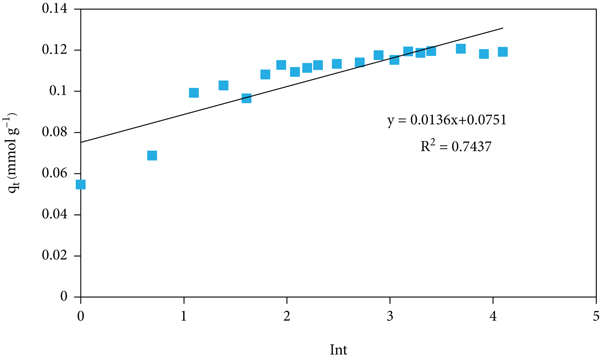

Comparison of the pseudo-first-order, pseudo-second-order, and Elovich models and their error values of linear analyses.
Furthermore, as observed in Figure 3, the Weber-Morris plot displayed multilinearity behavior. The first linear region indicates the intraparticle diffusion, while the second linear region indicates the slow equilibrium phase [30]. As the intercept of the first linear region of the Weber-Morris plot is not zero, this suggests that intraparticle diffusion is not the rate-controlling step.
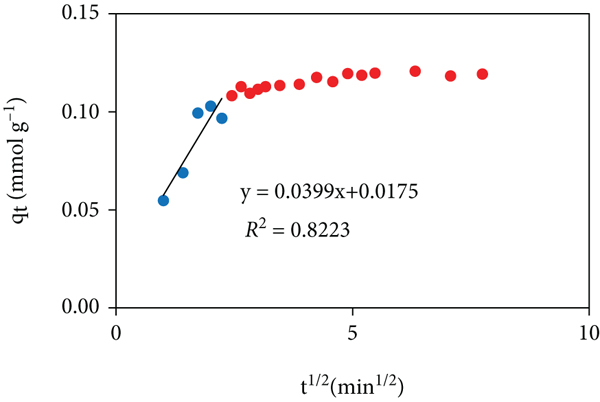
The linear plot of the Weber-Morris intraparticle diffusion model of MV adsorption (mass of
3.3. Adsorption Isotherm
A batch adsorption isotherm study was performed, and the data obtained were analyzed using five isotherm models, namely, Langmuir [39], Freundlich [40], Temkin [41], Redlich-Peterson [42], and Sips [43]. Their equations are as shown in Table S3. These models have been widely reviewed [38, 44]. All experiment isotherm data points to the Sips model being the best fit model to describe the adsorption of MV onto the based treated adsorbent. Based on the results obtained from Table 2, the Redlich-Peterson model has the lowest
Adsorption isotherm models and their parameters.

Simulation plots of Langmuir (blue line), Freundlich (green line), Temkin (black line), R-P (purple line), and Sips (yellow line) compared with the experimental data (black circle) obtained (mass of
Compared to stems, the KR exhibits better affinity toward MV dye, as shown in Table 3. KR also shows much higher
Comparison of the
3.4. Effect of pH on MV Removal and Point of Zero Charge (pHpzc) of NaOH-KR
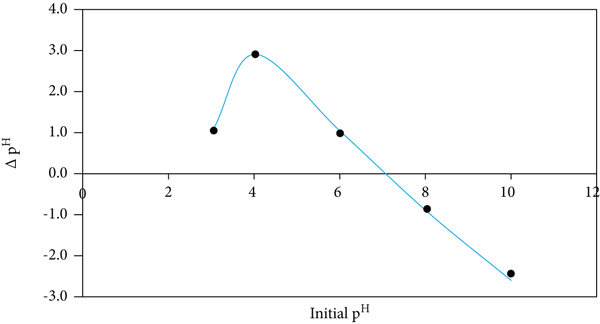
Except at strongly acidic pH, NaOH-KR exhibited stability under varying pH conditions and was able to maintain ~90% dye adsorption, as shown in Figure 5(a). The point of zero charge (pHPZC) of NaOH-KR was determined to be at pH 7.1, as shown in Figure 5(b). Except at a strongly acidic medium of pH 2, NaOH-KR was uninfluenced by pH and was still able to remove almost 90% MV when

(a) The effect of pH on adsorption of MV and (b) Determination of pHPZC of NaOH-KR (mass of
3.5. Effect of Ionic Strength on the Adsorption of MV by NaOH-KR
Generally, an increase in salt concentration will increase the ionic strength since the salt concentration is directly proportional to the ionic strength. This can affect an adsorbent’s ability to remove an adsorbate [61]. As most of the contaminated water usually contains various chemicals, including salts in different amounts, it is therefore crucial to study how ionic strength affects the adsorption process. NaOH-KR showed similar behavior to the untreated KR [25] and Ipomoea aquatica stems [26], where an increase in ionic strength caused a decrease in the adsorption of MV dye. Herein, approximately 34% reduction was observed at 1.0 M NaCl concentration
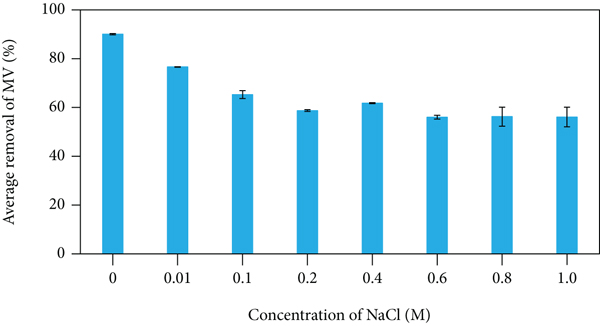
The effect of ionic strength of NaOH-KR for the removal of MV dye (mass of
The accumulation of Na+ ions on the adsorbent’s surface could lead to an increase in net positive charge and cause electrostatic repulsion of the cationic dye molecules because of the enhancement of hydrophobic-hydrophobic interaction [62]. Hence, there is an observed decrease in the dye removal at higher salt concentrations. Zhang et al. reported that chemical modification could enhance the dispersion properties of an adsorbent by increasing the interaction of adsorbent-adsorbate in the system as well as the adsorption capacity [61]. Furthermore, at high ionic strength, it was mentioned that surface modification could prevent the inherent aggregation of the adsorbent [61]. The ability of NaOH-KR to maintain almost 60% dye removal at 1.0 M NaCl is still an attractive feature since the stability of an adsorbent in varying ionic strength is also one of the criteria required for an adsorbent to be used in real-life applications of wastewater.
3.6. Regeneration Studies of NaOH-KR
An adsorbent not only needs to have a high adsorption capacity toward adsorbates, but it must also have the ability to be regenerated and reused. This is because the spent adsorbent, if not being regenerated, needs to be stabilized before disposal into the natural environment as it can lead to fire hazards and loss of potential resources and will release the adsorbed pollutants. Aside from that, if the spent adsorbent can be reused, then it can help lower the operating cost of wastewater treatment plants as well as reduce environmental pollution impact. Not all adsorbents can be regenerated and reused. For example, extracted pectin from durian rind reported about 70% reduction toward La3+ ions up to the fourth adsorption-desorption cycle [63].
Desorption can be achieved using acid, base, or distilled water which altered the equilibrium of the adsorption process, allowing the adsorbates to move back into the aqueous solution [64]. Herein, a reduction of 36% of MV dye was observed for the control of the spent adsorbent NaOH-KR, but base washing maintained the removal of ~96% MV throughout the five cycles (Figure 7). Thus, the above results confirmed that the modified adsorbent was able to be successfully regenerated and reused while maintaining excellent removal of MV even after five consecutive cycles. This is another attractive feature for its potential application in wastewater treatment since an adsorbent that can be regenerated and reused continuously will be beneficial in terms of financial viability.

Regeneration studies of NaOH-KR spent on adsorption of MV for 5 consecutive cycles with acid (pink bar), base (purple bar), water (yellow bar), and control experiment (blue bar) (mass of
3.7. Characterization of NaOH-KR
Upon modification, there was a distinct change to the surface morphology of the adsorbent, as illustrated in Figure 8. The untreated KR contained stripes with a relatively flat surface, which contrasts with the irregular and rough surface of NaOH-KR. This is possibly due to the strip off the waxes and fats on the adsorbent’s surface when treated with NaOH, thereby exposing the underlying adsorption sites of the adsorbent [46]. However, after the dye adsorption, there was no noticeable change on the surface of NaOH-KR.

SEM surface morphology of untreated KR, unused NaOH-KR, and NaOH-KR after adsorption of MV, at 1,000x magnification.
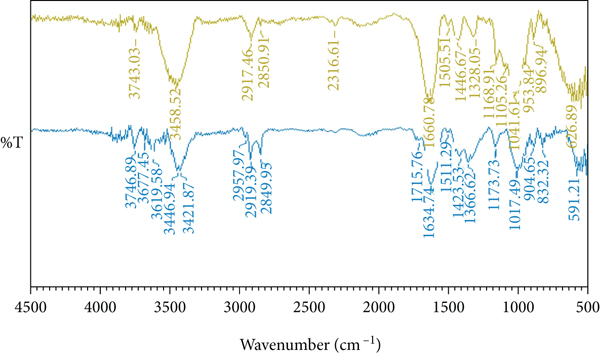
Upon base treatment of KR, as shown in Figure 9(a), a very prominent change was observed at 3421 cm-1 where the broad hydroxyl (-OH) group was shifted to 3459 cm-1. Furthermore, C-H stretch and C=C stretch at 2906 cm-1 and 1647 cm-1 were shifted to 2917 cm-1 and 1661 cm-1, respectively. When NaOH-KR was treated with MV dye, as shown in Figure 9(b), the peaks for O-H, C-H, and C=C were observed to be shifted, indicating their possible involvement in the adsorption process.

FT-IR spectra to compare (a) KR (blue) vs. NaOH-KR (Purple) and (b) NaOH-KR before (yellow) and after MV adsorption (blue).
4. Conclusion
Unlike many synthetic or modified adsorbents, which require complicated experimental procedures and conditions, herein, NaOH modification is a very straightforward and simple method which only requires stirring the adsorbent in a base at room temperature. This simple chemical modification of KR using 1.0 M NaOH was able to successfully enhance the adsorption capacity toward MV dye by more than 55% over nonmodified KR. The adsorption equilibrium was achieved within 60 min and the pseudo-second-order and Sips models best represent the adsorption process. The effect of ionic strength experiment shows that there is an enhancement of hydrophobic-hydrophobic interaction. The regeneration experiment also demonstrated a high removal rate after five consecutive cycles. With the high adsorption capacity of NaOH-KR, its stability under varying pH and salt conditions and its regeneration and reusability properties pave the way for its possible application in wastewater treatment.
Footnotes
Data Availability
The datasets generated during and/or analyzed during the current study are available in the Mendeley Data repository: Lu, YieChen; Kooh, Muhammad Raziq Rahimi; Lim, Linda Biaw Leng; Priyantha, Namal (2021), “Effective and Simple NaOH-Modification Method to Remove Methyl Violet Dye via Ipomoea aquatica Roots”, Mendeley Data, V1, doi: .
.
Conflicts of Interest
The authors declare that there is no conflict of interest regarding the publication of this article.
Acknowledgments
We, the authors, would like to thank the Government of Brunei Darussalam and the Universiti Brunei Darussalam (UBD) for their continuous support.