




Abstract
The present research was investigated to eliminate the cationic dye (malachite green (MG)) from the water environment using coal-associated soil. The adsorbent material was characterized using scanning electron microscopy (SEM) and Fourier Transform Infrared Spectrophotometer (FTIR) analyses. Batch experiments were performed to investigate the different factors which affect the adsorption study. The maximum percentage removal of MG dye was attained as follows: adsorbent dose of 1.0 g/L (0.2 to 1.6 g/L), solution pH of 6.0 (2.0 to 9.0), temperature of 30°C (30 to 60°C), time contact of 60min (10 to 90 min), and dye’s concentration of 25 mg/L (25 to 150 mg/L). The adsorption isotherm was studied with four different isotherm models and results showed that the Freundlich isotherm model gave the best fit than the other nonlinear models to designate the isotherm behaviours with
1. Introduction
In the current era, water scarcity is one of the environmental issues prevailing in the world. With an expanding population, industrialization, and less availability of freshwater resources, the demand for clean water has increased worldwide [1, 2]. Availability of clean water is required for both industrial purposes and household activities. Release of industrial effluents and prolonged excessive use of fertilizers and pesticides in agricultural fields causes deterioration in the water quality resulting in water contamination or pollution [3, 4]. In most industries, without proper treatment, effluents are discharged into water resources. Industrial effluents can be remediated to remove hazardous chemicals which can further be utilized for industrial or other activities [5–7]. Hence, wastewater treatment has gained significant attention in recent years. Dyes are one such chemical occurring in industrial discharges [8–10]. The occurrence of lesser concentrations of toxic dyes in water has a consequential impact on the environment. Dyes are mostly discharged from textile, food, pharmaceutical, paper, printing, leather, and cosmetic industries [11–13]. Of these, textile industries contribute to most of the dye pollution. Owing to the inefficacy of dye molecules for complete attachment onto fabrics, the majority of the dyes are released into the environment [14–16]. Dye effluents discharged from industries have received remarkable attention owing to the effects caused by it. A large number of hazardous chemicals are present in dye effluents expelled from industries. These chemicals pollute water and cause harmful effects on the aquatic environment [17–19]. Human health is also affected by these harmful chemicals. The release of toxic amines due to the decomposition of dyes can cause serious health impacts on animals and humans. Besides, the process of photosynthesis is also influenced by dye color, preventing the penetration of light. Environmental health is also deteriorated by the occurrence of dye molecules [20–23].
Various types of synthetic dyes are produced and employed for industrial purposes annually. MG dye is such an organic cationic basic dye. MG dye is widely employed in the textile, leather, and paper industries. Other applications of MG dye include usage as fungicide and parasiticide in aquaculture field, food additive or food coloring agent, and as an anthelminthic [24, 25]. However, several studies are reporting the hazardous and toxic effects of MG dye. The strong metal ions chelating tendency of MG dyes increases its toxicity towards aquatic organisms. Plant roots absorb water along with the dye molecules presents it which affects the metabolic process of the plants. Untreated MG dye molecules could enter and accumulate in the food chain causing teratological, mutagenic, and carcinogenic threats to mammalian cells. Other health effects include the liver, spleen, heart damage, skin lesions, and reduction in fertility rates, food intake, and growth. Despite this, they also act as a tumor promoter in liver cells by reducing leucomalachite green, increasing its persistence, and inducing apoptosis and tumor. Thus, there is prime importance in the removal or treatment of MG dye effluent due to its toxic impacts on the ecosystem [26–28].
Flocculation, coagulation, ultrasonication, rhizoremediation, membrane filtration, precipitation, adsorption, electrochemical oxidation, ozonation, reverse osmosis, and phytoremediation are some of the familiar techniques used for the elimination of dyes [29–31]. However, some of the negative aspects such as high operation cost, generation of byproducts, and poor removal of the complex organic structure have paved the way for researchers to shift their attention towards an adsorption process of wastewater treatment [32, 33]. A nonreactive, equilibrium process that involves in particle accumulation at the two-phase interface is known as adsorption [34]. Being cost-effective, simple operation, and highly efficient, adsorption strategy is widely used for the elimination of toxic dyes from the contaminated environment [35–37]. Also, the performance of adsorptive separation improves with the characteristics of the adsorbent [38]. Properties such as functional group, surface area, nontoxicity, reusability, and cost of the adsorbent are of paramount importance in the dye expulsion from industrial effluents [39, 40]. Different adsorbents exploited for MG dye adsorption include nylon microplastics [41], almond gum [42], litchi peel biochar [43], calcium alginate nanoparticles [44], Avenasativa hull [45], brewer’s spent grain [46], nanocomposites [47], and clayey soil [48]. In some cases, the expensiveness of activated carbon prepared from various materials limits its usage in the dye removal process. Hence, few studies have been carried out with soil as an adsorbent, for example, surface soils [49] and Laterite soil [50]. Coal-associated soil usually comprises few mineral-carrying oxides such as silicon dioxide (SiO2), manganese dioxide (MnO2), and aluminium oxide (Al2O3). These oxides have active sites and carbon present in the coal has mesoporous components which have the efficacy to adsorb dye molecules from industrial or aqueous effluents. Along with the mineral oxides, a sufficient quantity of carbon is also present in the coal-associated soil [51]. The advantages of using coal-associated soil involve the effective physical properties and characteristic features of the pore structure improvement mechanism. It also enhances mass transfer operation which is observed between the adsorbate and the adsorbents.
The present study focuses on utilizing coal-associated soil as adsorbents for MG dye removal from synthetic solutions. The characterization studies such as FTIR and SEM analysis were performed to analyze the surface property of adsorbent material. Batch adsorption study of different parameters—concentration of adsorbate, equilibrium time, best adsorption pH, temperature, and coal-associated soil dosage—was carried out to optimize the variables. Four distinct isothermal adsorption models and three different kinetic models were examined to extract information regarding the adsorption mechanism and kinetic rate of MG dye onto coal-associated soil. The thermodynamic analysis was studied to predict the nature of the adsorption process (exothermic or endothermic).
2. Experimental
2.1. Adsorbate
Malachite Green (MG) dye, 0.1 M HCL, and 0.1 N NaOH were purchased from E Merck (India) Pvt. Ltd. MG dye standard solution was arranged by liquefying 1 g of MG dye in 1 L of refined water. Dilution of the standard solution with distilled water was carried out to acquire requisite concentrations of dye solution (25 mg/L to 150 mg/L). Adjustment of pH solution was made by using 0.1 Molar HCl/0.1 Molar NaOH. The concentration of dye in the solution (before and after adsorption) was determined by ultraviolet-visible spectroscopy.
2.2. Adsorbent Preparation and Characterization
Coal-associated soil was collected from the Mannargudi coalfield, Tamil Nadu, India. To eliminate dust particles, the soil was rinsed with water and allowed for drying at room temperature. The dried soil samples were sieved through a mesh sieve to acquire the desired adsorbent for the MG dye removal. The qualitative analysis of coal-associated soil before and after adsorption was performed using FTIR and SEM analysis.
2.3. Batch Experimental Studies
A batch study was performed to investigate the factors affecting variables. Studies were conducted in an Erlenmeyer flask of 250 mL capacity comprising desired adsorbent measure with a notable concentration of MG dye solution. For a known contact time, the solution mixture was left to undergo agitation in a temperature-controlled shaking incubator. After definite time interims, centrifugation was carried out to separate adsorbate and soil adsorbent. The final concentration of MG dye was deliberated using ultraviolet-visible spectroscopy. MG removal was examined using the following equation.
2.4. Thermodynamic Analysis
Thermodynamic studies were carried out by carrying out the adsorption process at different temperatures (303 K to 333 K) in an incubation shaker. At a prearranged phase interims, samples were centrifuged and the remaining concentration of dye in the solution was analyzed using ultraviolet-visible spectroscopy. Thermodynamic parameters were evaluated using the following equation.
2.5. Study of Adsorption Isotherm and Kinetics
Adsorption isotherm studies were executed at different adsorbate concentrations (25 mg/L to 150 mg/L) by defining other experimental variables as constant. The equilibrium adsorption capacity of the coal-associated soil was assessed by the following formula.
Kinetic studies were performed by agitating flasks comprising different concentrations of dye solutions (25 mg/L to 150 mg/L) and the required amount of adsorbent at different time intervals (10 min to 90 min). At a prearranged time, the samples were introverted, centrifuged, and analyzed in ultraviolet-visible spectroscopy. Removal of MG dye onto coal-associated soil at distinct time interims is evaluated by the following equation.
3. Results and Discussion
3.1. Adsorbent Characterization-SEM and FTIR
The surface structure and porous nature of the adsorbent were studied using SEM analysis. Figures 1(a) and 1(b) depict the SEM analysis of coal-associated soil before and after the adsorption of MG dye. Rough permeable structure with higher craters can be perceived in SEM analysis of coal-associated soil before adsorption in Figure 1(a). It also illustrates the presence of increased surface area with irregular and interconnected pores for the efficient adsorption of MG dye molecules. Figure 1(b) displays the formation of the agglomerate after the adsorption of MG dye. Thus, the disappeared pores with a smooth surface and agglomerates confirm the MG dye adsorption onto coal-associated soil.

(a) SEM analysis of coal-associated soil (before adsorption). (b) SEM analysis of coal-associated soil (after adsorption).

FTIR analysis of coal-associated soil before and after adsorption of MG dye was analyzed. Peaks at 3400.63 cm-1 and 3420.95 cm-1 indicate the occurrence of NH-stretching and hydrogen-bonded OH groups. Before adsorption, an intense peak at 2848.85 cm-1 confirms C-H stretching in alkanes. The occurrence of other functional groups such as aromatic ring stretching, aliphatic fluoro compounds, and aliphatic and aromatic phosphate compounds is established by the absorption mounts at 1613.90 cm-1, 1114.42 cm-1, 1009.91 cm-1, and 910.99 cm-1. The sharp intense peak at 1032.58 cm-1 relates to the silicone group and primary amine (C-N) broadening [52]. From the FTIR analysis of coal-associated soil before adsorption, it can be inferred that alcohol and amine groups could form covalent bond-forming a matrix structure facilitating the removal of MG dye molecules. Broad absorption peaks 1419.81 cm-1 and 1123.94 cm-1 in after adsorption denotes the vinyl C-H group, organic sulfates, and sulfate ions. Peaks at 1525.52 cm-1 and 1061.52 cm-1 signifies the N-O asymmetric stretching in nitro compounds and aliphatic amines. This result after adsorption confirms the coal-associated soil has greater adsorption capability.
3.2. Impact of Coal-Associated Soil Dose
The effect of coal-associated soil dose on MG dye removal was deliberated by changing the dosage (0.2 to 1.6 g/L) and keeping other factors constant. Figure 2 displays the influence of adsorbent dose on the removal of MG dye molecules. The graph reveals that the adsorbate removal improves with the upsurge in the dosage of soil adsorbent up to 1 g/L. The availability of more locates on the soil surface is the cause for the enhanced removal. With advanced raise in adsorbent dose, MG dye removal persisted constantly due to low driving force and saturation of active sites on the surface of the soil adsorbent [52]. An optimum amount of coal-associated soil for the adsorption of MG dye was found to be 1 g/L.

Impact of the adsorbent dosage on the adsorption of MG dye onto coal-associated soil.
3.3. Impact of Temperature
Batch adsorption studies were performed at diverse temperatures (303, 313, 323, and 333 K) and different dye concentrations (25–150 mg/L). Figure 3(a) shows the effect of temperature on the adsorption of MG dye onto coal-associated soil. It can be perceived from Figure 3(a) that MG dye removal declined with raise in temperature due to the weak adsorptive forces between MG dye molecules and adsorbent surface resulted in reduced removal of MG dye from the synthetic solution. This indicates that adsorption was exothermic and the optimal temperature for the MG dye removal was experimental to be 30°C.

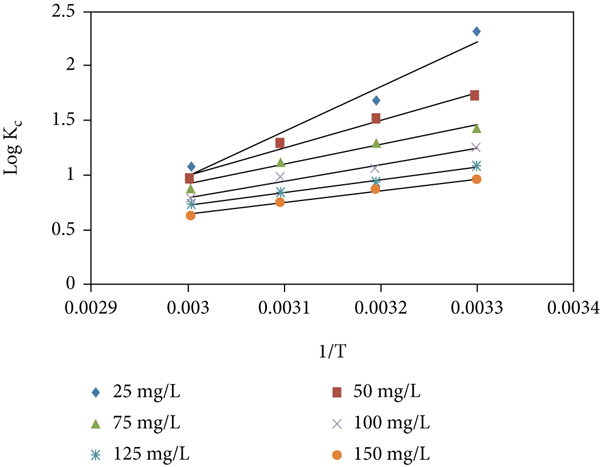
(a) Impact of temperature for the elimination of MG dye onto coal-associated soil. (b) Thermodynamic analysis for the removal of MG dye on coal-associated soil.
3.4. Thermodynamic Analysis
The thermodynamic investigation was studied to understand the randomness, spontaneity, and exothermic or endothermic nature of MG dye adsorption onto coal-associated soil. Figure 3(b) demonstrates the graph of log
Thermodynamic factors for the elimination of MG dye on coal-associated soil.
3.5. Impact of pH
Batch adsorption experimentations were performed with diverse solution pH varying from 2.0 to 9.0 by fixing other factors constant. Figure 4 depicts the impact of pH for the MG dye removal onto coal-associated soil. It revealed that the adsorption of MG dye was augmented with a pH value of 2.0 to 6.0. Due to electrostatic repulsion at the acidic conditions, slow removal was observed. Ionization of carboxyl functional groups might have resulted in a sudden enhancement in dye removal percentage. The maximal removal was observed at pH 6.0. Owing to deprotonation of amine groups beyond the pH value of 6.0, equilibrium adsorption condition is attained and the removal gradually decreases. Thus, the optimal pH for the adsorption onto coal-associated soil was identified to be pH 6.0.
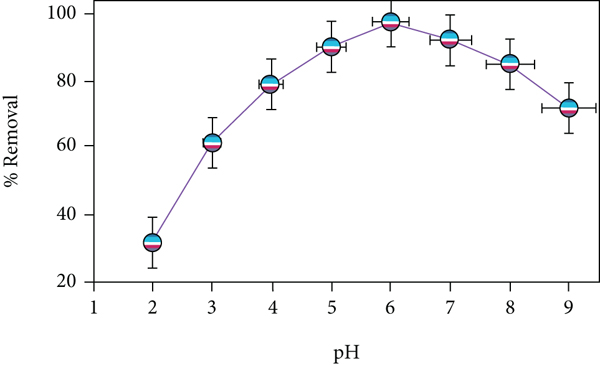
Impact of pH for the elimination of MG dye onto coal-associated soil.
3.6. Impact of Interactive Time
A batch study was performed with varying interactive time intervals of 10 min to 90 min. Figure 5(a) displays the impact of interactive time studies. Due to high dynamic locates on the surface of coal-associated soil, enhanced interaction of MG dye molecules was detected at the initial stage of adsorption which is revealed from Figure 5(a). As time proceeds, attainment of equilibrium of active sites resulted in reduced removal of MG dye molecules. Moreover, as the contact time increases, dye molecules aggregate making it unfeasible for diffusion. Thus, the higher percentage removal of MG dye onto coal-associated soil was observed with the contact time of 60 min.

(a) Impact of interactive time for the elimination of MG dye on coal-associated soil. (b) Adsorption kinetic modeling study for the elimination of MG dye on coal-associated soil.

3.7. Adsorption Kinetic Study
In the real-time application, sorption kinetics plays a crucial role in describing the rate-controlling steps, mechanism, and mass transfer. The data from the interactive study were fitted using three adsorption kinetic models (pseudofirst-order kinetics, pseudosecond-order kinetics, and Elovich kinetics). The following mathematical relationships were employed to represent the adsorption kinetic models.
Pseudofirst order [54]:
Pseudosecond order [55]:
Elovich kinetic [56]:
From the plot of adsorption kinetic data
Adsorption kinetic factors for the elimination of MG dye on coal-associated soil.
3.8. Impact of Adsorbate Concentration
The impact of the initial concentration of MG dye in the current adsorption system is portrayed in Figure 6(a). Studies were performed with diverse adsorbate concentrations (25, 20, 75, 100, 125, 150 mg/L) with an adsorbent dosage of 1 g/L and pH of 6.0. From Figure 6(a), it can be observed that adsorption of MG dye declines with raise in adsorbate concentration. The reason behind this is at a low concentration of dye, soil adsorbent has adequate active sites on its surface facilitating its adsorption. But at high concentrations, the adsorbent surface is deficient in free active sites resulting in reduced dye removal [40]. The maximum removal of MG dye was perceived at 25 mg/L.
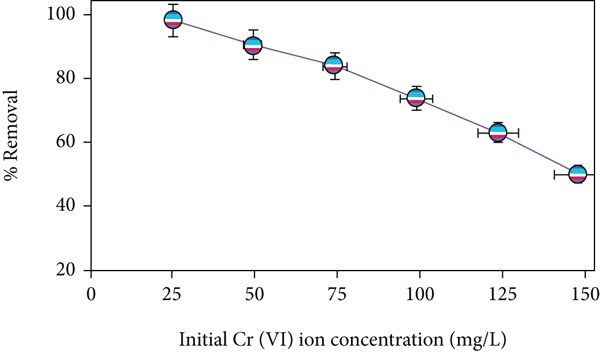
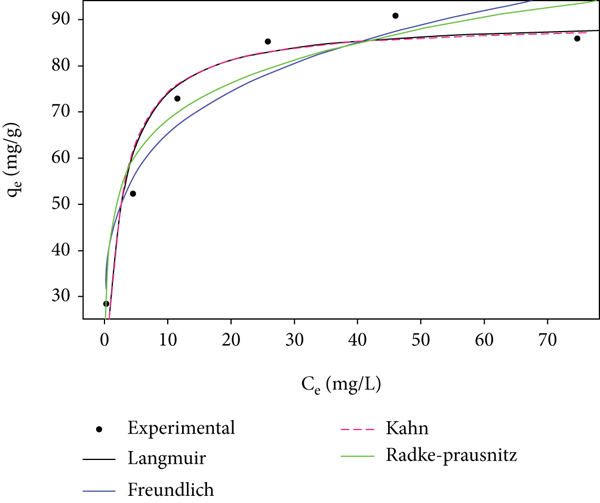
(a) Impact of dye’s initial concentration on the adsorption of MG dye onto coal-associated soil. (b) Adsorption isothermal study for the elimination of MG dye on coal-associated soil.
3.9. Adsorption Isotherm Study
The isothermal study helps to recognize the adsorption mechanism of the interface between MG dye and coal-associated soil [57]. In the present analysis, Langmuir, Freundlich, Kahn, and Radke-Prausniiz model has been employed to examine the MG dye adsorption onto coal-associated soil. Figure 6(b) displays the isothermal study of MG dye adsorption onto coal-associated soil and the data were listed in Table 3.
Adsorption isotherm factors for MG dye adsorption onto coal-associated soil.
3.9.1. Langmuir Isotherm
Theoretically, Langmuir adsorption isotherm is based on a few assumptions—maximal adsorption, while the adsorbent surface is occupied with saturated monolayer solute molecules, absence of adsorbate migration at the surface plane. Nonlinear Langmuir isotherm is expressed as follows [58]:
3.9.2. Freundlich Isotherm
Freundlich isotherm model applies to heterogeneous exteriors. It also suggests that with the completion of active centers on the adsorbent surface, an exponential decrease in adsorption energy can be noticed. Freundlich isotherm equation is represented as follows [59]:
3.9.3. Kahn Isotherm
Temperature independence of adsorption potential is signified by the Kahn isotherm model. It implies that the dependence of the adsorption process on adsorbent and adsorbate nature. Kahn isotherm equation is given as follows [60]:
3.9.4. Radke-Prausnitz Isotherm
For a wide range of adsorbent concentrations, Radke-Prausnitz isotherm is identified to be more suitable. Radke-Prausnitz isotherm equation can be described as follows [61]:
Monolayer adsorption capacity of different adsorbents for the elimination of MG dye.
4. Conclusion
Coal-associated soil used in the study is abundantly, freely available and is anticipated to be economical for the exclusion of MG dye. The qualitative analysis such as SEM and FTIR was performed for the coal-associated soil adsorbent, and the results corroborated the presence of adequate characteristics such as cavities, pores, and essential functional groups for MG dye removal from polluted water. The different essential parameters for MG dye removal were optimized via batch adsorption study as adsorbent dosage—1.0 g/L, temperature—30°C, pH—6.0, interactive time—60 min, and initial MG dye concentration—25 mg/L. Freundlich isotherm suited well with the experimental results explaining the multilayer adsorption of MG dye onto coal-associated soil. The maximum adsorption capacity of coal-associated soil was found to be 89.97 mg/g. In terms of kinetics, pseudofirst order was the best fitting model revealing the physical nature of the MG dye adsorption process. The exothermic, feasible, and spontaneous nature of the adsorption process was confirmed from the thermodynamic results. Therefore, the present study infers the potentiality of coal-associated soil as a desirable and economically feasible adsorbent for the removal of toxic dyes from the wastewater.
Footnotes
Data Availability
Data available on request from the authors.
Conflicts of Interest
The authors declare that they have no conflicts of interest.