




Abstract
Hedyotis umbellate activated carbon (HUAC) was prepared by chemical and thermal activation. The adsorption behavior of Hedyotis umbellate activated carbon in aqueous basic green 4 (BG4) and acid fuchsin (AF) was investigated and characterized by UV-vis, FTIR, and FESEM. The possible mechanism of the adsorption of BG4 and AF dyes on the HUAC surface was framed. The influence of various adsorption control parameters like the initial dye concentration, pH, adsorbent dose, contact time, and temperature was studied. The data confirmed excellent BG4 removal of 97.94% at pH 10 and AF removal of 76.7% at pH 4. The experimental data were fitted using Langmuir, Freundlich, and Temkin isotherms to examine the adsorption mechanism. The adsorption data revealed monolayer adsorption of BG4 with the maximum capacity of 102.38 mg/g and multilayer adsorption of AF with the capacity of 139.33 mg/g. The kinetic data for different initial dye concentrations were computed using pseudofirst order, pseudosecond order, and intraparticle diffusion models. Thermodynamic parameters like Gibbs free energy change
1. Introduction
The wastewater generated from industries contains heavy loads of colored effluents that are highly ecotoxic to aquatic organisms due to synthetic dyes and coloring pigments. Synthetic dyes are used in textiles, paper, printing, plastics, tanneries, cosmetics, pharmaceuticals, food, color photography, and petroleum. These dyes have a stable, symmetric, and complex aromatic structure that make them nondegradable. Their presence causes adverse impacts to aquatic environment. Basic green 4 is a direct dye used for silk, cotton, wool, jute, leather, and paper and in aquaculture as a parasiticide. However, the consumption of the dye causes carcinogenesis, mutagenesis, and chromosomal fractures [1]. Acid fuchsin or acid violet 19 is used for staining procedures, as a corrosion inhibiting substance for copper, in organic-inorganic hybrid nanocomposites preparation, and as a laboratory reagent. It is also used in selective inhibition of human immunodeficiency virus type 1 (HIV-1) and type 2 (HIV-2) in vitro [2]. Exposure of skin to acid fuchsin causes redness and itching, ingestion causes irritation and burning sensations of mouth and throat, nausea, vomiting, and abdominal pain, and inhalation causes irritation of mucous membranes, coughing, wheezing, and shortness of breath [3].
Though many conventional techniques are reported for wastewater treatment such as coagulation, precipitation, sedimentation, filtration, and color irradiation, the technical and economical disadvantages have resulted in using biosorption method that has been found to be efficient and cost-effective. The use of activated biosorbent not only serves to control pollution but also reduces agricultural waste generation. Various agricultural waste biomaterials were used for biosorption process such as rambutan seed [4], spent tea leaves [5], carob [6], Elaeagnus stone [7], pomelo peels [8], rice husk [9], sugar beet pulp [10], and malted sorghum mash [11]. The remarkable adsorption characteristics of activated carbon are that it contains small, low-volume pores that increase the surface area available for adsorption or chemical reactions. Hedyotis umbellate (Rubiaceae family), also known as Oldenlandia umbellate, is a low-growing tree native to India. Its leaves are used for the treatment of asthma, bronchitis, and catarrhal bronchitis [12], whereas its bark is abandoned as agricultural waste. In the present work, Hedyotis umbellate bark is rich in glycosides, and cheap and abundantly available agricultural waste is chemically activated and used to carry out adsorption of aqueous basic green 4 (BG4) and acid fuchsin (AF). The isotherm, kinetic, and thermodynamic analyses were done to determine the feasibility of using this material as a cost-effective and efficient adsorbent.
2. Materials and Methods
2.1. Preparation of Adsorbent and Adsorbate
The dried bark of Hedyotis umbellate was subjected to chemical activation with 50% by volume of sulphuric acid on constant stirring for 12 hours at room temperature [13]. The charred product was separated from the acid and soaked in 10% sodium bicarbonate to remove the residual acid from its pores. It is then heated in a vacuum at 500°C for 2 hours and cooled, crushed, and sieved using 75-micron sieve. Basic green 4 (C.I – 42000) and acid fuchsin were purchased from Loba Chemie Ltd. India and used to prepare adsorbate solutions. The stock solution of the dyes of 1000 ppm was prepared using double distilled water.
3. Experimental
A series of dye solutions were prepared by adjusting the pH over a range of 3–10 using 0.1 N HCl and 0.1 N NaOH solutions to evaluate the role of pH on adsorption of BG4 and AF dyes onto HUAC. The experiment was carried out using 50 ml of the aqueous BG4 and AF dyes at concentrations varying between 10-100 mgL-1. It was treated with 0.03 g of HUAC and shaken in bench top incubator cum orbital shaker at a constant speed of 100 rpm for a time period of 75 mins. Residual dye concentration was recorded using a double beam UV/vis spectrophotometer (Model: Analytik/Jena, Germany) at 617 nm for BG4 and 543 nm for AF for which the molecular structure is shown in Figure 1.

Molecular structure of (a) basic green 4 dye and (b) acid fuchsin.

The equilibrium amount of dye adsorbed on HUAC was calculated by equation 1, and the removal efficiency of the dye in percentage was calculated by equation 2 as listed in Table 1.
Equations of adsorption functions.
3.1. Adsorption Isotherms
The adsorbate-adsorbent interaction at equilibrium was found by fitting the experimental data in Langmuir, Freundlich, and Temkin equations 3, 4, and 5, respectively, as summarized in Table 1.
3.2. Kinetic Studies
The equations 7, 8, and 9 shown in Table 1 were used to examine the reaction kinetics for a specific contact time,
3.3. Thermodynamic Studies
The thermodynamic nature of adsorption of BG4 and AF onto HUAC was studied using Gibbs and Van’t Hoff equations 10 and 11 as given in Table 1.
3.4. Characterization of HUAC
The physical characteristics of HUAC such as pH, moisture content, ash content, bulk density, solubility in water, and acids were examined.
The pH of 1% adsorbent suspension was determined by standard test method. 1.0 g of HUAC was taken with 100 ml of double-distilled water and stirred for 1 hr. The pH of the suspension was recorded using a pH meter. Initially weighed HUAC sample was heated in electric hot air oven at 105-110°C for 1 hr and cooled in dessicator. From the weight loss, the moisture content of HUAC was calculated. HUAC sample was heated to 750°C in a muffle furnace for 30 minutes, and the weight of ash formed was used to calculate the percentage of ash content. 1 g of HUAC was treated with 25 ml of dilute hydrochloric acid and boiled for 5 min. The filtrate was evaporated to dryness at 100-105°C, and the solubility in acid was calculated.
FTIR analysis was carried out using the Bruker-ALPHA II model. FTIR spectrum of HUAC before and after the adsorption of BG4 and AF dye was obtained in the range of 4000–400 cm−1 and examined to confirm the adsorption of dyes by HUAC.
The surface morphology of HUAC was characterized by field emission scanning electron microscopy (FESEM) using the Zeiss Sigma model.
4. Results and Discussion
4.1. Characterization of the Adsorbent
From Table 2, the pH of HUAC shows that its surface is neutral to the reactivity of dyes. The low percentage of moisture and ash depicts the predominance of the percentage of carbon in HUAC for more adsorption. The lower value of bulk density indicates less compactness and more porous nature of HUAC. The solubility in water and acid values indicates its suitability with aqueous acid and basic dyes.
Characteristics of activated carbon.
From the FTIR spectra of HUAC, HUAC-BG4, and HUAC-AF as displayed in Figures 2(a)–2(c), respectively, it is observed that there is a peak shift in Figures 2(b) and 2(c) due to the presence of relative functional groups of BG4 and AF dyes indicating adsorption onto HUAC [14]. The FTIR spectrum of HUAC indicates peaks at 3747 and 2925 cm-1 that ascribe to hydrogen bridges [15] and -CH- asymmetric stretching of -CH3 group, respectively. The peak between 1750-1600 cm-1 indicates C=O stretching, two sharp peaks in the range of 1550-1500 cm-1 correspond to –C=C- stretching, and a broadband at 1157 cm-1 corresponds to C-H out-of-plane wagging [16]. The FTIR spectrum of HUAC-BG4 in Figure 2(b) shows sharp peaks between 3900 and 3600 cm-1 due to O-H bonding (H2O). The peaks at 2983 and 2897 cm-1 are of O-H stretching of carboxylic acid and –C-H- stretching, respectively [17]. The bands located at 1523 cm-1 and 779 cm-1 attribute to –N-H bending and –N-H rocking, respectively, and a sharp band at 1064 cm-1 confirmed the absorption of C-N3 stretching. The FTIR spectrum of HUAC-AF in Figure 2(c) has medium peaks in the range 3800-3600 cm-1 that belongs to O-H stretching. Two strong and sharp peaks at 2971 cm-1 and 1059 cm-1 are attributed by –C-H aromatic stretching and sulfoxide groups of AF dye, respectively. Medium peaks at 1550 cm-1 and 1248 cm-1 correspond to C=N [18] and C-N stretching of aromatic primary amines, respectively.

FT-IR spectrum of (a) HUAC, (b) HUAC-BG4, and (c) HUAC-AF.
The surface morphologies of HUAC, BG4 loaded HUAC, and AF loaded HUAC were investigated using FESEM micrographs. Figure 3(a) shows the FESEM photograph of sulphuric acid-activated HUAC that possess large pores with wide cavities needed for the adsorption purpose and amenable for the binding of relative functional groups of the dyes. Figure 3(b) represents the FESEM photograph of BG4 loaded HUAC that exhibits a rough surface in which the pores are closed with the dye deposits, and Figure 3(c) displays the FESEM photograph of AF loaded HUAC that shows the heterogeneous aggregation of the dye.

SEM micrograph of (a) HUAC, (b) BG4 loaded HUAC, and (c) AF loaded HUAC.


The UV-vis spectrum of BG4 and AF solutions before and after adsorption was recorded to have more information on the adsorption of both the dyes and is shown in Figures 4(i) and 4(ii), respectively. An intense absorption peak for BG4 is found at 615 nm in Figure 4(i) (a), and the intensity of the peak decreases quickly after maximum adsorption of the dye as seen in Figure 4(i) (b). The removal of AF dye from the solution is also clearly shown in Figure 4(ii). The UV-vis spectrum of AF dye in Figure 4(ii) (a) has a large peak at 543 nm. This peak is not found in the spectrum (b) that depicts the maximum adsorption of AF dye by HUAC.
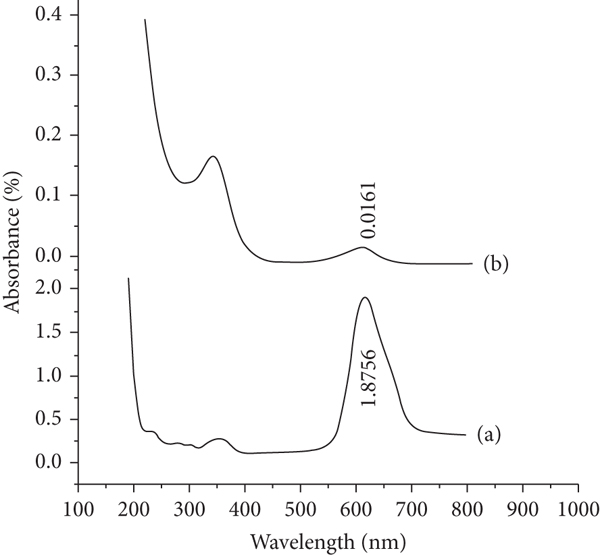
(i) UV-vis spectrum of BG4 dye and (ii) AF dye before and after adsorption.

4.2. Effect of pH on Dye Removal
The pH of the solution influences the surface behavior of the adsorbent and ionization characteristics of the adsorbate. From the experimental data, it is found that the removal efficiency of BG4 dye has increased with pH as shown in Figure 5. However, maximum adsorption of 79.76 mg/g of BG4 was observed at pH 10 (97.94%) which is comparatively better than the use of HCl pretreated clay and MnFe2O4 clay composite in the removal of methyl green that reported maximum adsorption of 44 mg/g at pH 8 [19]. Low pH produces protonation on the HUAC surface creating a cationic environment which strongly repels the positive part of the dye [20]. However, as pH increases, the number of OH groups increases on the surface of HUAC that attracts the quaternary ammonium group of the dye by hydrogen bonds as shown by the mechanism in Figure 6. This results in high BG4 dye diffusion onto HUAC. Very low pH attributes to the instability of the dye. Unlike BG4, AF exhibits good adherence to HUAC at lower pH (76.7% removal at pH 4). This may be due to the fact that at lower pH the protonic clouds on the HUAC surface attract the sulphonic acid group of AF thus accounting for more adsorption as displayed in Figure 6 [21]. The plot shows a decrease in AF uptake beyond pH 4. This may be due to an increase in negative charge density at higher pH thus repelling the dye ions and decreasing the rate of adsorption.

Effect of pH on the dye removal efficiency of HUAC.

Proposed mechanism for adsorption of BG4 and AF dyes on HUAC.
4.3. Effect of Adsorbent Dose on Dye Removal
The addition of adsorbent to the aqueous solution of the dyes revealed that dye removal efficiency improved on increasing the doses of adsorbent. Figure 7 indicates the maximum removal of BG4 of about 97.94% for 0.1 g of HUAC dose and maximum removal of AF of 76.6% for 0.03 g of HUAC dose and becomes steady further. It may be due to the increase in surface area with more number of binding sites on HUAC for dye uptake with an increase in the adsorbent dose [22]. A steady-state was found beyond the saturation point due to an equilibrium established between dye molecules on the adsorbent and within the solution [4].

Effect of adsorbent dose on dye removal efficiency of HUAC.
4.4. Effect of Initial Dye Concentration and Agitation Time
Figure 8 shows an increase in the amount of dye adsorbed with increase in initial concentration of aqueous BG4 upto 50 ppm (79.76 mg/g) and falls beyond. The adsorption of AF onto HUAC finds a gradual rise with increase in initial concentration of aqueous AF upto 100 ppm (91.08 mg/g). This depicts that there is a better interaction between dye ions and the binding sites of HUAC at lower dye concentration [23].

Effect of initial dye concentration on dye efficiency removal efficiency of HUMG.
The influence of agitation time on the removal efficiency of the dyes was examined in the range of 30–120 min. Figure 9 indicates an increase in removal efficiency of BG4 and AF with time. The plot shows 98% and 76.2% of BG4 and AF removal at 90 minutes and 120 minutes, respectively, that implies fast diffusion of the dye into the voids of the adsorbent. Diffusion continues with time of contact until equilibrium is reached between the dye concentration within the adsorbent and the solution beyond which there is no significant dye removal. This behavior may be due to the presence of exhausted sites in the adsorbent that repel the incoming ions [24].

Effect of contact time on the dye removal of HUAC.
4.5. Isotherm Studies
The study on adsorption isotherm is very important in describing the adsorption characteristics for a solid-liquid adsorption system [25]. Figure 10 gives the Langmuir plot (Ce vs. Ce/qe) for BG4 and AF adsorption and isotherm constants
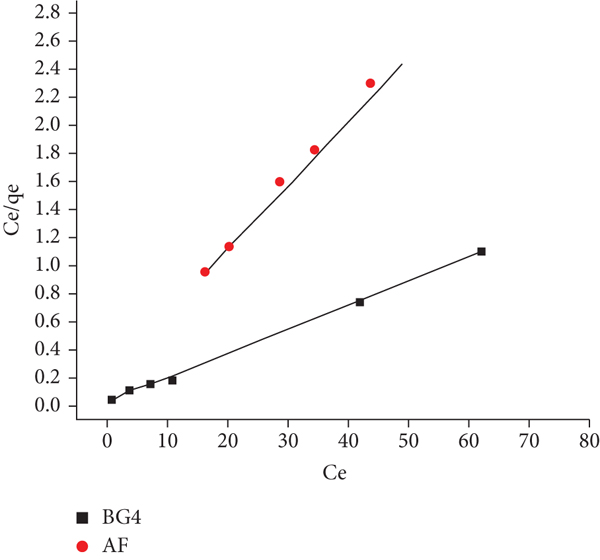
Langmuir plot of BG4 and AF adsorption onto HUAC.
Freundlich isotherm describes heterogeneity and multilayer adsorption process. Figure 11 shows the Freundlich plot (

Freundlich plot of BG4 and AF adsorption onto HUAC.

Temkin plot for adsorption of basic green 4 dye onto HUAC.
Adsorption isotherm parameters.
4.6. Kinetic Studies
Kinetic models such as pseudofirst order, pseudosecond order, and intraparticle diffusion models were used to interpret the experimented data [13]. The plot (

Pseudofirst order model of AF and BG4 adsorption onto HUAC.
Adsorption kinetic parameters.

Pseudosecond order model for BG4 and AF adsorption onto HUAC.
The intraparticle diffusion mechanism ascribes to the travelling of dye molecules from the bulk of the solution to the solid adsorbent. This mechanism can be understood from the plot (

Intraparticle diffusion model for adsorption of basic green 4 dye onto HUAC.
4.7. Thermodynamic Studies
The values of
Thermodynamic parameters.
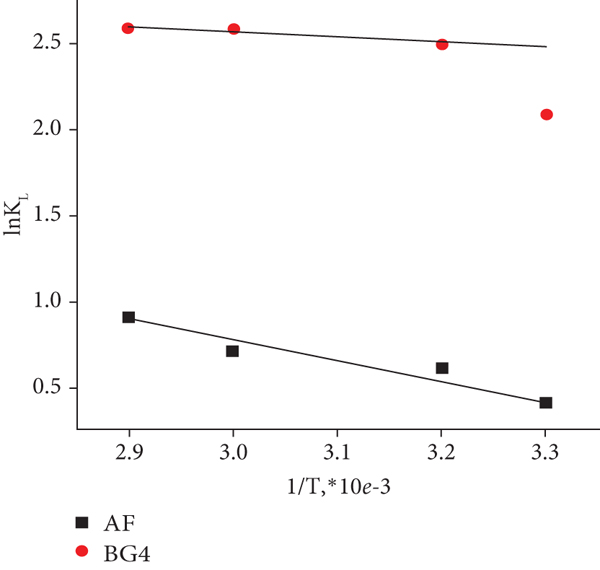
Van’t Hoff plot model for BG4 and AF adsorption onto HUAC.
4.8. Comparison with Other Adsorbents
Table 6 shows the comparison of the adsorption capacity of HUAC for BG4 and AF removal with a few other adsorbents. It may be noted that the amount of dye adsorbed is relatively more by HUAC than other adsorbents at similar conditions. Thus, it can be concluded that HUAC may be used as an efficient adsorbent.
Comparison of adsorption capacity of HUAC with other adsorbents.
5. Conclusion
The waste biomaterial was derived from Hedyotis umbellate, and its potential was evaluated in the aspect of removing highly toxic water-soluble acid and basic dyes, BG4 and AF from the aqueous solution by batch mode. The sorption capacity in terms of pH of the solution, adsorbent dose, agitation time, initial dye concentration, and temperature was examined. The control parameters were optimized and fixed. The isotherm investigation on adsorption of BG4 dye on HUAC revealed best fit of Langmuir isotherm which indicated monolayer adsorption of BG4 dye, and the adsorption of AF dye proved best fit of Freundlich isotherm that indicated multilayer diffusion of AF dye on HUAC. The kinetic studies confirmed pseudofirst order mechanism for the adsorption of BG4 and AF dyes onto HUAC. The adsorption of AF dye is driven by intraparticle diffusion. Therefore, Hedyotis umbellate activated carbon can be used as a cost effective and an efficient adsorbent for the removal of toxic dyes such as BG4 and AF from aqueous solution.
Footnotes
Data Availability
All data are included in the article itself. There is no separate data sheet available.
Conflicts of Interest
The authors declare that they have no conflicts of interest.