




Abstract
In this work, magnetized activated Juniperus procera leaves (Fe3O4@AJPL) were successfully prepared via chemical activation of JPL and in situ coprecipitation with Fe3O4. A Fe3O4@AJPL nanocomposite was successfully applied for the elimination of malachite green (MG) dye from aqueous media. The prepared Fe3O4@AJPL adsorbent was characterized by SEM, EDX, TEM, XRD, FTIR, TGA, and BET surface area analyses. The BET surface area and pore size of the Fe3O4@AJPL nanocomposite were found to be 38.44 m2/g and 10.6 nm, respectively. The XRD and FTIR results indicated the formation of a Fe3O4@AJPL nanocomposite. Different parameters, such as pH of the solution (3–8), adsorbent dosage (10–100 mg), temperature (25–45°C), contact time (5-240 min), and initial MG concentrations (20–350 mg/L), for the elimination of the MG dye using Fe3O4@AJPL were optimized and found to be 7, 50 mg, 45°C, 120 min, and 150 mg/L, respectively. The nonlinear isotherm and kinetic studies exhibited a better fitting to second-order kinetic and Langmuir isotherm models, with a maximum monolayer adsorption capacity of 318.3 mg/g at 45°C, which was highly superior to the previously reported magnetic nanocomposite adsorbents. EDX analyses confirmed the presence of nitrogen on the Fe3O4@AJPL surface after MG adsorption. The calculated thermodynamic factors indicated endothermic and spontaneous processes. The desorption of MG dye from Fe3O4@AJPL was performed using a solution of 90% ethanol. Finally, it could be concluded that the designed Fe3O4@AJPL magnetic nanocomposite will be a cost-effective and promising adsorbent for the elimination of MG from aqueous media.
1. Introduction
Water pollution by organic wastes produced by human activities is considered as one of the most dangerous environmental problems which have threatened human health and other living organisms. Dyes are widely utilized in different industries such as pharmaceuticals, paper, plastics, leather, and textiles. Malachite green (MG) has been extensively used in various fields such as in food processing, textile, cosmetic, pharmaceutical, plastic, and paper industries [1]. MG is used in aquaculture industries due to its great fungicide and bactericidal efficacy. Thus, it is extremely toxic to humans, plants, and aquatic fauna [2, 3], and it can cause carcinogenesis damage to the kidney and liver [4, 5]. Due to the toxicity and carcinogenic effect of MG dye ions, their removal from the aqueous environment is highly demanded. Therefore, the removal of dyes such as MG from wastewaters or surface waters is mandatory for the protection of human health. Different techniques were developed by researchers for the dye removal from the wastewater including membrane [6], photodegradation [7, 8], oxidation [9], electrochemical [10] ion exchange [11], and adsorption methods [12–14]. Among these techniques, adsorption is a successful, effective, and economical technique that is used to eliminate dyes from the polluted water as compared to other techniques [15, 16].
Many adsorbent materials were obtained from natural materials such as chitosan [17] and alginate beads [18]; wastes of agricultural activities, for example, almond shell [19], garlic peel [20], coffee waste [21], sugarcane bagasse [22], orange peels [23], banana peels [24], and peanut hull; and industrial waste, i.e., fly ash [25] for the elimination of dyes from aqueous media. Among the tested natural materials, leaf-based materials have received great attention as they possess various characteristics such as their low cost, easy preparation, and availability in large quantities. Leaves are used as an adsorbent material for the elimination of MG dye from wastewater by reducing the amount of waste produced [26]. Gupta et al. [27] have prepared Ashoka (Saraca asoca) leaf powder and tested for the elimination of brilliant green (BG), malachite green (MG), rhodamine B (RB), and methylene blue (MB) from an aqueous solution with 125, 83.3, 66.6, and 90.9 mg/g, respectively, as the maximum adsorption capacity. The treatment of the raw leaf-based material with different chemical reagents such as acids and bases could improve their adsorption properties toward the removal of dyes [28, 29].
Recently, it has been reported that biosorbent treated with H2O2 improved the capacity of dye adsorption from the solution since the H2O2 could increase oxygen-containing functional groups on the surface of the adsorbent and thus augment its capability to remove dyes from aqueous media [30, 31]. As we know, nonmagnetic material adsorbents suffer from the difficulty of isolation of adsorbate-loaded absorbents from aqueous media after the adsorption process due to their small particle size. To overcome this problem, the use of magnetism has been proposed by several researchers. Magnetite nanoparticles (Fe3O4) attract significant attention due to their unique large surface area, and these possess high saturation magnetization and can easily isolate toxic pollutants from aqueous solutions by using a magnet without using centrifugation and filtration compared to conventional adsorbents [32]. New economical, highly effective, and locally available biosorbents are still under development. Juniperus procera leaves are the most abundant plant in Saudi Arabia and many countries such as Lebanon, Bosnia, and Turkey [33–36]. Magnetic modification of low-cost adsorbents such as Juniperus procera leaves (JPL) could lead to materials appropriate for environmental applications. After a thorough literature survey, we have concluded that there are no previous studies reporting the activation of Juniperus procera leaves with H2O2 to increase the oxygen-containing functional groups on its surface. To our best knowledge, this is the first work to report the synthesis of a Fe3O4@activated Juniperus procera leaf nanocomposite.
This study was aimed at synthesizing a new Fe3O4@activated Juniperus procera leaf nanocomposite (Fe3O4@AJPL) via chemical activation and in situ coprecipitation methods. The prepared adsorbent was applied for removal of dyes from aqueous media. The Fe3O4@AJPL adsorbent was characterized by SEM, EDX, TEM, XRD, TGA, FTIR, and BET surface area analysis. The impact of various parameters on the MG dye adsorption onto Fe3O4@AJPL adsorbent such as solution pH, adsorbent dosage, contact time, initial MG concentrations, and temperature was achieved. The isotherm and kinetic data were analyzed by applying nonlinear equation models. Thermodynamic factors were also calculated.
2. Experiments
2.1. Chemicals and Instrumentation
Malachite green (MG), hydrogen peroxide (H2O2, 30%), ferric chloride (FeCl3·6H2O, 97%), ethanol (C2H5OH, 99.8%), and ferrous chloride (FeCl2·4H2O, 98%) were procured from Sigma Aldrich. Nitric acid (HNO3, 68.0-70.0%), sodium hydroxide (NaOH, ≥97%), and hydrochloric acid (HCl, 36%) were procured from BDH, England. Solutions were prepared using deionized water. The crystalline structures of AJPL, Fe3O4, and Fe3O4@AJPL were determined using an XRD-6000 (Shimadzu, Kyoto, Japan). The morphological properties of AJPL, Fe3O4, Fe3O4@AJPL, and Fe3O4@AJPL-MG were evaluated using a transmission electron microscope (TEM) and scanning electron microscope (SEM) (JEOL 200 kV, Tokyo, Japan). Fourier transform infrared spectra of activated Juniperus procera leaves (AJPL), Fe3O4@AJPL, and MG-saturated Fe3O4@AJPL (Fe3O4@AJPL-MG) were recorded using a Nicolet iS50, Thermo Scientific (Madison, WI, USA). The elemental composition of adsorbents was detected by energy-dispersive X-ray (EDX) (JEOL 7600F, Tokyo, Japan). The surface area of Fe3O4@AJPL was evaluated through the determination of N2 adsorption-desorption isotherms at −196°C by Micromeritics (USA). The concentration of MG was determined using a UV-visible spectrophotometer (Shimadzu 2450) at 616 nm.
2.2. Chemical Treatment of Juniperus procera Leaves
Juniperus procera leaves (JPL) were collected from Al Baha Province, Saudi Arabia. The leaves were washed with distilled water and dried for 7 days at room temperature (22–27°C) and ground using an electrical grinder. To increase oxygen-containing functional groups on the JPL surface, the JPL was treated with H2O2 by using the reported methods [30, 31]. Briefly, 20 g of the obtained JPL powder was immersed in 200 mL of 10% H2O2 and stirred for 24 h. Then, the sample was filtered off and was washed several times with deionized water. Following, 20 g of the AJPL powder was added into 200 mL of 1 M NaOH for removal of the impurities from the surface of JPL powder, resulting in improvement of the surface roughness of particles, formation of a pore structure, and opening of more hydroxyl groups and other reactive functional groups on its surface. Therefore, the removal of surface impurities can improve the adsorption properties of the JPL powder [37, 38]. The JPL powder was stirred for 24 h at 25°C. The resulting AJPL powder was washed with D.I. water and dried at 25°C for 3 days. Finally, the AJPL-obtained material was ground again to obtain a uniform particle size (Figure 1).

Synthesis of Fe3O4@AJPL nanocomposite and its mechanism of adsorption-desorption behavior for MG dye ions.
2.3. Magnetization of Juniperus procera Leaves (Fe3O4@AJPL)
The magnetization of AJPL powder was performed using the in situ coprecipitation method. Briefly, in a three-necked round bottom flask containing 90 mL D.I. water, 1.5 g of AJPL powder was suspended. To this mixture, 0.715 g of FeCl2·4H2O, and 2.15 g of FeCl3·6H2O (Fe2+ : Fe3+=1 : 2 molar ratio) were added and mechanically stirred for 20 min and heated to 80°C, and then, 10 mL of NH4OH was added dropwise over a period of 2 hrs. The obtained black precipitate (termed Fe3O4@AJPL) was collected by external magnetic field and washed with ethanol and D.I. water. Finally, the Fe3O4@AJPL was dried at 60°C for 24 h. Figure 1 demonstrates the preparation scheme of the Fe3O4@AJPL nanocomposite.
2.4. Adsorption Studies
The batch experiment method was conducted to select the best parameters for the adsorption process. The impact of adsorption parameters on MG dye adsorption by Fe3O4@AJPL adsorbents including adsorbent dosage (10–100 mg), pH (3–8), temperature (25–45°C), contact time (5-240 min), and initial MG dye concentration (20–350 mg/L) was achieved. The general procedure was as follows: the desired quantity of Fe3O4@AJPL adsorbents was taken in a 250 mL Erlenmeyer flask containing a 50 mL solution of MG with a given concentration, and then, the sample solution pH was adjusted using a 0.1 M HCl or 0.1 M NaOH to the desired pH. Then, the sample solution was shaken at 100 rpm for a specific time. After that, the sample was separated using a magnet, and the residual MG concentration was measured using a UV/Vis spectrophotometer at 616 nm. The adsorption efficiency (
3. Results and Discussion
3.1. Synthesis and Characterization of Fe3O4@AJPL
Juniperus procera leaves (JPL) were activated by using H2O2 and NaOH reagent. H2O2 is a strong oxidant, inexpensive, and clean. The use of H2O2 and NaOH is important to increase oxygen-containing functional groups on the JPL surface and improve the adsorption properties of JPL powder by removing the impurities from the surface of the JPL powder. AJPL carries hydroxyl, carboxyl, and carbonyl groups. Activated Juniperus procera leaves were successfully converted to the magnetized activated Juniperus procera leaves (Fe3O4@AJPL) via in situ coprecipitation. Fe3O4@AJPL has the ability to separate MG dye from aqueous solutions by using an external magnetic field, and it has a large surface area (116.9517 m2/g) and pore size (9.48 nm). It can easily separate the MG dye from aqueous solutions by using an external magnetic field. The Fe3O4@AJPL nanocomposite contains different functional groups (COOH, OH, C=O) which can adsorb MG ions by for π-π stacking, H-bonding, and electrostatic attraction (Figure 1).
Figure 2(a) displays the FTIR of AJPL, Fe3O4@AJPL before adsorption, and MG-saturated Fe3O4@AJPL (Fe3O4@AJPL-MG) adsorbent. In the spectrum of AJPL, the broad band centered at 3320 cm−1 is attributed to the OH group, suggesting the presence of a phenolic group [39]. The bands at 1731 and 1606 cm−1 ascribed to C=O and the one at 1026 cm−1 corresponding to C-O-C groups indicate the existence of carboxylic acid derivatives. Furthermore, the observed band of C=C stretching vibration at 1549 cm−1 as well as the C-H out-of-plane bending vibrations at 776 cm−1 is possibly characterizing the aromatic rings. Additional peaks of CH modes were also identified, e.g., at about 2943 cm−1. In the spectrum of Fe3O4@AJPL, a new band at 560 cm-1 assigned to the distinctive band of Fe-O stretching vibration was observed, confirming the presence of Fe3O4 nanoparticles [40, 41]. Moreover, it is observed that the modification of AJPL with Fe3O4 nanoparticles has resulted in intensity reduction of some characteristic peaks including the OH and C-O-C peaks. The spectra of the MG-loaded Fe3O4@AJPL showed shifts in the bands of some functional groups such as C=O, OH, and C-O-C from 1731, 3320, and 1026 cm−1 to 1721, 3329, and 1023 cm−1, respectively, due to adsorptive interaction.
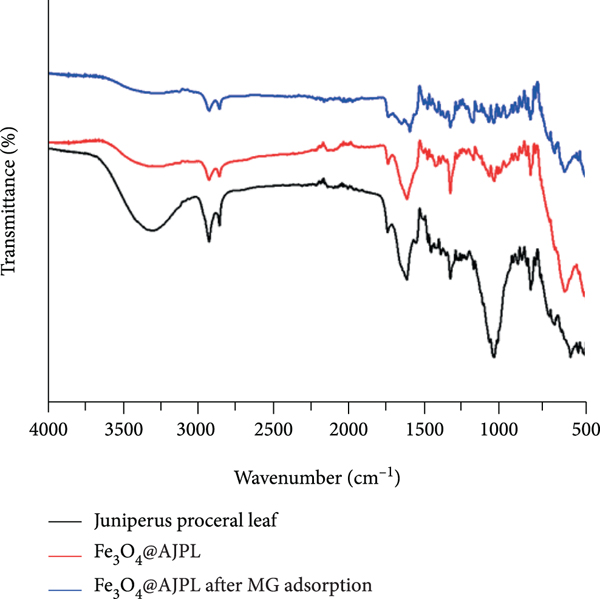
(a) FT-IR spectra, (b) XRD plot, (c) BET adsorption-desorption analysis, and (d) TGA analysis of adsorbents.


Figure 2(b) shows the XRD pattern of AJPL, Fe3O4 nanoparticles, and Fe3O4@AJPL nanocomposite. As implied in Figure 2(b), the characteristic peaks of Fe3O4 nanoparticles and the Fe3O4@AJPL nanocomposite perfectly matched the face-centered cubic crystalline which was confirmed by 2θ values of 30.24°, 35.56°, 43.22°, 57.11°, and 62.76° to (220), (311), (400), (511), and (440) planes, respectively [42]. The diffraction peaks for AJPL are 13.45°, 14.83°, 21.2°, 24.29°, 30.02°, 35.8°, and 38.15°. After modification of magnetite nanoparticles with AJPL, new peaks appeared at
Figure 2(c) displays the N2 adsorption/desorption isotherms of Fe3O4 nanoparticles and the Fe3O4@AJPL nanocomposite. The surface area, pore volume, and pore size were found to be 116.9517 m2/g, 0.322 cm3/g, and 9.48 nm for Fe3O4 nanoparticles and 38.44 m2/g, 0.136 cm3/g, and 10.6 nm for the Fe3O4@AJPL nanocomposite. The N2 adsorption-desorption curve of both adsorbents exhibited a type IV isotherm, suggesting the presence of mesopores in both adsorbents.
Figure 2(d) shows thermogravimetric analysis (TGA) of Fe3O4 and Fe3O4@AJPL. In the case of Fe3O4, about 10% is the total weight loss in the temperature range from 25°C to 1000°C due to the removal of the adsorbed water and conversion of hydroxide to oxide [44]. In the case of the Fe3O4@AJPL nanocomposite, it is a three-stage thermal degradation. The first stage from 25–180°C (3%) is related to the loss of moisture and adsorbed water. 7% and 50% weight loss were observed between the temperature ranges 180–320°C and 320–800°C in the second and third stages, respectively, due to decomposition of molecular organic compounds such as flavonoids of JPL in Fe3O4@AJPL [45]. The total weight losses of Fe3O4@AJPL and pure magnetite nanoparticles were 60% and 10%, respectively, which confirmed the formation of the Fe3O4@AJPL nanocomposite.
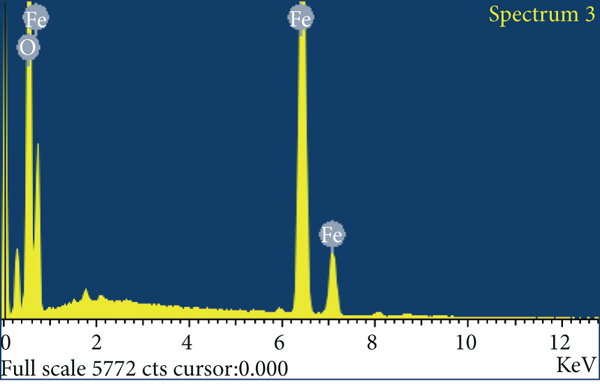
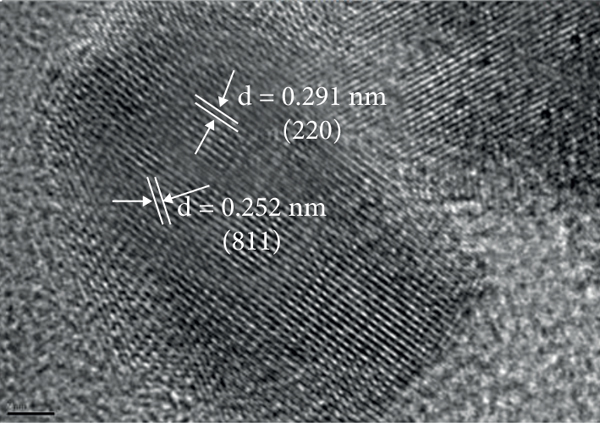
Figure 3 shows the SEM-EDX image results of the AJPL powder, Fe3O4, Fe3O4@AJPL, and MG dye-saturated Fe3O4@AJPL adsorbents. The surface structure of the AJPL powder is rough with the existence of some pore and crack sites (Figure 3(a)). After modifying the AJPL powder with magnetite nanoparticles, the magnetite nanoparticles are dispersed in the surface of AJPL (Figure 3(c)). The surface of Fe3O4 nanoparticles shows a spherical shape with diameters in the range of 12–25 nm (Figure 3(e)). The SEM image of the Fe3O4@AJPL loading MG showed a different morphology than before adsorption, which was well occupied with the MG dye as implied in Figure 3(g), indicating that the MG dye was successfully adsorbed on the Fe3O4@AJPL adsorbent. The EDX of the AJPL powder (Figure 3(b)) revealed the presence of mainly C (30.68%) and O (30.50%) and small amounts of Ca, Al, K, and Si. After modifying AJPL with magnetite nanoparticles, it was clearly observed that a new peak from iron (45.33%) appeared and increased in the intensity of oxygen (38.27%), confirming the synthesis of Fe3O4@AJPL successfully (Figure 3(d)). 65.32% of iron and 34.68% of oxygen were observed in the EDX spectrum of pure magnetite nanoparticles (Figure 3(e)). After MG dye was saturated on the Fe3O4@AJPL nanocomposite, a new peak of nitrogen was observed, indicating the successful adsorption of MG dye on the Fe3O4@AJPL adsorbent Figure 3(h). Figure 4(a) displays the TEM images of Fe3O4@AJPL nanocomposite. A small degree of agglomeration with a spherical shape was observed. The particle size was found to be 9 nm Figure 4(b). Figure 4(c) displays the lattice fringe spacing of the crystalline part (Fe3O4) of the Fe3O4@AJPL nanocomposite. The d spacing values were 0.291 nm and 0.252 nm, which are attributed to the (311) and (220) planes of Fe3O4 nanoparticles which were confirmed by the XRD results for the cubic structure of Fe3O4 nanoparticles. The selected area electron diffraction (SAED) analysis shows a ring pattern which confirms the presence of crystalline Fe3O4 nanoparticles in the nanocomposites (Fe3O4@AJPL) (Figure 4(c)).

(a) SEM image, (b) EDX analysis of activated Juniperus procera leaves (AJPL), (c) SEM image, (d) EDX analysis of Fe3O4@AJPL, (e) SEM images, (f) EDX analysis of magnetite nanoparticles, (g) SEM image, and (h) EDX analysis of MG adsorption onto Fe3O4@AJPL.




(a) TEM image, (b) size particles distribution, (c) SAED pattern, and (d) HRTEM image of Fe3O4@AJPAL adsorbent.


3.2. Adsorption Studies
3.2.1. Adsorbate Selectivity
The prepared adsorbents AJPL and Fe3O4@AJPL nanocomposite were examined for elimination of different cationic dyes such as MG, CV, and MB from aqueous solutions as implied in Table 1. It was noticed that, at the adsorption conditions of adsorbent dose 50 mg, initial adsorbate concentration (
Adsorption selectivity experiments with dye solutions (conditions: dye—20 mg/L, time—24 h, Fe3O4@AJPAL—50 mg, volume—0.05 L, temperature—25°C, and agitation—100 rpm).
3.2.2. Effect of pH
The impact of the solution pH on MG adsorption onto Fe3O4@AJPL was tested over a range of pH values from 3 to 8 (MG: 20 mg/L, contact time: 24 h, adsorbent dose: 50 mg, temperature: 25°C, and agitation: 100 rpm) as shown in Figure 5(a). The results indicate an increase in the adsorption capacity and removal percentage with increase in pH up to pH 7. This increase in adsorption capacity was due to the surface charge of Fe3O4@AJPL nanocomposites becoming more negative and having strong electrostatic attraction with the cationic MG dye, resulting in higher adsorption efficiency. On the contrary, under an acidic medium, the excessive protonation of the Fe3O4@AJPL nanocomposite surface hindered the binding of cationic MG ions on the Fe3O4@AJPL nanocomposite surface, resulting in a lower adsorption efficiency [46]. Similar trends have been reported by Asfaram et al. for the removal of MG using biosorbent Yarrowia lipolytica ISF7 [47]. Compared with pH 7, an almost similar performance was observed at pH 8 above which the solution becomes colorless due to the reaction occurrence between the MG and OH. These results are inconsistent with the ones reported by Pan et al. [48] and De Marco et al. [49].

(a) Effect of pH value (conditions: MG—20 mg/L, time—24 h, Fe3O4@AJPAL—50 mg, temperature—25°C, and agitation—100 rpm), (b) contact time (conditions: MG—20 mg/L, pH—7, Fe3O4@AJPAL—50 mg, agitation—100 rpm, and temperature—25°C), (c) adsorbent dose (conditions: MG—20 mg/L, pH—7, time—120 min, temperature—25°C, and agitation—100 rpm), and (d) initial MG concentration (conditions: time—120, Fe3O4@AJPAL—50 mg, pH—7, temperature—25°C, and agitation—100 rpm) on the adsorption of MG on Fe3O4@AJPAL.


3.2.3. Effect of Contact Time
The impact of the contact time on the MG adsorption by Fe3O4@AJPL was achieved over the time interval of 5–240 min under fixed conditions (MG: 20 mg/L, pH: 7, temperature: 25°C dose: 50 mg, and agitation: 100 rpm) (Figure 5(b)). At an initial period of 15 min, the adsorption rate was high with
3.2.4. Effect of Dosage
The impact of the adsorbent dosage on the removal efficiency and adsorption capacity was tested in the range 10-100 mg under the following conditions: MG: 20 mg/L, pH: 7, contact time: 120 min, agitation: 100 rpm, and temperature: 25°C. As shown in Figure 5(c), the
3.2.5. Effect of Initial Concentration and Temperatures
The adsorption capacities of the Fe3O4@AJPL adsorbent at different initial MG concentrations (20–350 mg/L) and temperatures (25, 35, and 45°C) were also studied, keeping other factors (time: 120 min, pH: 7, dose: 50 mg, and agitation: 100 rpm) as given in Figure 5(d). The outcomes show that the adsorbed amount of MG dye by Fe3O4@AJPL was linearly increased while the initial MG concentration increased, e.g., as
3.3. Adsorption Modeling
3.3.1. Adsorption Isotherm
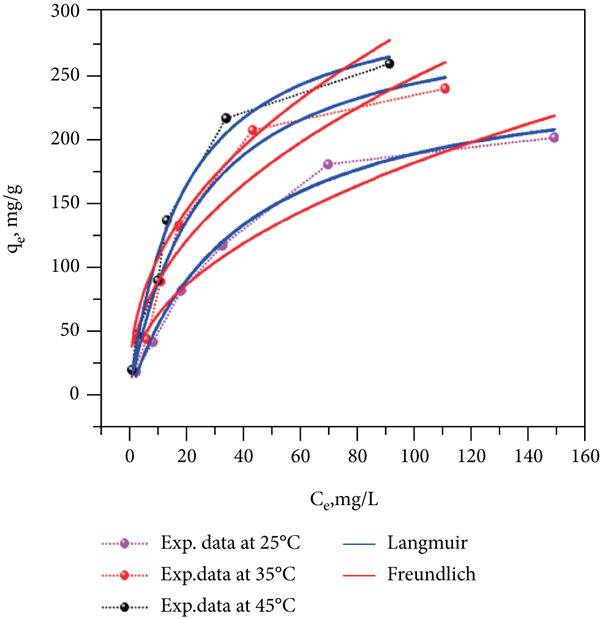
The adsorption isotherm studies were accomplished over a range of MG initial concentrations of 20–350 mg/L and at temperatures of 25, 35, and 45°C, keeping the other factors constants (i.e., adsorbent dose: 50 mg, pH: 7, contact time: 120 min, and agitation speed: 100 rpm). Nonlinear isotherm adsorption models such as Langmuir (Equation (4)) [56] and Freundlich (Equation (5)) [57] were applied to describe the behavior of the MG adsorption onto Fe3O4@AJPL.
(a
Langmuir and Freundlich isotherm models for MG adsorption on Fe3O4@AJPL nanocomposite (conditions: MG—20-350 mg/L, time—120 min, Fe3O4@AJPAL—50 mg, volume—0.05 L, and agitation—100 rpm).
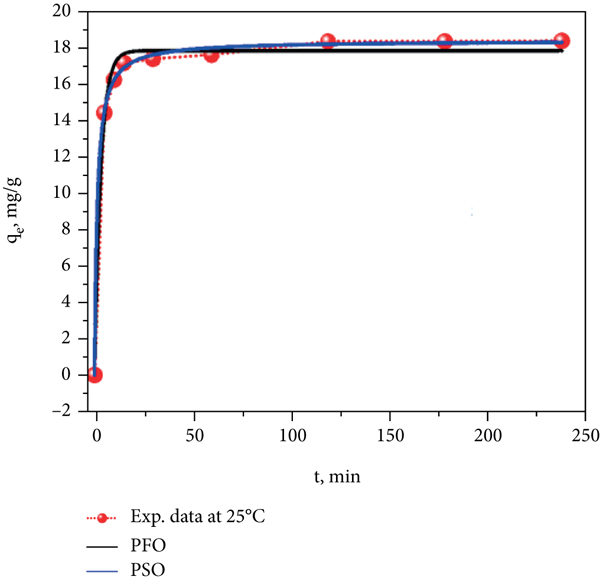
3.3.2. Kinetic Adsorption
The adsorption mechanism was achieved using the nonlinear kinetic models and pseudo-first-order (PFO) and pseudo-second-order models described by the following equations:
Kinetic model parameters for MG adsorption on Fe3O4@AJPL (conditions: MG—20 mg/L, time—120 min, Fe3O4@AJPAL—50 mg, volume—0.05 L, temperature—25°C, and agitation—100 rpm).
3.3.3. Adsorption Thermodynamics
The adsorption thermodynamic factors such as the Gibbs free energy (
Figure 7(a) and Table 4 summarize the data obtained. The value of

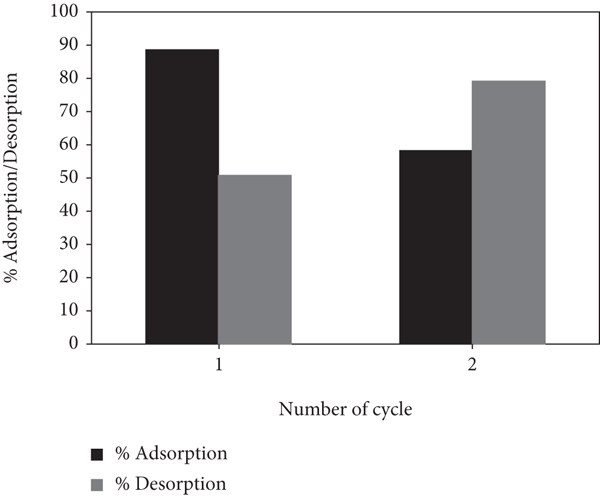
(a) Adsorption thermodynamics, (b) adsorption/desorption plot of MG dye from Fe3O4@AJPAL, and (c) recycling study (conditions: MG—20 mg/L, time—120 min, Fe3O4@AJPAL—50 mg, pH—7, temperature—25°C, and agitation—100 rpm).

Thermodynamic factors for adsorption of MG on Fe3O4@AJPL (conditions: time—120 min, Fe3O4@AJPAL—50 mg, volume—0.05 L, pH—7, and agitation—100 rpm).
3.4. Adsorption Mechanism
Figure 1 shows the stepwise preparation of the adsorbent Fe3O4@AJPL and the proposed adsorption mechanism. According to the FTIR spectrum, after MG dye adsorption on the Fe3O4@AJPL nanocomposite, there was a decrease and shift in the peak intensities of the functional groups. it was observed that the peaks at 3320 cm−1, 1731 cm−1, and 1026 cm−1 decrease and shift to 3329 cm−1, 1721 cm−1, and 1023 cm−1, respectively, due to adsorptive interaction between the MG dye and the COOH, OH, and C-O-C groups on the Fe3O4@AJPL surface by different mechanisms such as hydrogen bonding, π-π stacking, and electrostatic interaction. The nonlinear isotherm and kinetic adsorption studies exhibited a better fit to PSO kinetic and Langmuir isotherm models, indicating chemisorption adsorption. Additionally, the weak desorption efficiency of MG from the Fe3O4@AJPL surface confirms the chemisorption mechanism. It was observed that adsorption of MG onto Fe3O4@AJPL was fast in the first stage of the adsorption period (15 min) then slowly developed until equilibrium (120 min). The initial rapid rate may indicate existence of available active sites on the Fe3O4@AJPL surface. Furthermore, the data indicate that more than 85.7% of MG molecules were adsorbed in the first stage, supporting the chemical adsorption mechanism. However, the first stage cannot be recognized, and the slow rate in the second adsorption phase suggests a physical mechanism, which is possibly controlled by the diffusion process. On the other hand, the thermodynamic data support the physisorption mechanism. Therefore, it could be concluded that the MG adsorption on Fe3O4@AJPL occurred by physical adsorption together with the chemisorption process. The EDX analysis clearly shows a new peak of nitrogen along with the peaks of elements of the Fe3O4@AJPL nanocomposite, indicating MG adsorption onto the whole surface of the Fe3O4@AJPL adsorbent.
3.5. Comparative Performance of Fe3O4@AJPL with Other Adsorbents
For comparative purposes, the maximum adsorption capacity,
Comparison of the MG adsorption capacity of Fe3O4@AJPL nanocomposite with other magnetic adsorbents.
3.6. Desorption and Reusability Studies
To recover the MG dye from the Fe3O4@AJPL nanocomposite, three eluents, 0.1 M HCl, 0.1 M HNO3, and ethanol (90%), were used (Figure 7(b)). From the results, it was observed that the recovery performance of ethanol was the highest (50.77%), while the acidic eluents (HCl and HNO3) used showed only negligible efficiencies toward MG elution. The low recovery efficiency of MG from the Fe3O4@AJPL nanocomposite surface using ethanol indicates that most of the MG adsorption was probably by chemisorption. The outcomes of the kinetic and isotherm adsorption confirm the chemical adsorption mechanisms. The regeneration efficiency after two cycles was also examined. The result revealed that the adsorption efficiency of the MG dye on Fe3O4@AJPL was decreased from 89.5% to 58.2% as well as in the recovery percentage mostly due to incomplete desorption in the first cycle of the adsorption-desorption process as well as possible destruction of some active sites on the Fe3O4@AJPL surface.
4. Conclusion
In summary, a new magnetic nanocomposite (Fe3O4@AJPL) adsorbent was successfully synthesized via chemical activation of JPL and in situ coprecipitation with Fe3O4. The Fe3O4@AJPL nanocomposite was applied for the removal of the MG dye from aqueous solutions. The Fe3O4@AJPL nanocomposite was analyzed using different analytical techniques, and the results confirmed that the Fe3O4@AJPL nanocomposite was successfully synthesized. The surface area of the Fe3O4@AJPL nanocomposite was identified via BET analysis, and it is found to be 38.44 m2/g. The Fe3O4@AJPL nanocomposite was tested to thoroughly clarify the influences of the factors on the adsorption of MG onto Fe3O4@AJPL. The optimized adsorption factors were found to be pH: 7, contact time: 120 min, adsorbent dose: 50 mg, temperature: 45°C, and initial MG concentration: 150 mg/L. The adsorption kinetic and isotherm were revealed to be a better fit to the PSO kinetic and Langmuir isotherm models. The maximum monolayer adsorption capacity was 318.3 mg/g at 45°C, which was greater than magnetic nanocomposite adsorbents reported previously. The thermodynamic studies indicated that the adsorption of MG onto Fe3O4@AJPL is a spontaneous and endothermic process. The interaction between the Fe3O4@AJPL nanocomposite and the MG dye occurred by chemisorption and physisorption that can be achieved by H-bonding, π–π interactions, and electrostatic attractions. The recovery results indicated that ethanol was the best eluent among the all the tested eluents. Overall, it could be concluded that the prepared Fe3O4@AJPL adsorbent will be a promising adsorbent for the elimination of MG dye from aqueous solutions
Footnotes
Data Availability
Anyone who wants to request research article data can contact me directly via the following email:
Conflicts of Interest
There are no conflicts to declare.
Acknowledgments
We gratefully acknowledge the financial support by Albaha University (Project No. 1441/3) and are grateful to the Scientific Research Deanship.