




Abstract
In this research, biomass modification of Nannochloropsis sp. with surfactant cetyltrimethylammonium bromide (CTAB) through a cation exchange reaction to produce adsorbent Nannochloropsis sp.-cetyltrimethylammonium bromide (AlgN-CTAB) has been carried out. Biomass modification of Nannochloropsis sp. by CTAB has been successfully carried out through confirmation from the analysis data produced by Fourier-transform infrared spectroscopy (FTIR) and scanning electron microscopy and energy-dispersive X-ray spectroscopy (SEM-EDX). AlgN-CTAB adsorbent has been tested for its adsorption ability against anionic dye of methyl orange (MO) in solution by way of a sequence of experiments by the batch method. The optimum conditions for MO removal from the solution occurred at an adsorbent quantity of 0.1 g, pH of 5, and an interaction time of 60 min. MO adsorption kinetic data by AlgN and AlgN-CTAB tended to take the kinetic model of pseudo-second-order (PSO) with PSO rate constant (
1. Introduction
One of the major problems at this time is water contaminants which are caused by various activities of human life. Increasing technological and industrial advances so far have increased the release of unwanted contaminants like dyes, toxic metals, and pesticides into the surroundings [1, 2]. This waste is generated from the by-products of processing industrial materials such as textiles, tannery, rubber, plastics, food, and cosmetics which can have an impact on the health of living things and their ecosystems [3, 4]. One industry that is often found to produce dangerous contaminants like dyes resulting in toxic chemicals is the industry of textile. Dyestuff waste from the textile industry is a source of contaminants that are often found in the environment. Methyl orange (MO) is a coloring agent which is broadly utilized as a coloring agent in several industrial fields like fabric, leather, paper, and pharmaceutical manufacturing. The majority of the artificial dyes and their derivation products own a high environmental effect, particularly in waters because of their wide application but with poor levels of sewage treatment [5]. Since the dye goes in the wastewater, the blend is more stabilized and complicated to break down because of its complex chemical composition [6]. Dyes are able to lead to a rise in biological oxygen demand (BOD) and can transmit water-borne diseases although they just produce a little share to the amount of organic charge in wastewater [7].
Methyl orange (C14H14N3NaO3S) is an anionic coloring agent usually produced by azo compounds and their descendant from the group of benzene. The benzene groups are very difficult to degrade because of their stable structure. Azo compounds are compounds that have the –N=N group called the azo structure and are mostly present in waste. The compounds of azo in case overly lengthy in the surroundings are able to be a resource of illness due to their carcinogenic and mutagenic properties [8–11]. Therefore, it is necessary to reduce this dye in industrial waste, particularly in waste handling prior to its spread to the environment.
Treatment of dye waste such as MO was performed by way of various treatments consisting of coagulation, oxidation, flocculation, ion exchange, and adsorption [12–15]. The method that is quite effective and does not result in by-products which can damage the surroundings in treatment of waste containing dyes from various existing methods is the adsorption process [16, 17]. However, the effectiveness in the adsorption process is strongly influenced by the selection of characteristic and the type of adsorbent to be implemented.
Currently, many adsorbents based on natural materials have been developed, such as algal biomass. Algal biomass is a very effective adsorbent for absorbing organic compound pollutants derived from dyes [18–20]. This is because algal biomass has functional groups that can act as active adsorption sites. From several studies that have been reported, algal biomass and the results of its modification with various supporting matrices are very effective in absorbing positively charged chemical compounds such as metal cations and cationic dyes [21–23], but it is less effective for absorbing anionic compounds. This happens because algal biomass contains active groups such as hydroxyl, amino, sulphate ions, and carboxyl [23, 24] which tend to be negatively charged.
In previous studies, the researchers had increased the biomass adsorption ability of Nannochloropsis sp. to absorb anionic dyes such as MO by modifying the algal biomass using cationic surfactants. Surface modification utilizing cationic surfactants has been shown to be an effective technology for increasing adsorbent adsorption capability. Cationic surfactants can make adsorbents rich in positive charges. Cationic surfactants that have been utilized effectively for an adsorbent surface modified by researchers were polyethylenimine (PEI), dodecylbenzyldimethylammonium chloride, and [3-(2-amino ethyl amino) propyl] trimethoxysilane (APTS) [25–27]. Algae biomass adsorbent is negatively charged by having an active group of alkaline or alkaline earth cation exchangers such as Na+, K+, or Ca2+ ions. The cations that are bound to the negative charge of algae biomass functional groups act like a counterweight to their charge which can be exchanged with other cations such as cationic surfactants [3, 28, 29].
In this research, the adsorption characteristics of the adsorbent from the modified algal biomass of Nannochloropsis sp. with surfactant cetyltrimethylammonium bromide (CTAB) (AlgN-CTAB) were investigated which is cationic to adsorb MO dyes in solution. The increase in the adsorption ability of AlgN-CTAB on MO dyes can be determined by determining the kinetics and adsorption isotherm parameters. Thus, it can be obtained that modified algal biomass adsorbent is effective for application to absorb anionic dyes. Biomass modification increases the ability of algal biomass as a functional material that plays a role in absorbing toxic chemical compounds in chemical waste treatment.
2. Materials and Methods
2.1. Materials
Methyl orange and other chemicals required for the process of algal biomass modification and adsorption such as NaCl, CTAB, HCl, NaOH, citrate, and phosphate buffer are of analytical reagent (AR) grade and purchased based on the European Pharmacopoeia. Algae Nannochloropsis sp. was obtained from cultivation at the Center for Marine Cultivation in Lampung, Indonesia, and prepared into algal biomass in the Inorganic Chemistry Laboratory of FMIPA University of Lampung.
2.2. AlgN and AlgN-CTAB Preparation
Algae Nannochloropsis sp. was prepared to be biomass of Nannochloropsis sp. (AlgN) by drying it to air up to 72 h and in an oven at 40°C for 3 h [2]. Furthermore, 30 g of AlgN was reacted with 400 mL of 1 M NaCl solution in a 500 mL Erlenmeyer flask. After that, the solution was stirred with a shaker for 1 hour. The solution was then kept for 1 day and filtered. The solid produced was cleaned using H2O to neutral pH and dried at 25°C to give AlgN-Na. Then, 5 g of AlgN-Na was reacted with 500 mL CTAB and stirred for 4 h using a magnetite stirrer at 50°C. The solid produced was neutralized by deionized water, dried at room temperature, and ground by a grinder to be fine with a 100-mesh size to produce AlgN-CTAB.
2.3. Characterization of AlgN and AlgN-CTAB
Characterization of AlgN and AlgN-CTAB was undertaken to analyze the appearance of functional groups by Fourier-transform infrared spectroscopy (FTIR) (Shimadzu Prestige-21 IR, Japan), while identification of surface morphology and elemental constituents was done by scanning electron microscopy with energy-dispersive X-ray spectroscopy (SEM-EDX) (FEI Inspect-S50, USA).
2.4. Analysis of the Point of Zero Charge (pHpzc) Adsorbent
A total of 0.05 g of adsorbent was put into each beaker glass continued by adding 10 mL of 0.1 M NaNO3. Furthermore, each solution pH was arranged with a range between 3 and 12. The pH adjustment was done by the addition of 0.1 M hydrochloric acid for acidic conditions and 0.1 M sodium hydroxide for alkaline conditions. The solution was stirred up to 24 h, and the last pH for each solution was observed [21].
2.5. Batch Adsorption Experiment
The ability of the AlgN and AlgN-CTAB adsorbents to absorb MO anionic dyes was investigated by studying the impact of AlgN-CTAB dose, contact time, pH, concentration variations, and the ability to reuse adsorbent. A total of 1 g L-1 of stock solution of MO was made and further applied to result in the standard solution and initial concentration ([MO]o) by diluting the stock solution accordingly. All experiments were undertaken at temperatures of 27°C. In the adsorbent dose determination experiment, 25 mL of
where
The adsorption data of MO adsorbed by AlgN and AlgN-CTAB were analyzed by determining the correlation between the amount of MO in the adsorbed solution experimentally and the estimation results with the adsorption isotherm of Langmuir (AIML), Freundlich (AIMF), Dubinin-Radushkevich (AIMDR), and Temkin (AIMT). The evaluation was carried out by determining the root mean squared error (RMSE) and chi-square test (
2.6. Regeneration
Reuse of the AlgN-CTAB adsorbent was observed by performing adsorption experiments at optimum conditions. The MO dye that had been adsorbed by AlgN-CTAB was removed again using an eluent in the form of 0.1 M hydrochloric acid (50 mL). The adsorption-desorption processes were undertaken several times, until the % MO adsorption was <80%.
3. Results and Discussion
3.1. Preparation and Characterization of Adsorbents
AlgN-CTAB is an adsorbent based on the algal biomass of Nannochloropsis sp. modified by cation exchange reaction using CTAB surfactant. The procedure for making AlgN-CTAB is shown in Figure 1.
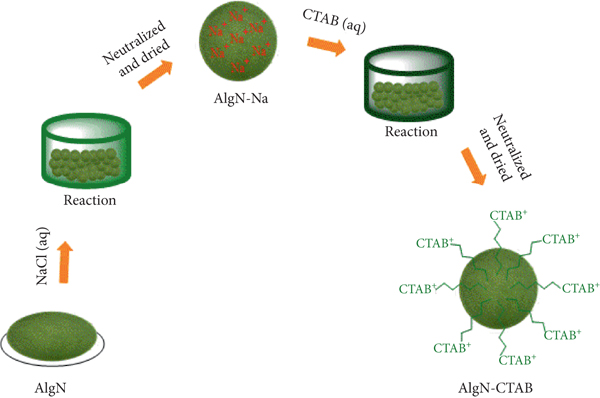
Adsorbent AlgN-CTAB preparation scheme.
AlgN-CTAB was made by uniforming the charge with excess Na+ cations using NaCl solution which is aimed at increasing the cation exchange capacity [5]. Ions of Na+ contained in the algal biomass of Nannochloropsis sp. were replaced with CTAB surfactant via a cation exchange reaction which produces AlgN-CTAB. Then, the AlgN-CTAB adsorbent was characterized by FTIR for functional group determination and SEM-EDX for surface morphology and elemental investigation.
Figure 2 illustrates that the IR spectrum of AlgN indicates an absorption band at wave number 1613.07 cm-1 identifying a typical C=O absorption of a carboxylic acid. In addition, the absorption appears at the wave numbers around 2854.85 and 2924.09 cm-1, respectively, obtained from the –CH2 symmetrical stretching and asymmetry vibration of a carbon chain (aliphatic) [32, 33]. The absorption at wave number 3695.61 cm-1 comes from the overlap of the -O-H and -N-H groups. In AlgN-CTAB, all characteristic IR spectra of the algal biomass of Nannochloropsis sp. appeared with the addition of a new absorption at a wavelength of 1465.90 cm-1 indicating the existence of the CH group which is the methyl group from CTAB [34–36].

IR spectra of AlgN and AlgN-CTAB.
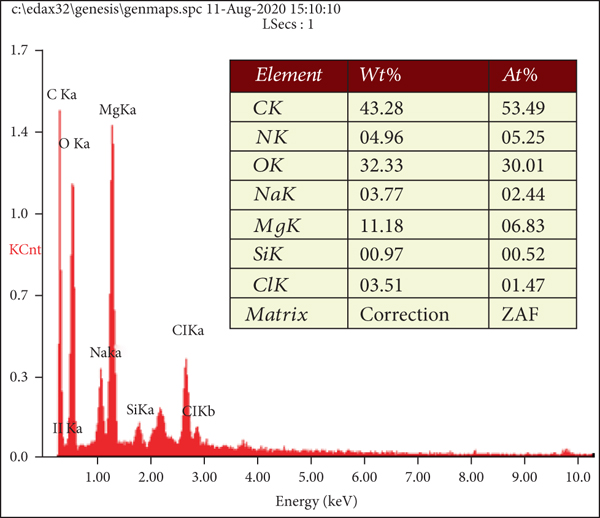
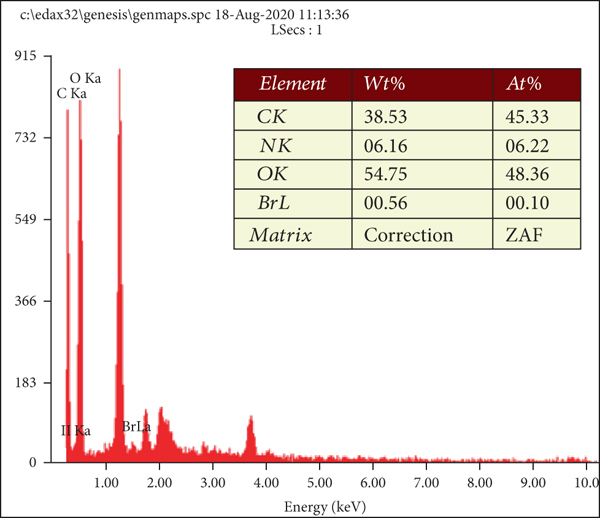
The surface morphology of AlgN-CTAB was explored with SEM coupled with the determination of constituent elements using EDX. SEM characterization provides main information on the surface morphology of adsorbent. In Figure 3(b), it could be investigated that, in AlgN-CTAB, the surface morphology area is wider than that in AlgN (Figure 3(a)) and there are sticky grains which indicate the existence of molecules of CTAB on the surface layer of the algal biomass of Nannochloropsis sp. Cetyltrimethylammonium bromide molecules do not enter the algae but only cover the algal cell walls after surfactant modification [5]. The presence of CTAB on the AlgN surface is also supported by the EDX data in Figure 3(d) which shows the appearance of the Br element derived from CTAB in AlgN-CTAB that did not previously appear in the EDX data from AlgN (Figure 3(c)).
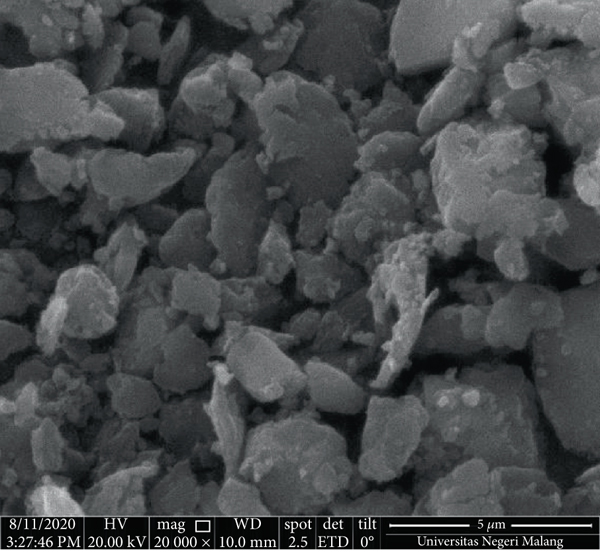
SEM-EDX of (a, c) AlgN and (b, d) AlgN-CTAB.

3.2. Impact of Adsorbent Dosage on Adsorption
Dosage of adsorbent is one of the main parameters in deciding the effective adsorption conditions so that it is economically feasible to use adsorbents for certain purposes. In this research, the impact of the adsorbent dosage was studied using AlgN-CTAB in the range 0.1-0.5 g in 10 mg L-1 [MO] (25 mL) as displayed in Figure 4.
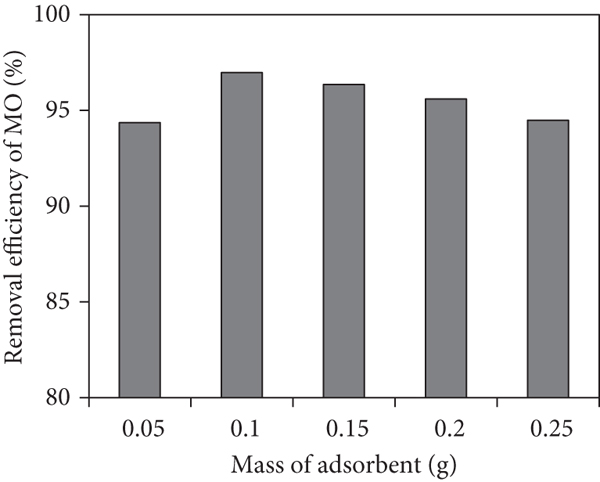
Impact of adsorbent mass on sorption of MO dye on AlgN-CTAB (
Figure 4 illustrates the impact of the adsorbent dose on the absorption percentage of MO dye which increases by the rise in the adsorbent dosage and the optimum at the particular adsorbent dosage used. This shows that raising the dose of adsorbent applied increases the amount of adsorption sites to absorb MO dye, but the increase in the amount of MO adsorbed is also limited by the amount of adsorbate concentration used. It may be seen in Figure 4 that the optimal AlgN dose is 0.1 g. This dose is used for further trials.
3.3. Impact of Solution Acidity on Adsorption
In this experiment, the impact of pH of MO dye solution on AlgN-CTAB adsorbent was studied in the pH range between 3 and 12. Figure 5 explains that the change in the pH value of the MO dye solution has no impact on the percentage of MO adsorbed by AlgN-CTAB. From these data, it appears that the removal efficiency of MO solution in the pH range 3-12 is more than 96%. This can occur because the interaction between MO dye and AlgN-CTAB occurs through an electrostatic interaction mechanism among the positive charges of AlgN-CTAB and MO dye [37, 38]. The existence of biomass modification with CTAB has increased its ability to absorb anionic dyes. This is supported by % MO which is adsorbed at very low AlgN in all pH ranges. This happens because AlgN is dominated by active groups that are negatively charged, so there is repulsion with MO dye which is negatively charged; as a result, the adsorption process is not optimal.
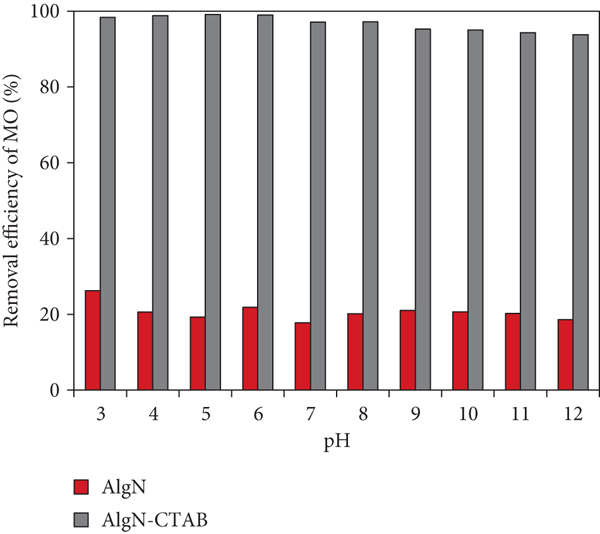
Impact of pH on the removal of MO dye using AlgN and AlgN-CTAB (
Increasing the

Investigation of pHpzc of the AlgN and AlgN-CTAB.
3.4. Impact of Contact Time on Adsorption
In order to observe the impact of contact time, adsorption experiments were done by the MO dye solution at varying contact times between 0 and 120 minutes. The resulting adsorption data is illustrated in Figure 7, and it shows that more than 94% of MO dye was absorbed by AlgN-CTAB in the initial 15 minutes and the adsorption stability period was reached at 60 min. Increasing the contact time of more than 60 minutes apparently did not increase the percentage of MO adsorbed by AlgN and AlgN-CTAB, by about 24.56 and 98.69%, respectively. Therefore, the equilibrium time was used for further experiments.
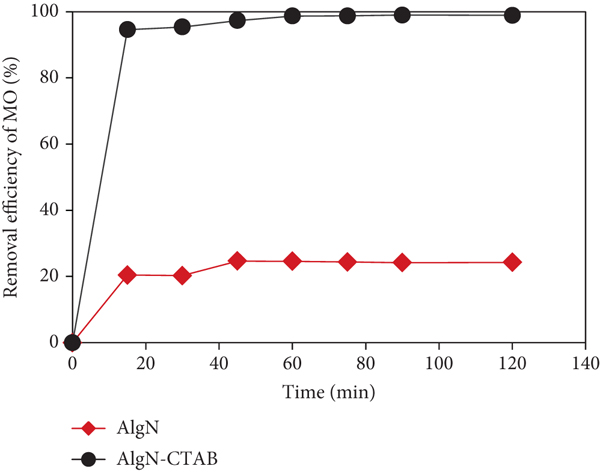
Impact of interaction time on the removal of MO dye using AlgN and AlgN-CTAB (
3.5. Adsorption Kinetics
Adsorption kinetic models are applied to identify the dominant mechanisms determining process of adsorption like chemical reactions and mass transfer. In this study, the pseudo-first-order (PFO), pseudo-second-order (PSO), and intraparticle diffusion (IPD) models have been used to explore the adsorption facts shown in Figure 7.
The PFO kinetic model presumes that the adsorption rate of the filled sites is combined by the amount of unfilled sites described by the next linear equation [40].
The PSO kinetic model supposes that the capacity of adsorption is comparable to the amount of active sites that existed on the adsorbent using a linear equation.

Linearized (a) PFO and (b) PSO kinetic models on adsorption of MO dye.

Kinetic parameters for the adsorption of MO dye on AlgN and AlgN-CTAB.
The use of the Morris-Weber kinetic model [41, 42] assumes that the diffusion process of adsorbates such as MO dye to the adsorbent is controlled by a physical mechanism that leads to a main part in the process of adsorption as described in
where
Data in Figure 7 were also analyzed with an IPD model that can describe the process of diffusion from the objects absorbed by the adsorbent which could be applied to simulate data of kinetics [43]. The results of the analysis are described in Figure 9 and listed in Table 2. It may be observed in Figure 8(c) that the entire plots contain two linear sections. These patterns show that there is over one adsorption model linked. The initial linear part covers time of adsorption of 0–60 minutes representing the external transfer of mass. The next linear part covers time of adsorption of 60–120 minutes, indicating a pattern depicting intraparticle diffusion. The second linear part does not pass through the origin (
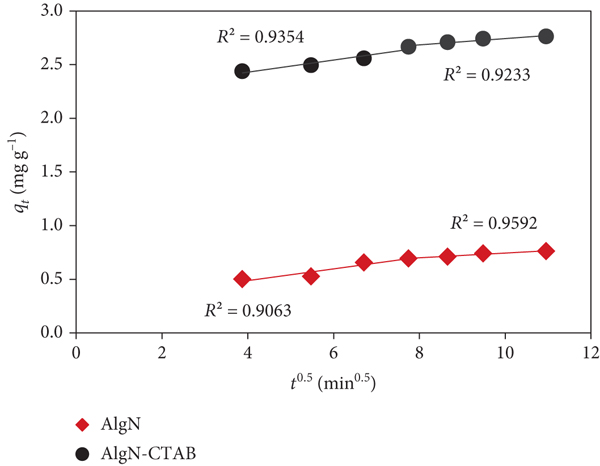
Linearized kinetic model of IPD on adsorption of MO dye.
Intraparticle diffusion model for MO dye adsorption onto AlgN and AlgN-CTAB.
The results of the analysis of the MO adsorption data by AlgN and AlgN-CTAB using the PFO, PSO, and IPD models are linearly shown in Figures 8 and 9 as well as in Tables 1 and 2. If the value of linear correlation coefficient (
According to the investigation in Figure 9, there are two stages that describe the transfer of MO from the solution to the adsorbent outer surface and further directional diffusion of the MO to active sites of the adsorbent through pore cavities and active groups, respectively. The mechanism of adsorption is able to be described in two dissimilar manners, namely, diffusion through adsorbent pores and electrostatic interactions in the existence of positive charges of functional groups from the modification of AlgN to AlgN-CTAB [45]. This is in line with the data analysis of the PSO kinetics discussed earlier.
3.6. Impact of MO Concentration on Adsorption
To determine the impact of [MO] on the adsorption capacity of AlgN and AlgN-CTAB and to learn the equilibrium of the adsorption process, adsorption tests at various

The impact of [MO]o on the amount of MO adsorbed in (a) AlgN and (b) AlgN-CTAB based on experimental results (

The increase in
3.7. Adsorption Isotherm
Adsorption isotherm data is the main indicator to know in explaining the adsorption process. The isotherm shows the relationship between the amounts of MO bound by the adsorbent at fixed temperature. The adsorption isotherm patterns that are often utilized in deciding the adsorption parameters are the Langmuir and Freundlich adsorption isotherm models (AIML and AIMF). In addition, the Dubinin-Radushkevich and Temkin models (AIMDR and AIMT) can also be used because they may present extra information consisting of energy and mechanism of adsorption. The products of the MO adsorption information analysis by AlgN and AlgN-CTAB are shown in Table 3. The relationship between [MO]o and the amount of MO dye bound in AlgN and AlgN-CTAB is according to experimental results (
Adsorption isotherm parameters of MO dye on AlgN and AlgN-CTAB.
The AIML presumes that, on the adsorbent surface, there is an amount of active sites which is proportionate toward the uniform surface area of the adsorbent accompanied by a monolayer adsorption process [48, 49]. The linear equation of AIML is displayed in Equation (5), while the AIMF is an empirical equation applied to multilayer adsorption and heterogeneous system [50]. The linear equation of AIMF is shown in Equation (6).
The AIMDR has more universal assumptions than the AIML. The AIMDR presumes that the adsorption surface is not homogeneous [51]. The adsorption isotherm equation of this model in linear form is expressed in Equation (7). Meanwhile, the AIMT calculates the complete interaction between adsorbent and adsorbate. The main significant presumption of the AIMT is that the adsorption heat will reduce linearly by the increase in the adsorbent surface coverage [20]. The AIMT linear equation is observed in Equation (8).
where
Table 3 explains that in accord with the regression coefficient data (
Relatively, it could be deduced that among the dissimilar isotherm patterns, the AIML and AIMDR can satisfy the experimental data more precisely than AIMF and AIMT. Therefore, it can be stated that the MO adsorption by AlgN-CTAB does not fully occur through chemical or physical interactions, but it is a combination of both [53].
3.8. Regeneration of Adsorbent AlgN-CTAB
The ability to reuse adsorbent needs to be known so that the adsorbent can be of practical use without drastic reduction after reuse. For this reason, the ability to reuse AlgN-CTAB adsorption against MO was performed through a series of repeated adsorption-desorption experiments with MO as seen in Figure 11. The MO adsorption and desorption results using eluent of 0.1 M hydrochloric acid continually for 4 times did not decrease the % removal of MO from 80%. The AlgN-CTAB adsorbent reuse data can be used as a reference that the adsorbent can be used repeatedly and efficiently in absorbing anionic dyes such as MO in aqueous solutions.
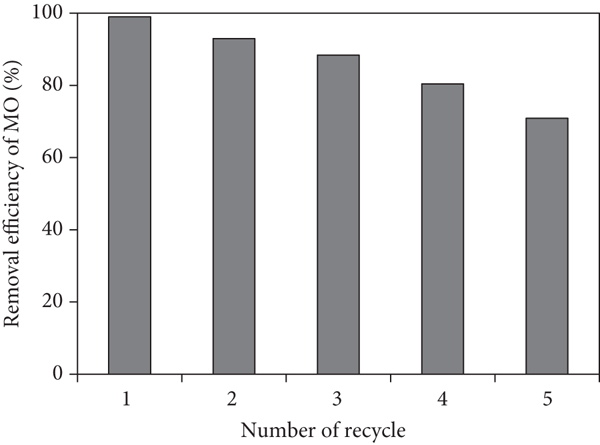
Reusability number efficiency of the adsorption of MO on AlgN-CTAB.
3.9. Comparing the AlgN-CTAB Adsorption Capacity to Other Materials
AlgN-CTAB is an adsorbent which is very effective in absorbing MO dyes. This may be observed from the value of
Comparing the adsorption capacity of MO on AlgN-CTAB with other adsorbents.
4. Conclusions
Biomass modification of Nannochloropsis sp. with CTAB surfactant through cation exchange reaction to produce adsorbent Nannochloropsis sp.-cetyltrimethylammonium bromide (AlgN-CTAB) has been successfully carried out. The ability of the AlgN-CTAB adsorbent to absorb methyl orange (MO) anionic dye is optimum at an
Footnotes
Data Availability
The data used to support the findings of this study are available from the corresponding author upon request.
Conflicts of Interest
The authors declare that they have no conflicts of interest.
Acknowledgments
This work was funded by Ministry of Education, Culture, Research and Technology (Kemdikbudristek) of the Republic of Indonesia with contract number 120/E4.1/AK.04.PT/2021. The authors thank the Center for Marine Cultivation Development-Lampung (Balai Besar Pengembangan Budi Daya Laut (BBPBDL) Lampung) for participating in this research.