




Abstract
Diatomite was slightly modified with a sodium hydroxide solution. The resulting material was characterized by using energy-dispersive X-ray spectroscopy (EDX), X-ray diffraction (XRD), Fourier-transform infrared spectroscopy (FT-IR), scanning electron microscopy (SEM), and nitrogen adsorption-desorption isotherms. The so-treated diatomite has a high specific surface area (77.8 m2/g) and a high concentration of isolated silanol groups on the surface, and therefore, its adsorption capacity increases drastically in both the single and binary adsorption systems for rhodamine B and methylene blue. The binary system is more effective than the single system, with methylene blue being adsorbed more than rhodamine B. The adsorption process is spontaneous and fits well with the Langmuir isothermal model, and it depends on pH significantly.
1. Introduction
Dyes are widely used in numerous applications, such as textile, paper, plastic, and dye industries [1]. The amount of dyes produced annually worldwide is estimated at over
A large number of dyes have a complex aromatic ring structure and are difficult to degrade biologically [4, 6]. Therefore, it is necessary to reduce their concentration in wastewaters prior to biological treatment. Chemical oxidation has been extensively studied for dye removal from wastewaters [1, 7–9]. However, oxidation often produces intermediate products that can cause secondary pollution. Meanwhile, the adsorption technique has proven to be a simple, efficient, and attractive way to remove nonbiodegradable pollutants (including dyes) from wastewaters [5, 10, 11].
To remove dyes from complex aqueous solutions, a variety of adsorbents have been used, such as banyan aerial roots [12], peat [2], bentonite [13], mesoporous silica nanoparticles [14], clay [15, 16], activated banana peel carbon [17], silica extracted from rice husk [18], and zeolite [19], and some of them exhibit high performance. However, the search for new, effective, cheap, and environmentally friendly adsorbents is on the way.
Diatomite is a low-density, small-particle sedimentary rock consisting mainly of amorphous silica (SiO2·nH2O) derived from diatoms. Diatomite encompasses a variety of structures and has high porosity (up to 80%), a large specific surface area, and multiple hydroxyl groups on the surface [3, 6, 10, 11, 20]. These properties enable diatomite to be a potential adsorbent for the pollutants present in industrial wastewaters, including dyes. Besides, diatomite is abundant in nature, cheap, and environmentally friendly [11]. Several studies have dealt with the applicability of natural diatomite in the adsorption field [6, 10, 11, 21–23]. Other studies have focused on diatomite surface modification with metals or organic functional groups to improve adsorption efficiency or expand its applications [1, 7–9, 24–32]. In some studies, natural diatomite is treated thermally [3, 10, 20, 33, 34], with acids [3, 20, 35–37], or with alkalines [4, 37, 38] to enhance its application performance. Other studies use diatomite as a raw material to manufacture other products [14, 35, 39–42]. The diatomite purified by calcining is also investigated by Yuan et al. [43]. They discovered that when the temperature increases, the condensation of surface silanol groups occurs. Hydrogen-linked hydroxyl groups condense more easily than isolated hydroxyl groups. Bronsted acid centers also condense at high temperatures. This condensation reduces the adsorption capacity of the diatomite treated by calcining toward base dyes. When treated with acids (normally at high concentration: 5 M H2SO4 [3], 5 M HCl [35], 1-5 M HCl [36], 10% HCl [20], and 1 M H2SO4 [37]), it is difficult to perform the modification and is easily contaminated by secondary pollution. Therefore, numerous studies have focused only on diatomite purification because it is cheap, easy to operate, and environmentally friendly [4]. When purified with alkali, diatomite retains its hydroxyl groups on the surface, and they are excellent adsorption centers for many metals as well as dyes.
Since most industrial wastewaters contain different pollutants, it is important to investigate the effect of multicomponent systems on the adsorption capacity. Various studies have studied the simultaneous removal of different pollutants from aqueous solutions [2, 5, 44] to assess the competitiveness of adsorbates. In this study, natural diatomite is activated by treating with low-concentrated sodium hydroxide to enhance the adsorption capacity for rhodamine B (RB) and methylene blue (MB) in single and binary systems. The equilibrium isotherms and thermodynamic parameters of the adsorption processes are studied. In addition, the effect of the solution pH on the adsorption efficiency of RB or MB in the single system is also investigated.
2. Materials and Methods
2.1. Materials
Natural diatomite was obtained from Phu Yen province, Vietnam. Natural diatomite was washed several times with water, dried at 100°C, sieved, and stored in closed containers for further tests. The product is called purified diatomite.
Sodium hydroxide (NaOH), hydrochloric acid (HCl), and potassium chloride (KCl) were purchased from Guangdong (China). Methylene blue (Guangdong, China) and rhodamine B (HiMedia, India) dyes were used as adsorbates. A summary of the main characteristics of these dyes is given in Table 1 [3, 5, 22, 27, 37].
Main characteristics of the dyes used in this study.
2.2. Activation of Diatomite
Purified diatomite was activated with NaOH to enhance the adsorption capacity. The purified diatomite sample was immersed in a 5% NaOH solution at a ratio of 1 : 10 (
2.3. Characterization
The chemical analysis of diatomite was performed by using energy-dispersive X-ray spectroscopy (EDX, JEOL JED-2300, Japan) at different sites of the material. The powder X-ray diffraction (XRD) patterns were recorded by VNU-D8 Advance, Bruker, Germany, with Cu Kα radiation (
2.4. Point of Zero Charge
The point of zero charge (pHPZC) of the adsorbent was determined to follow the methods of Mahmood et al. [45], Jing et al. [46], and Du and Hoai [47]. To a series of 100 mL Erlenmeyer flasks, 50 mL of a 0.01 M KCl solution was added. The initial pH (pHi) of the solutions was adjusted, ranging from 2 to 12, by adding a 0.1 M HCl or 0.1 M NaOH solution. Then, 0.1 g of the adsorbent was added to each flask and mixtures were shaken for 48 h. The final pH (pHf) of the solutions was measured. The difference between the final and initial pHs (
2.5. Adsorption
2.5.1. Adsorption Experiments
Adsorption experiments were carried out with a typical batch approach in a 250 mL round flask with a reflux condenser. In each experiment, 0.02 g of the adsorbent was stirred with 100 mL of a solution containing RB (or MB or a mixture of RB and MB) at a specific concentration, and the temperature of the reactor was fixed at 30 or 45°C. After a certain interval, 5 mL of the solution was withdrawn and centrifuged to remove the adsorbent, and the concentration of the remaining solution was determined. The concentration of dyes was determined with the UV-Vis method on UVD-3000 (Labomed, USA) at
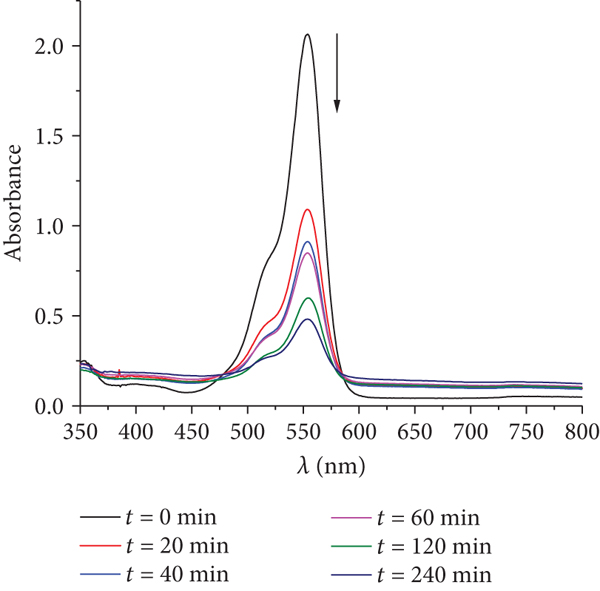
UV-Vis absorption spectra for aqueous solutions of (a) RB, (b) MB, and (c) both of the dyes along with alkali-activated diatomite at various adsorption times.


The influence of initial pH (3, 5, 7, 9, and 11) was also studied in a single system with a similar procedure.
2.5.2. Isothermal Models
In this work, the Langmuir and Freundlich two-parameter models were used to analyze the adsorption equilibrium data.
The Langmuir model is based on the assumption that the adsorption is a monolayer; that is, the adsorbates form a monolayer and all the sorption sites on the adsorbent surface have the same affinity for the adsorbates. The Langmuir isotherm equation [48] is as follows:
The plot of
The Freundlich expression is an exponential equation and therefore assumes that as the adsorbate concentration increases, the concentration of the adsorbate on the adsorbent surface also increases. The Freundlich isotherm is expressed by the following empirical equation [48]:
The linear form of the Freundlich equation is
The plot of
2.5.3. Thermodynamic Parameters
To determine whether the adsorption process occurs spontaneously or not, we have to study the thermodynamic parameters. At equilibrium, the Gibbs free energy of adsorption (
For the adsorption process,
In this study, the adsorption constant in the Langmuir isotherm (
3. Results and Discussion
3.1. Characterization of Purified and Alkali-Activated Diatomite Samples
As can be seen from Table 2, both the purified and alkali-activated diatomite samples mainly consist of O, Si, Al, and Fe. Alkali-activated diatomite has a lower O and Si content than purified diatomite, and this is probably due to the removal of organic constituents and the dissolution of SiO2 during alkali treatment. This decrease entrains the increase in the content of Fe and Al.
Elemental composition of the diatomite samples (
Both the purified and alkali-activated diatomite samples have an amorphous structure (Figure 2(a)). The broad peaks at 20-25° are typical for amorphous SiO2 [1, 32, 37, 39, 51]. The absence of the peak around 27° indicates that the diatomite in our study does not contain quartz crystals like other types of diatomite [1, 26, 30, 32, 35, 37, 39, 40].

XRD pattern (a) and FT-IR spectra (b) of the diatomite samples.
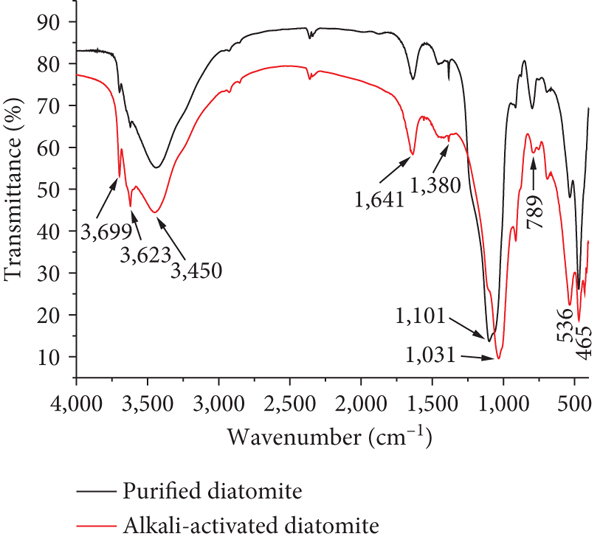
The FT-IR spectra of the diatomite samples are similar (Figure 2(b)). The broad absorption bands at 3450 cm-1 and 1641 cm-1 correspond to the adsorbed H2O, including interlayer water and hydrogen-bonded water with surface hydroxyl groups. A broad band centered at 1101-1031 cm-1 and two bands at 789 cm-1 and 465 cm-1 correspond to the asymmetric stretching vibration, symmetric stretching, and bending vibration of Si-O-Si bonds, respectively [1, 20]. The peaks observed at 3699 cm-1 and 3623 cm-1 are assigned to surface hydroxyl groups in diatomite. The peak at 3699 cm-1 is attributed to the isolated hydroxyl (Si-OH) on the surface of diatomite [1, 43, 55], while the peak at 3623 cm-1 belongs to O-H stretching vibration of the aluminol groups (≡AlOH) [55]. Alkali-activated diatomite has high-intensity peaks for O–H stretching, indicating that more isolated hydroxyl groups are present on the surface. The peak at 536 cm-1 corresponds to the stretching vibration of Fe-O [1]. The peak at 1380 cm-1 is attributed to some organic substances [20]. The intensity of this peak is lower in alkali-activated diatomite than in purified diatomite samples, indicating the removal of organic substances from purified diatomite during NaOH treatment.
The SEM images show that purified diatomite consists of circular cylinders of a diameter of about 5-7 μm, with small pores on the surface (Figures 3(a) and 3(b)). However, these cylinders are partly shattered, causing the pores to become smaller and even blocked. The alkali-activated diatomite retains its multipore structure, and the pores on the surface become larger after treatment (Figures 3(c) and 3(d)). This change may be the result of the formation of soluble silicates

SEM images. (a, b) Purified diatomite. (c, d) Alkali-activated diatomite.


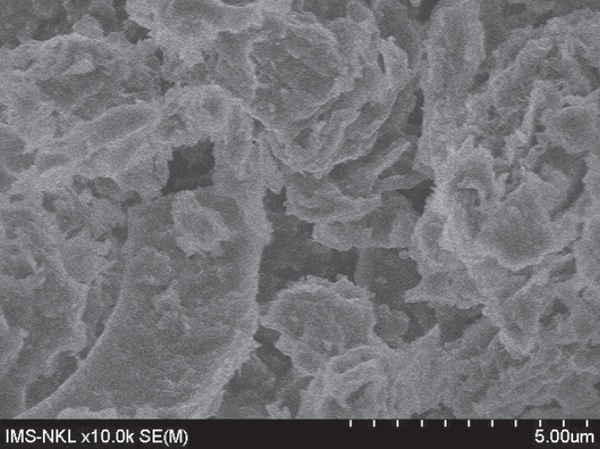
Figure 4 shows the nitrogen adsorption-desorption isotherms and pore size distribution of the diatomite samples. The diatomite exhibits a type II isotherm and an H3-type hysteresis loop, indicating the presence of macroporous structures with nonuniform size and/or shape [56]. Thus, the morphology of the diatomite consists of a variety of shapes (Figure 3). However, the pore size distribution curves of the diatomite samples demonstrate a uniform pore size with an average diameter of 4.3 nm. The textural properties of the samples are presented in Table 3. According to the Brunauer-Emmett-Teller analysis, the purified diatomite exhibits a large specific surface area of 55.4 m2/g. This value is consistent with that reported by Son et al. [6] (51 m2/g) for Phu Yen’s diatomite and is much higher than that published in previous works [4, 8, 11, 20, 24, 26, 32, 38, 55] (1.0-27 m2/g). It can be seen from Table 3 that the specific surface area of alkali-activated diatomite (77.8 m2/g) is significantly larger than that of purified diatomite. This increase in the surface area results from the removal of organic impurities during the alkali treatment.
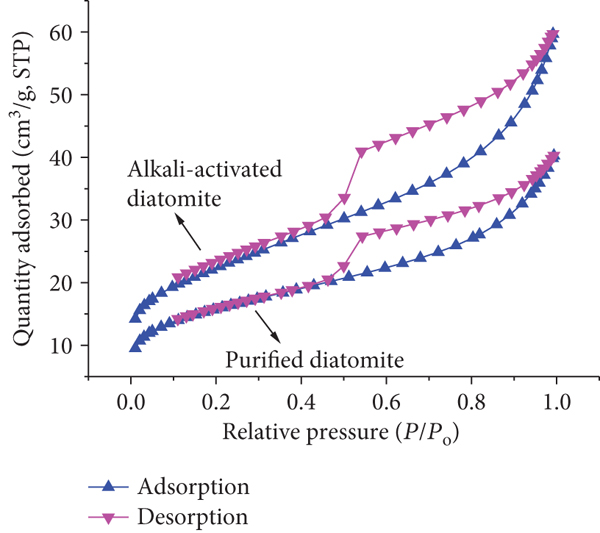
Nitrogen adsorption-desorption isotherms (a) and pore size distributions (b) of the diatomite samples.

Textural properties of the diatomite samples.
The zero charge point of purified diatomite is 5.7 (Figure 5). This pHPZC is similar to that published in the literature [6, 11, 21, 22]. However, the pHPZC of alkali-activated diatomite (8.9) is much greater than that of purified diatomite. This increase is probably due to the formation of isolated hydroxyl groups on the surface of the material during alkali treatment.
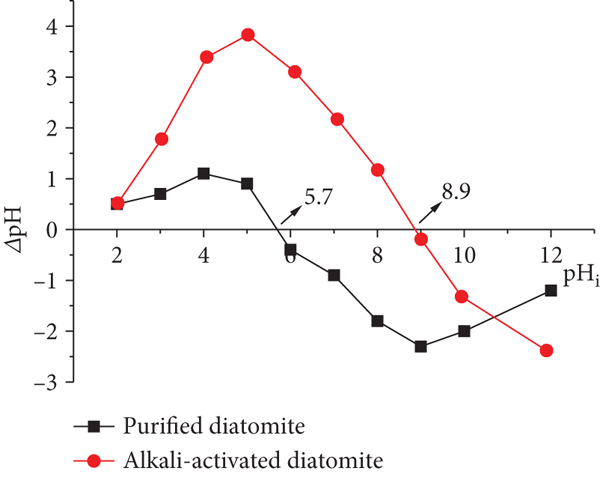
Determination of the point of zero charge of the diatomite samples.
3.2. Isothermal Studies
3.2.1. Adsorption in Single Systems
(1) Adsorption of RB onto Purified and Alkali-Activated Diatomite Samples. Figures 6 and 7 present the Freundlich and Langmuir isothermal models for the adsorption of RB dye onto the diatomite samples at 30 and 45°C. The isothermal parameters obtained from the experimental data and the respective correlation coefficients are listed in Table 4. It can be seen that the experimental points fit the models well with high correlation coefficients (0.9104-0.9955). Table 4 also shows that the maximal RB adsorption capacity of the alkali-activated diatomite sample is greater than that of the purified diatomite sample. Thus, the activation of diatomite with sodium hydroxide enhances the adsorption of the RB basic dye on diatomite. This enhancement can be attributed to a larger number of the silanol groups formed on the surface, as well as the larger specific surface area of the material.

Freundlich isothermal model for RB adsorption onto diatomite: (a) 30°C and (b) 45°C.


Langmuir isothermal model for RB adsorption onto diatomite: (a) 30°C and (b) 45°C.

Isotherm parameters for adsorption of RB onto the diatomite.
The results presented above show that alkali-activated diatomite is superior to purified diatomite in terms of chemical and physical properties and adsorption capacity. Therefore, in the following sections, only an alkali-activated diatomite sample is used for the adsorption of dyes from aqueous solutions.
(2) Adsorption of MB onto Alkali-Activated Diatomite. The MB adsorption isotherms onto alkali-activated diatomite were also investigated and analyzed according to the linear Freundlich and Langmuir equations. Analysis results are shown in Figure 8 and Table 5. In this case, the Langmuir model is significantly more suitable to describe the adsorption data than the Freundlich model (

Plots of the isothermal equations in the linear form for MB adsorption onto alkali-activated diatomite at different temperatures in the single systems: (a) Freundlich and (b) Langmuir.
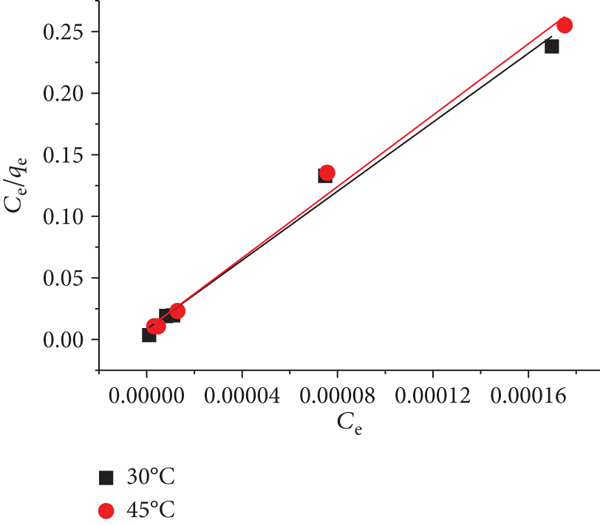
Isotherm parameters for adsorption of MB onto alkali-activated diatomite in the single systems.
3.2.2. Adsorption onto Alkali-Activated Diatomite in Binary Systems
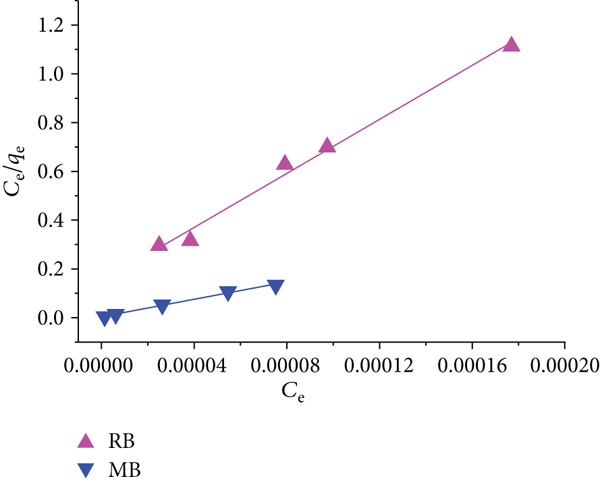
Like in the single system, in the binary system, the adsorption of the dyes at 30 or 45°C also follows the Langmuir isothermal model with the

Plots of the isothermal equations in the linear form for the adsorption onto alkali-activated diatomite in the binary systems at 30°C: (a) Freundlich and (b) Langmuir.

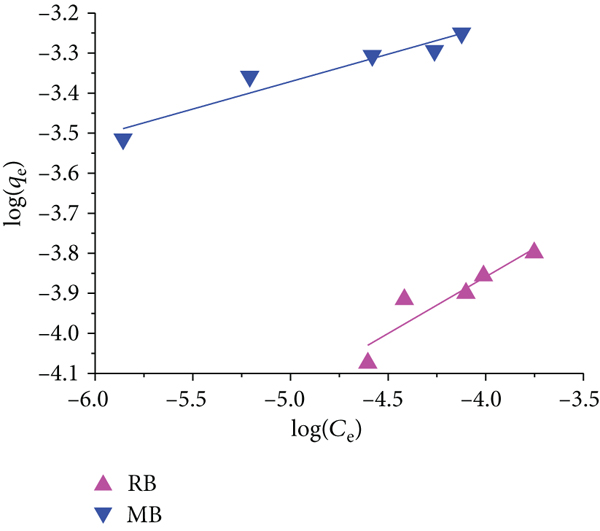
Plots of the isothermal equations in the linear form for the adsorption onto alkali-activated diatomite in the binary systems at 45°C: (a) Freundlich and (b) Langmuir.
Isotherm parameters for the adsorption onto alkali-activated diatomite in the binary systems at different temperatures.
Table 7 compares the adsorption capacity of the diatomite samples for RB and MB in this study and that of other adsorbents published in the literature. It can be seen that alkali-activated diatomite has a much higher adsorption capacity than all other adsorbents. Therefore, alkali-activated diatomite might serve as a promising adsorbent for the removal of dyes from aqueous solutions.
Maximum adsorption capacity of RB and MB of different adsorbents.
3.3. Thermodynamic Studies
The spontaneity of the adsorption process and the interactions on the liquid/solid interface can be explained by using thermodynamic parameters (
The thermodynamic parameters of RB and MB adsorption onto the diatomite samples are calculated from Equations (9)–(11). The
Thermodynamic parameters for adsorption of RB onto purified diatomite in single systems.
Thermodynamic parameters for the adsorption of the dyes onto alkali-activated diatomite.
3.4. Effect of Solution pH
Figure 11 shows the effect of solution pH on the adsorption of RB and MB onto alkali-activated diatomite in the single system. The pH of the solution was adjusted between 3 and 11 with a 0.1 M HCl or 0.1 M NaOH solution.

Removal efficiency of the dye onto alkali-activated diatomite at different initial solution pHs in the single systems: (a) RB and (b) MB (adsorbent dosage 0.2 g·L-1, initial RB concentration

As can be seen from Figure 11(a), the adsorption efficiency of RB reaches 94% after 240 min of contact at pH 3. At higher pH, this efficiency decreases drastically, reaching 37% up to pH 5–9 and even lower (30%) at pH 11. We know that RB has a carboxylic group in its molecule, and this group dissociates at higher pHs of the solution. This dissociation renders the molecule negative, resulting in the electric repulsion between RB and the negative surface of the adsorbent at high pH. This result is consistent with that of Eftekhari et al. [5].
For MB (Figure 11(b)), the adsorption efficiency reaches 100% after a short time (60 min) of contact at pH 3–9. The efficiency only decreases to around 60% at pH 11.
The zero charge point of alkali-activated diatomite is 8.9 (Figure 5). Theoretically, the surface of the material is positively charged when
4. Conclusions
Alkali-activated diatomite is applied to adsorb RB and MB in the single and binary systems. The treatment with sodium hydroxide increases the surface area of the diatomite from 55.4 m2/g to 77.8 m2/g and creates a large number of free silanol groups on the surface of the material. This increases the material’s ability to adsorb RB and MB. The adsorption equilibrium data of RB and MB onto alkali-activated diatomite fit the Langmuir model in both the single and binary systems. MB has a higher affinity to the adsorbent than RB, and the binary system is more effective than the single system. The adsorption process is spontaneous, and the removal efficiency of both MB and RB depends on pH significantly.
Footnotes
Data Availability
The data used to support the findings of this study are available from the corresponding author upon request.
Conflicts of Interest
The authors declare that they have no conflicts of interest.
Acknowledgments
This research is funded by Thu Dau Mot University under grant number DT.21.1-018.