




Abstract
We investigate the physical-layer security of a wireless sensor network comprised of a source-destination pair, multiple decode-and-forward (DF) relays, and an eavesdropper. When the relays forward the source signal to the destination, they should dissipate certain power for driving their physical circuits (e.g., amplifiers and filters), in addition to the transmit power required for emitting radio signals. However, no existing work considers the circuit power when exploiting relays for enhancing the wireless security against eavesdropping. We thus propose the relay-selection based cooperative beamforming framework, where partial relays are selected to forward the source signal in a beamforming manner. We present two relay-selection strategies, namely, the exponential-complexity exhaustive search and linear-complexity relay ordering. For comparison purposes, we also evaluate the conventional all-relay based and best-relay based beamforming schemes, where all relays or only the best one is selected to assist the source-destination transmission. It is shown that the proposed beamforming schemes significantly outperform the conventional all-relay and best-relay based beamforming schemes in terms of secrecy capacity. Additionally, the relay-ordering based beamforming scheme almost achieves the same secrecy capacity as the exhaustive-search method, but with a reduced computational complexity.
1. Introduction
Wireless sensor networks (WSNs) provide efficient data acquisition and processing solutions for various applications such as factory automation, environment monitoring, and battlefield reconnaissance. Cooperative communication is a popular technique in WSNs to improve system reliability and throughput as sensor nodes are usually equipped with single antenna and the destination node might be out of the coverage of the source node. However, the broadcast nature of wireless medium brings not only the feasibility of sensor cooperation, but also the vulnerability to wiretapping. Although cryptographic techniques are widely used in modern communication systems, information leakage is still likely to happen if brute-force attack occurs. Hence, it is necessary to further enhance the overall system confidentiality through physical-layer security (PLS) schemes.
Wyner pioneered the study of PLS by proving that it is possible to communicate safely without a secret key in a degraded broadcast channel [1]. His results were extended to nondegraded channels [2] and Gaussian wiretap channels [3] in 1978 and were further extended to general fading wiretap channels in 2008 [4]. PLS has exerted a tremendous interest on a growing number of researchers ever since. Recently, a lot of attention has been drawn to the improvement of secrecy capacity (which is defined in [3] as the difference between the capacity of the legitimate link and that of the wiretapping link) by incorporating relays [5–9] and performing beamforming [7–12].
Beamforming technique is widely used in relay systems [13–15] as an effective way to improve the received signal-to-noise ratio (SNR) at the destination. The core idea of applying beamforming in traditional relay systems without security concerns is to exploit the magnitudes and phases of the relay-to-destination channels and accordingly adjust the transmit powers and phases of the signals that are to be transmitted from several relays bearing a common message, so as to combine the signals at the destination constructively [14]. However, for relay systems with security concerns, the beamforming technique needs to exploit the channel information of both the destination and the eavesdropper. And the objective is no longer the received SNR at the destination but the secrecy capacity.
Among the aforementioned works in the area of beamforming for PLS purposes, [7] studied beamforming schemes for decode-and-forward (DF), amplify-and-forward (AF), and cooperative jamming where all available relays were adopted, either to retransmit the source signal or to send an artificial noise to confound the eavesdropper. Null-space beamforming was proposed in [8] to hide the information signal in the null-space of the relay-eavesdropper channel. These beamforming schemes were designed with perfect channel information of the wiretapping link while in [9, 11, 12, 16, 17], the authors proposed their schemes based on imperfect channel information or even no channel information of the wiretapping link. Although the assumption of imperfect channel information or even no channel information of the wiretapping link is more practical, the models in these papers do not accord with WSNs since sensors are usually equipped with single antenna. Besides, relay-selection (RS) strategies have also been studied in [5, 6] where the single best relay that can provide the maximal secrecy capacity or minimal secrecy outage probability is selected. Although the best-relay-selection strategy is easy to deploy, it sacrifices some security performance. It will be pointed out that although the models and assumptions of the relay/multiantenna systems are different, a common conclusion that system security improves with the increase of relay/antenna number and relay/antenna transmit power can be drawn.
The above existing studies that exploit relays to enhance system security are designed with only consideration of transmit power. No attention was paid to circuit power consumption (CPC) which is indispensable for relays to drive the circuit blocks. As a matter of fact, in a WSN, the dense distribution of sensors allows them to transmit with a low power that might be comparable to or even overwhelmed by the circuit power, which makes the negligence of CPC improper. Furthermore, the sensor nodes are usually powered by batteries which provide energy for both signal transmission and processing. Hence, the traditional power constraints need to be modified in a WSN. The consequence of incorporating CPC is that the increase of relay number means the decrease of relay transmit power; thus, it is unclear whether system security still can be improved if more relays are adopted. In fact, [18–20] have revealed that, in multiantenna/cooperative systems without eavesdroppers, using more antennas/relays might degrade the system performance if the total power is constrained. However, no existing work considering CPC takes system security as a metric of interest. This motivates us to reveal whether the same result exists in a security-oriented cooperative WSN and how to select the best relays if it does.
The main contribution of our work can be described as follows. We take CPC into account to perform cooperative beamforming, whereas existing literature on the cooperative beamforming aided PLS fails to consider the CPC. Our work shows that when CPC is considered, adopting more relays may degrade the secrecy capacity performance, which, to the best of our knowledge, has not been revealed by any previous work. It is thus important but challenging to determine which relays should be selected to form an optimal beamforming vector. Although the exhaustive-search approach is effective in finding the optimal relays, its computational complexity grows exponentially with the number of relays. To this end, we propose a relay-ordering based beamforming scheme which has only a linear computational complexity but achieves nearly the same security performance as the exhaustive-search aided beamforming scheme does.
The remainder of this paper is organized as follows. Section 2 establishes the system model along with the total power constraint which includes both transmit power and circuit power. Section 3 first updates the conventional all-relay based and best-relay based beamforming schemes by incorporating CPC and then proposes two partial-relay-selection based beamforming schemes. In Section 4, the four schemes described in Section 3 are evaluated in terms of their secrecy capacity performance. Conclusions are drawn in Section 5.
2. System Model
Consider a cooperative WSN consisting of a source-destination pair with K helpers

A cooperative WSN in the presence of an eavesdropper. The relays in the decoding set are shaded. Solid line: legitimate link; dashed line: eavesdropping link.
Note that many of the previous beamforming designs assumed perfect instantaneous channel state information (CSI) of both the legitimate link and the eavesdropping link. In practical scenarios, however, the eavesdropper is probably passive, so it might be difficult to attain its instantaneous CSI due to the absence of feedback. Hence, following [6, 16, 17], in this paper, we assume that only statistical information of the eavesdropping link is priorly known since it is possible that the location of the eavesdropper is roughly known.
In the first hop, the source transmits
The respective received signals at the destination and the eavesdropper can be expressed as

To obtain the total power constraint on relays with CPC included in a generic way, we divide the CPC of each relay into two parts, one of which is independent of the transmit power and the other of which is dependent. For


3. Relay-Selection Based Beamforming Schemes for PLS
A widely used metric of interest in security-oriented systems is secrecy capacity


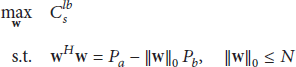

In order to prove that the optimal RS strategy is to select partial relays as well as for subsequent comparison purpose, we first update the conventional schemes where either all relays or only one best relay is selected, namely, the all-relay based and the best-relay based beamforming schemes; then we present the partial relay based schemes.
3.1. Conventional Beamforming Schemes for PLS
3.1.1. All-Relay Based Beamforming Scheme
Consider that all the candidate relays are selected to assist the source; that is,


This scheme only works when the power budget for relays is high enough to drive the circuit blocks in all M relays; that is,
3.1.2. Best-Relay Based Beamforming Scheme
Opportunistic relaying is also a common relaying strategy where only one best relay is selected. The best relay, say

Apparently, if

3.2. Proposed Beamforming Schemes for PLS
The objective in (8) is a Rayleigh quotient [22]; to maximize it the eigenvalue decomposition (EVD) method is usually used. However, the argument in this objective is self-constrained. It is infeasible to directly use the EVD method on this problem. To break the self-constraint, we need to preassume the relays to be selected. For simplicity, we assume
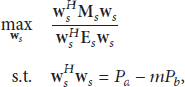

The next step is to determine the optimal relays to be selected; that is,

3.2.1. Exhaustive-Search Based Beamforming Scheme
It is obvious that the only way to obtain the optimal value of
Algorithm 1 (exhaustive-search based beamforming scheme).
The algorithm is described as follows:
For each The optimal set of relays is selected according to The optimal weight vector for
3.2.2. Relay-Ordering Based Beamforming Scheme
It will be noticed that the computational complexity of the exhaustive-search scheme is exponential in network size. To overcome this disadvantage, we introduce relay ordering into the RS strategy so that the computation will be significantly reduced.
If the received SNRs are high, the optimization problem in (13) is approximate to


Algorithm 2 (relay-ordering based beamforming scheme).
The algorithm is described as follows:
Order the candidate relays as Set The optimal set of relays is selected according to The optimal weight vector for
Remarks. (i) Firstly, although the relay-ordering criterion is obtained by assuming high received SNRs, if the interrelay distances are much smaller than the relay-eavesdropper distances (which is widely assumed in relay systems), the relay-ordering based scheme is indeed the optimal scheme. In this case,



4. Simulation Results
This section examines the performance of the proposed schemes. For simplicity, some of the circuit blocks are omitted such as the encoder, decoder, and pulse shaping block. Analog-to-digital converter and digital-to-analog converter are also omitted since their power consumption is relative to the hardware type. The resulting
The number of helpers is set to 4, so the sample space of
Figure 2 shows the relationship between the average number of selected relays and the power budget for relays with the eavesdropper in two different locations. Since the curves of the two proposed schemes are close to each other, we provide Table 1 as well, to show the percentage error of the average number of adopted relays in the relay-ordering based scheme as compared with the optimal number obtained in the exhaustive-search based scheme.
Percentage error of the average number of adopted relays.

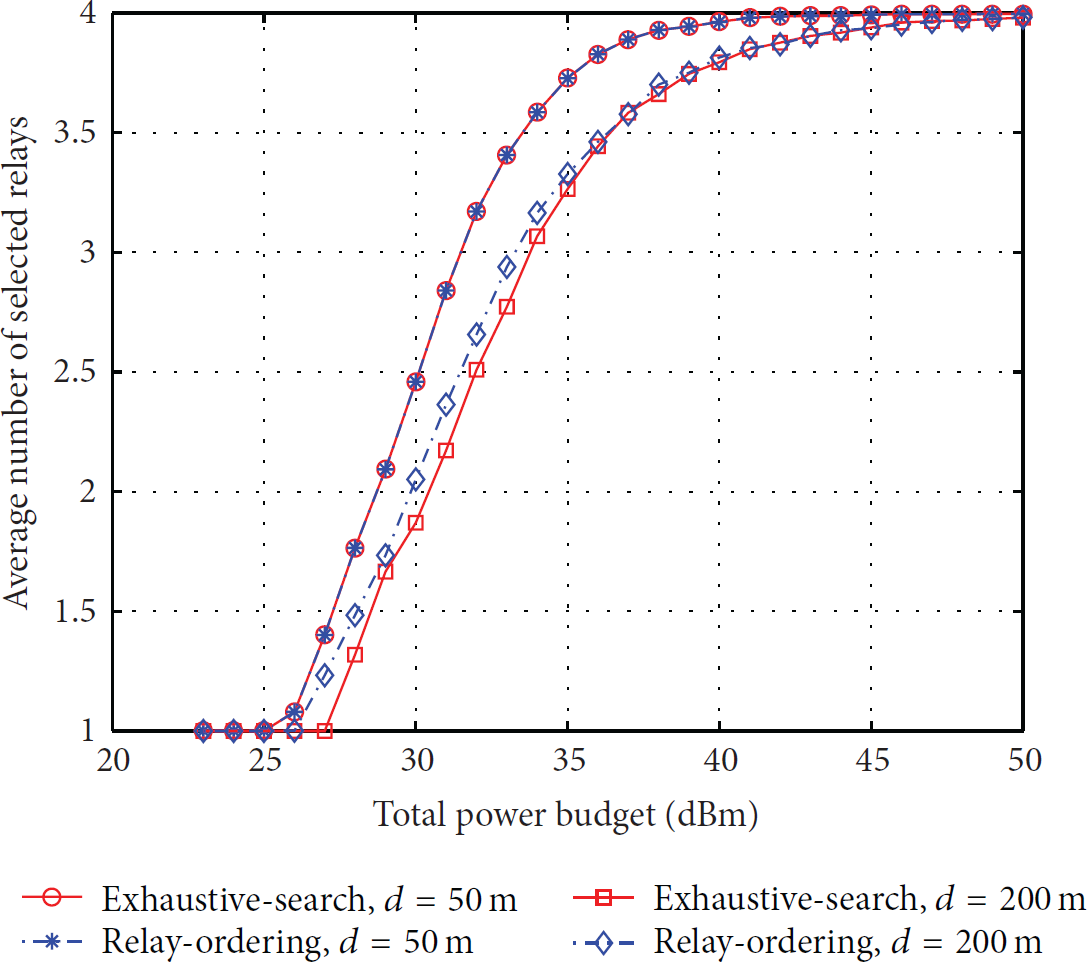
Average number of selected relays versus total power budget.
Notice that a total power budget of 29 dBm is enough to drive all the circuit blocks in all helpers. However, the average optimal number of relays obtained by exhaustive search is only 2.09 when
It is worth mentioning that, according to Figure 2, for a fixed power budget, the farther the eavesdropper is, the fewer relays we should adopt. This indicates that as the helper-eavesdropper distance increases, the benefit brought by the increase of transmit power surpasses that by the increase of relay number.
Figure 3 compares different schemes in terms of the secrecy capacity they achieve with

Performance comparison of different beamforming schemes.
5. Conclusion
We investigated beamforming schemes in a cooperative WSN for PLS with consideration of both transmit power and circuit power. We first revealed that the optimal beamforming scheme should be performed along with a partial RS strategy and then provided two partial RS based beamforming schemes, namely, the exhaustive-search based scheme and the relay-ordering based scheme, both of which adjust the selected relays dynamically according to the channels and the power budget. Simulation results show that our schemes combine the advantage of the all-relay based scheme in high power range and that of the best-relay based scheme in low power range. Moreover, the relay-ordering based scheme achieves almost the same secrecy capacity as the exhaustive-search based scheme does, but with a dramatically reduced computational complexity.
Footnotes
Competing Interests
The authors declare that they have no competing interests.
Acknowledgments
This work was supported by the Natural Science Foundation of China under Grants 61302101 and 61401223 and by the Graduate Innovation Plan of Jiangsu Province under Grant CXZZ12_0463.