




Abstract
Information-Centric Networking advocates ubiquitous in-network caching to enhance content distribution. Nonsafety application in vehicular communications is emerging beyond the initial safety application. However, content distribution based on TCP/IP Internet service in vehicular networks suffers from typical issue of low delivery ratio in urban environments, where high buildings block or attenuate the radio propagation as well as short radio coverage range. In order to solve this issue to deliver proximity marketing files, in this paper we propose in-network caching scheme in vehicular networks in accordance with traffic features, in which every vehicle is treated as either a subscriber to request a file or as a cache node to supply other nodes so as to accelerate file transmission effectively. Cache strategy of leave copy everywhere is uncoordinated and distributed, which fits the random and dynamic vehicular network. The performance evaluation is carried out by comparing the proposed scheme with the legacy solution of TCP/IP based scheme using simulation tools of OMNeT++ and Veins and SUMO, which is supplied with real-world urban map associated with random but reasonable traffic routes generated by our designed software for every vehicle. The simulation results validate the proposed scheme in four aspects: robustness resisting obstacle buildings, reliability and scalability in different traffic loads, low utilization ratios of RSUs and Internet resource, and efficiency of cache functions.
1. Introduction
Information-Centric Network (ICN) has motived the development of future Internet architectures instead of the current Internet of host-to-host communication model [1–3]. The common goal of ICN is to achieve efficient and reliable content distribution by providing a general platform for communication services that are today only available in dedicated system such as peer-to-peer (P2P) overlays and proprietary content distribution networks [1, 2]. ICN leverages in-network caching to provide a better-performing and more robust transport service. In-network caching has emerged as a distinct research field in the context of ICN [4].
Nonsafety application in vehicular communications is emerging beyond the initial safety application such as driving safety and driving efficiency [5–8], underlying the trend that multimedia contents will represent more than 90% of the whole Internet traffics in a few years [9, 10]. Additionally, the delay tolerant data service of nonsafety application in vehicular networks is recently considered to take advantage of sensor networks instead of relying on 4G-LTE Internet service. In-network caching embedded in vehicular networks becomes a prospective direction associating with the upsurge of new generation Internet because the characteristics of ICN match the requirement of vehicular networks, which is merely focusing on information itself in the most of cases rather than addressable vehicle entities like traditional IP networking paradigm.
In this paper, we address an application with respect to in-network caching technique leveraged in vehicular networks for proximity marketing file distribution in a metropolitan area, since cities as the centers of life and business are vitally important places to take advantage of the modern technologies to help people acquire information and to provide more comfortable experiences. We will review the recent developments, challenges, and related work and then propose in-network caching based scheme in the next section.
2. Background, Related Works, and Our Contributions
For vehicular communications, the automotive industry has standardized multiple radio and medium access technologies, for example, DSRC (Dedicated Short Range Communications) and WAVE (Wireless Access in Vehicular Environments, IEEE 802.11p) for direct vehicle-to-vehicle communication (V2V) as well as RSU-to-vehicle communication (R2V) [6, 7, 11, 12]. Term “Short Range” in DSRC means that the communication takes place over hundreds of meters, a shorter distance than what cellular and WiMAX services typically support [13]. This means when vehicles are travelling at normal speeds, they can exchange information each other like mobile communications.
Although the primary motivation for deploying DSRC is to enable collision prevention application, it is also able to be used for more general entertainment and commercial purposes beyond collision avoidance. Even though nonsafety application offered by current DSRC technique is still restricted, we can foresee its extension in the future. Figure 1 shows an elemental scenario of the current TCP/IP based data delivery for nonsafety application, which occurs between road side units (RSUs) and vehicles through accessing Internet. RSU is a fundamental infrastructure as a bridge between Internet and vehicles. In this situation, RSU infrastructure is essential and unique equipment to deliver data to vehicles.

TCP/IP based file delivery scenario.
Currently safety application has been sufficiently investigated in many opened literature; however, nonsafety application is still underlying an initial stage. Some solutions can achieve good performance under the legacy TCP/IP paradigm. The literature in [6] indicates that coding techniques (coded storage) are effective for large files transmission over small files and could speed up the download of large files in vehicular networks. The work in [8] tackled content downloading in vehicular networks by optimizing APs (access points) deployment, V2V relay, and penetration rate. Although TCP/IP protocols have been proposed to run on top of vehicular networks for data exchange among vehicles [7, 11], a fundamental limitation is that the requirement of infrastructure support is essentially needed for global IP address allocation [7], which is somewhat infeasible to assume a sustainable availability on infrastructure support due to instability connectivity to RSU infrastructures such as radio attenuation caused by obstacle buildings and limited radio coverage range shown in Figure 1, as well as rapidly expanded Internet traffics. Besides, the cost for RSU deployments is enormous in some countries, particularly in Japan, because of rare land resource and expensive construction cost. Thus, decreasing the utilization and dependency on RSUs has to be taken into account when designing a new scheme.
So far, few literatures of applying ICN to VANET (vehicular ad hoc networks) exist, with some examples being [5, 7, 12]. In [7], Wang et al. proposed instructive idea in data naming, routing, data structure, and so on. In [5], the proposed framework called ICNoW (Information-Centric Networking on Wheels) focuses on the content and its scope in space, time, and user interest. In [12], the design called content-centric vehicular networking focuses on naming data, retrieval process, and preliminary evaluations and concludes that ICN outperforms the legacy solution of TCP/IP when consumers increase.
Our work in this paper addresses an in-network caching based scheme shown in Figure 2, which aims at solving the issue of low data delivery caused by obstacle buildings and short radio coverage range in a metropolitan area for proximity marketing file distributions. The proposed scheme makes an effort to achieve high data delivery ratios and to reduce the access frequency to RSUs and the Internet traffic by adding vehicle-to-vehicle communication model since every vehicle is equipped with an on-board cache. In-network caching based V2V communications enable effectively overcoming the impact from obstacle buildings and limited radio coverage range compared to R2V communications so as to improve data delivery ratios.

In-network caching based file delivery scenario.
We employ leave copy everywhere (LCE) cache strategy and broadcast on-path routing to vehicular networks, as well as proposing least recently used (LRU) replacement algorithm running in all of caches according to the characteristics of vehicular dynamic movements and frequent information exchange in commercial environments. Every vehicle plays a role of not only a subscriber to require files, but also an in-network cache for responding to other vehicles requirements.
In order to validate the proposed in-network caching based scheme, a series of simulation scenarios are carried out by OMNeT++ [14] and Veins [15] framework using a real-world urban map and road traffics, which are accommodated by SUMO [16] and OpenStreetMap [17]. The realistic traffic routes for each vehicle are randomly generated by our designed software; thus the real-world traffic system makes the simulation results more reliable for performance evaluation.
We evaluate in-network caching based scheme with legacy solution of TCP/IP based scheme in four aspects.
(1) Robustness Evaluation. First, how much impact on data transmission caused by obstacle buildings is evaluated for the two schemes by comparing their file delivery ratio using a middle traffic load scenario. Proposed in-network caching based scheme performs stronger robustness and stability in both of situations: whether the obstacles exist or not. In contrast, the data delivery ratio of legacy TCP/IP based scheme is seriously impacted, decreasing by obstacles. Proposed scheme performs more robust for resisting obstacle buildings.
(2) Reliability and Scalability Evaluation. An effective scheme should keep up a steady performance in various traffic situations: low, middle, or high traffic load. Simulation results of proposed scheme in different traffic loads present reliable, stable, and high data delivery ratios whether there are obstacle buildings or not; however, TCP/IP based scheme is obviously inferior to proposed one especially when obstacle buildings exist. Moreover, the good performance under the high traffic load demonstrates that the proposed scheme is appropriate for scalability applications.
(3) Low Utilization of RSUs and Internet Resource. RSU is a bridge between vehicles and Internet. On one hand, the broadcast frequency of RSUs represents how much service has been provided to the vehicles. On the other hand, it is an indirect metric to estimate Internet traffic. In our experiment setup, the more broadcast number of RSUs means the more utilization of RSUs, so the more dependence on RSUs the more consumption of Internet traffics. The simulation results indicate the proposed scheme performs much less broadcast frequency than TCP/IP based scheme. The proposed in-network caching undertakes major of file delivery relying on vehicle-to-vehicle communication instead of RSU-to-vehicle communication; however, in the legacy scheme, the file delivery only depends on RSU-to-vehicle communication, so that the legacy scheme has more broadcast sent from RSU compared to the proposed scheme.
(4) Cache Efficiency Evaluation. In-network cache is a core technique in the proposed scheme. The data delivery ratio is significantly improved by the cache function that undertakes vehicle-to-vehicle communications instead of a large portion of RSU-to-vehicle communications. In order to demonstrate this, we give a quantitative analysis on data delivery ratios of V2V communication and R2V communications, respectively, in different traffic loads to evaluate the cache efficiency.
The remainder of this paper is organized as follows. In Section 3, we propose in-network caching based scheme through analyzing the key issues and challenges, while legacy TCP/IP based scheme is also presented for comparison with the proposal. Additionally, two application cases corresponding to the proposed and compared schemes, respectively, are described. In Section 4, the simulation-based validations with discussions are carried out in various traffic scenarios. Finally, we conclude our work in Section 5.
3. Proposed In-Network Caching Based Scheme and Legacy Solution of TCP/IP Based Scheme
3.1. Our Proposal: In-Network Caching Based Scheme
Data transmission in vehicular networks suffers from a typical issue, low data delivery ratio in urban environments, where high buildings block or attenuate the radio propagation emitted from RSU infrastructures [18, 19]. On the other hand, other technical issues, for example, absolute necessity of connectivity with RSU for global IP address allocations, short radio wave coverage range, and limited APs (access points) deployment, cause serious dependency on RSU infrastructures. Although more RSUs could be deployed to increase coverage range of radio wave, it is deviated from the trend of reducing the cost of expensive infrastructure deployments and eliminating network traffics.
Increasing RSU deployment that is treated as an alternating solution in some literatures could well improve data transmission [8, 20], even though multi-RSU synchronization and capital costs are still difficult to be tackled [21, 22]. The multi-RSU deployment can enhance data transmission, but the improvement is not infinite for the sake of inherent nature of DSRC equipment and geographical environments.
Above issues are difficult to be tackled by legacy solution so that impels us to explore new solutions toward ICN paradigm. Considering overcoming the capital costs of ubiquitous RSU and developing more efficient data transmission scheme, another solution that facilitates data transmission between vehicles is addressed in this paper. The solution scheme should allow mobile nodes to dynamically create storage points for contents that could be distributed more quickly and more robustly. In-network caching is a prospective technique to achieve this.
Although there are sufficient cache strategies proposed for ICN in previous works, for example, LCD (leave copy down), MCD (move copy down), Prob (copy with probability), and ProbCache (a weighted probability cache) [23–26], due to the vehicular characteristics of mobility, short-lived and intermittent connectivity, the caching strategy has to be uncoordinated and distributed, which fits the random, dynamic, and unstable features in V2V communication. Thereby in-network caching scheme called leave copy everywhere (LCE) for every vehicle is borrowed for V2V communication in our work. LCE can extend radio coverage range and decrease relay time.
Besides, least recently used (LRU) replacement algorithm is proposed to run in all of caches. In a commercial region, proximity marketing files are concerned by people. LRU algorithm in caches is reasonable according to the link popularity.
In the proposed vehicular network shown in Figure 2, every vehicle plays two roles as not only a subscriber for requiring files, but also an in-network cache for responding to other vehicles interests and forwarding files to them. The caches store high popular proximity marketing files and undertake data delivery instead of frequent connectivity with RSU infrastructure without considering the impact of obstacle buildings so as to accelerate the file delivery effectively and mitigate the dependency on RSU.
The flowchart of application cases is shown in Figure 3. The target is to make all nodes capture the same file that is initially placed in a server. In the first step, RSU downloads the file from the server to respond to the Interest from the vehicular network. Secondly, the file is broadcasted by RSU to the vehicular network. A fraction of vehicles receive the file by RSU-to-vehicle communication and cache this file; these cars belong to Group 1. Other vehicles that do not receive the file from RSU belong to Group 2. The file is spread to Group 2 through vehicle-to-vehicle communication.
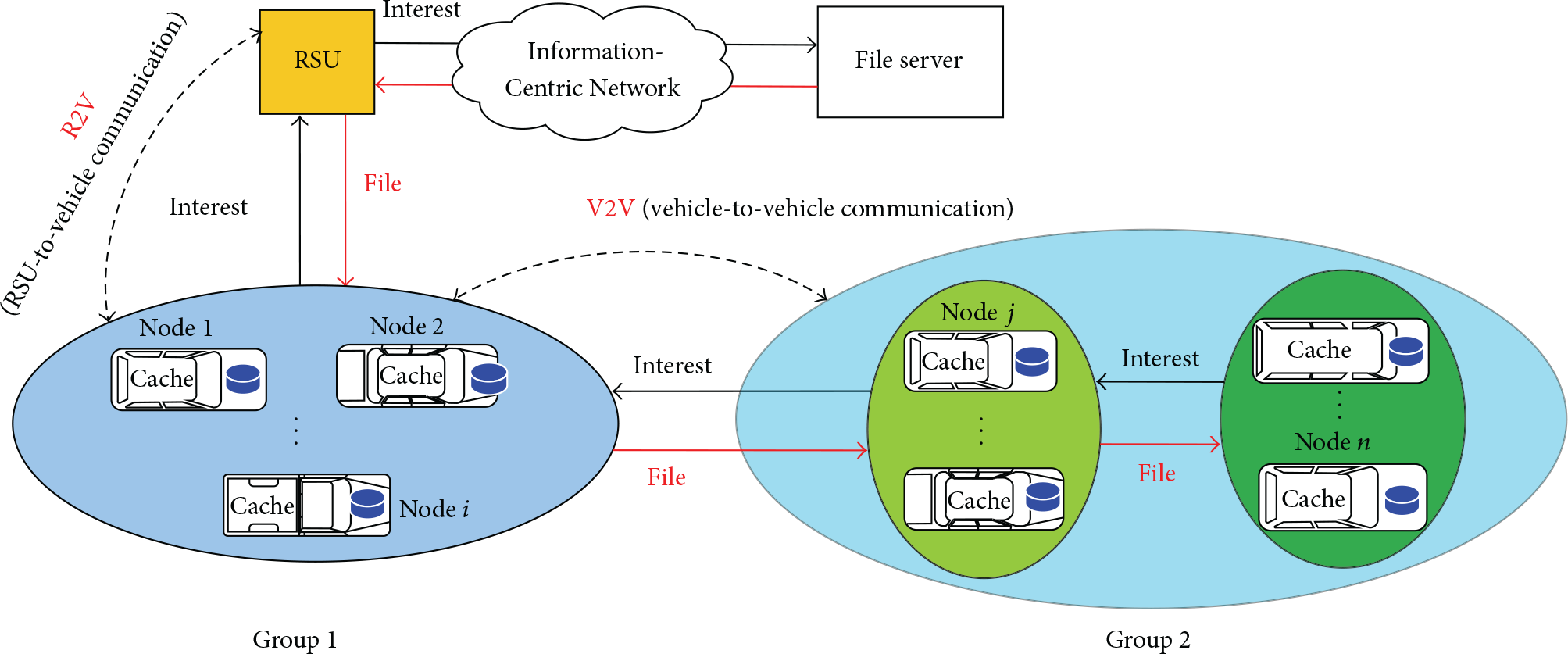
The flowchart of file transmission for proposed in-network caching based scheme.
The cache strategy of LCE is shown in Figure 4. The cache policy of Group 1 is shown in (1): after node i downloads the file from RSU, it caches this file. The cache policy of Group 2 is shown in (2) and (3). The nodes in Group 2 download file by two ways. One way is shown in (2): after node j gets the file from node i of Group 1, it caches this file. The other way is shown in (3): node n requests file via relay node j of Group 2 to node i of Group 1. On the back way, the file is cached in every node. Above operations are applied in every node.

Cache strategy of proposed scheme.
Furthermore, in order to increase data transmission happening between vehicle nodes (V2V communication) and reduce the utilizations of RSUs, we set up RSU broadcast frequency by responding to one per 10 interests.
3.2. Legacy Solution: TCP/IP Based Scheme
In the scenario of legacy scheme shown in Figure 1, all of vehicles capture files through RSU-to-vehicle communications. Although the file delivery could sometimes happen through V2V relay, indeed the last relay node still needs a connection with infrastructures. In another word, all cars have to capture data from RSU directly or indirectly. In accordance with this situation, we simplify the data delivery routes: assume all of cars capture data from RSU infrastructures. The vehicular network is seriously relying on RSU support.
Based on a condition of fair RSU resource, one RSU, same as proposed scheme, is deployed in legacy scheme. So an application case of TCP/IP based scheme is shown in Figure 5 for comparison with proposed scheme. When nodes request a file, they send a request to RSU, and RSU answers every request. And then RSU downloads the file from the server and broadcasts it to the nodes. Every car acquires the file only through the way of accessing the server via RSU. RSU-to-vehicle communications are the sole communication way in TCP/IP based scheme.
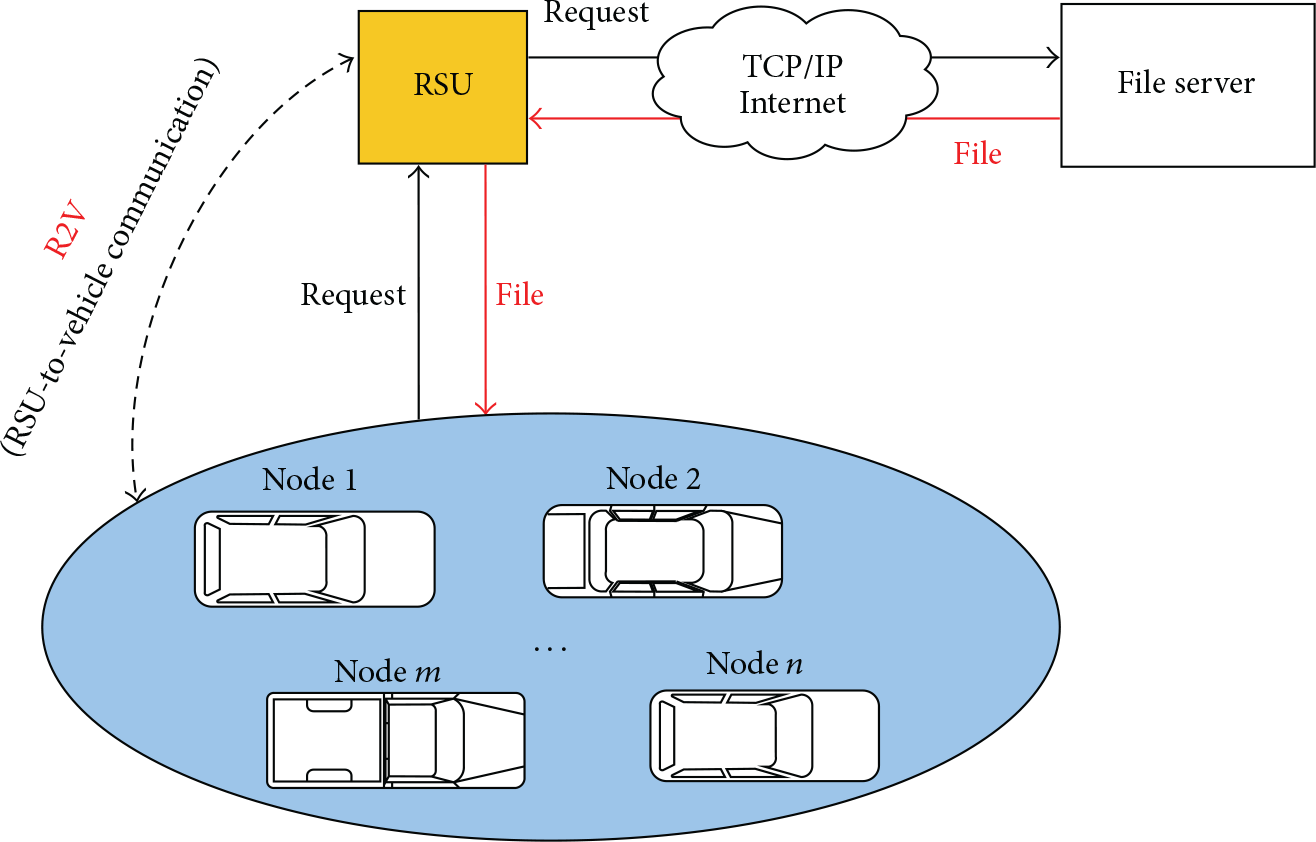
The flowchart of file transmission for TCP/IP based scheme.
The two application cases of the proposed and legacy schemes will be simulated in various scenarios in the next section.
4. Performance Evaluation
In this section, we present various traffic scenarios for the evaluation of the proposed scheme with experiment environments, simulation results, and corresponding discussions.
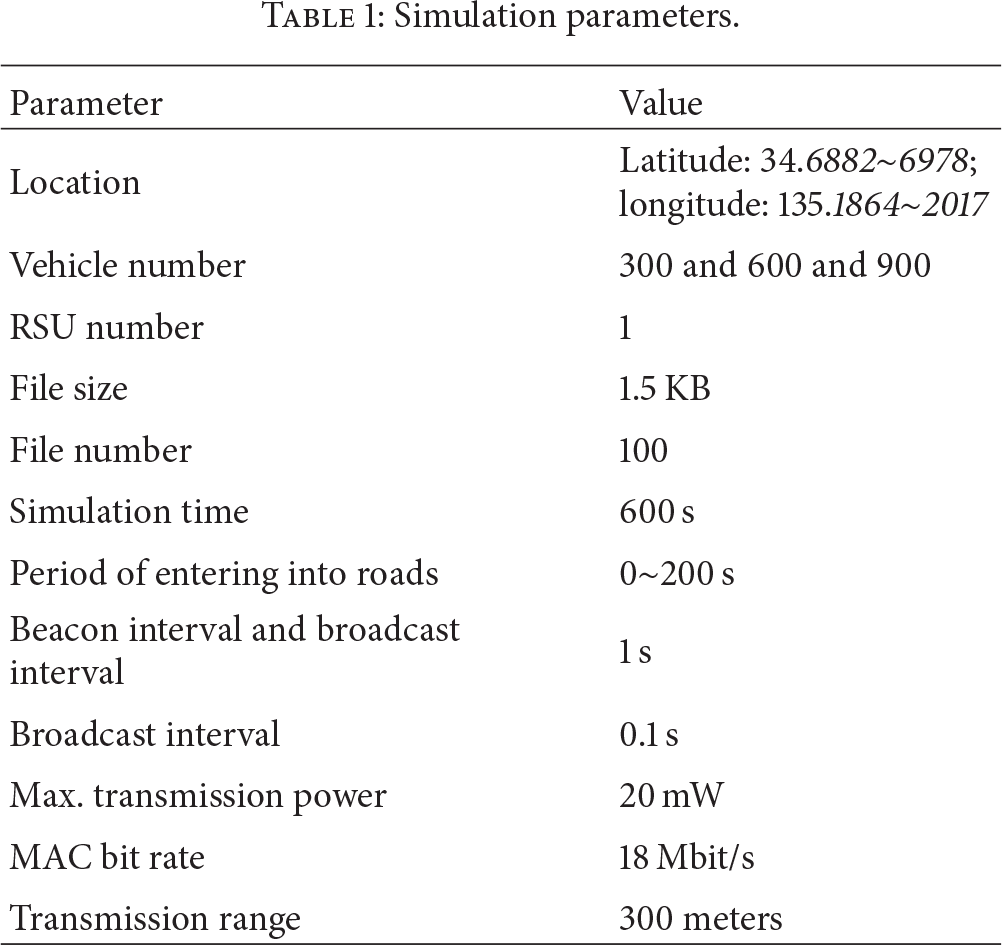
Vehicles are going into a metropolitan area called Sannomiya of Kobe in Japan shown in Figure 6(a), which is a real-world urban map downloaded from OpenStreetMap, and 100 files of proximity marketing will be distributed to these vehicles in this area. The simulation is implemented by OMNeT++ 4.4.1 (network simulator), combining with Veins 3.0 framework (vehicular network simulator) and SUMO 0.21.0 (road traffic simulator). Besides, we generated the traffic routes for every vehicle by designing proprietary software, so reasonable traffic routes are able to be provided. This traffic system makes the simulation results more reliable for validation. If zooming in the central location, the RSU setup location and the vehicle movements in low, middle, and high traffic loads can be observed in Figures 6(b), 6(c), and 6(d), respectively. The simulation parameters are listed in Table 1.
Simulation parameters.

Simulation map and scenarios.
The performance evaluation is carried out in four aspects as below.
4.1. Robustness Evaluation
How much impact on data transmission caused by obstacles is evaluated for the two schemes by comparing their file delivery ratios using a middle traffic load scenario of 600 vehicles.
First, we offload the obstacle module from Veins to observe the results. We compared the file delivery ratios of two schemes with the equal simulation parameters. The results without obstacles are shown in Figure 7(a). Both of schemes can achieve approximately 100% of file delivery ratios. This means, in the environment without obstacle buildings, the in-network caching scheme does not perform obvious advantage in data delivery ratio: certainly it performs a little well in speed.

File delivery ratios in a middle traffic load of 600 vehicles.
Second, we lead obstacle module into simulation programs and repeat the experiment with the same parameters. Proposed in-network caching scheme still presents approximately 100% of file delivery ratio; however, the percentage is only 64.8% for TCP/IP based scheme, shown in Figure 7(b).
Since obstacle buildings block radio propagation or attenuate radio wave as well as the limited radio coverage range, the file delivery ratio of legacy scheme suffers from serious lessening. Fortunately, the proposed in-network caching based scheme performs stronger robustness in both of situations: whether the obstacles exist or not.
4.2. Reliability and Scalability Evaluation
An effective scheme should keep up a steady performance in various traffic situations, so we provide 300, 600, and 900 vehicles corresponding to the low, middle, and high traffic loads.
First, the simulation results without obstacle modules for proposed scheme are shown in Figure 8(a). The file transmission duration shown in each figure reflects the speed of accomplishing file delivery. There is no obvious difference in file delivery ratio and speed between various traffic loads for proposed scheme. The file delivery ratio is 100% and the file transmission duration is 300 s. For the TCP/IP based scheme, the data delivery ratios shown in Figure 8(b) also reach approximately 100% even if TCP/IP based scheme takes longer transmission time of 500 s. In the point of processing speed, proposed scheme performs better than legacy scheme.
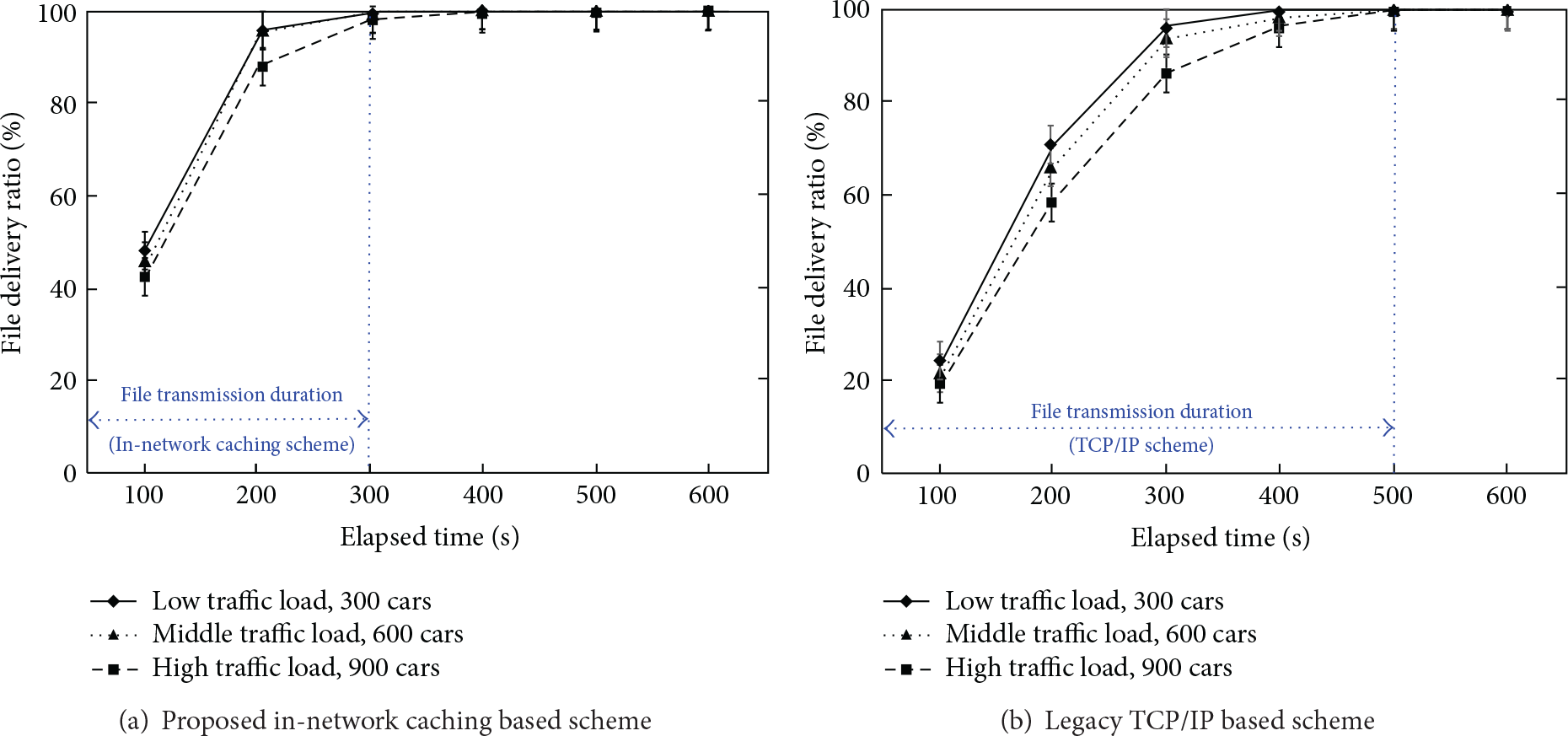
File delivery ratios in different loads without obstacle modules.
Second, the simulation results with obstacle modules are shown in Figures 9(a) and 9(b), respectively. Compared with Figures 8(a) and 8(b), in different traffic loads the proposed scheme always presents reliable, stable, and high data delivery ratios whether there are obstacle buildings or not. However, for the TCP/IP based scheme, file delivery ratio is obviously decreased and file transmission duration is increased, which is exceeding 600 s.

File delivery ratios in different loads with obstacle modules.
Moreover, the good performance in a high traffic load demonstrates that the proposed scheme is appropriate for the scalability applications.
4.3. Cache Efficiency Evaluation
In-network caching is the core technique in the proposed scheme. The data delivery ratio is significantly improved due to the cache function that undertakes vehicle-to-vehicle communications instead of a large portion of RSU-to-vehicle communications. In order to demonstrate this, we give a quantitative analysis on data delivery ratios of V2V communication and R2V communications, respectively, in the different traffic loads to evaluate the cache efficiency.
The statistics data shown in Figure 10 demonstrates that V2V communications are the overwhelming majority in the data delivery process, which means the in-network cache participates in the major file delivery instead of R2V communications.

File delivery ratios achieved by V2V and R2V communications.
4.4. Low Utilization of RSUs and Internet Resource
RSU is a bridge between vehicles and Internet. On one hand, the broadcast number of RSUs represents how much service has been provided to vehicles. On the other hand, it is an available metric to estimate Internet traffic. In the simulation setup, the more broadcast number of RSUs means the more data requests for RSUs and so the more dependence on RSU and the more consumption of Internet traffics.
The broadcast number of RSUs is aggregated for both schemes with obstacle modules under the low, middle, and high traffic loads shown in Figure 11. The data presents considerable difference from several hundreds to 6 thousands or so. In the legacy scheme, vehicles receive files only from RSU; contrastively in the proposed scheme vehicles receive most of files from vehicles rather than RSU, which is depicted in Figure 10. Thereby the broadcast from RSU in legacy scheme is much more than proposed scheme. The proposed scheme shows much lower utilization of RSU and Internet resource.

Broadcast number in low, middle, and high traffic load.
5. Conclusion
In this paper, we reviewed the related literatures of content distribution in vehicular networks and Information-Centric Networking and then proposed in-network caching based scheme in vehicular networks associated with leave copy everywhere strategy for disseminating proximity marketing files in urban environments. Additionally least recently used algorithm is suggested for every cached node. This enlightenment is derived from next generation Internet of ICN paradigm.
The proposed in-network caching scheme is effective to deal with the typical issue of low data delivery ratio in metropolitan areas, which is caused by obstacle buildings, short radio coverage range of RSU, limited RSU deployment, and crowded TCP/IP traffics. In-network caching is a core technique in the proposed scheme. The data delivery is significantly improved by cache function that undertakes vehicle-to-vehicle communications instead of a large portion of RSU-to-vehicle communications.
The performance evaluation is carried out by comparing the proposed in-network caching based scheme with the legacy solution of TCP/IP based scheme using power simulation tools of OMNeT++ and Veins and SUMO, which is supplied with a real-world urban map associated with random but reasonable traffic routes generated by our designed software for every vehicle. The simulation results validate the proposed scheme in four aspects: robustness for resisting obstacle buildings, reliability and scalability in different traffic loads, low utilization of RSUs and Internet resource, and excellent efficiency of cache function.
In-network caching based scheme in vehicular networks opens a prospective direction for content distribution in urban environments.
Footnotes
Competing Interests
The authors declare that they have no competing interests.