




Abstract
The average symbol error probability (ASEP) and outage probability (OP) performance of mobile-to-mobile (M2M) senor networks employing transmit antenna selection (TAS) and selection combining (SC) over N-Nakagami fading channels are investigated in this paper. Based on the moment generating function (MGF) approach, the exact ASEP expressions are derived for several modulation schemes. The exact closed-form OP expressions are also presented. Then, the ASEP and OP performance under different conditions are evaluated through numerical simulations to confirm the accuracy of the analysis. The simulation results show that the number of antennas, the fading coefficient, and the number of cascaded components have an important influence on the ASEP and OP performance.
1. Introduction
Mobile-to-mobile (M2M) communication is an important proximity communication technology [1]. M2M communication has many advantages, such as increasing data rate, reducing energy cost, reducing transmission delays, and extending coverage area [2, 3]. M2M communication can enable new peer-to-peer and location-based applications and services. Due to its advantages, M2M communication is widely employed in mobile sensor networks. In contrast to conventional fixed-to-mobile (F2M) cellular radio systems, in M2M sensor networks, both the transmitter senor and the receiver senor are in motion and equipped with low elevation antennas. The classical Rayleigh, Rician, or Nakagami fading channels are not applicable to M2M sensor networks. The double-Rayleigh and double-Nakagami fading models have been considered for M2M channel in [4, 5]. Meijer's G-function was used to analyze the N-Nakagami distribution in [6].
Multiple-input multiple-output (MIMO) technology has been proposed as a promising solution for the high data-rate coverage required in M2M senor networks. To improve the spectral efficiency or the reliability of M2M wireless communications over fading channels, the spatial diversity schemes are widely employed in MIMO system, such as maximal ratio combining (MRC), equal gain combining (EGC), and selection combining (SC). Unfortunately, MRC and EGC require channel state information, which can be difficult to obtain. On the contrary, SC only employs one of the diversity branches, and so it is a low complexity solution. The end-to-end performance of transmit antenna selection (TAS) and MRC in dual-hop amplify-and-forward (AF) relay network over Nakagami-m fading channels was investigated in [7]. In [8], the exact and asymptotic expressions for the symbol error rate (SER) of TAS/SC and TAS/MRC in a two-hop AF relay network over Nakagami-m fading channels were derived. The impact of outdated channel state information (CSI) and multiple cochannel interferers (CCI) on the performance of TAS/MRC in a dual-hop AF MIMO relay network over Rayleigh fading channels was investigated in [9]. The expressions for exact, approximate, and asymptotic SER of TAS/MRC MIMO systems for several modulation schemes over η-μ fading channels were derived in [10]. In [11], a comprehensive analytical framework on the performance of MIMO multihop AF relay network employing TAS/MRC in the presence of randomly located interferers over Rayleigh fading channels was provided.
To the best knowledge of the author, in [7–11], the performance of TAS/MRC and TAS/SC is investigated over Rayleigh, Nakagami-m, and η-μ fading channels. The performance of the TAS/SC M2M senor networks has not been investigated in the literature. Motivated by the above discussion, we aim to extend the TAS/SC technique to M2M senor networks over N-Nakagami fading channels. The N-Nakagami fading channels are more complex than Rayleigh, Nakagami-m, and η-μ fading channels. The main contributions are listed as follows: Closed-form expressions are provided for the probability density function (PDF) and cumulative density functions (CDF) of the signal-to-noise ratio (SNR) over N-Nakagami fading channels. These are used to derive exact average symbol error probability (ASEP) expressions for several modulation schemes. These exact ASEP expressions are based on the moment generating function- (MGF-) based approach. The exact closed-form expressions for outage probability (OP) are also derived. These OP expressions are based on the CDF-based approach. The accuracy of the analytical results under different conditions is verified through numerical simulations. Results are presented which show that the fading coefficient, number of cascaded components, and number of antennas have a significant influence on the ASEP and OP performance. The derived ASEP and OP expressions can be used to evaluate the ASEP and OP performance of the M2M senor networks employed in intervehicular communications, intelligent highway applications, and mobile ad hoc applications.
The rest of the paper is organized as follows. The M2M senor networks model is presented in Section 2. Section 3 provides the exact ASEP expressions for several modulation schemes. In Section 4, the exact closed-form OP expressions are presented. Section 5 conducts Monte Carlo simulations to illustrate the ASEP and OP performance. Concluding remarks are given in Section 6.
2. The M2M Senor Networks Model
Z follows N-Nakagami distribution, which is given as [6]


With the help of [6], the PDF of Z is given as

First, we consider an SC receiving senor network operating over N-Nakagami fading channels. We will assume that there is 1 antenna at the transmitter senor and L antennas at the receiver senor. The instantaneous SNR of the jth antenna at the receiver senor is given as


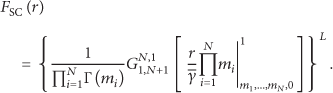
The CDF of


At the receiver side, the SNR

We assume that the branches in the system are subject to independently and identically distributed (i.n.i.d.) N-Nakagami fading. The average SNR can be given as


On the basis of the above, let us consider a TAS/SC senor network over the N-Nakagami fading channels. We will assume that there are K antennas at the transmitter senor and L antennas at the receiver senor. The best transmit antenna is selected from K antennas at the transmitter senor. Let


3. Average Symbol Error Probability
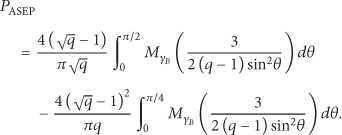
Using MGF method, the ASEP is given as [14]

For M-ary pulse amplitude modulation (PAM),

For M-ary phase shift keying (PSK) modulation,

For M-ary quadrature amplitude modulation (QAM),
4. The Outage Probability
The outage probability is given as


5. Numerical Results
In this section, we present Monte Carlo simulations to confirm the derived analytical results. Additionally, random number simulation was done to confirm the validity of the analytical approach. All the computations were done in MATLAB and some of the integrals were verified through MAPLE. For the simplicity, we use the (K, L) to represent the antenna configurationof the M2M senor networks.
Figure 1 presents the impact of the number of antennas on ASEP performance of the M2 M senor networks over N-Nakagami fading channels with QPSK. The number of antennasis (2, 2), (3, 2), and (4, 2). The fading coefficient is

The impact of the number of antennas on ASEP performance.
Figure 2 presents the impact of the fading coefficient m on the ASEP performance with QPSK. The number of antennasis (2, 2). The fading coefficient is

The impact of the fading coefficient m on the ASEP performance.
Figure 3 presents the impact of the number of cascaded components N on the OP performance. The number of antennasis (2, 2). The fading coefficient is
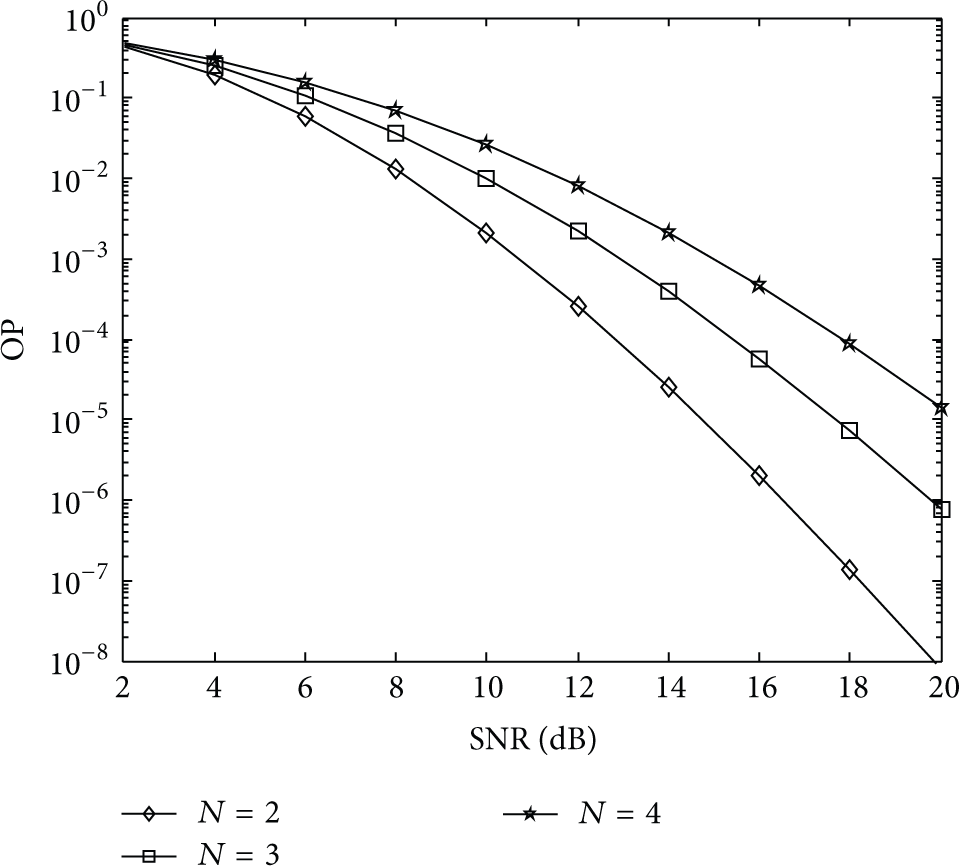
The impact of the number of cascaded components N on the OP performance.
6. Conclusions
The ASEP and OP performance of the M2M senor networks over N-Nakagami fading channels are investigated in this paper. The exact ASEP and OP expressions are derived. The simulation results show that the number of antennas, the fading coefficient, and the number of cascaded components have an important influence on the ASEP and OP performance. Compared with the derived ASEP and OP expressions in [5–9], the derived ASEP and OP expressions for N-Nakagami fading channels are more complex. The derived ASEP and OP expressions can be used to evaluate the ASEP and OP performance of the M2M senor networks employed in intervehicular, intelligent highway, and mobile ad hoc applications. We assume that the channels in the M2M senor networks are subject to independent and identically distributed N-Nakagami fading channels. In the actual environment, the channels are correlated. In the future, we will consider the impact of the correlated channels on the ASEP and OP performance of the M2M senor networks.
Footnotes
Competing Interests
The authors declare that they have no competing interests.
Acknowledgments
The authors would like to thank the referees and editors for providing very helpful comments and suggestions. This project was supported by the National Natural Science Foundation of China (no. 61304222), the China Postdoctoral Science Foundation (no. 2014M551905), the Natural Science Foundation of Shandong Province (no. ZR2012FQ021), and the Open Research Fund from Shandong Provincial Key Laboratory of Computer Network (no. SDKLCN-2015-04).