Forming cooperation through relay's assistance is a promising method to realize green communication by reducing transmission power. In this paper, for multiuser single-DF-relay wireless networks with direct links, the optimal power allocation strategy that minimizes system-sum-power consumption is investigated. Based on the principle that minimizing system-sum-power consumption is equivalent to maximizing system energy efficiency, users are classified into two parts after comparing the channel gains between source-destination link and relay-destination link. The optimal power allocation strategy of one part is determined directly, and minimizing the system-sum-power consumption of the other part is converted into minimizing source-sum-power consumption, which can be solved easily through Karush-Kuhn-Tucker (KKT) condition. Through numerical simulations, we further justified the effectiveness of our scheme compared to existing works.
1. Introduction
In wireless networks, energy efficiency and system capacity are the most important issues to consider. With relay's assistance, mobile nodes/users not only can save energy, but also can extend system capacity. Consequently, relay cooperative communication is deemed as one of the promising network architectures to realize green communication in the future [1–3]. Among relay cooperative strategies, decode-and-forward (DF) is the most commonly used strategy for its higher performance, and many researches are centered around it [4–6].
Nowadays, resource-scheduling optimality in multiuser cooperative systems is a hot topic in wireless communication. Multiuser power allocation strategy has been investigated in [7,8]. In [7], based on orthogonal frequency-division multiple-access (OFDMA), optimization of physical-layer transmission strategy is presented by introducing a set of pricing variables. In [8], power allocation strategies are proposed for three different design goals, that is, maximizing the minimum SNR among users, minimizing the maximum transmission power over sources, and maximizing network throughput. However, they do not present any exact solution procedure to realize sum-power minimization.
For three-terminal relay wireless networks, many power allocation strategies have been proposed. A joint power and time allocation scheme is proposed for an ideal relaying system in [9], where the relay can use arbitrary reencoding methods and can adjust allocated time arbitrarily. In [10], a power allocation scheme between source and relay is proposed when only the mean strengths of channels are available. In [11], for cognitive relay cooperative systems, an energy-efficient power allocation strategy is proposed under the constraints of primary user interference and secondary users' outage probability. In [12], when the instantaneous channel state information (CSI) of source-destination, source-relay, and relay-destination links is available, a joint optimal strategy on power allocation and time allocation is presented. For three-terminal relay systems, where energy can be harvested by taking advantage of radiation power, the system capacity is formulated, and then a power allocation strategy is proposed to maximize system capacity under the predetermined power constraints in [13]. In [14], when a relay can be selected and the relay can work in different modulation levels, an asymptotic expression of error probability in the presence of Gaussian imperfect channel estimations is presented, and then a power allocation strategy to minimize the asymptotic error probability is proposed. In [15], under the constraint of target quality-of-service (QoS), a power allocation strategy is proposed to minimize system-power consumption. In [16], optimum power allocation strategies are presented to minimize Symbol-Error-Rate (SER) for DF and amplify-and-forward (AF) protocols, respectively. In [17], for the scenarios that there are k candidate relays, the maximum tolerable outage probability is predetermined and transmission power is limited, the problem of minimizing total transmission power consumption is formulated, and then the closed-form expression of optimal power allocation is derived, based on which the best relay is selected as well.
In the aforementioned strategies, it is assumed that a source-destination pair can occupy one relay alone. Unfortunately, in the practical wireless relay networks, especially in the scenarios with fixed relays, the deployment cost is very high. Hence, only a few relays are available, and many mobile users want to complete their communication under the help of these relays. Therefore, it is probably unrealistic that a communication pair occupies a relay alone. Consequently, in practical relay-based systems, many mobile users probably share a common relay to perform their communication. In such multiuser single-DF-relay systems, power allocation strategy not only affects the system capacity, but also determines the number of mobile users it can support. Therefore, in such relay cooperative systems, the power allocation among users needs to be investigated.
In multiuser single-DF-relay systems, a few strategies have been proposed to optimize their power allocation. Centering around minimizing source-sum-power, I. Kim and D. kim have published a series of papers [18–20]. In [18], under outage-constrained condition, a procedure to minimize source-sum-power for multiple-sensor single-relay system without direct link is presented. In [19], for multisensor single-relay networks with direct links, source-sum-power allocation strategies are proposed for DF and AF, respectively. In [20], an exact and optimal power allocation strategy for AF without direct link is proposed. Though these strategies can minimize source-sum-power consumption under specific conditions, the energy efficiency is not necessarily the highest, as it is assumed that the relay power is easy to get and need not be considered. In fact, there are many practical communication scenarios such as when the radiation or energy efficiency should be considered, the power allocated from relay need to pay or the power of the relay is not convenient to recharge either. Consequently, the consumption of the relay power should be considered as well. Consequently, system-sum-power minimization in multiuser single-relay system needs further examination.
In this paper, we investigate the system-sum-power minimization problem for multiuser single-DF-relay cooperative systems. For DF relaying mode with direct links, based on the principle that system-sum-power minimization is equivalent to energy-efficiency maximization, the optimization of system-sum-power minimization is deduced into the problem of source-sum-power minimization, which can be easily solved by using KKT condition. If there are N source-destination pairs in the considered problem, the solution to get optimal power allocation can be realized within elementary arithmetic operations. Compared to the existing source-sum-power minimization strategy, it is shown that much power consumption can be saved when the distance between source and destination is equivalent to or shorter than the distance between relay and destination. With numerical investigation, the optimality of the proposed solution is illustratively verified.
2. System Description
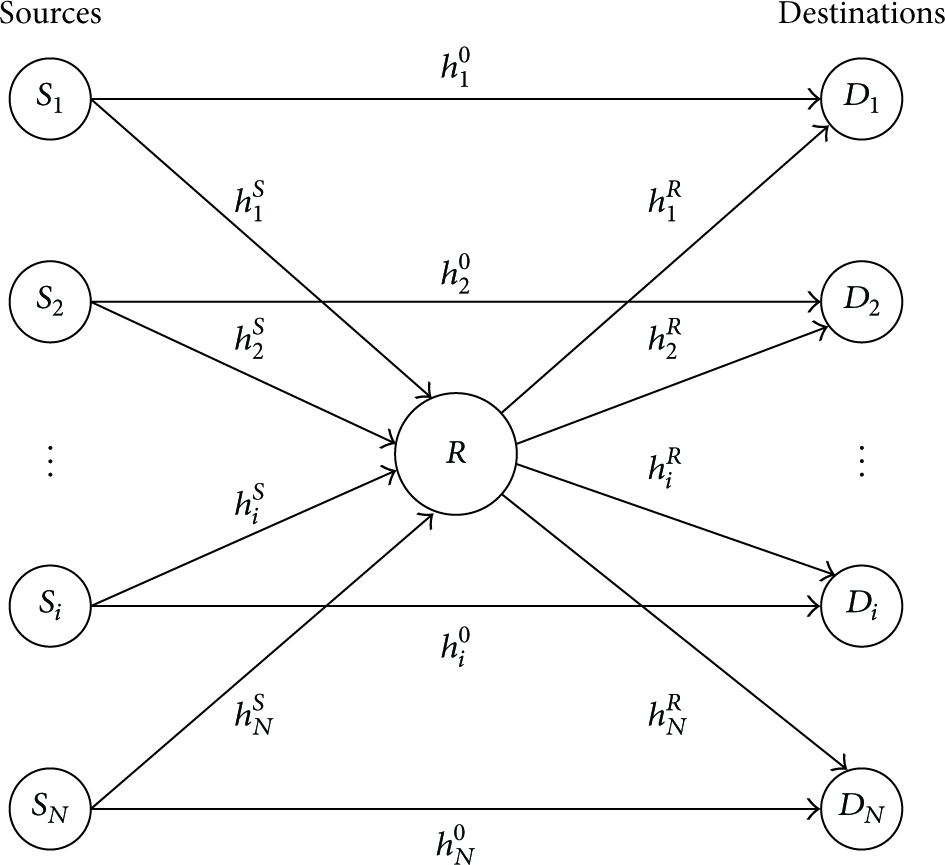
We consider a wireless communication system that consists of N source-destination pairs, denoted as , , and a relay, denoted as R, which is shown in Figure1, where the links from sources to relay, from relay to destinations, and from sources to destinations are denoted as , , and , respectively.
A cooperative network with multiple users and a single relay.
We assume that all the communication pairs are assigned to disjoint frequency channels, so they do not interfere with each other. Without loss of generality, we suppose that the channel quality of each link is too poor to reach the target SNR without the help of the relay. Therefore, all the pairs should use the relay to complete their communication. We consider that the relayed signal is combined with the direct-link signal at the corresponding destination by using maximum-ratio-combining (MRC) strategy.
In Figure1, for communication pair , let and be the transmission power at the source and relay R, and , , and denote the channel coefficients of , , and , respectively. For notation simplicity, channel powers are normalized as , , and , where is the additive noise power added to the signal transmitted from at R and and are the additive noise power of the signal from relaying link and direct link at destination , respectively. We assume that is the target SNR of communication pair , and and are the maximal power allowed for relay R and source . We also suppose that the relay has the knowledge of all the relevant channels information, and it is appointed to deal with the whole task of power allocation. In this paper, our aim is to minimize system-sum-power on the condition that , , and target SNR is guaranteed for all communication pairs.
3. Formulation and Power Allocation
In this section, system-sum-power minimization is formulated and its feasibility is analyzed firstly. Secondly, as system-sum-power minimization is equivalent to energy-efficiency maximization, communication pairs are classified into two parts. The users in one part can get the highest energy efficiency by allocating the maximal allowed power to their sources, and the other part can be deduced into source-sum-power minimization, which is similar to the formulation in [19] and can be solved easily by using Karush-Kuhn-Tucker (KKT) condition. Finally, the procedures of the optimal solution are presented.
3.1. Problem Formulation
In DF relay communication, when the relay cannot decode its overheard information correctly, the information will not be forwarded. Otherwise, the incorrect information will be propagated, and system performance will be deteriorated. Therefore, for an arbitrary communication pair , the constrained condition (1) should be satisfied primarily. It means that the signals transmitted from sources must be decoded reliably at the relay:
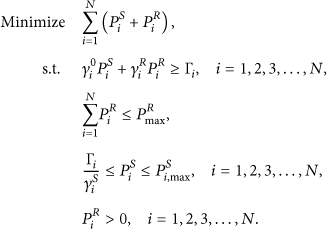
At the destination , the signals from relaying link and direct link are combined. As MRC strategy is taken at the destination, the SNR can be shown as , where and are SNRs from direct link and relaying link, respectively. Consequently, in the multiuser single-DF-relay systems with direct links, the power allocation problem can be formulated as (2), which is denoted as DF-WDT for notation simplicity.
(DF-WDT)
3.2. Optimal Power Allocation Strategy
3.2.1. Feasibility Analysis
It is similar to [19]. We consider the threshold situations, and the feasibility can be realized easily.
On one hand, for source node , if holds, which means the signal from cannot be decoded correctly at the relay even if the source transmits it with maximal power, such communication pairs should be removed from the power allocation problem.
On the other hand, we suppose that all sources transmit signals with their maximal allowed power . On this condition, let be the power allocated from the relay to support to reach its target SNR . Hence, (3) should be satisfied. Then, if holds, there is a feasible solution to the considered problem. Otherwise, it means that the relay's maximal power is not enough to support all the communication pairs. Nevertheless, some communication pairs should be removed by an admission control method as in [20]. Consequently, we can have a feasible set of communication pairs under all the supposed constrained conditions and target SNRs:
3.2.2. Optimality of Power Allocation
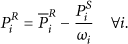
Now, we assume that the power allocation problem is feasible. As our aim is to minimize system-sum-power consumption under predetermined power constrains and target SNRs, it is equivalent to get the highest energy efficiency through power allocation. Therefore, through comparing the relationship between and , the N communication pairs can be classified into two parts, noted as β and α, where and . For and , as the target SNR is , we can see that the one with larger value is higher in energy efficiency. Furthermore, for an arbitrary source , setting does not affect the feasibility of the original considered problem, as there will be more relay power left for other pairs. As system-sum-power minimization is equivalent to efficiency-efficiency maximization, for the communication pairs in β, in order to get the highest energy efficiency, their sources should transmit signals with their maximal allowed power . On the contrary, for the communication pairs in set α, their sources should consume their power as small as possible. Consequently, the optimal problem of the set α is equivalent to source-sum-power allocation, which is similar to the strategy in [19]. By using KKT conditions, the optimal solution of (2) can be got, and the system-sum-power minimization allocation can be realized by (4) and (5), where
In (4) and (5), , , , and is the number of communication pairs that satisfy . is an ordering index obtained by the search method shown in the following part, which arranges 's in an ascending order such that after the communication pairs satisfying are removed from the set .
and are an index set in an ascending order of for communication pairs belonging to set α.
Step 5.
Compute as given in (4) and check whether is satisfied or not.
Step 6.
If is not satisfied, set and repeat Step4. Otherwise, stop and take the current .
In the previous part, β and α are constructed from Step0 to Step2, and the procedure requires at most arithmetic operations and comparison. To get from Step4 to Step5, at most simple arithmetic operations and comparison are needed. Hence, the optimal solution strategy can be obtained within simple operations.
Theorem 1.
The system-sum-power consumption of the proposed strategy is minimal.
Proof.
See the Appendix.
From the above analysis, it can be seen that only when holds for all communication pairs, the system-sum-power consumption of our strategy is the same as that of [19], which aims to minimize source-sum-power consumption. Otherwise, the system-sum-power consumption of our strategy is always smaller than that of [19]. For general scenarios, as communication pairs are distributed randomly, the probability that all pairs satisfy is very small. Therefore, our strategy can save much energy compared to the strategy in [19].
4. Numerical Results and Analysis
In numerical investigation, a linear network with N source-destination pairs and a relay is considered. Without loss of generality, we suppose that sources, destinations, and relay are located randomly in three different circle areas, which is shown in Figure2. The radius length of the three circles is the same, and its length is set as 0.2 unit. We suppose that the circle centers of source area and relay area are fixed, and their coordinates are and , respectively. On the other hand, the circle center of destination area can be moved along a curve on which the distance to the circle center of relay area is constant; that is to say, it can be moved along the arc whose radius is 0.5 unit and circle center is on .
The multiuser single-relay network mode used in simulation.
In the simulation, we assume a path-loss model where the channel gains are inversely proportional to the fourth power of the corresponding distances between the nodes. We set the source maximal power as w, and the noise power at receivers is assumed to be . In order to ensure that all communication pairs need the relay's help to obtain their target SNRs and the feasibility of the considered problem is easily to satisfy under specific power constraints, we suppose that the target SNRs are slightly bigger than the SNRs that the direct links can get when sources transmit their signals with maximal power alone. Consequently, the target SNR of an arbitrary communication pair is set as , where . Each simulation result is an average of 100,000 random experiments. For simulation simplicity, we set in all the simulation scenarios.
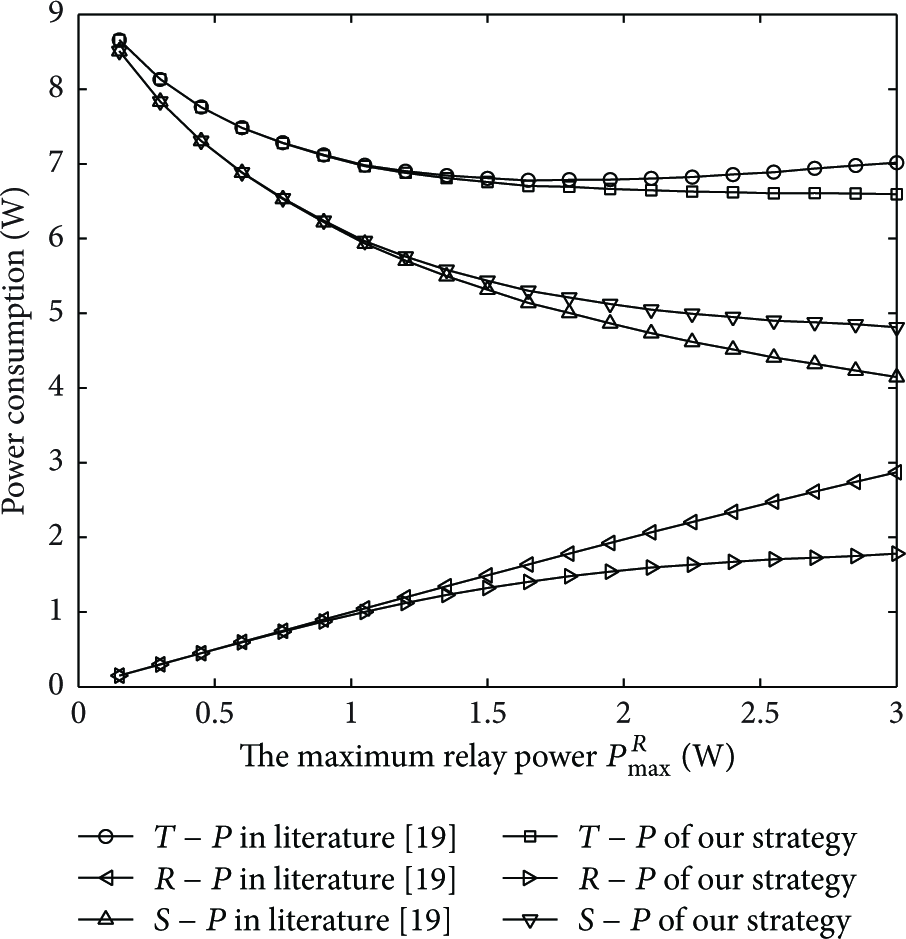
At first, the general network scenario is simulated, in which we set , which means that the distance between any two circle centers is equal. As sources, relay, and destinations are distributed randomly in their areas, is satisfied, where means the probability that the distance between node X and node Y is bigger than the distance between node I and node J. is increasing from 0.15 w to at step length 0.15w. The simulation results are shown in Figure3, where , , and denote the system-sum-power consumption, source-sum-power consumption, and relay-power consumption, respectively. To show the performance of our proposed strategy, the system-sum-power consumption, source-sum-power consumption, and relay-power consumption based on source-sum-power minimization strategy in [19] (named as DF-WDL) are also plotted. From the simulation results, we can see the following results when increases gradually. (1) For DF-WDT, the system-sum-power consumption decreases gradually and maintains being constant after is greater than . For DF-WDL, the system-sum-power consumption decreases firstly and then increases gradually with the increasing of , and it is clear that its system-sum-power consumption is always equal to or greater than that of DF-WDT. (2) The source-power consumption of the two strategies decreases monotonically. Nevertheless, the source-power consumption of DF-WDL is always lower than or equal to that of DF-WDT. (3) The relay-power consumption of the two strategies increases at first. However, when reaches about 2.5 w, the relay-power consumption of DF-WDT begins to keep constant, but the relay-power consumption of DF-WDL is keeping on increasing and it is always greater than or equal to that of DF-WDT. The reason of the three results is that the object of DF-WDL is to minimize source-sum-power and the object of DF-WDT is to minimize system-sum-power, and it is consistent with the theoretical analysis.
The power consumption of whole system, sources, and relay with , w, , and the varying from 0.15 w to 3 w. , , and denote the system-sum-power consumption, source-sum-power consumption, and relay-power consumption, respectively.
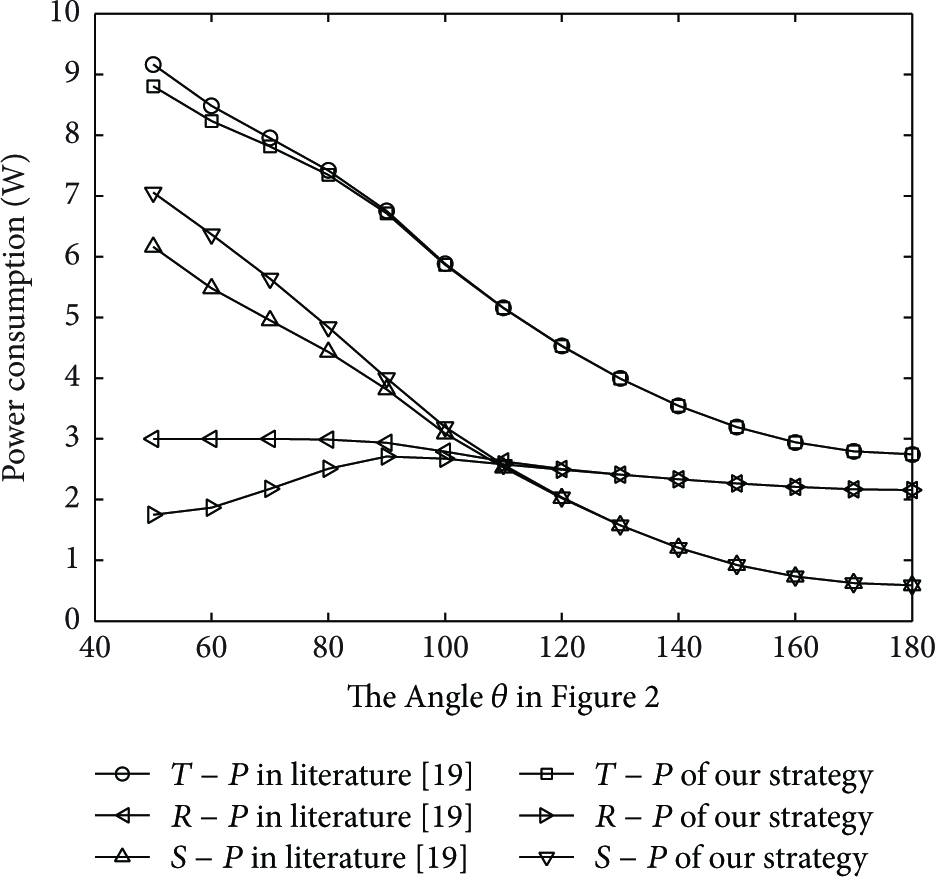
In order to illustrate the influence of node location on power consumption, on the condition that source area and relay area are fixed, destination area center is moved along the arc shown in Figure2, which means that θ varies from to (when , destination area and source area are contacted; for computation simplicity, we set the start angle as ). The simulation results are shown in Figure4. From the figure we can see that when θ increases gradually, for both DF-WDL and DF-WDT, their system-sum-power consumption and source-sum-power consumption are decreasing monotonically, and when , their power consumption is the same. For DF-WDL, relay-power consumption keeps constant when θ locates in and , and it decreases gradually from on. On the other hand, for DF-WDT, relay-power consumption increases gradually from on, and it reaches the peak at about , then it decreases monotonically, and it is equal to the relay-power consumption of DF-WDL from on. All these results are consistent with the theoretical analysis. Firstly, when θ increases from to , the average distance between relay and destination is unvaried, but the average distance between source and destination is increasing. When it reaches , is satisfied for all communication pairs, which means system-sum-power minimization is equivalent to source-sum-power minimization. Consequently, their system-sum-power consumption is the same. Secondly, in the area , is satisfied for some communication pairs, but is satisfied for the others. Consequently, for DF-WDL, in order to minimize source-sum-power consumption, relay power is used as much as possible. Hence, the power w is used completely. For DF-WDT, the relay-power consumption is increasing when more and more sources transmit their signals with minimal power to get their highest energy efficiency. When , the increased power needed by the communication pairs satisfying is equal to the decreased power as is increasing gradually, and relay-power consumption reaches the minimal peak. Thirdly, when θ locates in , it is obvious that the target SNR is decreasing with the increasing , as we set (as and is assumed). On this condition, all the sources transmit their signals with minimal power, and the needed relay power for each communication pair is , and it is easy to know that the relay power is decreasing with increasing. It is consistent with simulation results.
The power consumption of whole system, sources, and relay with , w, w, and the angle θ varying from to . , , and denote the system-sum-power consumption, source-sum-power consumption, and relay-power consumption, respectively.
5. Conclusions
In this paper, we concentrate on system-sum-power allocation in multiuser single-DF-relay cooperative communication network with direct links. Through formulating this problem into power efficiency optimization, its solution is obtained by KKT condition. And numerical simulation is carried out to verify the proposed strategy.
Footnotes
Appendix
Competing Interests
The authors declare that they have no competing interests.
Acknowledgments
This work was supported by the National Natural Science Funds of China (61372127), Research Fund for the Doctoral Program of Higher Education (20120162120099), and the Natural Science Foundation of Hunan Province of China (13JJ3065).
References
1.
WangJ.LuK.ZhangS.FanJ.ZhuY.ChengB.An efficient communication relay placement algorithm for content-centric wireless mesh networksInternational Journal of Communication Systems201328226228010.1002/dac.26662-s2.0-84923215209
2.
LuoC.YuF. R.JiH.LeungV. C.Distributed relay selection and power control in cognitive radio networks with cooperative transmissionProceedings of the IEEE International Conference on Communications (ICC '10)May 2010Cape Town, South Africa1510.1109/icc.2010.5502231
3.
KhanI.RajathevaN.TanoliS. A.JanS.Performance analysis of cooperative network over Nakagami and Rician fading channelsInternational Journal of Communication Systems201427112703272210.1002/dac.25002-s2.0-84911981018
4.
ZhangX.XingJ.WangW.Outage analysis of orthogonal space-time block code transmission in cognitive relay networks with multiple antennasIEEE Transactions on Vehicular Technology20136273503350810.1109/TVT.2013.22550732-s2.0-84884359362
5.
Al-MistarihiM. F.MohaisenR.SharaqaA.ShurmanM. M.DarabkhK. A.Performance evaluation of multiuser diversity in multiuser two-hop cooperative multi-relay wireless networks using maximal ratio combining over Rayleigh fading channelsInternational Journal of Communication Systems2015281719010.1002/dac.26402-s2.0-84916198167
6.
WangS.JiH.Distributed power allocation scheme for multi-relay shared-bandwidth (MRSB) wireless cooperative communicationIEEE Communications Letters20121681263126510.1109/LCOMM.2012.060812.1210882-s2.0-84865489229
7.
PhanK. T.Le-NgocT.VorobyovS. A.TellamburaC.Power allocation in wireless multi-user relay networksIEEE Transactions on Wireless Communications2009852535254510.1109/TWC.2009.0804852-s2.0-68949161758
8.
NgT. C.-Y.YuW.Joint optimization of relay strategies and resource allocations in cooperative cellular networksIEEE Journal on Selected Areas in Communications200725232833910.1109/JSAC.2007.0702092-s2.0-33847717542
9.
MoZ.SuW.BatalamaS.MatyjasJ. D.Cooperative communication protocol designs based on optimum power and time allocationIEEE Transactions on Wireless Communications20141384283429610.1109/TWC.2014.23158132-s2.0-84906228145
10.
DengX.HaimovichA. M.Power allocation for cooperative relaying in wireless networksIEEE Communications Letters200591199499610.1109/LCOMM.2005.110122-s2.0-28244477514
11.
NaeemM.IllankoK.KarmokarA.AnpalaganA.JaseemuddinM.Decode and forward relaying for energy-efficient multiuser cooperative cognitive radio network with outage constraintsIET Communications20148557858610.1049/iet-com.2013.01192-s2.0-84896989382
12.
GündüzD.ErkipE.Opportunistic cooperation by dynamic resource allocationIEEE Transactions on Wireless Communications2007641446145410.1109/TWC.2007.3483412-s2.0-34247397030
13.
HuangX.AnsariN.Optimal cooperative power allocation for energy harvesting enabled relay networksIEEE Transactions on Vehicular Technology201510.1109/tvt.2015.2424218
14.
SokunH. U.SediqA. B.IkkiS.YanikomerogluH.Power allocation optimization in selective DF relaying with different modulation levels in the presence of imperfect channel estimationsIEEE Communications Letters201519586787010.1109/LCOMM.2015.24085962-s2.0-84929312929
15.
ShengZ.FanJ.LiuC. H.LeungV. C. M.LiuX.LeungK. K.Energy-efficient relay selection for cooperative relaying in wireless multimedia networksIEEE Transactions on Vehicular Technology20156431156117010.1109/TVT.2014.23226532-s2.0-84925064619
16.
SuW.SadekA. K.LiuK. J. R.Cooperative communication protocols in wireless networks: performance analysis and optimum power allocationWireless Personal Communications200844218121710.1007/s11277-007-9359-z2-s2.0-37549010716
17.
QianL. P.WuY.ChenQ.Transmit power minimization for outage-constrained relay selection over rayleigh-fading channelsIEEE Communications Letters20141881383138610.1109/LCOMM.2014.23321632-s2.0-84906252568
18.
KimI.KimD.Outage-constrained source-sum-power minimization in multiple-sensor single-DF-relay networksIEEE Communications Letters20131771388139110.1109/LCOMM.2013.060513.1306522-s2.0-84881105562
19.
KimI.KimD.Source-sum-power minimization in multi-sensor single-relay networks with direct linksIEEE Communications Letters20121671076107910.1109/LCOMM.2012.050112.1205352-s2.0-84864123300
20.
KimI.KimD.Minimizing source-sum-power consumption in multi-sensor single-relay networksIEEE Transactions on Communications20115992362236610.1109/tcomm.2011.062311.1001012-s2.0-80052937133