




Abstract
Rare events detection is one of the main applications in Wireless Sensor Networks (WSN) and is currently a central concern of a vast literature. Compressed Sensing (CS) theory has been proved to be quite adapted to this objective. Although this is not the first work on applying CS to sparse events detection in WSN, it is the first to highly justify the validity of the targets detection and counting problem formulation. In order to enhance the CS recovery capacity in WSN, this work considers an approach based on a coherence reduction of the sensing matrix premised on the transmitted power control (PC). Simulation results prove that, under the constraint of equal power consumption, the detection and counting performance is improved when the proposed power control scheme is employed compared to the case without PC.
1. Introduction
Wireless Sensor Networks (WSN) are widely used in a variety of applications such as surveillance, control, and tracking [1]. Typically, a WSN involves a large number of wireless sensor nodes, each with a computational power and sensing capability. In such context, the problem of efficiently transmitting or sharing information from a vast number of distributed devices (nodes) makes a great challenge to the energy consumption and deployment cost which are the main constraints in WSN applications. As the number of WSN applications grows, the measure accuracy improvement and life time prolongment in WSN are essential. This is true especially for large scale networks. New mechanisms should then be deployed in order to optimize the cost, power, and traffic while guaranteeing good detection and estimation performance. It has recently been proved that Compressed Sensing (CS) theory holds promising improvements to the WSN system efficiency. Its potentials are those of minimizing the number of measurements required for field recovery from N to M (
CS is simultaneously a new framework for signal sensing and a smart compression technique [3]. The fundamental idea, on which CS is based, is that any unknown signal having a sparse representation in some basis can be recovered from a small number of projections onto a second basis (known as sensing basis) which is incoherent with the first one [4].
In this work, the problem of events detection in WSN is investigated from the perspective of CS. To this aim, the sensed area is divided into a grid of cells; each cell is equipped with one sensor. We are here interested in the case of discrete events which are enumerated per cell. Also, a cooperative framework is considered, where events can be controlled from sensors. We interchangeably use “targets” for events and “nodes” for sensors throughout the paper.
Most of the existing work assumes that each cell contains at most one event [5] (binary event) which is not true in practice. Contrarily, as in [6], we here assume that one active cell can hold many events. Using CS recovery algorithms, both the locations and the number of events can then be recovered. A novel Greedy Matching Pursuit (GMP) algorithm [6] is considered which adapts the Matching Pursuit (MP) [7] algorithm to the discrete nature of events number.
Successful CS application for events positioning and counting requires two key features: sparsity and incoherence. The sparsity is here fulfilled in the spatial domain as the events to detect are assumed to be rare. Such scenario occurs in several applications such as animals tracking in forests and environmental factors detection such as fire and earthquake. As a consequence of rareness, the number of active cells (cells where events occur) is much lower than the network cells number. The CS theory then allows for recovering the events location and number by using only a small subset of the sensors measurements.
On the other hand, and related to the incoherence feature, a widely used condition on the sensing matrix ensuring a unique and accurate reconstruction of the sparse parameter (here, the vector of events number per cell) is the Restricted Isometry Property (RIP) [8] which gives guarantees concerning unique identifiability. Nevertheless, checking whether a sensing matrix
This paper is organized as follows. In Section 2, the problem formulation for CS based events detection and counting is established. After introducing the CS application in WSN, the proposed mechanism based on transmitted power control (PC) is presented in Section 4. Finally, simulation results are drawn and analyzed in Section 5 before the conclusion.
Notations. Throughout this paper, we use the following notations:
2. Model Description and Motivation
2.1. Network Model and Assumptions
We consider the WSN system model where the monitored area is divided into N regular cells. We denote by
In the following, we precise the adopted assumptions:
As shown in Figure 1, the cell i three events

Network model scenario.
2.2. Problem Formulation
In large scale WSN, the propagation model should account for both path loss and Rayleigh fading effects. In this way, the received signal at sensor j corresponding to targets located in an active cell i, with


Concatenating all sensors measurements, we have in matrix form
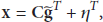

The autocorrelation matrix of the signal

For the jth sensor, it is

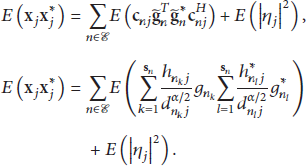

Referring to assumptions
Therefore,


CS is an emerging theory that is based on the fact that a signal with a sparse representation in a certain basis can be recovered through a relatively small number of projections which contain the most of its information. The CS framework is here used in the aim of events detection and counting. Once the WSN energy measurements are available at the fusion center, the goal is to accurately locate the events occurrence and their number per cell. This is obviously operated under the constraint of power consumption and deployment cost reduction for network lifetime maximization. To achieve such aims, CS theory has proved to be well adapted. Indeed, CS can be applied to the problem of rare events detection in WSN and allows for reducing the number of required measurements from N to some M such as


Our objective is to reconstruct the sparse representation
Concerning the data collection task at the fusion center (for processing purpose), different schemes can be envisaged. The data
2.3. Motivation
As stated in CS theory, a sufficient condition for the successful recovery of a sparse signal is that the decomposition basis
In the following, we illustrate the impact of the decomposition matrix characteristics on the recovery performance. To this end, we consider a comparison between four scenarios differing by the sensing matrix Perfect compensation of distance (exclusively Rayleigh effect),
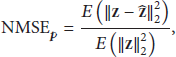
The corresponding GMP reconstruction performance is evaluated in terms of reconstruction error by Normalized Mean Squares Error (


For the same cells number, N, we then envisage small and then medium to large scale networks.
According to Figure 2 displaying the
Coherence comparison.


Further, a coherence reduction is shown to guarantee a more accurate recovery. Therefore, in order to enhance reconstruction accuracy, we propose to control the transmitted power of targets in order to compensate the path loss and to make
3. Existing Work
Reference [17] also addressed the problem of cooperative power control in WSN. It proposed a method for proper matrix

Power control model [17]. Only the nodes inside the radius
The performance is evaluated in terms of
The obtained results are given by Figure 4 and show that the referenced work achieves a high NMSE and missing and false alarm rates especially at low SNR compared to the case w.o.PC. This scheme outperforms the case w.o.PC above 35 dB and for this reason will not be further considered in the rest of the paper. Also, Figure 4 shows that the reconstruction and detection performance of the benchmark scheme (Rayleigh fading) are not very sensitive to noise, which is indeed due to the Rayleigh fading effect dominance.
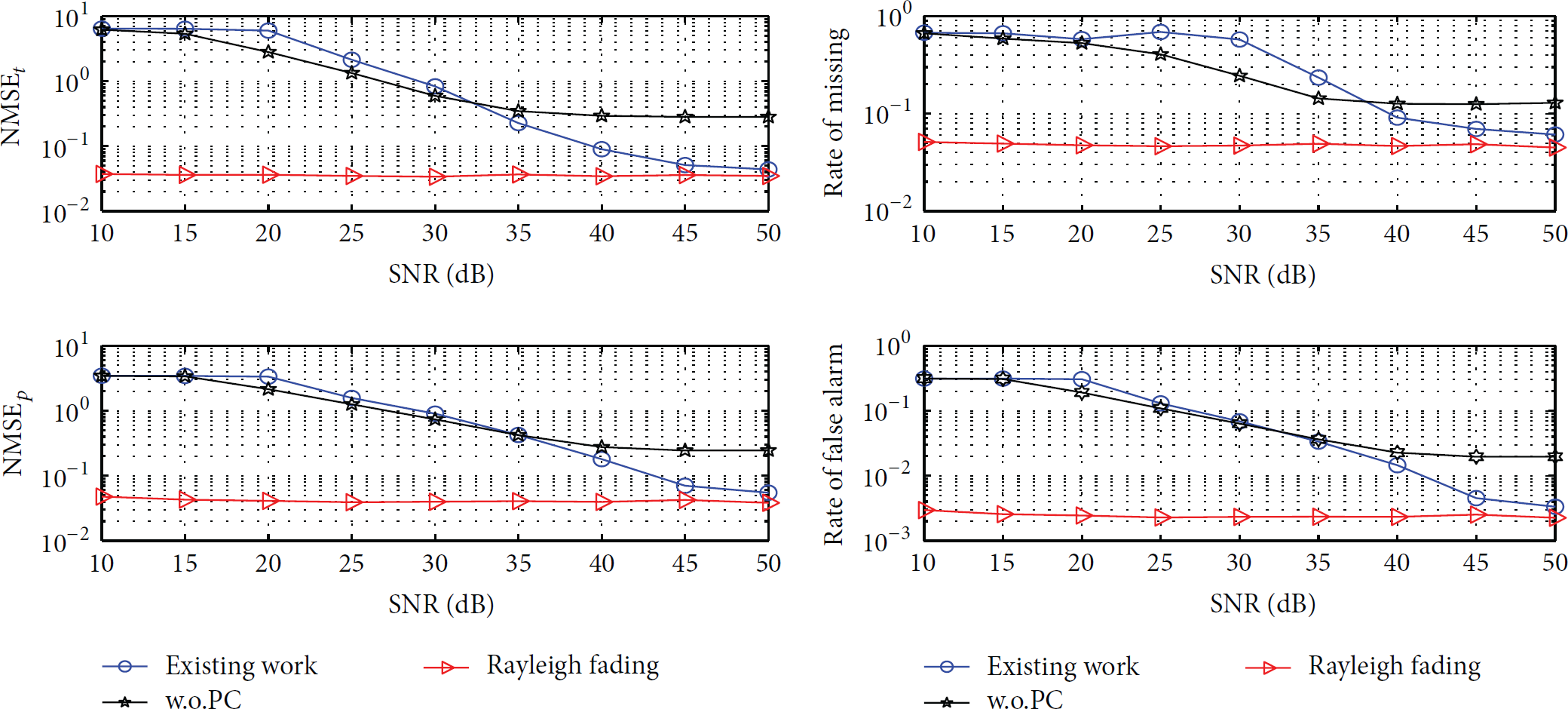
Performance comparison versus SNR when
In the following, we consider large scale WSN and low to medium SNR range (
This paper proposes new power control schemes whose accurate comparison to the existing work [17] is given in Table 2. Two new approaches are here proposed and compared, which are, respectively, based on sensors spatial repartition and sensors number.
Comparison between referenced and proposed approaches.

4. Proposed Approaches for Power Control
4.1. Framework Overview
In our work, we envisage a suboptimal power control based on distance compensation per subsets of cells (or clusters) which accounts for the sensors maximum coverage (range)
Decomposition matrix coherence evaluation in the absence of PC.

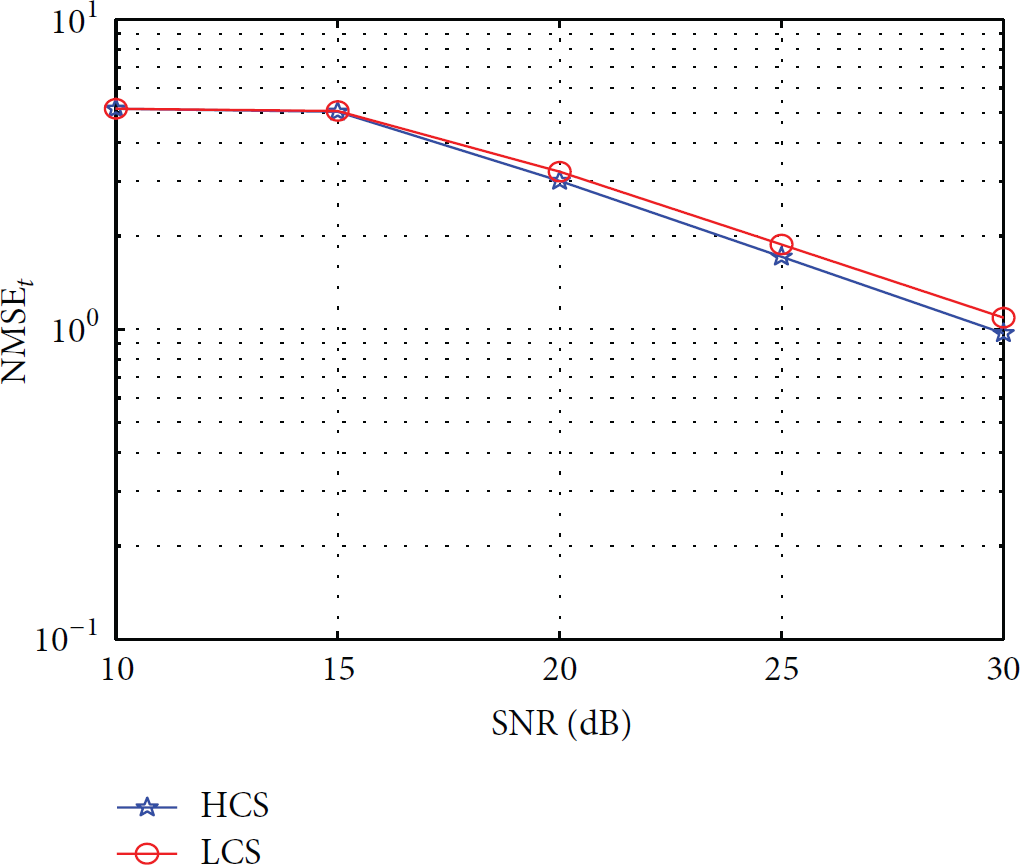
In the following, we focus on large WSN and account for the sensors coverage. More precisely, the Zigbee protocol (LCS) will be considered.
Actually, the coverage range
Referring to the power law model [21], let ϵ denote the lowest perceivable power by the sensors (the threshold or minimum value of the process required to obtain a nonzero output); then, ϵ depends on the maximal power and on its corresponding maximal coverage 

We propose in the following to control the transmitted power of nodes within the maximal coverage zone with radius 

Transmission model. Only the nodes inside the coverage zone transmit with power
4.2. Scenario Description
For reconstruction performance enhancement, we aim to reduce the coherence of the sensing matrix
In our study, we consider a time division multiplexing scheme where the time is divided into packets of M slots as shown in Figure 7, where

Scenario description.
We here propose two approaches for power control, both of which consider a spatial partition of nodes with respect to a reference node (CH). Contrarily to the perfect PC where each node has a perfect compensation of path loss effect, in our work, motivated by total power consumption reduction, the PC is operated by subgroups of nodes. These subgroups are formed either based on their proximity to the reference node (approach
For each of range and number based approaches, two schemes are envisaged, which are, respectively, global and local schemes. In global approach, the power control is done per class, or cluster, of nodes where the same transmitted power is allocated to the nodes belonging to the same ring. In local approach, the power control considers both the node distance from CH and the ring to which it belongs. In the following two sections, these proposed approaches are detailed.
4.3. Proposed Power Control Mechanism Based on Distance (PCMD)
This approach is based on the sensors maximum range,
Our approach attempts to compensate the energy attenuation caused by distance. First, we consider only the cells (sensors) within the coverage of the corresponding CH, that is, situated at a distance lower than 
This mechanism performs with two manners: in a global manner for which the scheme is denoted PCMDg, or in a local manner for which the scheme is named PCMDl. In the following, the two proposed schemes are developed.
4.3.1. PCMDg
In this part, we propose to globally compensate for the distance effect: the nodes within the same ring are allocated the same transmission power. In the following, we will discuss the cases
(i)

(ii)


PCMDg (
(iii) General Case. Generalizing the schemes described above for 
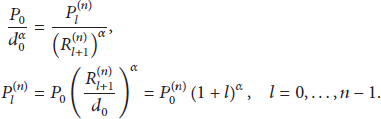
4.3.2. PCMDl
In this part, a local distance compensation is considered: each node is affected by a different transmission power according to its position. We keep the same notation presented in the PCMDg. Also, the cases
(i)

(ii)

(iii) General Case. The previous development can be generalized as follows:

4.4. Proposed Power Control Mechanism Based on Sensors Number (PCMSn)
The last approach proposed in Section 4.3 partitions the nodes into subsets with respect to the distance separating them from the CH as a fraction of the sensor coverage region radius
Like the distance-based PC, two ways can be envisaged for PCMSn scheme: global way which is denoted PCMSng and local way referred to as PCMSnl. In the following, we will limit the discussion to the case
In this case, for each sensor j, taken as CH, we divide the sensors network into two sets: the first set contains the 
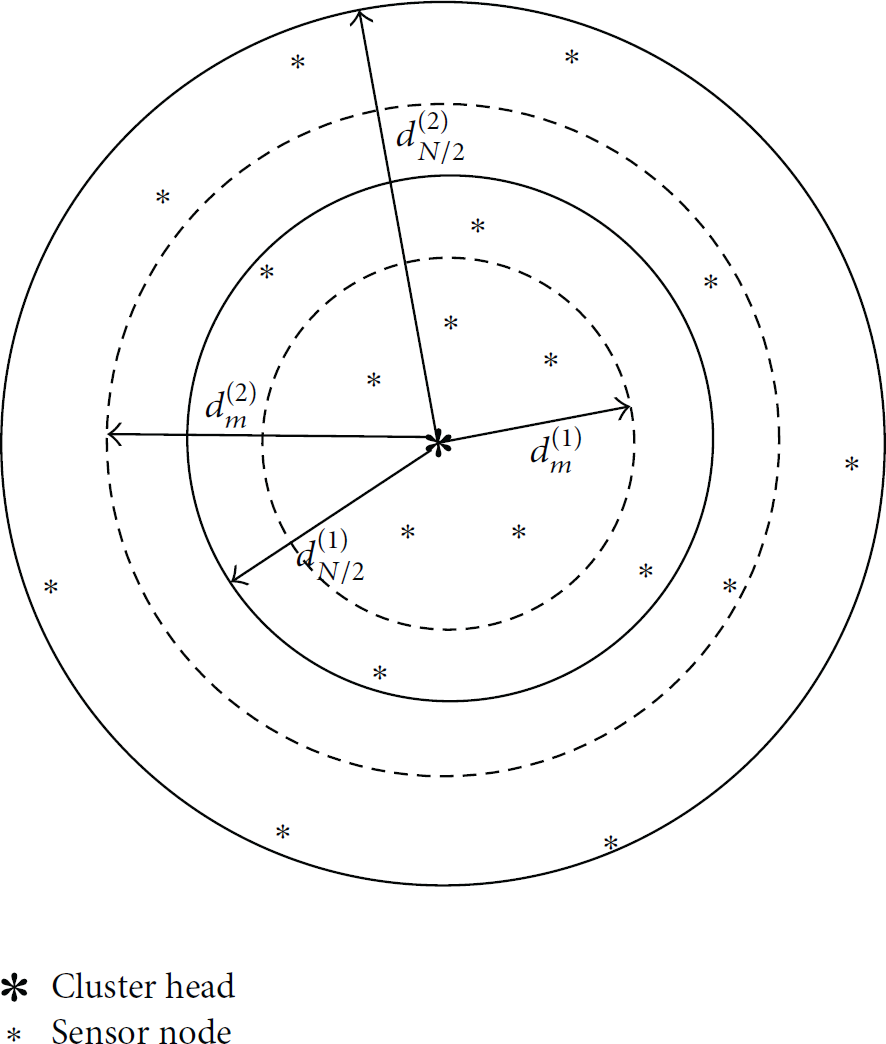
PCMSn (
4.4.1. PCMSng
This scheme is based on global compensation of distance. Indeed, we will associate the same transmitted power for a subset of sensors.
Case 1 (
).
The components of power control matrix can be presented as


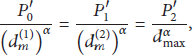

Case 2 (
).
Consider

Case 3 (
).
We seek to find the targets positions i with distance 
4.4.2. PCMSnl
In this part, a local distance compensation is adopted. The case
Case 1 (
).
The components of power control matrix can be presented as
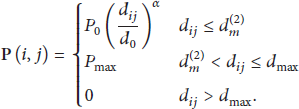
Case 2 (
).
Consider

Case 3 (
).
The corresponding PC procedure is as follows:
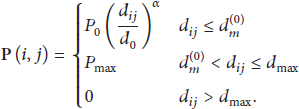
Compared to perfect distance compensation, the above local scheme allocates
4.5. Events Detection and Counting
Once the power control matrix 
The adopted decomposition algorithm is the GMP which has the advantage not to require any knowledge about the signal sparsity level. In [6], the recently proposed iterative scheme GMP jointly detects a new active (with events) cell and counts the number of events in the detected cell in each iteration. Then, the iterative projection procedure is updated according to the MP algorithm [7].
5. Performance Evaluation and Analysis
5.1. Simulation Parameters Setting
The hereafter displayed results are obtained through Monte Carlo simulations based on the following setting. We consider a regular monitored area divided into
Simulation parameters [18].

This section aims to evaluate the efficiency of the different proposed PC mechanisms and their impact on the recovery and detection performance which is evaluated in terms of
The above proposed power control schemes adjust the power to be transmitted according to a mean distance (global) or the actual distance (local) from the CH. It is then of great interest to also evaluate for the proposed schemes the total amount of consumed power in the network denoted as 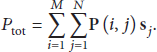
Our considered benchmarks cases are w.o.PC and perfect PC in which we compensate locally and perfectly the distance of the corresponding target within the range
5.2. Numerical Results
In this section, some numerical results will be presented showing the performance improvement obtained with each of the proposed PC approaches. Firstly, the coherence of the decomposition matrix
(i) Coherence and Required Power. Results are given in Tables 5–7, for different PC schemes, obtained by averaging over
Coherence and power consumption evaluations, benchmark approach.

Coherence comparison and power consumption for PCMD approaches.

Coherence comparison and power consumption for PCMSn approaches.

Table 5 displays the results relative to benchmarks: perfect PC and w.o.PC. It shows that when comparing the two cases, a coherence reduction and yet higher power consumption are induced by perfect PC compared to w.o.PC. It can be noticed that perfect PC reduces coherence and increases power consumption with respect to case w.o.PC.
Tables 6 and 7, respectively, give results of PCMD and PCMSn schemes.
Table 6 shows for PCMD that both PCMDg and PCMDl lead to lower coherence than w.o.PC, yet higher than perfect PC. As the number of clusters n of cells used in PC processing is increased, the coherence decreases, for both global, except for
Finally, to summarize,
in terms of power consumption, the case w.o.PC has the lowest value than perfect PC and finally proposed schemes consume the largest power, in terms of decomposition matrix coherence, the least value is obtained by perfect PC and then by proposed PC schemes and finally the case w.o.PC has the largest coherence, we note that, by increasing the cells repartition (n), the proposed PC schemes consume lower power and lead to smaller coherence converging to the perfect PC.
The criteria of power consumption and coherence evaluation are not sufficient to evaluate the different schemes relevance. Hereafter, we evaluate the recovery performance.
(ii) Detection and Counting. Figures 10–13 report, respectively, performance of PCMDg, PCMDl, PCMSng, and PCMSnl in terms of

Performance evaluation for PCMDg approach.
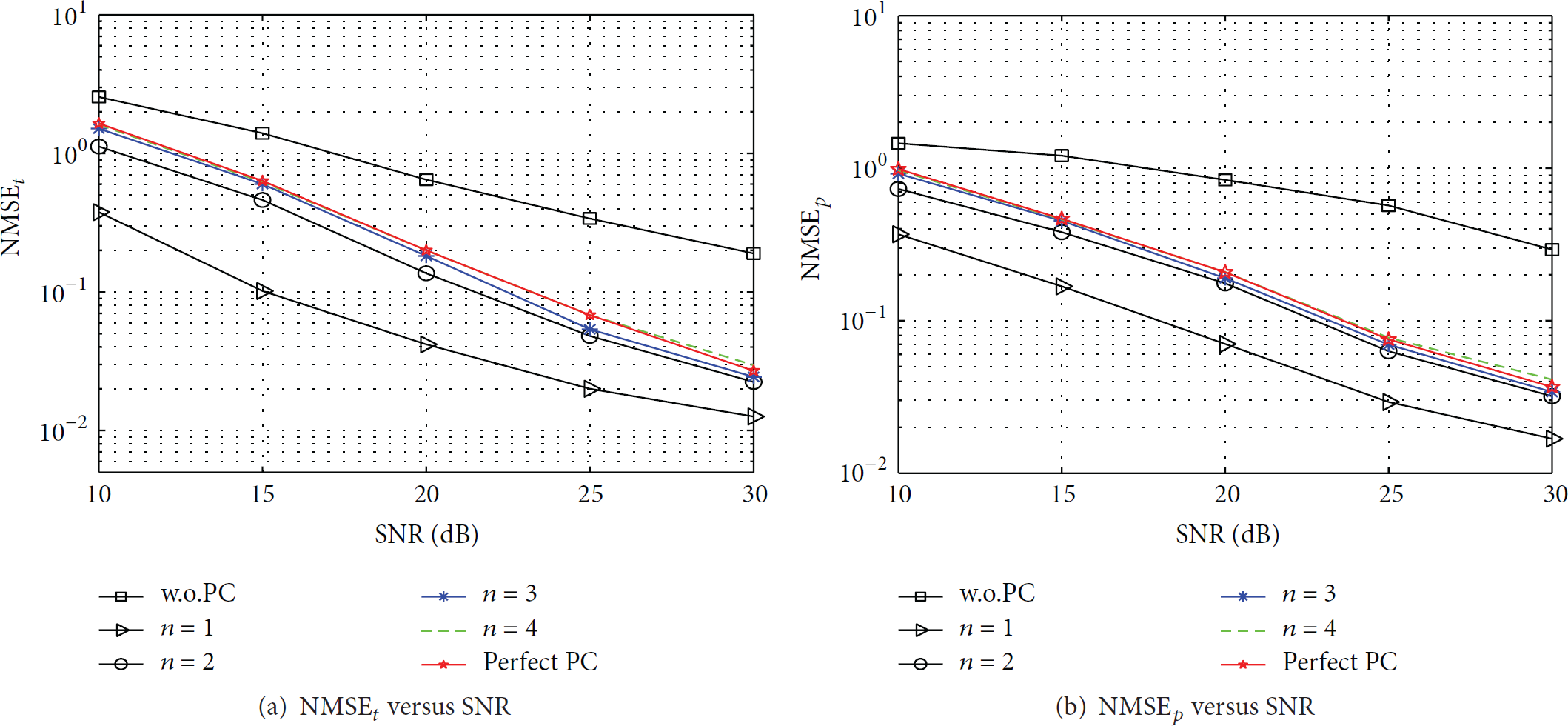
Performance evaluation for PCMDl approach.

Performance evaluation for PCMSng approach.

Performance evaluation for PCMSnl approach.
Figures 10(a) and 10(b) show performance enhancement when the levels number n decreases. In fact, the case
For all schemes, it is possible to achieve better performance than the case perfect PC which can be related to its reduced power consumption. The worst scheme is that of w.o.PC. The above performance comparison is elaborated for a given scenario by the definition of (
(iii) Comparison between the Proposed Power Control Approaches. In this part, a comparative study of the different PC proposed schemes is carried. Two cases are envisaged: Case

Comparison between different proposed schemes for
Case 1 (without constraint on power).
In Case
Case 2 (equal total power constraint).
We here compare each PC scheme to the case w.o.PC while imposing their consumed power equality. In Figure 14, dashed curves correspond to processing w.o.PC when it uses the same power compared to one of the PC schemes (solid line with the same symbol) when the latter has range
Respectively, for cases w.o.PC and with PC, the total consumed power is expressed as


(iv) Impact of the Coverage through

Performance evaluation versus coverage
6. Conclusion
In this paper, we investigated the problem of rare events detection in Wireless Sensor Networks (WSN) using the Compressed Sensing (CS) theory. In this context, two contributions are proposed. We first provided a theoretical, detailed formulation and proved the validity of the problem of CS based targets detection and counting. Then, we proposed a collaborative scheme which controls the transmitted power of some events in order to reduce the coherence of the sensing matrix thus guaranteeing an enhancement of CS recovery performance in WSN. Accounting for practical issues including sensors range and maximal allowed transmit power, we suggested two new schemes for power control that partition the sensor nodes into disjoint sets or clusters, respectively, based on the range of sensors from the cluster head “PCMD” and the deployed sensors density around the cluster head “PCMSn.” Each of the two schemes of power control envisages either a local or a global distance effect compensation, which are, respectively, denoted as PCMDl and PCMDg for PCMD mechanism, and PCMSnl and PCMSng for PCMSn approach. Simulation results validate their superiority over the case without power control in terms of coherence reduction and reconstruction (detection and counting) performance. Under equal consumed power constraint, the global approach (for both distance and nodes number based schemes) outperforms the local approach characterized by its lower sensitivity to the partition granularity.
Footnotes
Conflict of Interests
The authors declare that there is no conflict of interests regarding the publication of this paper.