




Abstract
Sharp increase of video traffic is expected to account for the majority of traffic in future 5G networks. This paper introduces the SELFNET 5G project and describes the video streaming use case that will be used to demonstrate the self-optimising capabilities of SELFNET's autonomic network management framework. SELFNET's framework will provide an advanced self-organizing network (SON) underpinned by seamless integration of Software Defined Networking (SDN), Network Function Virtualization (NFV), and network intelligence. The self-optimisation video streaming use case is going beyond traditional quality of service approaches to network management. A set of monitoring and analysis components will facilitate a user-oriented, quality of experience (QoE) and energy-aware approach. Firstly, novel SON-Sensors will monitor both traditional network state metrics and new video and energy related metrics. The combination of these low level metrics provides highly innovative health of network (HoN) composite metrics. HoN composite metrics are processed via autonomous decisions not only maintaining but also proactively optimising users' video QoE while minimising the end-to-end energy consumption of the 5G network. This contribution provided a detailed technical overview of this ambitious use case.
1. Introduction
Traffic generated by video applications has increasingly dominated 3G/4G mobile networks, placing great strain on network capacity. This is a trend which shows no signs of slowing as mobile Cisco forecasts video traffic to account for nearly 75% of global traffic by 2019 [1].
As network operators transit to 5G networks, they will have to contend with both the massive increase in video traffic and heightened user expectations of service levels and quality. In the face of such challenges, and despite the expected substantially enlarged network bandwidth/capacity of 5G, it is by no means assured that the enlarged bandwidth will be able to keep pace with the ever-growing consumer demands for higher quality and resource-hungry video applications.
The emergence of ultrahigh definition (U-HD) video streaming applications like U-HDTV [2], requiring up to 16 times the bandwidth of current high definition video, and an increasing number of 5G subscribers [3], when taken together, are likely to fuel continued rapid growth in video traffic. It can also be expected that the higher bandwidth of 5G networks will provide the impetus for the development of new mobile video services in M2M, IoT, and telemedicine, security/surveillance, and consumer domains [4].
Consumers of video content delivered over 5G networks are likely to have high expectations of video quality, network reliability, and service continuity. These expectations will be driven by new U-HD capable consumer devices (U-HD capable smartphones are already reaching the market) and user's perception of the improvements that a generational shift in network technology should deliver.
Video traffic increase and associated quality of experience are part of the issues tackled by SELFNET project. SELFNET aims to provide self-organized capabilities into 5G networks by achieving autonomic management of network infrastructures. This project is driven by ambitious use cases trying to showcase self-optimisation, self-healing, and self-protecting capabilities within 5G networks.
This paper is focused on one of such SELFNET use cases, the self-optimisation use case. The paper analyses several use case scenarios that are likely to impact on the end user's QoE and explain which autonomic behaviours and proposed architectural components are proposed to automatically respond when QoE levels either have fallen below or are predicted to fall below expected levels. Similarly, the end-to-end energy efficiency of the network is considered with specific architectural components monitoring and proactively managing the energy use of resources across the network.
The self-optimisation use case will address major areas of 5G development and performance. Firstly, it will underpin the EU 5G vision of ubiquitous delivery of new services based on U-HD [5]. Secondly, it will contribute to performance improvements through faster deployment times and reduced service discontinuity. Thirdly, it will place the user at the heart of network management decision making by adopting a QoE based approach to service level monitoring and delivery. Finally, it will reduce operational costs and help to meet carbon reduction targets by operating in an end-to-end energy efficient manner.
The transition from QoS to QoE aware service delivery represents a highly innovate change in how services are delivered. In QoE based video streaming [6], the emphasis is on how users perceive the quality of the services they receive. Any such transition will have significant societal impact. SELFNET's self-optimising use case will not only define novel methods of estimating the user's perceived QoE but implement them as part of an end-to-end user-centric approach to video streaming. In addition, further highly innovative and challenging QoE estimation techniques for video services such as M2M and automated surveillance are planned to be addressed. In these types of service, quality is measured by the utility of the information contained in a video when performing a task such as object recognition, target tracking, or decision making tasks. The SELFNET framework will provide sensors, actuators, and the decision making logic required to realise QoE based video streaming. The self-optimisation use case will also support the transition from current video encoding standards to the new H.265 standard [7] and its scalable extension [8].
The rest of this paper is organized as follows. In Section 2, the advances offered by the SELFNET framework and its associated self-optimisation use case are discussed from a technical perspective. Section 3 presents the use case, from a user's perspective, as a set of realistic scenarios. Section 4 summarizes how the SELFNET framework and the self-optimisation use case will help to meet very ambitious 5G KPIs. Section 5 outlines the system requirements of the self-optimisation use case and finally Section 6 concludes the paper.
2. The SELFNET Project
Advances in mobile technologies and the user-driven growth of an increasingly diverse range of services have triggered the requirement to create a new generation of efficient network management mechanisms and architectures able to support these new mobile technologies, services, and applications. Currently, in financial terms, the cost to mobile operators of operational expenditure (OPEX) is three times that of capital expenditure (CAPEX) [9]. Primarily, this disparity is a direct result of the complexity of the systems used to launch new, faster portfolios of voice and data products and to roll out technology upgrades or new customer service functions. In this context, the SELFNET project is designing and implementing an autonomic network management framework to provide SON capabilities in new 5G mobile network infrastructures. By automatically detecting and mitigating a range of common network problems, currently manually addressed by network administrators, SELFNET will provide a framework that can significantly reduce operational costs, improving at the same time the user experience.
By exploring the integration of novel technologies (SDN, NFV, SON, cloud computing, artificial intelligence, and QoE) and next-generation networking SELFNET will provide a scalable, extensible, and smart network management system. The framework will assist network operators to perform key management tasks such as automatic deployment of SDN/NFV applications that provide automated network monitoring and autonomic network maintenance delivered by defining high-level tactical measures and enabling autonomic corrective and preventive actions to mitigate existing or potential network problems. SELFNET will address three major network management concerns by providing self-protection capabilities against distributed network attacks, self-healing capabilities against network failures, and self-optimisation features to dynamically improve the performance of the network and the QoE of the users. An overview of the SELFNET architecture is shown in Figure 1.
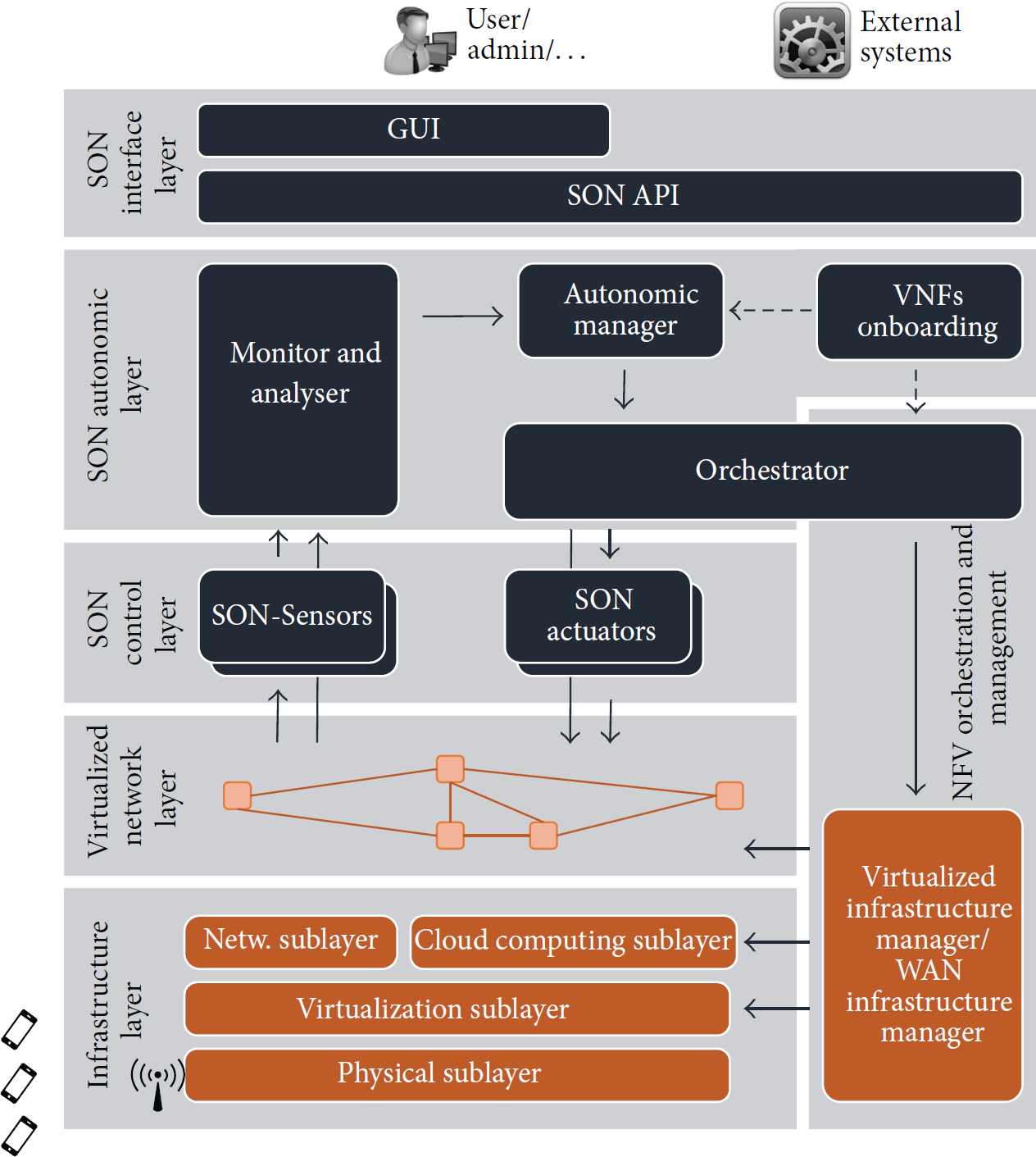
SELFNET architecture overview.
2.1. Technical Perspective
The challenge addressed in the self-optimising use case is finding autonomous methods of proactively predicting the impact of massive video traffic loads on network health, user experience, and energy efficient 5G network operation and then rapidly deploying network, video, and energy management resources in a coordinated fashion to counter potential failures and meet required health of network, user quality, and energy use service levels. It is also important that network management resources be deployed at appropriate locations in the network. This is especially relevant in 5G networks due to the fact that SELFNET is dealing with different geographical locations mainly based on mobile edge architectural principles.
This use case will demonstrate how the SELFNET framework can deliver self-adjusting traffic management mechanisms for delay reduction and loss prioritising in the video data plane by cooperating with intelligent encoding and packet marking schemes. The overall aim is to demonstrate an ability to achieve very high QoE even when traditional QoS levels are poor. Typically, this will be achieved by selective dropping of Enhancement Layer packets of scalable video streams and/or redundant transmission of important video frames essential to the decoding process. In addition, end-to-end QoE enhancement methods such as feedback of perceived quality to the sender will be considered.
In line with the trend of user-aware design, it is anticipated that users may be able to exert greater influence over the way in which services are delivered (including connection parameters and service differentiation). This use case will also consider ways of recording and utilising the preferences of users when making autonomous network management decisions. This will require a new, user-influenced way of differentiating application flows that will also satisfy the network management needs of service providers, in addition to delivering a personalised approach to the user within the robust, smart, and autonomous SELFNET framework.
2.2. Video Encoding Technologies
Each of the main components of this use case (self-optimised video adaptation, user-assisted approach, and energy-aware approach) is underpinned by video encoding and adaptation technologies. The last few years have seen the introduction of a new generation of video encoding standards including VP9 [10] and H.265 [7]. The H.265 standard, also known as High Efficiency Video Coding (HEVC), is widely seen as the replacement for the popular H.264 [11] standard, which is widely used in consumer electronics products and multimedia services today. H.265 offers a bandwidth saving of up to 50% over its predecessor without any loss of visual quality. The adoption of H.265, due to the bandwidth saving available, is seen as a key driver in the widespread introduction of extremely bandwidth intensive U-HD applications.
Among other potential adaptation schemes, a generic scalability-based video adaptation scheme is described to present a specific example, and initial starting point, for video adaptation mechanism that could be used by this use case to highlight the self-optimisation capabilities of the SELFNET framework.
As illustrated in Figure 2, flows of video data are encoded in a layered format, where the Base Layer (BL) contains the most important video packets that have the greatest impact on an end user's perceived visual quality. The Enhancement Layers (ELs) contain additional details for improved visual quality but are not essential (EL1 is more important than EL2, EL2 is more important than EL3, and so on). When network congestion at the core network or insufficient bandwidth at the Cloud Radio Access Network (C-RAN) is detected, selected higher Enhancement Layer video packets (EL2 packets in this example) will be dropped at a Media Aware Network Element (MANE) to reduce the demands on bandwidth whilst the Base Layer and the lower Enhancement Layer(s) will be delivered. Such selective packet dropping using layered video coding can result in substantial bitrate savings with little impact on the perceived quality at the end users [12, 13].

SELFNET video streaming adaptation use case scenario: data plane (example).
In this use case, MANEs may be deployed to intelligently adapt scalable video streams in support of multiple objectives in network capacity management, energy management, and user-centric quality management. MANEs can support user-assisted 5G aims as part of an overall user-influenced QoE management strategy where both objectively measured QoE utility estimates [14] and user preferences (as to which of his/her own application flows should have the highest priority) [15] form the basis of smart autonomic video adaptation schemes. Similarly, MANEs might be deployed at strategic points in the C-RAN to adapt video traffic intelligently in order to reduce the energy consumption of 5G base stations or access points as part of a wider energy management strategy.
The majority of previous MANE implementations [16, 17] have adapted video streams encoded using the H.264 Scalable Video Coding (SVC) codec [18] reactively in response to changes in available bandwidth. The starting point for this work will be a scalable video solution based on the very recent scalable extension [8] to the new H.265 standard [7] which offers substantial bandwidth savings [19] over the scalable extension to H.264. This use case, in addition to addressing the anticipated very large volumes of 5G U-HD video traffic encoded with these new and emerging codecs, further considers a combined proactive deployment of MANEs and complementary SDN/NFV enabled smart tools for related tasks such as video caching, load balancing, traffic offloading, and energy management.
This fact, combined with an efficient automated distributed deployment of MANE elements, is able to perform advanced video processing and adaptation wherever and whenever in the network and thus will contribute to a number of ambitious Key Performance Indicators (KPIs) envisioned in 5G. This will enable a real-time, continuous, smooth/seamless video streaming experience at the end users' side and resolve network congestion by discarding nonessential information, which reduces the bandwidth consumed by video traffic flows.
2.3. Beyond QoS-Meeting User Expectations
As part of the ambitious SELFNET approach, new and innovative ways of measuring the health of networks that take account of user expectations of quality must be found and implemented in SELFNET SON-Sensors and the SELFNET aggregator/analyser module. The definitions of who or what constitutes an end user in the 5G environment must be revised in light of the expected upsurge in M2M communications (including video application for surveillance) in 5G networks as must the way in which QoE is expressed for these new services.
It is now widely recognised that the estimation of user QoE for streamed video content is dependent on many factors [20], some of which relate directly to the nature of the video itself, some to the type of encoding used, some to the type of client side playback device and its resource limitations, and others to traditional QoS metrics from the transmission network. Estimation of QoE is therefore a very challenging and, as yet, unresolved area of research particularly when the use of new and emerging video codecs is taken into account. From a video perspective, the content type of the video is of primary importance [20]; for example, a video containing low levels of detail and motion such as a newsreader sitting at a desk is significantly less susceptible to network impairments than a high motion, highly textured sports broadcast. In order to successfully demonstrate the capabilities of the SELFNET framework to manage immense volumes of 5G video traffic, SELFNET SON-Sensors must be able to acquire important video stream metrics such as content type in real time [21, 22], either from preprocessed data inserted into the stream, metadata files, such as the Media Presentation Description (MPD) file used in the Dynamic Adaptive Streaming over HTTP (DASH) standard, or the fly during transmission. The SELFNET aggregator/analyser must also be able to derive high-level objective QoE estimates from the monitoring data delivered by the SON-Sensors.
Given that a great deal of video traffic in 5G networks will originate from content delivery networks and is likely to have some form of digital rights management (DRM) related encryption, one of the most important challenges associated with measuring QoE will be that the SELFNET framework must provide a means of accessing video stream QoE indicators from encrypted video streams. This may be achieved through either metadata, video stream descriptor file, or inclusion of unencrypted data in the video packet headers. Current approaches to encryption of DRM protected video content vary according to the type of streaming technology employed. In IPTV and RTP/RSTP, traditional MPEG encryption [23] algorithms have been applied to H.264 [11] encoded video content. One approach that some of these algorithms have taken is to use a Naive Encryption Algorithm (NEA) that employs standard encryption algorithms such as Advanced Encryption Standard (AES) to encrypt the whole bitstream without taking into account the nature and structure of the compressed video. NEA encryption has two main drawbacks: firstly encryption and decryption of the entire H.265 [7] video streams would be both time and energy intensive and secondly, and perhaps more importantly for SELFNET, prevent trusted middleboxes such as MANEs from preforming in-network adaptation of the video stream. The other approach is to use selective encryption where only certain components of the encoded video content are encrypted. This approach has recently been proposed for both H.265 standard [24] and its scalable extension [25]. In both cases, only a few parameters in the bitstream such as the transform coefficients have been encrypted. This level of encryption is sufficient to distort the video image but may still retain enough information to allow the QoE content type metric to be derived from the compressed domain.
A more recent trend in video encryption for Video on Demand (VOD) is that of using HTML5 with Encrypted Media Extensions (EME) and in the case of NETFLIX, one of the largest content providers, HTTPS encryption. In these cases, although the packet header remains unencrypted, all video content is encrypted presenting the same problem as NEA. Therefore, a means of conveying QoE metrics in an unencrypted format must be found. One possible solution may be to extend the MPD file used in HTTP streaming to include QoE information.
In addition, the SELFNET framework should also be able to perform QoE-aware video stream management end to end across multiple service provider domains. This will be further explored in our future work.
2.4. Two-Tier Data Centre Architecture
It is envisaged that MANE (and other traffic engineering resources) will be deployed across a two-tier data centre architecture. In access networks virtualized resources would be deployed at “last mile data centres” located at the ISP's point of presence (PoP), while virtual resources would be deployed at the SELFNET central data centre to provide network management functionality such as traffic engineering and video adaptation within the core network. This two-tier approach will facilitate, amongst others, coordinated local energy-aware management at the PoP of 5G base stations and access points. Unlike existing MANE deployments that provide static MANE resources in the core or C-RAN networks, this use case considers the ability to rapidly deploy MANEs either in the core (central data centre) or at the network edge (last mile data centre) to proactively manage video traffic and to meet user QoE expectations. This requires new intelligent behaviour that is aware of context (e.g., network topology), energy consumption, user preference, service type, and video content.
2.5. Energy Awareness
SELFNET should be an energy-aware system end to end. We can follow different approaches to get information about the energy consumed by each of SELFNET's components. Information can be collected either from the physical components present in the C-RAN or from congestion mapping and prediction taken from SELFNET HoN metrics. Intelligent algorithms based on these HoN metrics will be able to predict when congestion is about to happen in a given C-RAN including any given base station or access point and the estimated energy consumption of all scalable video streams routed through that base station.
The SELFNET decision making process will then decide how to cope with this congestion which may be either by energy-aware and QoE aware scalable video adaptation via a MANE deployed at the Data Centre Point of Presence (DCPoP) or by traffic engineering solutions such as redistribution to adjacent base stations according the network load. Additionally, in areas where high densities of users might be expected such as airports or sports venues/events stadia, the SELFNET decision maker will selectively activate and deactivate physical resources such as base stations and access points as and when required to manage energy consumption.
SELFNET will propose a more flexible way to optimise the number of active network elements as the traffic grows/decreases, making the network more efficient in terms of energy consumption. This is especially relevant in areas with a high density of users and time variant traffic patterns. In respect of the latter, the SELFNET platform can collect usage statistics and extract daily usage profiles per network element. The platform can extract users' location and movement patterns. This will identify heavily used locations and help to define the optimum number of network entities (NEs) that should be started at a given moment of the day and location. Improvements in terms of energy consumption can be achieved also at network element level: when high QoE is detected, it is very likely that the network elements have spare bandwidth. In such a case, we can reduce the link capacity to save energy. Should the system be able to use an energy-aware cloud system, SELFNET will also be aware of the energy consumed by the virtual network functions deployed in the cloud infrastructure. SELFNET can leverage the existing techniques in energy consumption measurement. For instance, GreenCloud [26] is an example of system with the capability to capture details of the energy consumed by data centre components as well as packet-level communication patterns between them.
2.6. New and Emerging Video Applications
SELFNET SON-Sensors and actuators must also be able to effectively manage, at immense scale, video applications other than the current provider/subscriber models of content delivery networks that may emerge as users gain access to the expected high bandwidth and low latency 5G network environment. For example, in addition to a potentially huge rise in the use of video calling applications at very high densities within the C-RAN, new real-time video streaming services where individual mobile users can be either content provider or subscriber may emerge. An example of such a potential new application is considered in Section 4.3.
2.7. Privacy of the Content of User Video Streams
Importantly, it is assumed in this use case that all QoE monitoring components that inspect video streams to obtain QoE metrics, whether in the compressed or uncompressed domains, will not impact on the privacy of users or owners of content. Whilst in many cases the video content will come from content delivery networks that may add metadata about content type or other QoE related low level metrics, many user generated and owned videos will also need to be processed to estimate content type, and so forth. It is anticipated that video type will be derived from the compressed bit stream using schemes based on our previous work [21] where video content type is estimated from the new H.265 coding tree structure and motion vector data without any inspection of the information content of the video stream.
3. Relation to 5G Requirements
This self-optimisation use case will have significant impact on major areas of 5G development and performance. Firstly, it will underpin the EU 5G vision of ubiquitous delivery of new services based on U-HD video. Secondly, it will contribute to performance improvements through faster deployment times and reduced service discontinuity. Thirdly, it will place the user at the heart of network management decision making by adopting a QoE based approach to service level monitoring and delivery and finally it will reduce operational costs and help to meet carbon reduction targets by operating in an end-to-end energy efficient manner.
The transition from QoS to QoE aware service delivery represents a highly innovate change in how services are delivered. In QoE based video streaming, the emphasis is on how users perceive the quality of the services they receive. Any such transition will have significant societal impact. The self-optimising use case will not only define novel methods of estimating the user's perceived QoE but implement them as part of an end-to-end user-centric approach to video streaming. In addition, further highly innovative and challenging QoE estimation techniques will be developed as part of the SELFNET framework. These will include devising new video quality metrics based on the suitability or utility of a video stream when performing a task such as recognition, target tracking, or decision making support. This approach varies from traditional QoE approaches by replacing perceptual-based quality of experience by QoE measurement with utility based QoE based measurement for automated M2M tasks. The SELFNET framework will provide sensors, actuators, and decision making logic required to realise QoE based video streaming.
The self-optimisation use case is also supporting the transition from current video encoding standards to the new H.265 standard and its scalable extension. Innovative, fast, and reliable network media adaptation NFVs will be developed for use with U-HD video encoded using these latest codecs.
SELFNET sensors must be equipped with a means of acquiring video metrics from both compressed and encrypted video streams and actuators, such as NFV-MANEs with a means of adapting those same streams. No such capability currently exists.
Another SELFNET innovation that will be developed from the YouQoS concept [15] is the introduction of receive-subscriber driven QoE optimisation. It allows the consumers to influence network management decisions about their traffic. This feature will help small service providers to compete with industry giants. For example, a subscriber may prefer to watch a video from a small service provider instead of, for example, YouTube, and assign priorities accordingly.
In terms of energy awareness, the self-optimisation use case will use novel energy monitoring sensors to develop a global view of energy usage across the network and then optimise energy use through the deployment of energy manager NFVs.
The proposed use case would be able to demonstrate SELFNET's contribution to the following 5G KPIs [9, 23]:
“new economically viable services of high societal value (like U-HDTV and M2M applications)” (societal KPI) in terms of supporting and optimising U-HD video services; “zero perceived downtime for services provision” (Performance KPI) in terms of minimising video streaming disruptions for end users; “10 to 100 times more connected devices” (Performance KPI) in terms of supporting more video sessions (or users) by employing the more efficient new video codec; the implementation of the use case that will contribute to the reduction of the provisioning time from “90 hours to 90 minutes” (Performance KPI) for the services involved in this use case. It would validate the feasibility of SELFNET framework to reduce the provisioning time of other software elements; to improve the speed of video delivery, via smart caching and/or other techniques wherever appropriate and to make complementary contribution at the application level to the ultralow latency envisioned in 5G (sub-1 ms latency Performance KPI within 1 km); to support applications and services with an optimal and consistent level of QoE anywhere and anytime.
The self-optimisation use case will be used to demonstrate the potential of SELFNET framework to meet the expectations of the following groups of 5G stakeholders: manufacturers; industry associations; research community; regulatory bodies and universities; network operators; vertical sectors like energy, health, manufacturing, robotics, environment, broadcast, content and creative industries, transport, and smart cities; communication service providers; public administrations.
4. Use Case Scenarios
Three user-driven scenarios have been chosen to highlight how each of the components and layers in the SELFNET framework can act in concert to manage a set of demanding real world scenarios.
4.1. Scenario 1: Video Streaming in Changing Network Environment Using a 5G Hot Spot
In this scenario, a nomadic mobile user enters a busy public location such as a cafe, arena, or airport where he connects to a 5G hot spot. There are a number of other users connected to the same 5G hot spot, all of whom use Internet access for a diverse set of tasks including social media networking, video watching, e-mail, and VPN access using their smartphones, tablets, and laptops. It is assumed that there will be a number of adjacent hot spots, some of which offer overlapping coverage. We focus on the QoE of a single user in a realistic evolving scenario. He has requested a U-HD video stream from a content provider located out with his own network. At the outset, this stream is the only significant (in terms of bandwidth) application that this user is running.
4.1.1. Step 1: Sparsely Populated RAN
Initially, there are few users concurrently attached to the hot spot and consequently network conditions are stable with perfect or near to perfect channel conditions. Since there is no network impairment, the user's QoE expectations will be met, providing him with ultrahigh resolution video without any noticeable buffering waits or visual artefacts such as blocking or blurring. The SELFNET framework is monitoring both the network state and video application flows, continually evaluating the health of the network and estimating the QoE of users. From the user QoE perspective no autonomic behaviour is required by the SELFNET framework as expected QoE has neither dropped, nor been predicted to drop in the short term, below the user's satisfaction threshold. Figure 3 shows the initial state where the user has entered the 5G hot spot.

A user moves into a sparsely populated 5G hot spot and begins to receive streamed U-HD video content.
From the service provider's perspective, SELFNET sensors have determined that, at a microlevel, the subscriber Service Level Agreements (SLAs) have been met and that they have fulfilled their QoS obligations to the individual subscriber, while at a macrolevel the overall health of the network has been maintained and consequently no autonomic behaviour is required to ensure compliance with SLAs. However, the SELFNET framework is also monitoring the energy efficiency of operations within the RAN. In this lightly populated situation, SELFNET decides that a single 5G hot spot is sufficient to manage the traffic load and meet QoE expectations; consequently adjacent hot spots are switched off to save energy. This decision has no impact on the users.
The SELFNET framework continues to monitor the estimated QoE level of the video throughout the duration of the user's session. Figure 4 shows the state after SELFNET intervention where the action performed has been to deploy an energy management actuator that places adjacent, unrequired hot spots into sleep mode.

An energy management actuator has been deployed to the RAN and adjacent hot spots put into sleep mode.
4.1.2. Step 2: Increasingly Congested RAN
Over time, more users arrive at the physical location and attach to the same hot spot. Simultaneously, some users open multiple applications on their devices, each of which generates a new application flow. The immediate implication is that each user now has less bandwidth available to him as the available bandwidth is shared fairly between users attached to the hot spot. Continuous monitoring and analysis of low level metrics by the SELFNET framework determines that congestion has been either observed or predicted to occur in the immediate future and anticipates that user QoE expectations will no longer be met. The net effect of this congestion in the RAN, if not proactively mitigated, would be a reduction in user's QoE. This would be observed by the user as periods of buffering and a reduction in picture quality (visual impairments such as blocking and blurring). The reduced bandwidth available to each user also results in subscriber SLA's having been breached or predicted to be breached.
As user density at the hot spot increases, SELFNET responds by performing autonomous behaviours aimed at minimizing the impact on user's QoE whilst ensuring that subscriber SLAs are met. Bearing in mind energy efficiency, SELFNET would start up the minimum number of adjacent hot spots required to offload users situated at the periphery attempting to ensure that each user had enough bandwidth to meet their subscriber SLA and that macrolevel health of networks metrics remained satisfactory. Where subscribers are currently running multiple applications, they will have the ability to influence the SELFNET decision making process by indicating which application is most important to them. However, SELFNET's autonomic responses will be transparent to the subscriber and will deploy smart media adaptation network entities (MANEs) and smart video caching actuators to the network edges. MANEs would intelligently adapt video streams to meet the bandwidth and delay limitations of the congested RAN in a QoE optimised manner. This would be done by considering not only network state metrics but also video metrics such as content type and the user's device capabilities.
Therefore, video quality degradation likely to result from increasing congestion is mitigated in the data plane. Intelligent video adaptation using MANEs ensures that any quality degradation occurs smoothly and has limited impact on human perception of quality (QoE), even though the congestion is already measurable by detectors (QoS).
The SELFNET framework will deploy the automated responses as close to the congested area as possible. The impact of SELFNET's automatic response is the return of user QoE levels to an acceptable level which in turn results in the delivery of ultrahigh resolution video without any noticeable buffering waits or visual artefacts such as blocking or blurring. The SELFNET framework continues to monitor the estimated QoE level of the video throughout the duration of the user's session. At a microlevel, the QoE of each user will be supported by adapting the video stream in the “best” way to suit his needs and circumstances, while at a macrolevel SELFNET decision making and planning will ensure fairness in the level of QoE provided to every user. Figures 5 and 6 show the initial and final states, respectively.

A large number of users who are all streaming videos traffic begin to cause congestion in the 5G hot spot.
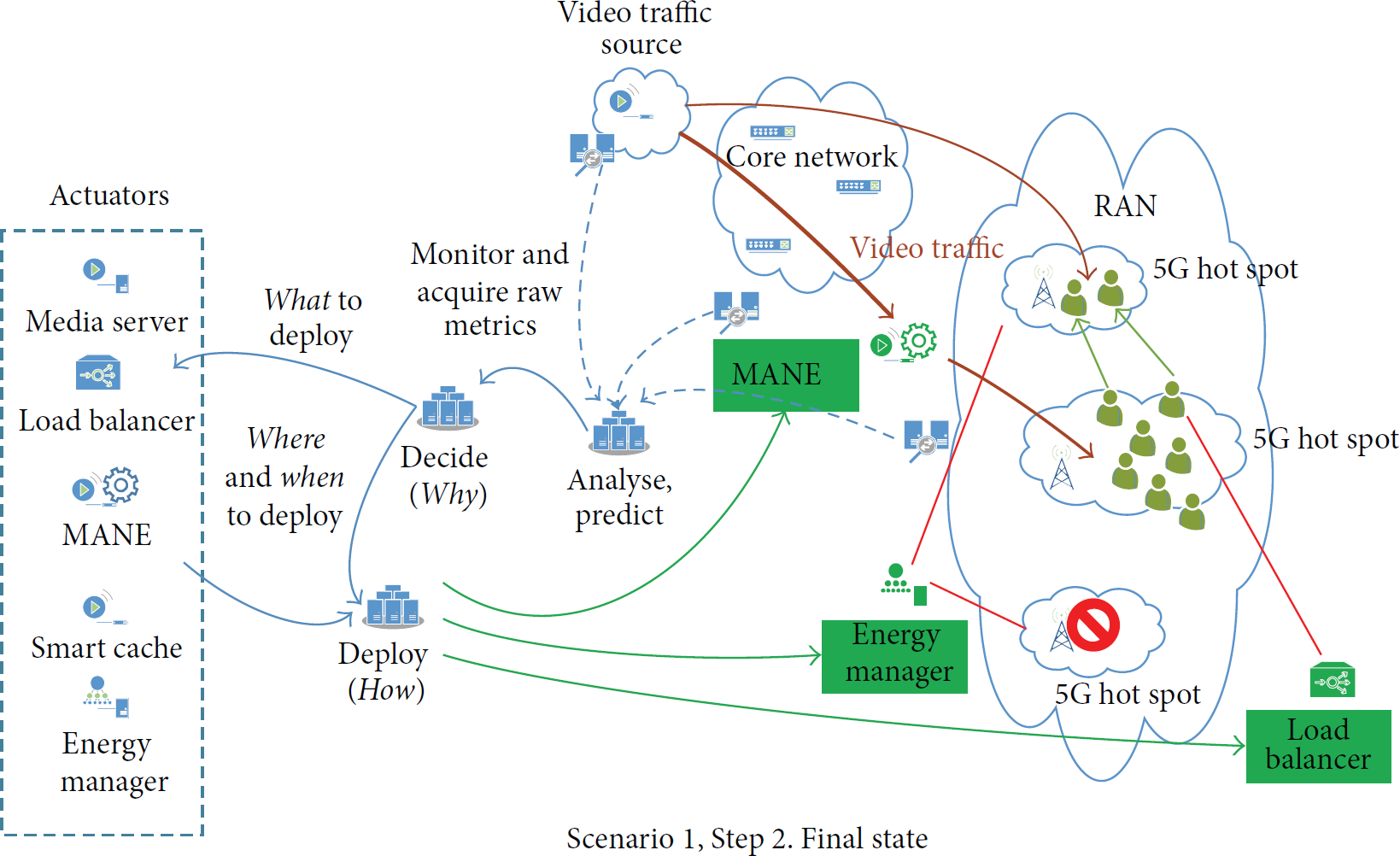
Media adaptation, energy management, and load balancing actuators deployed.
4.1.3. Step 3: Significant Network Impairment
Whilst the RAN is densely loaded with users in the original and adjacent hot spots, a significant impairment such as a network outage impacts the core network. Many users, across many RANs, are concurrently streaming U-HD video. After the self-healing use case reconfigures the network to restore connectivity to the best possible state, the self-optimisation algorithms will work to provide the highest possible level of QoE to the users affected by the network impairment without affecting the other users of the network.
Due to the impairment localized, SLA breaches will occur as, in some cases, it will not be possible to maintain all the streams at normal throughput. As part of the self-optimising response to such a network event, the SELFNET SON will deploy MANEs and traffic engineering resources globally across the network to reduce the resource usage of video flows in a QoE efficient manner in support of the self-healing effort. The above three steps of this scenario are summarized in Table 1.
Summary of SELFNET actions in Scenario 1, Part 3.

4.2. Scenario 2: Video Streaming Where the End User Is Both Consumer and Provider of Real-Time Video Content
This scenario considers the case of a nomadic user who may be both the consumer and originator of ultrahigh definition video content. This scenario makes the assumption that as high bandwidth low latency 5G networks become available and U-HD capable mobile devices become common, new services will allow users to participate in real-time video calling at spatial resolutions that make the full use of their device's capabilities. Similarly, it is anticipated that subscribers not only will be able to upload high frame rate U-HD videos quickly to social networking and video sharing sites but also will be able to stream videos they are currently taking in real time, or very close to real time, to other users or groups of users.
Although the recipient users' QoE will be managed at the network edge close to their physical location in the same manner as scenario A, SELFNET will need to deploy and manage a different set of resources to facilitate upstream video streaming from the RAN, through the core to another, remotely located RAN. Many user mobile devices will be capable of recording U-HD video. However, all, but the most heavily resourced mobile devices, may not be capable of encoding highly compressed scalable video in real time.
Traditionally, in today's networks, the bandwidth provisioning (governed by SLAs) is asymmetrical with download links typically having over 10 times as much capacity per user as upload links. To accommodate this scenario, uplink provisioning must be sufficient to support these new applications. When SELFNET's monitoring and analysis tools either observe that upstream video delivery or U-HD video calling is taking place or predict that it may do so by observing, for example, a surge in social media use in a certain 5G hot spot or RAN, the decision making planner must propose autonomic actions to support the subscriber to successfully stream in real time. Figure 7 shows the initial state when two remote users begin a real-time video call.
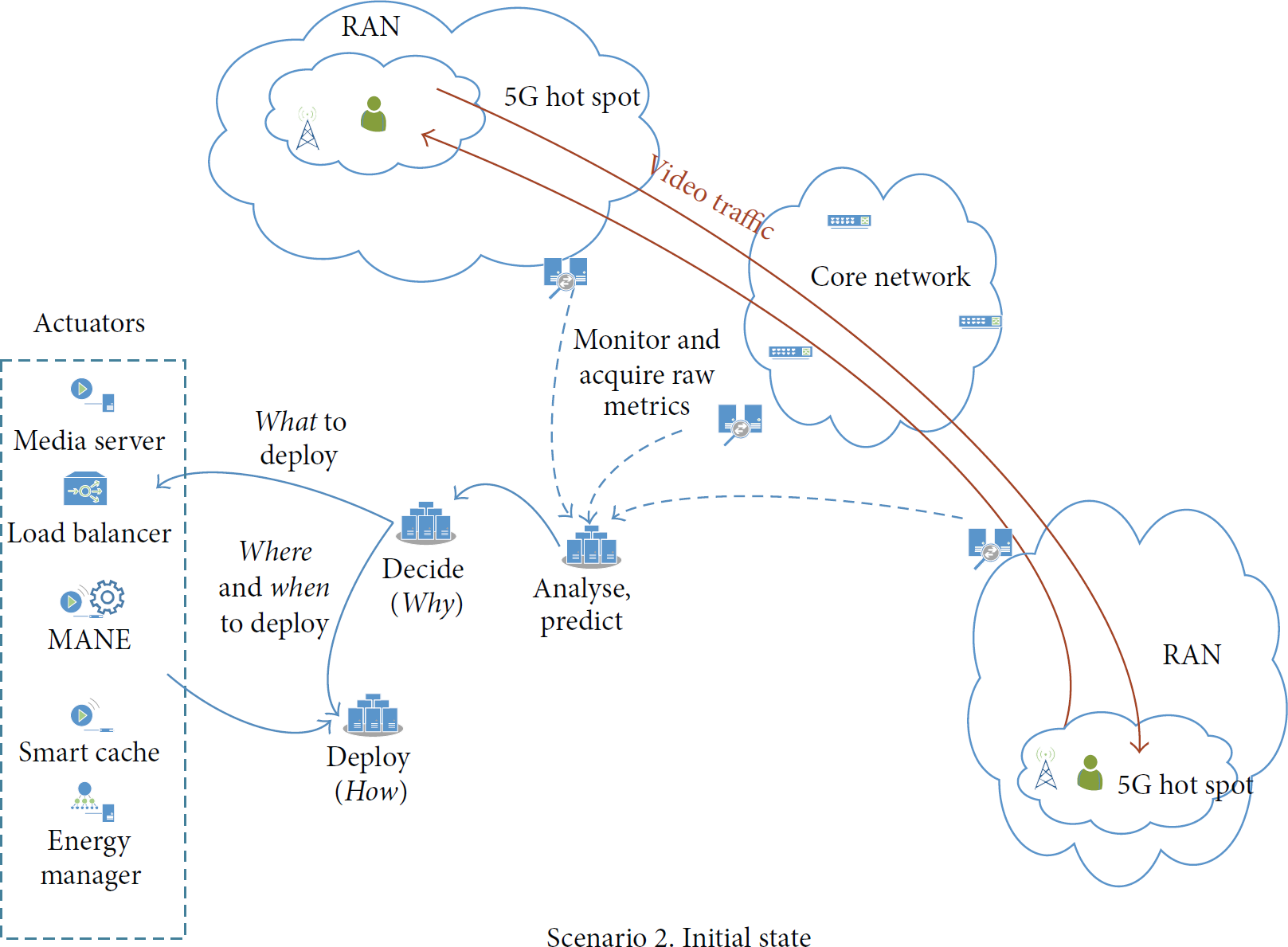
Initial state for a video calling application prior to framework intervention.
An example of SELFNET autonomic responses in this scenario is illustrated in Figure 8.

SELFNET has deployed media server and uplink provisioning actuators at both ends of the video.
Autonomic actions performed by SELFNET may include deployment of smart video caches and media streaming servers or video transcoders to the RAN; these new network entities would allow some of the management of the upstream video delivery away from possibly resource constrained UE devices and reduce the energy usage (battery depletion rate) of the user devices. From a network management perspective, when large volumes of video traffic originating in the access networks are detected, SELFNET will need to deploy resources that will provision uplink SLAs for the subscriber.
4.3. Scenario 3: Video Generated by Smart City Applications
In this scenario, the user is defined as an M2M application for automated video surveillance or some other critical application. Where this scenario differs significantly from the consumer driven scenarios (1 and 2) is that the QoE (if such a term is actually appropriate) of such services, although potentially of vital importance in future smart cities, is an area that has been underresearched.
In terms of monitoring and analysis, the video QoE high-level metric must reflect the information content of a video stream and its utility in performing automated recognition or detection tasks and must support appropriate decision making rather than perceptual quality from a consumer's perspective. Smart video adaptation algorithms running on MANEs used in the core or at the edge to manage this type of traffic should adapt stream in a manner that optimises this quality utility function rather than more traditional perceptual quality.
This is made more challenging by the fact that the video stream requires real-time delivery which is being adversely affected by high volumes of consumer U-HD video traffic in the core network. The M2M system operator established an SLA with the SELFNET operator that allows both a slight degradation of the video quality and the relaxation of the real-time constraints for small periods of time. The SELFNET framework will correctly identify the different characteristics of the M2M flow and apply a different policy to these flows, and if needed a MANE will modify the video stream in an attempt to reduce the required throughput while still maintaining the contracted SLA. If the network is still congested after the modification of the M2M traffic, the SELFNET framework should attempt other strategies to improve the situation, such as reconfiguring the MANEs that handle the other user's best effort traffic in an effort to allow the return of the M2M traffic to nominal conditions.
This scenario ends with the M2M traffic within the conditions that are considered nominal by the SLA and the lowest impact possible on the remaining user streams, either by severely degrading a few streams or by slightly modifying a large number.
5. Functional and Nonfunctional Requirements
The self-optimisation use case also has a number of specific requirements that need to be implemented in order to demonstrate its functionality. The list of requirements for the self-optimisation use case is shown in the Appendix. In the following subsections, a summary is provided to the reader.
5.1. Video QoE Related Requirements
In order to optimise network resource usage, while maintaining a good QoE, the self-optimisation use case must implement new functionality as well as port existing functions to the SELFNET framework. This use case takes advantage of the emerging codec H.265 that allows a layered encoding of video, as well as HD and U-HD resolutions. Codecs that allow layered encoding facilitate layer-specific packets to be dropped, reducing video quality, whilst preserving the video service continuity. This allows the video stream to be manipulated in such a way that the QoE is maintained for the end user without the need to use an expensive operation such as transcoding. The first set of requirements deals with the availability of the codec, as well as the building blocks needed to create a service chain that is able to manipulate a single H.265 stream in a SELFNET environment.
When many streams from different sources are present, it becomes necessary to categorise them according to SLA in order to differentiate urgent video streams such as telemedicine from normal streams like a regular video call. Once this initial differentiation is accomplished, each class of stream can then be subject to the different kinds of manipulation available on the SELFNET platform. If the RAN is congested, some nonessential layers of the video can be dropped, hence consuming less resources, allowing the QoE to be maintained. If the core network and ISP peering are congested, caches can be deployed on the network, reducing the pressure on the congested links by serving the most common streams from a cache placed as close to the end user as possible. A second set of requirements deals with the coexistence of very different flows of video on the network, as well as different types of congestion and unreliability. The objective is to perform different adaptations for each situation, while attempting to maintain a good QoE for the end users.
5.2. User Preference Requirements
This use case also attempts to take into account user preferences when deciding to apply any modification to a video and on what kind of modifications to apply. A user can record his preferences with the SELFNET system and specify relative priorities for each type of stream and the SELFNET elements will take those preferences into account when performing traffic optimisations, for instance, by dropping an extra layer of a lower priority stream to keep an extra layer on a higher priority stream for the same user. The third set of requirements attempts to reflect user orientation, where the user is allowed to save his personal preferences, and where possible, the SELFNET framework will take those preferences into account when deciding how to handle each video stream.
5.3. Energy Efficiency Requirements
The final goal of this use case is energy efficiency. The autonomic engine that manages the deployment of the components on the physical infrastructure will take among others expected energy impact of deploying a virtual function as well as the impact of activating certain elements such as radio antennas. This is expected to allow a higher level of virtual components consolidation allowing certain physical resources to enter lower energy states when not used at all.
A more aggressive possibility that will be explored is actually signalling some of the seldom used infrastructure to enter a soft off state, which would achieve a higher energy conservation not only via a direct reduction of consumed power but also via the reduction of the energy spent dissipating generated heat. The final set of requirements deals with the need to feed energy related metrics to the core of the SELFNET autonomic layer; the autonomic layer will then take these new metrics into account when deciding between similar deployments with different energy consumption requirements.
6. Conclusions
This paper has introduced the SELFNET framework for the autonomous management of 5G network infrastructures and described the self-optimisation use case that will be used to validate the SELFNET framework, demonstrate its ability to meet 5G KPI's, and deliver new, user-oriented services. The use case employs a series of ultrahigh definition video streaming scenarios to illustrate the full autonomic cycle (monitor, analyse, predict, decide, and deploy) of the SELFNET framework.
By using SELFNET SON-Sensors to monitor low level metrics for network state, video stream quality, and energy usage, the SELFNET framework is able to analyse and combine these metrics to create innovative health of network (HoN) metrics for network state, video QoE, and energy consumption. These metrics are used to provide an end-to-end picture of network health and to predict network behaviours likely to impact performance. The SELFNET framework can then decide which proactive or reactive actions to take, if any, and which resources to deploy at an appropriate time and location to maintain the health of the network, maximise end user QoE, and minimise end-to-end energy consumption. Whilst the SELFNET framework will deliver both capital and operational expenditure savings for network operators, the self-optimisation use case focuses on maximising the QoE of consumers and reducing the overall energy footprint of the 5G mobile communications infrastructure.
Footnotes
Appendix
See Table 2.
Conflict of Interests
All the authors declare that there is no potential conflict of interests, including financial interests, relationships, or affiliations, relevant to the subject of this paper.
Acknowledgments
This work was funded by the European Commission Horizon 2020 5G-PPP Programme under Grant agreement no. H2020-ICT-2014-2/671672-SELFNET (Framework for Self-Organized Network Management in Virtualized and Software Defined Networks). The authors would thank all the SELFNET partners for their support in this work.