




Abstract
Wireless Body Area Network (WBAN) is a small-scaled sensor network consisting of a series of medical devices attributed to, around, or implanted in a human body, providing continuous monitoring by different sensors to collect vital signals or motion and GPS. This paper proposes an effective routing algorithm to balance the energy consumption within a WBAN in order to prolong the overall lifetime of the network, called dynamic routing algorithm (DRA) and its improved version based on a multipath choice mechanism. Theoretical analysis and simulation result are demonstrated to evaluate the performance of the algorithm and represent that energy consumption of sensors in the network is reasonably scheduled and life cycle of the network is significantly extended. The routing algorithm proposed in this paper may be potentially applied to significantly save energy of multiple types of sensors during vital signals aggregating and transmitting under the WBAN.
1. Introduction
In recent years, the aging population has been receiving more and more attention; medical care problems of the elderly have become the focus of attention. The advent of Wireless Body Area Network can be a good solution to this problem. Wireless Body Area Network (WBAN) enables remote medical monitoring and diagnostics, saving a lot of manpower and resources for the medical care of the elderly, and the elderly do not have to stay in the hospital, which greatly expanded the space to improve the medical resources for the elderly utilization.
WBAN is a solution to personalization and ubiquitous calculation in area of medical system and entertainment, which is under the picture of rapid development of Internet of Things. Achievements in intergraded circuits and sensor technology have laid foundation for WBAN. IEEE 802 established a Task Group 6 for standardization of low-power, small-scale wearable medical devices network. A WBAN usually consists of a central node (could be a cellphone or PDA) and several sensor nodes. Central node is the sink within the network and also functions as the gateway to public network through WLAN or cellular network. A cellphone can also provide interface for the wearer to check the health indicator when needed. Sensors nodes collect anthropometric indicators such as EGG, CGG, pulse, temperature, and blood sugar and other information such as motion and GPS and transmit the data to the sink for primary processing of way to professionals. A typical WBAN is shown in Figure 1.

Typical WBAN model.
Currently WBAN is still in the development stage; there are many practical problems to be solved. The efficient use of energy resources being the core of all problems is the main constraint for the technology of commercial utilization. In view of this, research mainly focuses on improving the efficiency of energy resources.
IEEE 802.15 is a standardization organization for Wireless Personal Area Network (WPAN). Task Group 6 (TG6, 802.15.6) established in December 2007 is devoted to set standard for the communication between medical devices on or in a human body; most of their work is on the PHY layer and MAC layer [1, 2].
As a brand new area, WBAN has attracted plenty of organization from different countries to research and had several yielded results. Laboratory of Electronics and Information Technologies (LETI), France, studied the channel property on the surface of human body considering frequency, measurement in frequent domain and time domain, antenna size, and position and attribution of the nodes [3]. Santiso Bellon et al. modeled the channel around the human body and the human body channel. They pointed out that when human body is moving, there is shade having an impact on the quality of communication [4]. Philip Co. proposed that, according to the existing standard, scalability and validity and error tolerance on DLL are required [5]. Korea Telecom Joint Institute of Inha University for WBAN has analyzed data link layer protocol providing a reference for IEEE standards group [6]. A research group from the Yokohama National University represented the analysis work of WBAN by implanting a 2.4 GHz band spread spectrum system into the Industrial Scientific Medical Band [7].
Many organizations and companies are committed to commercial utilization of WBAN system because of the huge potential seen in the area. These researches provided variety of solutions and introduce the technology to all walks of life.
Atypical WBAN architecture usually includes a small network around the body (about 1-2 meters) and a gateway (sink) bridging to other network types that can be another node with some routing and data aggregate features. Beyond the sensors around the body, a whole network is the mechanism for communications by intra-WBAN and inter-WBAN that can be an Internet or intranet network, and WBAN also contains applications with GUI for medical or other healthcare personnel. In the real time application of WBAN, time-effectiveness is important because services for users must be provided in a timely manner for such mission-critical applications as life-saving. Energy efficiency is essential because a sensor node's energy resources are limited and easily exhausted which is the existing limitation of WBAN. For these reasons, energy efficiency and sink location as the core of the entire network probably are two key elements to enhance the performance of the WBAN.
To address the solution to enhance the energy efficiency of WBAN made up of the vital signs sensors and the sink node, in this paper, we propose a routing algorithm to properly arrange the forward route in the network to balance energy consumption of each sensor with the consideration about the network topology structure. Different from the classical routing algorithm working with the traditional sensor network to archive the minimum hops, the reported algorithm here is constructed according to the classical Dijkstra algorithm to determine the route matching the restrictions of minimization of the maximum energy where the optimization is processed to archive the maximum lifetime of the whole network.
2. Methods
2.1. Dynamic Routing Algorithm
WBAN is essentially a wireless sensor network, which is supposed to be self-organized and can survive the situation where topology changes and data is usually transmitted through relay nodes to central node. Aside of the features, WBAN has some other issues to care about. Firstly, energy for the nodes in WBAN is usually supplied by batteries so effective energy strategy is highly recommended. Secondly, sensors can be either in the human body or on the surface of human body and the channel around or inside human body has a distinct property. Thirdly, each sensor within a WBAN collects different kinds of data, thus leading to different transmission rate and throughput. On the other hand, traditional routing strategy tends to lead to a minimal hop route from each node to central node. And the nodes which are close to central node are more likely to be chosen to be a relay node, in which way their battery would be dying soon, therefore leading to degradation or even failure of the overall performance of the network. According to the reasons mentioned above, it is urgent to put forward a low-power, energy-saving, and robust routing strategy. This paper proposes a dynamic routing algorithm (DRA) based on multipath choosing strategy to meet these requirements.
In traditional routing strategy, minimum hop is the primary parameter. So some spots have a great probability to be chosen as a relay. In WBAN, sensor nodes are strictly energy-restrained and hot spots would die from much forward packages. These nodes are usually around the central node and loss of their cooperation would degrade the overall performance severely. Also, because each node around human body carries different sensors to collect different data, death of certain nodes would undermine the function of the system. To solve these problems, a dynamic routing algorithm based on multipath choosing strategy is proposed. The principle of the algorithm is to establish several paths between source node and destiny node. Optimize the selection strategy according to the channel condition and remaining energy of the possible relay nodes. To achieve the longest lifetime of the whole network, the node with the minimum amount of energy is primarily considered. Maximize the minimum remaining energy to choose the optimal path to process data transmission. Compared with static routing strategy, the optimization could enhance the lifetime of the whole network.
Even though human body is always not still, the comparative position of each node usually stays unchanged. That is to say, the far-away node, EGG sensor, for instance, is not likely to move to the space between CGG sensor and the central node. So although sensors are moving, the topology between them is abiding. So it is plausible to hypothesize as follows:
Each node is still and keeps transmitting data to central node. Central node has infinite energy while sensor nodes have the same finite initial energy. After a round of transmitting the package, sensor nodes are aware of their own remaining energy. All the sensor nodes have equal computing and signal processing capabilities.
Sensors nodes could be a wearable device or an implanted device, so it is not possible to recharge very often. The central node, however, is usually a hand device as mentioned before. Compared to sensor nodes, it has infinite energy and carries on the main signal processing.
Path choosing strategy considers channel condition and the remaining energy of each node. Channel condition is constant once the sensors are implemented. It is determined by the distance between two nodes and whether it is in-body channel or external channel. Remaining energy alters constantly and decides flexibility of the algorithm. Assign weight to these two parameters and the weight determines the adaptability of the network. The more the energy of the parameter weight is, the more the nodes are able to react to the change of the environment. It could balance the energy consumption within the relay nodes, rebuilding the routes, however, consuming extra energy as well. So it is critical to select the proper weight. In what follows in the paper, weight for channel condition is always considered as 1, and weight for energy consumption is referred to as matrix ω.
Dijkstra algorithm is a typical minimal path routing algorithm. It solved the problem to discover the shortest path from one single node to all other nodes within the whole network. In traditional ad hoc network where message transmission is uncertain, performance deteriorates rapidly as the scale of the network increases. Complexity is proportional to
Detailed process of DRA is as follows:
Network establishment: initialize all nodes within the network. Generate the coordinates of node i denoted by ( Calculate distance matrix d according to the coordinates of the nodes. Estimate transmission energy cost and get the energy consumption matrix, denoted by e. Use Dijkstra algorithm to derive one minimum energy consumption path to the central node, during which mark the nodes that are chosen as a relay node so that every node is just used only once. Start to transmit data through the optimal path.
Obviously this method could find the most energy-saving path. But it is not necessarily the optimal outcome which results in the longest lifetime of the whole network. In simulation process, sometimes it turns out to be that some branches worked nicely while others had a poor result. This is because there are no parameters that balance between different routes. To solve this problem, node protection strategy is proposed. That is to say, once the energy level of a relay node is below a certain threshold, it stops forwarding data and broadcasts the information to other nodes and its original son node is to find another relay node or transmit its data directly to central node directly.
2.2. Improved DRA
As discussed above, the reported DRA algorithm estimates the transmission energy cost to establish the energy consumption matrix and then bring the Dijkstra algorithm involved to optimize the path to minimize the sensor location related energy cost. However, as many studies mentioned characteristics of WBAN are dynamically associated with the distribution of nodes and varied topologies. Precisely, because of it, the DRA algorithm is quite unstable due to the lack of considering a global variable to balance the whole network energy consumption.
According to the WBAN architecture, some nodes next to central node take so much forwarding tasks as relay in the data transmission and this situation will consume their energy soon, which in turn deteriorate the cooperation communication of the whole network because these nodes are always at hot spots. To solve this issue, the improved DRA algorithm introduces a weight matrix for the energy consumption matrix. Since the Dijkstra algorithm is performed to choose the route limited by the minimum energy, which will evenly increase the energy cost of individual node according to the transmission work, this situation will run the hot spot quickly. The weight matrix along with the protection strategy when node energy level is low balances the energy consumption of nodes near or far from the central node. Detailed process of improved DRA is as follows:
Network establishment: initialize all nodes within the network. Generate the coordinates of node i denoted by ( Calculate distance matrix to ventral Estimate transmission energy cost and get the energy consumption matrix, denoted by Calculate weight for each node using
where r is a coefficient that adjusts the influence of the weight. Multiply the coefficient to corresponding value in Use Dijkstra algorithm to derive one minimum energy consumption path to the central node, during which mark the nodes that are chosen as a relay node so that every node is just used only once.

Routing is established and starting to transmit data through the optimal path.
3. Simulation Result
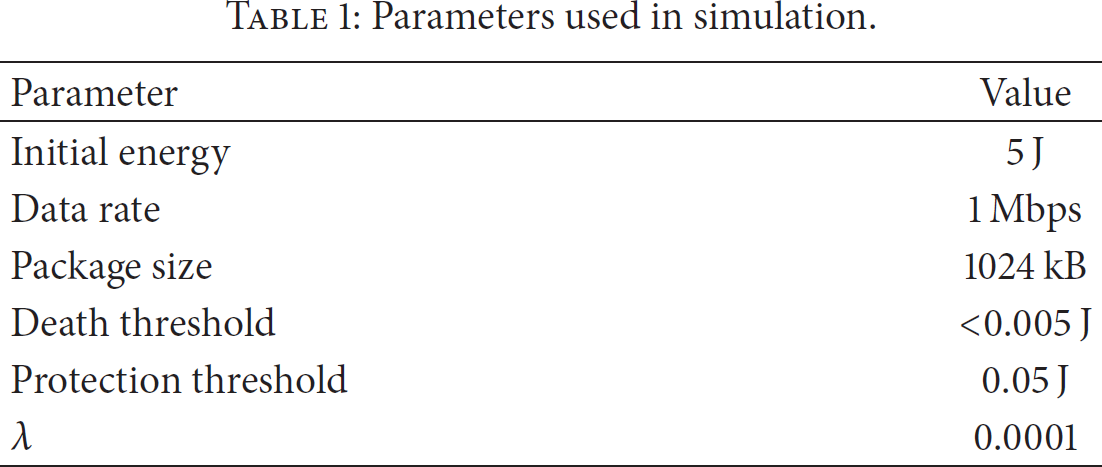
In this section some simulation result is presented to testify the performance of the given routing algorithm. Some simulation parameters are given in Table 1.
Parameters used in simulation.
To simulate the node working on or around or inside human body, 14 nodes (central node as node 1) are set on the same surface as shown in Figure 2. And the corresponding coordinates are shown in Table 2.
Coordinates of sensor nodes.

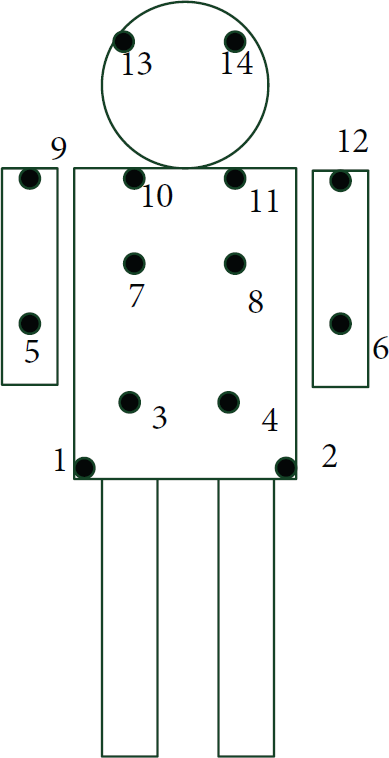
Distribution of sensor nodes.
Node 1 is the central node and other nodes sent 1024 kB-sized packages to node 1 every second. It is clear to see that node 12 should have the largest sending power and die much sooner than the node which could access node 1 at a low transmitting power. It is easy to infer that energy levels of each node decrease irrelevantly. And the nodes die in accordance with the distance from central node. The network fails when certain node acquires important data like EGG for patients with epilepsy.
DRA enable collaboration among the nodes and sacrifice the longest lifetime nodes to compensate the nodes which die sooner. Figure 3(a) shows the remaining energy of each node within WBAN when applying DRA. The curves are related to each other to a certain extent. But death points range from 5000 seconds to more than 35000 seconds, which means that energy consumption is not ideally balanced. Nodes near the central node die sooner than others because of the forwarding tasks. These nodes' death in turn makes it more expensive to transmit data from further nodes to central node. So it is crucial to prolong the lifetime of the network to reserve these nodes properly.

(a) The remaining energy level of each node within WBAN when applying DRA algorithm (
To further converge on the death point of sensor nodes, improved DRA introduce the weight matrix r for each node. When

(a) The remaining energy level of each node within WBAN when applying DRA algorithm (
Weight r represents the constraint of remaining energy when node chooses the best route. The weight r is set to be smaller and the routing strategy will consider more factor of remaining energy. So when

(a) The remaining energy level of each node within WBAN when applying DRA algorithm (
When r continue to decrease, nevertheless, the algorithm focuses on the remaining energy rather than energy while transmitting data, which lead to inefficient use of energy and deteriorate the result. As Figures 6(a) and 6(b) illustrated, the algorithm is not as effective as before. Death point of nodes extents and the network fails sooner. Therefore, appropriate value for r should be set between 0.1 and 0.5.
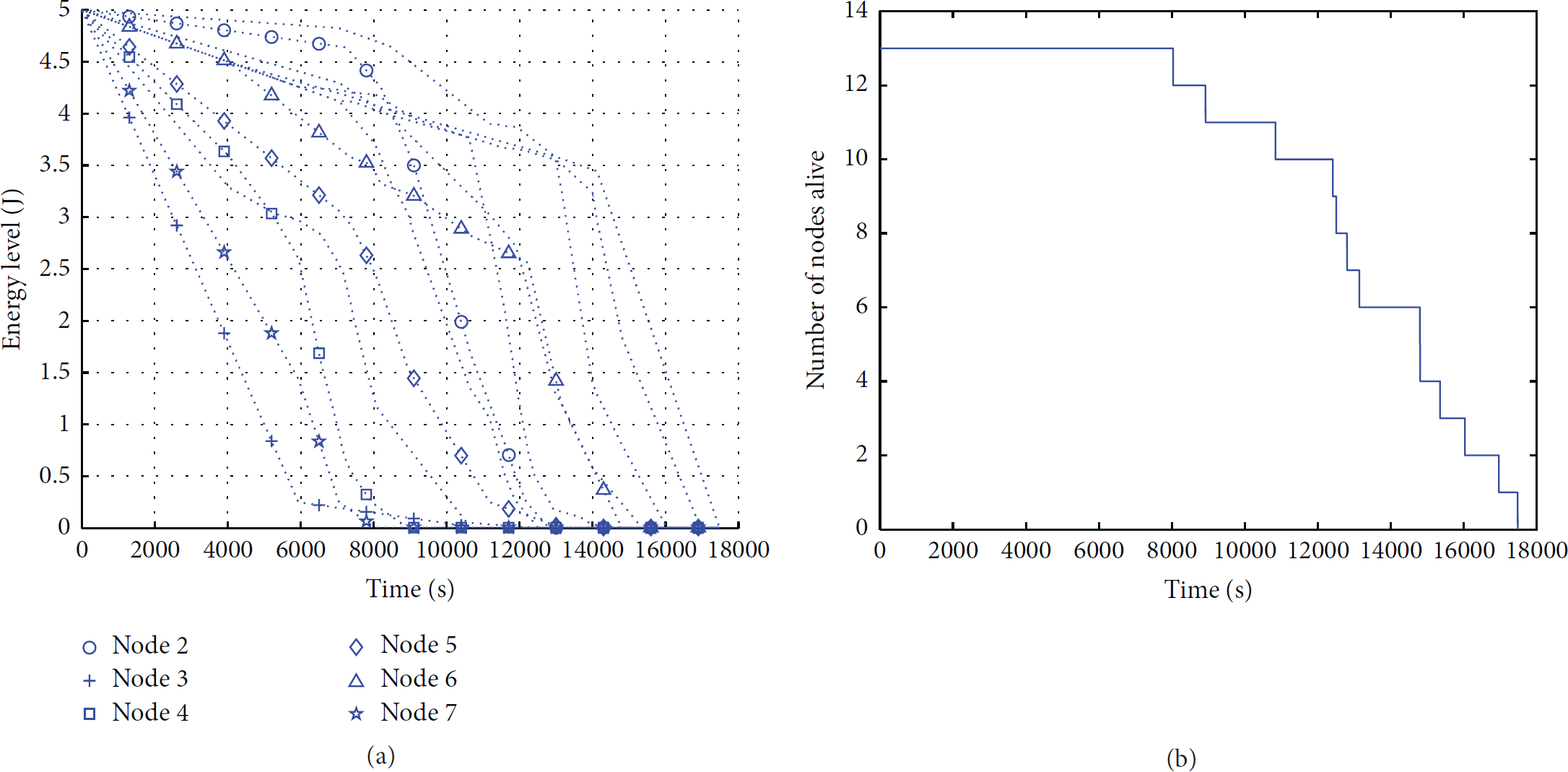
(a) The remaining energy level of each node within WBAN when applying DRA algorithm (
Review the simulation result along Figures 3–6; the DRA algorithm is seeking the balance of the whole network energy remaining and the individual transmission energy cost to archive the energy efficiency of WBAN. The changes of weight r keep manipulating the energy adaptation which is affected by both the entire remaining energy and the transmission cost. As Figure 5(b) shows, the network runs out of energy of each node almost simultaneously when
DRA make the lifetime of the nodes relevant but not in a desired way. Introducing the weight prolongs the lifetime of the whole network significantly with some sacrifice of the longest lifetime of some nodes which are of less reference value when most nodes are dead in a WBAN where sensors collect different kinds of data and work integrated. It is feasible to make the compromise.
4. Conclusion
WBAN is a solution to modern medical problem as its continuous data acquisition and processing. It provided seamless care for elderly and precaution for chronic diseases. Strictly restrained energy, however, is the limitation for commercial utility. DRA and improved DRA proposed in this paper solve the energy-saving and balance issue on the network level. The algorithm is to preserve the node at hot spot so that, with proper coefficient applied, network lifetime is significantly extended. The theoretical analysis and simulation result indicated that the performance of the algorithm varies according to different coefficients providing the algorithm appliance to other energy-restricted sensor networks, which probably need further study.
Footnotes
Conflict of Interests
The authors declare that there is no conflict of interests regarding the publication of this paper.
Acknowledgments
This work was supported by the National Science and Technology Major Project of China under Grant 2013ZX03005007-004 and National Natural Science Foundation of China no. 61201013. The authors would like to thank Dr. Liang Ye and Dr. Xu Bai for the helpful discussions.