




Abstract
In the body sensor networks (BSN), sensor nodes transmit data to remote receiving terminal via sink node. During the process of data aggregation, interference and self-similar character of wireless business have significant influence on traffic queue performance of sink node. To balance traffic quality of service (QoS) requirement and system present available resource and decide optimum resource distribution project. Hence, a complex function of sink node cache length, distributed channel rate and packet loss probability, and queue delay is built in this paper. Based on the function, by combining multiple target optimizing method and considering joint constraint of queue delay and packet loss probability, we proposed an admission control method based on traffic aggregation QoS constraint. In a BSN consisting of a large amount of sensor nodes, by admission control of sink node, reasonable acceptance of new nodes, and distribution sink node resource, the method we proposed can meet needs of important parameters in WSN design.
1. Introduction
Body sensor network, known as BSN, means traditional wireless sensor network, applied into body area monitoring. BSN is proposed to provide personal health monitor and long-distance medicine treatment [1, 2]. It is widely used in many areas such as emergency response [3] and interactive controls [4]. BSN is usually made up of many tiny sensor nodes communicating with each other in a wireless way, same as WSN, which means wireless sensor network. But BSN is applied in a body area. So its structure is simple. Two features of BSN are that, on the one hand, kinds of sensor nodes are various and frequency of data collection is high which makes it hard to compensate for the lost data and, on the other hand, BSN lays on or in the body. As the person moves, the mobility of BSN brings interference to the data transmission [5]. So it needs to be able to handle interference in the changeable environment.
In BSN, there are usually a central node called sink node and several sensor nodes used to collect body information. Sink node aggregates data from sensor nodes and transmits the data to remote receiving terminal through wireless channel, after that, the data is sent to sever in the hospital at last. When a sensor node makes an access request, sink node should comprehensively consider attributes of aggregated traffic, link state, and judge whether the QoS index of aggregated traffic meets the requirements or not to ensure overall network transport performance in interference environment [6].
At the aspect of traffic transmission, IP network packet traffic shows intermittent “ON/OFF” character during data generation, which will lead to strong self-similar of business flow in the process of transmission and converging [7, 8]. At the same time, we consider random intermittent feature of communication links in complex environment. These have influence on queue performance of business flow converging. Because there is long-range correlation of time length of ON/OFF state during transmitting data, self-similar characteristic is shown in data aggregation progress. Traffic's queuing performance of sink node will be affected significantly and QoS indexes such as packet loss rate and queuing delay decline [9].
Aiming at these problems, some papers suggest to set larger cache for self-similar traffic flow to absorb burst traffic and reduce packet loss rate [10, 11]. On this basis, some papers put forward the relationship between cache size and lower bound of limited bandwidth within the constraints of packet loss rate [12]. However, these methods consider only packet loss rate constraint but ignore queuing delay constraint. To solve the problems above, in this paper, we combine ON/OFF business model and good (available)/bad (unavailable) two-state-switch wireless channel model and analyze relationship between system resources (length of cache and effective bandwidth) and traffic QoS (queuing delay and average packet loss rate, APLR for shorten). Then we put forward a corresponding admission control method which satisfies traffic QoS requirement based on multiobjective optimization method.
In this paper, BSN data business model and channel model are built in Section 2. In Section 3, queue performance of data aggregation is analyzed according to simulation and mathematical derivation. In Section 4, we proposed a QoS constraint admission control algorithm faced to joint constraint of packet loss probability and delay. Simulation in Section 5 analyzes performance of algorithm that we proposed at the aspect of guaranteeing QoS needs. In the last section, we conclude that method we proposed can ensure queue delay and packet loss constraint of sink node effectively.
2. Data Traffic and Channel Model of BSN
At present it is widely agreed that self-similar characteristic exists in data flow of traditional IP network. Based on this character, we build traffic model of BSN single node, channel link model, and aggregation traffic model in this part.
2.1. Traffic Generation Model of Single Node
The profiled scenarios are shown in Figure 1. Nodes of BSN form a star topology, in which sensor nodes collect information continually and transmit the data to sink node as soon as possible. The sink node aggregates information from each node and then sends data to the next destination. Besides, sink node manages sensor nodes and is in charge of the BSN, because the interference leads to burstiness of traffic for sensor nodes. Load of single sensor node is analyzed as follows.

Scenarios of body sensor networks.
Each node is assumed as an ON/OFF traffic source and its ith ON state and OFF state duration is expressed as random variable
It is pointed out in [13] that traffic flow
2.2. Transmission Characteristic Analysis of Wireless Link under Interference
Suppose average duration of good state (available) and bad state (unavailable) of wireless link are
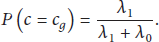
Traffic data flow

If traffic data flow

The formula above meets the definition of self-similarity, from which we can draw a conclusion that if traffic flow generated by nodes is self-similar process, it remains self-similar after going through wireless link model and self-similar parameter H that remain unchanged.
The main reason is that two-state wireless link model divides link into two states, “ON” and “OFF”, so the traffic flow is split into two parts. It is proved that self-similar traffic flow remains self-similar after partition.
3. Queuing Performance Simulation Analysis of Aggregated Data Traffic in BSN
3.1. Convergent Characteristic Analysis of Traffic Data Flow
Node needs to switch channels when communication between nodes is interrupted because of interference. If switchable channel is unavailable, node assumes the link is interrupted and keeps data in cache and waits for channel reconstruction. Therefore, for sink node, wireless link is divided into intermittent “ON” state and “OFF” states because of interference, making converging traffic flow shown as the aggregation of many fractured traffic flow.
Number of nodes in subnet is assumed to be N and traffic flow generated by each node is numbered as

In formula (4),
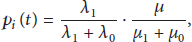
After scaling up time t, aggregated traffic flow of cluster head node in the time range

It is pointed out in [14] that

According to formula (7), average value of
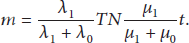
The swings degree of

Based on the analysis mentioned above, we get that aggregated traffic flow received by sink node consists of two parts: average traffic volume after aggregating multiservice and swing degree compared with average value. Because of interference, the link is divided into intermit ON and OFF state and aggregated traffic flow further shows up as aggregation of multifragmented traffic flow. The variance of traffic flow after aggregating can be shown as a fractal Brownian motion, making it self-similar.
3.2. Analysis of Average Loss Packet Rate
Assume that durations of wireless link in “good” state and “bad” state are independent of each other and the average durations are

According to the analysis mentioned before, aggregated traffic flow received by sink node consists of two parts: average value of aggregated traffic flow and swing degree based on average value, which are expressed as

As mentioned earlier, variance of aggregated traffic flow can be expressed by a fractal Brownian motion. Therefore, according to definition of fractal Brownian motion, we get

In queuing system, packet may be lost if buffer length B is less than queue length


Next, the influence of buffer queue length B and channel rate C on packet loss rate is studied by simulation.
It is assumed that aggregation traffic is stable at time t, then traffic self-similarity parameter H is related to tail index parameter α of duration distribution in ON state and OFF state (
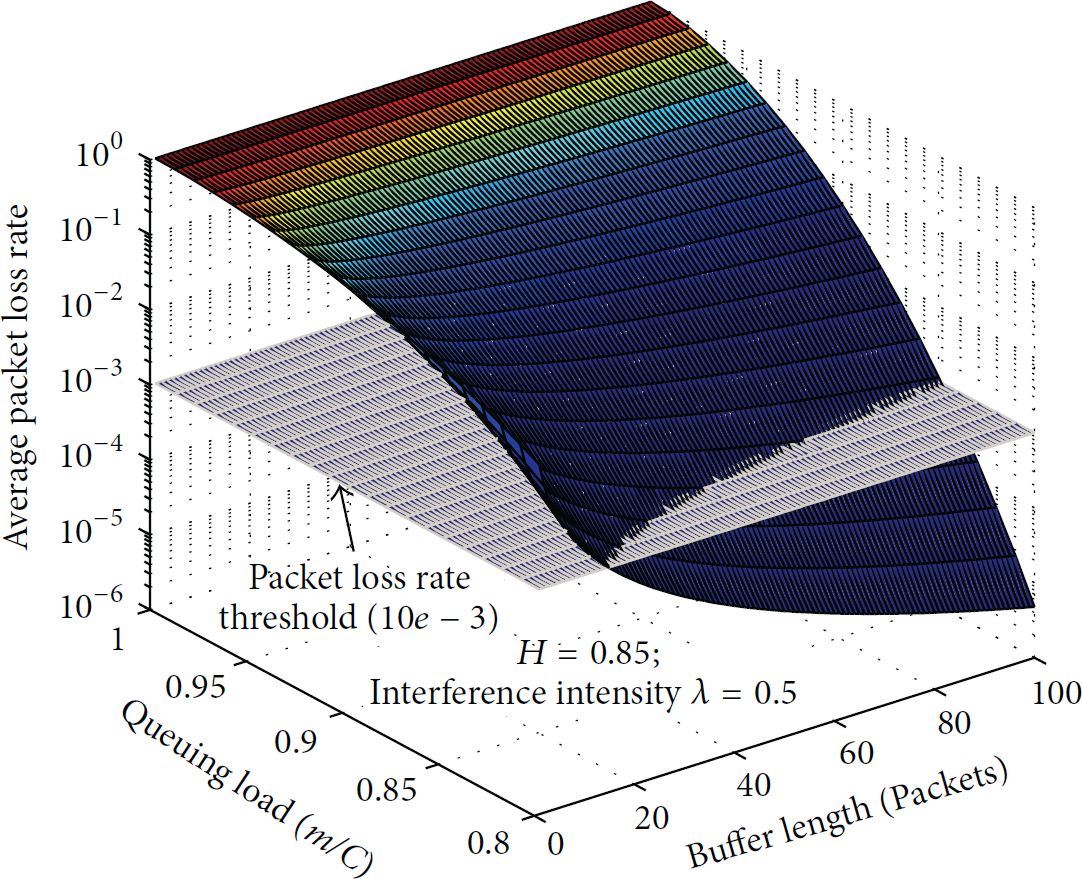
Relationship between average packet loss rate and buffer length B and channel rate C of aggregated traffic at time t.
As is shown in Figure 2, we can jointly adjust buffer length B and channel rate C to assure packet loss rate to some level. Under the simulation condition we set, when packet loss rate threshold is 10−3, channel rate C must exceed
From above, there is an interinfluence multidimensional relation among packet loss rate and parameters such as channel rate and buffer length in sink node. To assure packet loss rate to some level, we can jointly adjust buffer length B and channel rate C. In other words, when aggregated traffic grows gradually and it makes required channel rate C exceed the upper limit that the system can afford, buffer size needs to be enlarged further to ensure packet loss rate. However, as mentioned above, increasing buffer length blindly leads to the growth of queuing delay. To solve the problem, we will think about the relationship between average queuing delay (AQD) of sink nodes and queuing parameters then.
3.3. Analysis of Average Queuing Delay
Queue steady-state length of queuing system for sink nodes is
For queuing length of aggregated traffic flow, we have

According to formula (15), the probability of queuing length larger than B is

With the request of certain buffer overflow probability (less than 10−3 in general), if


According to Little's law and formula (18), network AQD is

Next, the influence of buffer queue length B and channel rate C on queuing delay is studied by simulation.
Being consistent with the simulation previous, it is assumed that aggregation traffic is stable at time t, then traffic self-similarity parameter H is related to tail index parameter α of duration distribution in ON/OFF state (

Relationship between AQD and buffer length B and channel rate C of aggregated traffic at time t.
As is shown in Figure 3, we can jointly adjust buffer length B and channel rate C to assure queuing delay to some level. Under the constraint of queuing delay less than 30 ms, the joint value range of channel rate C and buffer length B has arch shape.
From above, there is an interinfluence multidimensional relation among queuing delay and parameters such as channel rate and buffer length in sink node. To meet queuing delay constraint, buffer length B and channel rate C need to be adjusted jointly. Hence, when aggregated traffic grows gradually, adjusting system parameter only considering packet loss rate probably changes the delay performance of queuing system seriously. To meet the whole QoS constraint of traffic, packet loss rate and queuing delay should be combined and buffer length B and channel rate C should be adjusted jointly.
4. QoS Constraint of Aggregation Traffic Admission Control Method
4.1. Queuing Performance Jointly Optimizing Method Based on Nondominated Sorting Genetic Algorithm
In this section, queuing performance optimizing method orienting joint constraint of packet loss rate and queuing delay is put forward combining nondominated sorting genetic algorithm II (NSGA-II).
The multiple targets consist of minimum packet loss rate APLA, minimum queuing delay AQD, and minimum allocated channel rate C. According to BSNs model we presented before and to guarantee data transmission and BSN application, parameters are analyzed for BSN communication. Generally, it is set that [15, 16] average packet loss rate

The constraint set consists of upper limit and lower limit of buffer length and service rate:

We define different values of buffer length and service rate in the constraint set as individual value in generic algorithm and define queuing delay, packet rate loss, and channel rate as target value of generic algorithm. In this way, we can search a series of Pareto optimal frontier solutions with generic algorithm. The algorithm flow is as follows.
Step 1.
Do quick nondominated sorting for adjustable parameter set. Firstly, quickly sort the population by dominance relations, expressed as
Step 2.
Build virtual fitness under multiobjective function. After nondominated sorting, to keep individual varieties, it is needed to calculate local crowding distance between each individual and its adjacent individuals at the same level. Firstly, initialize individual distance of the same level; let
Step 3.
Select operation for Pareto optimal solution. After Steps 1 and 2, each individual i in group has two important properties: Pareto nondominated rank value
Step 4.
Retention strategy for elites of Pareto optimal solutions: to ensure excellent individuals of the parents go directly into their offspring, offspring population is generated through selection operation in Step 3, and crossover operation and mutation operation and next generation with the competition of offspring population and parent population. Firstly, combine all individuals of parent
Crossover Operation. Firstly select a group of individuals for crossover operation and select an individual i randomly to control constraint. After that, carry out crossover operation for the other
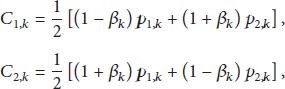

Define U as a random number between (0,1) and denote η as index of cross-distribution; then

Mutation Operation. Firstly select a group of individuals for mutation operation and select an individual k randomly to control constraint. After that, carry out mutation operation for the other


Step 5.
Repeat the four steps above until the number of times reaches a specific threshold.
After the five steps above, N optimal solutions of buffer length B and channel service C which satisfy
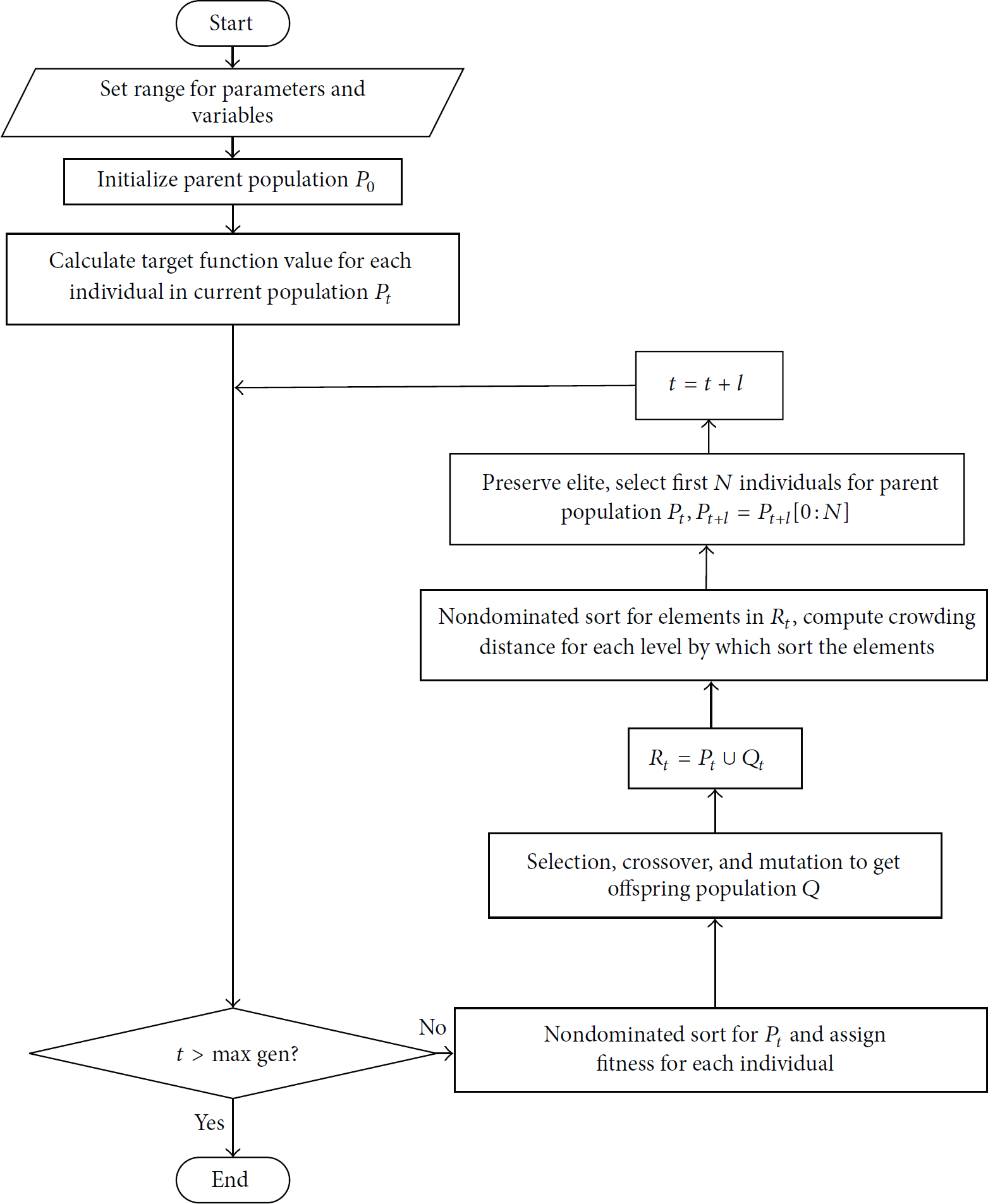
Algorithm flow chart of NSGA-II.
Select a time point as an example to inspect the result of queuing performance optimizing method. It is assumed that number of ON/OFF nodes in subnet is
Collection of adjustable parameters corresponding to optimal solution set.


Optimal solution set based on NSGA-II under multiobjective optimization.
In Figure 5, a series of optimal frontier solutions obtained are shown as “•” in target space and their planar projection are shown as “∘” to demonstrate the solution more clearly. The solution satisfying QoS constraint in optimal solution set when the number of nodes is 30 is an adjustable parameter set (
4.2. APLR and AQD Jointly Oriented Admission Control Method
Sink nodes need admission control when new users request for access to judge whether users who request for access can use network resource available and whether the aggregated traffic after admission meets QoS constraint.
According to analysis above, IP packet traffic generated intermittently by traffic source shows self-similarity which is directly related to number of users admitted and interference intensity in aggregation nodes. This results in a relationship restrained by each other between AQD and APLR for queuing system performance.
Therefore, admission control method orienting QoS constraint of aggregation business should consider the above factors overall. Obtaining features of traffic flow by measuring aggregated traffic flow, we can judge whether overall QoS constraint of aggregated traffic after admission can be met under the condition of current resources. Admit new user if OQS constraint of aggregated traffic can be meet by adjusting system parameters and deny the user otherwise. The algorithm has a relatively low requirement for users. Users need only afford average traffic generation rate and peak rate of traffic flow.
After new user requests for access, the concrete description of admission control algorithm is as follows.
Initialization. System record the number of users admitted currently N and average traffic generation probability μ and self-similarity parameters of history traffic
Input. Input is the new user's request for access.
Step 1.
Estimate self-similarity parameter H of aggregated traffic after admission.
Step 2.
Calculate average transmission rate m of aggregated traffic input in current spectrum environment according to formula (8) and sudden variance factor σ of aggregated traffic according to formula (9).
Step 3.
Calculate average packet loss rate of aggregated traffic after admission according to formula (14).
Step 4.
Calculate AQD of aggregated traffic after admission according to formula (19).
Step 5.
Calculate the optimal solution for buffer length B and service rate C under QoS constraint according to “queuing performance jointly optimizing method based on nondominated sorting genetic algorithm” proposed above.
Step 6.
Judge whether there is solution satisfying QoS constraint in optimal solution set obtained in Step 5. If solution set is empty, it indicates that it is impossible to meet QoS constraint for current overall traffic by adjusting resources and user's request should be refused.
Step 7.
If there is solution satisfying QoS constraint in optimal solution set obtained in Step 5, system will admit new user and select solution with minimum service rate according to minimizing bandwidth allocated principle and configure corresponding buffer length B and channel service rate C.
Output. The result that user's request is admitted or not.
5. Simulation and Analysis
It is assumed that traffic sources are independent of each other, average duration of traffic for ON state and OFF state is
The topological structure of network in our simulation is shown in Figure 6. Assume each sensor node selects one kind of traffic out of three as traffic source and sends data to sink nod. Sink node receives packet data and transmits. To simplify the process, propagation delay is not taken into consideration in simulation.
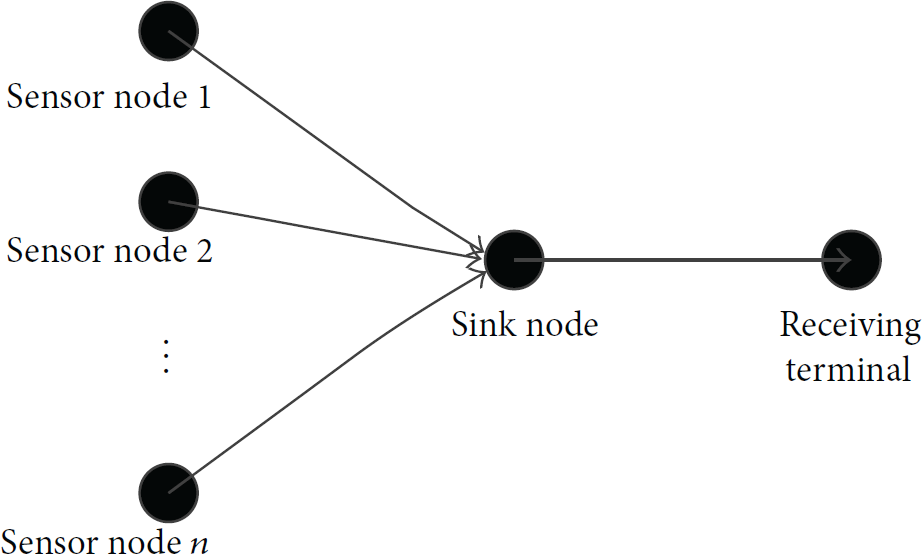
Topological structure of network simulation.
Effective bandwidth allocation algorithm [10] and minimum bandwidth allocation algorithm [13] are selected to compare with the algorithm we proposed. The core idea of effective bandwidth allocation algorithm is to consider maximum effective bandwidth 
Simulate AQD and average packet loss rate for the 3 different algorithms and different numbers of traffic source in the same condition to inspect admission ability of different algorithms for traffic source. The result is shown in Figures 7 and 8.

APLR performance in simulation.

AQD performance in simulation.
Figure 7 shows average packet loss rate performance when the traffic source nodes number differs. The average packet loss rate is controlled below threshold because three algorithms are all restrained by packet loss rate. Because effective bandwidth allocation algorithm allocates bandwidth according to upper limit of bandwidth, the maximum channel service rate C afforded cannot meet requirement of aggregated traffic flow and requests of new traffic source are denied, making average packet loss rate stabilize at 10−5. Minimum bandwidth allocation algorithm takes lower bound of bandwidth demanded by traffic flow into consideration, increasing number of sensor nodes admissible to about 120. The algorithm we proposed takes influence of AQD into consideration fatherly. Therefore number of sensor nodes admissible is relatively small, about 110.
It is shown in Figure 8 that although the algorithm we proposed has less number of admissible sensor nodes compared with minimum bandwidth allocation algorithm, it meets requirement of AQD effectively. As shown in Figure 8, at first number of sensor nodes is small, average arrival rate of aggregated traffic is relatively low, and system resources available is relatively rich, making channel service rate and buffer length allocated meeting the requirement of packet loss rate satisfy the constraint of delay. When number of traffic source exceeds 80, channel rate and buffer length need to be configured jointly. As minimum bandwidth allocation algorithm only considers constraint of packet loss rate, its AQD increases continuously and exceeds threshold. As a contrast, the algorithm presented in this paper ensures AQD of aggregated traffic flow after admission below constraint threshold, showing a stronger ability to ensure QoS, though the number of sensor nodes admissible is relatively small. It is noted that queuing delay of effective bandwidth allocation algorithm remains at very low level because it allocates system resources to each traffic flow as much as possible.
To further inspect admission control ability of three algorithms, number of admissible sensor nodes and bandwidth utilization ratio of aggregation nodes at different sending rate in ON state. The result is shown in Figures 9 and 10.

Number of admissible users performance.

Bandwidth utilization ratio performance.
As is shown in Figure 9, admissible users numbers of three algorithms all decline when send rate of traffic source increases. For effective bandwidth allocation algorithm, because it allocates system resources to each traffic flow as much as possible, its sensor nodes number is the least. For minimum bandwidth allocation algorithm and algorithm proposed, because of dynamically adjusted system buffer length and channel service rate, their numbers of admissible sensor nodes are increased. The performance of the algorithm is worse because it considers AQD in the meantime.
Figure 10 illustrates system bandwidth utilization ratio of three algorithms. Minimum bandwidth allocation algorithm has the highest bandwidth utilization ratio because it admits more traffic sources while that effective bandwidth allocation algorithm is the lowest because it allocates resources as much as possible. That of the algorithm proposed is lower than that of minimum bandwidth allocation algorithm because it considers the constraint of queuing delay.
Above all, effective bandwidth allocation algorithm allocates resources as much as possible and has least number of admissible sensor nodes and lowest bandwidth utilization ratio while having relatively low packet loss rate and delay. Minimum bandwidth allocation algorithm allocates resources as little as possible and has most number of admissible users and highest bandwidth utilization ratio while having increased packet loss rate and queuing delay obviously. The algorithm proposed in this paper considers queuing delay at the same time to ensure AQD under constraint threshold at the price of less admissible users and lower bandwidth utilization ratio compared to minimum bandwidth allocation algorithm.
Besides, since the proposed admission control method is designed for BSN, which is a kind of wireless sensor network (WSN), energy of nodes is an important aspect to be considered [16]. On the one hand, in this method, the algorithm is applied on sink node only. Sensor node does not need to do extra calculation. It is possible to ensure energy supply of sink node and, for sensor nodes, there is no more energy cost. On the other hand, most energy is used for packet transmission in BSN. Calculation costs little energy compared with that of [18, 19]. Therefore, applying proposed method in BSN, or in sink node of BSN more precisely, leads to only little extra energy cost and mainly of sink node, which can be solved by provide stronger power supply. This method is suitable for BSN.
6. Conclusion
Body sensor networks are usually made up of several tiny sensor nodes and a sink node. Nodes of BSN are organized in a star topology structure, communicating with each other in a wireless way. Information collected by sensor is collected and aggregated by sink node. Then sink node transmit the data to remote receiving terminal. In BSN, sensor data is various and its collection frequency and reliability need to be high.
To guarantee the data aggregating process to be rapid and reliable, we consider constraint of queuing delay and packet loss rate overall. An admission control method oriented on QoS constraint of aggregation business is put forward in this paper. Because of the self-similar character of sink node during traffic flow aggregation, the packet loss rate, queuing delay, buffer length, and service rate show a complicated relationship with each other during data aggregating and forwarding. To solve the problems above, in this paper, we use queuing theory and large deviation theory to study the influence that interference intensity has on packet loss rate and queuing delay under the condition of self-similar traffic flow. Function of cache B, channel rate C and packet loss rate, and queue delay is presented under different interference strength and different traffic self-similar parameter. According to this, combining NSGA-II multiple target optimizing method, we propose joint optimizing method of queue performance based on nondominated sorting genetic algorithm. On basis of optimal solution of cache length B and service rate C calculated under QoS constraint with the method proposed, an admission control method is designed, satisfying constraint of both queuing delay and packet loss rate. The simulation result, comparing with other methods, shows that the method we proposed can ensure constraint of queuing delay and packet loss rate of sink nodes effectively. Besides, by applying method proposed, number of users is up to about 110, near the number of minimum bandwidth allocation algorithm and is twice as much as that of effective bandwidth allocation algorithm. In a BSN consisting of a large amount of sensor nodes, the method we proposed can distribute sink node resource reasonably and guarantees quality of network service at the same time, which is a valuable reference contribution to BSN design.
Footnotes
Conflict of Interests
The authors declare that there is no conflict of interests regarding the publication of this paper.
Acknowledgment
This work was sponsored by the National Natural Science Foundation Project of China (61101123).