




Abstract
An innovative paradigm named Cooperative Cognitive Maritime Cyber Physical Systems (CCMCPSs) is developed to achieve high-speed and low-cost communication services. The analysis of the available white space at sea, as well as the framework, is presented. Specifically, a bilevel game with two stages of PUs-to-SUs (primary users to secondary users) and SUs-to-SUs is proposed, to address the resource allocation issue of Decode-and-Forward (DF) relay mode with maximal-ratio combining (MRC) receiving mode in destination. Stackelberg game with priority is employed between PU and SUs, while a symmetrical system model is considered among SUs-to-SUs. The game theoretic procedure that converges to Nash equilibrium based on the utility and payoff function is illustrated. Simulation results demonstrate that our proposed strategy could effectively increase the throughput as well as the payoffs of the system.
1. Introduction
Maritime Cyber Physical Systems (CPSs) target the tight incorporation of wireless communications, control, and computing technologies into the navigation transportation system, which posses the typical characteristics of CPSs revolutionizing the navigation pattern to be safer and more efficient through real-time embedded systems for distributed sensing, computation, and control between cyber and physical systems [1]. As we can see, the intelligent transportation systems in maritime filed have proliferative interest in vis-a-vis maritime CPSs to achieve a low-cost alternative for current maritime satellite system for data transmission. Some advanced wireless technologies have been previously adopted to build maritime wideband networks. For example, the Worldwide Interoperability for Microwave Access (WiMAX) technology is exploited for wireless-broadband-access for Seaport (WISEPORT) project in Singapore [2]. The Fourth Generation Long-Term Evolution (4G LTE) broadband service has been developed in US Navy ships since 2011 [3]. In our previous work [4, 5], a novel complementary scheme, for example, delay tolerant networks (DTNs) which exploits store-carry-and-forward routing scheme [6], is utilized in maritime scenario. However, the above scheme should apply the limited authorized spectrum resource for maritime communication, which is an important restriction for maritime communication. The cognitive technology has been already utilized to construct maritime mesh/ad hoc networks [7], to alleviate the insufficient spectrum provision for maritime purpose indeed. At the same time, a maritime cognitive mesh/ad hoc network could achieve the connection among neighboring vessels, sea farm, oil/gas platform, and marine beacons and buoys to sense the maritime information, exchange it, and send it to the land-based network through wireless communication between vessel-to-vessel and vessel to-infrastructure. In the maritime CPSs, all types of physical systems involving intelligent vessels should be equipped with seamlessly integrated embedded computing systems and in-vessel networking systems, which have the convergent functions of computation, communication, and control. The maritime CPSs involve interactions between vessel controllers, communication networks, and physical world. The behaviors of the physical world such as the the conditions of cargo and the vessel aredynamic and continuous changing with time while the process of communication and calculation in maritime CPSs is discrete. Endowed with control, monitoring, and data gathering functions, the maritime CPSs dramatically enhance the controllability, adaptability, efficiency, functionality, reliability, safety, and usability of maritime service. And thereby they promote a great deal of magnetic utilizations in terms of monitoring (e.g., transferring supervision videos gathering internal or external of vessels to shore-based authority being uploaded after collecting from bridge, engine room, or other critical places), safety (e.g., maritime safety information dissemination), infotainment (e.g., mobile office and multimedia data download and upload, especially for cruise industry), and cargo online management (e.g., real-time cargo status notification and handling management).
However, the remarkable fundamental characteristics of maritime environment are long transferring distance and irregularly worsening channel due to the obstruction, that is, sea clutters. Therefore, the communication distance range is still unsatisfactory. Fortunately, the cooperative technology fits the maritime communication environment very much, which could achieve diversity gain through collaboration between entities depending on relay transmission principle [8]. It is employed to overcome the disadvantage of channel fading, strengthen the reliability of delivery, augment the coverage, and utilize the spectrums definitely. In this paper, a state-of-the-art prototype, that is, Cooperative Cognitive Maritime CPSs (CCMCPSs), is developed on the basis of wireless mesh/ad hoc networks to provide high-speed and low-cost communications for maritime paradigm. It is envisioned that the CPSs which incorporate information communications technology and sensing-enabled vessels could impose new opportunities, application, and agendas as well as challenges for maritime community. However, the resource allocation and scheduling issue in Cooperative Cognitive Maritime CPSs are challenging, which is still an open issue.
In this paper, we will describe this new system in detail, including the framework, available white space on the sea, regulation requirement, and standards in maritime society. Heterogeneous network framework of CPSs is proposed which refers to the resource allocation issues between PUs-to-SUs (primary users to secondary users)and SUs-to-SUs, respectively. Specifically, a bilevel game with two stages of PUs-to-SUs and SUs-to-SUs is proposed to address the resource allocation issue of Decode-and-Forward (DF) relay mode with maximal-ratio combining (MRC) receiving mode in destination. Stackelberg game with priority is employed between PU and SUs, while a symmetrical system model is considered among SUs-to-SUs. Specifically, the contribution of this paper is threefold.
An innovative paradigm named Cooperative Cognitive Maritime Cyber Physical Systems is developed to achieve high-speed and low-cost communication. services, based on the analysis of available white space at sea. A bilevel game with two stages of PUs-to-SUs and SUs-to-SUs is proposed to address the resource allocation issue of DF relay mode with MRC receiving mode in destination. Stackelberg game with priority is employed between PU and SUs, while a symmetrical system model is considered among SUs-to-SUs. And the game theoretic procedure that converges to Nash equilibrium based on the utility and payoff function is illustrated.
The remainder of this paper is organized as follows. Section 2 reviews the related work. System model and white space analysis are illustrated in Section 3. Section 4 describes the Stackelberg game based resource allocation between PU and SUs. Section 5 demonstrated the game theory of symmetrical cooperative three-node model among SUs. In Section 6, simulation results validate the performance of our scheme. Finally, conclusions and references end this paper. Since many symbols are used in this paper, some important notation definitions are tabulated in Notations.
2. Related Work
The research related to CPSs has drawn much attention recent years. Kim and Kumar gave a nearly exhaustive survey that covers every aspect of CPS research [1]. The achievements in many research disciplines have been reviewed, including the history of CPSs, some advanced theoretical foundations and technologies of networked control systems, hybrid systems, wireless sensor networks, the evolution of technology, and some interest issues captured by CPSs. This survey also laid a great foundation for the later research. The work in [9] studied the multicast routing design for decentralized sensors and controllers in CPSs. The application of CPSs in intelligent transportation system is considered as a new research hotspot in the future. In [10], the authors extensively studied the CPSs in intelligent transportation system, and artificial systems, computational experiments, and parallel execution methodology are introduced based on data-driven model. For railway CPSs, Zhang proposed an aspect-oriented approach to modeling this system, whose velocity, flow, and density are dynamic and continuous changing with time during the process of communication and calculation [11]. For vehicular CPSs, defined as a combination of traditional state-based discrete control model and continuous models based on physical environments, the author provided adequate requirements specification for this specific system in [12]. In the literature, although there are few related research in maritime scenarios, the existing literatures such as [13] also provide us a myriad of hints. To our knowledge, this is the first work to study maritime CPSs.
We combine cooperative and cognitive technology to construct an innovative maritime communication network paradigm in this paper, that is, a Cooperative Cognitive Maritime wireless mesh/ad hoc network, to efficiently explore White Space (WS) on the sea and address the limited transmission range and distorted signal transmission simultaneously. Although the research on maritime scenario is still in the early stage, the counterparts on land-based network could provide a solid foundation for our work [14–22]. In [23], the authors studied the broadcast scheduling issue with minimum latency and redundancy analysis for cognitive radio networks, which could significantly improve the existing performance of latency and redundancy for CRNs. In [24], the distributed data collection problem for asynchronous CRNs is studied considering the proper carrier-sensing range and the fairness issue. In [25], the sensing-throughput trade-off issue and the impact of different system parameters on the optimal sensing time for cooperative spectrum sensing in CRNs are investigated, based on the soft decision schemes. They also compared the performance in different relay modes. In cognitive system, not only SUs could cooperate with PUs, but also could cooperate with each other. Generally speaking, in the research of cooperative system, it is always assumedthat relays would like to help source to transmit information. However, a challenge in practical maritime communication system is how to effectively build up a cooperative system in limited transmitter power level on the sea. On the other hand, nodes are independent selfish individuals and they are not voluntary to help other nodes. So, the user must pay fee to buy resources to attain corresponding help. Then, the other user calculates payoff of itself to decide whether to join the cooperative communication or not. It is inevitable to consume resources such as power and rate in helping other nodes to transmit; rational nodes are not obligatory to involve in this cooperate activity. Game theory is a good mathematical method to research effective cooperative condition and requirement. In [26], the authors investigated multichannel assignment in wireless sensor networks utilizing the game theoretic approach. In [27], the authors proposed adjustable price and rate algorithm based on cooperative stimulating method in ad hoc networks. One classic literature about channel allocation in cognitive radio networks applying Stackelberg game [28] achieved a minimum required SIR through setting a new potential utility function. However, it utilized the iteration scheme to get virtual price as cost of accessing channel. In [29], a joint pricing and power allocation strategy for dynamic spectrum access networks with stackelberg game model is proposed. However, it is about the resource allocation study between one pair of PU and SU. In [30], cooperative spectrum access of primary and secondary users, as well as MAC protocol for multichannel cognitive radio networks, is developed. In [31], the authors discussed a nonsymmetrical cooperative three-node model. But, in practice, the two users are likely the potential relays, which is better accordant with fairness of network. To address the resource allocation issue of this cooperative cognitive mesh/ad hoc maritime network, Stackelberg game with priority is employed between PU and SUs, while a symmetrical system model is considered among SUs-to-SUs in this paper.
3. System Model and WS Analysis
Cyber systems are embedded in all types of physical systems (we refer to them as PUs, SUs, and BS in this paper). Such networks comprise sensors and on-board units installed in the vessels (PUs and SUs) as well as shore-side BS. The data collected from the sensors on the vessels (PUs) could be shown on the bridge for navigators, delivered by the SUs or BS, and finally received by the maritime authorities, ship owners, or shipping companies, and then a feedback is given to the controlling service to the vessels. This software-intensive system demonstrates very complex maritime CPSs with intricate interplay between the physical world and the cyber world. This section presents the details of the system model as well as the analysis of WS on the sea.
3.1. System Model
We consider the scenario that an innovative paradigm CCMCPSs could be formed by exploring the connection between neighboring ships, sea farm, oil/gas platform, maritime security/safe monitors, and marine beacons and buoys. Depending on the node mobility, the network close to the shore could be the combination of the following two classes of network:

System model.
As illustrated in Figure 2, PU would like to send data to base station (BS). When the direct channel quality is not very well or the PU has large capacity data to transmit, the shore infrastructure-based PU could cooperate with ad hoc nodes SUs as relays which adopt Decode-and-Forward (DF) mode to relay the message for PU. And the destination BS employs maximal-ratio combining (MRC) reception. We only consider the scenario of single channel; that is, one PU corresponds to the shore-based BS on one channel in time slot T. There are totally n SUs participating in the relaying process. The Time Division Multiple Access (TDMA) based media access control (MAC) protocol is employed. The portion of α is utilized for cooperative transmission, including the PU-to-SUs in the first half period

Cooperative model between PU and SUs.
3.2. The Analysis of WS on the Sea
There is abundant TVWS and cellular WS resources at sea nowadays, especially on the open ocean. The present maritime communication system, that is, GMDSS (Global Maritime Distress and Safety System) [32] partly occupies the frequency bands from 300 kHz to 300 MHz but does not utilize them efficiently. “Maritime WS” is nominated for the unused bands for maritime communication. Furthermore, the fundamental of maritime WS usage should be as follows.
4. Game Theory Based Resource Allocation between PU and SUs
In this section, the resource allocation between PU and SUs will be discussed. Due to the selfishness of each entity, the optimization aims for PU and SUs are distinctive, where PU targets maximizing its throughput and SUs desire to obtain the bandwidth to deliver via cooperation. Stackelberg game is utilized here to model the cooperation process to achieve Nash equilibrium.
4.1. Utility of PU and SUs
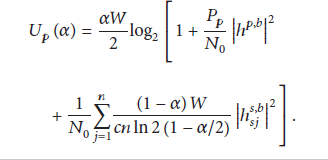
We define the utility for both PU and SUs as the transmission rate via DF cooperative transmission, when MRC receiving mode is adopted at BS. The utility of PU is presented as follows:


4.2. Stackelberg Game Analysis
Stackelberg game is a sequential game with priority, that is, existing leader and follower, which could be estimated by Backward induction method. It consists of two stages. In the first stage, we determine the best choice of the follower (SUs), by making a hypothesis that the scheme of leader (PU) is prefixed. Then, in the second stage, the optimal strategy of PU is determined formally, on the basis of the optimal schemes of SUs. We give a clear explanation again that the payment resources for the two parties to join this Stackelberg game are access time portion α of PU and transmitting power
4.2.1. SUs Payment Selection Game
Definition 1.
Denote
Theorem 2.
The optimal payment selection

Proof.
As described above, we first suppose that the PU allocates α to SUs for cooperation. Then, the SUs payment selection game is to maximize the utility by choosing the optimal transmitting power


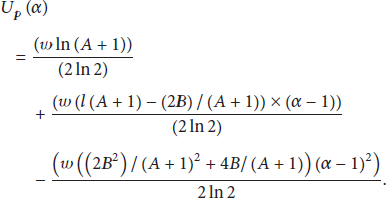
The first-order derivative of the above expression with respect to α is
4.2.2. Maximizing PU's Utility
We maximize the PU's utility on the basis of having the knowledge of SUs' optimal payment choice. Then, the optimization issue could be formulated as

Definition 3.
Denote
Theorem 4.
The optimal payment selection

Proof.
In order to solve this optimization problem, we apply the optimization results of

5. Game Theory Based Resource Allocation between SUs
In Section 4, we focus on the game between PU and SUs in cognitive mesh/ad hoc network. Actually, the scheme is that SUs cooperate with each other to thereby form a cluster firstly, and then the cluster cooperates with PU further to attain the transmission opportunities as the benefits. However, the SUs are independent and selfish such that they are not voluntary to help others with no profit. Thereby they should pay fees to buy resource to obtain transmission assistance. And the users could count for the payoff to determine whether to cooperate with each other or not. A symmetrical system model is exploited, and a price game based on payoff function is developed. Then, the game theoretic procedure converging to Nash equilibrium is described further.
5.1. Game Theory Model
In the cooperative symmetry, with triple nodes, source node s, relay node r, and destination node d are players. Strategies space is stimulating prices μ and ν, which are the price paid to the partner, while
(i) Utility Function. We utilize a common utility function described as the received data when consuming one-unit energy [35]. The unit throughputis defined as 1/bit.
Then, the utility of noncooperative source node is

The utility of cooperative source node is

The utility of noncooperative relay node is

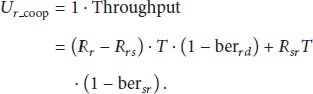
The utility of cooperative relay node is
(ii) Price Function. The service price is denoted as
The price function of noncooperative source node is

The price function of cooperative source node is

The price function of noncooperative relay node is

The price function of cooperative relay node is

(iii) Payoff Function. Payoff function is defined as the difference between utility function and price function; that is,
The payoff function of noncooperative source node is

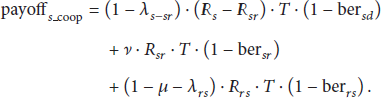
The payoff function of cooperative source node is
The payoff function of noncooperative relay node is

The payoff function of cooperative relay node is

5.2. Game Theory Analysis
The game theoretic procedure converging to Nash equilibrium by the iteration algorithm is described in this section. Specifically, the value boundary of u and v is induced. The value boundary of relaying rate
5.2.1. Value Boundary Analysis
Lemma 5.
Using game theory converging into Nash equilibrium, the stimulating price of source and relay u and v, as well as
Proof.
(i) Value Boundary of u and v. With cooperation, according to the rules that



Jointly considering the formulas (26)–(29),
(ii) Value Boundary of

When

Similarly,
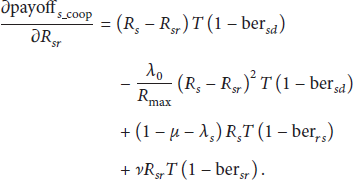
When

As we see,
5.3. Game Theoretic Procedure
This issue is a two-party game with priority decision. Based on the above derivation,


6. Simulation Results
In the simulation, WS in VHF band spectrum is considered. Similar to [30], we normalize the distance between PU and BS, and SU is located at the distance
Figure 3 presents the throughput of PU on a certain channel versus the access time allocation coefficient α. The parameter of weights c is set as 0.2 and 0.3 for
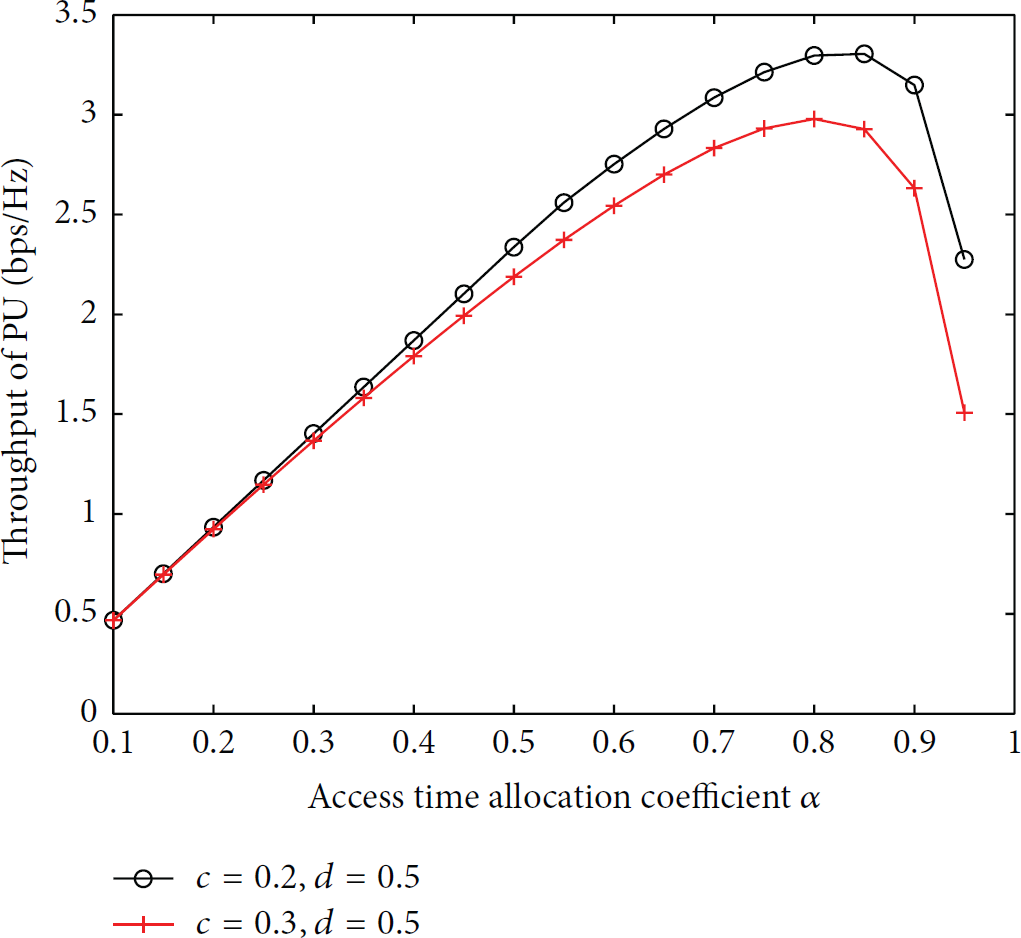
Throughput of PU versus time allocation coefficient α.
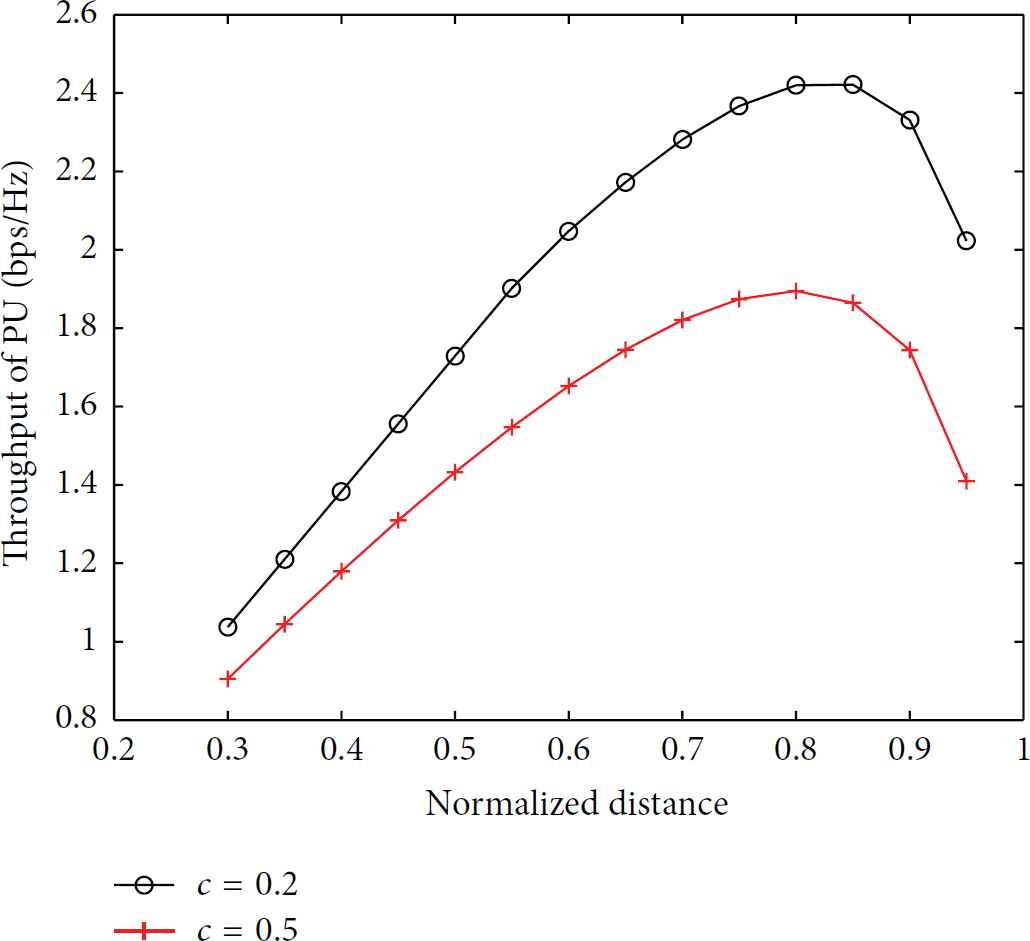
Throughput of PU versus the normalized distance.
With the cooperation among SUs, we set the parameters as follows. The coordination of destination is
The simulation results show the comparison of total payoff, source payoff, and relay payoff, when axes x and y, respectively, indicate horizontal and vertical coordination. From Figures 5, 6, and 7, it could be seen that the payoff of cooperative scheme is obviously increased than noncooperative scheme. Along with the increased distance between relay and destination, the difference of the total payoff as well as relay payoff between cooperative and noncooperative becomes larger. But the payoff of source is very close between cooperation and noncooperation. It could be explained that it does not achieve the best offset from payoff fee in cooperation. Meanwhile, the payoff of source could be increased if the value of μ is larger.
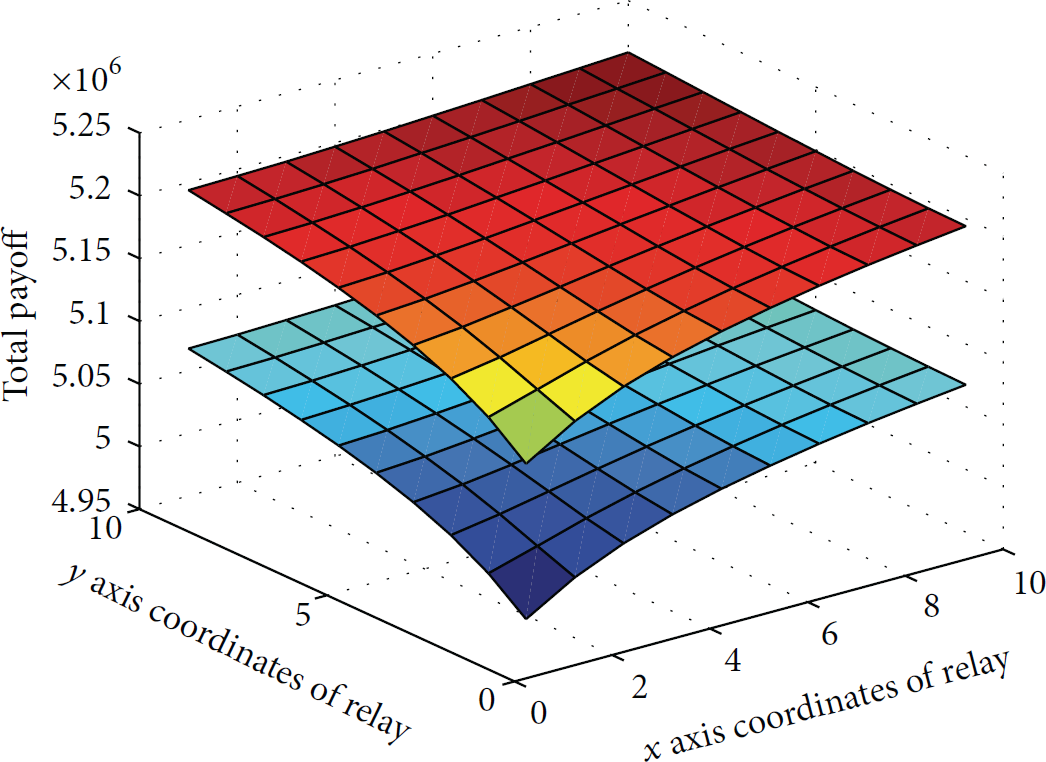
The total payoff comparison between cooperative and noncooperative schemes.

The source payoff comparison between cooperative and noncooperative schemes.
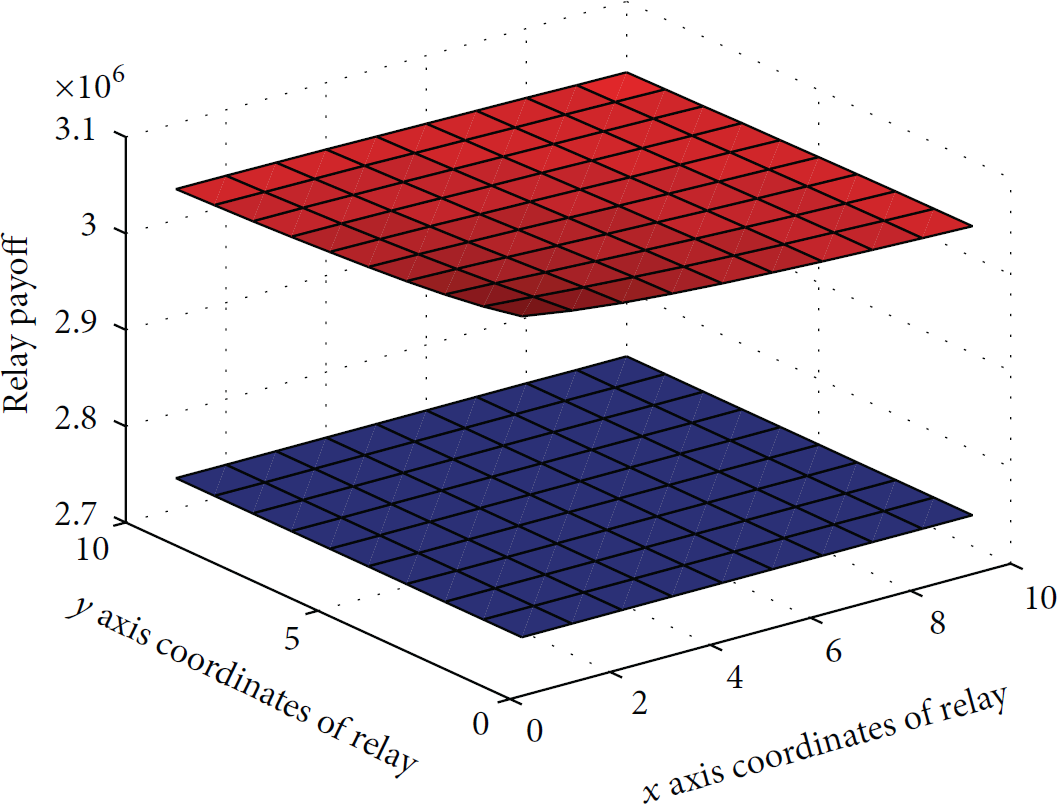
The relay payoff comparison between cooperative and noncooperative schemes.
7. Conclusion
In this paper, an innovative paradigm CCMCPSs is developed to provide high-speed and low-cost communications for maritime community. We focus on the resource allocation between the two stages, that is, PU-to-SUs and SUs-to-SUs based on the game theory. In the first stage, Stackelberg game, which is a sequential game with priority, is introduced to obtain the optimal resource allocation between PU and SUs. In the second stage, SUs-to-SUs, an symmetrical system model is considered, while a price game based on the payoff function is proposed. Then, the game theoretic procedure that converges to Nash equilibrium is illustrated. Simulation results indicate that our proposed schemes could effectively increase the throughput as well as the payoffs of the system. For future work, the combination of the designing of MAC layer and resource allocation will be further considered.
Footnotes
Notations

Conflict of Interests
The authors declare that there is no conflict of interests regarding the publication of this paper.
Acknowledgments
This work was supported in part by China Postdoctoral Science Foundation under Grant 2013M530900, Special Financial Grant from the China Postdoctoral Science Foundation under Grant 2015T80238, Natural Science Foundation of China under Grant 61401057, Science and Technology Research Program of Liaoning under Grant L2014213, Dalian Science and Technology Project under Grant 2015A11GX018, NSERC, Canada, Research Funds for the Central Universities 3132015201, China Postdoctoral International Academic Exchange Fund, and Scientific Research Foundation for the Returned Overseas Chinese Scholars from Ministry of Human Resources and Social Security.