




Abstract
A number of nodes that are interested in the same content can be grouped into a cluster and the cluster head can be used to relay the content received from the base station (BS) to the cluster members using device-to-multidevice (D2MD) communication. However, the data rate of such multicast communication depends on the worst channel among the cluster members and the cluster head. The rate can be enhanced by increasing the transmit power; however, this approach may deteriorate energy efficiency (EE) performance of the system. In this paper, we propose transmitting the content from more than one cluster head simultaneously. A novel algorithm is proposed that selects the cluster heads to improve the data rate of the multicast communication while keeping the total transmit power from the cluster heads constant. The cluster members receive power from all the cluster heads within the cluster and hence the received signal to noise power ratio improves. The improved received power makes communication at higher data rates possible, thus reducing the total transmission time. Hence, the energy requirement per bit will reduce. Simulation results show that 19% of reduction in energy per bit is possible by using more than one cluster head within the cluster.
1. Introduction
Much research has been conducted to increase the spectrum utilization, energy efficiency, and data rates in LTE-Advanced (LTE-A). Device-to-device (D2D) communication has emerged as a promising technique for efficient utilization of scarce spectrum. Some other resulting benefits include higher data rates, less power requirements, and reduced interference to other nodes. As a result of these benefits, D2D has been adopted in LTE-A [1,2]. In essence, D2D communication enables mobile devices to communicate directly, when they are in vicinity of each other, instead of communicating through the BS. In this way, the effective distance between the communicating nodes is largely reduced and hence the aforementioned benefits can be observed.
In the recent past, the user equipment (UE) has become complex due to the advancements in the hardware as well as the software applications that run over the UE. Due to the increasing capabilities of the UE, frequent updates are performed over the air (OTA) through the BS [3]. In such a scenario a number of users are interested in the same information. Another possibility of such information exchange may exist when a group of users request to view a specific video content, for example, a football match [4,5]. The number of users requesting the content may be up to hundred within a short circular area of 25-meter radius. This is possible in scenarios such as football stadium or an open-air festival [6]. For such situations independent isolated transmissions from the BS to individual users are less energy efficient [7] than the D2D cooperation case. A better strategy for the BS will be to group adjacent users into cluster [8]. Then BS transmits the content to only that cluster member which has, on average, the best channel conditions compared with all the other cluster members. The cluster member that has the best channel condition compared with all the other cluster members is called the cluster head. Subsequently, the cluster head can relay the content it received from the BS to the cluster members. In this way, a D2MD scenario is established. Peng et al. in [9] proposed a clustering strategy based on game theory that tries to minimize the transmission time of the content dissemination. A network controlled multicasting approach is proposed in [10] to reduce the average delay of the transmission. In their model, they have considered a fixed number of cluster members, and the transmission power of the cluster head is also fixed. However in a practical scenario, these parameters may vary during transmission. A reduced complexity cluster formation mechanism is provided in [11] for multicast applications. Generally, it is desired to have higher data rate of multicast communication so that overall communication time can be reduced. The total power of a mobile device is comprised of transmit power and circuit power [12]. The reduction in communication time will ensure reduced circuit energy consumption in all the devices that are participating in multicast communication. In order to increase the data rate of the multicast communication, the transmission power of the cluster head needs to be increased if the allocated bandwidth is fixed. The transmit power depends on the channel condition of the worst channel among all the cluster members. The worse the channel condition is, the higher the transmission power will be required. The increase in transmission power can cause the quick exhaustion of the cluster head battery and it can also introduce higher level of adjacent channel interference (ACI) to the nodes that are having independent communication with the BS [13]. Therefore, it is desirable to minimize the transmission power of the cluster head while maintaining higher data rates. The power received by a cluster member can be increased if the cluster member receives the power from more than one cluster head. In this way, the probability that a particular cluster member will be in a deep fade can be reduced, and the average data rate of the transmission can be increased due to the multiplexing gain. The effect of higher data rate of multicast communication is the reduced communication time and, consequently, reduced overall energy consumption. Further, the amount of power required to increase the data rate to a specific value may be much less in multiple cluster head reception (MCHR) case than in the single cluster head reception (SCHR) case due to the reduced average distance between the cluster heads and cluster members. In addition, the reduction in the required transmit power can have good effects on the neighboring nodes that are communicating directly with the BS due to reduced ACI. In summary, the main contributions of the paper are listed below:
A scheme for reception from multiple cluster heads, namely, MCHR, is proposed for improving the communication data rate for multicasting in the cluster. An algorithm is proposed for selection of cluster heads within the cluster while minimizing the energy consumption. The results of the proposed MCHR are compared with SCHR in terms of energy consumed per bit, total transmission time, and fairness of the received power among cluster members.
The rest of the paper is organized as follows: Section2 describes the related work; system model is provided in Section3. In Section4, we present the problem formulation and proposed scheme for energy efficient D2MD broadcasting and its energy analysis. Section5 discusses simulation results and conclusions are drawn in Section6.
2. Related Work
In [14], an energy efficient multicasting scheme for machine-to-machine (M2M) communication is proposed. The load of feedback traffic is reduced to enhance the energy efficiency of the transmission. Moreover, the transmission delay also reduces due to lower overhead of the feedback. In their approach, they have used different cluster heads for retransmission of different packets of the same data block and hence individual packets are transmitted by only one cluster head at any given instant. Such a strategy can lead to the same problem that if a single cluster member is in deep fade at an instant then it can have worse effect on the transmission energy of the cluster head that is in charge of retransmission for that particular instant. A multicast scheme is proposed in [15] that tries to reduce the number of cluster heads while maintaining higher data rates. However, the frequency reuse in D2D links is not considered in their work.
The cluster head has to sacrifice its energy for retransmission and hence can consume its battery quite quickly. To solve this issue, a reduced energy consumption clustering scheme for multicasting with fairness constraints is proposed in [16]. The fairness is achieved by dividing the content into small packets and retransmitting those packets through different cluster members subsequently. The selection of a cluster member as a cluster head for a specific packet is made on the basis that allocation of the current packet to that cluster member results in the least increment in transmission energy compared to any other cluster member. Therefore, if the cluster members are constantly moving, then the probability that a single cluster member is selected as a cluster head for successive retransmissions will be low and, consequently, fairness will be achieved among the cluster members. However, mobile users pause their movement intermittently during the communication [17] and the probability of pause length
An intracluster D2D relay algorithm is proposed in [18]. All the devices that receive the content correctly from the BS in the first stage will retransmit the content to the devices which were unable to receive the content correctly from the BS in the second stage. However, at any particular instant the receiving devices will receive the content from only one transmitting device and hence the diversity gain is not utilized. Further, the energy consumption of the scheme is not considered in their work. In our work, we propose to receive the signal from more than one cluster head to improve the received power at the worst cluster member. As the received signal will arrive from different sources, there may be a problem of synchronization. However, some cyclic prefix coding (CPC) schemes can be used to combine the signals arriving from different sources [19]. As long as the delay among all the cluster heads is less than one cyclic prefix, all the received signals at the cluster members can be added up to make a stronger signal.
3. System Model
The system model consists of a BS and M mobile users, where M is the number of users who are interested in similar content. The BS is assumed to be far from the mobile users, while all the M users are assumed to be clustered within a small area. The channels between the mobile users and BS are assumed to be experiencing both path loss and fading, as we discuss in the following. All the M users send a request for the content to the BS which in turn make a cluster
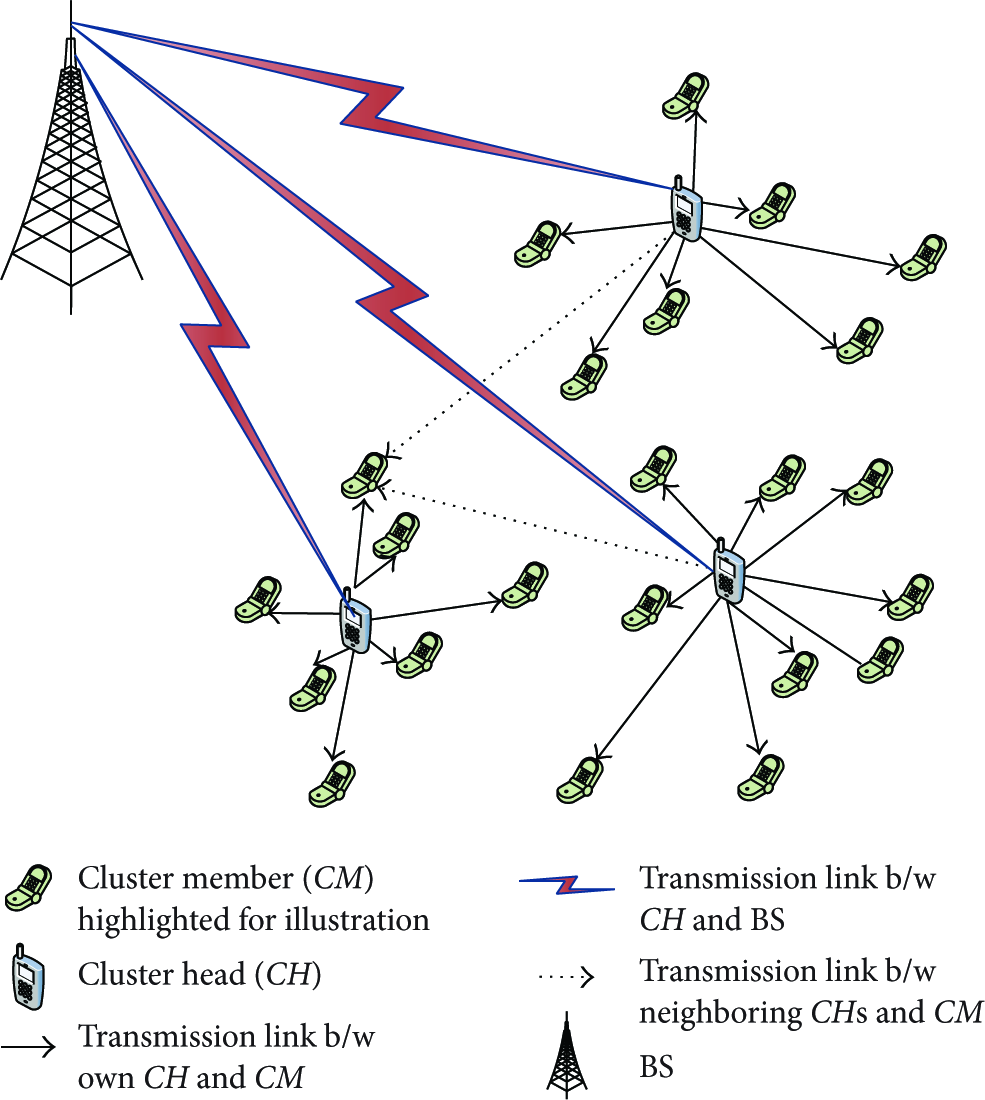
System model comprised of cluster members and cluster heads.
The channel between the nodes includes the attenuation, slow fading, and Rayleigh fading. The received power of the desired signal at a cluster member in terms of transmit powers of cluster heads and channel parameters is [16]

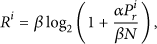
The power consumed by the jth cluster head while retransmitting the content is given by


4. Problem Formulation
As we have discussed above, the rate of the communication in the multicast scenario depends on the worst transmission link. This can lead to a very low rate of multicast communication and consequently reduced energy efficiency due to increased communication time. To increase the rate, the transmit power has to be increased. On the other hand, increasing transmission power may have bad effects on the energy efficiency of the system and it can cause quick exhaustion of the cluster head battery. The other way of increasing the rate is to increase the received power by receiving from multiple cluster heads simultaneously. In the next subsection, we will discuss the possibility of improving energy efficiency by increasing the cluster heads while keeping total transmit power of the cluster heads constant.
4.1. Improving Energy Efficiency by Multiple Cluster Heads
The total energy consumed within the cluster, for a cluster with K cluster heads and M cluster members, in (4) can be written as


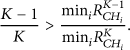

4.2. Example
Figure2 shows the distribution of the cluster members within the cluster. We can see that most of the cluster members are crowded around the cluster head while a single cluster member is quite far from the cluster head and hence has a very bad channel condition with the cluster head. We denote this cluster member by
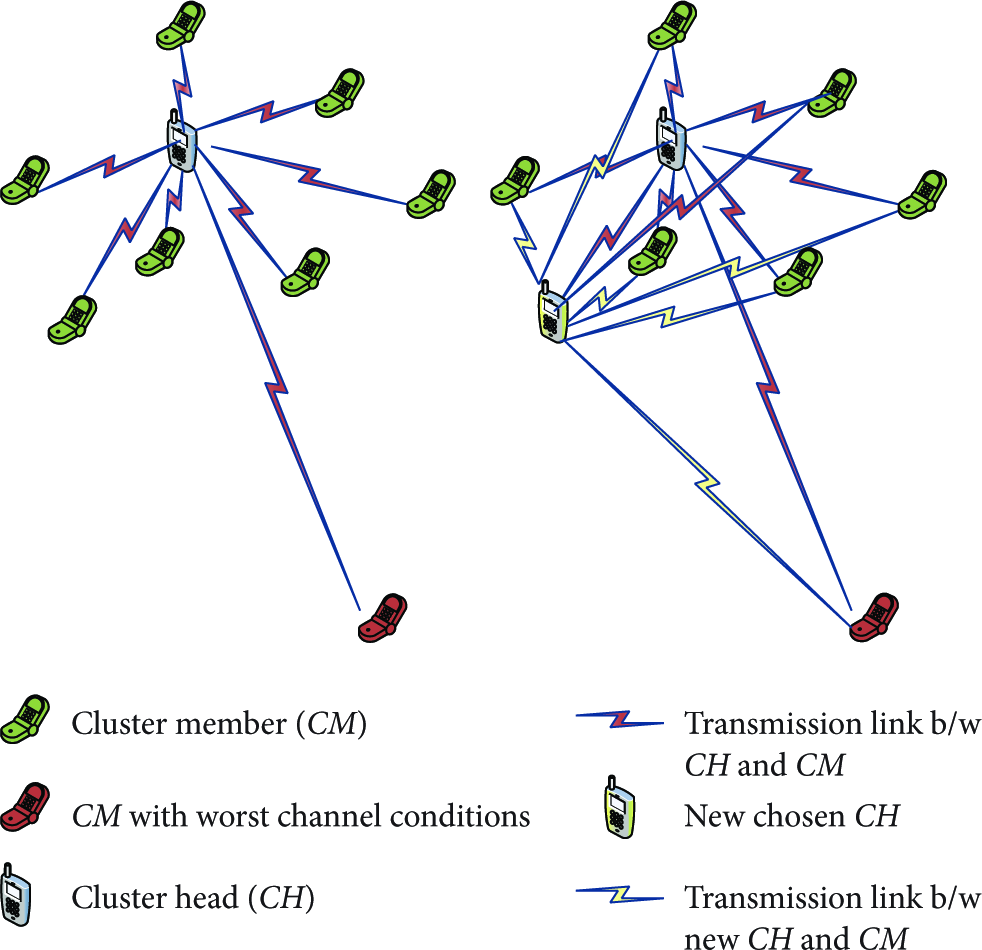
Example scenario.
After attaining
4.3. Cluster Heads Selection and Their Power Allocation Algorithm
The algorithm for selection of cluster heads and their corresponding power allocation is given in Algorithm1. The terminology used in the algorithm is given in Notations. The number of cluster heads is optimized while keeping ρ constant to maximize the energy efficiency. The algorithm can be used for different values of ρ to achieve a specific data rate while keeping energy per bit low.
(1) the cluster members of the cluster (2) (3) (4) Calculate (5) (6) Repeat (7) (8) (9) (10) choose a new cluster head BS and (11) Adjust the bandwidth of BS such that (11) is satisfied (12) update: (13.1) If: ρ can be distributed among members of members of higher or equal to (13.2) Then: update (13.3) Else: (14) update the rate vector (15) until
The selection of new cluster head in step (10) is made as follows. First, the path loss between all the cluster members, except the existing cluster heads, and the worst cluster member is found and then path loss between all the cluster members, except the existing cluster heads, and BS is obtained. Afterwards, the cluster member that provides the least overall path loss between BS and worst cluster member is selected as the new cluster head. As a result of this criterion, the rate of the communication between BS and cluster heads may decrease. Since the BS usually does not operate on batteries [16], hence higher transmit power can be used at the BS to improve the data rate of the communication between BS and cluster heads. The proposed algorithm is used by the BS so it does not introduce higher complexity at the cluster members. The BS needs the channel state information of the worst cluster member with all the other members of the cluster. This may increase the overhead of channel state information exchange. However, it is mostly assumed that the D2D links are stationary, so less frequent exchange of channel information may be required [18] and hence better overall performance can be expected by applying the proposed algorithm at the BS. Further, in any clustering formation technique, the channel information is mandatory and, hence, it should not be considered an extra overhead introduced by the proposed algorithm.
The complexity of the proposed algorithm is high because it has to find the worst cluster member among all the members at each iteration and further the selection of new cluster heads also increases the complexity of the algorithm. This is because at every iteration the algorithm has to find the cluster member that has the best channel conditions with the BS as well as with the worst cluster member.
5. Results and Discussion
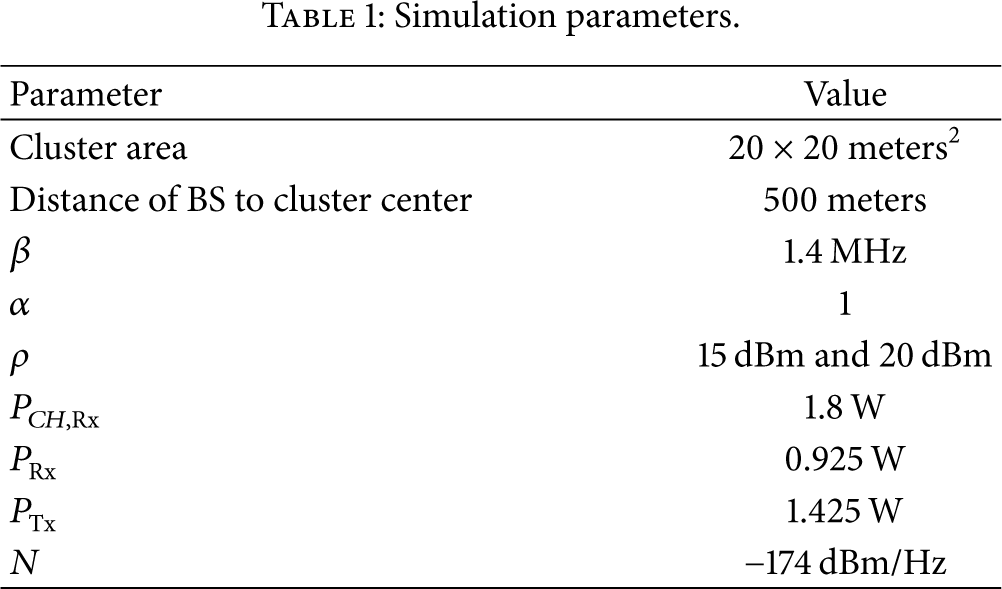
MATLAB simulations are used to obtain the results. The simulation parameters are given in Table1 [16]. The results are averaged over 106 simulations. The number of cluster members varies from 20 to 100 and the cluster members are Poisson distributed within the cluster area of 20 × 20 meters2. The total transmit power of the cluster heads (ρ) is varied from 15 dBm to 20 dBm with an increment of 5 dBm. Four types of results are discussed. First, a snapshot result is shown which shows the achievable data rate improvement of the cluster members as a result of using proposed algorithm. The introduction of new cluster heads and adjustment of their transmitting powers will change the variations of the received power among cluster members. To illustrate these variations, the result of fairness among received powers of the cluster members is provided.
Simulation parameters.
5.1. Snapshot Results
The snapshot results of data rate for a cluster of 20 members are shown in Figure3 to demonstrate the working of proposed algorithm. To illustrate the improvement in data rate, the condition in (12) of step (13.1) in the algorithm is relaxed. Initially, there is only a single cluster head and 19th cluster member is the worst cluster member as it has the lowest possible data rate. This is highlighted by a box on the diagram. During the execution of the algorithm, it is found that the 4th cluster member has the minimum path loss between 19th cluster member and BS among all the cluster members. Hence, 4th cluster member is chosen as the second cluster head and ρ is distributed among the two cluster heads. The transmit power of the second cluster head is increased until the data rate of 19th cluster member becomes equal to the data rate of one of the other cluster members, which in this particular case is 17th cluster member. Further increase in transmit power of second cluster head will increase the data rate of 19th cluster member; however, it will further reduce the data rate of 17th cluster member and thus will result in lower data rate of multicast communication. Further increasing of the data rate of multicast communication is achieved by introducing a third cluster head that has the minimum path loss between 17th cluster member and BS among all the cluster members. Exclusive search yields that 5th cluster member is the best candidate for the third cluster head and hence is chosen as the third cluster head. Now ρ is shared among three cluster heads in such a way that the data rate of both 17th and 19th cluster member increases. The adjustment of power is done until the data rate of 17th and 19th cluster member becomes equal to one of the other cluster members, which in this particular case is 14th cluster member.
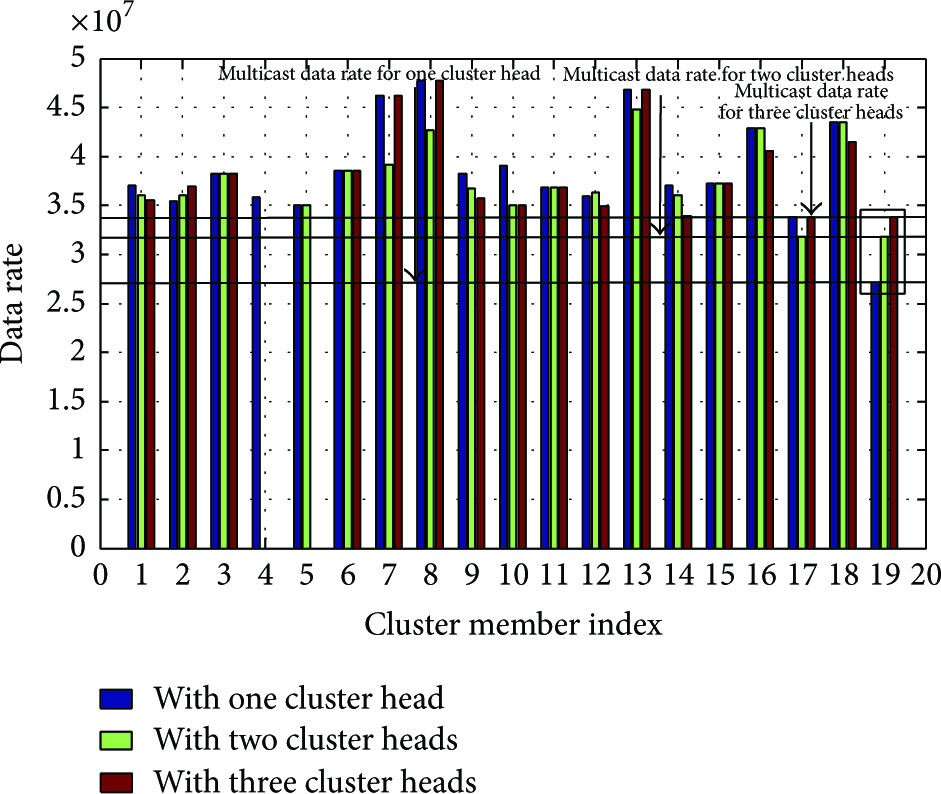
Result of running the algorithm with a constraint of three cluster heads.
5.2. Total Energy Consumption per Bit
Figure4 shows the percentage of reduction in total energy per bit when ρ is 15 dBm and 20 dBm. The percentage of reduction in total energy per bit is negative for smaller number of cluster members. However, it increases with increase in number of cluster members. This behavior can be justified by the following reasoning. The higher number of cluster heads increases the data rate of multicast communication, thus decreasing the overall communication time. The reduction in time will ultimately reduce the circuit energy of the cluster members. On the other hand, the increase in number of cluster heads also increases the circuit energy of the cluster heads due to the first term of (8). Hence, the reduction in circuit energy of the cluster members should balance out the increase in circuit energy of the cluster heads. The number of cluster members needed to balance out the increase in circuit energy of the cluster heads for different values of ρ is different. We denote the number of cluster members required to balance out the increase in circuit energy of cluster heads by

Reduction in total energy for MCHR when compared to SCHR.
5.3. Total Transmission Time
The percentage of reduction in time for the MCHR scheme as compared to the SCHR is shown in Figure5. As expected, the transmission time for MCHR scheme is less than SCHR scheme for both transmit power levels considered. However, the reduction is less significant for higher value of ρ. The reason for this behavior is as follows. With the increase in ρ, the received power of the worst cluster members also increases, thus resulting in increase in its data rate. To further increase its data rate, a new cluster member will be introduced according to the proposed algorithm. To achieve a certain increase in data rate, a higher power should be allocated to the newly introduced cluster head so that the data rate of the worst cluster member also increases. This is due to the fact that at higher received power levels the data rate increases logarithmically [20]. As the power of the new cluster head is increased, the achievable data rate of some other cluster member becomes equal to that of the worst cluster member and hence the algorithm stops itself early as compared to the case of smaller value of ρ. Hence, relatively small increase in data rate is experienced and consequently smaller reduction in transmission time is shown in Figure5.
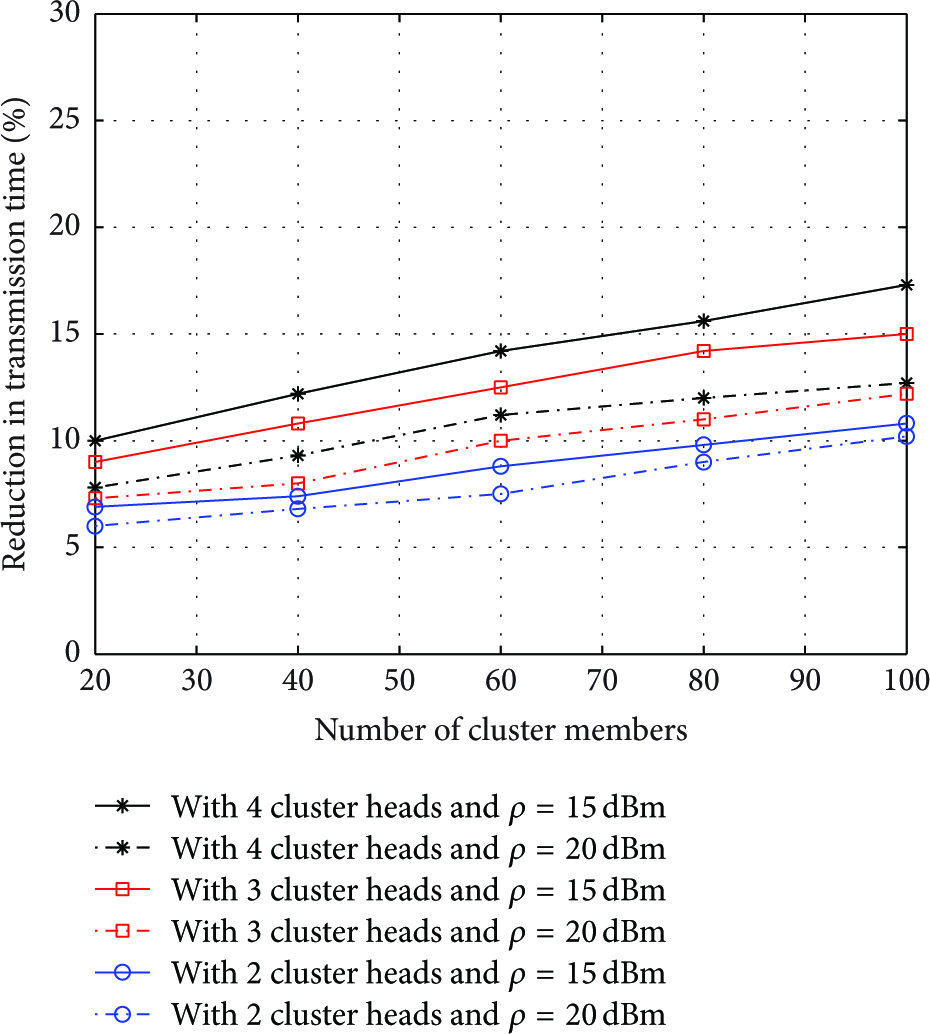
Reduction in transmission time for MCHR when compared to SCHR.
5.4. Fairness of the Received Power
In this subsection, we show the fairness of the received power of the cluster members. Since the proposed scheme tries to increase the received power of the worst cluster members while reducing the received power of the good cluster members, hence a better fairness of the received power among cluster members is expected with the application of the proposed scheme. Jain's fairness index is used to measure the fairness among the received power of the cluster members with the proposed MCHR scheme and SCHR scheme. Jain's fairness index is defined as [21]


Fairness among the received powers of cluster members.
6. Conclusions
The data rate of the multicast communication within a cluster depends on the worst transmission link within the cluster. The data rate of the multicast communication is improved by introducing new cluster heads within the cluster. All the cluster members receive the content from all the cluster heads simultaneously. The increase in data rate has resulted in reduced total energy consumption per bit. As the performance of the proposed scheme improves for higher number of cluster members, it is concluded that the multiple cluster heads transmission within the cluster is better than single cluster head transmission for higher user densities. The fairness of the received power also improves as a result of using different transmit powers for different cluster heads.
Footnotes
Notations
Competing Interests
The authors declare that they have no competing interests.
Authors' Contributions
Mr. Mateen Ashraf proposed the idea and the research work was supervised by Dr. Kyung-Geun Lee, Dr. Miae Woo, and Dr. Woon-Young Yeo.
Acknowledgments
This research was supported by the Basic Science Research Program through the National Research Foundation of Korea (NRF) funded by the Ministry of Education, Science and Technology (NRF-2015R1D1A1A09059026).