




Abstract
Considering a nonregenerative untrusted relay network, we investigate three different secure transmission strategies, for example, noncooperative strategy, conventional amplify-and-forward (AF) strategy, and cooperative jamming (CJ) strategy. To thoroughly assess the secrecy performance achieved by the three strategies, we derive the closed-form expressions for the connection outage probability and secrecy outage probability regarding each strategy. Based on these expressions, the reliability and security tradeoff (RST) is examined to facilitate the design of the transmitting parameters. We then present the closed-form expression for the effective secrecy throughput (EST) and characterize the overall efficiency of these transmission strategies. Furthermore, we conduct the asymptotic analysis for the secrecy throughput, which enables us to determine the optimal transmission strategy under different scenarios. Our analytical and numerical results demonstrate that compared with the noncooperative and AF strategies, the CJ strategy possesses the best performance in terms of RST. Additionally, we also find that the EST performance of the AF strategy is nearly invariable when the quality of the second hop changes.
1. Introduction
Due to the broadcast nature of the open medium, wireless communication systems are particularly vulnerable to security attacks. Recently, the information-theoretic security, referred to as physical layer security, has been recognized as a promising method to develop low-complexity and effective wireless security mechanism [1, 2]. The initial work in this area goes back to Wyner [3], who introduced the wiretap channel and concluded that secure communication can be achieved without relying on private keys. In [4], the secrecy capacity of the Gaussian wiretap channel was investigated, which is the maximal achievable secrecy rate below which the eavesdropper is unable to decode any confidential message. The transmission of confidential message over broadcast channels was generalized in [5].
Some studies have focused on the physical layer security in wireless ad hoc networks [6] and cognitive radio networks [7]. Meanwhile, cooperative communication has been emerging as a promising technique, due to its significant spatial diversity and low hardware demands. Therefore, current studies concentrated on generalizing the physical layer security to the relay networks. The information security in the relay network is often susceptible to eavesdropping by unintended receivers. Thus, one possible scenario in which external eavesdropper(s) may overhear transmission in the relay network was investigated in [8, 9]. Considering the practical working condition, the design of secure transmission scheme under channel state information (CSI) uncertainty has already been studied by [10–12] with eavesdropper. However, from a robust perspective, relay can also be viewed as a potential eavesdropper [13–22]. For example, the relay might belong to a heterogeneous network without the same security clearance as the source and the destination nodes. The work in [13, 14] investigated the achievable secrecy rate with an untrusted relay and proved that using nonregenerative untrusted relay can help achieve a higher secrecy rate than simply treating it as an eavesdropper. Subsequently, [15] examined the outage performance in a three-node relay network using the adaptive transmission scheme. Moreover, the use of multi-input multioutput (MIMO) [16, 17], multiple untrusted relays [18, 19], opportunistic relay [20], and two-way relay [21] was investigated for the security of information transmission. The optimal power problem was examined in [21, 22]. However, the aforementioned contributions only focused on secrecy rate and outage performance without paying much attention to the reliability and security tradeoff (RST) and effective secrecy throughput (EST) performance.
This motivates us to explore the secrecy coding aided secure wireless communications to achieve the reliability and security tradeoff, where the reliability is quantified in terms of the connection outage probability, while the security is quantified in terms of the secrecy outage probability [23]. Although the notion of reliability and security tradeoff has been studied in [24, 25], this work only focused on the scenario where the eavesdropper is an external entity. By contrast, in our work we consider the untrusted relay network. That is, the relay, who helps forward the signal to the destination, is also a potential eavesdropper. We adopt the fixed-rate transmission scheme to meet the reliability and security requirements for three different transmission strategies, for example, noncooperative strategy, conventional amplify-and-forward (AF) strategy, and cooperative jamming (CJ) strategy. The main contributions of this work are summarized as follows. First, we characterize three key performance metrics, including the connection and secrecy outage performance, the reliability and security tradeoff, and the effective secrecy throughput. Second, the asymptotic analysis of the EST is conducted to reveal the optimal transmission strategy under different scenarios. Additionally, our numerical results highlight the advantage of the CJ strategy over the noncooperative and AF transmissions in terms of RST. We also find that the EST of the AF strategy is not sensitive to the channel coefficient of the second hop.
2. System Model
As shown in Figure 1, we consider a cooperative network composed of a source S, a nonregenerative untrusted relay R, and a destination D. We assume that all nodes are equipped with a single-antenna and operate in a half-duplex mode. The channel between i and j is quasistatic Rayleigh fading, denoted by

System model.
In this paper, the constant-rate Wyner coding scheme [3] is employed for confidential message transmission to satisfy the physical layer security requirements. Specifically, there are two parameters, namely, the codeword transmission rate
2.1. Noncooperative Strategy
For the noncooperative strategy, the relay is treated as a pure eavesdropper, and the source does not cooperate with the relay. Information transmission is finished under the source broadcasting information in one time slot. Thus, the received signal at the relay is expressed as


2.2. AF Strategy
When the untrusted AF relay is employed, the complete transmission can be divided into two slots. During the first slot, the source broadcasts information to the relay and the destination. During the second slot, the source keeps silent, and the relay adopts the nonregenerative protocol to process the received signal with a variable amplify coefficient

2.3. CJ Strategy
Under CJ strategy, in the first transmission slot the destination ignores the information from the source instead of transmitting a jamming signal. Thus, the received signal at the relay is


3. Reliability and Security Tradeoff
In this section, we investigate the reliability and security performance for the three transmission strategies. Then, we calculate the RST to help the legitimate users choose proper transmit parameters to meet the reliability and security requirements.
3.1. Noncooperative Strategy
For noncooperative strategy, the relay does not help the source forward information and is treated as a pure eavesdropper. Therefore, this model, simplified as a traditional wiretap model, can be regarded as a benchmark for comparison purposes. Let

Combining the COP and SOP expressions, the RST of the noncooperative strategy can be expressed as

Remark 1.
According to (7), we can see that increasing the SOP reduces the COP and vice versa. This observation indicates that there exists a tradeoff relationship between reliability and security. As such, the security in the untrusted relay network can be improved at the cost of the reliability degradation.
3.2. AF Strategy
When the untrusted AF relay is employed for cooperative communication, the mutual information

Then, the COP of the AF strategy can be written as

The SOP of the AF strategy can be expressed as

Combining (9) and (10), the RST of the AF strategy can be formulated as

Remark 2.
Without the second link of the noncooperative strategy, it is difficult to distinguish the RST performance between the noncooperative strategy and the AF strategy. In other words, given a required SOP, which strategy can achieve a better reliability performance is not determined. Conversely, the security performance which is better is also not estimated between the two strategies with a target COP requirement.
3.3. CJ Strategy
According to the signal model of the CJ strategy mentioned in Section 2, the mutual information
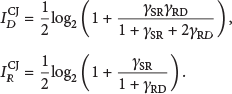
Thus, the COP of the CJ strategy can be expressed as

Then, the SOP of the CJ strategy is formulated as


Then, combining (13) and (14), the RST of the CJ strategy can be written as

Remark 3.
Due to the jamming signal by the destination, the security performance is improved for the CJ strategy. In addition, the CJ strategy is more sensitive about the reliability without the direct link. Thus, the RST of CJ strategy is better than the cooperative and AF strategies which is consistent with the simulation result.
4. Effective Secrecy Throughput and Asymptotic Performance Analysis
Besides the fact that reliability and security need our attention, we are also concerned about the effective secrecy throughput of the transmission strategy, which can achieve both reliable and secure transmission. The EST proposed in [27, 28] is adopted here to measure the overall reliable and secure throughput given by

4.1. Noncooperative Strategy
Substituting the expression of
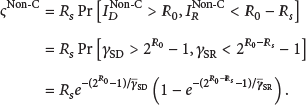
4.2. AF Strategy
According to (8) and (17), the EST of the AF strategy can be formulated as

Proposition 1.
The EST of the AF strategy can be expressed as

Proof.
See Appendix A.
The performance of the AF strategy achieving both reliable and secure transmission is characterized by (20). From (20), we can choose appropriate λ,
4.3. CJ Strategy
Substituting the expression of

Proposition 2.
The EST of the CJ strategy can be expressed as

Proof.
See Appendix B.
We see that the EST of the CJ strategy mainly depends on
4.4. Asymptotic Performance Analysis
Based on the above expressions of the EST for the three strategies, we investigate the asymptotic behavior for each to determine conditions, which allows us to determine the transmission strategy providing best efficiency.
4.4.1. Case of
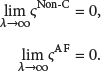
From (18) and (19), we can know that

Remark 4.
It can be inferred from (23) that when transmit power is sufficiently large, noncooperative and AF strategies are obviously not applicable since
4.4.2. Case of
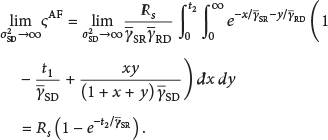
From (18), we have

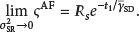
4.4.3. Case of
or
From (18), it is easy to prove that

Remark 5.
It is shown that the AF strategy is better than the noncooperative strategy when the link between the source and the destination is strong, while the CJ strategy can achieve a better EST performance than the noncooperative and AF strategies when the link between the source and the destination is weak.
4.4.4. Case of
or
Since
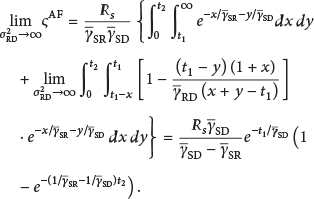

When

5. Numerical Results
In this section, we present some numerical simulations to illustrate the accuracy of our analytical results.
Figure 2 plots the COP and SOP as a function of the transmit SNR λ. In this figure, we first observe that the Monte Carlo simulation results precisely match the numerical analysis, which validates our analysis. We also observe that as the transmit power increases, for each strategy the COP is reduced accordingly, whereas the corresponding SOP increases. This demonstrates that the reliability and security tradeoff between COP and SOP exists in the untrusted relay network. Besides, the figure also shows that the CJ strategy strictly performs better than the noncooperative and AF strategies in terms of the SOP. Meanwhile, the COP of the noncooperative and AF strategies outperforms the CJ strategy. This is due to the fact that the jamming signal of the CJ strategy makes the relay eavesdrop difficult, while ignoring the information from the source during the first slot results in the reliability degradation. Therefore, this figure highlights that the security performance of the CJ strategy is upgraded at the cost of the reliability depression.

SOP and COP versus transmit SNR with
Figure 3 plots the COP of the three strategies versus the SOP. We first observe that the COP decreases as the SOP increases and vice versa. This observation explicitly demonstrates the tradeoff relationship between reliability and security in the untrusted relay network. Moreover, we can see that the RST of CJ strategy outperforms the noncooperative and AF strategies. Therefore, given a required SOP, CJ strategy can achieve a better reliability than the noncooperative and AF strategies. Conversely, with a target COP requirement, the SOP performance of CJ strategy would be lower than the noncooperative and AF strategies. Furthermore, it is also worth noting that there is an almost linear relationship between the COP and SOP of CJ strategy. Thus, we conclude that CJ strategy is more sensitive to reliability and security than noncooperative and AF strategies.

COP versus SOP with
Figure 4 plots the EST of the three strategies versus the transmit power. It is seen from Figure 4 that there is an optimal transmit power maximizing the EST of the noncooperative and AF strategies. This is because not only the destination benefited from increasing the transmit power but also the untrusted relay benefited from it. Moreover, we observe that the EST of the CJ strategy first increases as transmit power increases and then approaches a constant as transmit power approaches large values. This can be explained by the fact that the jamming signal leads to the enhancement of the security. Therefore, we can conclude that increasing transmit power is an efficient method of enhancing the EST performance of the CJ strategy, while it is not appropriate for noncooperative and AF strategies.

EST versus transmit SNR with
Figure 5 plots the EST against

EST versus
Figure 6 plots the EST versus

EST versus
Figure 7 plots the EST versus
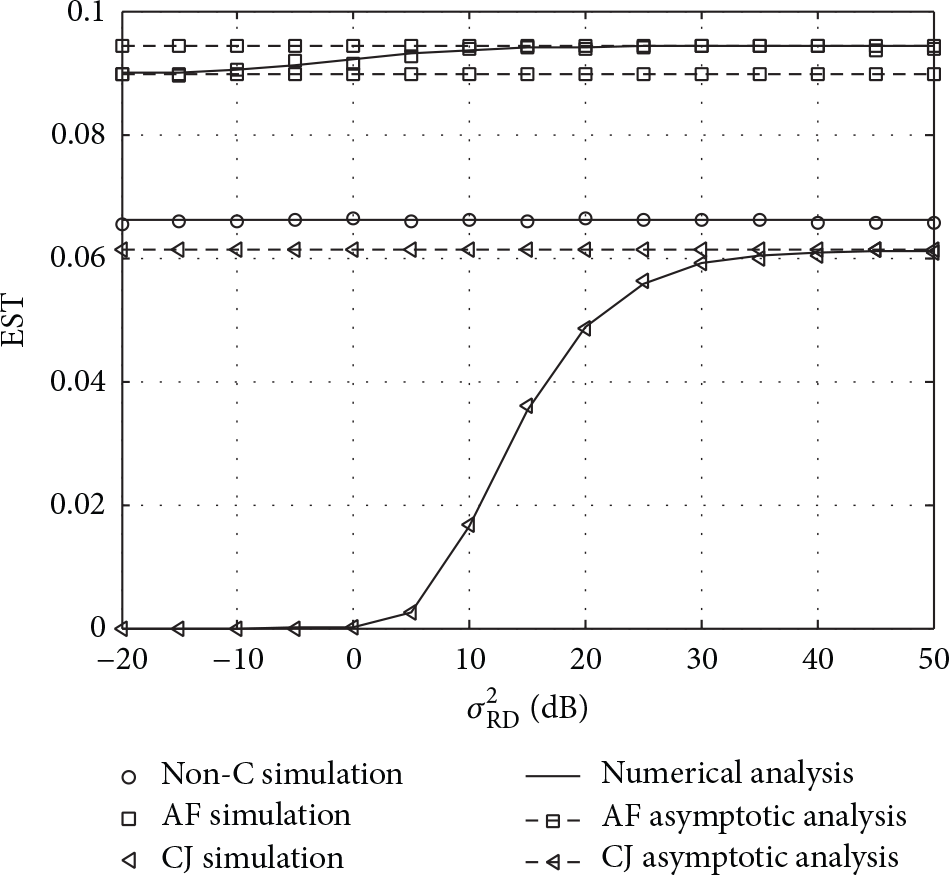
EST versus
6. Conclusion
Considering a three-node nonregenerative untrusted relay network, in this paper we investigated the three secrecy transmission strategies, for example, noncooperative strategy, conventional AF strategy, and CJ strategy. We derived the closed-form expressions for the COP, the SOP, the RST, and the EST. Furthermore, the asymptotic analysis of the secrecy throughput was examined to determine the optimal transmission strategy under different scenarios. Results showed that the CJ strategy performs consistently better than the noncooperative and AF strategies in terms of RST performance, demonstrating the tradeoff advantage of the CJ strategy. Moreover, we found that there exists an optimal transmit power maximizing the EST for the noncooperative and AF strategies, and the EST performance of the AF strategy does not change significantly when the quality of the second hop varies.
Footnotes
Appendix
Disclosure
This work was presented in part at the International Conference on Wireless Communication and Signal Processing, 2015.
Competing Interests
The authors declare that they have no competing interests.
Acknowledgments
This work by D. Chen, W. Yang, J. Hu, Y. Cai, and S. Zhu was supported by the National Natural Science Foundation of China (no. 61371122, no. 61471393, and no. 61501512) and Jiangsu Provincial National Science Foundation (BK20150718) and the China Postdoctoral Science Foundation under a Special Financial Grant (no. 2013T60912).