




Abstract
Combinatorial auction is a popular approach for resource allocation in cloud computing. One of the challenges in resource allocation is that QoS (Quality of Service) constraints are satisfied and provider's profit is maximized. In order to increase the profit, the penalty cost for SLA (Service Level Agreement) violations needs to be reduced. We consider execution time constraint as SLA constraint in combinatorial auction system. In the system, we determine winners at each bidding round according to the job's urgency based on execution time deadline, in order to efficiently allocate resources and reduce the penalty cost. To analyze the performance of our mechanism, we compare the provider's profit and success rate of job completion with conventional mechanism using real workload data.
1. Introduction
Over recent years, the growth of the IoT (Internet of Things) is expected to create a pervasive connection of things such as embedded devices, sensors, and actuators. This will inevitably result in the generation of enormous amount of data, which have to be autonomously stored, processed, accessed, and managed. Cloud computing has been recognized as a paradigm for the big data problem [1]. Cloud computing allows the sensing data to be stored and used intelligently for smart applications.
One of challenges which arose when IoT meets cloud is resource allocation by which a cloud provider efficiently allocates its resources to cloud users with SLA constraints. The dominating performance factors in resource allocation include provider's and user's profit, resource utilization, and QoS (Quality of Service) [2]. For resource allocation in cloud, auction-based model is a popular approach in resource allocation and pricing [3]. In particular, combinatorial auction is preferred in cloud computing because it allows a user to buy a package of resources rather than an individual resource. Since the auction is done on group of resources, it provides efficient resource allocation and helps to improve the profit to both a provider and a user.
The other issue of resource allocation in cloud computing is meeting SLA (Service Level Agreement) established with a user. Before a provider provisions a service to a user, a provider and a user need to establish SLA contract. The SLA is an agreement that specifies QoS between a provider and a user [4]. We define two-levels of SLA to represent different objectives: class-based SLA and job-based SLA [5]. In class-based SLA, for each job class, QoS is measured based on performance metrics. In job-based SLA, QoS is measured using the metrics of individual jobs. Any single job with a poor service quality immediately affects the measured QoS and incurs some SLA penalty cost. We believe the job-based SLA is a more robust type of SLAs from the users' perspective than providers' perspective and we focus on this. In general, SLA is defined in terms of various performance metrics, such as service latency, throughput, consistency, and security. In our paper, SLA is defined in terms of deadline along with execution time of each job. The deadline violation is important from QoS guarantees perspective. It causes loss of profit for a provider due to incompletion to execute the certain jobs and SLA penalty cost [6].
Considering SLA guarantee, we propose a resource allocation mechanism in combinatorial auction system for cloud computing. For efficient resource allocation, winner determination problem in the auction should be solved. The conventional winner determination mechanisms are proposed to maximize resource utilization and a provider's profit for each time interval. However, the profit can be maximized by reducing the penalty cost for SLA violation. To reduce SLA violations, the deadline constraints need to be considered when winner is determined in the auction. Thus, we propose a winner determination mechanism with consideration for the deadline constraints to maximize the provider's profit.
The rest of the paper is organized as follows. In Section 2, we discuss the related work. In Section 3, we present our winner determination mechanism. In Sections 4 and 5, we evaluate the performance of our mechanism and conclude the paper with the future research plan.
2. Related Work
We investigate resource allocation strategies for the SLA-based cloud computing framework. Several proposals in the literature are based on utility functions to dynamically allocate resources. In [7], a two-tier resource management approach based on utility functions is presented. It defines the VM (Virtual Machine) utility function as a linear function of the CPU resources. In [8], an autonomic resource manager is presented to control the virtualized environment which decouples the provisioning of resources from the dynamic placement of VMs. It finds an optimal number and size of VMs to allocate CPU resources to applications while maximizing the utility function.
There are several proposals that dynamically manage VMs by optimizing objective functions. Reference [9] determines dynamic placement of VMs based on minimizing an objective cost function using linear programming. The function is to provide an economic model between infrastructure providers and users. The pMapper [10] system includes a power-aware application placement controller to optimize a cost-performance function. It uses the bin-packing algorithm based on a modified version of FFD (First-Fit Decreasing) to place the VMs on the servers, while trying to meet the target utilization.
Researchers have investigated maximizing the profit under SLA constraints. In [11], a multilevel generalized assignment problem is formulated. To solve the problem, the first-fit heuristic is used for maximizing the profit under SLA and the power budget constraint. In [12], a combinatorial optimization problem is defined to maximize the provider's profit from SLA compliant placement. The problem is presented as a multiunit combinatorial auction. To solve the problem, a column generation method is presented to obtain near optimal solutions.
A combinatorial auction allows bidders to bid for a combination of multiple resources. In other words, bids are submitted for the whole bundle as a single unit. After the auction, each bidder receives either the whole bundle or nothing. In the auction, the goal of a cloud provider is to efficiently allocate the available resources to users and to maximally generate its revenue. In [13], CA-provision is proposed as an allocation mechanism to maximize the revenue for a cloud provider as well as maximize the resource utilization. The provider's revenue has three elements: the revenue of the resource, the cost of the VM instances that are allocated to the users, and the cost of keeping the remaining resources idle. The purpose of considering the two costs is to reduce the cloud provider's losses. Reference [14] proposes a model, called ABRA (Auction-Based Resource Co-Allocation) to solve the resource coallocation problem. It imposes penalty costs on unallocated resources after an auction in order to improve the resource utilization. First, a new neighborhood structure is proposed to define an ordering as a permutation of the bids in the auction. Then, the search space is defined as the set of all possible orderings to find the optimum solution. Finally, various neighbor selection methods are used to find the solution.
The conventional resource allocation mechanisms in combinatorial auction system present winner determination algorithms to reduce the penalty cost in each bidding round. However, since they do not consider the probability of SLA violation when deadline gets to end, the performance is limited. We present a new winner determination algorithm with consideration for deadline constraints of jobs (i.e., urgency) to reduce the penalty cost for SLA violation and maximize the profit of the provider.
3. Proposed Mechanism
A cloud provider offers computing services to users through m different types of VM instances,
The provider runs auction mechanism periodically to allocate the VM instances. Thus, users bid for obtaining the VM bundles for a unit of time. If the user's job requires a bundle for more than one unit of time, the user has to bid again in the next round of the auction, separately. A user bids until its application is completed or its deadline is exceeded. Conventional winner determination mechanisms do not consider that each job has different urgency. In other words, the job which has impending deadline needs to have a weight to the job with the time left before the deadline in the competitive bidding. To maximize the provider's profit by reducing the penalty cost for SLA violations, we use the probability of deadline violations by considering the job's urgency, when winners are determined [16].
In our paper, SLA is defined in terms of completion deadline


Figure 1 shows that

4. Performance Analysis
To evaluate the performance of our mechanism, we conduct simulation with real workload data and compare the performance of the conventional mechanism (CA-provision [13]). In preliminary experiments, we use UniLu-Gaia-2014 workload logs from the Parallel Workload Archive [17]. In the logs, the average number of submitted jobs per round is set to about 24 and the average number of processors required per job is 9.97. In the experiments, we set
Figure 2 shows the probability of bidding success at current round

The probability of bidding success at a current round.
Figure 3 shows the success rate of job completion for each user. The success rate of job completion indicates the number of jobs completed before the deadline to the number of jobs submitted by user

The success rate of job completion for users.

The success rate of job completion with varying the deadline factors.
Figure 5 shows the profit of a cloud provider with varying the deadline factors. The profit of our mechanism is about 10.5%, 12%, 10%, and 13% higher than that of CA-provision, respectively. This figure shows that, through the winner determination by considering the job's urgency, deadline violation decreases and the profit of the provider increases.

The provider's profit with varying the deadline factors.
To evaluate the performance in different system scenarios, we use eight workload logs from the Parallel Workload Archive [17]. In Table 1, we show a brief description of the workload files. The table describes the log file name, the average execution time of the jobs (
Real workload data.

Figure 6 shows the success rate of job completion in different workloads. In the experiments, we set
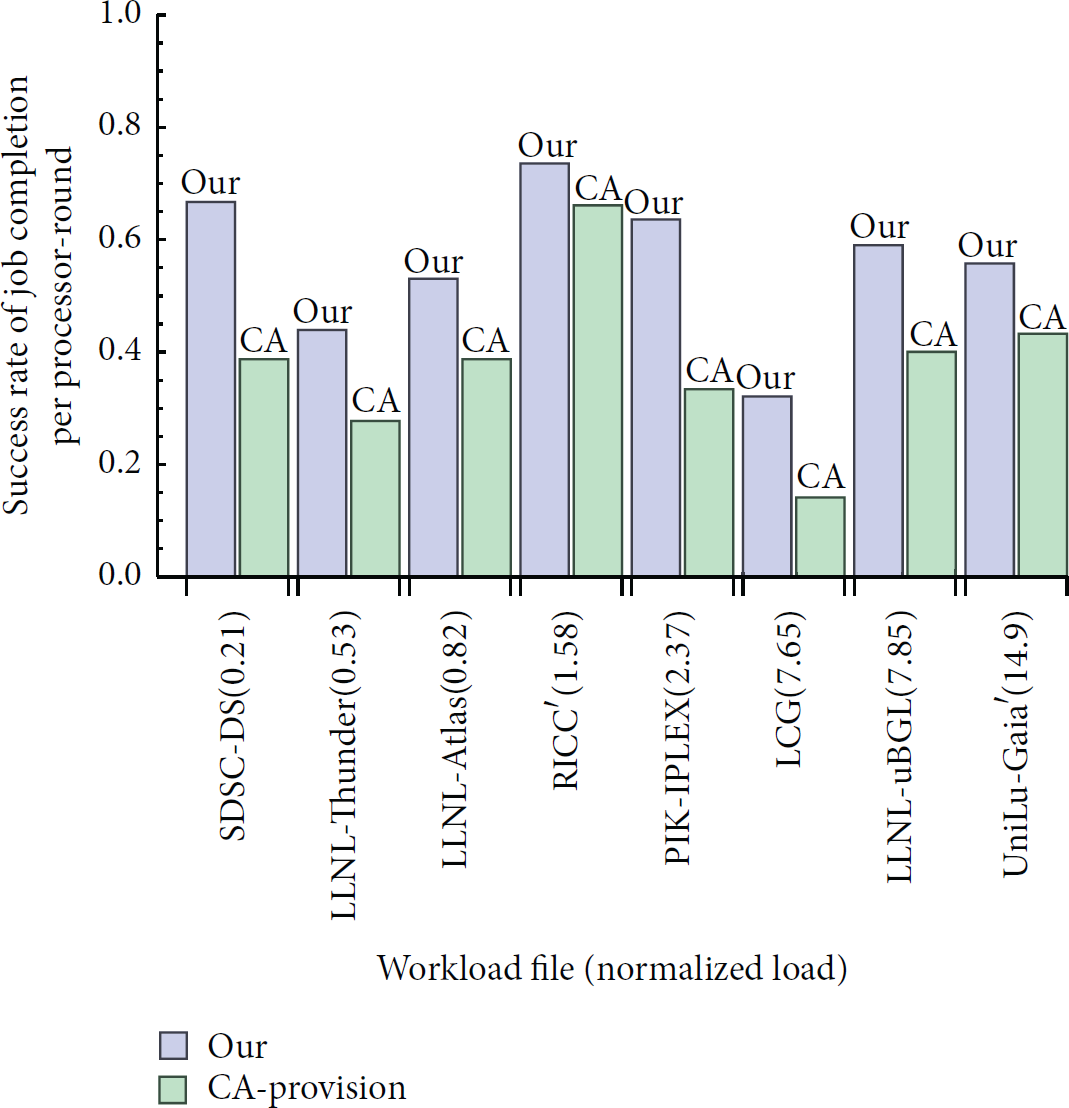
The success rate of job completion with varying the workloads.

The provider's profit with varying the workloads.
5. Conclusion
To increase the provider's profit, the penalty cost for SLA violations needs to be considered. To reduce the cost, we consider the job's urgency based on the deadline constraint when winners are determined in the combinatorial auction. Taking the urgency into consideration, we calculate the probability of deadline violation for each job. Then, using the probability, we calculate the expected value of the provider's profit when the corresponding user is selected as a winner at a bidding round. The user with the larger expected value is likely to be determined as a winner. Thus, the penalty cost decreases by the decrease of SLA violation, and the provider's profit increases. The experimental results show that our mechanism has higher profit and success rate of job completion than these of the conventional mechanism. We look forward to compare the other winner determination mechanisms in the combinatorial auction and demonstrate effectiveness of our mechanism.
Footnotes
Conflict of Interests
The authors declare that there is no conflict of interests regarding the publication of this paper.
Acknowledgment
This research was supported by Basic Science Research Program through the National Research Foundation of Korea (NRF) funded by the Ministry of Education (NRF-2015R1D1A1A09057141).