We propose a novel algorithm to optimize the energy efficiency (EE) of OFDM-based cognitive opportunistic relaying links (CORL) under secondary users (SUs) incorrectly sensing the unlicensed spectrum. We formulate an optimization problem with imperfect sensing that satisfies a specified power budget for the secondary users (SUs), while restricting the interference to primary user (PU) in a statistical manner. Unlike all related works in the literature, we consider the effect of subcarrier transmission mode on the relaying links and we additionally consider the effect of limited sensing capabilities of the SUs. The optimization problem is nonconvex and it is transformed to an equivalent problem using the concept of fractional programming. With the aid of the fractional programming method, an EE-oriented power allocation policy with low complexity is proposed which adopts the bisection method to speed up the search of the optimum. Simulation results show that the EE deteriorates as the channel sensing error increases. Comparisons with relevant works from the literature show that the EE is slightly deteriorated if the SU does not account for spectrum sensing errors.
1. Introduction
Cognitive radio (CR) networks have emerged as an efficient solution to the problem of spectrum scarcity and its underutilization. This is achieved by granting SUs' opportunistic access to the white spaces within PUs' spectrum while controlling the interference to PUs. Orthogonal frequency-division multiplexing access (OFDMA) is recognized as an attractive technique for CR due to its spectrum shaping flexibility, adaptively in allocating vacant radio resources, and capability of analyzing the spectral activities of PUs [1]. Incorporating cooperation into cognitive radio networks results in substantial performance gains in terms of spectrum efficiency (SE) for both PUs and SUs [2]. Besides the SE, the EE becomes a key issue for future wireless networks since energy cost imposes both financial and ecological burden on its development. EE power allocation especially is of crucial importance for cognitive relaying network design [3]. This is because that high EE is a basic premise for SUs to achieve high utilization of the limited transmit power which is consumed to not only improve SE but also implement some additionally important functionalities, for example, spectrum sensing.
As a result, energy-efficient resource management has attracted attention in both industry and academia recently, especially for the OFDMA system which is the most popular modulation technique for current wireless networks. Different from the throughput-oriented optimization targets, energy-efficient resource management aims at maximizing the energy efficiency of the wireless system. One of the energy-efficiency metrics is called “bits-per-Joule,” which is defined as the system throughput to unit-energy consumption. For instance, the EE-maximization problem in an OFDMA system under a maximum total power constraint in frequency-selective channels is addressed [4]. In [5], the authors studied the tradeoff between EE and SE in the downlink of OFDMA networks. They showed that the EE is quasi-concave in the SE. Then based on this observation, a power and subcarrier allocation algorithm is proposed. In the uplink of an OFDMA system, the EE is addressed in [6]. Furthermore, in [7], the EE of two-way relaying was compared with those of the one-way relaying, showing that two-way relay transmission is not always more energy-efficient than one-way relay transmission. Nevertheless, [4–7] aim at maximizing the EE of system without taking the interference by SUs in CRNs into account. In [8], a method named as water-filling factor aided search (WFAS) was proposed to maximize EE under multiple constraints with perfect channel state information (CSI) at CR source, but relaying was not considered. In [9], the energy efficiency of an OFDM-based system is maximized, where multiple radio access technologies are employed for parallel transmission. In [10], an energy-efficient resource management scheme is developed for a downlink multiuser OFDM system with distributed antennas while considering proportional fairness among users. In our previous work [11], we propose an optimal power allocation scheme to maximize the EE of OFDMA opportunistic relay which is first proposed in [12] to better exploit the frequency-selective channels. However, [11] has not considered the peak primary PU's interference constraints and spectrum sensing errors. Note that [13] also studied the EE optimization problem in CR system with imperfect spectrum sensing, but they all focus on the frame design including optimal sensing duration and data-transmission duration, as well as the optimal transmission power instead of the power allocation among each subcarrier. Besides, the authors in [14–16] analyze the EE performance of CRNs with imperfect spectrum sensing while relay strategies are not applied. Although a solution for EE-maximization problem in relay-aided CRN is proposed in [17], the authors only consider the ideal situation, that is, ignoring sensing errors.
Based on research in CR relaying system, the motivation of this paper is expressed as follows. In order to further improve the SUs' performance in terms of EE metric, we introduce the opportunistic DF (Decode and Forward) relaying strategy [12] to CR relay-aided networks to better exploit the frequency-selective channels, unlike [5, 6] where always-relaying protocol was considered. On the other hand, we assume that the SUs can coexist with the PU in the presence of both idle and busy sensing decisions while adapting their transmission power according to the imperfect sensing results, which differs from [15, 18]. In fact, the perfect spectrum sensing results are unavailable in practice, which makes the past research too idealistic to achieve feasible schemes for real system. Therefore, it is of great importance to study the energy-efficient resource management scheme under imperfect channel sensing.
In this paper, adaptive power allocation is investigated to maximize EE for CORL with spectrum sensing errors considered in the system model. To achieve the optimal solution, the EE-maximization problem is simplified and transformed into an equivalent concave form, and then we use the Lagrangian technique to transform the equivalent problem into a corresponding dual problem. Finally, optimal allocation algorithm is proposed. To the best of our knowledge, adaptive EE power allocation is investigated to maximize EE for CORL considering spectrum sensing errors which has not been discussed in the literature. Our main contributions of this paper are summarized as follows:
An EE optimization problem for CORL system with imperfect sensing results is established, subject to the individual power budget, peak PU's interference constraints, and circuit power consumption in the total power expenditure, as well as considering subcarrier transmission mode. Particularly, our model can be easily extended to many practical scenarios with necessary modifications.
We probe into the optimal power allocation scheme with incorrect sensing in CORL system. On the basis of CORL model, we proposed a novel EE-oriented optimal power allocation iterative algorithm by exploiting the fractional programming and bisection method to completely solve the optimization problem, which reduces computation complexity significantly and yields a good tradeoff between EE and computational complexity.
Finally, extensive numerical simulation results corroborate our theoretical analysis and demonstrate the effectiveness of the proposed method. We found out that opportunistic relay protocol as compared to always relay-aided transmission protocol in CR networks is able to achieve higher performance in terms of EE metric. Furthermore, comparisons with relevant works from the literature show that the EE is slightly deteriorated if the SU does not account for spectrum sensing errors.
The rest of this paper is organized as follows. Section 2 introduces the system model considering the imperfect sensing. The EE power allocation optimization problem is analyzed, and we outline the proposed algorithm for its solution in Sections 3 and 4. Finally, simulation results are presented in Section 5, and conclusions are drawn in Section 6.
2. System Model and Problem Formulation
2.1. System Model
We consider a scenario where a two-hop OFDM-based CR system coexists with a PU in the same geographical location. As shown in Figure 1(a), the system comprises one PU, one SU-transmitter (ST), one SU-relay (SR), and one SU-destination (SD) in the system. Let us denote the set of the PU's bands including the occupied subcarriers set and spectrum holes (unoccupied subcarriers by PU) set . Thus, we can obtain . Each of PU's bands has a fixed bandwidth of Hz. The opportunistic DF protocol in [12] which is used assists ST transmission to SD. It can be seen in Figure 1(b) that data frame structure for the considered CORL is different from the always relay-aided transmission protocol which is always idle for ST in the second slot. Specifically, every data-transmission session takes two consecutive equal-duration time slots (, ) and OFDM with subcarrier is used. In the first time slot, the ST radiates OFDM symbols using as the transmit power for subcarrier k while the SR and SD receive. The ST-to-SD and ST-to-SR channel coefficients for subcarrier k are and , respectively. In the second time slot, we define the subcarriers transmission mode indicator , which is a binary integer variable; that is, . represents relay transmission mode (RTM) which means that the SR retransmit OFDM symbols using as the transmit power. The SR-to-SD channel coefficient is for subcarrier k. In band represents direct transmission mode (DTM) which means transmission is solely undertaken by the ST in two successive time slots, and the SR is inactive for subcarrier k. Here, we define to facilitate further description. Based on the two signaling intervals, the SD exploits maximum ratio combining (MRC) to retrieve the message. We further assume noise variance within one OFDM subcarrier to be at SR and at SD. According to the Shannon capacity formula, the secondary achievable data rate for DTM and RTM over subcarrier k can be, respectively, expressed as
where , , and denote the channel gain to noise ratio on the kth subchannel. Consequently, the achievable sum data rate for CORL can be derived as
where denotes the power allocation on ST and SR.
System model. (a) Transmission process of CORL. (b) A frame structure for one particular subcarrier in CORL.
2.2. Interference with Spectrum Sensing Errors
In CR system, PU can access the licensed spectrum at any time and the probability of PU using subcarrier j is denoted by . Let and denote the false alarm and detection probability of subcarrier j, respectively. Since this paper is focused on the EE problem, we consider , independent to reduce the complexity. Therefore, and are given by [19]
where is the Gaussian tail probability, ε denotes a common threshold used across all subcarriers, denotes the noise power received at each SU, and τ is the sensing time used by the SU when sensing the primary behavior in each frame. is the sampling frequency during the sensing time and γ is the PU's average SNR. Via (4), can be rewritten as
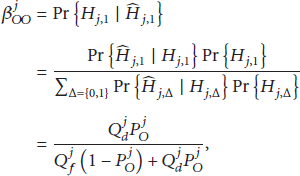
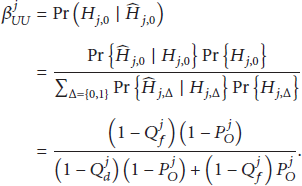
Let be the posterior probability that the SU detects subcarrier as being used by PU which is indeed occupied. Using Bayes' theorem and the law of total probability [20], can be derived as
where and represent the events that PU is active and idle on subcarrier j and , are the sensing results that subcarrier j is occupied or unoccupied by PU, respectively. is the posterior probability that the evidence subcarrier j is really unoccupied given that SU senses it to be unoccupied, which can be expressed as
Note that for perfect sensing and There exist two cases in which subcarrier k may introduce interference to PU. One is that subcarrier k is sensed correctly to be occupied by PU and the other is that subcarrier k is sensed incorrectly to be unoccupied by PU. Taking the above into account, the average interference introduced into the PU over subcarrier k with unit transmission power [21] can be written as
where indicates the interference introduced into PU on subcarrier j when ST or SR transmits on subcarrier k with unit transmission power [22], and it can be expressed as
where and are, respectively, denoted as the channel gain from ST to PU and SR to PU over subcarrier k, respectively. represents the power spectral density (PSD) of OFDM transmitted signal, and represents the duration of OFDM symbol.
2.3. Problem Formulation in CORL
The overall transmission power consumption in a unit frame contains the transmit power on ST and SR, which is calculated by
To transmit data, the energy consumption consists of two parts: the energy consumption of power amplifier related to transmit power and the circuit energy consumption incurred by signal processing and active circuit blocks. We further assume that the circuit power consumption of equipment has nothing to do with the state of transmission system, and its average value is constant [13, 23]. In conclusion, the system total power consumption consists of circuit consumptions and overall transmit power. Therefore, considering power amplifier efficiency , the total circuit power consumption can be expressed as
where , are denoted as the ST and SR circuit consumption which can be a constant. Like [14–18, 23], the EE measured by the “throughput-per-Joule” metric is defined as ratio of total throughput and total power; that is, . Hence, maximizing the average EE metric for the CORL system can be written as
where represents the optimal power allocation on ST and SR.
3. Problem Analysis on EE Power Allocation
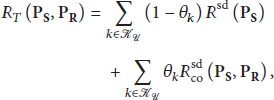
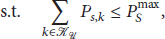
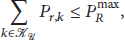
To maximize the EE of the CORL network while guaranteeing that the interference to the PU receiver is maintained below a predefined threshold, we formulate a transmit power allocation optimization problem under some practical constraints. For simplicity, let us collect all indicator and power variables in θ, , and , respectively, and define . Mathematically, we can formulate the EE-maximization problem for CORL as follows:
where and are denoted as the individual power limitations at ST and SR, respectively. signifies the maximum interference power threshold prescribed by the PU. Constraints (16) and (17) in ensure that interference to PU should be restricted by a specified threshold to prevent the PU from severe performance degradation in TS1 and TS2. In its current form (13), it is obvious that the joint optimization problem is a nonconvex mixed-integer nonlinear program (MINLP) which is known to be NP-hard. However, the aim of this work is to maximize the EE metric of (13) subject to the individual power budget and peak PU's interference constraints. According to the idea of subcarrier transmission mode indicator in [12], we introduced a straightforward method for CORL system for which the subcarrier k is selected RTM if and . Otherwise, the DTM offers a better capacity. In what follows, we denoted two sets and to represent DTM and RTM, respectively, which are defined as follows:
Theorem 1.
In a three-node DF relaying link network, when the system EE achieves maximum, each subcarrier rate for two hops should be equal. Namely, the most economical choice is .
Proof.
Suppose that the system EE achieves optimum; there exists , satisfying . Because each subcarrier rate for two hops depends on the smaller one, this means one can reduce the transmit power of the larger rate hop in and , leading to . By the definition of EE function, reducing transmission power of the larger rate hop will increase system EE under the condition that the system rate is a constant [4]. Obviously, the original hypothesis leads to contradiction. Therefore, the original proposition is true.
According to Theorem 1, we have the following relationship:
Then , where . Based on this classification, the equivalent problem of can be reformulated as
where represents the capacity for CORL system. It can be expressed as
From , we observe that constraints are either linear or convex, but objective function equation (22) is not a concave function. Actually, the problem of belongs to the quasi-concave programming, which has been proved in our previous work [11]. In the next section, we will show that we can obtain optimal solution of EE-maximization problem by exploiting special structure of the objective function. To this end, the monotonically increasing and strictly concave characteristic of the numerator in (22) is summarized in Theorem 2.
Theorem 2.
Given θ, for CORL is monotonically increasing and strictly concave with respect to .
According to [24], it is easy to know that , , and are monotonically increasing and strictly concave with respect to . On the other hand, we observe that the subcarriers transmission mode indicator is defined as nonnegative integers, so we only need to prove that the second item in (29), that is, , is monotonically increasing and strictly concave with respect to . Considering the relationships in (21), we can rewrite (3) as . Then we have
where , . Hence, is monotonically increasing and strictly concave with respect to .
4. Adaptive Power Allocation to Maximize EE
It is noticeable that objective function equation (22) in is not a concave function, and the solution for it will be of high complexity. In this section, we first use fraction programming [25] to transform the problem into an equivalent convex optimization problem and then use the Lagrangian technique to transform the equivalent problem into a corresponding dual problem. Subsequently, an optimal iterative algorithm is proposed.
4.1. Adaptive Power Allocation
From Theorem 2, we follow the fact that the numerator in (22) is a concave function, and the denominator of (22) is affine function of SUs' power. Besides, all the constraints are convex set. Inspired by Dinkelbach's algorithm in [25], we can transform this problem into a parameterized convex maximization problem. Primarily, a new objective function is defined as
where q is a positive parameter and can be interpreted as a pricing factor for SUs' power consumption. Hence, another problem is formulated as
Let denote the feasible region of and . Define as the maximum value of with each fixed q. Then, the optimal value and solution of can be defined as
The following lemma introduced by Dinkelbach's algorithm [25] can relate and , and the detailed proof of Lemma 3 can also be found in [25].
Lemma 3.
The optimal solution achieves the optimal value of , that is, , if and only if
This lemma indicates that, at the optimal parameter , the optimal solution to is also the optimal solution to . Hence, solving can be realized by finding the optimal power allocation of for a given q and then update q until (31) is established. For a given q, the optimal power allocation can be obtained using convex theory [24] because of the convex characteristic of . Hence, the existing water-filling power allocation approach gives the solution to it [26]. However, besides adapting the power allocation on all subcarriers, we need to consider subcarrier transmission mode. The Lagrange function for is constructed as
where , , , and are the nonnegative Lagrangian dual variables for constraints (26)–(30), respectively. And the dual problem of is given by
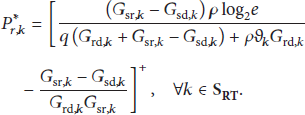
Using the Karush-Kuhn-Tucker (KKT) conditions [24], we can deduce the optimal power allocation of problem , which can be written as
where and and denotes . In addition, subcarrier k is used for RTM communication; that is, . The corresponding relay transmission power at SR can be expressed as
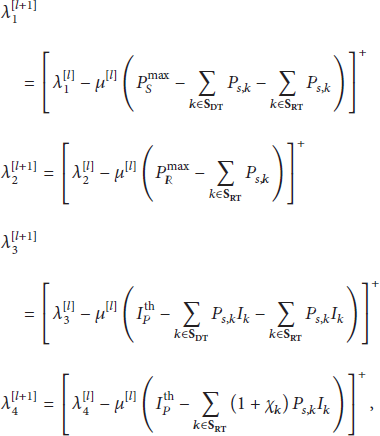
It can be found that the traditional water-filling method could not solve the primal problem directly, because the denominator of (37) and (38) contain a linear combination of the Lagrangian dual factors. Thus the incremental-update based subgradient method in [27] is introduced to derive the optimal dual factors for power and interference constraints. For our problems, the corresponding iterative update λ is based on the following iteration procedure:
where l refers to the iteration index and denotes a sufficiently small positive step size for the lth iteration, and it is a sequence of step size which is defined in many types in [27]. It should be mentioned that small step size leads to slow convergence. Besides, each element of the gradient depends on the corresponding subcarrier's channel gain, potentially differing from each other by orders of magnitude. Hence, a line search of the optimal step size needs to cover a large range to ensure global convergence on all subcarriers, which is computationally expensive. Therefore, in order to find the optimal step size, like [4], we define , which has also been proved to be concave in , and can quickly obtain the optimal step value of by using bisection search algorithm summarized in [4]. After we obtain the optimal power assignment for the given q, update until Lemma 3 is satisfied; thus the equivalent optimal power assignment of can be achieved in the end. So, jointing the fractional programming and bisection method, an EE-oriented power allocation iterative optimization algorithm for CORL called ECORL is provided, which is described in Algorithm 1 to solve the power allocation of programming .
Algorithm 1: ECORL.
Input: the error tolerance , and the maximum iteration number ;
Output: optimal EE power allocation policy sets of 1;
Initialize maximum EE , the iteration index and , dual variables ;
Compute, Then
Obtain subcarrier transmutation mode θ using (20);
Whiledo
Update λ via the subgradient method as follow:
Repeat
Step Compute , and , through (37) and (38) respectively;
Step Find the optimal step size by using the bisection algorithm described in [27];
Return, the ξ-optimal solution of 1 and calculate the EE and capacity for CROL networks.
Remark 4.
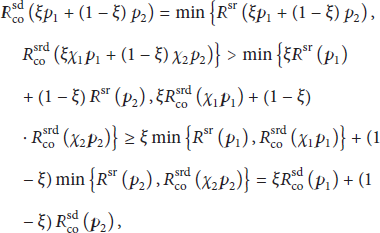
Note that, in the case of , EE-maximization problem is equivalent to SE-maximization. Consequently, for given maximum iteration number and error tolerance ς and δ, the optimal EE and SE power allocation policy of can be easily obtained by ECORL, which will be validated by the simulation in Section 5.
4.2. Coverage and Complexity Analysis
The proposed algorithm ECORL will always converge to optimum provided by Theorem 5, meaning that, for every ς, the power policy set that maximizes is found. The algorithm execution stops if q is zero or less than the ς value.
Theorem 5.
The ECORL will always converge to optimum.
Proof.
To prove the convergence of ECORL, we let , for ease of presentation, where denotes the energy consumption in CORL system and can be written as
Before going into the proof of convergence, we will first discuss an observation that is decreasing in q. For the sake of generality, we assume ; then
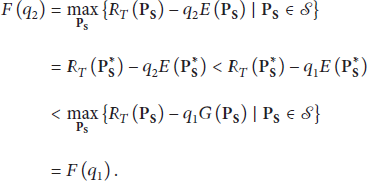
From (42), we know that is decreasing in q. To prove the convergence of ECORL, we only need to show that becomes smaller than ς with the number of iterations. We now show that q is nonincreasing in successive iterations of the algorithm. We have
Now, it follows that , because . From the above observation, we have that is decreasing in q and q is nonincreasing in successive iterations of ECORL. Therefore, is nonincreasing in successive iterations. Furthermore, does become zero from Lemma 3, which follows that fact that does become smaller than ς. Therefore, the ECORL algorithm will always converge to optimum.
In addition, the ECORL has two iterations: one is for the total individual power constraint and the other is for the Lagrange multiplier λ for the total power constraint. The complexity of ECORL can be expressed as , where , , respectively, denote the iteration numbers of the while-loop and repeat-loop in ECORL and represent the number of subcarrier realizations. and especially rely on the choice of the corresponding error tolerance ς and δ, respectively. Hence, the EE optimization problem can be solved by the proposed algorithm with a considerable saving in terms of computational complexity, which is very applicable for the physical life.
5. Simulation Results
In this section, we present numerical results to illustrate the performance of the proposed EE-maximizing power adaptation methods. Consider the scenario as the following: the location of ST is and the coordinates of PU, SR, and SD are fixed on , , and , respectively. We consider the CR relay-aided system consists of subcarriers; that is, , the probability of spectrum holes ≥50%. The bandwidth of each subcarrier and the duration of the OFDM symbol in , are assumed as MHz and us, respectively. Further define circuit power consumption W, W, MHz, ms, dB, , , and the noise variance . In the primary network, the central location of the PU is defined as . Assume the activity probability equals [14]. For ease of analysis, the detection is uniformly distributed over . Channel complex gains are picked from a Rayleigh fading channel with the following distribution: [12], where the path loss exponent α is , distance is i m, and the number of taps L is . Finally, given , , , and the channel gains-to-noise-power ratios , , , , and are calculated as described in Section 2.
Figures 2 and 3, respectively, present the power allocation for maximizing EE (EE-Max) and maximizing SE (SE-Max) versus each subcarrier link when running ECORL algorithm. As shown in Figures 2 and 3, the notation indicates the subcarrier is occupied by PU, and the notations and at the top of the figure signify the opportunistic relay link transmission mode; that is, and , respectively. It is needed to mention that the corresponding power on SR has to be used over two successive time slots (value shown by the solid curve) when notation (□) is active. It can be shown that the individual power budget is split among ST power (solid line) and SR power (dotted line) appropriately and effectively under the peak PU's interference constraints, which demonstrates that ECORL algorithm has excellent performance on power allocation both for EE-Max and for SE-Max scheme. It is needed to mention that the EE-Max problem is equivalent to SE-Max when we set in ECORL algorithm, which confirms the conclusions in Remark 4. Moreover, in contrast to optimal power allocation between EE-Max and SE-Max as shown in Figures 2 and 3, it is clear that the EE-Max scheme on each subcarrier link is far smaller than SE-Max scheme, for the reason that the SE-Max scheme greedily grows with the interference tolerance all the time until the transmit power is used up. We also found that we should use low power transmission to guarantee high EE rather than augment transmission power budget. Consequently, it validates that the proposed method is better for EE not for SE, which is valuable in physical life.
Power allocation on SU's each subcarrier link with maximizing EE considering sensing errors.
Power allocation on SU's each subcarrier link for maximizing SE considering sensing errors.
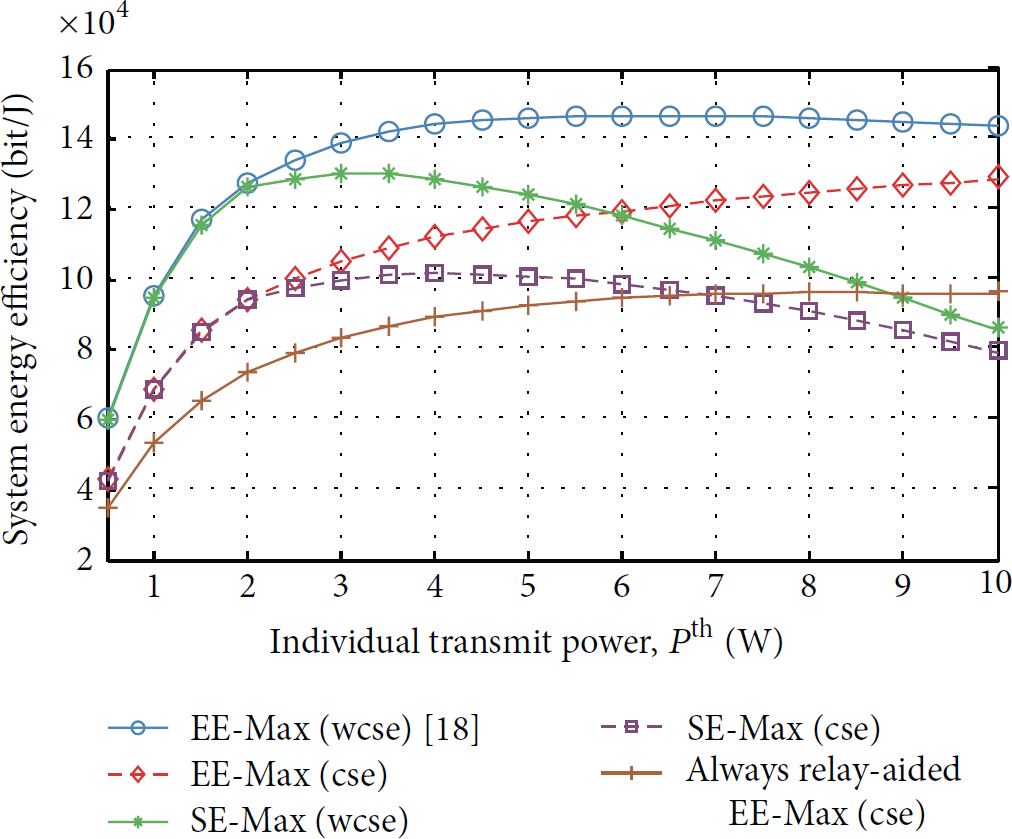
Figure 4 demonstrates the EE-Max and SE-Max solved by the proposed ECORL algorithm with/without considering sensing errors (cse/wcse) with respect to , where the interference threshold is . Here, the maximizing EE without considering sensing errors is obtained by the proposed method in [18] to facilitate comparison. In Figure 4, as increases, the EE is first increasing and then decreasing, because when becomes larger, the EE performance is subject not to the individual power constraint but to the interference constraint. Besides, the interference constraint is first gradually bound and then strictly bound. From the figure, we observe that the EE by the proposed method first is the same as that by maximizing SE, while it is larger than the latter when transmitted power goes larger. Because system rate R is a logarithmic function of transmission power and it will consume much more transmission power to further improve R when the capacity is greater than a certain degree, thus the EE decreases. It also conveys that the EE without sensing errors is better than that with sensing errors. More importantly, we found that the opportunistic relay protocol as compared to always relay-aided transmission protocol is able to effectively improve performance in terms of EE metric. This is because introducing the opportunistic DF relaying strategy into CR relay-aided networks can better exploit the frequency-selective channels.
System EE versus individual power budget .
In Figure 5, we illustrate the EE versus the interference threshold with/without considering sensing errors (cse/wcse) under different individual total transmit power. It can be observed that the greater the total individual transmit power, the higher the EE. When the transmit power is relatively high, for example, W, the EE performance is mainly decided by the interference threshold. However, when the transmit power is low enough, for example, W, the EE is constrained by the total transmit power and will be constant as the interference threshold increases. Also, the figure shows that the performance of ECORL which has taken spectrum sensing errors into consideration has a reasonable loss compared to that without considering sensing errors depending on the value of the total transmit power. When the interference constraints are relatively small, the EE achieved without considering sensing errors [18] is about larger than that gained considering sensing errors. This is due to the fact that the strategy proposed in [18] is EE-Max with the total power and interference constraints, and it does not consider sensing errors. Besides, we found the error gap caused by imperfect sensing will become smaller as increases.
System EE versus the interference threshold with perfect and imperfect sensing.
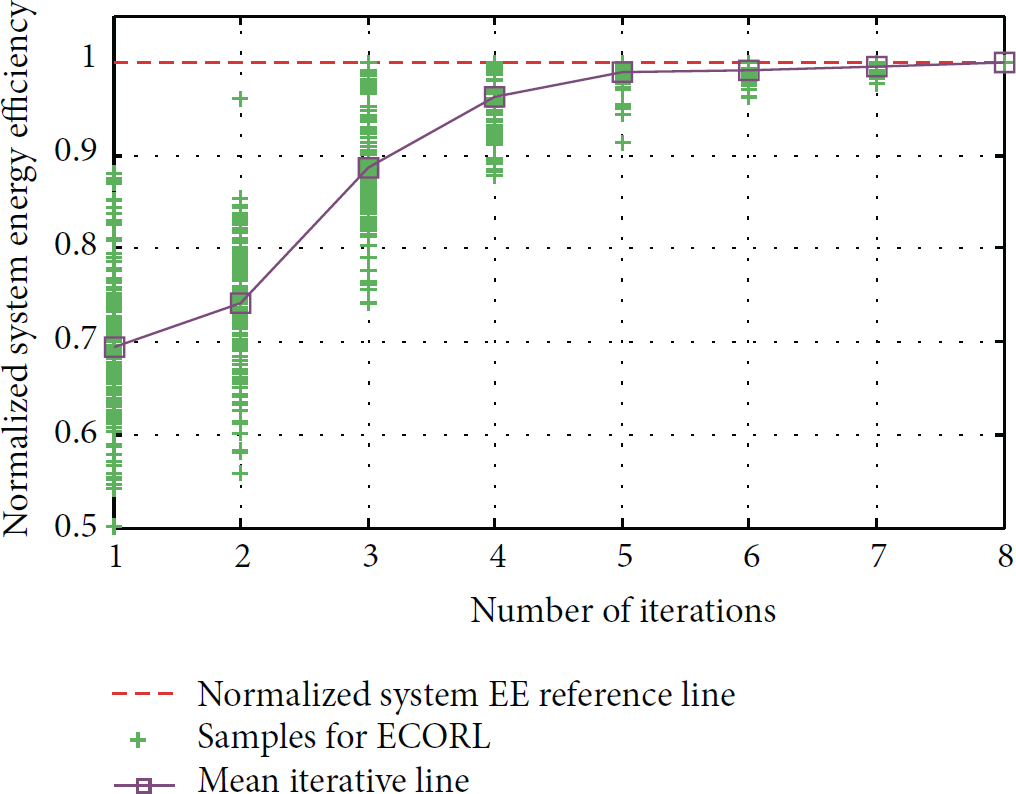
Figure 6 displays the system EE with respect to with/without considering sensing errors (cse/wcse). For simplicity, we assume a common reliability of decision instead of . Clearly, the system EE increases as increases, for the reason that SU can obtain more chance to access spectrum as increases. This is due to the fact that SU gains more access probability, and the dominated interference to the primary system decreases. Hence, the improved throughput, to some extent, leads to larger energy efficiency. Besides, the system EE considering sensing errors is not better than that without considering case because the more interference resulted from PU. It also explains that the sensing errors can weaken the performance of the secondary system, and it is important to improve the accuracy of spectrum sensing. Figure 7 demonstrates the relationship between the normalized system EE and the number of iterations. Here we assume the channel gain of each subcarrier has Rayleigh distribution with a unit average. The system EE is normalized by the optimal value. It can be shown that the sequence of iterations produces a monotonically increasing objective and always converges. After at most six iterations, the achieved normalized system EE converges to the final optimal value. And the normalized system EE has been up to of the final optimal value on the average after only four iterations; meanwhile, the values of all the samples are more than of the final optimal value. So we can take four as the maximum number of iterations in the practical design to greatly reduce the complexity of the algorithm. Besides, we can see that ECORL algorithm converges very fast to the global optimum.
System EE versus with perfect and imperfect sensing.
Convergence rate of ECORL: relationship between normalized system EE and iterations.
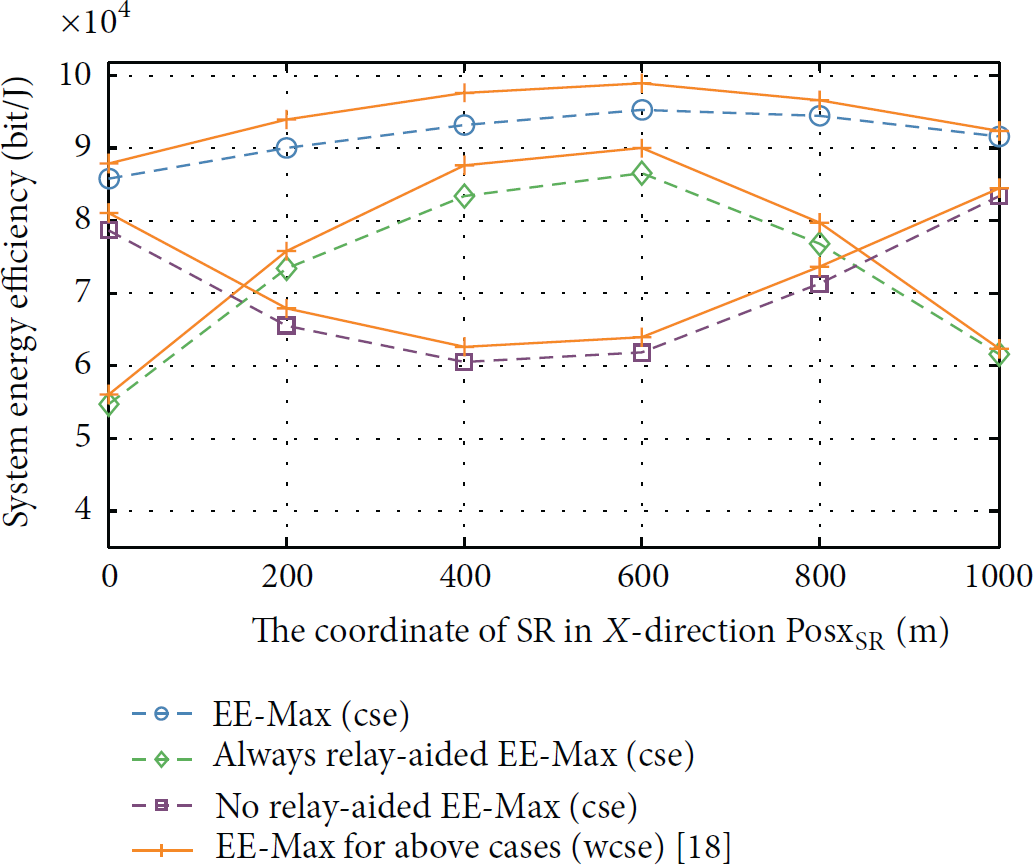
Finally, we consider the scenario that the coordinate of SR moves from point m to point m with step 200 m; that is, m. In Figure 8, we depict the system EE versus different for ECORL under the three special transmission mode cases (such as CORL, always relay, and no relay) with and . We first find out that the EE curve of CORL system is relatively flat and always higher than that of other cases in CR networks. This accounts for the fact CORL system uses opportunistic DF relaying, which better exploits the flexibility of transmission mode selection for the power reduction. The second case is the always cooperative transmission; that is, RTM is used at each subcarrier. We can observe that the curve first increases and then decreases with increasing. Meanwhile, the system EE will increase as increases and achieve their maximum EE when SR lies in the middle range both (such as ) in CORL and in always relay cases. The third one is the noncooperative transmission; that is, DTM is used at each subcarrier. The EE curve which is first increasing and then decreasing is quite different from the previous two cases. It is clear that DTM is more energy-efficient than RTM when the SR lies in the point of or m, for the reason that it is more likely to have one of or be much smaller than , which can explain the observation. Additionally, we also see that the sensing errors can weaken the performance of the secondary transmission, and it is important to improve the accuracy of spectrum sensing.
System EE versus different .
6. Conclusion
In this paper, we have studied the resource allocation problem for EE power allocation in OFDM-based cognitive opportunistic relay links with spectrum sensing errors considered. To maximize the EE of the SUs under joint individual transmit power and interference constraints, we proposed an optimal power allocation algorithm using equivalent conversion and transform the equivalent problem into a corresponding Lagrangian dual problem. The simulation results show that when imperfect spectrum sensing is not taken into account, excessive interference will be introduced to PU; however, the EE is about larger than that obtained by ECORL scheme. Meanwhile, the proposed strategy can improve EE significantly compared to the always relay-aided scheme in CR networks, and the proposed algorithm exhibits a good convergence performance both theoretically and in simulation analysis. In the future, the energy-efficient resource allocation problems for more complicated green cognitive radio networks (e.g., multiuser scenario with imperfect channel state information) should be considered.
Footnotes
Conflict of Interests
The authors declare that there is no conflict of interests regarding the publication of this paper.
Acknowledgments
This work is fully supported by a grant from the National High Technology Research and Development Program of China (863 Program) (no. 2012AA01A502), the National Natural Science Foundation of China (no. 61201129, no. 61471099), the Fundamental Research Funds for the Central Universities (no. 2012QNA5046), and the Research Fund of Huawei Corporation.
References
1.
GoldsmithA.JafarS. A.MaricI.SrinivasaS.Breaking spectrum gridlock with cognitive radios: an information theoretic perspectiveProceedings of the IEEE200997589491410.1109/jproc.2009.20157172-s2.0-67349259569
2.
RongB.EphremidesA.Cooperative access in wireless networks: stable throughput and delayIEEE Transactions on Information Theory20125895890590710.1109/tit.2012.2204491MR29660632-s2.0-84865360898
3.
GürG.AlagoüzF.Green wireless communications via cognitive dimension: an overviewIEEE Network2011252505610.1109/mnet.2011.57305282-s2.0-79952775974
4.
MiaoG. W.HimayatN.LiG. Y.Energy-efficient link adaptation in frequency-selective channelsIEEE Transactions on Communications201058254555410.1109/tcomm.2010.02.0805872-s2.0-76949107518
5.
XiongC.LiG. Y.ZhangS.ChenY.XuS.Energy- and spectral-efficiency tradeoff in downlink OFDMA networksIEEE Transactions on Wireless Communications201110113874388610.1109/TWC.2011.091411.1102492-s2.0-83555162538
6.
MiaoG.HimayatN.LiG. Y.TalwarS.Low-complexity energy-efficient scheduling for uplink OFDMAIEEE Transactions on Communications201260111212010.1109/TCOMM.2011.112811.0901222-s2.0-84857368531
7.
SunC.CenY. J.YangC.Energy efficient OFDM relay systemsIEEE Transactions on Communications20136151797180910.1109/tcomm.2013.021913.1205552-s2.0-84878680535
8.
MaoJ.XieG.GaoJ.LiuY.Energy efficiency optimization for ofdm-based cognitive radio systems: a water-filling factor aided search methodIEEE Transactions on Wireless Communications20131252366237510.1109/twc.2013.013013.1210132-s2.0-84878677333
9.
LimG.XiongC.CiminiL. J.LiG. Y.Energy-efficient resource allocation for OFDMA-based multi-RAT networksIEEE Transactions on Wireless Communications20141352696270510.1109/twc.2014.032014.1314102-s2.0-84901459632
10.
HeC.LiG. Y.ZhengF.YouX.Energy-efficient resource allocation in OFDM systems with distributed antennasIEEE Transactions on Vehicular Technology20146331223123110.1109/tvt.2013.2282373
11.
FengL.KuangY. J.WuB. W.Energy-efficient configuration of power resource for OFDM-based opportunistic regenerative relay linksChinese Journal of Electronics2015244571584
12.
VandendorpeL.LouveauxJ.OguzO.ZaidiA.Power allocation for improved DF relayed OFDM transmission: the individual power constraint caseProceedings of the IEEE International Conference on Communications (ICC ′09)June 2009Dresden, GermanyIEEE1610.1109/icc.2009.51993472-s2.0-70449490495
13.
TianY.XuW.LiS.GuoL.LinJ.Energy-efficient power and sensing/transmission duration optimization with cooperative sensing in cognitive radio networksProceedings of the IEEE Wireless Communications and Networking Conference (WCNC ′14)April 2014Istanbul, Turkey69570010.1109/wcnc.2014.69521322-s2.0-84912103540
14.
GaoY.XuW.LiS.NiuK.LinJ.Energy efficient resource allocation for cognitive radio networks with imperfect spectrum sensingProceedings of the 24th IEEE International Symposium on Personal Indoor and Mobile Radio Communications (PIMRC ′13)September 2013London, UKIEEE3318332210.1109/PIMRC.2013.6666720
15.
OzcanG.GursoyM. C.Energy-efficient power adaptation for cognitive radio systems under imperfect channel sensingProceedings of the IEEE Conference on Computer Communications Workshops (INFOCOM WKSHPS ′14)May 2014Ontario, CanadaIEEE70671110.1109/infcomw.2014.68493172-s2.0-84904512080
16.
BedeerE.AminO.DobreO. A.AhmedM. H.BaddourK. E.Energy-efficient power loading for OFDM-based cognitive radio systems with channel uncertaintiesIEEE Transactions on Vehicular Technology20156462672267710.1109/tvt.2014.2342226
17.
WangY.XuW.YangK.LinJ.Optimal energy-efficient power allocation for OFDM-based cognitive radio networksIEEE Communications Letters20121691420142310.1109/lcomm.2012.070512.1206622-s2.0-84866633621
18.
GeM. Y.WangS. W.Energy-efficient power allocation for cooperative relaying Cognitive Radio networksProceedings of the IEEE Wireless Communications and Networking Conference (WCNC ′13)April 2013Shanghai, China69169610.1109/wcnc.2013.65546472-s2.0-84881571512
19.
LiangY.-C.ZengY.PehE. C. Y.HoangA. T.Sensing-throughput tradeoff for cognitive radio networksIEEE Transactions on Wireless Communications2008741326133710.1109/TWC.2008.0608692-s2.0-46149091216
20.
RossS. M.Introduction to Probability Models2006Elsevier
21.
AlmalfouhS. M.StüberG. L.Interference-aware radio resource allocation in OFDMA-based cognitive radio networksIEEE Transactions on Vehicular Technology20116041699171310.1109/TVT.2011.21266132-s2.0-79955978138
22.
WeissT.HillenbrandJ.KrohnA.JondralF. K.Mutual interference in OFDM-based spectrum pooling systems4Proceedings of the 59th IEEE Vehicular Technology Conference (VTC ′04)May 2004Milan, ItalyIEEE1873187710.1109/VETECS.2004.1390598
23.
LiG. Y.XuZ. K.XiongC.YangC.ZhangS.ChenY.XuS.Energy-efficient wireless communications: tutorial, survey, and open issuesIEEE Wireless Communications2011186283510.1109/mwc.2011.61083312-s2.0-84555189267
24.
BoydS.VandenbergheL.Convex Optimization2004Cambridge, UKCambridge University Press10.1017/cbo9780511804441MR2061575
WangT.VandendorpeL.Sum rate maximized resource allocation in multiple DF relays aided OFDM transmissionIEEE Journal on Selected Areas in Communications20112981559157110.1109/jsac.2011.1109062-s2.0-79960430377