




Abstract
In wireless sensor networks (WSNs), energy saving is a critical issue. Many research works have been undertaken to save energy. Data aggregation is one of the schemes that save energy by reducing the amount of data transmission. Normally, researchers focus on saving energy by aggregating multiple data or turning to achieving short transmission delay in data aggregation; few of them are concerned with network lifetime. This work achieves an optimum network lifetime by balancing energy consumption among nodes in network. Here, we propose a waterfalls partial aggregation, controlled by a set of waterfalls pushing rate vectors. The first contribution of this paper is to propose a waterfalls partial aggregation and to model it with queuing theory. The second contribution is that the optimum network lifetime is achieved mathematically and a near optimum algorithm is proposed for a given transmission delay. The results are compared with existing energy efficient algorithms and the evaluation results show the efficiency of proposed algorithm.
1. Introduction
In the recent development of wireless technology, wireless sensor networks (WSNs) [1] have attracted researchers’ attention because of the applicability in many fields for effective collection of sensing data with low cost [2]. WSN consists of a large number of sensor nodes, where sensor nodes sense events and generate event data, then transmitting the data to a sink node via intermediate sensor nodes in a multihop manner [3]. Sensor nodes are battery-powered with limited energy supply; moreover, in many of the applications, sensor nodes are deployed in harsh nature environment or vast space so that the continuous energy supplement is impossible. In this case, if one of the nodes in the network exhausted energy, the network would break down and perform reorganization, where the reorganization of the network also consumes much energy and time. For these reasons, WSNs should be energy efficient. For energy saving, many researchers are working on Medium Access Control (MAC) protocols [4], routing protocols [5], topology control [6], and data aggregation [7] in WSNs.
In WSNs, data generated from neighboring sensor nodes are often redundant and highly correlated. Sensor nodes spend considerable energy for sending or relaying a large number of redundant data. Moreover, a large number of data transmissions cause data collisions and data congestion. All these lead to the turning up of data aggregation technique. Data aggregation is defined as the process of aggregating data from multiple sensor nodes to eliminate redundant transmission and provide fused information to a sink node. In data aggregation, there are mainly three kinds of aggregation ways. The first is clustering data aggregation where data are collected and aggregated at a cluster node and then transmitted to a sink node [8, 9]. The second is hop by hop aggregation, which means that data are aggregated at each intermediate node [10]. The third is partial aggregation, where data aggregation satisfies a time or energy threshold [11]. However, all these three kinds of data aggregations have their drawbacks. In clustering data aggregation, a cluster head always consumes much energy than others; WSNs always perform a cluster head selecting algorithm to decide a new cluster head, which wastes considerable time and energy [12]. In hop by hop aggregation, data suffer long transmission delay and nodes on the transmission way suffer unbalanced energy consumption [10]. Compared to these two, partial aggregation appears to be more flexible. In partial aggregation with scheduling technique always set a time period to collect data for nodes that have aggregating function. Here, time period is always decided by a given time threshold or requested data accuracy but always does not consider the energy consumption of nodes in the network [11, 13, 14]. As everyone knows, network lifetime is always decided by nodes’ lifetime; when a node's energy is exhausted, the network has to perform reorganization. Hence, even though the partial aggregation can shorten the transmission delay, it still has the shortcoming of unbalanced nodes lifetime, which leads to short network lifetime.
In this paper, to achieve optimum network lifetime, at first, we propose a waterfalls partial aggregation (WPA), which is a kind of scheduling data aggregation scheme where optimum network lifetime is achieved by controlling the data transmitting period. Secondly, by analyzing the data transmission process of proposed scheme, we determined the formulations of energy consumption and transmission delay of the network, which causes advantage for future scientific studies. Then in Section 4, optimum network lifetime is analyzed mathematically and achieved by a heuristics algorithm. We present evaluation in Section 5. Finally, we show the conclusion in Section 6.
2. Related Work
WSNs have various applications. Some applications are required to send data as soon as possible, while in other applications energy saving is much more important. For example, in disaster monitoring or emergency rescue, immediate data transmission is more important than others; hence, data are always transmitted to neighboring nodes without aggregation; we call this nonaggregation. However, in nature monitoring, energy is more significant than transmission delay because the replacement of battery for sensor nodes is supposed to be impossible. In respect to energy saving, data aggregation technique is widely applied in WSNs that are composed of large number of sensor nodes and meanwhile it is not so easy to supply continuous energy. Hence, we call it full aggregation that processes data aggregation only for energy saving in the network. In some applications of WSNs, it is required to trade off node energy and transmission delay or some other properties. In this case, data aggregation should consider corresponding delay or some other required thresholds; we call this kind of data aggregation a partial aggregation. In this section, we introduce nonaggregation, full aggregation, and partial aggregation and then discuss their advantages and disadvantages.
2.1. Nonaggregation
Definition of nonaggregation is that a node transmits received data to an adjacent lower node immediately after receiving data from a neighboring node which means that all data are sent to a sink node one by one, as shown in Figure 1.

Nonaggregation.
From the definition of nonaggregation, we find that data transmission rate at a node becomes larger near a sink node because of data relaying properties of a node. Hence, energy consumption of nodes near a sink node is much more than that in nodes far from the sink. As a result, nodes near the sink node exhaust energy sooner than others, which results in short network lifetime. Moreover, when event data generation rate is large, data congestions occur at nodes around a sink node and they prolong transmission delay as well as let the network lifetime become worse [4–6, 15–18]. Sensor MAC [4] (S-MAC) is proposed for energy saving in wireless sensor networks based on IEEE 802.11 MAC protocols. In S-MAC, the network is always assumed to be less in amount of data transmission; data process and data aggregation can be performed in the networks where the transmission delay is considerably tolerant. S-MAC uses a listen/sleep model and divides the time into frames; each frame has the model of listen/sleep. Besides, topology control algorithms are studied for improving network lifetime, and the minimum spanning tree is the typical one. LMST [16] is a minimum spanning tree (MST) based topology control algorithm for multihop wireless networks, called local minimum spanning tree (LMST). The topology is constructed from each node, where a node builds its local MST independently (with the use of information locally collected) and keeps only one-hop on-tree nodes as its neighbors.
2.2. Full Aggregation
Full aggregation is that a node processes data aggregation when new data generated at itself. In more detail, the node does not transmit any received data from neighboring node immediately; all arrival data from neighboring nodes wait for new generated data. When there are new data at a node, the node aggregates all arrival data with its own data and then transmits them to its lower node. Figure 2 illustrates the full aggregation in detail. It is clear to see from the definition that full aggregation can save much energy by aggregating data at every relay node. The only condition for data transmission is that a new event data occurs at a node, which means that the data transmission rate is the same with data generation rate. If we assume data generation rates at all nodes are the same, then the number of data transmissions for each node is the same, so that full aggregation can achieve balanced energy consumption among nodes.
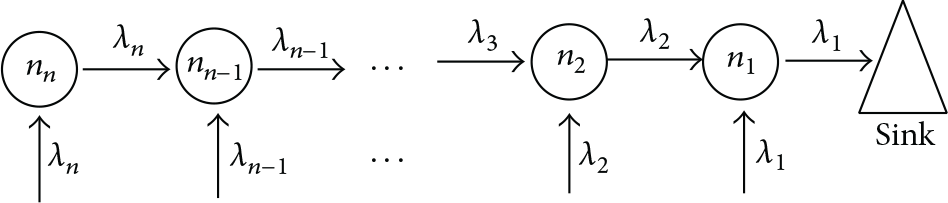
Full aggregation.
However, full aggregation has its inevitable defect that transmission delay is too long for data occurring at nodes far from a sink node because of the waiting time for generating data at every intermediate node. And what is more, the transmission delay is longer when data generation rate is low at nodes. PEGASIS (Power-Efficient Gathering in Sensor Information Systems) [10] is one of the energy efficiency chain based data aggregation protocols that employs a greedy algorithm. There are two assumptions in this scheme: one is that all nodes are far from a sink node; the other is that nodes except the end nodes fuse the received data and their own data and then aggregate them into one packet before transmitting them to another neighboring node. The main idea of PEGASIS is forming a chain among the sensor nodes so that each node will receive from and transmit to fused data only with a close neighbor. The fused data are sent from node by node, and all the nodes take turns to be the leader for transmission to the sink node. The disadvantage of PEGASIS is that transmission delay is too long for nodes that are at the end of a chain.
2.3. Partial Aggregation
In partial aggregation, data always wait a period of time to be transmitted for collecting more data at a node; all collected data are aggregated into one or several representative data and then transmitted to an upper neighboring node. The waiting time at nodes is adjustable and is always decided by corresponding applications [11, 13, 19–21]. Figure 3 illustrates a most simple class of partial aggregation in which data wait

Partial aggregation.
In in-network cascading timeout data aggregation [13] and ATS-DA (Adaptive Timeout Scheduling for Data Aggregation) [11], a sink initially broadcasts a request to all nodes. Each node waits for a certain time period to receive data from their child nodes. The timeout period of each node is set based on the position of the node in the data aggregation tree. However, these studies are not applicable when real time data or short delay data are required. Because all data at a node have to wait at least
3. Waterfalls Partial Aggregation
3.1. Sensor Network Model
In this research, we apply queuing theory to analyze and model wireless sensor network. As in mathematical analysis, too complex network model makes it too sophisticated to get the analytical result and formulation; therefore, we define the network model to be the most basic and simplest model of tandem sensor network; however, the results can be extensible to other more complex topologies. The structure and transmission principle of tandem network are shown in Figure 4.

Tandem sensor network.
In tandem networks, all the nodes deployed in a flat are allocated omnidirectional antennas with the same transmission range. Data generated at the nodes are transmitted to a sink node in multihop manner. The distance between two neighboring nodes is the same, and all the nodes are within the transmission range of their neighboring nodes: n is a set of all nodes; N is natural number set.
3.2. Definition of Waterfalls Partial Aggregation
To shorten the data transmission delay and to lengthen the network lifetime of the network as well as to suppress data congestion around a sink node, we propose a waterfalls partial aggregation (WPA). In WPA, data are transmitted to a neighboring node in two conditions: (a) if there are new local generated data at a node or (b) after waiting a holding time

Waterfalls partial aggregation.
In other words, data tends to be aggregated rarely at nodes far from a sink node to suppress delay. When there are new generated data at a node or the holding time at this node is over, all data at this node are aggregated and wait for further transmission. In more detail, the holding time for nodes nearer a sink node is longer than the ones far from the sink, so that it results in the decrease of the amount of data transmission near a sink node. Finally, it can achieve an equal amount of data transmission at each node by controlling the waterfalls pushing rate vectors. The flow chart of data aggregation and transmission is shown in Figure 6.
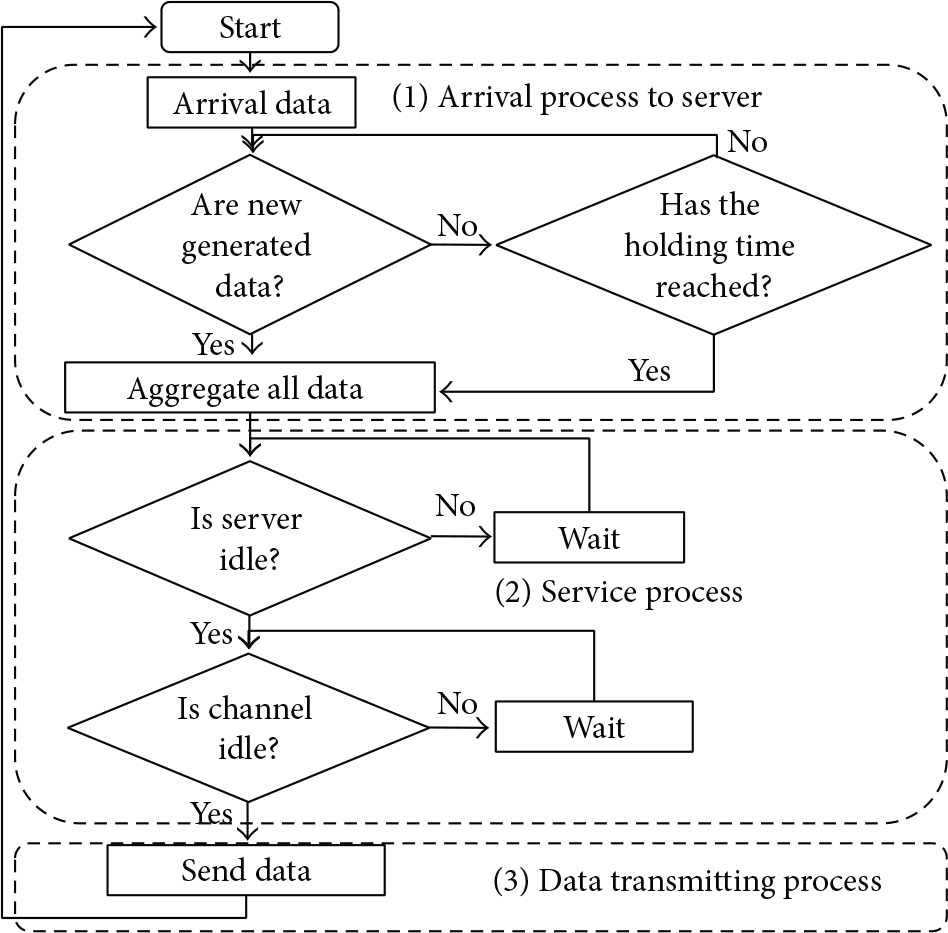
Flow chart of waterfalls partial aggregation.
In the flow chart, after data arriving from neighboring node, node
3.3. Problem Definition
In WPA, the waterfalls setting of holding time is for balancing energy consumption among nodes as well as suppressing load. As we mentioned in Section 2 that network lifetime is always decided by the shortest lifetime node in the network; therefore, to lengthen the shortest node lifetime is to extend network lifetime. When tolerable maximum transmission delay is given by corresponding application, we set the holding time
In other words, how long should the holding time of arrival data for data aggregation at a node be to meet the conditions of balanced energy consumption among nodes and given transmission delay? For a node, if required transmission delay is given as

Here,



3.4. Analytical Model of WPA
3.4.1. Queuing Theory Analysis
For determining the transmission delay, we model the data arrival process and data transmission process of WPA by queuing theory. The analytical model of node

Analytical model of waterfalls partial aggregation at node
Before explaining the model, we introduce
In the analytical model,
3.4.2. Event Waiting Time
In this subsection, we decide the time interval that data wait in

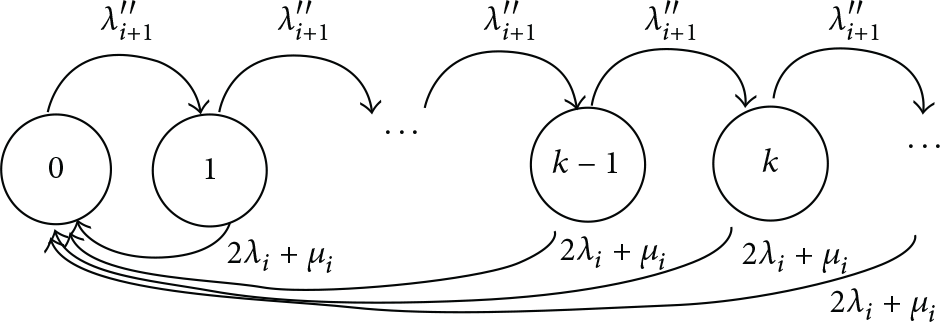
State transition of
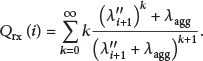
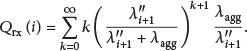
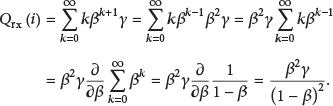
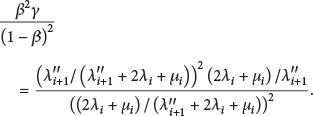
In the diagram, the state variable is the number of data waiting for an event. Assume that a number of data are waiting for an event data at node


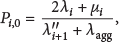





3.4.3. Arrival Process to
From the analytical process of
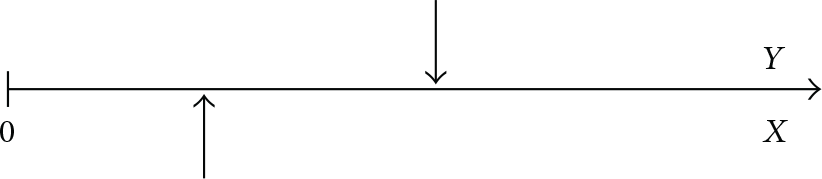
Property distribution of X, Y.
We determine the property as follows.


3.4.4. Service Process
Since the data generation rate is Poisson distribution and the waterfalls pushing rate abides by exponential distribution, the data arrival rate to

Since

We figure up the probability density function of the server time by means of Laplace transform in queuing theory and evaluate server waiting time

3.4.5. Channel Waiting Time
In general queuing system, customers can be served if there are no other customers waiting in front of them. However, when we apply queuing theory to model wireless communication, it is necessary to consider the impact of wireless channel caused by its properties. In wireless sensor networks, because of the overhearing of omnidirectional antenna, node has to wait a period of time if its upper or lower neighbors are transmitting data. Here, we call this time as channel waiting time

3.4.6. Total Delay
Total delay

3.4.7. Energy Consumption
The energy consumption





4. Optimum Network Lifetime
4.1. Mathematical Solution
According to the analysis in Section 3.2, the longest network lifetime is decided by the total transmission delay and waterfalls pushing rate vectors. Here, we illustrate the relationship between transmission delay, energy consumption, and network lifetime, so that at last we determine the formulations of a set of waterfalls pushing rates. Accordingly, energy consumption can be written as follows:




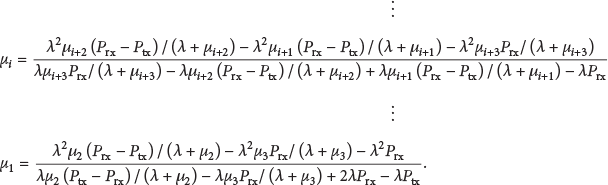
From the above equations, we obtained the relationship among waterfalls pushing rate. Equation (45) shows that if
4.2. Heuristics Algorithm
In a given application, we assume that data generation rates at all nodes are known and are λ. Thus, at node

Input: λ, Output: [
While
End Return
5. Evaluation
5.1. Validation of the Queuing Theory Model
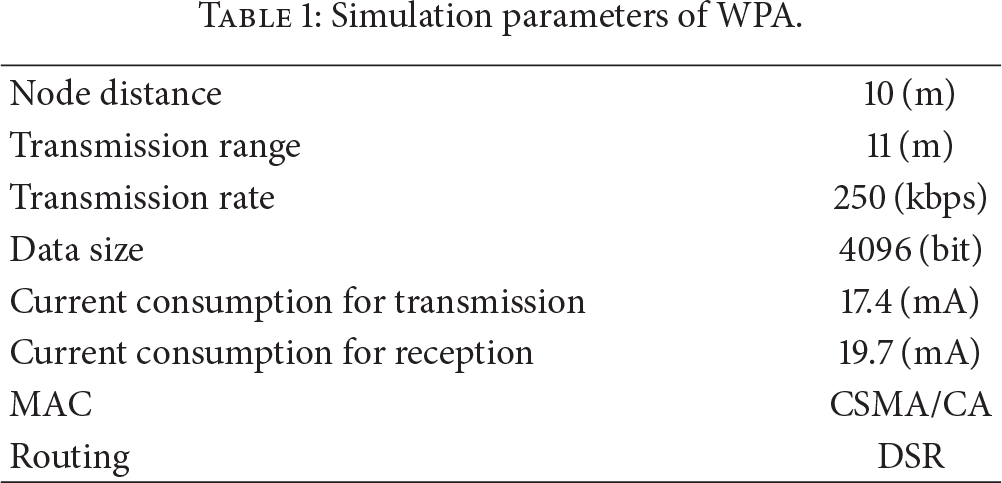
We implement WPA in the original network simulator written in C++ language. Analytic results in the previous section are shown as well as simulated result. The parameters are shown in Table 1.
Simulation parameters of WPA.
In the simulation, data occurs at each node randomly and independently. Buffer size of each node is infinite. Although analytic model assumes that transmission error is negligible, transmission errors and retransmission may occur in the simulation. We set data generation rate
From Figures 10 and 11, we find that our analytical model meets with simulation results, so that we basically confirm the correctness of queuing theory model of WPA.

Total delay of WPA.
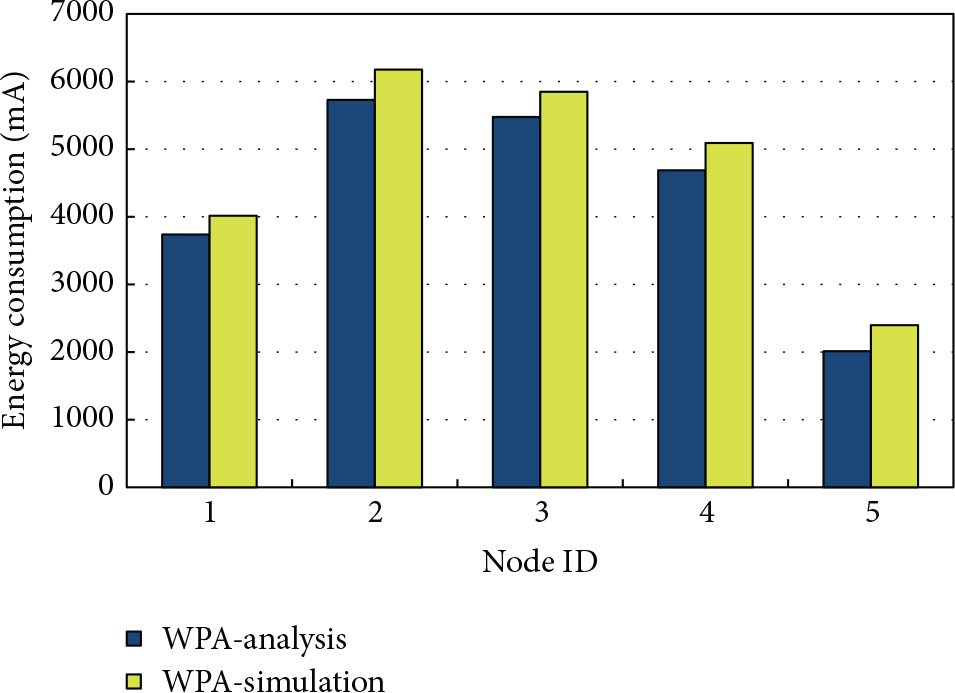
Node energy consumption of WPA.
5.2. Evaluation of Optimum Network Lifetime
In this section, we evaluate the effectiveness of the proposed waterfalls partial aggregation. Here, we consider network environment as nature monitoring network, so that we obtain the maximum network lifetime, which is the same with network lifetime of full aggregation. We set E in (44) which is equal to
Waterfalls pushing rate for optimum network lifetime.

Figure 12 shows the lifetime of all nodes in the network where we set the waterfalls pushing rate of nodes as the same with Table 2. From the figure, we find that all nodes almost have the same lifetime in WPA. In this case, we can say that the node energy is utilized optimally in WPA. In full aggregation, the second and the third node consumed most energy and the other nodes have less energy consumption which results in the suboptimum utilization of energy. The nonaggregation has very large energy consumption at the second node, which results in the short lifetime of the entire network. We find from the figure that nonaggregation and full aggregation have the largest energy consumption at their second node. The reason is that the first node has no adjacent upper node, which means that it does not consume overhearing energy compared with others.

Lifetime of nodes.
Figure 13 shows the corresponding total delay of the network where we set the same waterfalls pushing rates with Table 1. From the figure, we find that when it has the same network lifetime with full aggregation, WPA can shorten the transmission delay by considerable amount. When data generation rate becomes larger (larger than 6 types of data/sec), transmission delay of nonaggregation gets longer rapidly due to data congestion at nodes. However, in WPA, the rapid increase of transmission delay arises later (at data generation rate of 30 types of data/sec) than nonaggregation and full aggregation on data generation line, which indicates that WPA can relieve data congestion at nodes. This is because, with waterfalls pushing rates, proposed WPA can adjust the number of data transmissions. Moreover, we find from the figure that with the given waterfalls pushing rates there is minimum transmission delay and we can determine it in WPA.
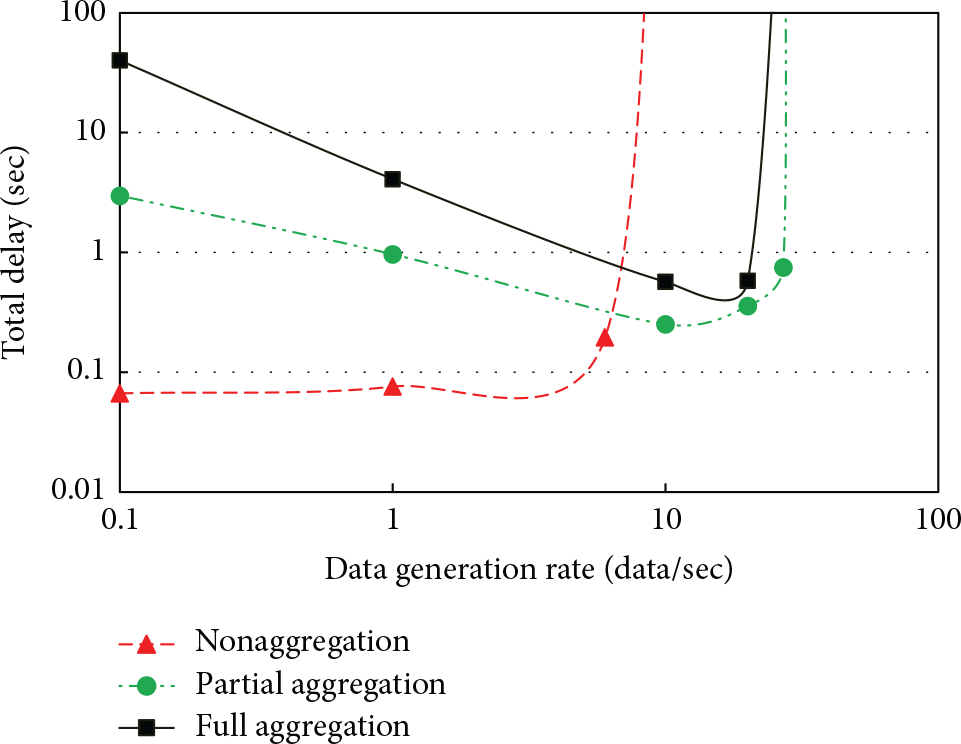
Transmission delay of network.
5.3. Summary of Evaluation
Firstly, from the presentation of Section 5.1, we conclude that our analytical model of WPA meets with simulation results; the diversity of energy consumption is that we did not consider retransmission in analytical model and considered it in simulation. Secondly, in Section 5.2, compared to nonaggregation and full aggregation, proposed WPA has the superiorities as follows: nonaggregation consumes much energy and data congestion occurs easily when data generation rate is larger. In WPA, after data are sent to a neighboring node, the data have to be aggregated together or aggregated with local data for further transmitting; hence, WPA is more energy efficient than nonaggregation. When data generation rate is larger at a node, data congestion occurs at nonaggregation, which leads to long transmission delay; however, proposed WPA can relieve data congestion via reducing the number of data transmissions by aggregating received data at nodes. On the other hand, full aggregation can save much energy consumption and suffer long transmission delay. Compared to full aggregation, proposed WPA has similar energy consumption and is superior in balancing energy consumption among nodes. Moreover, with waterfalls pushing rates, WPA can control data waiting time more reasonably and efficiently than full aggregation at nodes, so that transmission delay of WPA is superior to full aggregation.
6. Conclusion
In this paper, we proposed a waterfalls partial aggregation that can achieve optimum network lifetime in WSN via applying data aggregation. At first, we modeled WPA in queuing theory and then determined transmission delay of the network and energy consumption of a node. Then, we continued to model balanced energy consumption among nodes. The evaluation parts show the correctness of our analytical model and demonstrate the superiorities of proposed WPA.
Footnotes
Competing Interests
The authors declare no competing financial interests.
Acknowledgments
This work is supported in part by the Natural Science Foundation of Inner Mongolia Autonomous Region of China under Grant no. 2014BS0603 and no. 2014BS0601 and the Program of Higher-Level Talents of Inner Mongolia University under Grant no. 30105-135134.