




Abstract
Device-to-device (D2D) communications are expected to offload cellular networks and enhance public safety. In addition to the capability of direct communication between devices, the capability of delivering data over multihops in an ad hoc manner by autonomous decision of each device is highly desired to expand application areas of D2D communications. To address this issue, we propose a fast and energy efficient D2D multihop routing method using the geographic locations of nodes. To expedite data delivery while saving transmission powers of nodes, we devise the next hop selection method considering the congestion levels of potential next hops. In addition, we devise a detour scheme to move around a routing hole that is encountered when a node cannot find a neighbor that is closer to the destination of a packet than itself. We also propose management procedures so that each node acquires the locations of destinations and its neighboring nodes. Through extensive simulations, we validate the proposed method by comparing the performance of the proposed method with those of maximum progress method (MaxP), cost over progress method (CoP), and congestion-aware forwarder selection method (CAFS). Even though the number of hops obtained by the proposed method is larger than those obtained by MaxP and CAFS, our method is superior to them in terms of the probability of successfully delivering packets to destinations and total amount of energy consumption. We also show that our method can reduce end-to-end delay considerably compared with CoP.
1. Introduction
The amount of wireless data traffic has been surged over several years [1]. This is mainly due to the rapid proliferation of smart handheld devices used by people. In addition, as the era of Internet of Things is coming up, not only do people produce and consume data traffic by using the infrastructures that provide the capability of ubiquitous information exchange and acquisition but also the amount of traffic exchanged between machines is expected to increase substantially [2]. Thus, the amount of data transferred wirelessly will keep increasing over the near future [3]. The traffic demands have been accommodated by increasing the bandwidth of communication links. However, it becomes more and more difficult to use the traditional way of absorbing traffic demands because the throughput achievable at the physical layer is approaching its theoretical limits. As an alternative means, device-to-device (D2D) communications have attracted much attention not only from an academia and an industry but also from a public sector.
In the industry, D2D communications are expected to provide an efficient way of offloading cellular traffic, increasing spectral efficiency, and providing robustness [4]. In cellular networks, D2D communications are developed to provide proximity services [5, 6] by reusing the spectrum of cellular networks. Since D2D communications use the same radio frequencies with base stations, the researches on D2D in cellular networks have focused on the interference management [7] and resource management [8, 9].
Generally, transmission ranges of D2D nodes are short because the transmit powers of D2D nodes are low so as not to interfere base stations. In addition, D2D communications in a cellular network are controlled by network operators. As a result, D2D communications in a cellular network typically assume 1-hop or 2-hop relay [5, 10]. However, to fully utilize the potential of D2D communications, providing multihop D2D networks that operate autonomously is highly required.
In a public sector, D2D communications are expected to increase the public safety by providing a communication path when communication infrastructures are not available (e.g., in an area where disasters occurred) [11–14]. In such a region, even though communication infrastructure is not available, displaced people have communication devices at hand that are equipped with multiple wireless network interface cards. In addition, there are many communication devices around them such as smartphones, laptops, and tablets [11], and for some cases rescue teams can deploy resource units to support data relay [15]. If the devices can relay messages, the probability of saving lives will increase.
Reflecting the interest in multihop D2D communications from an industry and a public sector, D2D routing methods have been proposed for various types of applications. Routing protocols at the network layer that have been proposed for ad hoc and sensor networks are adopted for multihop D2D networks [16, 17]. Even though a delay-tolerant data delivery is required for some applications [18, 19], a fast and energy efficient routing method is required to expand the application areas of multihop D2D networks.
In [20], an interference-aware routing method is proposed to minimize hop count. The method aims to decrease the delay for D2D connections and power consumptions by minimizing hop count from a source to a destination. The similar idea is proposed for packet radio networks, where the node that can make the maximum progress to the destination of a packet is selected as the next hop [21]. However, it is noted in [22] that the transmit power decreases as
To reduce the amount of energy consumption of a sending node, a method called cost over progress (CoP) is proposed [23, 24]. A node selects the node that has the smallest transmit power over progress made to the destination as the next hop. Since CoP decreases the distance between the current sender and the next hop, it can reduce the amount of transmit power while the number of hops taken from a source node to a destination node increases. In addition, since CoP does not consider the congestion levels of potential next hops, it can bring about large end-to-end (e2e) packet transfer delay.
A congestion-aware forwarder selection method (CAFS) is proposed in [25]. CAFS uses multiple metrics to choose the next hop. By using the congestion levels of neighboring nodes among the metrics, CAFS attempts to find a balance between the cost (i.e., energy consumption) and the gain (i.e., e2e packet transfer delay). However, CAFS does not incorporate a void handling method that handles the situation where a node cannot find a potential next hop that can make progress to the destination of a packet.
In this paper, we propose a fast and energy efficient multihop D2D routing method using the geographic locations of nodes. Our method is focused on efficiently providing mobile services while offloading cellular networks. Since a server maintaining the profiles of mobile users is an integral part of a general mobile service platform, we exploit the server to obtain the locations of users. Using the location information, we propose a D2D routing method that can enhance the end-to-end packet delivery ratio while reducing energy consumption. The proposed method is composed of two distinct procedures. The first procedure is activated when a node does not face a routing void while the second procedure called a detour procedure is initiated when there is a routing hole. In the first procedure, potential next hops are filtered according to their congestion levels. Among the filtered nodes, the node that requires the minimum amount of transmit power compared to the progress that can be made to the packet is chosen as the next hop. In the detour process, a node that can provide the maximum detour success probability is selected as the next hop.
The rest of the paper is organized as follows. In Section 2, we review related works on multihop D2D networks. In Section 3, we propose a multihop D2D routing framework. We evaluate the performance of the proposed routing method through simulations in Section 4. Section 5 concludes the paper.
2. Related Works
Multihop D2D networks have been investigated in various aspects, from performance evaluations at MAC layer to practical services at application layer. In [26], the capacity of D2D multihop communications in an LTE-A network is studied when multiple idle user equipment acts as relay nodes. In [27], the outage probability of multihop D2D communications is analyzed theoretically when the transmissions from other D2D links and cellular networks interfere each other.
Clustering methods have been proposed for efficient multihop D2D communications. In [28], a simple clustering method is designed for multihop cooperative D2D communications where macrobase stations control the clusters of relay nodes. In [29], a distributed cluster-based routing protocol is proposed to improve the network energy efficiency by borrowing the idea of routing protocols in wireless sensor networks. To offload cellular traffic, a peer-to-peer (P2P) data sharing paradigm is introduced to D2D networks [18]. On the other hand, social network services and opportunistic D2D data sharing methods are applied to alleviate mobile traffic [19].
An attempt to combine the content-centric networking (CCN) paradigm with multihop D2D communications has been made. In [30], a MANET-aware CCN algorithm is proposed to disseminate messages efficiently. In [31], a CCN-like cooperative caching method is adopted for multihop wireless D2D networks.
Considering the link qualities and service quality required by each user, an optimal transmission scheduling and congestion control method is proposed for multihop D2D networks [32]. The authors in [16] test four ad hoc routing methods to show the possibility of multihop D2D routing over Wi-Fi Direct.
Experimental verification of D2D networking is made in [33]. The authors propose a framework and application toolkits for opportunistic wireless mesh networking and demonstrate a chat program and file exchange applications with several Android smartphones and tablets. For disaster relief applications, a multihop D2D routing method that combines the optimized link state routing protocol (OLSR) and an epidemic routing is proposed in [11]. The authors also identify important ingredients for multihop D2D communications and show the feasibility of their approach through field experiments.
Unlike these methods, we take a geographical approach for multihop D2D routing. In addition, in terms of the system model, we use a presence server to acquire location information of nodes. We also propose a detour process when a node faces a routing hole which can increase the end-to-end packet delivery ratio.
3. Multihop D2D Routing Framework
In this section, we describe a fast and energy efficient D2D multihop routing framework. We assume that each node registers its profile in a presence server. The profile of a node
3.1. System Model and Management Procedures
Figure 1 shows our system model. Each node updates its states by sending a presence message (PRES) to a presence server through an infrastructure network. The PRES message contains the coordinates of the node sending the message. The PRES message can be sent periodically or when the states of a node are changed. For example, when a node does not move around, PRES message is sent periodically at large time scale. Conversely, when a node

System model.
Each node periodically 1-hop broadcasts a keep-alive message with a period
A node
Figure 2 shows the finite-state machine definitions for a node. A node

Finite-state machine definition for a node.
When a node
When a node
3.2. Routing Procedures
Each node should relay a packet sent by other nodes. A flowchart for a node to send a message is presented in Figure 3. When a node

Nodal behavior when a node sends a packet.
On the contrary, if a node

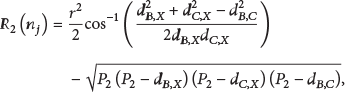
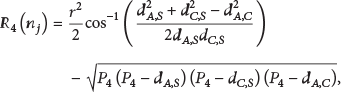
If

Detour success area.
The area covered by the circular arcs




4. Performance Evaluation
In this section, we evaluate the performance of our multihop D2D routing method. We build an event driven simulator using C language for the performance evaluation. Specifically, we compare the performance of the proposed method with the maximum progress method (MaxP), the cost over progress method (CoP), and the congestion-aware forwarder selection method (CAFS), in terms of the end-to-end packet delivery success ratio (
We randomly deploy n nodes in 200 m by 200 m rectangular area. The location of each node is configured according to the uniform distribution. In other words, the x-coordinate and the y-coordinate of a node are randomly selected from
For a given network topology, we randomly select a source node and a destination node. For a given source node and a destination node pair, we apply four different routing methods to deliver a packet under the same condition. For fair comparison, we apply our detour method and reliability method to the other routing schemes. We repeat the same experiment 1,000 times under the same network topology and routing strategy. For each multihop D2D routing trial, we collect
Figure 5 shows the end-to-end packet delivery success ratio. The x-axis shows node density which is defined as the average number of nodes within a circle with a radius r. Since MaxP method selects a node that is farthest away from the current sending node as the next hop, it is the most vulnerable to the random fading in a wireless channel. Therefore,

End-to-end packet delivery success ratio.
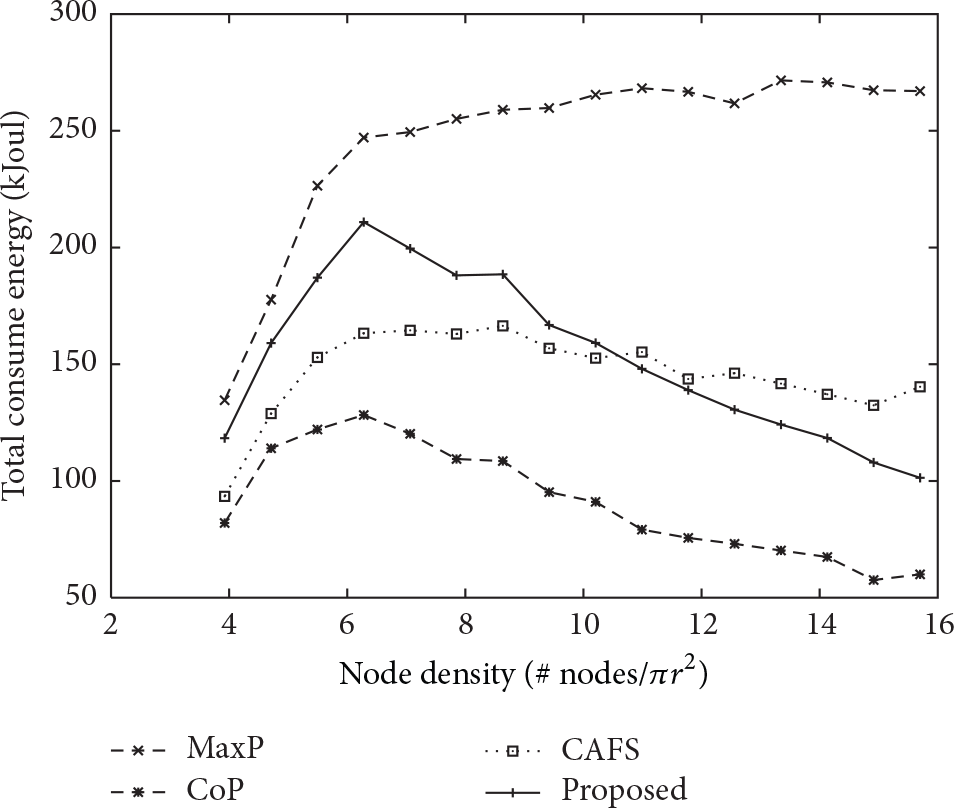
Figure 6 shows the amount of energy consumed in the network. Since CoP considers the amount of energy needed to send a packet, the amount of energy consumed in the network is the smallest when CoP is used. In the case of the proposed method, the congestion levels of potential next hops are considered first. Therefore,
The amount of energy consumed in the network.
Figure 7 shows the end-to-end packet transfer delay and Figure 8 shows the number of hops taken from a source to a destination. The results are obtained from the packets that are delivered successfully end-to-end. Since MaxP attempts to increase the progress made to the destination as long as possible, it selects the neighboring node that is the closest to a destination (i.e., the farthest neighbor from the current sender) as the next hop. Therefore,

End-to-end packet transfer delay.

The number of hops taken from a source to a destination.
CAFS selects the next hop by considering multiple metrics. However, CAFS puts more weight on the progress made to a packet than other metrics. On the contrary, the proposed method considers the congestion levels of neighboring nodes first when it selects the next hop. Thus, the distance between the current sending node and the node selected as the next hop by the proposed method may be smaller than those obtained by MaxP and CAFS, which leads to more

The distance ratio (
5. Conclusions
In this paper, we proposed a fast and energy efficient D2D multihop routing framework. In the framework, the roles of an infrastructure network and a multihop D2D network are separated. In our framework, management packets related to identifying the states of nodes are transferred though an infrastructure network. Since we are using a presence server, there can be a single point of failure problem. However, data packets between nodes are delivered through multihop D2D network to alleviate the burden of an infrastructure network.
In the framework, we also proposed a fast and efficient multihop D2D routing method for a D2D network. The proposed method operates based on the geographic locations of nodes. To expedite the delivery of data packets, the proposed method selects the node that is less congested as the next hop node. In addition, we devised a reliable data transfer algorithm by taking advantage of broadcast nature of a wireless channel for the case where an unreliable medium access control protocol is used.
Through extensive simulation studies, we showed that even though the proposed method takes a roundabout way compared to the other methods, it can reduce the end-to-end packet transmission delay substantially, which leads to the increase in the probability of delivering a packet successfully end-to-end while saving energies of nodes in a D2D network.
Footnotes
Competing Interests
The author declares that there are no competing interests.
Acknowledgments
This work was partly supported by Basic Science Research Program through the National Research Foundation of Korea (NRF) funded by the Ministry of Education (NRF-2015R1D1A1A01060117) and by the GRRC program of Gyeonggi Province [(GRRCSUWON2015-B2), Study on Object Recognition System for Industrial Security and Intelligent Control System for Establishing Social Safety Net Based on Advanced Neuro-Fuzzy Technologies].