




Abstract
In dense wireless sensor network, we usually remove the unnecessary communication links by topology control in order to get an energy efficient routing. The channel environment becomes more complex, which results in difficulty to control topology under a mass node distribution according to the accurate interference model. This paper introduces the concept of a guard region, defined as the region around each receiver where interfering transmissions are inhibited to make the topology control. Based on the hard-core process in stochastic geometry, the scheduling of interfering node in guard region and the density of active sensors are achieved theoretically. Then we do the analysis of coverage of receiver; the interference around receiver is computed as main interference in guard region and secondary interference outside guard region. Finally, through Monte-Carlo simulation, the topology model based on guard region is proved to be correct and the influences on coverage under different parameters are analyzed.
1. Introduction
The rapid development of sensor technology, heterogeneous convergence network, and wireless communication technique give birth to the appearance of wireless sensor network (WSN), which has brought great change to the acquisition layer of Internet of Things technology. Wireless sensor network can be formed by immense amounts of small-sized sensors with the ability of sensing, information processing, and wireless data transmission. As a modern emerging network, compared with traditional communication network solution, WSN has been increasingly widely applied in various domain, such as environment monitoring, animal monitoring, battlefield surveillance, and smart Grid, due to its low-cost, expansibility, reliability, accuracy, flexibility, and easy deployment. The emergence of WSN extends the capacity for human communicating with physical information and objective world, which is considered as an influential technology [1]. Each node is expected to send the information to the base station, called sink, via multihop communication through the assistance of other nodes. However, if the node distribution in WSN is too dense, due to the existence of a large number of links, there will be too much interference among nodes which will lead to packet retransmission, and then the energy consumption will become higher. Due to the limited energy in sensor node, higher energy consumption results in a short lifetime of the network. Thus, it is expected that topology controlling techniques play an important part in the management of the complex of such highly complicated and distributed network [2]. Through topology control, the unnecessary communication links can be removed to make the topology of the network energy efficient.
An efficient topology guarantees the interconnected nodes a reliable data link; thus, a key challenge in WSN is to design efficient topology control mechanisms to ensure the data transmitting to the sink. A lot of research has been focused on topology controlling [3–16]; nevertheless, some control algorithms proposed in these studies adopt sensing disk model to make a topology model without considering the degrading from channel fading; thus, these topology models cannot reflect the actual transmission conditions, which make the theoretical precision of the topology control model proposed in these papers not able to meet the need of practical situations.
In this paper we propose a topology controlling model based on guard region in wireless sensor network to extend the network lifetime without increasing the interference. The proposed topology controlling model contains density controlling for active sensors based on hard-core process and coverage analysis based on guard region around receiving node. We check the topology controlling method by analysis of coverage measure of receiving node.
The remainder of this paper is organized as follows: Section 2 presents related work and details the contributions of the paper. Section 3 describes the related model and some preliminaries. The details of the topology controlling model based on guard region are presented in Sections 4 and 5. Section 4 presents density controlling for active sensors and Section 5 demonstrates the coverage analysis based on guard region around receiving node. Simulation results are presented in Section 6 and the analysis based on the results is also presented in this section. Finally, Section 7 concludes the paper.
2. Related Work
Our work is based on the contribution of a variety of other researches. There has been a great deal of work in the area of topology controlling in WSN. In this section we present some of the previous work related to this paper and give the contribution of our paper.
When related to getting the energy efficient topology controlling scheme, we should analyze the density of active sensors around receiver, and then through lower the interference node of receivers to make the topology of network energy efficient. During the achievement of active sensors, most papers adopt sensing models which define the sensing domain as regular shape, such as disk sensing model [3], Boolean sector sensing model [4], attenuated disk sensing model [5], the truncated attenuated disk sensing model [6], detecting sensing model [7] based on the data fusion technique in event detection, and estimation sensing model [8] based on the parameter estimation of receiving signal power. However, the channel fading degrades the signal power badly which makes the sensing domain of sensors become an irregular region. To get a nearly optimal density of active sensors, we adopt stochastic geometry [9] to describe the relationship of nodes. In [10], Poisson point process (PPP) is adopted to describe the node topology of the interested region, and then the connectivity of the interested region is analyzed based on the PPP-based topology. In [11], the stochastic geometry is utilized to analyze the coverage problem of network; the minimum number of nodes to realize the complete coverage is achieved by topology controlling. In [12], detection performance of receivers is improved through optimizing the probability of event detection based on PPP-based topological distribution. In [13], the topology in CSMA network is analyzed based on stochastic geometry. In [14], the QoS topology control problem is mapped into an ordinal potential game model, and a distributed strategy adjustment algorithm for nodes is designed accordingly. In [15], the topology of local event detection is controlled via PPP model. In [16], the topology of the detection of distributed event in the network when being attacked is controlled. In [17], the topology of the active sensors in the network is controlled by detection polymerization technology. However, in order to lower the density of interference node, we resort to the hard-core process to thin the density of sensors which bring interference to receiver to get the topology of active sensors.
There are two problems during the topology control in WSN; the first is the uncertainty of channel which makes the coverage in WSN become complex. Moreover, in order to lower the energy consumption, we should schedule the work state in network. To make the scheduling meaningful, we should inhibit the distance of active sensors; thus, the guard region concept is introduced, which is the region around each receiver where interfering transmissions are inhibited. In theory, we adopt the hard-core process in stochastic geometry to thin the density of active sensors.
In wireless network, there are a lot of studies related to guard region. A guard region of a receiver of cell is imposed in [18]; thus the transmitting power at the receiver is guaranteed. In [19], an optimal guard zone, defined as the region around a receiver where transmissions are inhibited, is employed, and the capacity of receiver is enhanced compared to a simple ALOHA-type MAC. And in [20], a theory model of guard region is proposed to get a higher capacity, which is defined as the maximum permissible density of simultaneous transmissions that satisfies a target SINR at each receiver, with a specified outage probability. In [20], a guard region is proposed to lower the cochannel interference to the user caused by a randomly chosen transmitter. In [21], the author proved the optimum guard zone size that maximizes the network throughput for a desired communication performance. In [22], the author proposed an interference coordination scheme in which a guard zone protecting the macro cell user is utilized. In [23], the author studied and found the existence of an optimal guard zone radius that maximizes the total system throughput in D2D wireless networks.
However, in these works, the coverage analysis of wireless network is not considered. Considering the complex transmit characteristic, in this work, we aim to derive the topology control method based on the guard region which can increase the energy efficiency (EE) and extend the network lifetime without increasing the interference in the networks.
The main contributions of this paper are as follows: In WSN, we propose a guard region around the receiver in which no other transmitters exist to reduce the interference and unnecessary link around receiver. In theory, we get the guard region through hard-core process, in which points are forbidden to be closer than a certain minimum distance. Thus, the retained sensors after thinning are activated and the necessary node in sensors forming the data routing is achieved. The correctness of density of active sensors is validated through Monte-Carlo simulations. Considering the distribution of active sensors and the characteristic of channel, we propose a novel sensing model based on an irregular sensing domain. Besides, the interference around receiver is perceived as main interference in guard region and secondary interference outside the guard region; based on the interference analysis, we propose a guard region based interference model. Then coverage of receiver is analyzed based on irregular sensing domain and interference model. The correctness of interference model is validated through Monte-Carlo simulations.
3. System and Network Model
3.1. System Model
When the network model is as easy as Boolean disc model, the sensing ability of a node in the whole sensing domain can be considered to be equal everywhere. Once an event exists in the sensing radius of the nodes, that event is covered immediately. However, in a sensor network where the distribution of nodes is more intensive and transmission environment becomes more complex, the spatial distribution characteristics of the node, the interference from other transmitter nodes and complex channel fading, all impact the sensing ability of the node, which makes the sensing region of the nodes no longer a regular circular region but an irregular region which can be changed by the channel gain. For wireless channel circumstance, we develop a general power law path loss model in which the signal power decays at the rate


3.2. Network Model
We consider that the network model consists of multiple stationary sensors with different transmitter-receiver pairs in an infinite two dimension plane. Sensors are distributed according to a Poisson bipolar model.

The network model of controlling scheme with
The content region existing among the transmitter nodes makes the density of nodes in the spatial deployment unable to be too high, which is the foundation of the topology control mechanism. That is to say, there are no other nodes existing in the content region of node 1, and the existence of node 3 is due to its location which is outside the content region of node 1. So we assumed that each transmitter
The scheme for receiver based MAC protocols (e.g., carrier sense multiple access and multiple access with collision avoidance) or other local coordination techniques to limit the interference creates a guard zone around the receiver. Guard region aims to achieve higher capacity via protecting the receiver node. In the analysis of the topology control mechanism, the introduction of the guard region will make the interference distribution more complicated. As shown in Figure 1, we set a guard region around node 2; the radius of guard region is
Figure 1 illustrates that the increasing
4. Density Controlling for Active Sensors Based on Hard-Core Process
To fit the distribution of transmitter, PPP is proposed to initial node deploying. Having known that
Lemma 1.
The PPP on the mean of for every compact set giving that

As is shown in Figure 1, a generic node which is denoted by node 1 located
(1) Starting with a basic uniform PPP
(2) Adding to each point
(3) A marked point


In Figure 1,


We make the communication domain of node 1 the contention region and allocate a random time mark uniformly distributed on

5. Coverage Analysis Based on Interference Model considering Guard Region
As the guard region can provide receivers with less interference by inhibiting transmissions around them, in this section, we develop a topology controlling scheme based on guard region to model the interferer around receiving node. We model the interferer locations according to a marked point process, where the marks correspond to the time access to channel between the interferers and target receiver. Therefore, in the interference model, two kinds of interference sources are mainly considered, one is inside the guard region, which is called the dominant interference source


The dominant interference source
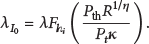
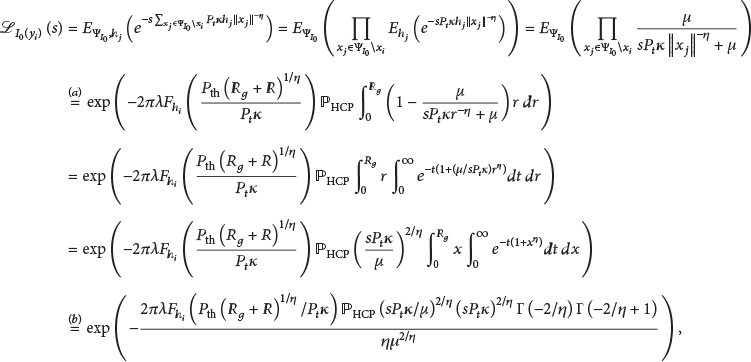
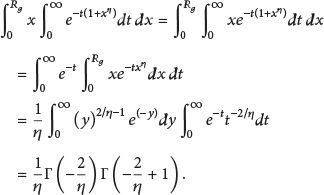
The secondary interference source


The coverage can be calculated as

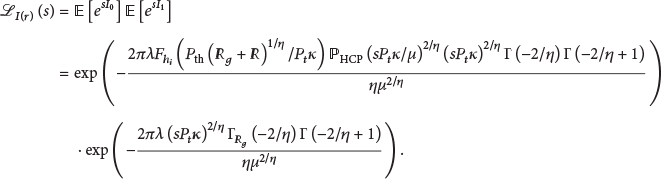
In this paper, based on the interference model we proposed, the aggregate interference is considered to be caused by two kinds of interference sources, which are denoted as
6. Simulation Results and Analysis
In this section, the system synthetical performance of the designed schemes is illustrated by the computer simulation using MATLAB. First, we describe the parameter settings adopted in our simulation, and then the simulation results and discussions are presented. Simulation parameters discussed above are summarized in Table 1. We assume that the size of the area A is
Simulation parameter settings.

The analysis of the influence that channel random parameters η and β and the transmission power
Figure 2 shows the influence that channel attenuation factor μ has on the activity probability with the adoption of hybrid scheduling scheme. It can be illustrated that, given the density of nodes λ in the network, the bigger the channel attenuation factor μ is, the more active the nodes in the network are. That is because when μ gets bigger, the sensing field of the node shrinks, which means that the active contention region of the nodes becomes smaller. Accordingly, the number of the active nodes increases. The simulation of the

Influence of active probability under different μ.
Figure 3 shows the influence the path loss exponent η has on the activity probability with the adoption of hybrid scheduling scheme. It can be illustrated that, given the density of nodes λ in the network, the bigger the path loss exponent η is, the more active the nodes in the network are. That is because when η gets bigger, the sensing field of the node shrinks, which means that the active contention region of the nodes becomes smaller. Accordingly, the number of the active nodes increases. The simulation of the

Influence of activity probability under different η.
Figure 4 shows the influence that receiving power threshold
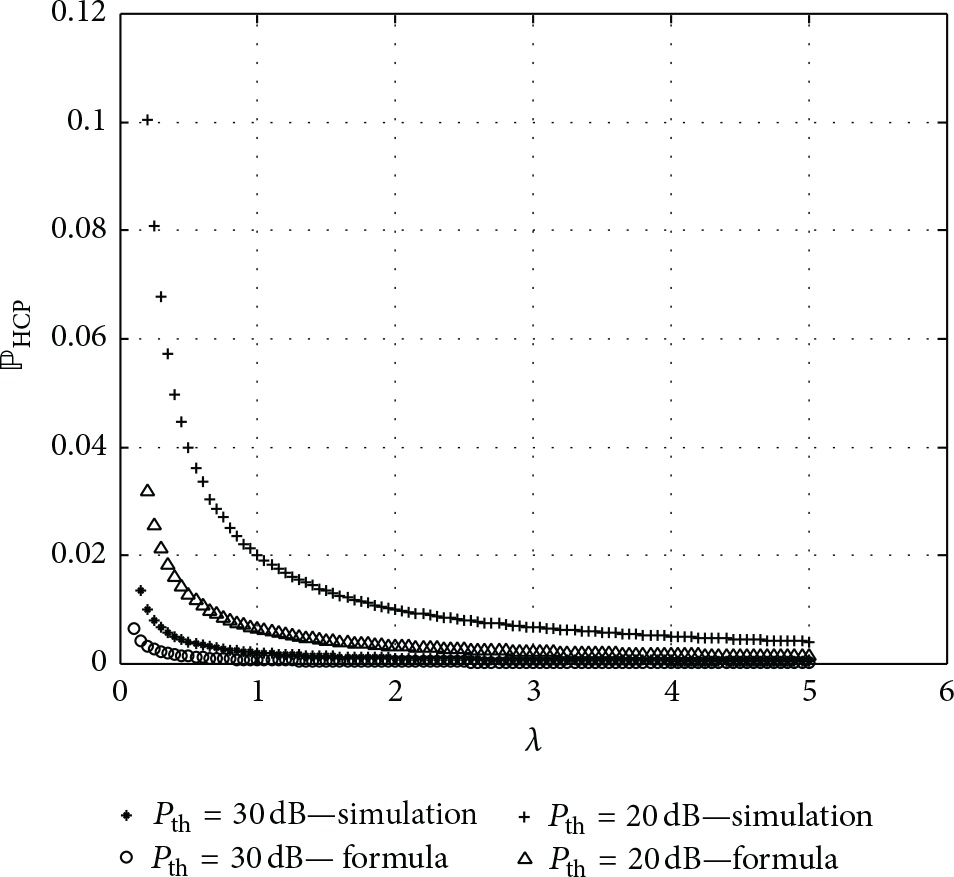
Influence of activity probability under different
Figure 5 shows the influence that the threshold value of SNR β has on the coverage probability. It can be illustrated that the bigger the threshold value of SNR β is, the smaller the value of the coverage probability computed by formula is, and so is the simulation of the coverage probability. The simulation of the
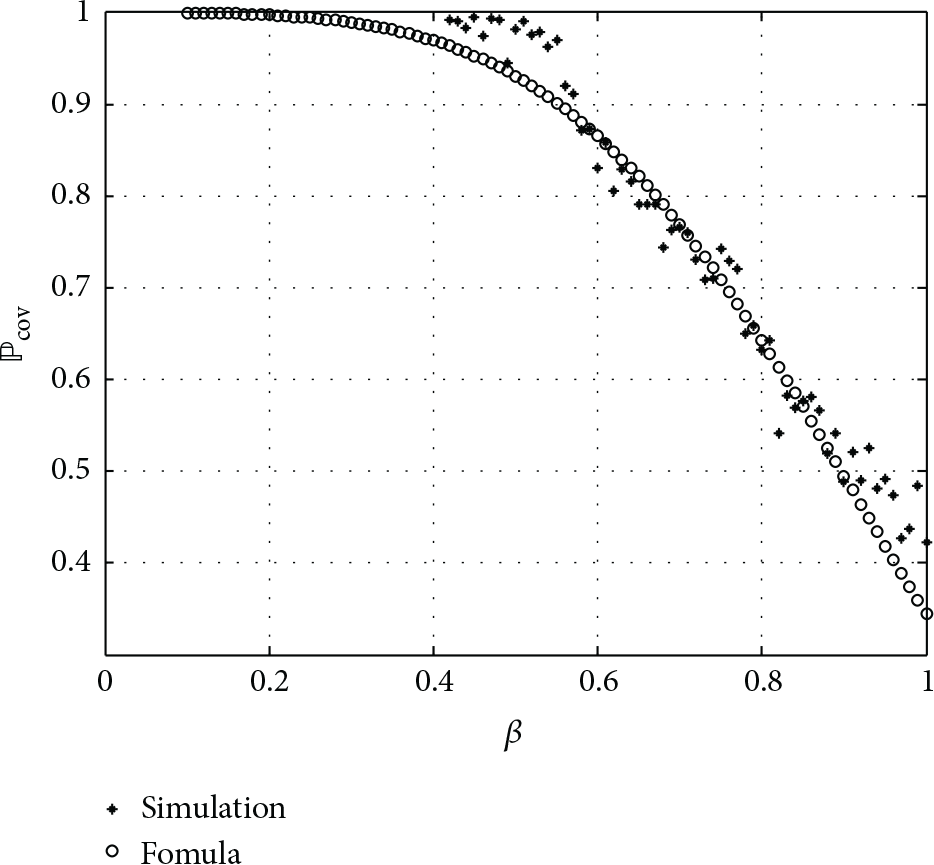
Coverage probability versus threshold value of SINR.
Figure 6 shows the influence that receiving power threshold
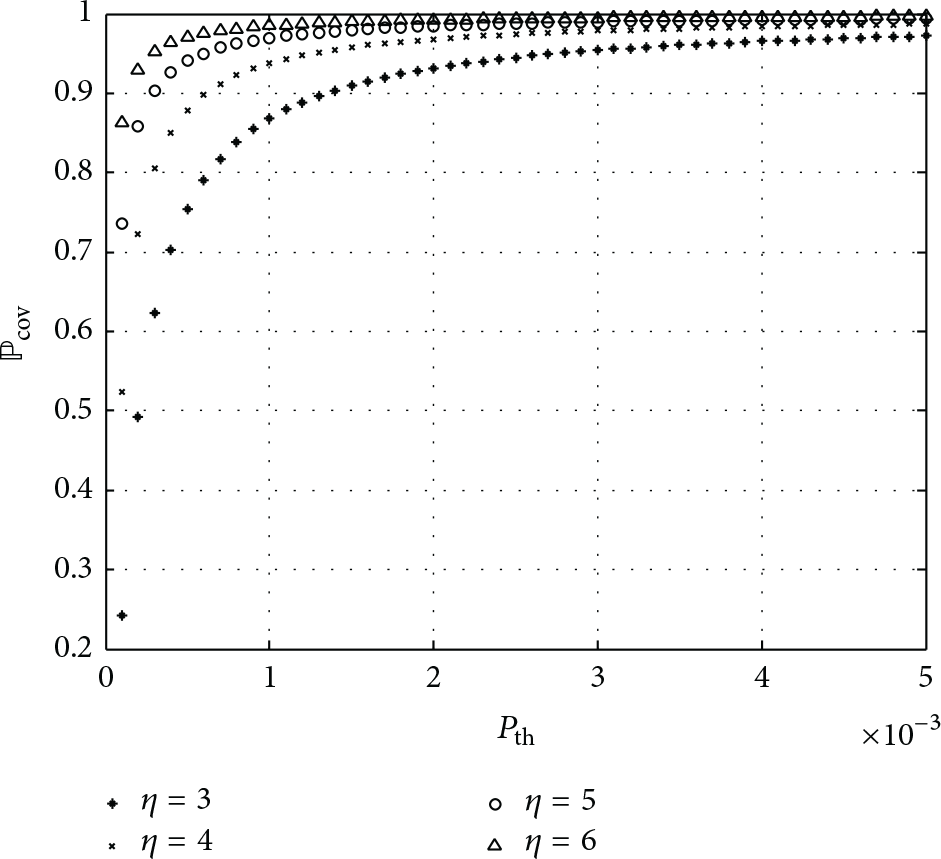
Coverage probability versus
Figure 7 shows the influence that channel attenuation factor µ has on the coverage probability. It can be illustrated that, given the path loss exponent η in the network, the bigger the channel attenuation factor µ is, the lower the value of the coverage probability is. That is resulted by the truth that, with the given path loss exponent η, the increasing channel attenuation factor µ can result in more interferences, which means lower coverage probability. While the channel attenuation factor µ is given, with the increasing of the path loss exponent η, the coverage probability gets bigger. That is because once the channel attenuation factor µ is settled, the path loss exponent η getting bigger leads to less interferences, which means the coverage probability becomes bigger.

Coverage probability versus µ under different η.
The hard-core scheduling scheme controls the conversion of the nodes' operating state in order to achieve an equitable distribution of the limited energy, time slot, and spectrum resource in the network as well as reduce the interference during the transmission.
When comparing the performance of the hard-core scheduling scheme and the random scheduling scheme, we use a more exquisite index, where k is the number of sensors covering the event. 
Figure 8 illustrates the effect that different scheduling schemes have on coverage probability. After comparing the two figures in Figure 8, it can be observed that when the density of active nodes is given, limited by the number of active node, the coverage probability decreases with the increasing k. As for the point that the two figures, respectively, illustrate, first we do the Monte-Carlo approach to the network when

Comparison between the hard-core scheduling scheme and the random scheduling scheme.
7. Conclusion
This paper has analyzed the effect of the guard region of receiving nodes to network interference model in WSN and Rayleigh fading channel. It has proposed the theoretical analysis model of topology control. It spreads mainly in two aspects: one is density controlling scheme and the other is coverage analysis, in which we succeed to make a refined calculation of the interference inside the guard region resulting as
Footnotes
Competing Interests
The authors declare that they have no competing interests.
Acknowledgments
This work was supported by the National Natural Science Foundation of China (no. 61372117).