




Abstract
We propose two constant-false-alarm-rate (CFAR) decision fusion approaches, the low-SNR and likelihood-ratio-based decision fusion in the central limit theory (LLDFCLT) and high-SNR and likelihood-ratio-based decision fusion in Kaplan-Meier estimator (HLDFKE). They are based on the clustered RSN model which combines clustering structure, target detection model, and fusion scheme. We mainly apply the clustering performances by low energy adaptive clustering hierarchy (LEACH) and hybrid energy-efficient distributed clustering approach (HEED) to RSN. Their CFAR detection performances in LLDFCLT and HLDFKE are analyzed and compared. Our analyses are verified through extensive simulations in different CFARs and various numbers of initial RSs and residual RSs in RSN. Monte Carlo simulations show that LLDFCLT can provide higher probability of detection (PD) than HLDFKE; and compared to LEACH, HEED not only prolongs the lifetime of ad hoc RSN but also improves target detection performances for different CFARs.
1. Introduction and Motivation
A radar sensor network (RSN) is an independent system composed of multiple radars. Due to the outstanding features like flexibility of setting and dynamic management, RSN can be applied to various fields. One of the main applications of the RSN is target detection and tracking, especially in safety and military area such as homeland security, border inspection, and defense against terrorists. Besides target detection and tracking, the lifetime is also a fundamental factor considered for the applications of RSN, especially when low-cost and energy-constrained radars are used remotely from a power source. Traditional radars, on the other hand, usually require high power for outstanding target detection performances [1, 2]. Therefore, how to improve target detection performances for RSN while keeping as energy-efficient as possible is still an open research issue [3, 4].
Investigations on improving the target detection performances of RSN are very extensive. A maximum likelihood multitarget detection algorithm [5] to estimate the number of targets present in the sensing area and a diversity scheme [6] to reduce the interference are proposed to improve multitarget detection performances of RSN. New waveform models [1, 7, 8] are developed to alleviate blind speed problem and eliminate interference. Additionally, RSNs based on impulse radio ultrawideband (UWB) are further investigated [9–11], since UWB communications [12] are robust to clutter and interference. In particular, J. Liang and Q. Liang in [9] have exhibited an approach by applying the short time Fourier transform to the received UWB radar waveform to achieve the detection of targets in foliage environment. However, all of the above papers have not considered node topology for either detection or power loss.
Considering both the detection performance and energy constraint has been rarely discussed in the existing literature about RSNs. These solutions can be divided into two groups. One is power control algorithms [13, 14] and the other is a distributed scheduling scheme [15].
Clustering topologies can be used in RSN to save energy, since [16] shows that the node clustering approaches based on the information of geographical location perform better in sensor networks than those without clustering. Current node clustering approaches [17–20] are robust against node failures and hold the whole network remaining connected. Also, data aggregation techniques can be used to combine several correlated data signals into a smaller set of information that maintains the effective data of the original signals [17]. Hence, much less actual data needs to be transmitted from the cluster to the base station (BS). Among the existing studies, a hybrid protocol for efficient routing and comprehensive information retrieval (APTEEN) [18] and an energy-efficient deployment and cluster formation scheme (EEDCF) [19] are typically a centralized algorithm, whereas LEACH [17] and HEED [20] are distributed cases, which are more flexible and efficient. However, none of the above papers touched target detection performances in RSN.
Therefore, all the above research restrictions motivate us to analyze the target detection performance when applying the low-cost clustering topologies to RSN and to find a clustering topology with a higher PD. However, we face one key challenge. The current decision fusion rules [21–25] may not be practical for RSN. Firstly, the transmitted information has to endure both channel fading and noise/interference, whereas optimal fusion [21, 22] and the blind adaptive decision fusion [23] have been derived without regard to the communication constraints, even though this assumption may be reasonable for some applications. Secondly, the local information of radar sensors (RSs), for example, PD, may be different among each other. A maximum ratio combining (MRC) fusion [24] and an equal gain combiner (EGC) fusion [24], which have been further studied in RSN for target detection under multihop transmission [25], have been obtained in the condition of identical local sensors. Finally, a CFAR in cluster heads (CHs) and base stations (BS) can obtain predictable and consistent performance. It is crucial to exploit the CFAR decision threshold, since the above work has not taken this into consideration.
In this paper, we mainly applied LEACH and HEED to RSN. Their target detection performances in LLDFCLT and HLDFKE are also evaluated. The novelty and contributions of this paper are threefold.
We develop the clustered RSN model combining clustering structure, target detection model, and fusion scheme. This model, as far as we are aware, is the first one which accounts for both the energy consumption in clustering and detecting and detection performance (in terms of PD and CFAR) at the same time. The PD in LLDFCLT of the whole network is formulated in the condition of CFAR. It not only can approach the Monte Carlo results, but also is higher than that of HLDFKE. The detection performances in different node degree with constant size of the surveillance area (CSSA) and various sizes of the area with the fixed node degree (FND) are presented for the first time to the best of our knowledge. What is more, we also studied the impact of the cluster radius of HEED and the RSs reduction because of the energy consumption on the CFAR detection performance.
The rest of the paper is organized as follows. In Section 2, LEACH and HEED are briefly discussed. Section 3 elaborates models of clustered RSN and formulates the problem. Section 4 proposes the LOLCLT and HOLKE approaches. The energy consumption model is given in Section 5. Section 6 compares and analyzes performances in LEACH and HEED and LOLCLT and HOLKE. Finally, Section 7 draws the conclusion.
2. LEACH and HEED
2.1. LEACH
LEACH is an application-specific clustering protocol, which significantly improves networks' lifetime (e.g., compared with static clustering), latency, and application-perceived quality. Applying LEACH to RSN, we assume that each RS is reachable in a single hop and the load distribution is uniform among all RSs. LEACH assigns a fixed probability


2.2. HEED
Compared with LEACH, HEED [4] can guarantee more uniform distribution of CHs and more efficient load balancing among the network that we will show in Section 5 considering the energy depletion for detection. HEED assigns a fixed cluster radius and uses the residual energy of RSs as the primary parameter to probabilistically elect temporary CHs (TCHs). Let

We assume that each RS is able to select the appropriate power level to communicate with its CH. Consider the case when the distance between two TCHs, named u and v, is less than the cluster radius; u replaces v and becomes the final CH. This case is subject to the secondary parameter, the average minimum reachability power (

3. The Clustered RSN Model and Problem Formation
We consider a set of RSs deployed in large numbers over a rectangular field. Some assumptions about the properties of the network are as follows. (1) The RSs in the network are quasi-stationary and location aware; (2) all RSs have similar capabilities (processing/communication) and equal initial energy; (3) all RSs are left unattended after the deployment. Figure 1 depicts a clustered RSN structure with two fusion strategies for target detection. When LEACH or HEED is applied, the non-cluster-head RSs (NCHs) are responsible for detecting the targets and transmitting the decision results to the corresponding CHs, while CHs receive and fuse messages and transmit their own decisions to the BS, which makes the second fusion and the final decision. There is a single-hop path between NCHs and the CHs and CHs and BS. Due to the two fusion strategies, the model of the clustered RSN can be referred to as a two-cross-layer design.

A clustered RSN model with two fusion strategies for target detection.
We make the assumption that RSN is parted to c clusters, and each cluster has
3.1. Detection Process
In the detection process, we model the wireless propagation of RSN under the pass-loss fading, which is given by


Each RS declares either “target absent” or “target present” based on the received data. Due to the above radar detection model, the two hypotheses

Assume the kth local RS to make a binary decision

We assume that the communication range of the local RSs is the circular with radius


3.2. Problem Formation
Using the above detection model, we can obtain the optimal likelihood-ratio-based (OL) fusion statistic of CHs. That is

Due to the constraints among the existing research on the decision fusion rules that we mentioned in Section 1, we faced two problems: one is how to derive the alternative fusion statistics to simplify formula (11) based on the pass-loss fading channel model while taking the different PD of RSs into account; the other problem is how to obtain the CFAR according to the fusion statistics both in CHs and in BS.
We shall answer these questions in the following section.
4. CFAR Decision Fusion Approaches
4.1. LLDFCLT
If

Obviously,
Mean and variance of
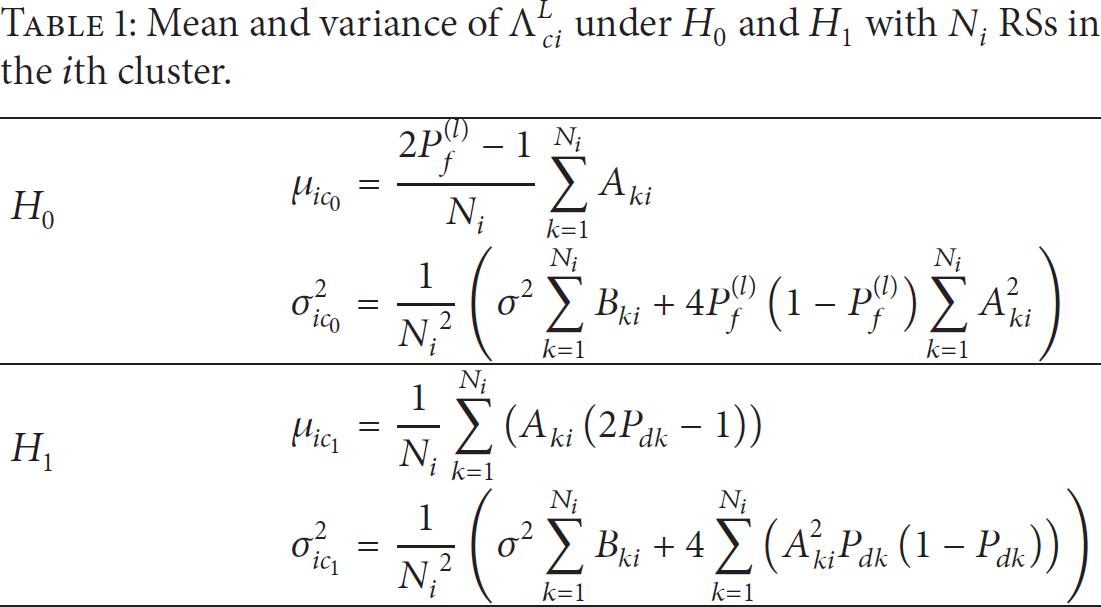
When the CFAR of the CHs 
The ith CH also makes a binary decision 
Mean and variance of

Similarly, when the CFAR of the RSN 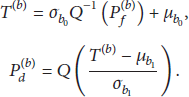
4.2. HLDFKE
If 
In order to obtain the CFAR for the whole network, the decision threshold based on the empirical cumulative distribution function (ECDF) of
Suppose 

Suppose that 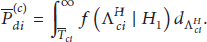
Then the fusion statistic of BS is

We could easily acquire the decision threshold by secondly using KE.
5. Radio Energy Consumption Model
The energy is primarily consumed for detection and data transmission. We implement the free space and the multipath fading channel models. The transmitter dissipates energy to run the radio electronics and the power amplifier, and the receiver dissipates energy to run the radio electronics. To transmit an l-bit detection or fusion message to a distance d, the radio expends


Presumably the distance to the CH is small, so the energy consumption follows the Friss free-space model (power loss). Then the energy consumed by a NCH during one detection 

6. Performances Evaluation
In this section, we present and analyze the detection performances of the three groups, LEACH and HEED, LLDFCLT and HLDFKE, and CSSA and FND, respectively. Specific simulation setup is listed as follows.
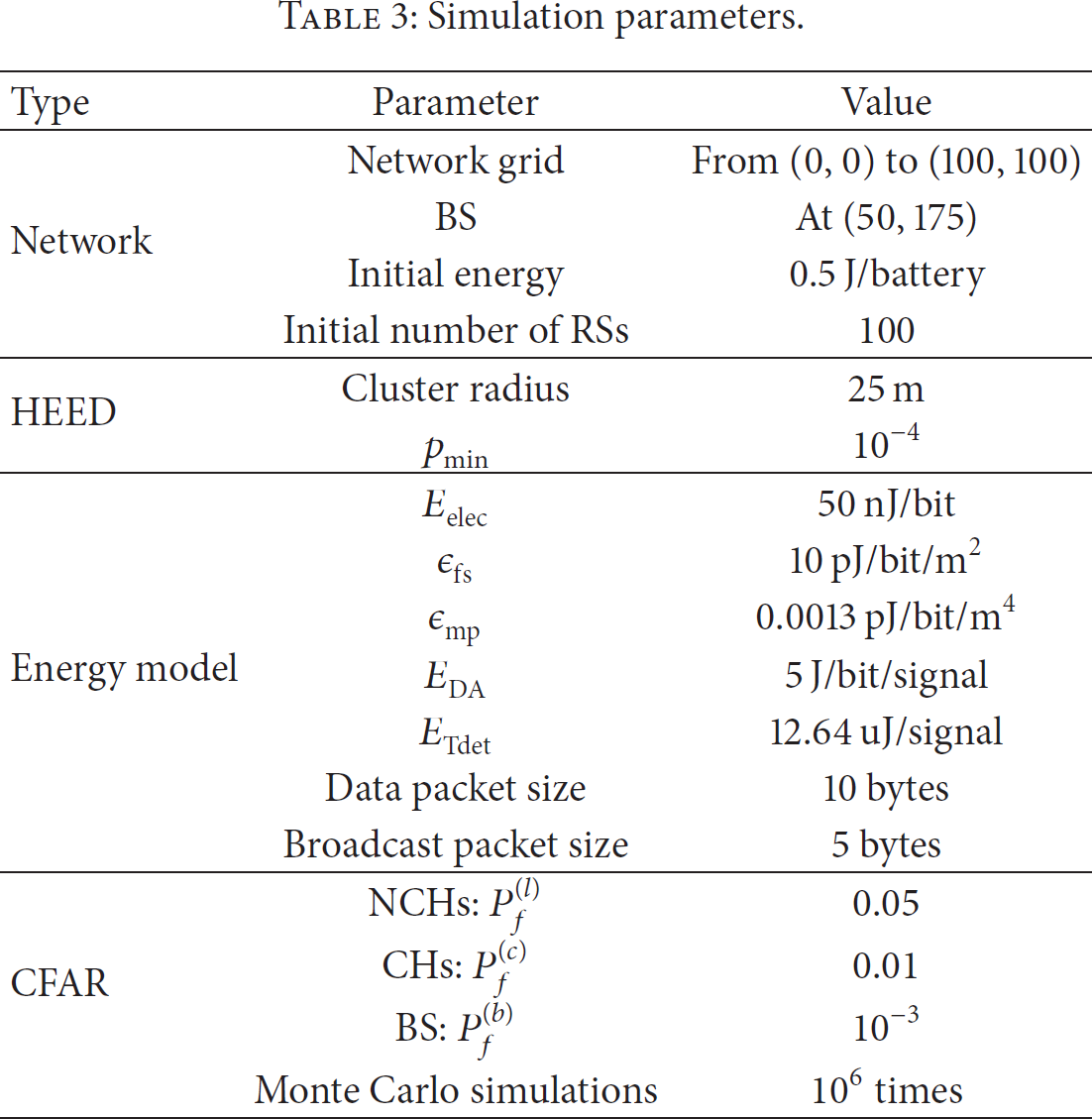
Simulation parameters (SPs) shown in Table 3 are for the first and second groups, and some SPs of radio energy consumption model are similar to those in [17]. Here, we briefly describe them. We assume that 100 RSs with the same initial energy, 0.5 J/battery, are uniformly dispersed into a square field with dimensions 100 m × 100 m; the CFARs of NCHs and CHs, given as As for the last group, we only changed the number of initial RSs and network grid in Figure 8 and the cluster radius of HEED (from 12 m to 40 m) in Figure 9. For example, if the number of initial RSs is 200, the dimensions are 100 All of the ROC curves except Figure 5 are generated using
Simulation parameters.
First of all, we will analyze CFAR detection performances of LEACH and HEED in LLDFCLT.
6.1. CFAR Detection Performance Analysis of LEACH and HEED in LLDFCLT
Figure 2 presents the receiver operating characteristic (ROC) curves obtained both by Monte Carlo simulation and by numerical approximation using LLDFCLT. While some discrepancy exists, approximations using LLDFCLT match relatively well to the corresponding simulation results.
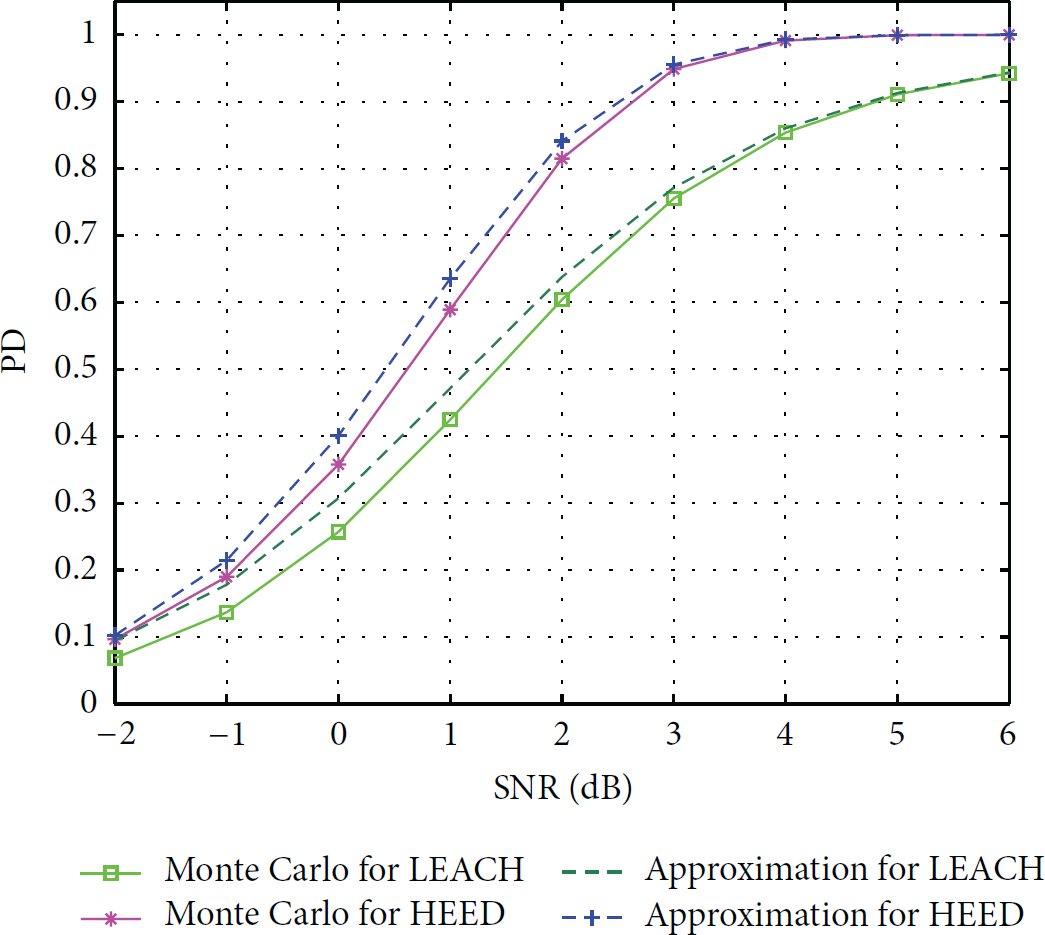
The PD of LEACH and HEED in LLDFCLT.
Application of CLT also allows a more intuitive explanation and analysis. From Stein's lemma [26], the relative entropy (Kullback-Leibler distance) between the two distributions under test is directly related to the detection performance in an asymptotic regime. The relative entropy between two Gaussian distributions can be presented as

We can therefore get the asymptotic relative entropy as a function of SNR for LLDFCLT of both LEACH and HEED by plugging in the corresponding mean and variance from Table 2. Figure 3 shows the results for both LEACH and HEED for the same parameter setting. Both Figures 2 and 3 illustrate that HEED has a better CFAR detection performance than LEACH.

Kullback-Leibler distance (relative entropy) between the two hypotheses for both LEACH and HEED in LLDFCLT.

The PD of LEACH and HEED in LLDFCLT with constant SNRs versus different CFARs.

The lifetime of RSN in LEACH and HEED.
To better understand the performance differences as various CFARs of the system, we change the value of previous
The lifetime of RSN in LEACH and HEED is shown in Figure 5. The first RS dies in LEACH ahead of 50 intervals. The last RS dies during the 2860th interval in HEED, which extends 14.86 percent of lifetime. Therefore, HEED can reduce more energy dissipation and prolong the lifetime of RSN compared with LEACH.
Based on Figure 5, we also want to know the PD of RSN in LEACH and HEED when the number of RSs is decreasing because of the energy consumption, which is presented in Figure 6. Figure 6 shows that the PD of RSN both in LEACH and in HEED is declined when the number of residual RSs (NRR) is diminishing, but when SNR is more than 4 dB, HEED with the number of residual RSs between 60 and 45 can have an approximate PD to LEACH with the number of residual RSs between 90 and 75.

The PD of RSN in LEACH and HEED when NRR is in the range between 90 and 75 and between 60 and 45.

The PD of LEACH and HEED in LLDFCLT and HLDFKE. (a)

The PD of RSN in LEACH and HEED and CSSA and FND.

The PD of RSN in HEED versus different cluster radius.
6.2. The Comparison between LLDFCLT and HLDFKE
Figure 7 gives the CFAR detection performance of LEACH and HEED in LLDFCLT and HLDFKE. Figure 7 shows that for both LEACH and HEED, HOLKE offers lower PD than LLDFCLT, since HLDFKE ignores the channel fading while LLDFCLT holds almost complete knowledge; different with LLDFCLT, the PD of HEED is higher than that of LEACH when SNR is more than 2 dB.
6.3. Detection Performances in CSSA and FND versus Different Cluster Radius of HEED
Since LLDFCLT has a better CFAR detection performance than HLDFKE, we studied the impact of the cluster radius of HEED, CSSA, and FND on PD of the whole network, as observed in Figures 8 and 9, respectively. From Figure 9, we can observe that the PD of HEED degrades as the cluster radius increases. The conclusion from Figure 8 is as follows.
Whether in CSSA or in FND, the PD of both LEACH and HEED can be enhanced by the increasing number of initial RSs but will remain constant from a certain number of initial RSs. CSSA makes a distinct improvement of PD compared with FND.
7. Conclusion
In this paper, we propose two CFAR detection approaches based on the clustered RSN model, namely, LLDFCLT and HLDFKE, which combine clustering structure, target detection model, and fusion schemes. We compare the clustering performances of LEACH and HEED, and the target detection performances in both LLDFCLT and HLDFKE are also analyzed and compared. We demonstrate that LLDFCLT outperforms HLDFKE; compared with LEACH, HEED not only prolongs the lifetime of the network but provides better target detection performances for different CFARs and entire SNR values in LLDFCLT and for moderate-to-high-SNR values in HLDFKE; the detection performance can be improved by the increasing number of initial RSs but will remain constant from a certain number of initial RSs, while the less the number of residual RSs in RSN or the larger the cluster radius of HEED, the worse the detection performance at the same SNR.
Accordingly, the HEED in LLDFCLT approach has the robust CFAR detection performances. We can apply it to RSN to improve the PD and also keep energy efficiency. In future work, we may investigate multitarget detection performance of clustered RSN and multihop clustering methods for RSN.
Footnotes
Conflict of Interests
The authors declare that there is no conflict of interests regarding the publication of this paper.
Acknowledgments
This work was supported by the National Natural Science Foundation of China Project no. 61102140, Doctoral Fund of Ministry of Education of China Project no. 20110185120003, and the Fundamental Research Funds for the Central Universities Project no. ZYGX2012J015.