




Abstract
Most research done on the channel polling mechanisms for WSN MAC protocols has focused on achieving efficiency in terms of optimizing either delay or energy performance. This study introduces the mechanism of altering the polling interval distribution for the MAC protocol, based on the application's optimization objective (delay or energy). Two options have been considered for both packet interarrival and polling interval distributions: deterministic and exponential, and their impact on performance analysis has been studied. The packet aggregation and block acknowledgements transmission schemes have also been incorporated in the performance analysis. Simulations for energy consumption and delay have been performed using MATLAB, for various combinations of interarrival and polling interval distributions. Results show that the energy consumption improves for the exponentially distributed polling intervals, while deterministic polling intervals provide better delay performance. Changing values of traffic load and packet aggregation demonstrate the trade-off between delay and energy consumption. The impact of aggregation on the error probability and subsequently on delay and energy has also been illustrated in simulations. Finally, optimal operating parameters have been studied in order to combine delay and energy consumption as optimization criteria.
1. Introduction
Wireless Sensor Networks (WSNs) have been widely studied and their applications range from enemy tracking and battlefield surveillance to environmental observation, habitat monitoring, target tracking, intrusion detection, robotics exploration, health monitoring, and forecasting. A typical WSN comprises a number of small footprint nodes, where geographical distribution is generally based on the application requirement [1]. These nodes are often battery powered and operate for long durations unattended. For the purposes of managing the energy use in WSNs, the MAC protocols are of major researchers’ interest as these control the radio directly and hence can result in reduced energy consumption through efficient duty cycling and transmission mechanisms [2]. A large number of synchronous and asynchronous MAC protocols for WSNs have been proposed, aiming at achieving energy efficiency.
Channel polling refers to the process of scanning the wireless channel to detect activity. During the channel polling, the nodes do not necessarily receive data but wake up to detect possible activity [3]. In case a node detects some activity, it stays awake to receive data or else goes back to sleep. This technique is often deployed in asynchronous MAC protocols, due to which these protocols appear significantly efficient in energy consumption [4], in comparison to the traditional synchronous MAC protocols [5–8]. Although many WSN MAC protocols have been built on the concept of channel polling, the polling interval distribution has not been studied, to the best of our knowledge. The efficient management of polling events can lead to performance improvement of a MAC protocol, both in terms of energy and delay.
In this study, we propose an approach of altering the polling interval distribution of WSN MAC protocol, based on the application's optimization objective. The differences in energy consumption and delay performance due to deterministic and exponential polling intervals have been analyzed. The techniques of packet aggregation and block acknowledgement transmission have been incorporated to analyze their impact over the overall energy consumption, while the polling interval distribution is altered. The impact of varying arrival rates and Degree of Aggregation (DoA) over the energy and delay performance has been investigated. Moreover, the impact of varying DoA on the collision probability, delay, and energy has also been analyzed. Through selecting the appropriate polling distributions and other techniques implemented in this study, the WSN MAC protocols would be able to conserve the polling energies and also to achieve the desired delay performance. Also, the optimal point of operation based on the application requirements can be selected.
The remainder of this paper is organized as follows: Section 2 summarizes the related work; Section 3 describes the research problem and conceptual framework for the study; Section 4 presents the simulation results and analysis. Finally, Section 5 concludes the paper and also suggests future research directions.
2. Related Work
A large number of polling based protocols have been proposed in both the categories of synchronous and asynchronous WSN MAC protocols. In this section, a brief overview of prominent polling based MAC protocols is presented. The technique of block acknowledgement transmission has also been described as it is one the major aspects of the proposed approach.
2.1. Polling Based MAC Protocols
Berkley Media Access Protocol (B-MAC) has been proposed with the features of asynchronous duty cycling, preamble sampling [9], and bidirectional interface, in order to achieve low duty cycle operation [10–13]. B-MAC outperformed the S-MAC [5] and T-MAC protocols [14] but suffered performance degradation due to the excessive energy used in long preambles and overhearing [10, 15]. The major contribution of B-MAC is to develop the concept of changing the parameters of WSN MAC protocols on the applications; a similar concept has been deployed in the present study, where the polling interval distribution is altered.
The nodes using a Low Power Listening (LPL) based protocol Wise-MAC wake up periodically in an asynchronous fashion [10]. Each data packet is preceded by a preamble in order to inform the receiving nodes about the arriving packet as they wake up, according to their own schedule. Lack of hand shaking between the nodes and high energy loss were the major issues with this protocol [16, 17].
X-MAC reduces the preamble overhead, present in the earlier protocol B-MAC, by sending short preambles with the destination addresses and by implementing the queuing mechanism [11]. Due to the presence of destination addresses in the preamble, the nonrelevant nodes can sleep immediately [17].
X-MAC becomes less efficient when the number of contending nodes is high [16].
AX-MAC adjusts the polling intervals dynamically based on the network traffic conditions [18]. Markov chain has been used for adjusting the polling intervals based on the threshold parameters U (how many times a node should detect that network is quite in order to accept this status) and D (how many times a node should detect that network is busy in order to accept this status). The proposed dynamic adjustment of polling intervals offers certain energy advantage but the selection parameters might not be realistic and thus energy wastage may occur.
Asynchronous Scheduled MAC is a duty cycle based general purpose multihop MAC protocol [19] which stores the schedule of neighbors and therefore does not need sending long preambles. Due to this feature, AS-MAC improves on energy consumption as compared to many synchronous and asynchronous protocols, namely, S-MAC [5], T-MAC [14], SCP-MAC [3] (synchronous) and X-MAC [11], RI-MAC [20], PW-MAC [21], and EM-MAC [22] (asynchronous). The disadvantage of this protocol lies in its memory overhead and requirements of frequent distribution of schedules for avoiding collisions [23].
Dynamic Polling Media Access Control has been proposed to dynamically control the polling activity in order to improve the bandwidth allocation and throughput [24]. In this scheme, the polling table is dynamically refreshed depending on the active state of the node. The bandwidth is then allocated according to the traffic requirements. Although efficient in terms of delay management, there would again be memory overhead and increased energy consumption during the process of refreshing the polling table dynamically.
SCP-MAC efficiently combines the synchronization and channel polling approaches in order to reduce the energy consumption [3]. The receiver node polls the channel at synchronized intervals, which reduces the energy consumed in sending long preambles. The concept of adaptive channel polling is used for detecting the bursty traffic. Despite the advantages of synchronized channel polling, SCP-MAC wastes considerable amount of energy in overhearing and increases delay due to synchronization approach [25]. In addition, the adaptive channel polling also results in excessive wastage of polling energy and overhead increases for the traffic bursts [26].
2.2. Transmitting Block Acknowledgments
In addition to the duty cycling mechanisms, various other approaches have also been developed for reducing the energy consumption and delay optimization of WSN MAC protocols. One such approach is to send block acknowledgements in order to reduce the number of control packets and delay which result while sending the fragments of data packets [27]. Implicit acknowledgements have also been introduced for reducing the control packets: during the multihop transmissions, the sensor nodes monitor the transmission activity of the neighbors. In case the neighbor is found to transmit the same packet which was initially forwarded by the node, it comes to know that the packet was successfully received by the neighbor and there is no need of an acknowledgement [28]. This approach however has an overhead for listening to the channel.
3. Problem Formulation
3.1. Research Problem
Based on the analysis of existing polling based WSN MAC protocols, it is seen that a gap exists for efficient selection of the polling intervals. In a large number of applications, no channel activity takes places in the network for long intervals; continuously polling during such intervals degrades the energy performance of a MAC protocol. On the other hand, no occurrence of polling events in the presence of packets degrades the delay performance of the protocol. Therefore, the MAC protocol should target achieving the delay or energy efficiency, or both, through efficient selection of polling interval distribution. The optimal point of operation should also be selected based on the required application objective.
3.2. Conceptual Framework
The conceptual framework for this research is based on analyzing the impact of altering the polling interval distribution, transmitting aggregated data packets, and transmitting block acknowledgements, over the energy and delay performance of WSN. These techniques can be made a part of MAC protocol to achieve the desired objective (delay or energy efficiency or to switch between the two).
3.2.1. Packet Aggregation Mechanisms and Degree of Aggregation (DoA)
The packet aggregation techniques deployed in this study are as follows:
No packet aggregation: even if the packets are intended for the same receiver, they are not aggregated and sent separately with their individual overhead bytes, as soon as a polling event occurs. Forced aggregation: the packets are aggregated into a burst of 3 as an example case; regardless of the occurrence of polling events, the packets are only sent when the burst size reaches 3; this reduces the overhead bytes as instead of sending overhead for 3 packets separately, the overhead bytes of single packets are transmitted; it is to be noted that this is an extreme condition and has been demonstrated only for comparison purposes. Variable aggregation: all the packets that arrived before the occurrence of the next polling event are aggregated; this scenario also reduces the overhead bytes.
Degree of Aggregation (DoA) has been defined as the number of packets to be aggregated in any scenario [29]. There exists a trade-off between the Degree of Aggregation (DoA) and delay, as illustrated by the case of forced aggregation in Section 4. A higher DoA would lead to decreasing the probability of collisions and improving the utilization of network resources such as bandwidth. At the same time, a high DoA would result in larger size of packets which may increase the probability of collisions and transmission errors [30, 31]. Therefore, the MAC protocol should decide the limit for DoA based on the application requirements and the incoming traffic patterns. A flexible DoA would help the protocol to optimize the latency, which could otherwise be very high.
The concepts of no packet versus aggregation versus forced aggregations have been illustrated in Figure 1, assuming a fixed value of 50 B for packet payload and 11 B for overhead, and DoA = 3. The DoA is set to 3 as an example case.

Impact of packets aggregation over the transmission of overhead bytes.
As shown in Figure 1, the payload lengths of the 3 packets remain the same, but the overhead of these packets combine into one, reducing the number of overhead bytes significantly. The mechanism of variable aggregation is similar to that of forced aggregation, only with the difference of no limit on the burst size/DoA. Table 1 summarizes all the scenarios which have been analyzed in this paper.
Scenarios/combinations of interarrival and polling interval distributions studied.

Scenarios 3-B have been illustrated in Figure 2 which is the case of variable packet aggregation for the exponential arrivals; the other scenarios of Table 1 are not visually illustrated due to the limited space and also to avoid redundancy. All the proposed features including the packet aggregation, block acknowledgements, and the altering of polling distribution have been conceptualized in this scenario; thus, the energy savings would be achieved due to both the packet aggregation and block acknowledgments. Clearly, the energy advantage is higher for the case of exponential polling intervals (Figures 2(a) and 2(b)), due to the higher probability of sending more aggregated packets and fewer acknowledgements.

Variable packet aggregation (no limit on burst size N) with exponential arrivals: (a) deterministic polling and corresponding block acknowledgements and (b) exponential polling and corresponding block acknowledgements.
3.3. Simulation Scenarios and Parameters
Tables 2 and 3 present the simulation scenarios and parameters, respectively.
Simulation scenarios.

Simulation parameters.
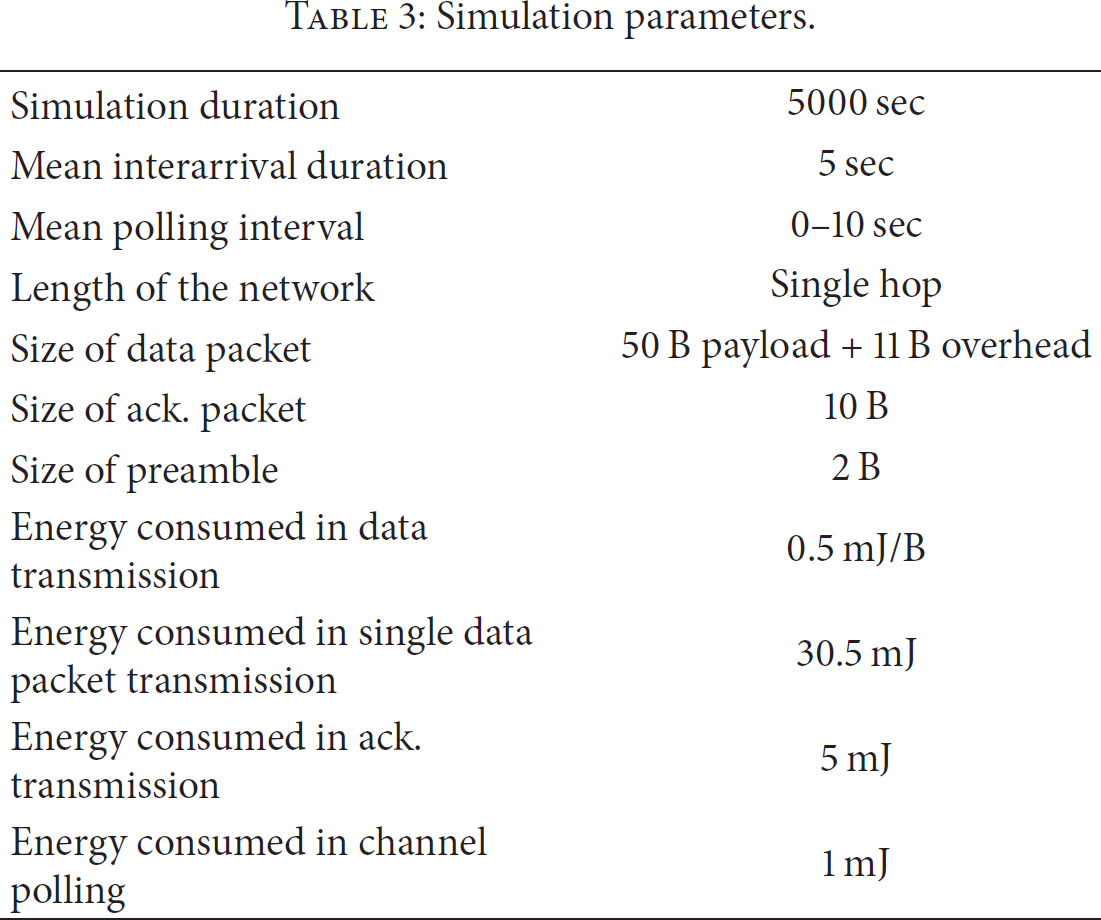
The simulation duration has been set to 5000 sec in order to have a suitably large set of observations to base the conclusions on. The interarrival has been set to 5 sec assuming that WSNs do not generate data with much higher rates. The mean of polling distribution has been varied from 0 to 10 sec to observe the impact of changing mean over the energy and delay performance. A single hop network has been used for the illustrations of major concepts of this study (effects of altering polling interval distributions, packet aggregation, and block acknowledgements). The contention and channel winning probabilities have not been implemented since the present work proposes a general polling mechanism which can be implemented in any MAC protocol with its specific attributes. The packet sizes and energy consumption values have been derived from the implementation of existing MAC layer protocols (SMAC and SCP-MAC).
3.3.1. Total Energy Consumption and Average Delay
The calculation of total energy consumption incorporates the polling energy, as well as data and acknowledgement transmission energy, and the average delay is calculated by averaging the delay for all packets, which they faced due to the difference between the instants of generation and polling.
3.3.2. Packet Aggregation
The three scenarios of no packet aggregation, variable aggregations, and forced aggregation have been simulated. It is to be noted that packet aggregation implemented in this study is very preliminary due to the assumption of single hop network; the overhead of the packets is combined into one, in order to reduce the transmitted packets, without checking for the fields of source and destination addresses. Similar approach can be deployed for the multihop networks as well, with the checks of address fields implemented.
4. Results and Discussions
4.1. Simulation Study for Deterministic Arrivals
From Table 1, all the scenarios of deterministic arrivals: 1-A, 2-A, and 3-A are included in the following simulation.
4.1.1. Total Energy Consumption
Figure 3 illustrates the total energy consumption for the deterministic arrivals with different packet aggregation scenarios, plotted with 95% confidence intervals (formula used for calculation of confidence interval:

Total energy consumption for different cases of deterministic interarrivals.
Firstly, the comparison between the deterministic and exponential polling distributions for the deterministic arrivals, with no packet aggregation, is shown. The exponential polling clearly results in lower energy consumption, due to the lesser number of acknowledgments sent. The polling events in the case of exponential polling distribution take place such that the packets are received in blocks, hence reducing the number of acknowledgements. There is higher probability that any given polling event of exponential polling would result in reception of more data packets, as compared to the polling events generated through the deterministic distribution. This concept remains valid even with approximately same number of polls. The difference is highest for the polling interval mean 5, which is also the mean of interarrival distribution. Thus exponential polling serves best even in terms of energy when the mean of polling interval approximates that of the mean interarrival.
Next, the comparison between the deterministic and exponential polling distributions for the deterministic arrivals, with variable packet aggregation, is shown. The results are similar as discussed above. Finally, the comparison between the deterministic and exponential polling distributions for the deterministic arrivals, with forced packet aggregation, is shown. Unlike the above two cases, the energy consumption for both deterministic and exponential polling is found to be initially overlapping as the number of packets aggregated is the same. However, as the mean polling interval increases above the mean arrival rate, considerable difference between the energy consumption for two polling distributions is seen. This is again because of the higher probability of packets to aggregate in the case of exponential polling.
Now, let us consider the overall comparison of all the scenarios. The energy consumed in the case of “forced aggregation” is found to be lowest, because the DoA here is 3, which not only reduces the energy of overhead bytes but also of the acknowledgement transmissions (because of more block acknowledgments). Next, “variable aggregation” is shown to be the second lowest energy consumer due to reduced overhead bytes. Finally, the energy consumption is shown to be highest for the case of “no aggregation” when the overhead bytes will be sent for each packet separately.
4.1.2. Average Delay
The average delay for deterministic arrivals with different aggregation and polling mechanisms is illustrated in Figure 4. The same set of results represents the delay for the cases of “no aggregation” and “variable aggregation.” In both these cases, the packets have to wait only till the polling event comes regardless of the burst size, resulting in low delay.

Average delay for different cases of deterministic interarrivals.
It is to be noted that, for the cases of “no aggregation” and “variable aggregation,” there are considerable differences in the energy consumption (Figure 3) because of difference in number of bytes transmitted, but no difference in delay as all the aggregated or not aggregated packets will be transmitted at the same polling instant. On the other hand, the “forced aggregation” case will face larger delay as the packets will only be transmitted when the burst size will reach 3. The delay is minimum for the case of deterministic polling (at the polling interval mean 5), as the packets will arrive at the same rate, and will immediately get transmitted. Also at high polling intervals, the deterministic polling with forced aggregation results in lower delay as compared to the case of no/variable aggregation-exponential polling.
4.1.3. Varying Traffic Arrival Rate
The previous results focused on varying the polling interval mean while keeping the mean arrival rate constant at 5 sec. The impact of varying traffic load and switching of polling distribution over the average delay and total energy consumption can be seen in Figure 5.
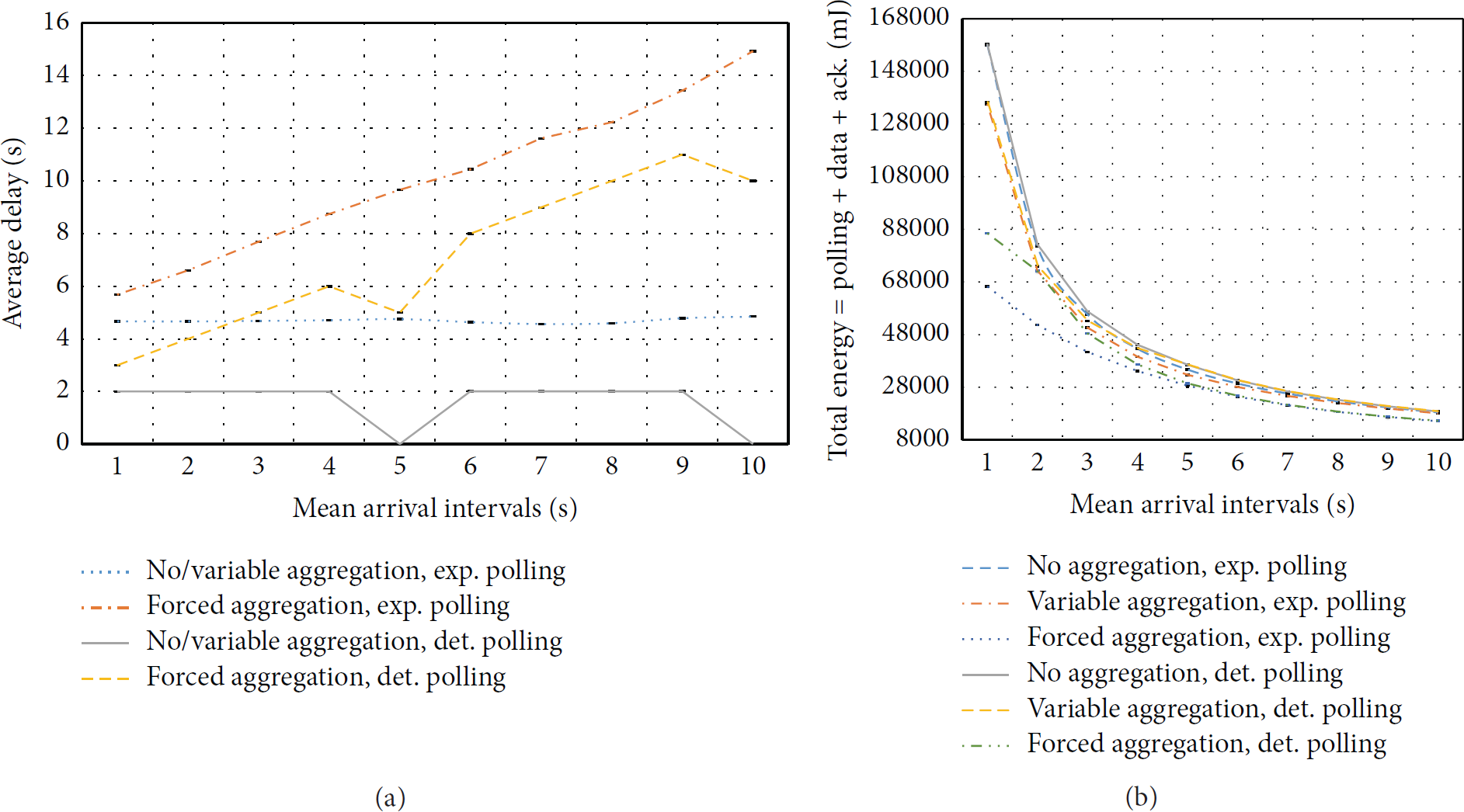
Deterministic arrivals with deterministic and exponential polling: (a) impact of varying arrival rate over the delay performance and (b) impact of varying arrival rate over the energy performance.
Figure 5(a) shows the trend for average delay with respect to the changing traffic load. For no/variable aggregations, the average delay remains constant for all arrivals for both the cases of deterministic and exponential polling. This is because the arriving packets will be polled at regular intervals. For the deterministic polling, a dip is seen at 5 sec and 10 sec, reason being the value of polling interval which is set as 5 sec. Exponential polling exhibits higher delay and also there is no dip, since the polling would not take place exactly at 5 or 10 sec.
On the other hand, for the forced aggregation, a shift is seen in the results causing the increase in delay. The trend for this case of aggregation exhibits an increase in delay with the decreasing traffic load. This is because the packets will be transmitted only in the bursts of size 3 which will result in high average delays, in the cases where packets will be generated with large intervals.
The energy consumption trend with respect to the changing traffic load has been depicted in Figure 5(b). For every case of aggregation and traffic rate, the exponential polling results in lower energy consumption as compared to deterministic. The forced aggregation results in lower energy consumption as compared to no or variable aggregation due to the differences in number of overhead bytes transmitted and block acknowledgements.
4.1.4. Varying Degree of Aggregation (DoA)
To investigate the impact of Degree of Aggregation over delay and energy, the DoA has been varied between 1 and 10.
Figure 6(a) shows increasing trend for the delay with the increasing DoA. This is because the packets will be serviced once DoA reaches the specific value. Exponential polling exhibits higher delays as compared to the deterministic for all the values of DoA.

Deterministic arrivals with deterministic and exponential polling: (a) impact of DoA over the delay performance and (b) impact of DoA over the energy performance.
Figure 6(b) depicts the comparison of total energy consumption with the exponential and deterministic polling when the DoA varies. The decreasing trend has been shown for the increasing values of DoA. As more packets will be aggregated, lesser overhead bytes will be transmitted, causing the overall reduction in energy consumption. Also, the number of block acknowledgements will reduce at the high values of DoA. At low Degree of Aggregation, the exponential serves to be better in terms of total energy consumption, while the results show an overlap for the other aggregation values. This is because, as the DoA becomes higher, number of successful polls becomes the same for both polling distributions, consequently resulting similarly in number of block acknowledgements and energy consumption.
4.1.5. Impact of Probability of Error
This section illustrates the impact of increasing the DoA on the probability of error and subsequently on delay and energy (due to retransmissions). Here, the retransmissions have been assumed to be mainly happening due to the bit error rates (BER = 1 × 10⁻⁴) and the collisions have been assumed to be negligible. The probability of error

Impact of increasing
Figure 7(a) shows the results of average delay for the cases of deterministic and exponential polling, each with and without retransmissions. For both the cases of deterministic and exponential polling, the updated delay is found to be higher than the original because of the retransmissions. The difference between original and updated delays is initially found to be small because of the low values of
Figure 7(b) illustrates the results of total energy consumption for the cases of deterministic and exponential polling, each with and without retransmissions. For both the cases of deterministic and exponential polling, the updated energy consumption is found to be higher than the original because of the retransmissions. Initially, the differences between the original and updated energy are small because the DoA is low resulting in low number of retransmission. As the DoA increases, the number of retransmissions and the energy consumption increases.
Moreover, the exponential polling interval distribution is found to be better in terms of energy consumption as evident from Figure 7(b). For the original values of deterministic and exponential polling, the values were overlapped at the higher aggregation values. However, as the retransmissions are taken into account, the overlap between the exponential and deterministic polling has been reduced. This is due to the fact that there is lower difference in the original and updated values of exponential polling. Therefore, exponential polling serves better in terms of energy consumption even in the presence of transmission errors.
4.2. Simulation Study for Exponential Arrivals
From Table 1, all the scenarios of exponential arrivals: 1-B, 2-B, and 3-B, are included in the following simulation.
4.2.1. Total Energy Consumption
Figure 8 illustrates the energy consumption for exponential arrivals with different mechanisms of packet aggregation. Here, the comparison between deterministic and exponential polling can be made for each aggregation type. For the 2 cases of exponential arrivals, “no aggregation” and “variable aggregation,” the exponential polling results in lower energy consumption. Fewer acknowledgements are sent in both these cases, while the case with “variable aggregation” also results in reduced number of overhead bytes transmission. For the case of “forced aggregation,” the energy consumption for deterministic and exponential polling is shown to be nearly overlapping. Since this is the case where DoA is set to 3, the number of bytes transmitted and the block acknowledgements are approximately the same resulting in the equal amount of energy consumption.
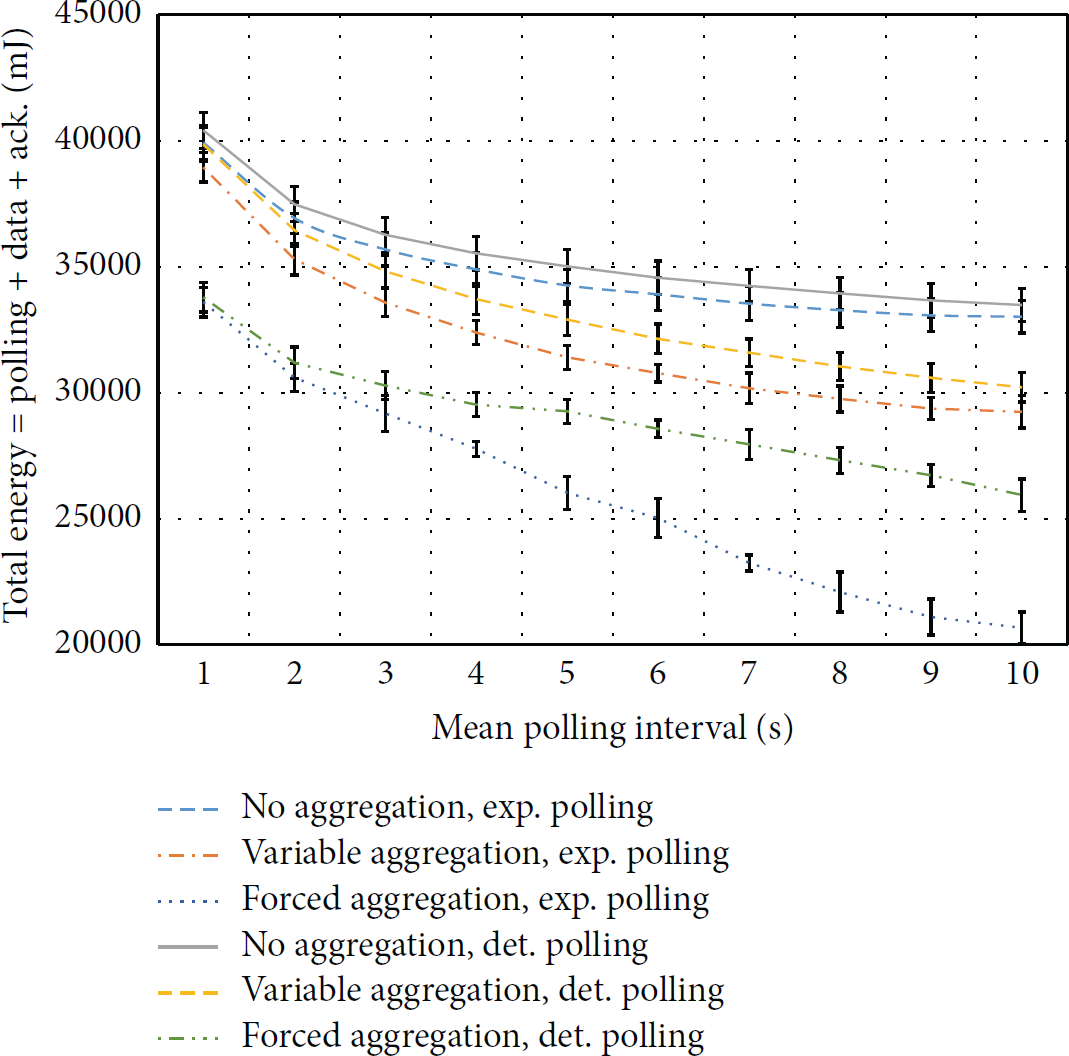
Total energy consumption for different cases of exponential interarrivals.
Comparison of all the above cases depicts that the energy consumption is lowest for the “forced aggregation” and highest for “no aggregation,” while the consumption for “variable aggregation” lies in between of the previous two cases. Therefore, the findings are the same as that of deterministic interarrivals.
4.2.2. Average Delay
The average delay for exponential arrivals with different aggregation and polling mechanisms is illustrated in Figure 9.

Average delay for different cases of exponential interarrivals.
The delay of the “forced aggregation” is higher as compared to the cases of “no aggregation” and “variable aggregation.” The exponential polling results in higher delay for all the cases of packet aggregation. As for the deterministic arrivals, the trade-off between energy and delay exists for the exponential arrivals as well.
4.2.3. Varying Traffic Arrival Rate
The arrival rate has been varied for exponential arrivals, keeping the mean polling interval constant at 5 sec. The results of average delay and total energy consumption are shown in Figure 10.
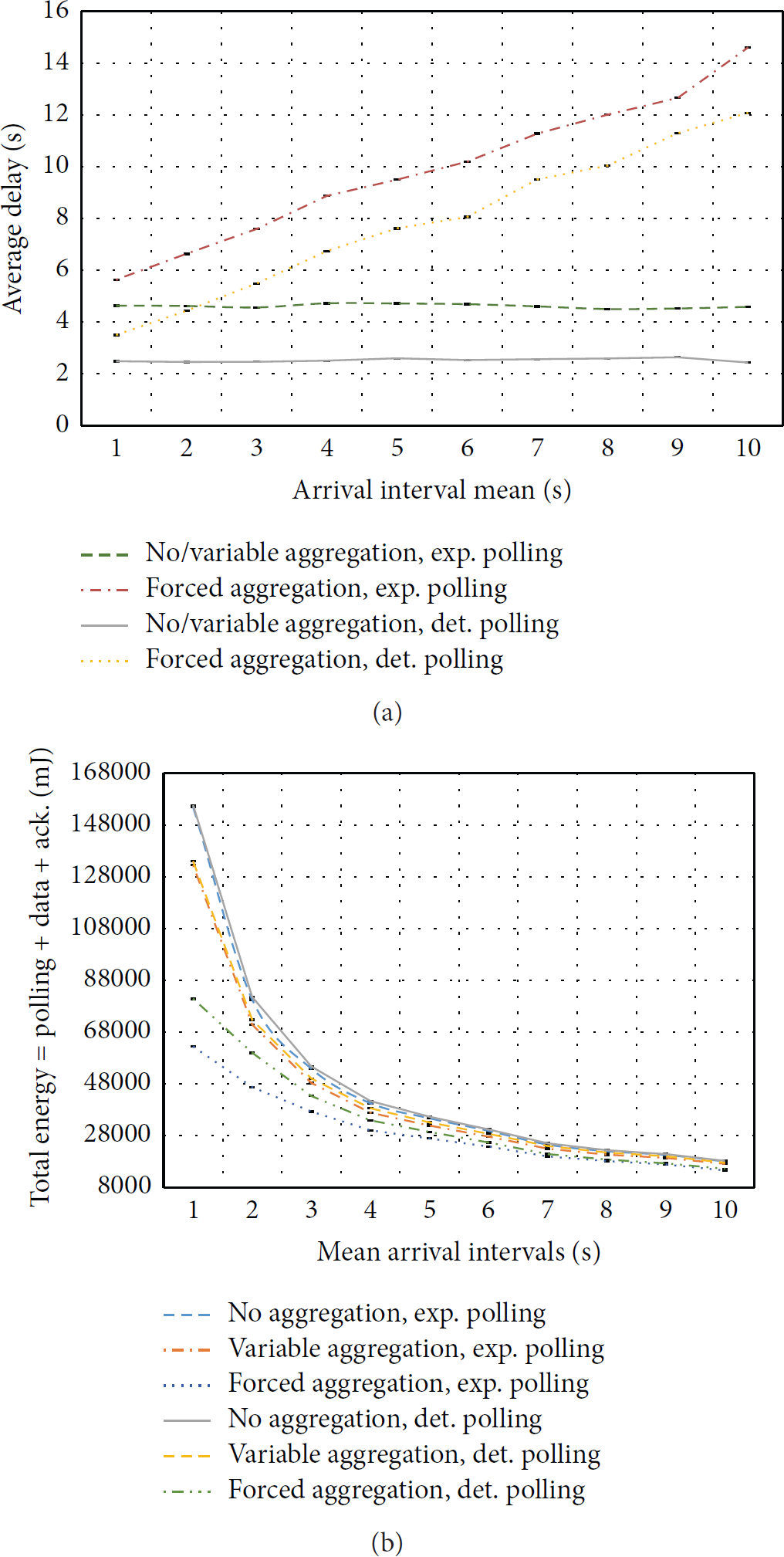
Exponential arrivals with deterministic and exponential polling: (a) impact of varying arrival rate over the delay performance and (b) impact of varying arrival rate over the energy performance.
As evident from the above results, the “no/variable aggregation” has lower delays as compared to the “forced aggregation.” For “no aggregation,” the values of delay remain constant while the shift in values can be seen for deterministic and exponential polling. On the other hand, the forced aggregation shows increasing trend for delay at high arrival means. This is due to the large difference between the packet arrivals with a consequent delay in reaching the burst size 3.
According to Figure 10(b), the energy consumption is low for the case of forced aggregation and exponential polling, whereas the deterministic polling in every case exhibits higher energy consumption.
4.2.4. Varying Degree of Aggregation (DoA)
The impact of varying DoA for the exponential arrivals with both cases of polling can be seen in Figure 11. As seen in Figure 11(a), due to the inherent random nature of exponential arrivals, the trend is not smooth as was in the case of deterministic arrivals. However, the trend is increasing for average delay with the increase in DoA; exponential polling results in higher delay as compared to deterministic.
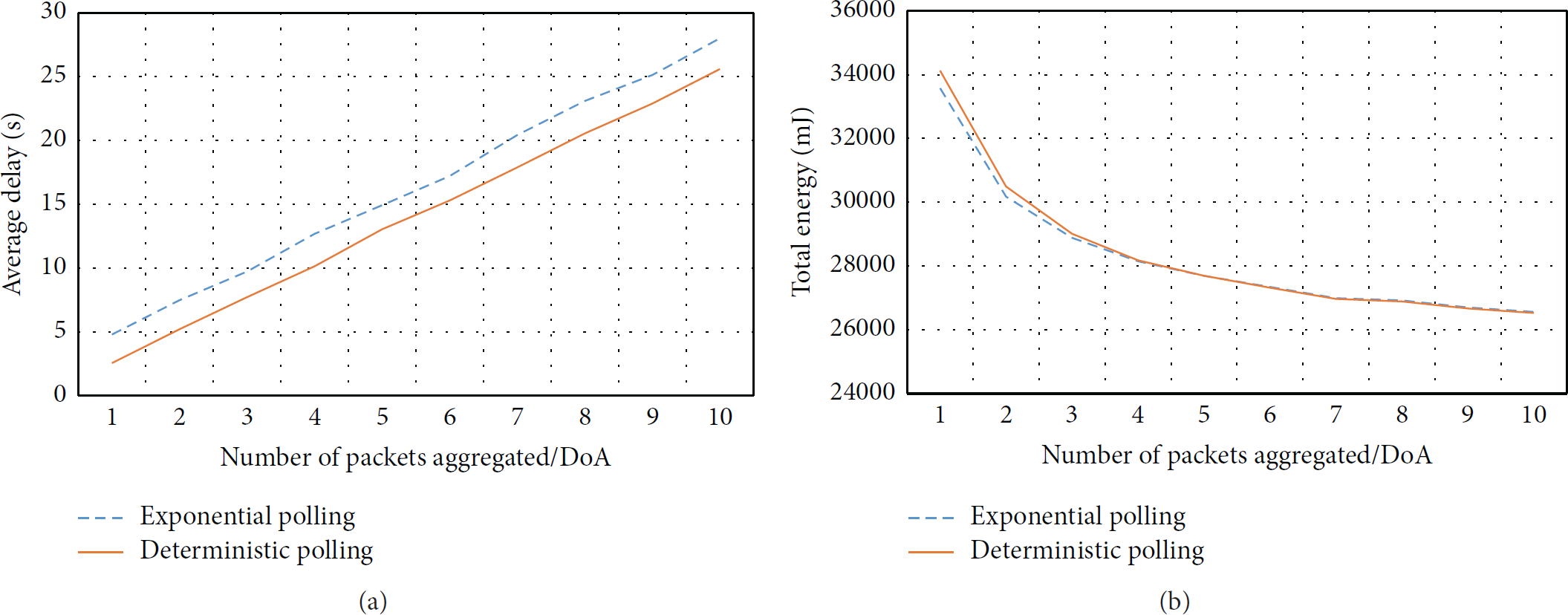
Exponential arrivals with deterministic and exponential polling: (a) impact of DoA over the delay performance and (b) impact of DoA over the energy performance.
Figure 11(b) shows the results of total energy consumption with the decreasing trend for the increasing values of DoA. The reduction in energy consumption is due to the less number of transmitted overhead bytes and block acknowledgements at high values of DoA.
4.2.5. Impact of Probability of Error
All the experimental settings for this section are kept similar to those of Section 4.1.5, except the arrivals which have been taken as exponential in this case. Figure 12 depicts the energy and delay with and without retransmissions. For both the polling distributions, the energy and delay with retransmissions came out to be higher, due to the increasing aggregation and subsequent increase in

Impact of increasing
4.3. Energy and Delay Optimization
The normalized values of energy consumption and average delay have been plotted on a single graph for each combination of arrival and polling interval distribution, in order to find out the optimal values of polling interval mean. The normalization criteria used are as follows:


Each of the cases for interarrival and polling intervals distribution has been used for performing the optimizations. Figures 13 and 14 represent the case of exponential arrivals for all aggregation scenarios studied. As illustrated in Figure 13, for the case of exponential arrivals-deterministic polling, the value of mean polling interval with no aggregation is found to be 3.8 sec; it is 4.2 for the variable aggregation and 4.6 sec for the forced aggregations.
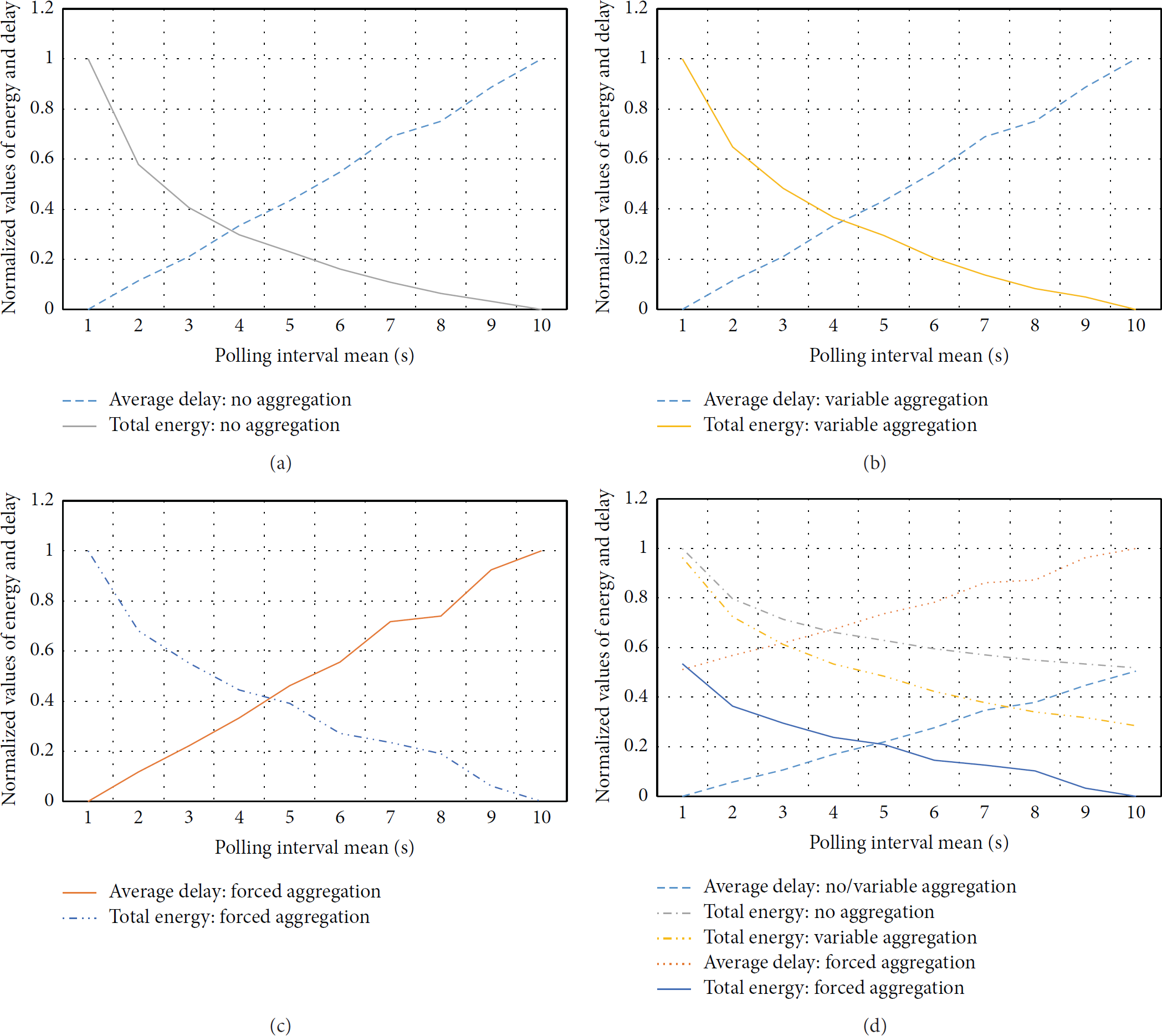
Normalized values of energy and delay for exponential arrivals-deterministic polling: (a) no aggregation, (b) variable aggregation, (c) forced aggregation, and (d) comparing the optimal point for different aggregations.
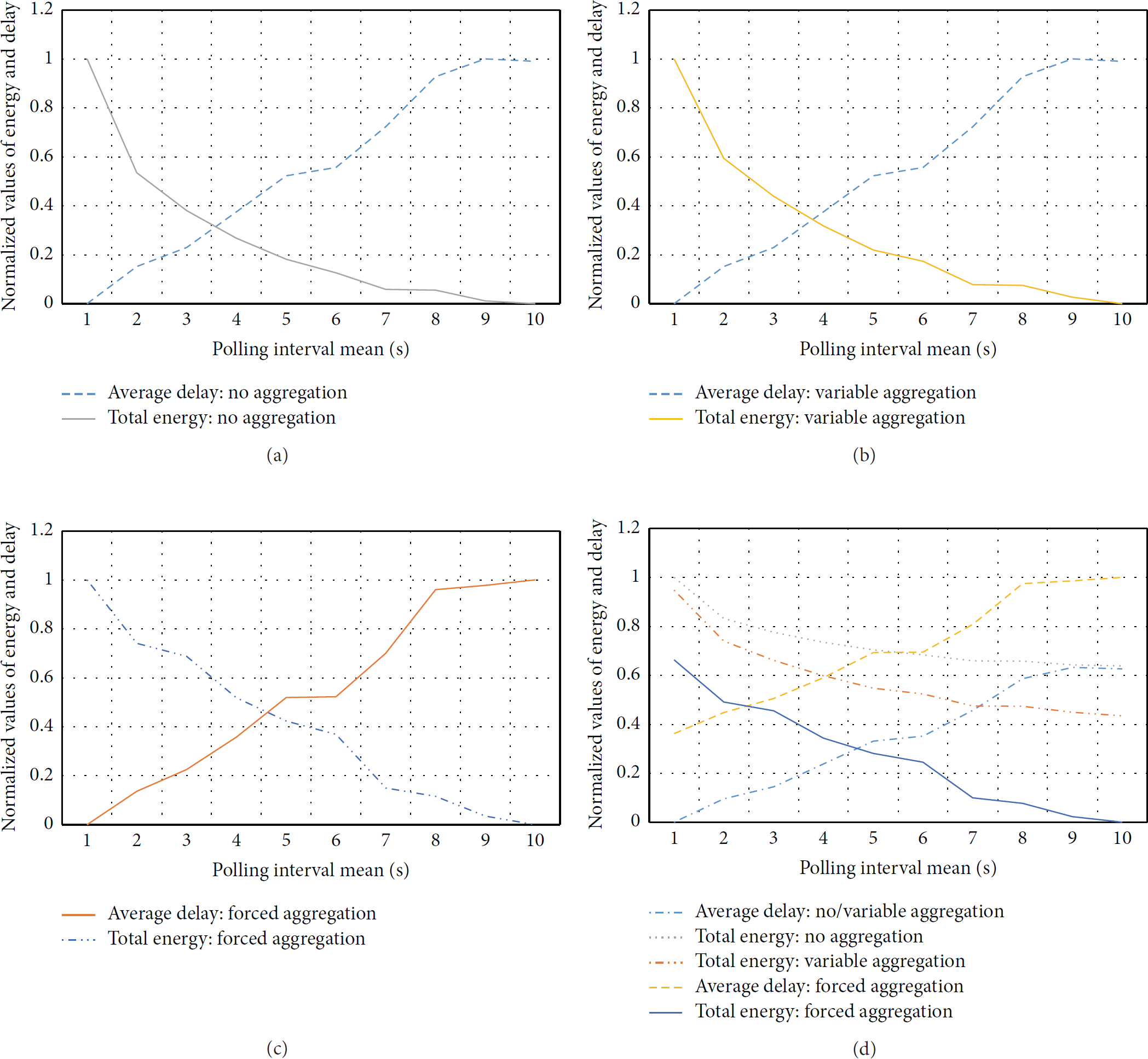
Normalized values of energy and delay for exponential arrivals-exponential polling: (a) no aggregation, (b) variable aggregation, (c) forced aggregation, and (d) comparing the optimal point for different aggregations.
The comparison of all the aggregation cases for the exponential arrival-deterministic polling has been shown in Figure 13(d). This figure can only be used for comparing the cases but it cannot specify the optimal polling interval of any one, as the normalization criteria now used have combined the all cases. Therefore, it is revealed that for the application requiring energy efficiency forced aggregation would suit, while no or variable aggregation mechanisms shall be used for delay sensitive applications.
Next, the optimization is performed for exponential arrival-exponential polling case. Here, the mean polling interval is found to be 3.6 sec for no aggregation; for variable aggregation, the value is 3.8 sec while it is 4.6 sec for the case of forced aggregation. This is shown in Figures 14(a), 14(b), and 14(c), whereas Figure 14(d) shows the comparison of normalized values for the 3 cases of aggregation.
In case if the application is based on the exponential arrivals and exponential polling, Figure 14(d) can be used to select the aggregation mechanism based on the optimization requirement. For the applications with minimum delay requirement, forced aggregation shall be used, while no or variable aggregation shall be used for the delay sensitive applications. However, the forced aggregation would serve best for the applications requiring optimizing performance based on both energy and delay.
5. Conclusions and Future Work
This work proposed combining the techniques of altering the polling interval distribution, packet aggregation, and block acknowledgement transmission for improving the energy efficiency of the WSN MAC protocols. The major contribution of the study is to suggest the selection of polling interval distribution based on the optimization objective of any WSN application. The simulation results for deterministic and exponential traffic arrivals and polling distributions are presented and analyzed. The impact of varying mean of polling intervals, DoA, and traffic loads over the energy and delay performance has been illustrated. Moreover, the optimizations have also been performed using normalization criteria.
It has been found that the exponential polling serves best for improving the energy performance, while the deterministic is more suitable for achieving delay efficiency. Also, the low DoA results in lower delay and high energy consumption. The low arrival intervals result in lower delays and higher energy consumptions for no aggregation, while the forced aggregation demonstrates the opposite phenomenon. The impact of probability of error has been studied on the delay and energy for both the polling distributions. The probability of error is assumed to be there due to the bit error rate, and the number of retransmissions is computed based on this probability. With the increasing DoA, the number of retransmissions and the resulting energy consumption and delay incurred are found to be increasing. However, deterministic polling is found to perform well in terms of delay, and exponential polling is found to be better at energy performance even when the transmission errors are incorporated.
The optimal values of mean polling intervals have also been suggested on the basis of arrival and polling distributions. Thus, the polling distribution should be deployed by the MAC protocol, based on WSN application requirements of improved delay or energy performance. In addition to the impact of altering the polling distributions, the features of transmitting aggregated packets with the reduced bytes of overhead, and block acknowledgement would also help the MAC protocol to further reduce the energy consumption.
In the future, we plan to extend this research by developing a MAC protocol based on the proposed techniques of switching polling interval distribution, packet aggregation, and block acknowledgement transmissions. The protocol would fit to a wide range of WSN applications, as it could ensure the efficiency in terms of energy or delay, or even of both in accordance with the applications requirement. The efficiency of suggested protocols would then be compared with the established MAC protocols such as SCP-MAC and AS-MAC.
Footnotes
Conflict of Interests
The authors declare that there is no conflict of interests regarding the publication of this paper.