




Abstract
We propose a quality-aware media access control (MAC) protocol for real-time voice delivery in cognitive radio- (CR-) enabled wireless sensor networks (WSNs). The temporal structure of the system model is addressed by using periodic timeslots in order to make more efficient use of the spectrum. In our proposed temporal structure, a bandwidth broker in such centralized CR networks (CCRNs) is selected as a central counterpart to synchronize with secondary users (SUs) and assign spectral resources to them. We develop an analytical model for SUs for the Call Admission Control (CAC) of voice traffic using the quality of service (QoS) requirements of delay bound and delay bound violation probability. Ours is an approach that provides reliable data transmission and reduces packet delay and packet delay jitter. In addition to the aforementioned packet-level performance metrics, we calculated a call-level performance metric, that is, the number of acceptable SUs, satisfying QoS requirements.
1. Introduction
With the introduction of the Internet of Things (IoT), wireless sensor networks (WSNs) are expected to play an important role in future social technologies. Major applications of WSNs have traditionally involved the simple use of sensing and reporting [1], since the nodes in WSNs are constrained in terms of storage resources, computational capability, communication bandwidth, and power supply [2, 3]. WSNs used for applications such as emergency healthcare and disaster surveillance are required to support voice and low-rate video capabilities. These networks also have stricter quality of service (QoS) requirements, such as low data latency and maximum reliability, than traditional WSNs [1].
Although the collective effort of all communication protocols is necessary for QoS provision, the media access control (MAC) layer is particularly important because its medium sharing and influence on upper-layer protocols are dominant [1]. The numerous QoS-aware MAC protocols that have been proposed for WSNs [4–11], which we survey in Section 2.2, all assume the presence of only licensed users, that is, primary users (PUs), in the network.
However, WSNs mostly operate in license-free bands and are expected to suffer heavy interference from other wireless networks sharing the same spectrum [12]. With the imposition of increasing demands on wireless networks by the license-free spectrum, it is difficult to guarantee QoS only for WSNs. Therefore, the coexistence of multiple networks in the same license-free spectrum becomes inevitable and raises issues regarding improving spectral efficiency and providing QoS for real-time traffic [12].
A cognitive radio network (CRN) is a promising approach to providing real-time services in a WSN with strict QoS requirements [13]. According to their network architecture, CRNs can be categorized into centralized CRNs (CCRNs) and distributed CRNs (DCRNs). The CCRN has a central network entity, such as a base station (BS) in cellular networks or an access point (AP) in wireless local area networks (WLANs). On the contrary, an unlicensed user, that is, a secondary user (SU), in the DCRN can communicate with other SUs through ad hoc connections on unlicensed bands. Thus, the CCRN is a suitable network architecture for WSNs, where each sensor node determines how to recognize available channels and which available channel to access [14].
The flux in the availability of licensed channels poses severe problems in guaranteeing acceptable QoS for voice users [15]. When channel availability varies with the activities of PUs on licensed channels, voice calls requested by SUs should accordingly be regulated to ensure the satisfaction of QoS requirements. Thus, unlike traditional QoS provision, which relies primarily on traffic statistics, providing QoS for SUs should be implemented through spectrum sensing, spectrum access, and the admission control across the relevant network layers [14].
Some research has been conducted in recent years on modeling CRNs with voice traffic [16–22], but this is insufficient. Furthermore, from the viewpoint of network architecture, most past research on CCRNs has been conducted under unrealistic assumptions, which we detail in Section 2.3.
In this paper, we propose a quality-ware MAC protocol for real-time voice delivery in CR-enabled WSNs. For more efficient Call Admission Control (CAC) for voice traffic, we propose a temporal structure with periodic timeslots for CR-enabled WSNs. The IEEE 802.11 distributed coordination function (DCF) [23] is applied to several SUs to avoid interference with PUs in a timeslot. Furthermore, a bandwidth broker (BB) is automatically determined by the proposed temporal structure, and operates as a central counterpart in the network. The BB is responsible for identifying available resources in PU channels and assigning them to SUs. We thus develop an analytical model for the satisfaction of QoS requirements by the CAC. We used delay bound and its violation probability as QoS requirements and calculated the following packet-level and call-level performance metrics using our model: average packet delay, packet delay jitter, and the number of acceptable SUs.
The rest of this paper is organized as follows. In Section 2, we describe the QoS requirements for real-time voice delivery as well as research in the area related to QoS-aware MAC protocols. The system model and operation of our proposed scheme are described in Sections 3 and 4, respectively. In Section 5, we detail the analytical and simulation-based results obtained from the proposed scheme. We offer our conclusions in Section 6.
2. Related Work
2.1. QoS Requirements for Real-Time Voice
The pattern of packet arrivals closely follows that of speech generation: that is, this source of traffic exhibits “intrinsic temporal behavior” [24], and this pattern must be preserved for faithful reproduction of the speech at the receiver's end. The packet network will introduce delay: fixed propagation delay as well as queuing delay that can vary from packet to packet. Hence, the network cannot serve such a source at arbitrary rates, as in the case of elastic traffic. In fact, depending on the adaptability of a stream source, the network may need to reserve bandwidth and buffers in order to provide an adequate transport service to a stream source. Applications such as real-time voice and video conferencing are examples of stream sources.
The following are typical QoS requirements of stream sources.
Delay (Average and Variation (Jitter)): real-time interactive traffic requires tight control of end-to-end delays. For example, for voice packets, the end-to-end delay may need to be controlled for it to be shorter than the delay bound with a violation probability of less than 0.01. Packet Loss: due to the high levels of redundancy in speech and images, a certain amount of packet loss is imperceptible. For example, in voice packets where each packet carries 20 ms of speech and the receiver conducts lost packet interpolation, 5% to 10% of the packets can be lost without significant degradation of speech quality. Due to delay constraints, the acceptable packet loss target cannot be attained by first losing and then recovering the lost packets; in other words, stream traffic expects a specific “packet loss ratio” from the packet transport service.
In this paper, as well as the aforementioned packet-level performance metrics, that is, average packet delay and packet delay jitter, we define the number of acceptable SUs, that is, the number of voice calls, in CR-enabled WSNs as a call-level performance metric. We assume that no packet loss occurs in the network because only SUs are accepted when achieving QoS requirements, and thus the relevant packets are transmitted successfully.
2.2. QoS-Aware MAC Protocols for WSNs
The MAC layer of the architecture stack plays a key role in QoS provision because the upper layers cannot be accessed without the assumption of a MAC protocol that solves the problems of medium sharing and supports reliable communication. Various MAC protocols for WSNs have been proposed for decades, but few consider QoS support. The primary motivation underlying almost all traditional MAC protocols is energy awareness due to the characteristics of WSNs, such as severe resource constraints and harsh environmental conditions. However, there is a rising need for efficient QoS-aware MAC protocols, proportional to the increasing number of the fields of their applications, such as health care, surveillance, and process control.
QoS-aware MAC protocols for WSNs are categorized into two trends: protocols with differentiated service [4–8] and application-specific protocols [9, 10]. The former provide service differentiation by varying contention window (CW) size, contention slot selection probability, transmission slot scheduling, interframe space (IFS) duration, the backoff exponent, and adaptation coefficients. The latter fulfills the QoS requirements of specific applications that perform multimedia transmission, vehicular communication, tactical communication, and so forth. They attempt to provide hard/soft QoS bounds by employing various mechanisms, such as adaptation and learning, data suppression and aggregation, error control, and clustering.
A system for quality-aware voice streaming (QVS) in WSNs has most recently been proposed [11]. QVS comprises several novel components, including an empirical model for online voice quality evaluation and control, dynamic voice compression/duplication adaptation for lossy wireless links, and distributed stream admission control that exploits network capacity for rate allocation.
2.3. Real-Time Voice Services in CRNs
With the development of CR technology, voice services are considered very important and useful in CRNs. However, scant research has been conducted on the mathematical modeling of CRNs while considering voice traffic. For mathematical verification, [16–19] assumed a fixed number of secondary users [16–18], only one wireless channel [17], or an infinite backlog model [18]. Moreover, traffic analyses developed in [16–19] ignored the effect of unreliable spectrum sensing.
More importantly, the Call Admission Control (CAC) scheme has not been considered in [16–18] to guarantee QoS for voice services. Hence, [16–18] did not consider the admission control scheme with the call-level dynamics of the system. CAC schemes for multimedia streaming have been proposed in [21, 22]. These schemes assume that PUs and SUs generate traffic modeled by a Poisson arrival process and consider call blocking and dropping probabilities to be QoS requirements of admission control. In this paper, we deploy the infinite backlog model for the voice packet generation of each SU in order to measure the number of concurrent connections. For this, we define the number of acceptable SUs in the network to satisfy the following QoS requirements: delay bound and delay bound violation probability. These are described in Section 2.1.
We calculate average packet delay and packet delay jitter for packet-level analysis and use the number of acceptable SUs as the call-level performance metric. However, [21, 22] use fragmentary approaches using performance metric. Only call-level analysis was conducted in [21], due to which the delay was unknown. Contrary to [21] with call-level performance metric, while [22] compared the proposed scheme with complete sharing in terms of packet-level performance metrics, its results were unrestricted by such delay bounds and delay bound violation probabilities.
It is further assumed in [21, 22] that a channel is only used for an SU to deliver its packet. This is an impractical assumption that can lead to inefficient spectrum use. Thus, given a condition that satisfies QoS requirements, our proposed scheme makes multiple SUs occupy a channel and contend with one another based on IEEE 802.11 DCF [23] in order to judiciously use the channel.
Of [16–22], the majority of studies concerned CCRNs. The central entity in these networks is a secondary base station (SBS), a sink node, and so forth. A few [18, 19] consider the DCRNs, where the channel access of each SU is controlled by a distributed MAC protocol. In [18], slotted ALOHA and round robin protocols were used without considering the accompanying control signaling overhead incurred for executing the protocols. There was a limitation in [19] whereby each channel can be accessed only by one SU. The greater the number of SUs, the greater the control overhead required. Thus, this kind of overhead should be considered as it affects network performance.
3. System Model
We consider a CR-enabled WSN, as shown in Figure 1. The network consists of four kinds of nodes: primary users (PUs), a primary base station (PBS), secondary users (SUs), and a bandwidth broker (BB). The PUs represent legacy nodes with a license for occupied channels. All channels licensed by PUs are monitored continuously by the PBS, which can determine the status of a given channel by estimating the available bandwidth, as detailed in Section 4.1. The available bandwidth estimated by the PBS is then delivered by periodically transmitting a beacon message. The BB is automatically determined among SUs through an algorithm and is operated as a central counterpart that synchronizes with other SUs and assigns spectrum resources in the network, as detailed in Section 4.2. The BB receives the beacon message from the PBS, and thus knows the status of the relevant channel. The BB then transmits a beacon message, including the estimated available bandwidth, periodically to SUs to notify them regarding channel availability at any given time. An SU represents an unlicensed user communicating with another SU in ad hoc connection, as shown in Figure 1. The SUs are interested in real-time voice with stringent QoS requirements. Once SUs receive the beacon message, they inquire with the BB regarding a channel to transmit a real-time voice by exploiting a JOIN message based on channel availability. The BB that receives requests admits or rejects them using the Call Admission Control with strict QoS requirements detailed in Section 4.3. The SU admitted by the BB sends its voice traffic by contending with the other SUs over an assigned channel. Note that all control signaling, except contention-based data transmission over assigned channels, is performed in a control channel.
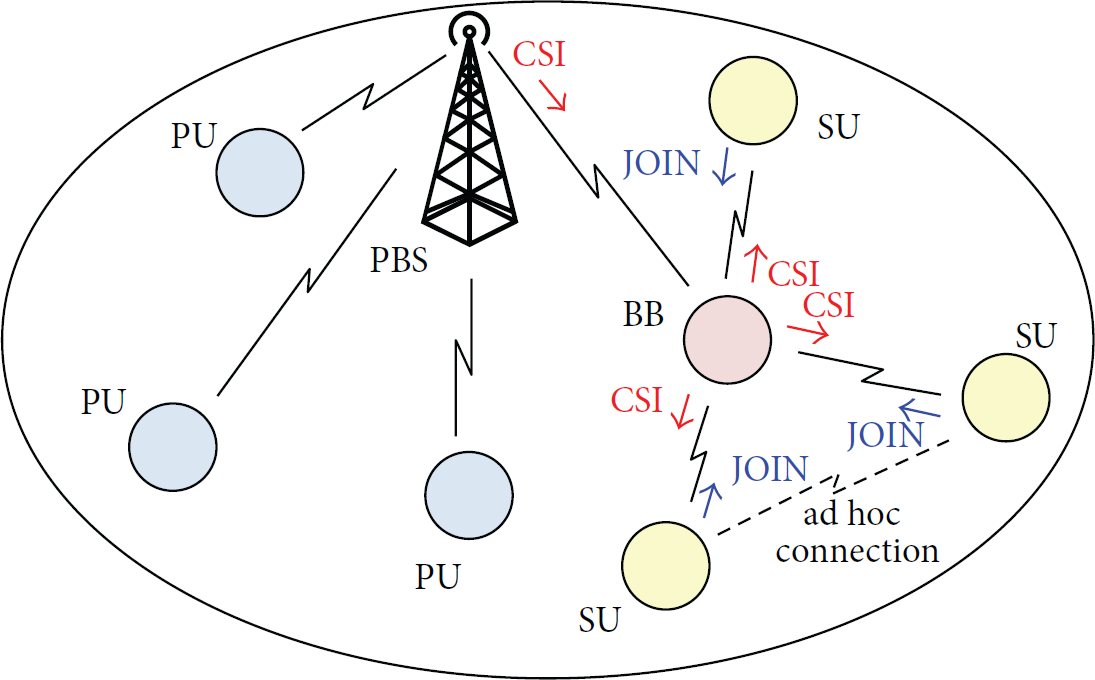
A CR-enabled WSN scenario for the proposed scheme.
Figure 2 shows the temporal structure for the QoS provision for real-time voice traffic in CR-enabled WSNs, where a single control channel as well as

Temporal structure for real-time voice delivery in CR-enabled WSNs.
We further assume that time in the PU channels is divided into timeslots, each of which has a duration of
In order to use a timeslot at any given time, the state of the PU channel is sensed by SUs assigned to the channel by the BB during the sensing period (

4. Quality-Aware MAC for CR-Enabled WSNs
4.1. Available Bandwidth Estimation
Available bandwidth estimation (ABE) is one of the most critical functions in all QoS mechanisms applicable to CRNs [29]. A number of studies on estimating the available bandwidth in wireless networks have been conducted. However, it remains a challenging problem in CRNs because the radio environment changes momentarily due to the activities of PUs, and hence the wireless bandwidth needs to be shared among SUs to prevent interference in the PUs in the network.
In this paper, we propose a practical approach for the BB to periodically estimate the available bandwidth of PU channels. Here, it is assumed that channel states are classified into busy and idle. The passive listening method [29] is used to estimate bandwidth. The PBS is capable of continuously monitoring changes in channel state, thus listens to all channels to determine channel status, and computes the busy time for


Therefore, the PU channel utilization measured by PBS is written as

As shown in Figure 1, BB performs a role in a central entity that synchronizes with other SUs and assigns available channels to them in a CR-enabled WSN. To this end, it receives the beacon message from the PBS to synchronize and know the channel availabilities estimated by the PBS for each beaconing period (
4.2. Bandwidth Broker Selection
The available bandwidth can be controlled independently by users, or by agents with some knowledge of the priorities and policies of the relevant organization, such that they can allocate bandwidth with respect to these policies. Independent labeling by users is simple to implement but unlikely to be sufficient for pertinent resource allocation, since it is unreasonable to expect all users to know all of their organization's priorities and network use policies, and to always mark their traffic accordingly.
In this CR-enabled WSN, an agent called the bandwidth broker (BB) is required to perform admission control in order to determine whether an incoming voice call request will be accepted and to synchronize with the SUs.
For the proposed scheme, a BB is required to periodically send beacon messages, thereby allowing each SU to synchronize with the others and share its available bandwidth information through the network. The procedure for selecting the BB is as follows: An SU joining the CR network first attempts to receive beacon messages periodically sent by the BB. If it does not listen to any beacon messages for K consecutive
Moreover, for seamless voice call management, a backup BB is required when the BB no longer exists. An SU that needs voice service sends a voice call request, that is, a JOIN, message, to the BB. If the BB receives the message for the first time, it responds with beacon messages to the effect that the relevant SU has been selected as the backup BB. Hence, the backup BB can substitute for this role even though there is no BB in the network.
4.3. Voice Call Admission Control
To guarantee the QoS of voice traffic, it is crucial to apply a proper CAC mechanism. CAC is responsible for accepting and rejecting new voice calls based on the available bandwidth to satisfy the QoS requirements of all admitted voice calls. Let

The probability that an SU takes the chance to occupy an available PU channel is given by


Moreover, the probability that a channel state secured by an SU changes from idle to busy is as follows:

In order to identify a packet that satisfies the delay bound and the delay bound violation probability, we need to know the number of timeslots used to serve a packet that has arrived. Figure 3 shows an instance of voice packet arrival and the corresponding timeslots over the ith channel.
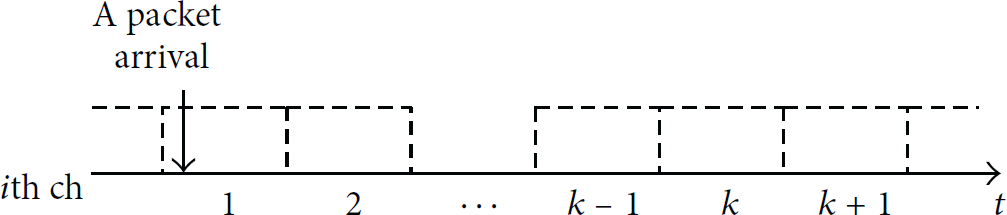
Voice packet arrival and the corresponding timeslots over the ith channel.
Thus, we obtain the probability that an SU sends its packet at the next kth timeslot [

The number of timeslots, denoted by x, from the first timeslot where a packet is generated to the kth timeslot to which it is successfully transmitted such that it exceeds the delay bound, denoted by δ, is first required as follows:

With (9) and (10), the probability that the delay time

Thus, we can attain the maximum number of acceptable SUs as the call-level performance metric in the presence of a constraint on the delay bound violation probability ε as follows:
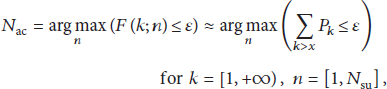
Algorithm 1 is the procedure for Call Admission Control in the BB to accept or reject call requests by SUs in the network, using (12). The BB first receives a beacon message from the PBS and updates
Input:
δ
,
ε
Update (1) (2) It broadcasts beacon to notify of the withdrawal of (n – (3) (4) (5) (6) (7) It sends ACK to accept the SU in the network. (8) (9) It sends NACK to reject the SU for the network. (10) (11) (12) (13) It sends ACK to allow the SU to leave the network. (14) (15)
If
4.4. Voice Packet Delay Analysis
Quality of service is a major issue in real-time voice traffic. The fluctuation in the availability of licensed channels poses severe problems with regard to guaranteeing acceptable QoS for voice users [15]. When channel availability varies with the activities of the PU on licensed channels, voice calls requested by the SUs should be accordingly regulated to ensure voice service satisfaction. The service requirement for voice calls is characterized by average packet delay and delay variations (jitter) at the packet level. The specified end-to-end packet delay requirement refers to the absolute value of delay experienced by voice packets. In this section, we analyze the average packet delay and the packet delay jitter as packet-level performance metrics to test the reliability of our proposed scheme.
Packet delay is the amount of time it takes for a packet to travel from end to end. Let


If the delay is short and constant, voice quality is unaffected. Voice quality is affected by considerable packet delay variation (jitter), that is, the fluctuation, from packet to packet, in the time taken from the generation of a packet at the source to its arrival at the receiver. Accordingly, using (9) and (14), we compute
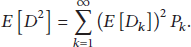
From (13) and (15), we can compute the packet delay jitter J of the packet delays [31, 32]:

5. Performance Evaluation
For the analytical and simulation-based results, we used MATLAB as performance analyzer. The parameters employed in the proposed scheme are shown in Table 1. Unless otherwise specified, the following parameters were used in the plots shown in this section: The number of control and PU channels was set to one and five, respectively. The PBS and the BB transmit beacon messages every second over the control channel to synchronize with other SUs and share the available bandwidth. Considering the IEEE 802.11b [23] as the physical medium,
Parameters of the proposed scheme.

All our numerical results were validated by our simulation. To show this, Figure 4 shows the number of acceptable SUs versus PU channel utilization with

Analytical and simulation-based results for the number of acceptable secondary users plotted against the channel utilization of primary users, with
It is necessary to check whether the proposed scheme could stably perform for SUs allowed to join the network. Figure 5 plots the average packet delay against packet delay jitter for whether the proposed scheme is applied, where

Average packet delay and packet delay jitter plotted against PU channel utilization for whether the proposed scheme is applied, where
Figure 6 shows the analytical results for the number of acceptable SUs plotted against PU channel utilization with (a)
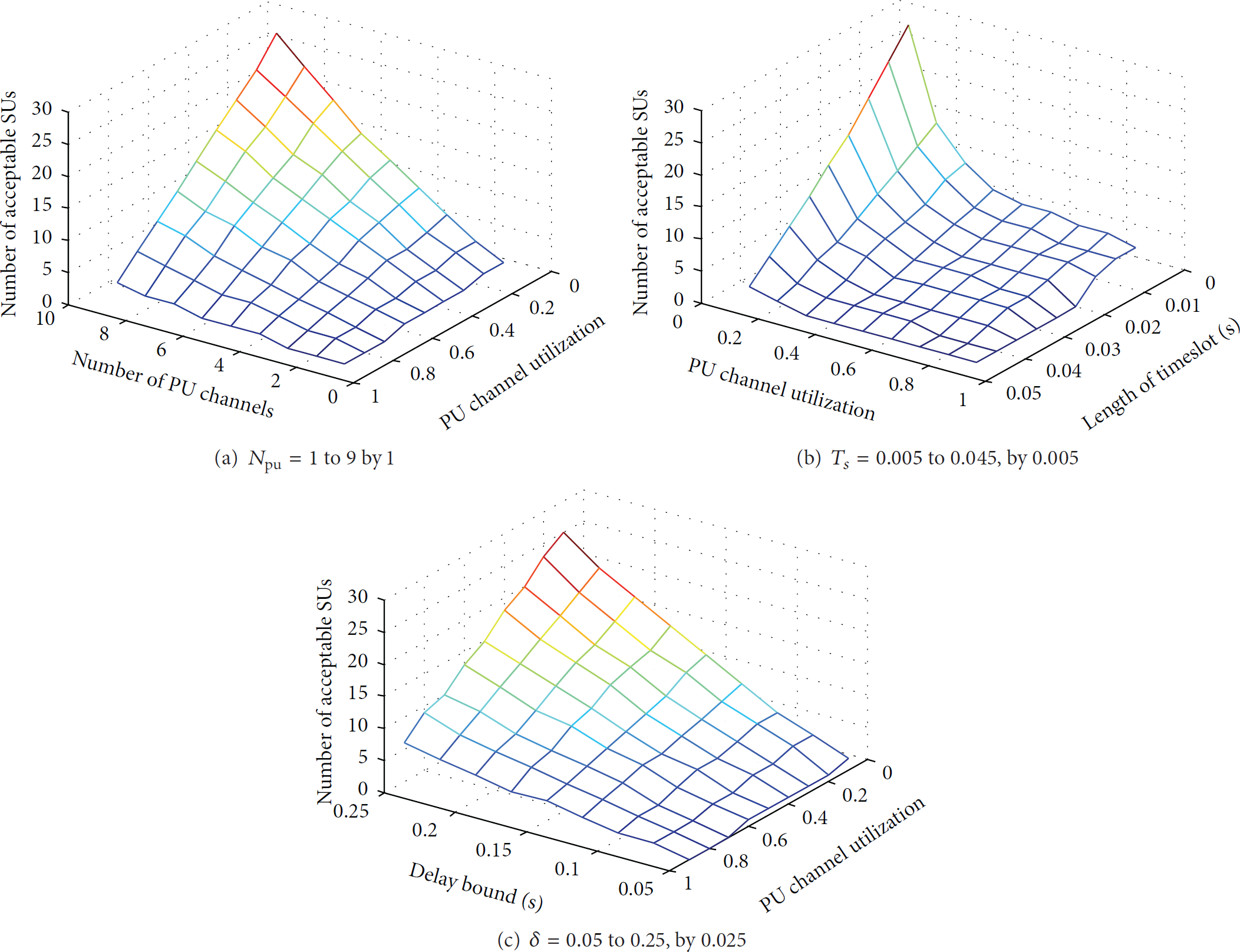
Variation in the number of acceptable SUs plotted against the channel utilization of PUs with (a)
6. Conclusion
In this paper, we proposed a quality-aware MAC protocol for real-time voice delivery in CR-enabled WSNs. For QoS provision in CR-enabled WSNs, we first address the temporal structure of the system model. A bandwidth broker as a central entity for such CCRNs is selected automatically in the proposed temporal structure. The BB then synchronizes with other SUs and allocates the remaining resources utilized by PUs based on the estimated available bandwidth. We noticed that with regard to QoS requirements, that is, the delay bound and the delay bound violation probability, we developed an analytical model for evaluating the number of acceptable SUs for call-level analysis, as well as average packet delay and packet delay jitter for the packet-level analysis. We showed that the number of acceptable SUs varied according to the composition of the number of PU channels, the duration of the timeslot, and the delay bound. With the calculated average packet delay and the packet delay jitter, we confirmed that the proposed scheme can stably ensure reliable packet delivery to accepted voice users. In spite of these challenges, it is necessary for the proposed scheme to calculate optimal parameters to guarantee voice delivery.
Footnotes
Conflict of Interests
The authors declare that there is no conflict of interests regarding the publication of this paper.
Acknowledgment
This work was supported by the National Research Foundation of Korea (NRF) grant funded by the Korea Government (MSIP) (no. NRF-2015R1A2A2A01005577).