




Abstract
To extract statistic features of communication signal from compressive samples, such as cyclostationary property, full-scale signal reconstruction is not actually necessary or somehow expensive. However, direct reconstruction of cyclic feature may not be practical due to the relative high processing complexity. In this paper, we propose a new cyclic feature recovery approach based on the reconstruction of autocorrelation sequence from sub-Nyquist samples, which can reduce the computation complexity and memory consumption significantly, while the recovery performance remains well in the same compressive ratio. Through theoretical analyses and simulations, we conducted to show and verify our statements and conclusions.
1. Introduction
Communication signals exhibit cyclostationary property associated with symbol period, carrier frequency, pilot position, and so forth. Because cyclic features embedded in signal are quite robust to both noise uncertainty and additional white noise, which have been exploited for various purposes, including signal detection, classification, parameter estimation, synchronization, and equalization [1]. However, signal processing based on cyclic features always requires high-rate sampling which is very costly in the wideband regime. Compressed sensing is a technology proposed by Candies and Donoho in 2004 that use fewer samples than Nyquist theory and can meet the challenge of big data and ultra wide band signal processing [2, 3]. Traditionally, in CS framework, signal recovery is achieved using nonlinear and relatively expensive optimization-based or iterative algorithms. But for the purpose of extracting cyclic feature only, signal recovery is not actually necessary or somehow expensive. An alternative approach in such signal processing problems is solved directly in the compressive measurement domain without first resorting to a full-scale signal reconstruction [4, 5].
Taking the sparsity of signal's cyclic spectrum into consideration, a cyclic feature detection method based on compressive measurements is proposed by Tian and others [6], which is widely accepted by recent fellows. In the framework, signal's 2D cyclic spectrum was reconstructed based on CS theory and spectrum occupancy estimation was done on the frequency sets of 2D cyclic spectrum according to binary hypothesis test [6]. However, the reconstruction formulation they used is quite complex that contains multiple Kronecker product and pseudoinverse operations, which make the reconstruction hard to be implemented in practice. Besides, when it is used in multiple carrier systems, for example, OFDM system, the vector length dramatically increases as the number of subcarriers gets larger and matrixes in the formulations are of tremendous scale which is hard to implement in practice.
In our study, taking signal's cyclostationary property into consideration, signal detection and recognition could be accomplished in use of cyclic-autocorrelation function (CAF) [7]. Inspired by the process of 2D cyclic spectrum reconstruction, we choose reconstructing the signal's sparse CAF according to CS theory. However, we find that the computational complexity is still quite high and the memory requirement is considerable. So in this paper we propose a new cyclic feature recovery approach based on the reconstruction of autocorrelation function with sub-Nyquist samples [8, 9], which can reduce the computation complexity and memory consumption significantly, while the recovery performance remains well in the same compressive ratio. Basically in the method, not following the way of directly reconstructing cyclic feature, CAF is recovered by the reconstructed autocorrelation function. Another important contribution of this paper is that the theoretical model for the recovery performance was built to support both evaluating the effect of reconstruction error and achieving the exact recovery accuracy in the means of normalized mean squaring error. Moreover, we do the comparison with the method of directly recovering CAF by simulation, and the results are conducted to show and verify our statements and conclusions.
The remaining part of this paper is organized as follows. In Section 2, we present the system model. Section 3 describes the proposed cyclic feature recovery approach. In Section 4, we do theoretical analyses of algorithm performance. A modulation type classification application is demonstrated in Section 5. Simulation and analysis are present in Section 6. Finally, we present the conclusion in Section 7.
2. System Model
As in the definition of cyclostationary property, a wide-sense cyclostationary property signal


From the above expression, it prompts us that once we recover the autocorrelation sequence of the signal, the cyclic autocorrelation sequence will be calculated sequentially. In other words, autocorrelation sequence uniquely determines cyclic autocorrelation sequence.
Meanwhile in order to reduce the signal acquisition costs, compressive sampling could be adopted at the receiving side. More specifically, in the compressive sensing framework the sampling procedure is modeled as

To recover the cyclic cumulant of signal, the straightforward method is to reconstruct the original (or Nyquist rate) samplers based on compressive measurements firstly. However, the weakness of the way is the strict constraints on signal sparsity and compressive dimensionality. The other way is directly reconstructing cyclic cumulant (see Figure 1) from compressive samples, in which relating the compressive samples to CC accompanies high computation complexity due to the nonlinear projection. To avoid the aforementioned weakness, another way presented in the following is to reconstruct autocorrelation (see Figure 2) firstly and then retrieve the CAF. Its strong points are both significant compression and low-complexity relating operation.

Autocorrelation function of OFDM signal.
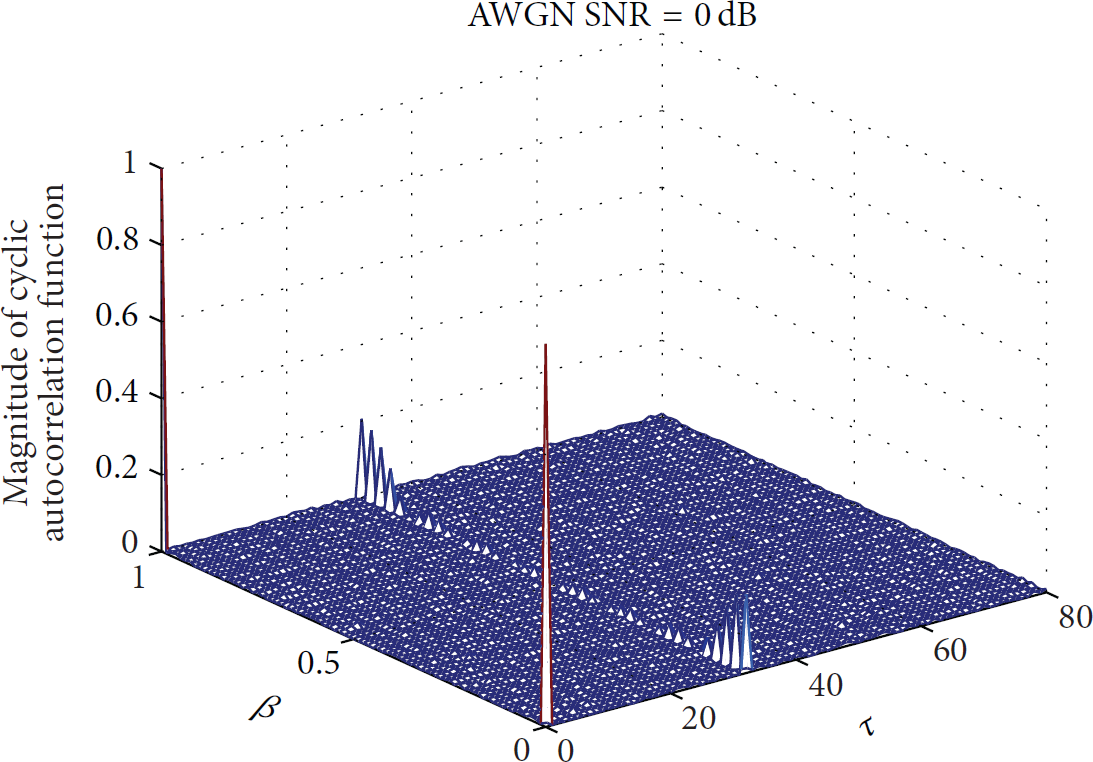
Cyclic autocorrelation function of OFDM signal.
3. CAF Recovery from Compressive Measurements
According to the theory of compressed sensing, to reconstruct the target signal with high probability, we need to confirm that the signal is sparse in some transformation domain; the measurement matrix used must be unrelated to the transformation matrix. Therefore, the sparsity property of autocorrelation function is discussed firstly in the following.
3.1. Sparsity of the Autocorrelation
As is referred to in Section 1, signal recognition and detection are conducted in the 2D (two dimensional) CAF domain. However to achieve well estimation performance and lower reconstruction complexity, we would like to set the 2D autocorrelation function as the sparse transformation domain to be recovered. For all n and τ are integers, the autocorrelation function of the signal is

So, the autocorrelation matrix


Under the system model, OFDM signal is cyclostationary property, so its autocorrelation function is periodical with period P:
3.2. Linear Relationships
The sampling can be modeled as


3.3. Cyclic Autocorrelation Recovery
As is analyzed in Section 3.1, the autocorrelation of a signal is sparse enough. According to the compressed sensing theory, the recovery of sparse object vector
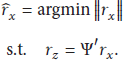
According to the sparsity reconstruction theory in CS, (9) can be transformed into a

The sampling matrix we choose in the front of the receiver is of Gaussian random distribution with a subsampling rate of
Once we have reconstructed the autocorrelation sequence, by referring to (2), the cyclic autocorrelation function is retrieved sequentially. Based on this method of recovery of CAF, we can show both calculation complexity and memory consumption are reduced significantly.
In the process of direct reconstruction of CAF, the sensing matrix used is
When considering the space consumption, in calculation of Ψ we need at least 7 mass matrices of size
4. Performance Analyses
Besides the reduction of computation complexity, in this section, we will show the accuracy performance of proposed algorithm is improved while compared to the direct reconstructing CAF method. Firstly, we present a reconstructing error (RE) model to analyze the maintenance of cyclic feature and the effect of reconstruction error. After that, the exact reconstruction performance of CAF is derived in the way of normalized mean square error.
4.1. Performance Analysis Based on RE Model
From the above analyses, for the recovered AF there may exist addition error


From the perspective of the maintenance of cyclic feature, we use the same error signal model of recovered AF as (11). In our study we do signal processing by a block of two OFDM symbols. And the estimated CAF can be expressed as follows:
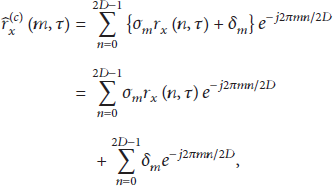
4.2. NMSE Evaluation
In this part, considering that the incomplete signal feature reconstruction method we use is not optimal, the recovery accuracy can be affected by both the algorithm of reconstruction and the infinite signal length L in practice.
At the receiver, given L measurement vectors

Obviously,

Further, we have

In the process of OMP reconstruction, after m iterations, we obtain the evaluated sequence


The performance of

So the NMSE of the estimated autocorrelation

From Section 2 we can see autocorrelation sequence uniquely determines cyclic autocorrelation sequence; therefore the NMSE of CAF is calculated conveniently once the NMSE of AF is available.
5. Application Demonstration
As mentioned in Section 1, cyclostationary property of signal could be exploited for various purposes. The proposed recovery method especially adapts to the applications with the challenge of big data and ultra wide band, such as sensor network [11], modulation classification, and RADAR target recognition [12].
An application of classifying the modulated signal type between OFDM and SCLD is demonstrated in the following. Here, signals are transmitted through AWGN channel and the processing procedure of the received signal is shown in Figure 3.
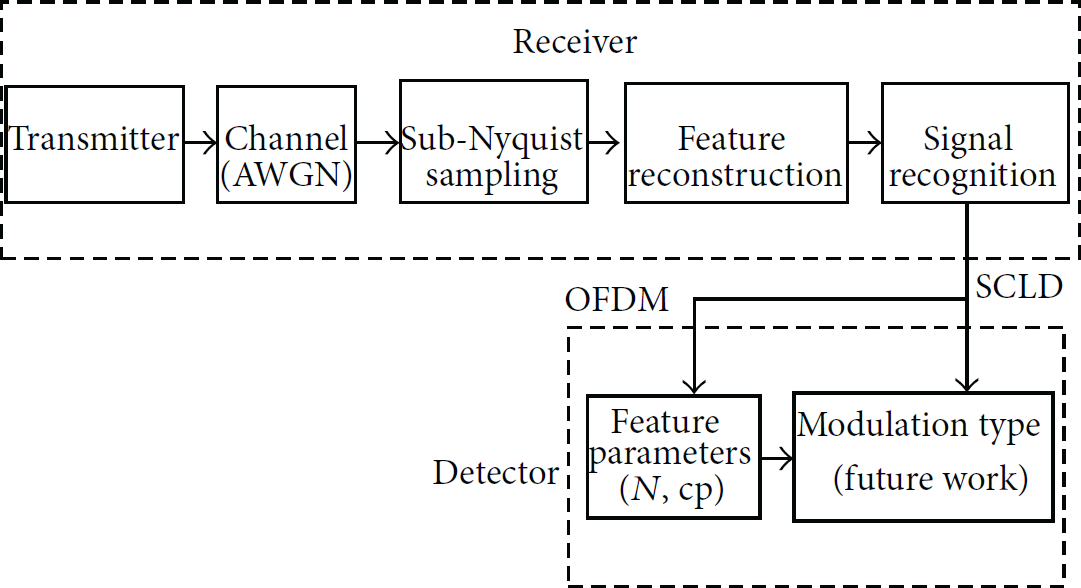
Signal processing procedure of the system model.
We regard the communication signal
At the receiver, sub-Nyquist sampling is done at first with a sampling rate of
The module of signal recognition is to distinguish the type of signals before which we should calculate the CAF based on the recovered autocorrelation. We assume that the received signal of the system only contains zero-mean Gaussian i.i.d. noise whose CAF function is generally of value zero and the point (0,0) of CAF reflects the signal's average power. So in the detection of signal existence, we can judge the existence of signals by detecting whether there is a peak at point (0,0).
Then the type of the signal can be identified by the different structure of SCLD and OFDM signal in CAF domain. The SCLD signal owns a peak on certain nonzero cyclic frequency that is related to the sampling rate. While for OFDM signals, the peak with cyclic frequency of zero and the position of time delay reflects the number of subcarriers
6. Simulation and Analysis
6.1. Simulation Setting
In our simulation, each subcarrier of OFDM is modulated with QPSK, the whole signal bandwidth is 480 kHz, the number of subcarrier is 32, and the symbol period is set as 0.8 us with CP of 0.2 us. We simulated 1000 OFDM symbols as the signal length and transmitted it under the AWGN channel.
At the receiver, we deal with two symbols as a unit to conduct the sub-Nyquist sampling and the sample autocorrelation is sent as reconstruction input. To confirm the compliment of AF reconstruction we set the iterations as 120. In the tests we choose the probability of correct detection as the evaluation criterion, and the detection method used is asymptotically optimal test with the constant false alarm rate (CFAR) property.
6.2. Simulation Results
When testing the performance of the algorithm, there are generally three factors that may affect the accuracy of the detection: the signal to noise ratio (SNR), sub-Nyquist sampling rate
To study the performance of the indirectly proposed recovery method of CAF, we firstly do simulations on the comparison with the direct method; from Figure 4, we can clearly find the differences.

The comparison of CAF by the two methods.
During the test we set the sampling rate as
In the next case, the normalized mean square error (NMSE) of recovered AF, indirectly recovered CAF based on AF, and directly recovered CAF has been compared with different value of system SNRs, which is presented in Figure 5, from which we can see that the performance on the recovery of CAF by the two methods shows almost the same, and the indirect method is even a little bit better. However the performance of AF recovery is unsatisfactory, and the fact also confirms the analyses result in Section 4.2. Furthermore, both the two methods perform a gently deteriorate with SNR, and we can conclude that the method can perfectly tolerate the noise.

The NMSE of recovered AF, CAF based on AF, and recovered CAF.
Despite the above hopeful results, from Figure 6 we find that when doing signal detection, the method we prefer is not that ideal as we supposed. As the SNR decreases (especially when it is below −3 dB), the points with higher value over cyclic frequency domain get dramatically decreased and as a result of that the distribution of the cyclic frequency domain is just like the white noise that stops the reliability.

The correct probability of detection with various SNRs.
However, we realize that a bit lower detection performance is tolerant and acceptable. By the proposed method we get a dramatic decrease of implementation complexity.
7. Conclusion
We have proposed a method of CAF recovery by AF reconstruction with sub-Nyquist samples that dramatically reduce the time and space complexity of most recovery puzzles. By theoretical analyses and simulations, we proved that the proposed methods perform well on both the accuracy of the autocorrelation reconstruction and the signal detection. In the future work, under the idea of indirect reconstruction, there may be a rapid and more convenient approach in detection of signal's high-order cumulant such as the modulation type.
Footnotes
Conflict of Interests
The authors declare that there is no conflict of interests regarding the publication of this paper.
Acknowledgments
This work was supported by the National Science and Technology Major Project of China under Grant 2013ZX03001003-003 and the China National Natural Science Fund under Grants 61271181 and 61171109.