




Abstract
The placement of roadside units (RSUs) is a difficult and yet important issue in vehicular networks. If too few RSUs are placed, the system performance would be very poor. However, with too many RSUs, it would incur high installation cost and maintenance cost of these RSUs. In this paper, we study the problem of delay bounded roadside unit placement (DRP) in vehicular networks. For a given delay bound, our objective is to place the minimal number of RSUs in the system such that a message from any of RSUs in the region can be disseminated to all vehicles within the given delay bound. We consider two cases of RSUs, the case that all RSUs are interconnected through wired lines (called DRP-L problem) and the case that RSUs connect to other RSUs through wireless link (called DRP-W problem). We first prove that both DRP-L and DRP-W problems are NP-hard. Then, we propose several heuristic algorithms to solve DRP-L and DRP-W problems, respectively. Extensive simulations have been conducted to show that the performance of our proposed methods is superior to the other methods.
1. Introduction
Vehicular networks (VANETs) have recently attracted great interest in the research community and intervehicle communication is becoming a promising field of research [1]. A vehicular network consists of two types of nodes, the nodes of vehicular on-board units (OBUs) that are installed on the vehicles and the nodes of roadside units (RSUs) that are installed at roadside to form the backbone (or infrastructure) network. A vehicle can communicate with other vehicles either directly by using OBUs, if they are within each other's transmission range, or otherwise through the RSUs. RSUs can be interconnected through wired lines or wireless communications. They allow passing vehicles to collect data from or deposit data into them. The primary use of vehicular networks is for information dissemination, routing, geocasting, and data delivery [2–5]. That is, whenever a node (event source) has some information such as road accidents and traffic congestion, it can use the vehicular network to broadcast the information to all vehicles in a region efficiently. Meanwhile, the proper placement of RSUs is crucial for the new generation ITS applications, such as content downloading [6–8] and content distribution [9–11]. In a word, the overall performance can be improved by placing additional RSUs in the vehicular networks.
The performance of the vehicular network highly relies on the placement of RSUs. On one extreme case, if there is no RSU installed in the system, then, the information propagation would only rely on one vehicle passing to another nearby vehicle. It would take a long time for all vehicles in a region to receive the information (some of them could never receive it) in this case. On the other extreme case, if a sufficient number of RSUs are installed in a region such that anywhere in the region is covered by the signal of at least one RSU, then, a message can be broadcasted to all RSUs via either the backbone network of RSUs or passing by vehicles and it is further broadcasted to all vehicles by RSUs in one hop. The information dissemination can be done in a very efficient way in this case. Thus, the placement of RSUs is a difficult issue. With the placement of too few RSUs, the system performance would be poor. However, with too many RSUs, it would incur high installation cost and maintenance cost of these RSUs. It is important to find the optimal solution that places the minimal number of RSUs and meets the performance requirements.
In this paper, we study the problem of delay bounded roadside unit placement (DRP) in vehicular networks. We are given a delay bound. The objective is to place the minimal number of RSUs in the system such that a message from any of RSUs in the region can be disseminated to all vehicles within the given delay bound. We consider two cases of RSUs, the case that all RSUs are interconnected through wired lines (called DRP-L problem) and the case that RSUs connect to other RSUs through wireless link (called DRP-W problem). We first prove that both DRP-L and DRP-W problems are NP-hard. Then, we propose several algorithms to solve DRP-L and DRP-W problems, respectively.
Our problem is different from the previous works of RSUs placement in two aspects: (1) we consider both wired connection of RSUs and wireless connection of RSUs; (2) we consider delay bounded information dissemination, which is desired by many real-time applications in vehicular networks.
The rest of this paper is organized as follows. Previous studies are summarized in Section 2. We present the system model and the problem in Section 3. The detailed description of our DRP-L problem and DRP-W problem are in Sections 4 and 5, respectively. In Section 6, we evaluate our proposed approach by comparing it with different environment. We conclude this paper in Section 7.
2. Related Work
Nowadays, there are many studies of the capacity, delay, and coverage of the wireless hybrid infrastructure (i.e., the base stations and mobile nodes) [12–14], data multicast, and message dissemination [15–18] in wireless networks. In particular, there are some published work about the node and AP placement problem in wireless sensor networks [19–28]. Liu et al. [20] investigated the relay node placement in two-tiered wireless sensor networks and proposed several approximation algorithms to solve the minimum relay-node placement problem. Lloyd and Xue [21] studied two versions of relay node placement problems. One is the single-tiered relay node placement problem and the other is the two-tiered relay node placement problem. Zhang et al. [22] investigated four versions of relay node placement problems, which were single-tiered placement with base stations, single-tiered placement without base stations, two-tiered placement with base stations, and two-tiered placement without base stations. Then, they proposed several polynomial time algorithms to solve the problems. In [23], the authors addressed the full fault-tolerant relay node placement problem and partial fault-tolerant relay node placement. In [24, 25], the authors considered a heterogeneous wireless sensor network consisting of three kinds of nodes: base stations, sensor nodes, and relay nodes. They studied the scenario where relay nodes can be placed only at certain candidate locations. In [26], the authors addressed a new problem in which the network cost is minimized while the resulting lifetime is at least equal to a given value. Then, they proved that this problem was NP-hard and derived a lower bound on the minimum number of sensors required. In [27, 28], the authors proposed two optimal node deployment patterns to minimize the number of nodes for completely covering a long belt. Also, there are some published work about the node problem in wireless networks [29, 30]. Zhang et al. [29] studied the optimal placement of APs such that the total cost of all APs is minimized, subject to the constraint that the traffic demand for each client can be fulfilled. Zhou et al. [30] investigated the minimal number of APs placement problem, so that both fault tolerance and QoS constraints can be satisfied. All above node placement studies are most related to our problem.
Moreover, there is some published work related to the problem of increasing the performance of vehicular opportunistic networks with the deployment of RSUs or stationary relay nodes [31–36]. In [31], authors addressed the problem of optimally placing gateways in vehicular networks to minimize the average number of hops from access points (APs) to gateways, so that the communication delay can be minimized and the average capacity of each AP can be maximized. Therefore, they found the optimal placement of gateways to minimize the average number of hops from APs to gateways in 1D vehicular networks and 2D vehicular networks, respectively. This previous work was extended in [32], where the authors showed that the problem of optimal relay node placement is a NP-hard problem and proposes an integer linear programming (ILP) formulation for this problem. Two heuristic algorithms were also presented. One of the algorithms aimed at minimizing the number of hop counts between source-destination terminal nodes, while the other aimed at minimizing the average message delivery time to the destination. Nevertheless, both algorithms also attempted to minimize the number of required relay nodes in the network. Lochert et al. [33] presented their solution of RSU placement for a VANET traffic information system using a genetic algorithm. In order to cope with the highly partitioned nature of a VANET in an early deployment stage, they identified good spots for RSUs from a set of possible positions that are initially given. Barrachina et al. [34] proposed a density-based road side unit deployment policy (D-RSU), specially designed to obtain an efficient system with the lowest possible cost to alert emergency services in case of an accident. In [35], the authors considered capacity cost tradeoffs for vehicular access networks with three cases of wireless access infrastructure, such as cellular BSs, wireless mesh backbones (WMBs), and roadside access points (RAPs). Reis et al. [36] studied the benefits of deploying RSUs to improve communications in highway scenarios. All the RSUs or stationary relay nodes placement problems in vehicular ad hoc networks are helpful for us to solve our RSUs placement problem.
The works in [14, 37–39] are most related to our problem. In [37], the authors solved the optimal schedule problem of turning RSUs on and off within a given time period so that the overall energy consumption in the system was minimized while the network connectivity was still maintained. They also divided the problem into two subproblems called the snapshot scheduling problem and the snapshot selection problem. However, they only considered all the RSUs connected through wired lines. In [14, 38], the authors studied the problem of optimal wireless relay placement (RPP) for sensory data collection from the vehicles. They also proposed heuristic algorithms to get the near-optimal results in a reasonable computing time. They proposed an approximate algorithm for the RPP with given vehicle traces (D-RPP) and proposed an algorithm for solving the RPP without a priori knowledge about future vehicle traces (N-RPP), which exploited regularity extracted from historical traces. The work of [39] studied two AP deployment problems and proved both problems are NP-complete. Then, they developed several optimal and approximation algorithms for different topologies of mobility graphs. However, delay bounded placement is not considered in prior research.
The difference between their works and ours is that our objective is minimizing number of RSUs rather than maximizing data collection in vehicular networks. Meanwhile, we consider two cases of placement of wired and wireless RSUs. In a word, our objective is to design an optimal placement scheme for both wired and wireless RSUs; the information disseminates to all the vehicles in the network within the given delay bound and the number of RSUs is minimized. To the best of our knowledge, our work is the first to study this problem in the literature.
3. System Model and Problem Formulation
In this section, we give the system model used in our analysis to solve the DRP problem; then, we formally formulate the problem.
3.1. System Model
A VANET system consists of a set of vehicles equipped with OBUs and a set of RSUs that are installed at the road side. Since, in this paper, we are only concerned about the placement of RSUs, we do not consider the nodes of vehicles. Whenever there is an emergency or road accident, a user or traffic policeman would report the emergency to an information center, and the information center would broadcast an emergency message to all vehicles on road through RSUs. For the vehicles that are not currently within the direct communication range of RSUs, the message will be forwarded to them via other vehicles. A vehicle can only forward a message to another vehicle if they are within each other's transmission range. We assume that the transmission time of a message between two vehicles is negligible, compared with time that a vehicle carries the message on the road and forwards it to another vehicle when it comes to the range of the other vehicle (i.e., the carry-and-forward model).
We consider the DRP problem in two cases: (1) RSUs are interconnected by wired lines and (2) RSUs are interconnected by wireless link. We assume all RSUs have the same transmission range. In the case that RSUs are interconnected by wired lines, we assume the communication between RSUs takes no time (the delay is 0). In the case of DRP-W problem, we further assume that a wireless RSU only receives the message from a nearby RSU but never gets the message from a passing vehicle. Once it receives a message, an RSU would broadcast the message immediately. When two RSUs are within each other's transmission range, they can communicate directly via wireless link.
Given the road map of a region, it has to decide the possible candidate sites for installing RSUs. The candidate sites are the locations where the RSUs may be installed but are not yet. The RSUs are usually installed at intersections of roads, and, sometimes, they are installed along a highway or bridge for relay purpose if the highway or bridge is too long. Suppose we are given a set of candidate sites, denoted by
Definition 1.
Two candidate sites
The road map can be represented by a undirected weighted graph
Now we consider the link delay between two candidate sites along the road without the help of RSUs infrastructure. We need to estimate the delay of message propagation done by vehicles passing from one to another under the normal situation of road traffic. In the vehicular networks, there are many forwarding methods. In this paper, we only consider the epidemic forwarding method where if vehicles fall into each other's transmission range, they can forward messages successfully. Let


Due to propagation delay several orders of magnitude longer than the transmission delay, we assume that the link delay approximately equals the propagation delay. The assumption is acceptable as the unit of propagation delay is a second and the unit of transmission delay is a millisecond.
After computing the link delay of edges of graph

3.2. Problem Formulation
The delay bounded RSUs placement problem (DRP for short) is formally defined as follows. Given a delay bound Δ, DRP problem is to find the minimum number of candidate sites to install RSUs such that a message originating from any of RSUs can be propagated to all vehicles in the region within delay Δ through the help of RSUs.
The DRP problem under the case that RSUs are interconnected by wired lines is called DRP-L problem, and the problem under the case that there is no infrastructure for RSUs is called DRP-W problem.
Let



Constraint 5 indicates that there is at most one RSU in each candidate site. Constraint 6 says that if any two candidate sites
4. DRP-L Problem
In this section, we first give some definitions for solving DRP-L problem. Then, we reduce reduction from constrained minimum vertex cover problem on bipartite graphs (MIN-CVCB) to DRP-L problem and prove it is NP-hard. Finally, we give our solution for DRP-L problem.
4.1. Definition
In the case of DRP-L problem, we assume that the communication delay between RSUs is zero because all RSUs are interconnected through wired lines. Then, we model the system as the delay bounded graph and transform the DRP-L problem to the vertex cover problem. Before we study the DRP-L problem, we first give some definitions as follows.
Definition 2.
Delay bounded vertex cover set of a candidate site
The expected end-end propagation delay between two candidate sites

Definition 3.
Delay bounded edge cover set of a candidate site
The expected

As shown in Figure 1, when given a delay bound Δ, a message is sent from the RSU A to the vertexes A, B, and C, so that delay bounded vertex cover set of the RSU A is
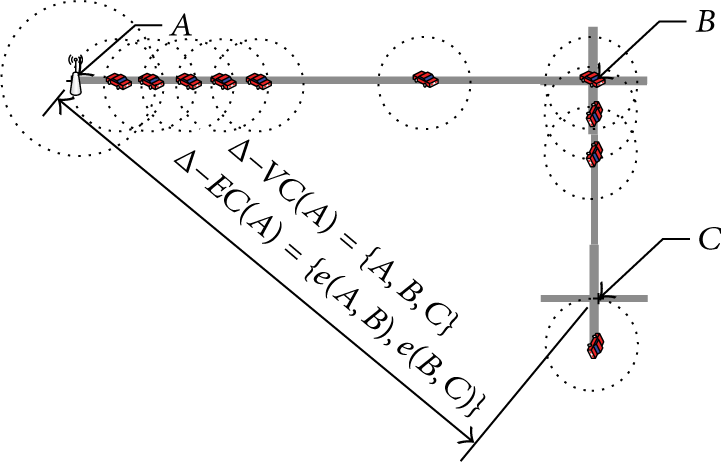
An example of delay bounded vertex cover set and edge cover set.
Now, we introduce a delay bounded graph

Figure 2 presents an illustrative example of the delay bounded graph. In Figure 2(a), the system has four candidate nodes

An example of the delay bounded graph.
Obviously, if there are no isolate vertex,
Lemma 4.
Delay bounded graph
Proof.
According to definition of bipartite graph [42], the bipartite graph is a graph whose vertices can be divided into two disjoint sets
According to definition of
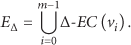
Thus, the number of edges is
Our problem is transformed into the minimal vertex set cover problem in
The DRP-L problem is difficult to solve, as shown in the following theorem.
Theorem 5.
The DRP-L problem is NP-hard.
Proof.
To provide the evidence of NP-hardness, we provide a polynomial reduction from constrained minimum vertex cover problem on bipartite graphs (MIN-CVCB) [43] to DRP-L.
Considering the MIN-CVCB problem, the inputs of MIN-CVCB are a graph
If we input delay bounded graph
4.2. DRP-L Algorithm
As proven in Theorem 5, the DRP-L problem is NP-hard. So there is not a deterministic polynomial time algorithm to solve it. Therefore, we focus on designing an efficient approximation algorithm to solve the DRP-L problem. Due to the monotonicity of minimum vertex set function, greedy algorithm is a competitive candidate. As our greedy algorithm, we can select the candidate sites that maximize the delay bounded coverage gain in each iteration. Let W be the set of all covered road segments. When we consider installing an RSU at site

Our algorithm for DRP-L is presented as Algorithm 1. The major steps of Algorithm 1 are as follows. First, we compute the expected information dissemination delay
(1) (2) For all (3) (4) Compute (5) (6) (7) (8) Calc delay bounded coverage gain (9) (10) (11) (12) (13) (14)
Figure 3 shows an illustrative example of the DPR-L algorithm. As shown in Figure 3(a), the graph G has

An example of the DRP-L algorithm. (a) The undirected weighted graph
4.3. Analysis
We analyze the time complexity of Algorithm 1 as follows.
Theorem 6.
The time complexity of Algorithm 1 is
Proof.
Line
Next, we analyse the approximation ratio of Algorithm 1. We denote the road segments of
Lemma 7.
Let
Proof.
Assume the optimal placement set


We substitute 12 and 13 in the following equation; then, we have

In the iteration in which element

Theorem 8.
Let
Proof.
The theorem can be founded in a similar way as in [44]. We have

5. DRP-W Problem
In this section, we investigate the DRP-W problem. We first prove that DRP-W problem is also NP-hard. Then, we propose our greedy and MST-based algorithm to solve the DRP-W problem.
5.1. DRP-W Greedy Algorithm
In the DRP-L problem, RSUs are interconnected to each other by wired line, and a wired RSU can be installed at any candidate site in the DRP-L algorithm. Compared with the DPR-L problem, each wireless RSU is interconnected by wireless link in the DRP-W problem. In this case, we should consider that each wireless RSU should be within the transmission range of an existing RSU. That is, DRP-W problem requires not only covering all the road segments within the delay bound but also connection of each wireless RSU. Therefore, if a candidate site falls outside the transmission area of any existing RSU, a wireless RSU cannot be placed at this candidate site. We use
The DRP-W problem is also difficult to solve, as shown in the following theorem.
Theorem 9.
The DRP-W problem is NP-hard.
Proof.
Let an instance
The DRP-W problem is a complicated combinatorial optimization problem, and we first proposed a greedy algorithm to solve the DRP-W problem. The strategy of DRP-W greedy algorithm is the same as the DRP-L algorithm. In each iteration, we can select the candidate sites that maximize the delay bounded coverage gain. The major difference between DRP-L cases and ORP-W case is the interconnected way of RSUs. Note that a wired RSU can be installed at any candidate site in V. However, since a wireless RSU only communicate with other RSUs, it should be within the transmission range of an RSU. This difference is shown in line
(1) (2) (3) (4) Compute (5) Calc delay bounded coverage gain (6) (7) (8) (9) (10) (11)
5.2. DRP-W MST-Based Algorithm
In the previous section, we proposed the greedy algorithm. Each time we add a new RSU, we need to evaluate all candidate sites for the RSUs and select the best combination. The greedy algorithm can lead to good placement of RSUs; however, its time complexity is a bit high. Therefore, we propose a more efficient algorithm in this section. Our solution for DRP-W is composed of two steps. In step one, we apply Algorithm 1 for DRP-W to compute a placement set
Before we use MST-based algorithm to solve DRP-W problem, we define the communication set of placed RSUs and weighted communication graph (WCG) in the following.
Definition 10.
Communication set of placed RSUs
Definition 11.
Weighted communication graph (WCG) is an undirected weighted graph
The WCG characterizes all possible communications between the placed RSUs and the unselected candidate sites. The weight of each edge is defined as the number of placed RSUs. As shown in Algorithm 3, we first apply Algorithm 1 to obtain an installing RSUs set
(1) Apply Algorithm 1 to obtain a installing RSUs set (2) Construct the weighted communication graph (3) Apply an approximation algorithm for MST to obtain additional wireless RSUs set such that G is connected; (4)
We illustrate the major steps of Algorithm 3 via the example shown in Figure 4. The graph G also has

(a) Apply Algorithm 1 and obtain an installing RSUs set
Next, we analyse the complexity and approximation ratio of Algorithm 3 as follows.
Theorem 12.
The time complexity of Algorithm 3 is
Proof.
Line
Theorem 13.
Let
Proof.
The theorem can be founded in a similar way as in [20]. Let

According to Theorem 5, we have

Let

According to [20], we have

According to 17, 18, 19, and 20, the total number of wireless RSUs placed by the Algorithm 3 is

6. Performance Evaluation
In this section, we evaluate the performance of our proposed methods and present the simulation results of our algorithms in different cases.
6.1. Simulation Model
In the simulation, we model the street layout of urban areas by a grid graph Random algorithm for RSU-L problem (Random-L): in this algorithm, we randomly install wired line RSUs. Our DRP-L algorithm (DRP-L): it is our proposed algorithm for DRP-L problem. Random algorithm for RSU-W problem (Random-W): in this algorithm, we randomly install wireless RSUs. Our DRP-W greedy algorithm (Greedy-W): it is our proposed greedy algorithm for DRP-W problem. Our DRP-W MST-based algorithm (MST-W): it is our proposed MST-based algorithm for DRP-W problem.
6.2. Impact of Candidate Sites
We investigate how the changes of candidate sites impact the performance of the different algorithms. Figure 5 shows the number of RSUs, the

Impact of candidate sites (transmission range of RSUs = 500 m, delay bound = 5 mins).
6.3. Impact of Delay Bounds
We investigate how the changes of delay bounds impact the number of RSUs and Δ-coverage ratio in Figure 6. The delay bounds are from 5 mins to 30 mins, the candidate sites are
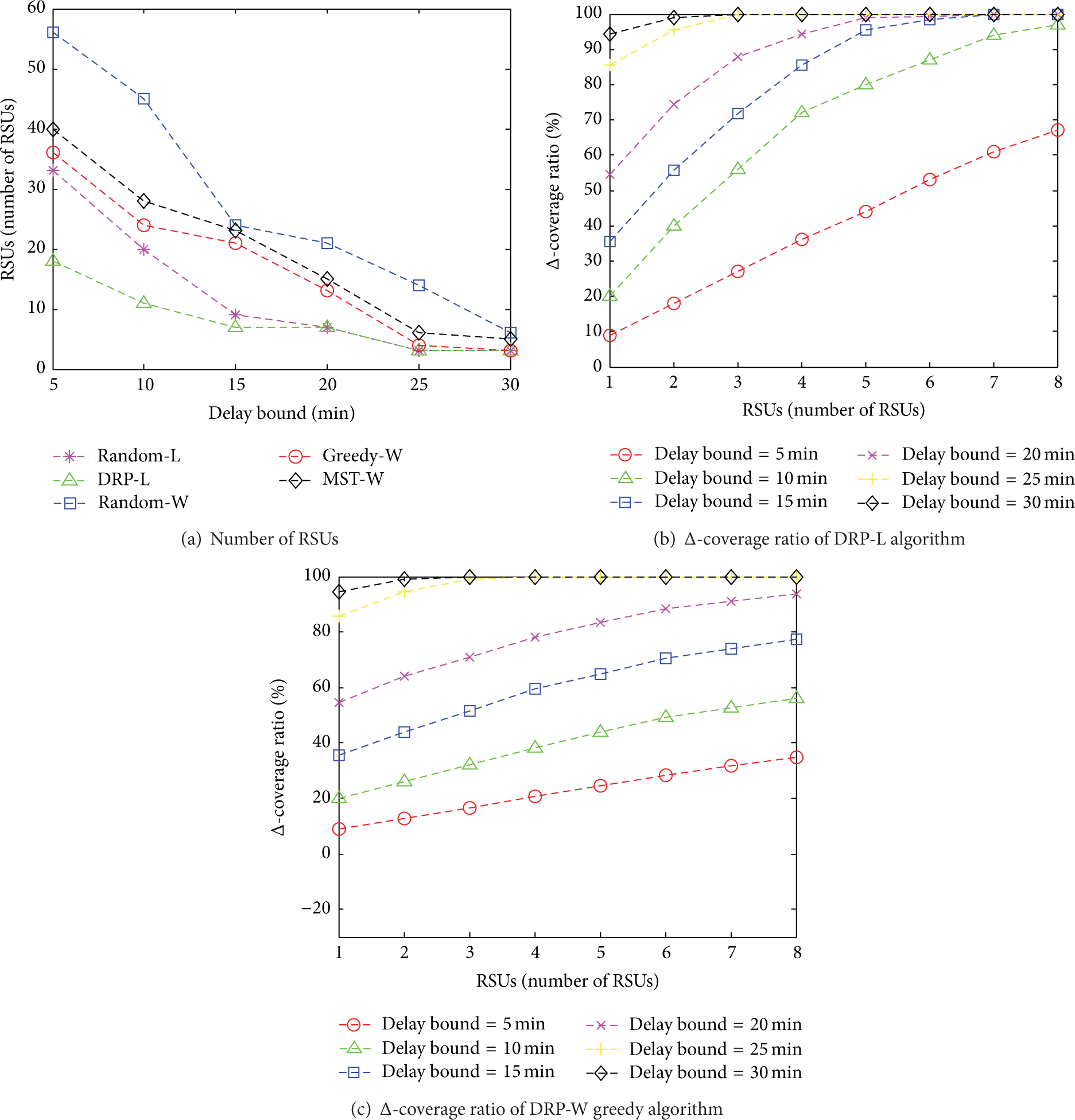
Impact of delay bound (candidate sites =
6.4. Impact of Transmission Range
Figure 7 shows the different performance under different transmission range. The transmission of RSUs is from
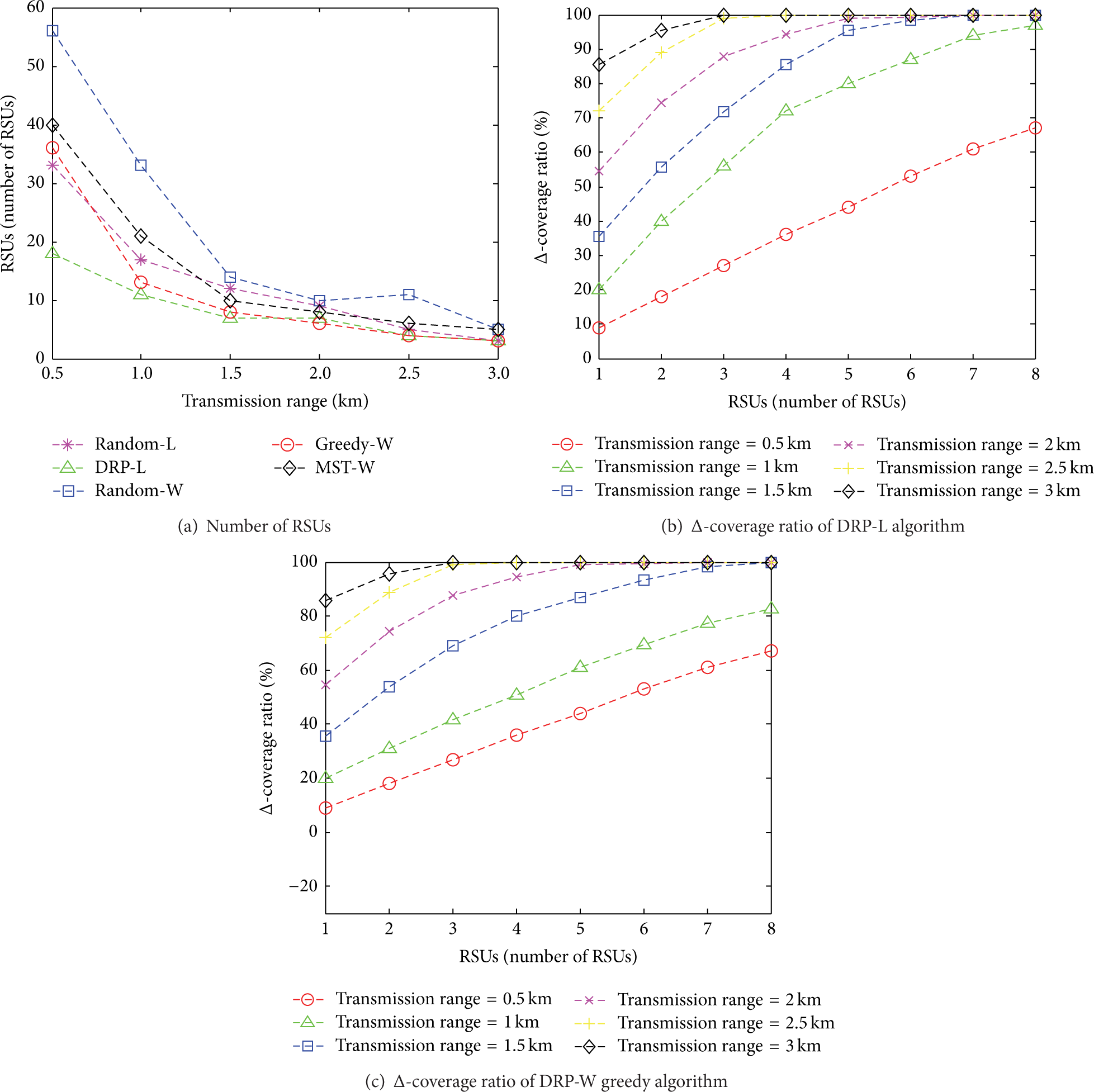
Impact of transmission range (candidate sites =
7. Conclusion
In this paper, we investigate the problem of delay bounded roadside unit placement (DRP) problem in vehicular networks, which enables all vehicles to receive the messages in a given delay bound. First, we divide the DRP problem into two subproblems called delay bounded roadside unit placement for wired line RSUs (DRP-L) problem and delay bounded roadside unit placement for wireless RSUs (DRP-W) problem. Next, we theoretically prove that both DRP-L and DRP-W are NP-hard. Finally, we propose several heuristic algorithms to solve the DRP-L problem and DRP-W problem, respectively. Simulation results show that the performance of our methods is superior to the other methods under different environment.
Footnotes
Conflict of Interests
The authors declare that there is no conflict of interests regarding the publication of this paper.
Acknowledgment
This work was supported by the National Science Foundation of China (no. 61373040, no. 61303117, no. 61173137, and no. 61103217), the Ph.D. Programs Foundation of Ministry of Education of China (no. 20120141110073), Key Project of Natural Science Foundation of Hubei Province (no. 2010CDA004), Research Foundation of Hubei Province Key Laboratory (no. znss2013B012), and Foundation of Education Bureau of Hubei Province (no. B20101104).