




Abstract
In cognitive radio sensor networks (CRSNs), the frequency used by second users will be terminated unexpectedly as the preemption of primary user or reinitialized route discovery process in data transmission process, which will lead to unreliable communication and degrade the network performance greatly. In this paper, an efficient backup routing algorithm is proposed for reliable routing based on the uncorrelated degree and delay constraint in CRSNs. Numerical and simulation results show that the proposed algorithm can effectively overcome the intermittent connection problem and decrease delay greatly.
1. Introduction
With the rapid development of wireless communication technology, the contradiction between limited spectrum resources and the demand of growing applications became more and more prominent [1]. As one of promising technique to improve spectrum resource utilization, cognitive radio (CR) [2–4] is able to change the transmitter parameters based on its interactive work environment. From the perspective of signal processing, CR is an intelligent wireless communication system, which can sense the external environment and learn from the environment using artificial intelligence techniques, by changing operating parameters in real time (e.g., transmission power and carrier frequency and modulation techniques). And this makes the internal state to adapt to the change of the received radio signal statistics to achieve highly reliable communication at any time in any place and makes use of spectrum resources effectively.
Recently a variety of techniques are developing to promote the development of CR in different application scenarios [5–8], such as wireless local area network (WLAN) based air interface standards (IEEE 802.22), IEEE 802.16, and cognitive radio sensor networks (CRSNs) [9–11]. CRSNs are the potential next generation wireless sensor networks (WSNs), which can mitigate overcrowded unlicensed spectrum bands by opportunistically using temporally unoccupied unlicensed and licensed spectrum bands [12–14]. The notable features of CRSN are flexible, intelligent, and reconfigurable [15–18]. Based on internal state statistical variations of the received radio signal [11, 19], nodes will sense the external environment and use artificial intelligence to learn from the environment, to adjust some system parameters timely to achieve highly reliable communication and efficient use of heterogeneous network environment of limited radio spectrum resources [20–25]. CRSNs also can solve spectrum resources scarcity and a variety of heterogeneous network coexistence issues [26, 27], which use cognitive sensors to improve system performance without interference and reduce the total energy consumption.
Routing is an important issue in CRSNs [28, 29]. Recent work on CR routing protocol mainly focuses on reducing the data transmission delay and packet loss ratio and improves throughput. Although there are many effective routing schemes in CRSNs [17, 24], the existing schemes mostly focus on energy constraint and do not consider the reliability. Another issue is the effective intelligent cognitive routing that will be considered to provide better routing discovery and recovery in CRSNs.
In this paper, an efficient reliable backup routing algorithm based on the unrelated degree and delay constraint (BUD) is proposed, which overcomes the intermittent connection problems and decrease delay greatly. The main idea of the proposed scheme is providing not only efficient fault tolerance scheme, but also fast recovery mechanism when channel of second user is deprived. In order to meet this requirement, the proposed algorithm will find the smallest delay route as the primary route and then calculate a suboptimal route as a backup route according to the unrelated degree and delay in all candidate routes. When the primary route fails, the proposed scheme can use the backup route to transmit data effectively. Numerical analysis and detailed simulation results show that the proposed algorithm can overcome the intermittent connection problem and decrease delay greatly.
2. Related Work
Routing algorithm in cognitive radio networks focuses on three aspects: active routing, cross-layer routing, and network performance metric. Spectrum aware on-demand routing protocol (SORP) [30] based on multi-hop spectrum aware on-demand routing cross-layer joint strategy proposed a scheduling scheme based on active frequency collection of polling cross-node multiband multistream. DORP [31] protocol is based on delay metric on-demand routing protocol, which uses joint interaction strategies and spectrum scheduling. DORP employed the analysis model NAM to describe polling-based scheduling channel allocation process, which can reduce interference between data streams and spectrum switching delay. MSCRP protocol [32] is based on a single transceiver multi-hop CRN spectrum sensing on-demand routing protocol. Each node has only one CR transceiver which is the main characteristic, and a routing protocol packet exchange mechanism is also proposed in MSCRP.
Cognitive networking with opportunistic routing protocol for CRSNs is proposed in [10], which improves the network performance after increasing network scalability based on an accurate channel model to evaluate the signal strength in different areas of a complex indoor environment. An energy- and cognitive-radio-aware routing protocol (ECR) was proposed in [11], which performs joint node-channel assignment by taking energy into consideration, is aware of cognitive radio at the network layer, and can seize spectrum opportunity in other spectrum bands.
In active routing based on table-driven approach, nodes need to maintain the whole routing table, which does not has response delay, while leads to heavy overhead. The stability CR routing protocol SRP [33] has higher stability and less signaling overhead, which can achieve less end-to-end delay and higher throughput than the existing methods. The difference between on-demand routing and active routing is that on-demand routing is only created by the source node. Therefore, the routing table is updated on-demand. Generally, on-demand routing includes three phases: route discovery, route maintenance, and routing release. The on-demand routing protocol [30, 32] can reduce interference between data flows and spectrum switching delay, and it has low packet loss rate and can reduce the primary user interference. However, it will lead to high overhead in route establishment and maintenance [34–36].
In order to achieve better performance, cross-layer design considers both routing and spectrum selection [9, 37, 38], which can improve system performance greatly [33, 39, 40]. However, cross-layer design will inevitably degrade system versatility and portability, and it is not conducive to the routing updating and maintenance. And cross-layer considerations for implementing viable CRSN routing solutions also were explored in [19]. Additionally, a detailed performance evaluation of routing strategies in a cognitive radio environment is performed to expose research gaps.
With considering different metric, the routing protocol can meet the quality of service, optimize network resource, reduce packet loss, and improve network throughput. However, the routing maintenance caused by spectrum change is not considered comprehensively. A high-throughput channel allocation routing protocol was proposed [14], which can achieve robustness; efficient, low computational complexity; and low protocol complexity. However, it will lead to high overhead in route establishment and maintenance.
A spectrum-aware cluster-based energy-efficient multimedia (SCEEM) routing protocol for CRSNs was proposed [9], which jointly overcomes the formidable limitations of energy and spectrum to support the quality of service and energy-efficient routing by limiting the participating nodes in route establishment. Data collection and dissemination framework was proposed in [12], which can fully utilize wireless resources while maintaining a reliably connected and efficient topology for each channel. In the proposed framework, each sensor node selects a channel considering the primary user (PU) channel utilization and network connectivity. Cognitive information-centric sensor networks (CICSNs) were explored in [13], in which sensory information is identified using attribute-value pairs, and elements of cognition are used to deliver data to the sink with user-desired quality of information. Latency and reliability are identified as attributes that impact the quality of information (QoI) perceived by the end user.
In CRSNs, the routing design will improve the resource utilization while considering cognitive capacity of nodes. Considering the resource-constrained node characteristics, energy optimization strategy also should be considered in routing protocol. The adaptive reliable and scalable, robust routing protocol will also be considered in dynamic topology.
3. Routing Algorithm Design
The backup routing algorithm (BUD) and route metrics are proposed for reliable routing based on the unrelated degree and delay constraint, which includes two parts: route discovery and route maintenance. Notation Description list shows the notations in the proposed routing algorithm.
3.1. Unrelated Degree
The optimized alternative route known as the backup route
In the proposed scheme, each cognitive node

When a data transmission session is established between source node

In addition to the source node
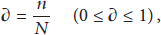
Unrelated degree ∂ is defined as the ratio of the number of contained nodes n and all nodes N (exclude the source node
3.2. Delay Parameter
In the proposed scheme, when selecting a backup route,
In CRSNs, the transmission delay of source node
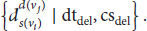
Transmission delay and spectrum handoff latency data transceiver of each forwarding node can be expressed as

The CRSN can be denoted by a directed graph
Suppose there are

3.3. Route Discovery
When the source node


3.4. Route Maintenance
The primary user preemption or node failure will lead to disconnected link. Quickly recover interrupted data transfer and effective rerouting become very important. In the proposed routing algorithm, when the source node
3.5. Algorithm Design
The proposed algorithm BUD employs an improved depth first search (DFS) algorithm to find multiple paths in CRSNs. From the source node to the destination node, the DFS algorithm can only find one path. In order to find multiple suboptimized paths, when accessing a node
Considering the route selection criteria, the proposed algorithm BUD chooses a route with the minimum delay as the primary route
(1) (2) (3) go to step 8. (4) (5) (6) (7) DFS (G, (8) (9) find the next neighbor nodes of the top node in the stack; (10) (11) Select the route with smallest (12)
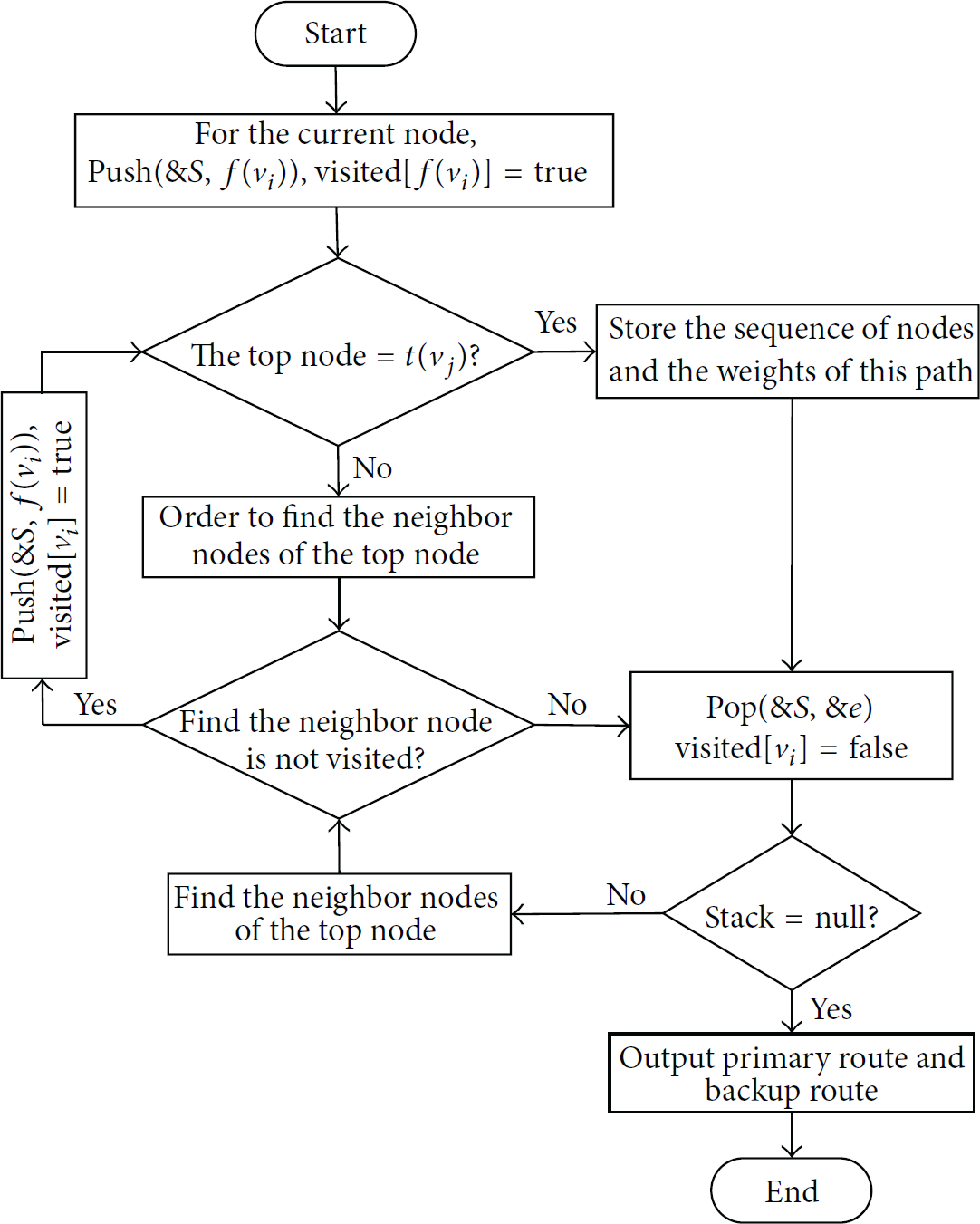
The flowchart of the proposed algorithm BUD.
The proposed algorithm works as follows.
Step 1.
For the node
Step 2.
If the top node in the stack is the destination node
Step 3.
Store the sequence of nodes and the weights of this path in
Step 4.
Find the neighbor node
Step 5.
If the neighbor node
Step 6.
Set
Step 7.
Consider DFS (
Step 8.
Output current node from the stack and mark
Step 9.
If the stack S is empty, go to Step 10, or else find the next neighbor node
Step 10.
Select the minimum weight path as the primary route
Step 11.
Calculate
Step 12.
Output primary route
A general CRNS topology is shown in Figure 2. The corresponding weighted adjacency matrix is shown in Figure 3.

General CRSN topology.

Weighted directed graph G.
Weighted Adjacency Matrix. Consider

As shown in Figure 2,
For example, suppose that
4. Performance Analysis
4.1. Numerical Results
The CRNs can be denoted as a directed graph
Path finding process of G.

Weighted Adjacency Matrix of
G. Consider

The proposed algorithm BUD works as follows. Push
Pop the top node of the stack and mark it as not being accessed. Since the stack is not empty, the top node of the stack node is
With the similar method, we can get all paths and corresponding weights from source node Path 1: Path 2: Path 3: Path 4:
According to the proposed algorithm, the shortest path 1 is the primary route 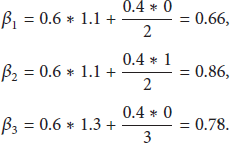
According to the results, although the two paths (
Figure 4 shows another weighted directed graph
Path finding process of


Weighted directed graph
Weighted Adjacency Matrix of 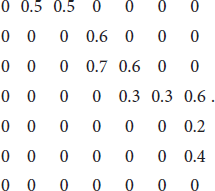
According to the proposed algorithm, we can get all paths and the corresponding weights from source node Path 1: Path 2: Path 3: Path 4: Path 5: Path 6: Path 7:
It is clear that the path 
Although path 2 and path 5 have the same delay, path 5 has the same nodes
4.2. Simulation Results
In order to evaluate the performance of the proposed scheme, we implemented the backup routing based on delay constraint (Bud) with C++, and the algorithm without Bud is also simulated as discussed here. Our simulation is performed considering the deployed region as a square of fixed area of 500 m × 500 m. The communication range between two nodes is 100 m. The run time is 100 s. The system will generate 30 cognitive nodes randomly in every 10 s. And the source node and destination nodes also will be selected randomly.
In the first scenario, we consider the random multi-hop topology networks with uniform increasing load. Figure 5 shows the primary route, backup route, and topology with uniform increasing load when

Route and topology with uniform increasing load (
As shown in Figure 5, there are 2 nodes in the primary route from source SN to destination node DN and 3 nodes in the backup route. And the unrelated degree of two routes is zero, which means that the backup route will work efficiently if the primary route fails.
The delay of difference routes is shown in Figure 6. As the load increases, the delay of two schemes will increase accordingly. When the load is less than 30%, the delay of the proposed scheme is slightly higher than the scheme without the Bud. The reason is that backup route will lead to some delay in channel switching. However, for the scheme without the Bud, delay will increase to more than 130 ms when the load increases to 40%, which is obviously higher than that of the proposed scheme, while the delay is 87 ms for the proposed scheme. The reason is that, without Bud, nodes will start the route discovery procedure when load is heavy. In particular, the primary node will occupy most channel and some nodes will fail as the load increases. However, the proposed scheme takes both delay and unrelated degree into consideration, which will help the traffic to avoid the failure nodes and start backup route to guarantee transmission delay.
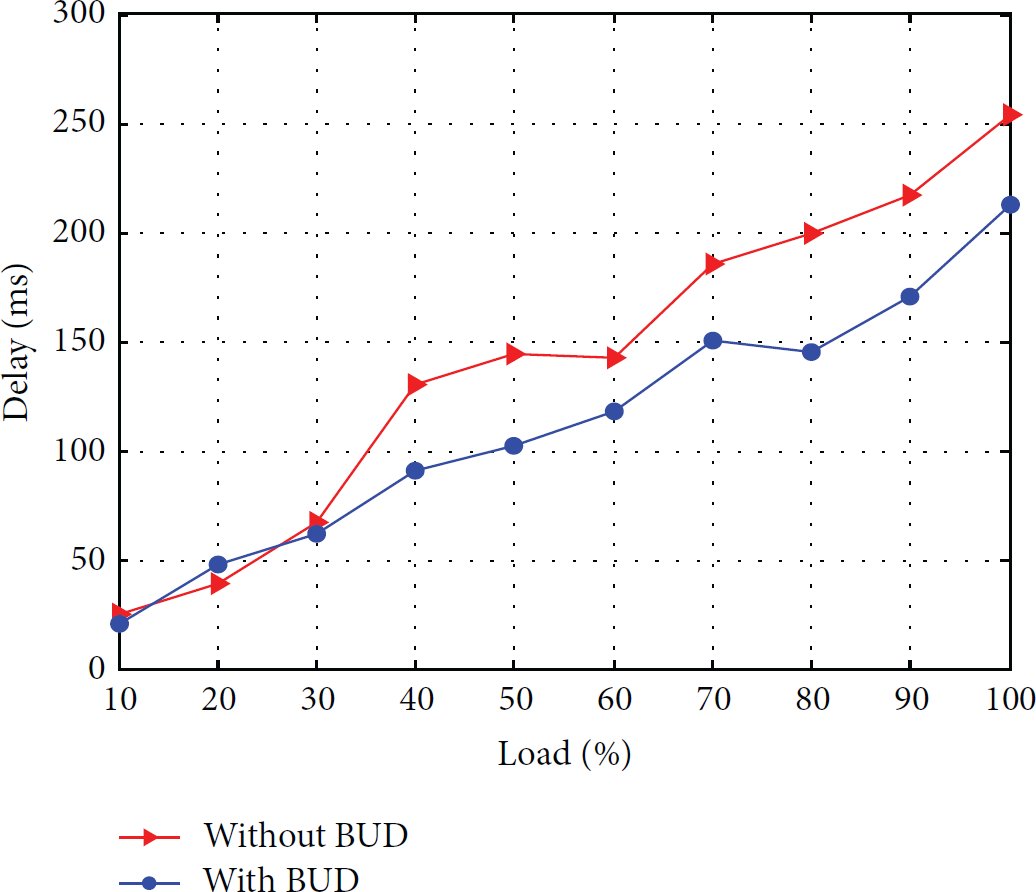
Delay of different schemes with uniform increasing load (

Route and topology with random increasing load (
In the second scenario we evaluate and compare the performances with/without the proposed scheme in randomly network topologies with random load. Figures 7 and 8 show route and delay, respectively, when

Delay of different schemes with random load (
As shown in Figure 7, the primary route includes 6 nodes from source SN to destination node DN, and the backup route includes 6 nodes, too. And there is one contained node in the backup route (excluding the source node and destination node). The unrelated degree ∂ of two routes is 0.25, which means the backup route will fail if the contained node is invalidation. However, the backup route will work effectively in most cases when the primary route is out of service.
The delay of difference route schemes with random load is shown in Figure 8. As the load increases, the delay of two schemes will increase accordingly. When the load is less than 10%, the delay error of two schemes is not obvious. However, for the scheme without the Bud, delay will increase greatly. For example, the delay is more than 200 ms after the load increases to 30%, which is more than 100% of the proposed scheme, since the delay is 99 ms for the proposed scheme. When the load arrives at 95%, the delays of two schemes are 642 ms and 341 ms, respectively. And the reason is that, without Bud, random increasing load will lead some nodes to consume power quickly, and the failure nodes will lead to the primary route out of work, which will make the node to start the route discovery procedure and lead to heavy delay. In particular, the primary node will occupy most channel and some nodes will fail as the load increases. However, the proposed scheme will start backup route easily to avoid the failure nodes and guarantee transmission delay, since it considers both delay and unrelated degree. The results in Figure 8 also show the effectiveness of the proposed scheme.
5. Conclusion
This paper proposed a backup routing algorithm for reliable routing based on the delay constraint and unrelated degree, which is able to provide higher reliability to dynamic spectrum used by the primary route and backup route. The proposed algorithm will determine the primary route with the smallest delay and select the backup route with the minimum β according to expression (6). Numerical and simulation results show that the proposed algorithm can effectively overcome the intermittent connection problem and also decrease delay greatly.
Footnotes
Notations
Conflict of Interests
The authors declare that there is no conflict of interests regarding the publication of this paper.
Acknowledgments
This work was supported by the National Natural Science Foundation of China (no. 61103019, no. 61272497, and no. 60902053) and the Foundation of Young Teacher Join Enterprise Action Plan of Colleges of Hubei Province (no. XD2012020).