



Abstract
To facilitate the efficient use of information generated from the Internet of Things (IoT) by sensors and automatically drive entities to meet the needs of human beings, this paper presents an information processing framework using semantic web technologies. The framework represents the entities as semantic web services and automatically creates service sequences as transactions by analyzing the information need in specific queries. Moreover, the framework ensures the effective management and control of information collected by mobile sensors during the transaction. The foundation of this framework lies in a set of ontologies we proposed: goal ontology, role ontology, constraint ontology, message ontology, status ontology, space-time ontology, and activity ontology. In addition to their respective definitions, we also present a detailed exploration of the relationships between them. Finally, we validate the effectiveness of the framework and the ontologies with a case study of the logistics system. The evaluation shows that the ontologies support the framework well and our approach increases the logistics system efficiency with lower operating costs.
1. Introduction
The Internet of Things (IoT) vision [1] promotes the ubiquitous computing paradigm on a global scale. In ubiquitous and pervasive contexts, intelligence is embedded into objects and physical locations by means of a relatively large number of heterogeneous microdevices; for example, sensors are used in applications ranging from meteorology to medical care, environmental monitoring and security, and surveillance. This increase is accompanied by an increasing volume of data, as well as increasing heterogeneity of devices, data formats, and measurement procedures. It would be ideal if this information can be automatically extracted and processed in order to better support the current activity of users and satisfy their needs [2].
Semantic technologies can assist in managing, querying, and combining entities and observation data. Thus, it allows users to operate at abstraction levels above the technical details of format and integration instead, work with domain concepts and restrictions on quality. With the development of the semantic web [3], the use of ontologies is becoming common as a formalism to describe knowledge and information in a way that can be shared on the web is becoming common. Ontologies currently have been widely used in knowledge engineering (KE) and artificial intelligence (AI) to structure the concepts of a domain. Ontology is represented as a knotted tree of linked concepts or classes. A class can have subclasses which represent concepts more specific than the super class. The properties of each concept describe the characteristics, the attributes of the concept, and the attributes restrictions. Ontology and the individual instances of the classes constitute a knowledge base.
The purpose of this paper is to present an information autoprocessing framework for IoT based on the semantic web technologies and describe the design of the top ontologies for the framework. The main contributions can be summarized as follows.
An effective framework is designed for automatically constructing and executing the transactions on IoT.
The designed ontologies are reasonable and meet the need of the framework. They can be used to support the applications intelligently.
This paper reported the implementation in logistic and proofed the effectiveness.
The rest of this paper is organized as follows: Section 2 gives an introduction to the related works. Section 3 discusses the problems we have met in the transaction control of IoT. Section 4 describes the architecture of the framework and Section 5 describes the design of the top ontologies. In Section 6, we give the logistics scenario in different environments and discuss their workflow. Finally Section 7 gives the conclusion and the future work directions.
2. Relate Work
The current researches on Internet of Things are deployed in three directions: things, networks, and intelligence. In the direction of things, the major research is the frameworks of IoT, which is targeted at the visibility improvement of things, for example, identification and investigation. The most famous architecture is EPCGlobal [4] presented by Auto-ID center of MIT and UID [5] put forward by Ubiquitous ID Center. In the second direction, the research includes wireless sensor networks, privacy protection and security. Numerous studies have been committed to improving the energy efficiency of wireless sensor network capacity, scalability, reliability, and robustness [6, 7], for example, 6LoWPAN [8], a combination of the IP protocol and IEEE 802.15.4, lightweight security architecture of networks and smart identification [9]. In the direction of intelligence, researchers have proposed to use distributed artificial intelligence, rich intelligent application (service) to facilitate the problems of coordinating interaction between tasks of IoT [10].
However, the most important thing for the intelligence of IoT is to establish a suitable architecture, where the functions, data process, and message transfer models can subsequently be designed appropriately to construct and control the transactions. In the past few decades, the research on the semantic web has been dedicated to combining the artificial intelligence and knowledge engineering for representation and processing of data and knowledge. The semantic technology with formal descriptions by machines provides a method to describe the heterogeneous objects, information sharing, and integration issues.
The development of a series of semantic web technologies, such as ontology, semantic annotation, bond information, and semantic web services [11], can be used as the main solution to achieve the sharing of semantic information between IoT entities. Among them, the representative studies include Task Computing based middleware [12], Smart Semantic middleware [13], and Semantic Device bus [14]. In 2009, Scioscia and Ruta have proposed to use the technologies of semantic web with IoT and developed the semantic web of things (SWoT) [15]. The main idea is to use the theory of ontology to make IoT intelligent. The University of Munich and DOCOMO Euro-Labs developed the Perci framework to implement basic mechanisms for seamless interaction between mobile services and tagged objects [16]. In 2011, the Semantic Sensor Network Incubator Group has developed the SSN [17] ontology to describe the sensors and the resources in the sensor network. Which provides a high-level description of the behavior of the sensor devices themselves, observation and deployment aims to make the sensor networks intelligent [18]. Other researchers, such as De et al. [19], proposed a service modeling for the IoT and the main idea is to represent entities and humans as devices or resources and using web services to organize and reasoning. Besides the above, a standardized protocol XMPP [20] had been proposed for communication of IoT and some methods have been proposed for testing its conformance and performance [21, 22].
3. Problem Statement
So far, the research on intelligent of the sensor network and the IoT mostly focus on how to describe, manage, and monitor the entities (sensors in the sensor network and things in IoT) and how to annotate the data acquired from entities to improve the efficiency of retrieval. For example, SPITFIRE [23] framework aims to semiautomatically annotate the entities with linked open data as well as inference and query of the sensors status. The SSN ontology is developed for the purpose of perception of objects, sensor data, and system deployment. The main idea is still central to the sensor and limited to the semantic annotation of data and the data processing is still manual. Although [19] proposed the idea of entities as services, it still limited in representing data.
However, the real IoT is described as “Everything from tyros to toothbrushes from realty to napkins might soon be in communications range” and “from anytime, anyplace connectivity for anyone, we will now have connectivity for anything” [1]. Therefore, IoT should not be limited to the sensor network. Instead, it should be inclusive of all entities and the entities interact and cooperate with each other to complete a variety of simple or complex tasks. In a sense, the information processing in IoT should be automatic, while people become just bystanders as passive observers. For example, a service provider in the logistics system is only concerned about the object delivery, receipt, and costs. The storage time and place, selection of transport vehicles, transportation path determination, and other issues should be decided by the system. So it requires a mechanism to automatically build a chain of activities according to the user needs. Also, it needs to monitor and regulate the execution of activities.
4. Architecture for the Process of Transactions
In this paper, we propose a framework to process the transaction on IoT based on semantic web technologies as shown in Figure 1. By the support of the ontologies defined on the top of the framework, we can implement the functionalities at various levels.
The main goal of the entities link layer is information transmission and control drive. It is the intermediate layer between logical and entity layers. This layer is not only to achieve the discovery of the newly added entities, converse all kinds of communication protocol, and operate entities, but also to access the real-time status of entities. It provides a basis for the construction and implementation of IoT transactions.
The semantic annotation layer annotates metadata with semantic tags and supports the higher layer. In the proposed framework it is also entrusted with the function of package the entities’ information as semantic web services.
The service registry center as UDDI (Universal Description, Discovery and Integrate) can use the standard SOA to store and manage the IoT services.
The main function of the transaction construction layer is to construct the activity chains as transaction according to the user needs. Service composition algorithms can be used to achieve this goal by taking into account the context, such as the location of the entity and the scheduling order. Furthermore, it needs to consider whether the conditions exist that there are synergies between transactions.
The transaction execution layer main functions are to perform transaction management and control, including state information of entities in the activity chain, state perception of subsequent entity in the transaction, the entity dynamic replacement or termination when an entity is unable to work and the scheduling and merger between synergies transactions.

Framework for the transactions on IoT.
5. Top Ontologies for Transactions on IoT
The foundation of aforementioned framework is a series of compliant common ontologies. It should be able to complete the description of transaction logic and become the top to support the whole architecture. We have proposed the following competency questions (CQ) in accordance with the construction method of the literature [24].
CQ1. For a user needed transaction, what conditions does it perform in and what role does it play?
CQ2. What are the premise, impact, and result?
CQ3. What is the series of activities to constitute a particular transaction?
CQ4. How does the activities construct?
CQ5. For a specific activity, what is its execution condition? What kind of output and effect will it cause?
CQ6. For a specific activity, what role does it play in a transaction?
CQ7. What are the constraints for the execution of transactions and activities?
CQ8. When will the transactions and activities start and finish?
We define the top ontologies for the transactions on IoT following the questions above:

In the definition, we have the following:
P: for the process collection;
φ: for the transmission functions.
5.1. Domain Ontology
The entities that interact with each other in a particular domain are the essence of the transactions on IoT. Construction and execution of transactions involve the concepts and relations between concepts of the domain, and it should be the basis for the control. Domain ontology can be a closed area defined by domain experts, such as a simple booking system, or a multiple field based on several closed domains, such as the modern manufacturing involves logistics, materials and energy. If the domain is a multiple field, it should combine domains as a closed area which is the significance of IoT to involve everything.
5.2. Goal Ontology
Goal ontology indicates the goals of transactions or activities. It can be explained as a result status of entity that operated by a series of operations. We use it to define the termination of transactions or activities. The goal ontology can be defined as a triple:

5.3. Role Ontology
The main idea of role ontology is to define roles for the entities in transactions and how they should perform. For example, trucks act as conveyance in transport but act as operation targets in refuel event. Meanwhile, the definition of role ontology provides means for security, trust, and privacy. The role ontology can be defined as a quadruple:

5.4. Constraint Ontology
Constraint ontology is defined as data constraint of entities. It indicates the next events trigger as well as end conditions or decides which direction the transaction should be going. The constraint ontology not only guilds the construction of transaction as QoS, but also judges the status and environment to make decisions. The ontology can be defined as a triple:

Logical Expressions

5.5. Message Ontology
The trigger message for the subsequent activity and the information exchange between the parallel activities can be represented by message ontology. We define the message ontology as a quadruple:

5.6. Status Ontology
It is noted that the status ontology is used to indicate the state of entities in transactions, including materials, products, parts, personnel, tools, data, and other information about the status. The information represented by status ontology not only participates in the construction of transactions as determined constraints, but also dynamically is updated during the execution of a transaction and available to determine the constraint conditions of the next step. The status ontology can be defined as a two-tuple:

The definition of
What needs to be addressed is that the status is dynamic for the transactions on IoT. The statuses focused are those changes with time, location and environment, and so forth and affect the activities or transactions. The static properties, commonly, are not consisted.
5.7. Space-Time Ontology
Space-time ontology is used to represent temporal and spatial properties of entities or activities. For example, in the field of GIS, the ontology has been carried on the thorough research [25, 26]. The spatial properties of entities restrict the construction of transaction generally. Both of spatial and temporal properties restrict the entities or activities when the transactions are executing. It must be in consideration that spatial and temporal properties are one of the most important factors for synergy. The space-time ontology in our opinion is an abstract ontology and it has two subontologies: space ontology and time ontology. We use our method for two reasons, even if the two functions are all works. Firstly, the entities in our approach may be real items or data; we should consider the time and location for the real items but only focus on the attribute of time and ignore the location attribute for data; so we only need the subontology of time ontology. Secondly, for the implementation using java language, it does not support multiple inheritances and must use interfaces which increases the difficulties of development.
We simply defined the space-time ontology in Figure 2.

Space-time ontology.
5.8. Activity Ontology
Activity is the most basic unit of the transaction process. The activity ontology describes the concepts, functions, and situations of each act or step. In the transactions on IoT, activity means not only the data process but also the functions of entities represented as web service. The activity ontology defined as follows:

5.9. Process Ontology
The process ontology is used to describe the process sequence relationships between activities. We direct reference to the definition in OWL including <Sequence>, <If-Then-Else>, <Choice>, <Any-Order>, <Split>, <Split-Join>, <Repeat-While>, and <Repeat-until> [27].
5.10. Relations between the Top Ontologies
The relationships between the top ontologies show in Figure 3. We created the top ontologies by Protege4.1 and the part of codes showed in Algorithm 1.
<owl:Class rdf:about=“&IoTrans;ActivityOnto”> <owl:ObjectProperty rdf:about=“&IoTrans;Trigger”> <rdfs:subClassOf rdf:resource=“&owl;Thing”/> <rdfs:range rdf:resource=“&IoTrans;ActivityOnto”/> …… <rdfs:domain </owl:Class> rdf:resource=“&IoTrans;MessageOnto”/> </owl:ObjectProperty> <owl:Class rdf:about=“&IoTrans;ConstraintOnto”> <rdfs:subClassOf rdf:resource=“&owl;Thing”/> <owl:ObjectProperty …… rdf:about=“&IoTrans;expressedBy”> </owl:Class> <rdfs:domain rdf:resource=“&IoTrans;ConstraintOnto”/> <owl:Class rdf:about=“&IoTrans;DomainOnto”> <rdfs:range <rdfs:subClassOf rdf:resource=“&owl;Thing”/> rdf:resource=“&IoTrans;Space-timeOnto”/> …… <rdfs:range rdf:resource=“&IoTrans;StatusOnto”/> </owl:Class> <rdfs:subPropertyOf rdf:resource=“&owl;topObjectProperty”/> <owl:Class rdf:about=“&IoTrans;GoalOnto”> </owl:ObjectProperty> <rdfs:subClassOf rdf:resource=“&owl;Thing”/> …… <owl:ObjectProperty </owl:Class> rdf:about=“&IoTrans;hasConstraint”> <rdfs:domain rdf:resource=“&IoTrans;ActivityOnto”/> <owl:Class rdf:about=“&IoTrans;MessageOnto”> <rdfs:range <rdfs:subClassOf rdf:resource=“&owl;Thing”/> rdf:resource=“&IoTrans;ConstraintOnto”/> …… <rdfs:domain rdf:resource=“&IoTrans;Transaction”/> </owl:Class> </owl:ObjectProperty> …… ……
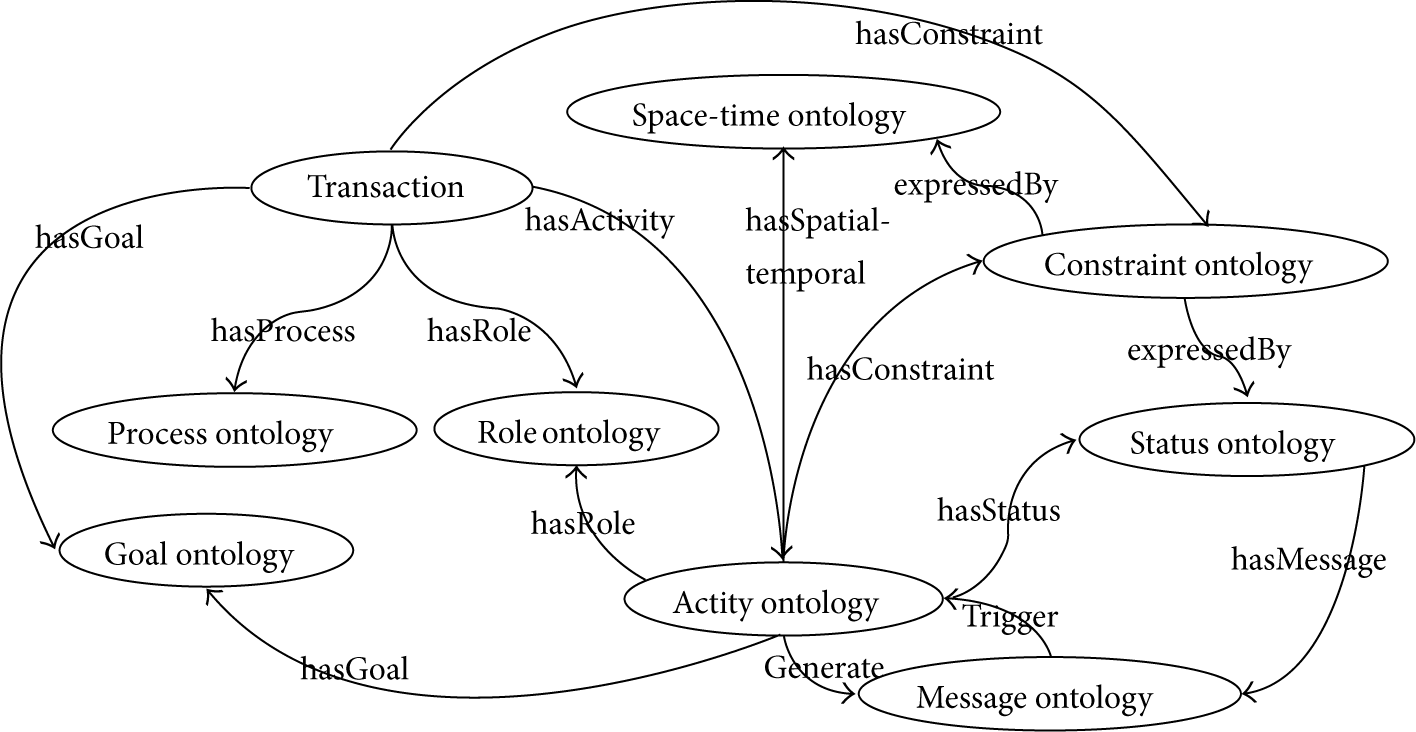
Relationships between top ontologies for transactions on IoT.
6. Case Study of Logistics
In this section we take the third-party transport logistics as a case study to evaluate the proposed framework. In this scenario we compare our approach with the traditional transport logistics and the transport logistics using web services.
6.1. The Traditional Transport Logistics
Figure 4 shows the traditional business process of the third-party logistics. The dotted line indicates the internal information flow and the solid line indicates the information exchange between businesses. This business process includes the following steps.
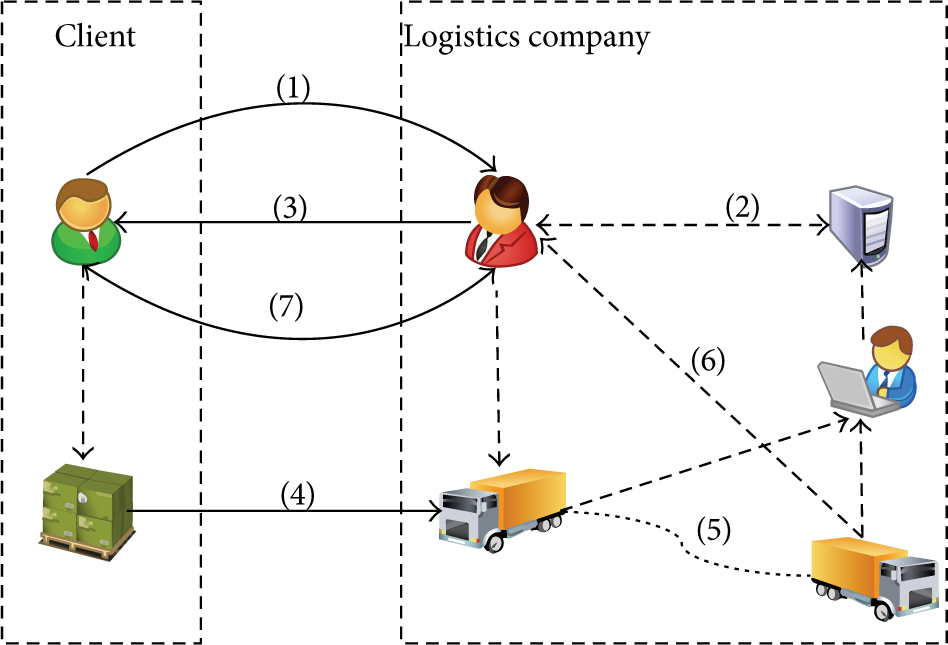
The traditional business process of the third-part logistics.
It should be noted that in the traditional third-party logistics enterprise for transportation equipment, such as vehicles, the management is carried out by specialized employees and input the information into the enterprise database manually. It can be seen that the workflow of traditional third-party logistics is still a manual-based and thus less efficient.
6.2. The Transport Logistics Using Web Services
With the development of IoT, more and more relevant technologies are getting used in the logistics industry, such as decision system [28], which has greatly improved the efficiency of logistics management. The most effective method is introduction of web services to logistics systems. Logistics services have been packaged into web services and published in the registry center, which has improved the efficiency of information dissemination and retrieval [29, 30]. With this technology the third-party logistics transport workflow is depicted in Figure 5.

The third-part logistics transport using web services.
In this scenario, the business process has been changed into the following steps:
From Figure 5, we can see that the use of web services has automated the information process. For instance, customers can get the suitable services provided by logistics enterprises without knowing the contact with the support of web service discovery and composition algorithms which reduces the human interaction. However, in this scenario, the management of the equipment still needs through specialized staff. The services registered are static services and cannot schedule the logistics entities automatically (see step (4)).
6.3. The Transport Logistics Using Our Framework

Truck ontology and relationships.

Dynamic definitions of truck ontology.
6.3.1. Ontology Design
As shown in Figure 6, based on the top ontologies, we have designed the truck ontology and individuals by Protege4.1.
After analysis, trucks should have different roles and activities during the whole transport. So we used the top ontologies to define the truck ontology dynamically, as in Figure 7.
It can be seen that in Figure 7 the truck plays a role of “Container” when it has activities of “Load” (a) and “Discharge” (c) and plays a role of “Transporter” (b) when it has an activity of “Transport.” Other properties, such as “hasSpatial-Temporal” and “hasStatus,” are defined in Figure 7 too, where we omitted some data properties for the sake of clarity.
The next thing we care about is “Activities.” The three activities, for example, are “Load,” “Transport,” and “Discharge”; we defined them in Figure 8.

Definition of activities of “Load,” “Transport,” and “Discharge.”
To answer the CQs in Section 5, we can get the following information from Figures 7 and 8: “Load” is an activity of “truck001” (Figure 8(a)) and its goal is “ToLoad,” “truck001” plays a role of “Container” (Figure 7(a)), when the activity starts at some “Location” under constraint of “Load_Cons,” and the entity “truck001” will “hasStatus loading” for a “period” and the activity will continue for a “period.” After loading it will create a “LoadedMessage” to the next activity as a “Trigger.” Moreover, we can see that the next Activity is “Transport” (Figure 8(b)) and the order is “Sequence.” The next role (Figure 7(b)) and activity (Figure 8(b)) continued automatically and so on.
6.3.2. Use Case of Transport Logistics
In our framework, with the top ontologies, each entity is described as a dynamically structured web service that changes with the status and the context of the entity. As shown in Figure 9, with transport entities like trucks as services, the whole business process now runs by interacting these services.

The transport of the third-part logistics under the framework of transactions on IoT.
In this scenario, the business process now consists of the following steps:
Particularly, the following should be noted.
The services registered in addition to the enterprises also include the entities of enterprises and the functions of entities are registered as activities. The entity activities bond with enterprises with roles.
The transaction construction layer decomposes the requirement and mapped to some composition acts according to specific constraints steeply. There is a difference with forward situation as the requirement may be met by several services of different companies.
The entity's property (such as time, space, and status) will change timely and the change will be captured by sensors or RFID. The data will be sent to the enterprise information system as messages by wireless network. When it happens, the enterprise information system send a message to service registry center and the entity services will be changed (as dotted lines “a” in Figure 9).
Whenever the goods load or transport both of the customer and the logistics enterprise can obtain the transport status by querying the services (showed in Figure 9 dotted lines “b”).
The framework greatly reduces the intervention of human beings and in some special conditions the customer can be an entity, too. The framework supported by the top ontologies realizes direct communication between things and automatic generation and control of transactions.
6.4. Evaluations and Discussion
The main idea of our approach is to automatically construct and execute the transactions on IoT to decrease the communications between entities and human beings. For a logistics company it should decrease the operating costs and increase the efficiency and earnings.
Obviously, due to e-commerce model (the transport services published in the Internet and clients can use e-business platform to fulfill transactions) and cloud technology, our approach and the related methods of web services have an advantage over the traditional transport logistics. As mentioned in [31], the logistics industry had been and will be keeping on growing exponentially. The investment in advance for e-commerce will be recovered soon and the earnings will increase rapidly.
The biggest difference between Figure 5 and Figure 9 is that in the scenario of Figure 5 the company processes the internal data manually but it is automatic in the scenario of Figure 9. Suppose the labor cost per transaction is α and the growth rate is k in Figure 5. The investment in advance (for sensors and network) is β and the maintenance cost per transaction is ε in Figure 9. Besides the necessary costs, the extra costs of each transaction show in Figure 10 and the blue solid lines denote the function of

From efficiency point of view, the whole process is automated and the manager only acts the last actor in Figure 9 (action (6)) that is automated. But in Figure 5, after clients make an order (action (3)), the manager should inquire and schedule (action (4)) that is semiautomated. Due to the reduction of certain aspects such that the company manager arranges for the corresponding services and communicates with clients and internal schedule, our approach is better than the method of using web services in terms of efficiency.
Besides all the advantages above, our approach will decrease the error rate of schedule and provide a better user experience, for clients can keep abreast of the logistics situation through the cloud platform using the date that the sensors generated.
7. Conclusion
In order to achieve the goal of intelligent IoT, we have proposed a framework for the construction and execution of the transactions on IoT. To support the framework from semantic layer we have designed the top ontologies. The main idea is to use semantic technology to describe the entities as dynamic web services, construct transactions with web service discovery and composition technology, and control their executions.
Our framework provided an approach to the intelligence of IoT. In our architecture we can package the entities as web services and using semantic web technology to reason about them. The designed top ontologies can be a guide of how to use our architecture.
The framework has worked well with the support of the top ontologies in the field of logistics and thus minimized the intervention of people. However, there are still some problems that remain open.
The web services described by OWL-S are not enough to depict the dynamic services; the provided components (ServiceProfile, ServiceModel, and ServiceGrounding) need to be extended because of having no abilities to describe dynamic status.
Algorithms of service discovery and composition can be used to construct transactions, but it does not consider the status and environment as the factor. So the new algorithms need to be designed to address these issues.
The most special characteristics of transactions on IoT are the correlation of entities, which is different from that in the information space. When errors occur in information space, it can be eliminated by using reset or rollback. In the case transactions on IoT, however, we need another treatment for the error.
We are still in the research of how to implement the combination and synergy to the transactions. It needs more complex algorithms and schedule supports.
Footnotes
Conflict of Interests
The authors declare that there is no conflict of interests regarding the publication of this paper.
Acknowledgments
This paper is supported by the 3th strategic rising industry program of Guangdong Province, (Project no. 2012556003); International Cooperation Special Program for platform, (Project no. 2012J510018); the key lab of cloud computing and big data in Guangzhou (Project no. SITGZ